

Ragnarök

Encyclopedia
Norse mythology
Norse mythology, a subset of Germanic mythology, is the overall term for the myths, legends and beliefs about supernatural beings of Norse pagans. It flourished prior to the Christianization of Scandinavia, during the Early Middle Ages, and passed into Nordic folklore, with some aspects surviving...
, Ragnarök (typically spelt Ragnarǫk in the handwritten scripts) is a series of future events, including a great battle foretold to ultimately result in the death of a number of major figures (including the gods
Æsir
In Old Norse, áss is the term denoting a member of the principal pantheon in Norse paganism. This pantheon includes Odin, Frigg, Thor, Baldr and Tyr. The second pantheon comprises the Vanir...
Odin
Odin
Odin is a major god in Norse mythology and the ruler of Asgard. Homologous with the Anglo-Saxon "Wōden" and the Old High German "Wotan", the name is descended from Proto-Germanic "*Wodanaz" or "*Wōđanaz"....
, Thor
Thor
In Norse mythology, Thor is a hammer-wielding god associated with thunder, lightning, storms, oak trees, strength, the protection of mankind, and also hallowing, healing, and fertility...
, Týr, Freyr
Freyr
Freyr is one of the most important gods of Norse paganism. Freyr was highly associated with farming, weather and, as a phallic fertility god, Freyr "bestows peace and pleasure on mortals"...
, Heimdallr, and Loki
Loki
In Norse mythology, Loki or Loke is a god or jötunn . Loki is the son of Fárbauti and Laufey, and the brother of Helblindi and Býleistr. By the jötunn Angrboða, Loki is the father of Hel, the wolf Fenrir, and the world serpent Jörmungandr. By his wife Sigyn, Loki is the father of Nari or Narfi...
), the occurrence of various natural disasters, and the subsequent submersion of the world in water. Afterward, the world will resurface anew and fertile, the surviving and reborn gods will meet, and the world will be repopulated by two human survivors. Ragnarök is an important event in the Norse canon, and has been the subject of scholarly discourse and theory.
The event is attested primarily in the Poetic Edda
Poetic Edda
The Poetic Edda is a collection of Old Norse poems primarily preserved in the Icelandic mediaeval manuscript Codex Regius. Along with Snorri Sturluson's Prose Edda, the Poetic Edda is the most important extant source on Norse mythology and Germanic heroic legends, and from the early 19th century...
, compiled in the 13th century from earlier traditional sources, and the Prose Edda
Prose Edda
The Prose Edda, also known as the Younger Edda, Snorri's Edda or simply Edda, is an Icelandic collection of four sections interspersed with excerpts from earlier skaldic and Eddic poetry containing tales from Nordic mythology...
, written in the 13th century by Snorri Sturluson
Snorri Sturluson
Snorri Sturluson was an Icelandic historian, poet, and politician. He was twice elected lawspeaker at the Icelandic parliament, the Althing...
. In the Prose Edda, and a single poem in the Poetic Edda, the event is referred to as Ragnarök or Ragnarøkkr (Old Norse "Fate of the Gods" or "Twilight of the Gods" respectively), a usage popularized by 19th century composer Richard Wagner
Richard Wagner
Wilhelm Richard Wagner was a German composer, conductor, theatre director, philosopher, music theorist, poet, essayist and writer primarily known for his operas...
with the title of the last of his Der Ring des Nibelungen
Der Ring des Nibelungen
Der Ring des Nibelungen is a cycle of four epic operas by the German composer Richard Wagner . The works are based loosely on characters from the Norse sagas and the Nibelungenlied...
operas, Götterdämmerung
Götterdämmerung
is the last in Richard Wagner's cycle of four operas titled Der Ring des Nibelungen...
.
Etymology
The Old NorseOld Norse
Old Norse is a North Germanic language that was spoken by inhabitants of Scandinavia and inhabitants of their overseas settlements during the Viking Age, until about 1300....
word "ragnarök" is a compound of two words. The first word in the compound, ragna, is the genitive
Genitive case
In grammar, genitive is the grammatical case that marks a noun as modifying another noun...
plural of regin ("gods" or "ruling powers"), derived from the reconstructed Proto-Germanic term *ragenō. The second word, rök, has several meanings, such as "development, origin, cause, relation, fate, end." The traditional interpretation is that prior to the merging of /ǫ/ and /ø/ in Icelandic (ca. 1200) the word was rök, derived from Proto-Germanic *rakō. The word ragnarök as a whole is then usually interpreted as the "final destiny of the gods." In 2007, Haraldur Bernharðsson proposed that the original form of the second word in the compound is røk, leading to a Proto-Germanic reconstruction of *rekwa and opening up other semantic possibilities.
In stanza 39 of the Poetic Edda poem Lokasenna
Lokasenna
Lokasenna is one of the poems of the Poetic Edda. The poem presents flyting between the gods and Loki....
, and in the Prose Edda, the form ragnarøk(k)r appears, røk(k)r meaning "twilight." It has often been suggested that this indicates a misunderstanding or a learned reinterpretation of the original form ragnarök. Haraldur Bernharðsson argues instead that the words ragnarök and ragnarøkkr are closely related, etymologically and semantically, and suggests a meaning of "renewal of the divine powers." Usage of this form was popularized in modern popular culture
Popular culture
Popular culture is the totality of ideas, perspectives, attitudes, memes, images and other phenomena that are deemed preferred per an informal consensus within the mainstream of a given culture, especially Western culture of the early to mid 20th century and the emerging global mainstream of the...
by 19th century composer Richard Wagner
Richard Wagner
Wilhelm Richard Wagner was a German composer, conductor, theatre director, philosopher, music theorist, poet, essayist and writer primarily known for his operas...
by way of the title of the last of his Der Ring des Nibelungen
Der Ring des Nibelungen
Der Ring des Nibelungen is a cycle of four epic operas by the German composer Richard Wagner . The works are based loosely on characters from the Norse sagas and the Nibelungenlied...
operas, Götterdämmerung
Götterdämmerung
is the last in Richard Wagner's cycle of four operas titled Der Ring des Nibelungen...
.
Other terms used to refer to the events surrounding Ragnarök in the Poetic Edda include aldar rök ("end of the world") from stanza 39 of Vafþrúðnismál
Vafþrúðnismál
In Norse mythology, Vafþrúðnismál is the third poem in the Poetic Edda. It is a conversation in verse form conducted initially between the Æsir Odin and Frigg, and subsequently between Odin and the giant Vafþrúðnir...
, tíva rök from stanzas 38 and 42 of Vafþrúðnismál, þá er regin deyja ("when the gods die") from Vafþrúðnismál stanza 47, unz um rjúfask regin ("when the gods will be destroyed") from Vafþrúðnismál stanza 52, Lokasenna stanza 41, and Sigrdrífumál
Sigrdrífumál
Sigrdrífumál is the conventional title given to a section of the Poetic Edda text in Codex Regius....
stanza 19, aldar rof ("destruction of the world") from Helgakviða Hundingsbana II
Helgakviða Hundingsbana II
Völsungakviða in forna, Helgakviða Hundingsbana II or the Second Lay of Helgi Hundingsbane is an Old Norse poem found in the Poetic Edda...
stanza 41, regin þrjóta ("end of the gods") from Hyndluljóð
Hyndluljóð
Hyndluljóð or Lay of Hyndla is an Old Norse poem often considered a part of the Poetic Edda. It is preserved in its entirety only in Flateyjarbók but some stanzas are also quoted in the Prose Edda where they are said to come from Völuspá hin skamma.In the poem, the goddess Freyja meets the völva...
stanza 42, and, in the Prose Edda, þá er Muspellz-synir herja ("when the sons of Muspell move into battle") can be found in chapters 18 and 36 of Gylfaginning
Gylfaginning
Gylfaginning, or the Tricking of Gylfi , is the first part of Snorri Sturluson's Prose Edda after Prologue. The Gylfaginning deals with the creation and destruction of the world of the Norse gods, and many other aspects of Norse mythology...
.
Völuspá
In the Poetic Edda poem Völuspá
Völuspá
Völuspá is the first and best known poem of the Poetic Edda. It tells the story of the creation of the world and its coming end related by a völva addressing Odin...
, references to Ragnarök begin from stanza 40 until 58, after which the aftermath of the events are described for the rest of the poem. In the poem, a völva
Völva
A vǫlva or völva is a shamanic seeress in Norse paganism, and a recurring motif in Norse mythology....
recites information to Odin
Odin
Odin is a major god in Norse mythology and the ruler of Asgard. Homologous with the Anglo-Saxon "Wōden" and the Old High German "Wotan", the name is descended from Proto-Germanic "*Wodanaz" or "*Wōđanaz"....
. In stanza 41, the völva says:
Old Norse:
|
English:
|
The völva then describes three roosters crowing: In stanza 42, the jötunn herdsman
Herder
A herder is a worker who lives a possibly semi-nomadic life, caring for various domestic animals, in places where these animals wander pasture lands....
Eggthér
Eggthér
In Norse mythology, Eggthér is a giant and herdsman who is described as sitting on a mound and joyfully playing his harp while the red rooster Fjalar begins to crow, heralding the onset of Ragnarök....
sits on a mound
Tumulus
A tumulus is a mound of earth and stones raised over a grave or graves. Tumuli are also known as barrows, burial mounds, Hügelgrab or kurgans, and can be found throughout much of the world. A tumulus composed largely or entirely of stones is usually referred to as a cairn...
and cheerfully plays his harp
Harp
The harp is a multi-stringed instrument which has the plane of its strings positioned perpendicularly to the soundboard. Organologically, it is in the general category of chordophones and has its own sub category . All harps have a neck, resonator and strings...
while the crimson rooster Fjalar
Fjalar
In Norse mythology, Fjalar may refer to:* Fjalar and Galar, dwarf brothers who killed the god Kvasir and turned his blood into the mead of poetry* The other is a rooster that will crow to signify the beginning of Ragnarok...
(Old Norse
Old Norse
Old Norse is a North Germanic language that was spoken by inhabitants of Scandinavia and inhabitants of their overseas settlements during the Viking Age, until about 1300....
"hider, deceiver") crows in the forest Gálgviðr. The golden rooster Gullinkambi
Gullinkambi
In Norse mythology, Gullinkambi is a rooster who lives in Valhalla. In the Poetic Edda poem Völuspá, Gullinkambi is one of the three roosters whose crowing is foretold to signify the beginning of the events of Ragnarök...
crows to the Æsir in Valhalla
Valhalla
In Norse mythology, Valhalla is a majestic, enormous hall located in Asgard, ruled over by the god Odin. Chosen by Odin, half of those that die in combat travel to Valhalla upon death, led by valkyries, while the other half go to the goddess Freyja's field Fólkvangr...
, and the third, unnamed soot-red rooster crows in the halls of the underworld location of Hel
Hel (realm)
In Norse mythology, Hel, the location, shares a name with Hel, a female figure associated with the location. In late Icelandic sources, varying descriptions of Hel are given and various figures are described as being buried with items that will facilitate their journey to Hel after their death...
in stanza 43.
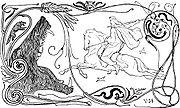
After these stanzas, the völva further relates that the hound Garmr produces deep howls in front of the cave of Gnipahellir
Gnipahellir
In Norse mythology, Gnipahellir is an overhanging cave where Garmr, the hound, is chained until the onset of Ragnarök....
. Garmr's bindings break and he runs free. The völva describes the state of humanity:
|
|
The "sons of Mím
Mímir
Mímir or Mim is a figure in Norse mythology renowned for his knowledge and wisdom who is beheaded during the Æsir-Vanir War...
" are described as being "at play", though this reference is not further explained in surviving sources. Heimdall holds the Gjallarhorn
Gjallarhorn
In Norse mythology, Gjallarhorn is a horn associated with the god Heimdallr and the wise being Mímir...
into the air and blows deeply into it, and Odin converses with Mím's head. The world tree Yggdrasil
Yggdrasil
In Norse mythology, Yggdrasil is an immense tree that is central in Norse cosmology. It was said to be the world tree around which the nine worlds existed...
shudders and groans. The jötunn Hrym
Hrym
In Norse mythology, Hrym is a jötunn and the captain of the ship Naglfar according to the Gylfaginning . During the end time conflict of Ragnarök he will set sail from Jotunheim, transporting the legions of jötnar toward the battlefield of Vígríðr to confront the gods in the final battle.Yet in...
comes from the east, his shield before him. The Midgard
Midgard
Midgard is one of the Nine Worlds and is an old Germanic name for our world and is the home of Humans, with the literal meaning "middle enclosure".-Etymology:...
serpent Jörmungandr
Jörmungandr
In Norse mythology, Jörmungandr , mostly known as Jormungand, orJörmungand , or Midgard Serpent , or World Serpent, is a sea serpent, and the middle child of the giantess Angrboða and the god Loki...
furiously writhes, causing waves to crash. "The eagle
Hræsvelgr
In Norse mythology, Hræsvelgr is a giant who takes eagle form. According to stanza 37 of the poem Vafþrúðnismál from the Poetic Edda, he sits at the end of the world and causes the wind to blow when he beats his wings in flight...
shrieks, pale-beaked he tears the corpse," and the ship Naglfar
Naglfar
In Norse mythology, Naglfar or Naglfari is a boat made entirely from the fingernails and toenails of the dead. During the events of Ragnarök, Naglfar is foretold to sail to Vígríðr, ferrying hordes that will there battle with the gods...
breaks free thanks to the waves made by Jormungandr and sets sail from the east. The fire jötnar inhabitants of Muspelheim
Muspelheim
In Norse mythology, Muspelheim , also called Múspell, is a realm of fire. This realm is one of the Nine Worlds and it is home to the fire jötunn or the Sons of Muspell, and Surtr, their ruler. It is fire; and the land to the North, Niflheim, is ice...
come forth.
The völva continues that Jötunheimr
Jötunheimr
Jötunheimr is one of the Nine Worlds and the homeland of the Giants of Norse Mythology — Rock Giants and Frost Giants.-Legend:...
, the land of the jötnar, is aroar, and that the Æsir are in council. The dwarves groan by their stone doors. Surtr
Surtr
In Norse mythology, Surtr or Surt is an eldjötunn. Surtr is attested in the Poetic Edda, compiled in the 13th century from earlier traditional sources, and the Prose Edda, written in the 13th century by Snorri Sturluson...
advances from the south, his sword brighter than the sun. Rocky cliffs open and the jötnar women sink. People walk the road to Hel and heavens split apart.
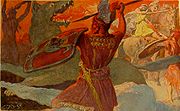
The gods then do battle with the invaders: Odin is swallowed whole and alive fighting the wolf Fenrir, causing his wife Frigg
Frigg
Frigg is a major goddess in Norse paganism, a subset of Germanic paganism. She is said to be the wife of Odin, and is the "foremost among the goddesses" and the queen of Asgard. Frigg appears primarily in Norse mythological stories as a wife and a mother. She is also described as having the power...
her second great sorrow (the first being the death of her son, the god Baldr). The god Freyr
Freyr
Freyr is one of the most important gods of Norse paganism. Freyr was highly associated with farming, weather and, as a phallic fertility god, Freyr "bestows peace and pleasure on mortals"...
fights Surtr and loses. Odin's son Víðarr avenges his father by rending Fenrir's jaws apart and stabbing it in the heart with his spear, thus killing the wolf. The serpent Jörmungandr opens its gaping maw, yawning widely in the air, and is met in combat by Thor. Thor, also a son of Odin and described here as protector of the earth, furiously fights the serpent, defeating it, but Thor is only able to take nine steps afterward before collapsing. After this, people flee their homes, and the sun becomes black while the earth sinks into the sea, the stars vanish, steam rises, and flames touch the heavens.
The völva sees the earth reappearing from the water, and an eagle over a waterfall hunting fish on a mountain. The surviving Æsir meet together at the field of Iðavöllr. They discuss Jörmungandr, great events of the past, and the runic alphabet
Runic alphabet
The runic alphabets are a set of related alphabets using letters known as runes to write various Germanic languages before the adoption of the Latin alphabet and for specialized purposes thereafter...
. In stanza 61, in the grass, they find the golden game pieces that the gods are described as having once happily enjoyed playing games with long ago (attested earlier in the same poem). The reemerged fields grow without needing to be sown. The gods Höðr
Höðr
Höðr is the brother of Baldr in Norse mythology. Guided by Loki he shot the mistletoe missile which was to slay the otherwise invulnerable Baldr....
and Baldr return from Hel and live happily together.
The völva says that the god Hœnir
Hœnir
In Norse mythology, Hœnir is one of the Æsir. He is mentioned as the one who helped Odin to create humans.- Attestations :In Ynglinga saga, along with Mímir, he went to the Vanir as a hostage to seal a truce after the Æsir-Vanir War...
chooses wooden slips for the purpose of prophecy, and that the sons of two brothers will widely inhabit the windy world. She sees a hall thatched with gold in Gimlé
Gimlé
In Norse mythology, Gimlé was a place where the survivors of Ragnarök were to live. It is mentioned in the Prose Edda and Völuspá and described as the most beautiful place on Earth, more beautiful than the Sun....
, where nobility will live and spend their lives pleasurably. Stanzas 65, found in the Hauksbók
Hauksbók
The Hauksbók is one of the few medieval Norse manuscripts of which the author is known. His name was Haukr Erlendsson , and as long back as it is possible to trace the manuscript it has been called the Hauksbók after its author. It was partly written by Haukr himself, partly by assistants...
version of the poem, refers to a "powerful, mighty one" that "rules over everything" and who will arrive from above at the court of the gods (Old Norse regindómr), which has been interpreted as a Christian
Christianity
Christianity is a monotheistic religion based on the life and teachings of Jesus as presented in canonical gospels and other New Testament writings...
reference added to the poem. In stanza 66, the völva ends her account with a description of the dragon Níðhöggr
Níðhöggr
In Norse mythology, Níðhöggr is a dragon who gnaws at a root of the World Tree, Yggdrasill.-Prose Edda:...
, corpses in his jaws, flying through the air. The völva then "sinks down." It is unclear if stanza 66 indicates that the völva is referring to the present time or if this is an element of the post-Ragnarök world.
Vafþrúðnismál

Vanir
In Norse mythology, the Vanir are a group of gods associated with fertility, wisdom and the ability to see the future. The Vanir are one of two groups of gods and are the namesake of the location Vanaheimr . After the Æsir–Vanir War, the Vanir became a subgroup of the Æsir...
god Njörðr is mentioned in relation to Ragnarök in stanza 39 of the poem Vafþrúðnismál
Vafþrúðnismál
In Norse mythology, Vafþrúðnismál is the third poem in the Poetic Edda. It is a conversation in verse form conducted initially between the Æsir Odin and Frigg, and subsequently between Odin and the giant Vafþrúðnir...
. In the poem, Odin, disguised as "Gagnráðr" faces off with the wise jötunn Vafþrúðnir
Vafþrúðnir
Vafþrúðnir is a wise jötunn in Norse mythology. In the Poetic Edda poem Vafþrúðnismál, Vafþrúðnir acts as both Odin's host and opponent in a deadly battle of wits, resulting in Vafþrúðnir's defeat....
in a battle of wits. Vafþrúðnismál references Njörðr's status as a hostage during the earlier Æsir-Vanir War
Æsir-Vanir War
In Norse mythology, the Æsir–Vanir War was a war that occurred between the Æsir and the Vanir, two groups of gods. The war ultimately resulted in the unification of the two tribes into a single tribe of gods...
, and that he will "come back home among the wise Vanir" at "the doom of men."
In stanza 44, Odin poses the question to Vafþrúðnir as to who of mankind will survive the "famous" Fimbulvetr ("Mighty Winter"). Vafþrúðnir responds in stanza 45 that those survivors will be Líf and Lífþrasir, and that they will hide in the forest of Hoddmímis holt, that they will consume the morning dew, and will produce generations of offspring. In stanza 46, Odin asks what sun will come into the sky after Fenrir has consumed the sun that exists. Vafþrúðnir responds that Sól will bear a daughter before Fenrir assails her, and that after Ragnarök this daughter will continue her mother's path.
In stanza 51, Vafþrúðnir states that, after Surtr's flames have been sated, Odin's sons Víðarr and Váli
Váli (son of Odin)
In Norse mythology, Váli is a son of the god Odin and the giantess Rindr. He was birthed for the sole purpose of killing Höðr as revenge for Höðr's accidental murder of his half-brother, Baldr. He grew to full adulthood within one day of his birth, and slew Höðr...
will live in the temples of the gods, and that Thor's sons Móði and Magni
Móði and Magni
In Norse mythology, Móði and Magni are the sons of Thor. Their names mean "Angry" and "Strong," respectively. Rudolf Simek states that, along with Thor's daughter Þrúðr , they embody their father's features....
will possess the hammer Mjolnir. In stanza 52, the disguised Odin asks the jötunn about Odin's own fate. Vafþrúðnir responds that "the wolf" will consume Odin, and that Víðarr will avenge him by sundering its cold jaws in battle. Odin ends the duel with one final question: what did Odin say to his son before preparing his funeral pyre? With this, Vafþrúðnir realizes that he is dealing with none other than Odin, whom he refers to as "the wisest of beings," adding that Odin alone could know this. Odin's message has been interpreted as a promise of resurrection to Baldr after Ragnarök.
Helgakviða Hundingsbana II
Ragnarök is briefly referenced in stanza 40 of the poem Helgakviða Hundingsbana IIHelgakviða Hundingsbana II
Völsungakviða in forna, Helgakviða Hundingsbana II or the Second Lay of Helgi Hundingsbane is an Old Norse poem found in the Poetic Edda...
. Here, the valkyrie
Valkyrie
In Norse mythology, a valkyrie is one of a host of female figures who decides who dies in battle. Selecting among half of those who die in battle , the valkyries bring their chosen to the afterlife hall of the slain, Valhalla, ruled over by the god Odin...
Sigrún
Sigrún
Sigrún is a valkyrie in Norse mythology. Her story is related in Helgakviða Hundingsbana I and Helgakviða Hundingsbana II, in the Poetic Edda...
's unnamed maid is passing the deceased hero Helgi Hundingsbane
Helgi Hundingsbane
Helgi Hundingsbane is a hero in Norse sagas. Helgi appears in Volsunga saga and in two lays in the Poetic Edda named Helgakviða Hundingsbana I and Helgakviða Hundingsbana II. The Poetic Edda relates that Helgi and his mistress Sigrún were Helgi Hjörvarðsson and Sváva of the Helgakviða...
's burial mound
Tumulus
A tumulus is a mound of earth and stones raised over a grave or graves. Tumuli are also known as barrows, burial mounds, Hügelgrab or kurgans, and can be found throughout much of the world. A tumulus composed largely or entirely of stones is usually referred to as a cairn...
. Helgi is there with a retinue of men, surprising the maid. The maid asks if she is witnessing a delusion since she sees dead men riding, or if Ragnarök has occurred. In stanza 41, Helgi responds that it is neither.
Prose Edda
Snorri Sturluson's Prose Edda quotes heavily from Völuspá and elaborates extensively in prose on the information there, though some of this information conflicts with that provided in Völuspá.Gylfaginning chapters 26 and 34
In the Prose Edda book GylfaginningGylfaginning
Gylfaginning, or the Tricking of Gylfi , is the first part of Snorri Sturluson's Prose Edda after Prologue. The Gylfaginning deals with the creation and destruction of the world of the Norse gods, and many other aspects of Norse mythology...
, various references are made to Ragnarök. Ragnarök is first mentioned in chapter 26, where the throned figure of High, king of the hall, tells Gangleri
Gylfi
In Norse mythology, Gylfi, Gylfe, Gylvi, or Gylve was the earliest king in Scandinavia recorded. The traditions on Gylfi deal with how he was tricked by the gods and his relations with the goddess Gefjon.-The creation of Zealand:...
(King Gylfi
Gylfi
In Norse mythology, Gylfi, Gylfe, Gylvi, or Gylve was the earliest king in Scandinavia recorded. The traditions on Gylfi deal with how he was tricked by the gods and his relations with the goddess Gefjon.-The creation of Zealand:...
in disguise) some basic information about the goddess Iðunn
Iðunn
In Norse mythology, Iðunn is a goddess associated with apples and youth. Iðunn is attested in the Poetic Edda, compiled in the 13th century from earlier traditional sources, and the Prose Edda, written in the 13th century by Snorri Sturluson...
, including that her apples will keep the gods young until Ragnarök.
In chapter 34, High
High, Just-As-High, and Third
High, Just-As-High, and Third are three men that respond to questions posed by Gangleri in the Prose Edda book Gylfaginning...
describes the binding of the wolf Fenrir by the gods, causing the god Týr to lose his right hand, and that Fenrir remains there until Ragnarök. Gangleri asks High that, as the gods could only expect destruction from Fenrir, why the gods did not simply kill Fenrir once he was bound. High responds that "the gods hold their sacred places and sanctuaries in such respect that they chose not to defile them with the wolf's blood, even though the prophecies foretold that he would be the death of Odin."
As a consequence of his role in the death of the god Baldr, Loki (described as father of Fenrir) is bound on top of three stones with the internal organs of his son Narfi
Narfi
Narfi in Norse mythology may refer to the son of Loki or the father of Nótt, the personified night.-Son of Loki:In the Prose Edda book Gylfaginning, Narfi, also known as Nari or Narvi, is a son of Loki and Sigyn who is killed to punish Loki for his crimes. The gods turned his brother Váli into a...
(which are turned into iron) in three places. There, venom
Snake venom
Snake venom is highly modified saliva that is produced by special glands of certain species of snakes. The glands which secrete the zootoxin are a modification of the parotid salivary gland of other vertebrates, and are usually situated on each side of the head below and behind the eye,...
drops onto his face periodically from a snake placed by the jötunn Skaði
Skaði
In Norse mythology, Skaði is a jötunn and goddess associated with bowhunting, skiing, winter, and mountains...
, and when his wife Sigyn
Sigyn
Sigyn is a goddess and wife of Loki in Norse mythology. Sigyn is attested in the Poetic Edda, compiled in the 13th century from earlier traditional sources, and the Prose Edda, written in the 13th century by Snorri Sturluson...
empties the bucket she is using to collect the dripping venom, the pain he experiences causes convulsions, resulting in earthquake
Earthquake
An earthquake is the result of a sudden release of energy in the Earth's crust that creates seismic waves. The seismicity, seismism or seismic activity of an area refers to the frequency, type and size of earthquakes experienced over a period of time...
s. Loki is further described as being bound this way until the onset of Ragnarök.
Gylfaginning chapter 51
Chapter 51 provides a detailed account of Ragnarök interspersed with various quotes from Völuspá, while chapters 52 and 53 describe the aftermath of these events. In Chapter 51, High states the first sign of Ragnarök will be Fimbulvetr, during which time three winters will arrive without a summer, and the sun will be useless. High details that, prior to these winters, three earlier winters will have occurred, marked with great battles throughout the world. During this time, greed will cause brothers to kill brothers, and fathers and sons will suffer from the collapse of kinship bonds. High then quotes stanza 45 of Völuspá. Next, High describes that the wolf will first swallow the sun, and then his brother the moon, and mankind will consider the occurrence as a great disaster resulting in much ruin. The stars will disappear. The earth and mountains will shake so violently that the trees will come loose from the soil, the mountains will topple, and all restraints will break, causing Fenrir to break free from his bonds.High relates that the great serpent Jörmungandr
Jörmungandr
In Norse mythology, Jörmungandr , mostly known as Jormungand, orJörmungand , or Midgard Serpent , or World Serpent, is a sea serpent, and the middle child of the giantess Angrboða and the god Loki...
, also described as a child of Loki in the same source, will breach land as the sea violently swells onto it. The ship Naglfar, described in the Prose Edda as being made from the human nails
Nail (anatomy)
A nail is a horn-like envelope covering the dorsal aspect of the terminal phalanges of fingers and toes in humans, most non-human primates, and a few other mammals. Nails are similar to claws, which are found on numerous other animals....
of the dead, is released from its mooring, and sets sail on the surging sea, steered by a jötunn named Hrym
Hrym
In Norse mythology, Hrym is a jötunn and the captain of the ship Naglfar according to the Gylfaginning . During the end time conflict of Ragnarök he will set sail from Jotunheim, transporting the legions of jötnar toward the battlefield of Vígríðr to confront the gods in the final battle.Yet in...
. At the same time, Fenrir, eyes and nostrils spraying flames, charges forward with his mouth wide open, his upper jaw reaching to the heavens, his lower jaw touching the earth. At Fenrir's side, Jörmungandr sprays venom throughout the air and the sea.
During all of this, the sky splits into two. From the split, the "sons of Muspell
Muspelheim
In Norse mythology, Muspelheim , also called Múspell, is a realm of fire. This realm is one of the Nine Worlds and it is home to the fire jötunn or the Sons of Muspell, and Surtr, their ruler. It is fire; and the land to the North, Niflheim, is ice...
" ride forth. Surtr
Surtr
In Norse mythology, Surtr or Surt is an eldjötunn. Surtr is attested in the Poetic Edda, compiled in the 13th century from earlier traditional sources, and the Prose Edda, written in the 13th century by Snorri Sturluson...
rides first, surrounded by flames, his sword brighter than the sun. High says that "Muspell's sons" will ride across Bifröst
Bifröst
In Norse mythology, Bifrost or Bilröst is a burning rainbow bridge that reaches between Midgard and Asgard, the realm of the gods...
, described in Gylfaginning as a rainbow bridge, and that the bridge will then break. The sons of Muspell (and their shining battle troop) advance to the field of Vígríðr
Vígríðr
In Norse mythology, Vígríðr or Óskópnir, is a large field foretold to host a battle between the forces of the gods and the forces of Surtr as part of the events of Ragnarök. The field is attested in the Poetic Edda, compiled in the 13th century from earlier traditional material, and in the Prose...
, described as an expanse that reaches "a hundred leagues in each direction," where Fenrir, Jörmungandr, Loki (followed by "Hel's own"), and Hrym (accompanied by all frost jötnar) join them. While this occurs, Heimdallr stands and blows the Gjallarhorn
Gjallarhorn
In Norse mythology, Gjallarhorn is a horn associated with the god Heimdallr and the wise being Mímir...
with all his might. The gods awaken at the sound, and they meet. Odin rides to Mímir's Well in search of counsel from Mímir. Yggdrasil shakes, and everything, everywhere fears.
High relates that the Æsir and the Einherjar
Einherjar
In Norse mythology, the einherjar are those that have died in battle and are brought to Valhalla by valkyries. In Valhalla, the einherjar eat their fill of the nightly-resurrecting beast Sæhrímnir, and are brought their fill of mead by valkyries...
dress for war and head to the field. Odin, wearing a gold helmet and an intricate coat of mail
Mail (armour)
Mail is a type of armour consisting of small metal rings linked together in a pattern to form a mesh.-History:Mail was a highly successful type of armour and was used by nearly every metalworking culture....
, carries his spear Gungnir
Gungnir
In Norse mythology, Gungnir is the spear of the god Odin.-Poetic Edda:In the Poetic Edda poem Völuspá, the Æsir-Vanir War is described as officially starting when Odin throws a spear over the heads of an assembly of Vanir gods. Whether or not this was specifically Gungnir is, however, unstated...
and rides before them. Odin advances against Fenrir, while Thor moves at his side, though Thor is unable to assist Odin because he has engaged Jörmungandr in combat. According to High, Freyr
Freyr
Freyr is one of the most important gods of Norse paganism. Freyr was highly associated with farming, weather and, as a phallic fertility god, Freyr "bestows peace and pleasure on mortals"...
fiercely fights with Surtr, but Freyr falls because he lacks the sword he once gave to his messenger, Skirnir
Skirnir
In Norse mythology, Skírnir is the god Freyr's messenger and vassal. In the Poetic Edda poem Skírnismál, Skírnir is sent as a messenger to Jötunheimr to conduct Freyr's wooing of the fair Gerðr on condition of being given Freyr's sword as a reward. Skírnir also threatens Gerðr with his gambantein,...
. The hound Garmr (described here as the "worst of monsters") breaks free from his bonds in front of Gnipahellir
Gnipahellir
In Norse mythology, Gnipahellir is an overhanging cave where Garmr, the hound, is chained until the onset of Ragnarök....
, and fights the god Týr, resulting in both of their deaths.
Thor kills Jörmungandr, yet is poisoned by the serpent, and manages to walk nine steps before falling to the earth dead. Fenrir swallows Odin, though immediately afterward his son Víðarr kicks his foot into Fenrir's lower jaw, grips Fenrir's upper jaw, and rips apart Fenrir's mouth, killing Fenrir. Loki fights Heimdallr, and the two kill one another. Surtr covers the earth in fire, causing the entire world to burn. High quotes stanzas 46 to 47 of Völuspá, and additionally stanza 18 of Vafþrúðnismál
Vafþrúðnismál
In Norse mythology, Vafþrúðnismál is the third poem in the Poetic Edda. It is a conversation in verse form conducted initially between the Æsir Odin and Frigg, and subsequently between Odin and the giant Vafþrúðnir...
(the latter relating information about the battlefield Vígríðr).
Gylfaginning chapters 52 and 53
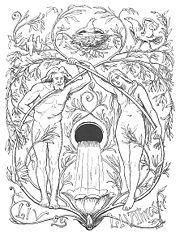
The figure of Third, seated on the highest throne in the hall, responds that there will be many good places to live, but also many bad ones. Third states that the best place to be is Gimlé
Gimlé
In Norse mythology, Gimlé was a place where the survivors of Ragnarök were to live. It is mentioned in the Prose Edda and Völuspá and described as the most beautiful place on Earth, more beautiful than the Sun....
in the heavens, where a place exists called Okolnir
Okolnir
In Norse mythology, Okolnir is the name of a plain on which is located the hall of Brimir and mentioned only in stanza 37 of the poem Völuspá from the Poetic Edda. The location of this plain is not stated in the poem.-References:...
that houses a hall called Brimir
Brimir
In Norse mythology, Brimir is another name for the giant Ymir and also the name of a hall for the souls of the virtuous following the endtime conflict of Ragnarok....
—where one can find plenty to drink. Third describes a hall made of red gold located in Niðafjöll called Sindri, where "good and virtuous men will live." Third further relates an unnamed hall in Náströnd
Náströnd
In Norse mythology, Náströnd is a place in Hel where Níðhöggr lives and sucks corpses.-Poetic Edda:The Völuspá says:-Prose Edda:...
, the beaches of the dead, that he describes as a large repugnant hall facing north that is built from the spines of snakes, and resembles "a house with walls woven from branches;" the heads of the snakes face the inside of the house and spew so much venom that rivers of it flow throughout the hall, in which those that break oaths and murderers must wade. Third here quotes Völuspá stanzas 38 to 39, with the insertion of original prose stating that the worst place of all to be is in Hvergelmir
Hvergelmir
Hvergelmir is the wellspring of cold in Niflheim in Norse mythology. All cold rivers are said to come from here, and it was said to be the source of the eleven rivers, Élivágar. Above the spring, the serpent Níðhöggr gnaws on one of the roots of the world tree, Yggdrasil.-References:* Orchard,...
, followed by a quote from Völuspá to highlight that the dragon Níðhöggr harasses the corpses of the dead there.
Chapter 53 begins with Gangleri asking if any of the gods will survive, and if there will be anything left of the earth or the sky. High responds that the earth will appear once more from the sea, beautiful and green, where self-sown crops grow. The field Iðavöllr exists where Asgard once was, and, there, untouched by Surtr's flames, Víðarr and Váli
Váli (son of Odin)
In Norse mythology, Váli is a son of the god Odin and the giantess Rindr. He was birthed for the sole purpose of killing Höðr as revenge for Höðr's accidental murder of his half-brother, Baldr. He grew to full adulthood within one day of his birth, and slew Höðr...
reside. Now possessing their father's hammer Mjolnir, Thor's sons Móði and Magni
Móði and Magni
In Norse mythology, Móði and Magni are the sons of Thor. Their names mean "Angry" and "Strong," respectively. Rudolf Simek states that, along with Thor's daughter Þrúðr , they embody their father's features....
will meet them there, and, coming from Hel
Hel (realm)
In Norse mythology, Hel, the location, shares a name with Hel, a female figure associated with the location. In late Icelandic sources, varying descriptions of Hel are given and various figures are described as being buried with items that will facilitate their journey to Hel after their death...
, Baldr and Höðr also arrive. Together, they all sit and recount memories, later finding the gold game pieces the Æsir once owned. Völuspá stanza 51 is then quoted.
High reveals that two humans, Líf and Lífþrasir, will have also survived the destruction by hiding in the wood Hoddmímis holt. These two survivors consume the morning dew for sustenance, and from their descendants the world will be repopulated. Vafþrúðnismál
Vafþrúðnismál
In Norse mythology, Vafþrúðnismál is the third poem in the Poetic Edda. It is a conversation in verse form conducted initially between the Æsir Odin and Frigg, and subsequently between Odin and the giant Vafþrúðnir...
stanza 45 is then quoted. The personified sun, Sól, will have a daughter at least as beautiful as she, and this daughter will follow the same path as her mother. Vafþrúðnismál stanza 47 is quoted, and so ends the foretelling of Ragnarök in Gylfaginning.
Archaeological record
