


Princess of Wales

Encyclopedia
Princess of Wales is a British
courtesy title held by the wife of The Prince of Wales
since the first "English" Prince of Wales in 1283.
Although there have been considerably more than ten male heirs to the throne, there have been only ten Princesses of Wales. The majority of Princes of Wales married after acceding to the throne as King. A number of other Princes of Wales died too young to marry.
The second wife of the present Prince of Wales, Camilla, Duchess of Cornwall, is the Princess of Wales, but does not use the title, out of respect for the late Diana, Princess of Wales
.
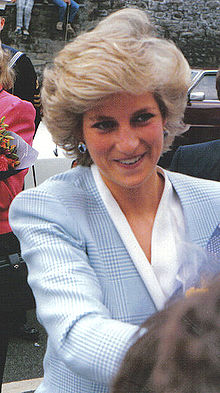
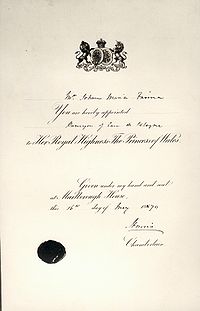 The ten Princesses of Wales (and the dates the individuals held that title) are as follows:
Several Princesses of Wales became queens consort. Those who did not generally took the title of "Dowager Princess of Wales" after the deaths of their husbands. (Following the annulment of Henry VIII's marriage to Catherine of Aragon, Catherine officially reverted to her earlier title of Dowager Princess of Wales, as the widow of Henry's older brother, Arthur, Prince of Wales
, because Henry did not wish to acknowledge that he had ever been legally married to her.)
Under the male-preference primogeniture
in use in the United Kingdom, a daughter, sister, or other female relative of a monarch may be heir presumptive
, but none has ever been heir apparent
, since it has always been (theoretically) possible for the monarch to beget or bear a male heir who would displace any female heir, even an older sister. A woman could become heir apparent if she was the brotherless eldest child of a deceased heir apparent; this situation has never arisen, however, in the history of the United Kingdom.
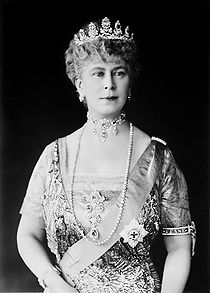 The Princess of Wales is not a princess in her own right. While some past princesses, for example Catherine of Aragon, Alexandra of Denmark and Mary of Teck, were called "Princess Catherine", "Princess Alexandra" and "Princess Mary", that was because they were already princesses (of Spain
, Denmark
and Teck
respectively) when they married. Though Diana, Princess of Wales was commonly called "Princess Diana" after her marriage to Charles, Prince of Wales
, it was officially incorrect, as Diana herself pointed out, because she was not a princess in her own right. Similarly Camilla, Duchess of Cornwall, is neither "Princess Camilla" nor "Duchess Camilla".
There is, however, one notable exception to this rule. During her youth, Mary I
was invested by her father, Henry VIII
, with many of the rights and properties traditionally given to the Prince of Wales, including use of the official seal of Wales for correspondence. For most of her childhood, Mary was her father's only legitimate heir, and for this reason she was often referred to as "the Princess of Wales", although Henry never formally created her as such. For example, Spanish scholar Juan Luis Vives
dedicated his Satellitium Animi to "Dominæ Mariæ Cambriæ Principi, Henrici Octavi Angliæ Regis Filiæ".
When a title was sought for the future Elizabeth II, the possibility of investing her as Princess of Wales in her own right was raised. This suggestion was rejected, because Princess of Wales is a courtesy title held by the wife of the Prince of Wales. If it were used by Princess Elizabeth, it would have degraded her right as a Princess of the United Kingdom unless Letters Patent
or Legislation
were introduced to the contrary. Furthermore, if the then Princess Elizabeth had been given the title of Princess of Wales, there would have been the problem of what to call her future husband. Therefore, King George VI decided not to give his elder daughter the title.
, Duchess of Rothesay
, Countess of Chester, Countess of Carrick, Baroness Renfrew, Lady of the Isles and Princess of Scotland.
If the Princess of Wales divorces, she loses the title and the style "Her Royal Highness" but continues to be styled by courtesy until remarriage.
Of all these titles, "Princess of Wales" has been used officially, due to it being of a higher rank than the additional peerage titles. However, as noted with the example of the current holder, a subsidiary title may just as easily and legally be used.
The Princess is known as Duchess of Rothesay in Scotland, as the Prince of Wales is known as Duke of Rothesay there, the dukedom being the title historically associated with the heir to the Scottish throne. The Princess of Wales also holds the titles of Duchess of Cornwall and Countess of Chester, as spouse to the Prince of Wales who is also Duke of Cornwall and Earl of Chester.
can be definitively shown to have used the title, several consorts of native Welsh princes of Wales were theoretically princesses of Wales while their husbands were on the throne. Llywelyn ab Iorwerth's consort, Joan, Lady of Wales
, used that title in the 1230s; Isabella de Braose
and Elizabeth Ferrers
were likewise married to princes of Wales, but it is not known if they assumed a title in light of their husbands' status.
British people
The British are citizens of the United Kingdom, of the Isle of Man, any of the Channel Islands, or of any of the British overseas territories, and their descendants...
courtesy title held by the wife of The Prince of Wales
Prince of Wales
Prince of Wales is a title traditionally granted to the heir apparent to the reigning monarch of the United Kingdom of Great Britain and Northern Ireland and the 15 other independent Commonwealth realms...
since the first "English" Prince of Wales in 1283.
Although there have been considerably more than ten male heirs to the throne, there have been only ten Princesses of Wales. The majority of Princes of Wales married after acceding to the throne as King. A number of other Princes of Wales died too young to marry.
The second wife of the present Prince of Wales, Camilla, Duchess of Cornwall, is the Princess of Wales, but does not use the title, out of respect for the late Diana, Princess of Wales
Diana, Princess of Wales
Diana, Princess of Wales was the first wife of Charles, Prince of Wales, whom she married on 29 July 1981, and an international charity and fundraising figure, as well as a preeminent celebrity of the late 20th century...
.
- Joan of KentJoan of KentJoan, Countess of Kent , known to history as The Fair Maid of Kent, was the first English Princess of Wales...
(held title 1361–1376) — became dowagerDowagerA dowager is a widow who holds a title or property, or dower, derived from her deceased husband. As an adjective, "Dowager" usually appears in association with monarchical and aristocratic titles....
princess when her husband, Edward, the Black PrinceEdward, the Black PrinceEdward of Woodstock, Prince of Wales, Duke of Cornwall, Prince of Aquitaine, KG was the eldest son of King Edward III of England and his wife Philippa of Hainault as well as father to King Richard II of England....
, died as Prince of Wales. - Anne NevilleAnne NevilleLady Anne Neville was Princess of Wales as the wife of Edward of Westminster and Queen of England as the consort of King Richard III. She held the latter title for less than two years, from 26 June 1483 until her death in March 1485...
(1470–1471) — through her marriage to Edward of Lancaster, though there is no record of her having used the title. She became queen consortQueen consortA queen consort is the wife of a reigning king. A queen consort usually shares her husband's rank and holds the feminine equivalent of the king's monarchical titles. Historically, queens consort do not share the king regnant's political and military powers. Most queens in history were queens consort...
when her second husband became King Richard III of EnglandRichard III of EnglandRichard III was King of England for two years, from 1483 until his death in 1485 during the Battle of Bosworth Field. He was the last king of the House of York and the last of the Plantagenet dynasty...
. - Catherine of AragonCatherine of AragonCatherine of Aragon , also known as Katherine or Katharine, was Queen consort of England as the first wife of King Henry VIII of England and Princess of Wales as the wife to Arthur, Prince of Wales...
(1501–1502) — became dowager princess when her first husband, ArthurArthur, Prince of WalesArthur Tudor, Prince of Wales was the first son of King Henry VII of England and Elizabeth of York, and therefore, heir to the throne of England. As he predeceased his father, Arthur never became king...
, died as Prince. She remarried Arthur's younger brother, HenryHenry VIII of EnglandHenry VIII was King of England from 21 April 1509 until his death. He was Lord, and later King, of Ireland, as well as continuing the nominal claim by the English monarchs to the Kingdom of France...
, shortly after his succession in 1509 and became queen consort. - Caroline of AnsbachCaroline of AnsbachCaroline of Brandenburg-Ansbach was the queen consort of King George II of Great Britain.Her father, John Frederick, Margrave of Brandenburg-Ansbach, was the ruler of a small German state...
(1714–1727) — became queen consort when George IIGeorge II of Great BritainGeorge II was King of Great Britain and Ireland, Duke of Brunswick-Lüneburg and Archtreasurer and Prince-elector of the Holy Roman Empire from 11 June 1727 until his death.George was the last British monarch born outside Great Britain. He was born and brought up in Northern Germany...
acceded to the throne. - Augusta of Saxe-Gotha (1736–1751) — Dowager Princess of Wales after her husband, Frederick, Prince of WalesFrederick, Prince of WalesFrederick, Prince of Wales was a member of the House of Hanover and therefore of the Hanoverian and later British Royal Family, the eldest son of George II and father of George III, as well as the great-grandfather of Queen Victoria...
, died. - Caroline of BrunswickCaroline of BrunswickCaroline of Brunswick-Wolfenbüttel was the Queen consort of King George IV of the United Kingdom from 29 January 1820 until her death...
(8 April 1795–29 January 1820) — Married George, Prince of WalesGeorge IV of the United KingdomGeorge IV was the King of the United Kingdom of Great Britain and Ireland and also of Hanover from the death of his father, George III, on 29 January 1820 until his own death ten years later...
, on 8 April 1795; became queen consort on the accession of her husband as George IV of the United Kingdom. Caroline and George were estranged, and she was barred from his court and from her husband's coronation. An attempt to divorce her by act of Parliament in 1820 failed. Queen Caroline died 7 August 1821. - Alexandra of DenmarkAlexandra of DenmarkAlexandra of Denmark was the wife of Edward VII of the United Kingdom...
(10 March 1863–22 January 1901) — The daughter of King Christian IX of DenmarkChristian IX of DenmarkChristian IX was King of Denmark from 16 November 1863 to 29 January 1906.Growing up as a prince of Schleswig-Holstein-Sonderburg-Glücksburg, a junior branch of the House of Oldenburg which had ruled Denmark since 1448, Christian was originally not in the immediate line of succession to the Danish...
, she married Albert Edward, Prince of WalesEdward VII of the United KingdomEdward VII was King of the United Kingdom and the British Dominions and Emperor of India from 22 January 1901 until his death in 1910...
, and became Princess of Wales on 10 March 1863. On the accession of her husband as Edward VII of the United Kingdom on 22 January 1901, she became queen consort following a wait of 37 years. Queen Alexandra died 20 November 1925. - Mary of TeckMary of TeckMary of Teck was the queen consort of the United Kingdom and the British Dominions, and Empress of India, as the wife of King-Emperor George V....
(9 November 1901–6 May 1910) — Married George, Duke of YorkGeorge V of the United KingdomGeorge V was King of the United Kingdom and the British Dominions, and Emperor of India, from 6 May 1910 through the First World War until his death in 1936....
, on 6 July 1893 and became Duchess of York; became Duchess of Cornwall on the accession of her father-in-law as Edward VII of the United KingdomEdward VII of the United KingdomEdward VII was King of the United Kingdom and the British Dominions and Emperor of India from 22 January 1901 until his death in 1910...
on 22 January 1901; became Princess of Wales on 9 November 1901; became queen consort upon accession of husband George VGeorge V of the United KingdomGeorge V was King of the United Kingdom and the British Dominions, and Emperor of India, from 6 May 1910 through the First World War until his death in 1936....
on 6 May 1910. She held the titles Duchess of YorkDuchess of YorkDuchess of York is the principal courtesy title held by the wife of the Duke of York. The title is gained with marriage alone and is forfeited upon divorce. Four of the twelve Dukes of York did not marry or had already assumed the throne prior to marriage, therefore there have only ever been eleven...
, Princess of Wales, Queen-Empress and Queen-Empress Dowager. Queen Mary died 24 March 1953. - Lady Diana Frances SpencerDiana, Princess of WalesDiana, Princess of Wales was the first wife of Charles, Prince of Wales, whom she married on 29 July 1981, and an international charity and fundraising figure, as well as a preeminent celebrity of the late 20th century...
(29 July 1981–31 August 1997) — Diana was the first wife of Charles, Prince of WalesCharles, Prince of WalesPrince Charles, Prince of Wales is the heir apparent and eldest son of Queen Elizabeth II and Prince Philip, Duke of Edinburgh. Since 1958 his major title has been His Royal Highness The Prince of Wales. In Scotland he is additionally known as The Duke of Rothesay...
, whom she married on 29 July 1981. Following her divorce from him (finalized 28 August 1996), she lost the style "Royal HighnessRoyal HighnessRoyal Highness is a style ; plural Royal Highnesses...
" and assumed the style of Diana, Princess of Wales. Had Diana remarried, any right to use the title Princess of Wales would have been lost permanently. Diana died as the result of injuries sustained in an automobile crash on 31 August 1997. - Camilla Rosemary Shand (2005–present) — Camilla is the second wife of Charles, Prince of Wales, whom she married on 9 April 2005. Though entitled to be styled Princess of Wales, Camilla is the first Princess of Wales whose husband previously had another official consort known as Princess of Wales. Camilla uses the style of Duchess of Cornwall or Rothesay in accordance with public sentiment.
Several Princesses of Wales became queens consort. Those who did not generally took the title of "Dowager Princess of Wales" after the deaths of their husbands. (Following the annulment of Henry VIII's marriage to Catherine of Aragon, Catherine officially reverted to her earlier title of Dowager Princess of Wales, as the widow of Henry's older brother, Arthur, Prince of Wales
Arthur, Prince of Wales
Arthur Tudor, Prince of Wales was the first son of King Henry VII of England and Elizabeth of York, and therefore, heir to the throne of England. As he predeceased his father, Arthur never became king...
, because Henry did not wish to acknowledge that he had ever been legally married to her.)
Under the male-preference primogeniture
Primogeniture
Primogeniture is the right, by law or custom, of the firstborn to inherit the entire estate, to the exclusion of younger siblings . Historically, the term implied male primogeniture, to the exclusion of females...
in use in the United Kingdom, a daughter, sister, or other female relative of a monarch may be heir presumptive
Heir Presumptive
An heir presumptive or heiress presumptive is the person provisionally scheduled to inherit a throne, peerage, or other hereditary honour, but whose position can be displaced by the birth of an heir or heiress apparent or of a new heir presumptive with a better claim to the position in question...
, but none has ever been heir apparent
Heir apparent
An heir apparent or heiress apparent is a person who is first in line of succession and cannot be displaced from inheriting, except by a change in the rules of succession....
, since it has always been (theoretically) possible for the monarch to beget or bear a male heir who would displace any female heir, even an older sister. A woman could become heir apparent if she was the brotherless eldest child of a deceased heir apparent; this situation has never arisen, however, in the history of the United Kingdom.
Status of the title
Spain
Spain , officially the Kingdom of Spain languages]] under the European Charter for Regional or Minority Languages. In each of these, Spain's official name is as follows:;;;;;;), is a country and member state of the European Union located in southwestern Europe on the Iberian Peninsula...
, Denmark
Denmark
Denmark is a Scandinavian country in Northern Europe. The countries of Denmark and Greenland, as well as the Faroe Islands, constitute the Kingdom of Denmark . It is the southernmost of the Nordic countries, southwest of Sweden and south of Norway, and bordered to the south by Germany. Denmark...
and Teck
Teck
Teck was a ducal castle in the kingdom of Württemberg, immediately to the north of the Swabian Jura and south of the town of Kirchheim unter Teck , taking its name from the ridge, 2544 feet high, which it crowned. It was destroyed in the German Peasants' War...
respectively) when they married. Though Diana, Princess of Wales was commonly called "Princess Diana" after her marriage to Charles, Prince of Wales
Charles, Prince of Wales
Prince Charles, Prince of Wales is the heir apparent and eldest son of Queen Elizabeth II and Prince Philip, Duke of Edinburgh. Since 1958 his major title has been His Royal Highness The Prince of Wales. In Scotland he is additionally known as The Duke of Rothesay...
, it was officially incorrect, as Diana herself pointed out, because she was not a princess in her own right. Similarly Camilla, Duchess of Cornwall, is neither "Princess Camilla" nor "Duchess Camilla".
There is, however, one notable exception to this rule. During her youth, Mary I
Mary I of England
Mary I was queen regnant of England and Ireland from July 1553 until her death.She was the only surviving child born of the ill-fated marriage of Henry VIII and his first wife Catherine of Aragon. Her younger half-brother, Edward VI, succeeded Henry in 1547...
was invested by her father, Henry VIII
Henry VIII of England
Henry VIII was King of England from 21 April 1509 until his death. He was Lord, and later King, of Ireland, as well as continuing the nominal claim by the English monarchs to the Kingdom of France...
, with many of the rights and properties traditionally given to the Prince of Wales, including use of the official seal of Wales for correspondence. For most of her childhood, Mary was her father's only legitimate heir, and for this reason she was often referred to as "the Princess of Wales", although Henry never formally created her as such. For example, Spanish scholar Juan Luis Vives
Juan Luís Vives
Juan Luis Vives , also Joan Lluís Vives i March , was a Valencian Spanish scholar and humanist.-Biography:Vives was born in Valencia...
dedicated his Satellitium Animi to "Dominæ Mariæ Cambriæ Principi, Henrici Octavi Angliæ Regis Filiæ".
When a title was sought for the future Elizabeth II, the possibility of investing her as Princess of Wales in her own right was raised. This suggestion was rejected, because Princess of Wales is a courtesy title held by the wife of the Prince of Wales. If it were used by Princess Elizabeth, it would have degraded her right as a Princess of the United Kingdom unless Letters Patent
Letters patent
Letters patent are a type of legal instrument in the form of a published written order issued by a monarch or president, generally granting an office, right, monopoly, title, or status to a person or corporation...
or Legislation
Legislation
Legislation is law which has been promulgated by a legislature or other governing body, or the process of making it...
were introduced to the contrary. Furthermore, if the then Princess Elizabeth had been given the title of Princess of Wales, there would have been the problem of what to call her future husband. Therefore, King George VI decided not to give his elder daughter the title.
Other titles of the Princesses of Wales
The Princess of Wales, by virtue of her marriage to The Prince of Wales, takes on the feminine equivalent of her husband's subsidiary titles. Thus, upon marriage, the wife of The Prince of Wales assumes the styles and titles – Her Royal Highness The Princess (husband’s Christian name) of the United Kingdom of Great Britain and Northern Ireland, Princess of Wales, Duchess of CornwallDuchess of Cornwall
The Duchess of Cornwall is the title held by the wife of the Duke of Cornwall. Duke of Cornwall is a non-hereditary peerage held by the British Sovereign's eldest son and heir....
, Duchess of Rothesay
Duchess of Rothesay
Duchess of Rothesay is a Scottish courtesy title. It is held by the wife of The Dukes of Rothesay since the first Duke in 1398. Due to the mortality rate and the fact that very few Dukes of Rothesay were of majority or married prior to ascending the throne , there have in fact been only eight...
, Countess of Chester, Countess of Carrick, Baroness Renfrew, Lady of the Isles and Princess of Scotland.
If the Princess of Wales divorces, she loses the title and the style "Her Royal Highness" but continues to be styled by courtesy until remarriage.
Of all these titles, "Princess of Wales" has been used officially, due to it being of a higher rank than the additional peerage titles. However, as noted with the example of the current holder, a subsidiary title may just as easily and legally be used.
The Princess is known as Duchess of Rothesay in Scotland, as the Prince of Wales is known as Duke of Rothesay there, the dukedom being the title historically associated with the heir to the Scottish throne. The Princess of Wales also holds the titles of Duchess of Cornwall and Countess of Chester, as spouse to the Prince of Wales who is also Duke of Cornwall and Earl of Chester.
Native princesses of Wales
Though only Eleanor de MontfortEleanor de Montfort
Eleanor de Montfort, Princess of Wales and Lady of Snowdon was a daughter of Simon de Montfort, 6th Earl of Leicester and Eleanor of England. She was also the first woman who can be shown to have used the title Princess of Wales....
can be definitively shown to have used the title, several consorts of native Welsh princes of Wales were theoretically princesses of Wales while their husbands were on the throne. Llywelyn ab Iorwerth's consort, Joan, Lady of Wales
Joan, Lady of Wales
Joan, Princess of Wales and Lady of Snowdon was the wife of Llywelyn the Great, Prince of Wales and Gwynedd and effective ruler of most of Wales.-Early life:...
, used that title in the 1230s; Isabella de Braose
Isabella de Braose
Isabella, Princess of Wales and Lady of Snowdon was the eldest daughter of William de Braose, Lord of Abergavenny, and his wife Eva Marshal...
and Elizabeth Ferrers
Elizabeth Ferrers
Elizabeth Ferrers was a daughter of William de Ferrers, 5th Earl of Derby and his second wife Margaret de Quincy...
were likewise married to princes of Wales, but it is not known if they assumed a title in light of their husbands' status.