

Prehistoric medicine

Encyclopedia
Medicine
Medicine is the science and art of healing. It encompasses a variety of health care practices evolved to maintain and restore health by the prevention and treatment of illness....
before the invention
Invention
An invention is a novel composition, device, or process. An invention may be derived from a pre-existing model or idea, or it could be independently conceived, in which case it may be a radical breakthrough. In addition, there is cultural invention, which is an innovative set of useful social...
of writing
Writing
Writing is the representation of language in a textual medium through the use of a set of signs or symbols . It is distinguished from illustration, such as cave drawing and painting, and non-symbolic preservation of language via non-textual media, such as magnetic tape audio.Writing most likely...
. As the timing of the invention of writing varies per culture
Culture
Culture is a term that has many different inter-related meanings. For example, in 1952, Alfred Kroeber and Clyde Kluckhohn compiled a list of 164 definitions of "culture" in Culture: A Critical Review of Concepts and Definitions...
and region, the term "prehistoric medicine" encompasses a wide range of time periods and dates.
The study of prehistoric
Prehistory
Prehistory is the span of time before recorded history. Prehistory can refer to the period of human existence before the availability of those written records with which recorded history begins. More broadly, it refers to all the time preceding human existence and the invention of writing...
medicine relies heavily on artifacts
Artifact (archaeology)
An artifact or artefact is "something made or given shape by man, such as a tool or a work of art, esp an object of archaeological interest"...
and human remains
Human Remains
Human Remains is a British black comedy television series written by and starring Rob Brydon and Julia Davis. It consisted of six episodes that aired in 2000. Each episode documented the relationship of a different couple, all of whom were played by Brydon and Davis and all but two of whom were...
, and on anthropology
Anthropology
Anthropology is the study of humanity. It has origins in the humanities, the natural sciences, and the social sciences. The term "anthropology" is from the Greek anthrōpos , "man", understood to mean mankind or humanity, and -logia , "discourse" or "study", and was first used in 1501 by German...
. Previously uncontacted peoples
Uncontacted peoples
Uncontacted people, also referred to as isolated people or lost tribes, are communities who live, or have lived, either by choice or by circumstance, without significant contact with globalized civilisation....
and certain indigenous peoples
Indigenous peoples
Indigenous peoples are ethnic groups that are defined as indigenous according to one of the various definitions of the term, there is no universally accepted definition but most of which carry connotations of being the "original inhabitants" of a territory....
who live in a traditional way have been the subject of anthropological studies in order to gain insight into both contemporary and ancient practices.
Beliefs and ideas on disease
It is clear that prehistoric societies believed in both natural and supernatural means of variably causing and treating disease. For serious or disabling diseases, for which there was no rational cause, blame was placed on the supernatural—godsPantheon (gods)
A pantheon is a set of all the gods of a particular polytheistic religion or mythology.Max Weber's 1922 opus, Economy and Society discusses the link between a...
, evil spirits, and sorcery
Witchcraft
Witchcraft, in historical, anthropological, religious, and mythological contexts, is the alleged use of supernatural or magical powers. A witch is a practitioner of witchcraft...
. It was believed that evil spirits, conjured
Conjuration
Conjuration is used in many video games, mainly RPGs, where it is usually referred to as summoning.* A notable example is the Final Fantasy franchise which incorporates summoning of monsters to fight alongside the characters....
by a sorcerer, could inhabit a person's body and cause illness and that these spirits could be removed from the patient, through the skull, by trephining, and through other treatments carried out by a shaman, a medicine man.
Logic
Logic
In philosophy, Logic is the formal systematic study of the principles of valid inference and correct reasoning. Logic is used in most intellectual activities, but is studied primarily in the disciplines of philosophy, mathematics, semantics, and computer science...
and reasoning were used to deduce the cause of injuries. Injuries, for which there was a clear cause, were not blamed on the supernatural.
In 1991 in the Tyrolean Alps
Alps
The Alps is one of the great mountain range systems of Europe, stretching from Austria and Slovenia in the east through Italy, Switzerland, Liechtenstein and Germany to France in the west....
in Northern Italy, the discovery of a mummified body suggested that prehistoric societies may have had greater medical knowledge than had previously been thought. The body, that came to be known as Ötzi the Iceman
Ötzi the Iceman
Ötzi the Iceman , Similaun Man, and Man from Hauslabjoch are modern names for a well-preserved natural mummy of a man who lived about 5,300 years ago. The mummy was found in September 1991 in the Ötztal Alps, near Hauslabjoch on the border between Austria and Italy. The nickname comes from the...
, contained in his possessions a fungus that scientists found could kill internal parasites; in a Lancet study which followed, Dr. Luigi Capasso concluded that "the discovery of the fungus suggests that the Iceman was aware of his intestinal parasites and fought them with measured doses of Piptoporus betulinus
Birch bracket
Piptoporus betulinus, commonly known as the birch polypore, birch bracket, or razor strop, is one of the most common polyporous bracket fungi and, as the name suggests, grows almost exclusively on birch trees. The brackets burst out from the bark of the tree, and these fruiting bodies can last for...
." Although the Iceman may not have had a detailed understanding of intestinal parasites, the findings further imply that prehistoric societies were willing to accept and apply practical outlooks on disease.
Disease and mortality
Different diseases and ailments were common in prehistory than are prevalent today; there is evidence that many people suffered from osteoarthritisOsteoarthritis
Osteoarthritis also known as degenerative arthritis or degenerative joint disease, is a group of mechanical abnormalities involving degradation of joints, including articular cartilage and subchondral bone. Symptoms may include joint pain, tenderness, stiffness, locking, and sometimes an effusion...
, probably caused by the lifting of heavy objects which would have been a daily and necessary task in their societies. The transport of, for example, latte stones, involving hyper extension and torque of the lower back, while dragging the stones, may have contributed to the development of micro fractures in the spine and subsequent spondylolysis
Spondylolysis
Spondylolysis is a defect of a vertebra. More specifically it is defined as a defect in the pars interarticularis of the vertebral arch. The great majority of cases occur in the lowest of the lumbar vertebrae , but spondylolysis may also occur in the other lumbar vertebrae, as well as in the...
. Things such as cuts, bruises, and breakages of bone, without antiseptics, proper facilities, or knowledge of germs, would become very serious if infected.
There is also evidence of rickets
Rickets
Rickets is a softening of bones in children due to deficiency or impaired metabolism of vitamin D, magnesium , phosphorus or calcium, potentially leading to fractures and deformity. Rickets is among the most frequent childhood diseases in many developing countries...
bone deformity and bone wastage (Osteomalacia
Osteomalacia
Osteomalacia is the softening of the bones caused by defective bone mineralization secondary to inadequate amounts of available phosphorus and calcium, or because of overactive resorption of calcium from the bone as a result of hyperparathyroidism...
), which is caused by a lack of Vitamin D
Vitamin D
Vitamin D is a group of fat-soluble secosteroids. In humans, vitamin D is unique both because it functions as a prohormone and because the body can synthesize it when sun exposure is adequate ....
.
The life expectancy in prehistoric times was low, 25–40 years, with men living longer than women; archaeological evidence of women and babies found together suggests that many women would have died in childbirth, perhaps accounting for the lower life expectancy in women than men. Another possible explanation for the shorter life spans of prehistoric humans may be malnutrition; men, as hunters, generally received better food than their female counterparts, who would subsequently have been less resistant to disease.
Plant materials
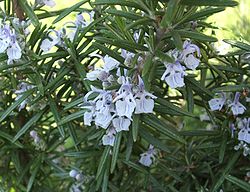
Unlike the ancient civilisations which could source plant materials internationally, prehistoric societies would have been restricted to localised areas, though nomadic tribes may have had a greater variety of plant materials at their disposal than more stationary societies.
The effects of different plant materials would have been found through trial and error. Dispensal and gathering of plant materials was handled by women, who cared for the health of their family. Plant materials were an important cure for diseases throughout history. As they would not have been able to record the effects of different herbs, knowledge of them would have been passed down orally through the generations.
There has been suggestion that the Piptoporus betulinus, which are commonly found in alpine environments, could have been used as a basic laxative by prehistoric peoples living in those areas (Northern Europe), since it is known to bring on short bouts of diarrhoea when ingested, and was found among the possessions of a mummified man.
The use of earth and clays
Earths and clays may have provided prehistoric peoples with some of their first medicines. This is related to geophagyGeophagy
Geophagy is the practice of eating earthy or soil-like substances such as clay, and chalk. It exists in animals in the wild and also in humans, most often in rural or preindustrial societies among children and pregnant women...
, which is extremely widespread among animals in the wild as well as among domesticated animals. In particular, geophagy is widespread among contemporary non-human primates. Also, early humans could have learned about the use of various healing clays by observing animal behaviour. Such clay is used both internally and externally, such as for treating wounds, and after surgery (see below). Geophagy, and the external use of clay are both still quite widespread among aboriginal peoples around the world, as well as among pre-industrial populations.
Surgery
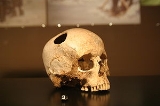
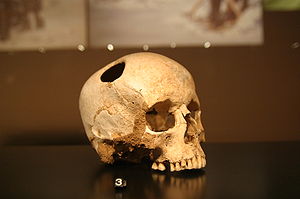
Trepanning (sometimes trephining) was a basic surgical operation carried out, predominantly by medicine men, in prehistoric societies across the world, although evidence shows a concentration of the practice in PeruPeru
Peru , officially the Republic of Peru , is a country in western South America. It is bordered on the north by Ecuador and Colombia, on the east by Brazil, on the southeast by Bolivia, on the south by Chile, and on the west by the Pacific Ocean....
. Several theories question the reasoning behind trepanning; it could have been used to cure certain conditions such as headache
Headache
A headache or cephalalgia is pain anywhere in the region of the head or neck. It can be a symptom of a number of different conditions of the head and neck. The brain tissue itself is not sensitive to pain because it lacks pain receptors. Rather, the pain is caused by disturbance of the...
s and epilepsy
Epilepsy
Epilepsy is a common chronic neurological disorder characterized by seizures. These seizures are transient signs and/or symptoms of abnormal, excessive or hypersynchronous neuronal activity in the brain.About 50 million people worldwide have epilepsy, and nearly two out of every three new cases...
. These might have been considered effects of an evil spirit trapped within a person. Despite it being medically inappropriate in the vast majority of cases, and very dangerous procedure to carry out there is evidence of bone tissue surrounding the surgical hole partially grown back, therefore survival of the procedure did occur.
The plate of skull bone, sometimes as large as 5 cm
Centimetre
A centimetre is a unit of length in the metric system, equal to one hundredth of a metre, which is the SI base unit of length. Centi is the SI prefix for a factor of . Hence a centimetre can be written as or — meaning or respectively...
(2 in
Inch
An inch is the name of a unit of length in a number of different systems, including Imperial units, and United States customary units. There are 36 inches in a yard and 12 inches in a foot...
) in diameter, would have been kept with the person until their death, serving as a charm or in some spiritual or religious capacity; burial of this bone plate was thought to return the body to its full state for the afterlife
Afterlife
The afterlife is the belief that a part of, or essence of, or soul of an individual, which carries with it and confers personal identity, survives the death of the body of this world and this lifetime, by natural or supernatural means, in contrast to the belief in eternal...
. Trepanning is amongst few surgical operations to be carried out in prehistoric times; other surgery was rarely undertaken; medicine men had neither the training or the specialised equipment required to do surgery on the internal body. The procedure would have taken around 60 minutes in a single session, and if done in several sessions, it could have taken up to 12 days to complete.
Many prehistoric peoples, where applicable (geographically and technologically), were able to set broken or fractured
Fractured
Fractured is an Industrial band created by Canadian Nick Gorman in 2003. Formed in Toronto, his self produced release CD-R demo titled Contami-Nation caught the attention of European label Dependent who signed them. After the release of the demo Gorman was joined by Famine and in 2006 released...
bones using clay materials. An injured area was covered in clay, which then set hard so that the bone could heal properly without interference.
Also, primarily in the Americas
Americas
The Americas, or America , are lands in the Western hemisphere, also known as the New World. In English, the plural form the Americas is often used to refer to the landmasses of North America and South America with their associated islands and regions, while the singular form America is primarily...
, the pincers of certain ant species were used to close up wounds from infection; the ant was held above the wound until it bit, where its head would be removed allowing the pincers to remain and hold closed the wound.
Magic and medicine men
Medicine man
"Medicine man" or "Medicine woman" are English terms used to describe traditional healers and spiritual leaders among Native American and other indigenous or aboriginal peoples...
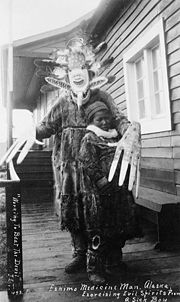
(also witch-doctors, shamans) maintained the health of their tribe by gathering and distributing herbs, performing minor surgical procedures, providing medical advice, and supernatural treatments
Magic (paranormal)
Magic is the claimed art of manipulating aspects of reality either by supernatural means or through knowledge of occult laws unknown to science. It is in contrast to science, in that science does not accept anything not subject to either direct or indirect observation, and subject to logical...
such as charms, spells, and amulet
Amulet
An amulet, similar to a talisman , is any object intended to bring good luck or protection to its owner.Potential amulets include gems, especially engraved gems, statues, coins, drawings, pendants, rings, plants and animals; even words said in certain occasions—for example: vade retro satana—, to...
s to ward off evil spirits. In Apache
Apache
Apache is the collective term for several culturally related groups of Native Americans in the United States originally from the Southwest United States. These indigenous peoples of North America speak a Southern Athabaskan language, which is related linguistically to the languages of Athabaskan...
society, as would likely have been the case in many others, the medicine men initiate a ceremony over the patient, which is attended by family and friends. It consists of magic formulas, prayers, and drumming. The medicine man then, from patients' recalling of their past and possible offenses against their religion or tribal rules, reveals the nature of the disease and how to treat it.
They were believed by the tribe to be able to contact spirits or gods and use their supernatural powers to cure the patient, and, in the process, remove evil spirits. If neither this method nor trepanning worked, the spirit was considered too powerful to be driven out of the person. Medicine men would likely have been central figures in the tribal system, because of their medical knowledge and because they could seemingly contact the gods. Their religious and medical training were, necessarily, passed down orally
Oral tradition
Oral tradition and oral lore is cultural material and traditions transmitted orally from one generation to another. The messages or testimony are verbally transmitted in speech or song and may take the form, for example, of folktales, sayings, ballads, songs, or chants...
.
Dentistry
Archaeologists in MehrgarhMehrgarh
Mehrgarh , one of the most important Neolithic sites in archaeology, lies on the "Kachi plain" of Balochistan, Pakistan...
in Balochistan
Balochistan (Pakistan)
Balochistan is one of the four provinces or federating units of Pakistan. With an area of 134,051 mi2 or , it is the largest province of Pakistan, constituting approximately 44% of the total land mass of Pakistan. According to the 1998 population census, Balochistan had a population of...
province in the present day Pakistan
Pakistan
Pakistan , officially the Islamic Republic of Pakistan is a sovereign state in South Asia. It has a coastline along the Arabian Sea and the Gulf of Oman in the south and is bordered by Afghanistan and Iran in the west, India in the east and China in the far northeast. In the north, Tajikistan...
discovered that the people of Indus Valley Civilization
Indus Valley Civilization
The Indus Valley Civilization was a Bronze Age civilization that was located in the northwestern region of the Indian subcontinent, consisting of what is now mainly modern-day Pakistan and northwest India...
from the early Harappa
Harappa
Harappa is an archaeological site in Punjab, northeast Pakistan, about west of Sahiwal. The site takes its name from a modern village located near the former course of the Ravi River. The current village of Harappa is from the ancient site. Although modern Harappa has a train station left from...
n periods (c. 3300 BC) had knowledge of medicine and dentistry
Dentistry
Dentistry is the branch of medicine that is involved in the study, diagnosis, prevention, and treatment of diseases, disorders and conditions of the oral cavity, maxillofacial area and the adjacent and associated structures and their impact on the human body. Dentistry is widely considered...
. The physical anthropologist
Physical anthropology
Biological anthropology is that branch of anthropology that studies the physical development of the human species. It plays an important part in paleoanthropology and in forensic anthropology...
who carried out the examinations, Professor Andrea Cucina from the University of Missouri
University of Missouri
The University of Missouri System is a state university system providing centralized administration for four universities, a health care system, an extension program, five research and technology parks, and a publishing press. More than 64,000 students are currently enrolled at its four campuses...
, made the discovery when he was cleaning the teeth from one of the men. Later research in the same area found evidence of teeth having been drilled, dating back 9,000 years.
The problem of evidence
The definition of "prehistoric" dictates that there is no written evidence which can be used for investigation into this period of history. Historians must use other sources such as human remainsHuman Remains
Human Remains is a British black comedy television series written by and starring Rob Brydon and Julia Davis. It consisted of six episodes that aired in 2000. Each episode documented the relationship of a different couple, all of whom were played by Brydon and Davis and all but two of whom were...
and anthropological studies of societies living under similar conditions. A variety of problems arise when the aforementioned sources are used.
Human remains from this period are rare and many have undoubtedly been destroyed by burial rituals or made useless by damage. The most informative archaeological evidence are mummies, remains which have been preserved by either freezing or in peat bogs; no evidence exists to suggest that prehistoric people mummified the dead for religious reasons, as Ancient Egypt
Ancient Egypt
Ancient Egypt was an ancient civilization of Northeastern Africa, concentrated along the lower reaches of the Nile River in what is now the modern country of Egypt. Egyptian civilization coalesced around 3150 BC with the political unification of Upper and Lower Egypt under the first pharaoh...
ians did. These bodies can provide scientists with subjects' (at the time of death): weight, illnesses, height, diet, age, and bone conditions, which grant vital indications of how developed prehistoric medicine was.
Not technically classed as 'written evidence', prehistoric people left many kinds of paintings, using paints made of minerals such as lime, clay & charcoal and brushes made from feathers, animal fur or twigs, on the walls caves. Although many of these paintings are thought to have a spiritual or religious purpose, there have been some, such as a man with antlers (thought to be a medicine man), which have revealed some part of prehistoric medicine. Many cave paintings of human hands have shown missing fingers (none have been shown without thumbs), which suggests that these were cut off for sacrificial or practical purposes, as is the case among the Pygmies and Khoikhoi
Khoikhoi
The Khoikhoi or Khoi, in standardised Khoekhoe/Nama orthography spelled Khoekhoe, are a historical division of the Khoisan ethnic group, the native people of southwestern Africa, closely related to the Bushmen . They had lived in southern Africa since the 5th century AD...
.
The writings of certain cultures (such as the Romans) can be used as evidence in discovering how their contemporary prehistoric cultures practiced medicine. People who live a similar nomadic existence today have been used as a source of evidence too, but obviously there are distinct differences in the environments in which nomadic people lived; prehistoric people who once lived in Britain
Great Britain
Great Britain or Britain is an island situated to the northwest of Continental Europe. It is the ninth largest island in the world, and the largest European island, as well as the largest of the British Isles...
for example, cannot be effectively compared to aboriginal peoples in Australia
Australia
Australia , officially the Commonwealth of Australia, is a country in the Southern Hemisphere comprising the mainland of the Australian continent, the island of Tasmania, and numerous smaller islands in the Indian and Pacific Oceans. It is the world's sixth-largest country by total area...
, because of the geographical differences.
See also
- Primitive skillsPrimitive skillsPrimitive skills refers to prehistoric handicrafts and pre-industrial technology. Primitive skills are those skills that relate to living off the land, often using handcrafted tools made from naturally gathered materials...
- Sweat lodgeSweat lodgeThe sweat lodge is a ceremonial sauna and is an important event in some North American First Nations or Native American cultures...
- Mellified ManMellified ManMellified man, or human mummy confection, was a legendary medicinal substance created by steeping a human cadaver in honey. The concoction is mentioned only in Chinese sources, most significantly the Bencao Gangmu of the 16th-century Chinese pharmacologist Li Shizhen...
- Bush medicineBush medicineBush medicine is the term used in Australia by Aboriginal people to describe their traditional medicinal knowledge and practices. The term is often used in conjunction with Bush tucker....
- MummiaMummiaMummia, Mumia, or "Mummy" is either a substance used in the embalming of mummies, or a powder made from ground mummies, used as a "medical preparation"...
- Human fatHuman fatHuman fat was mentioned in European pharmacopoeias since the 16th century as an important fatty component of quality deemed ointments and other pharmaceuticals in Europe. In old recipes human adipose tissue was mentioned as Pinguedo hominis, or Axungia hominis Human fat (German Menschenfett, Latin...
- Venus of WillendorfVenus of WillendorfThe Venus of Willendorf, also known as the Woman of Willendorf, is an high statuette of a female figure estimated to have been made between 24,000 and 22,000 BCE. It was discovered in 1908 by archaeologist Josef Szombathy at a paleolithic site near Willendorf, a village in Lower Austria near the...
- AnthropologyAnthropologyAnthropology is the study of humanity. It has origins in the humanities, the natural sciences, and the social sciences. The term "anthropology" is from the Greek anthrōpos , "man", understood to mean mankind or humanity, and -logia , "discourse" or "study", and was first used in 1501 by German...
- Paleolithic dietPaleolithic dietThe modern dietary regimen known as the Paleolithic diet , also popularly referred to as the caveman diet, Stone Age diet and hunter-gatherer diet, is a nutritional plan based on the presumed ancient diet of wild plants and animals that various hominid species habitually consumed during the...