


Podiatry

Encyclopedia
Podiatry is a branch of medicine
devoted to the study, diagnosis, and treatment of disorders of the foot
, ankle
, and lower leg
. The term podiatry came into use first in the early 20th century United States
, where it now denotes a Doctor of Podiatric Medicine (DPM), a specialist who is qualified by their education and training to diagnose and treat conditions affecting the foot, ankle, and related structures of the leg. Within the field of podiatry, practitioners can focus on many different specialty areas, including surgery, sports medicine, biomechanics, geriatrics, pediatrics, orthopedics, or primary care.
Podiatry is practiced as a specialty
in many countries including Australia
, Brunei
, Canada
, Cyprus
, Ireland
, Malta
, New Zealand
, Singapore
, South Africa
, the United Kingdom
, and the United States. In many English-speaking countries, the older title of "chiropodist" may still be used by some clinicians. In many non-English-speaking countries of Europe
, the title used instead of podiatrist may be "podologist" " or "Podólogo". The level and scope of the practice of podiatry varies among countries. Podiatry is a very high paying specialty and was listed by Forbes as the 15th best paid profession in the United States.
as evidenced by bas-relief carvings at the entrance to Ankmahor's tomb dating from about 2400 BC where work on hands and feet is depicted.
Corns
and calluses were described by Hippocrates
who recognised the need to physically reduce hard skin, followed by removal of the cause. He invented skin scrapers for this purpose and these were the original scalpels. Aulus Cornelius Celsus
, a Roman
scientist
and philosopher, was probably responsible for giving corns their name. Later Paul of Aegina
(AD 615–690) defined a corn as "a white circular body like the head of a nail, forming in all parts of the body, but more especially on the soles of the feet and the toes. It may be removed in the course of some time by paring away the prominent part of it constantly with a scalpel or rubbing it down with pumice
. The same thing can be done with a callus."
Until the turn of the 20th century, chiropodists—now known as podiatrists—were separate from organized medicine. They were independently licensed physicians who treated the feet, ankles and related leg structures. Lewis Durlacher was one of the first people to call for a protected profession. He held the appointment of Surgeon-Chiropodist successivley to King George IV, King William IV and eventually also to Queen Victoria. He tried to establish the first association of practitioners in 1854, although it would take another century to come to pass.
There are records of the King of France
employing a personal podiatrist, as did Napoleon. In the United States, President Abraham Lincoln
suffered greatly with his feet and chose a chiropodist named Isachar Zacharie, who not only cared for the president’s feet, but also was sent by President Lincoln on confidential missions to confer with leaders of the Confederacy
during the U.S. Civil War.
The first society of chiropodists, now known as podiatrists, was established in—and still operates in—New York in 1895 as NYSPMA, with the first school opening in 1911. One year later the British established a society at the London Foot Hospital and a school was added in 1919. In Australia professional associations appeared from 1924 onwards. The first American journal appeared in 1907, followed in 1912 by a UK journal. In 1939, the Australians introduced a training centre as well as a professional journal. The number of chiropodists increased markedly after the Great War then again after World War II.
, podiatry is classified as an allied health profession, and is practised by individuals licensed by their representative State Boards of Podiatry. There are seven registration boards and six teaching centres, with two levels of awards — unclassified bachelors degree and honours level. In Australia there exist 2 levels of professional accreditation and professional privilege: Podiatrist and Podiatric Surgeon. Australian podiatrists are able to practise abroad with their qualifications recognised in some Commonwealth countries.
The Podiatry Board of Australia recognizes 3 pathways to attain specialist registration as a Podiatric Surgeon:
1. Fellowship of the Australasian College of Podiatric Surgeons
2. Doctor of Clinical Podiatry, University of Western Australia
3. Eligibility for Fellowship of the Australasian College of Podiatric Surgeons
Australian podiatric surgeons are specialist podiatrists with further training in advanced medicine, advanced pharmacology, and training in foot surgery. Podiatrists wishing to pursue specialisation in podiatric surgery must meet the requirements for Fellowship with the Australasian College of Podiatric Surgeons. They first complete a degree of 4 years, which includes 2 years of didactic study and 2 years of clinical experience. Following this, a masters degree must be completed with focus on biomechanics, medicine, surgery, general surgery, advanced pharmacology, advanced medical imaging and clinical pathology. They then qualify for the status of Registrar with the Australasian College of Podiatric Surgeons. Following surgical training with a podiatric surgeon (3–5 years), rotations within other medical and surgeons' disciplines, overseas clinical rotations, and passing oral and written exams, Registrars may qualify for Fellowship status. Fellows are then given Commonwealth accreditation under the Health Insurance Act to be recognised as providers of professional attention, for the purposes of health insurance rebates.
Recent legislative changes, which are expected to come into effect soon, will allow registered podiatrists and podiatric surgeons in Victoria and New South Wales to prescribe relevant schedule 4
poisons. In other states, such as Western Australia and South Australia, podiatrists with Masters Degree's in Podiatry, and extensive training in pharmacology are authorised to prescribe S4 poisons. In Queensland, Fellows of the Australasian College of Podiatric Surgeons are authorised to prescribe a range of Schedule 4 and one Schedule 8 drug for the treatment of podiatric conditions.
All podiatrists may refer patients for Medicare rebatable plain x-rays of the foot, leg, knee and femur, as well as ultrasound examination of soft tissue conditions of the foot. Podiatrists may refer patients for other radiology investigations such as CT, MRI or bone scans, however Medicare rebates do not currently exist for these examinations. Similarly, podiatrists may refer patients when needed to specialist medical practitioners, or for pathology testing, however similar exclusions in the Medicare Benefits Schedule prevent rebates being available to patients for these referrals.
and Alberta
, the standards are the same as in the United States where the Doctor of Podiatric Medicine (DPM)is the accepted qualification. Quebec
, too, has recently changed to the DPM level of training although other academic designations may also register. Also in Quebec, in 2004, Université du Québec à Trois-Rivières
started the first program of Podiatric Medicine in Canada based on the American definition of podiatry. In the prairie and atlantic provinces, the standard was originally based on the British model now called podiatry (chiropody). That model of podiatry is now the accepted model for most of the world including the United Kingdom, Australia and South Africa.
The province of Ontario
, now only registers Chiropodists since July 1993 where the Ontario Government imposed a cap on new podiatrists. Even if an American, British or other countries registered podiatrist were to emigrate to Ontario they would have to registar and practice as a chiropodist. The podiatrists who were practicing in Ontario previous to this cap were grandfathered and kept the title of podiatrist as a subclass of chiropody. The scope of these grandfathered (mostly American trained) podiatrists includes boney procedures of the forefoot and the ordering of x-rays in addition to the scope of the chiropodist.
New Zealand podiatrists were granted the right of direct referral to radiologists for X-rays in 1984. Acknowledgement of podiatric expertise marked improved services to patients and eventually in 1989 suitably trained podiatrists were able to become licensed to take X-rays within their own practice. Diagnostic radiographic training is incorporated into the degree syllabus and on successful completion of the course, graduates register with the New Zealand National Radiation Laboratory.
In 1986, the profession undertook a needs analysis in conjunction with the Central Institute of Technology to identify competencies for podiatry in 2000. A Bachelor of Health Science was introduced in 1993. Auckland University of Technology is now the only provider of podiatry training in New Zealand.
In a similar way to podiatrists in Australasia, UK podiatrists may continue their studies and qualify as podiatric surgeons.
Due to recent changes in legislation, common professional titles like ‘chiropodist’ and ‘podiatrist’ are now protected by law. Anyone who uses a protected title must register with the Health Professions Council (HPC). Such registration is normally only granted to those holding a Bachelors degree from one of 13 recognized schools of podiatry in the UK.
Professional bodies recognised by the Health Professions Council are : The Society of Chiropodists and Podiatrists, The Alliance of Private Sector Practitioners
, The Institute of Chiropodists and Podiatrists and The British Chiropody and Podiatry Association.
The first year of podiatric medical school is similar to training that either medical doctors
or osteopathic doctors receive, but with an emphasized scope on foot, ankle, and lower extremity. Being classified as a second entry degree, in order to be considered for admission an applicant must first complete a minimum of 90 semester hours at the university level and/or complete a bachelor's degree. In addition, potential students are required to take the Medical College Admission Test (MCAT). The DPM degree itself takes a minimum of four years to complete.
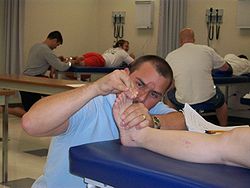 The four-year podiatric medical school is followed by a residency, which is hands-on post-doctoral training. There are two standard residencies: Podiatric Medicine & Surgery 24 and Podiatric Medicine & Surgery 36 (PM&S 24 or PM&S 36). These represent the two- or three-year residency training. By July 2013, all residency programs in podiatry will be required to transition to a minimum three-years of post-doctoral training. Podiatric residents rotate through core areas of medicine such as emergency medicine, internal medicine, infectious disease, behavioral medicine, physical medicine & rehabilitation, vascular surgery, general surgery, orthopedic surgery, plastic surgery, dermatology and of course podiatry — both clinic and surgical. During these rotations, surgeons and physicians train the resident podiatrists in medicine and surgery of the foot and ankle. Fellowships are available for further training and experience after residency.
Upon completion of their residency, podiatrists can become board certified by either the American Board of Podiatric Orthopedics and Primary Podiatric Medicine and/or the American Board of Podiatric Surgery. Within the American Board of Podiatric Surgery, PM&S 24 graduates can sit for Board Certification in Foot Surgery and those that complete PM&S 36 can sit for Board Certification in Foot Surgery and Board Certification in Reconstructive Rearfoot & Ankle Surgery. Both boards in ABPS are examined as separate tracks.
Podiatrists certified by the ABPS have successfully completed an intense board certification process comparable to that undertaken by individual MD and DO specialties. There are two surgical certifications under ABPS. They are Foot Surgery and Reconstructive Rearfoot/Ankle (RRA) Surgery. In order to be Board Certified in RRA, the sitting candidate has to have already achieved board certification in Foot Surgery. Certification by ABPS requires initial successful passing of the written examination. Then the candidate is required to submit surgical logs indicating experience and variety. Once accepted, the candidate has to successfully pass oral examination and computer questions of clinical simulation.
providing care to veterans of military service.
Some podiatrists have primarily surgical practices. Some specialists complete additional fellowship training in reconstruction of the foot and ankle from the effect of diabetes or physical trauma. Other surgeons practice minimally invasive percutaneous surgery for cosmetic correction of hammer toes and bunions. Podiatrists utilize medical, orthopedic, biomechanical and surgical principles to maintain and correct foot deformities.
(AACPM). The AACPM describes its mission as to enhance academic podiatric medicine. All podiatric medical schools in the United States are accredited by the Council on Podiatric Medical Education.
Medicine
Medicine is the science and art of healing. It encompasses a variety of health care practices evolved to maintain and restore health by the prevention and treatment of illness....
devoted to the study, diagnosis, and treatment of disorders of the foot
Foot
The foot is an anatomical structure found in many vertebrates. It is the terminal portion of a limb which bears weight and allows locomotion. In many animals with feet, the foot is a separate organ at the terminal part of the leg made up of one or more segments or bones, generally including claws...
, ankle
Ankle
The ankle joint is formed where the foot and the leg meet. The ankle, or talocrural joint, is a synovial hinge joint that connects the distal ends of the tibia and fibula in the lower limb with the proximal end of the talus bone in the foot...
, and lower leg
Human leg
The human leg is the entire lower extremity or limb of the human body, including the foot, thigh and even the hip or gluteal region; however, the precise definition in human anatomy refers only to the section of the lower limb extending from the knee to the ankle.Legs are used for standing,...
. The term podiatry came into use first in the early 20th century United States
United States
The United States of America is a federal constitutional republic comprising fifty states and a federal district...
, where it now denotes a Doctor of Podiatric Medicine (DPM), a specialist who is qualified by their education and training to diagnose and treat conditions affecting the foot, ankle, and related structures of the leg. Within the field of podiatry, practitioners can focus on many different specialty areas, including surgery, sports medicine, biomechanics, geriatrics, pediatrics, orthopedics, or primary care.
Podiatry is practiced as a specialty
Specialty (medicine)
A specialty in medicine is a branch of medical science. After completing medical school, physicians or surgeons usually further their medical education in a specific specialty of medicine by completing a multiple year residency to become a medical specialist.-History of medical specialization:To...
in many countries including Australia
Australia
Australia , officially the Commonwealth of Australia, is a country in the Southern Hemisphere comprising the mainland of the Australian continent, the island of Tasmania, and numerous smaller islands in the Indian and Pacific Oceans. It is the world's sixth-largest country by total area...
, Brunei
Brunei
Brunei , officially the State of Brunei Darussalam or the Nation of Brunei, the Abode of Peace , is a sovereign state located on the north coast of the island of Borneo, in Southeast Asia...
, Canada
Canada
Canada is a North American country consisting of ten provinces and three territories. Located in the northern part of the continent, it extends from the Atlantic Ocean in the east to the Pacific Ocean in the west, and northward into the Arctic Ocean...
, Cyprus
Cyprus
Cyprus , officially the Republic of Cyprus , is a Eurasian island country, member of the European Union, in the Eastern Mediterranean, east of Greece, south of Turkey, west of Syria and north of Egypt. It is the third largest island in the Mediterranean Sea.The earliest known human activity on the...
, Ireland
Ireland
Ireland is an island to the northwest of continental Europe. It is the third-largest island in Europe and the twentieth-largest island on Earth...
, Malta
Malta
Malta , officially known as the Republic of Malta , is a Southern European country consisting of an archipelago situated in the centre of the Mediterranean, south of Sicily, east of Tunisia and north of Libya, with Gibraltar to the west and Alexandria to the east.Malta covers just over in...
, New Zealand
New Zealand
New Zealand is an island country in the south-western Pacific Ocean comprising two main landmasses and numerous smaller islands. The country is situated some east of Australia across the Tasman Sea, and roughly south of the Pacific island nations of New Caledonia, Fiji, and Tonga...
, Singapore
Singapore
Singapore , officially the Republic of Singapore, is a Southeast Asian city-state off the southern tip of the Malay Peninsula, north of the equator. An island country made up of 63 islands, it is separated from Malaysia by the Straits of Johor to its north and from Indonesia's Riau Islands by the...
, South Africa
South Africa
The Republic of South Africa is a country in southern Africa. Located at the southern tip of Africa, it is divided into nine provinces, with of coastline on the Atlantic and Indian oceans...
, the United Kingdom
United Kingdom
The United Kingdom of Great Britain and Northern IrelandIn the United Kingdom and Dependencies, other languages have been officially recognised as legitimate autochthonous languages under the European Charter for Regional or Minority Languages...
, and the United States. In many English-speaking countries, the older title of "chiropodist" may still be used by some clinicians. In many non-English-speaking countries of Europe
Europe
Europe is, by convention, one of the world's seven continents. Comprising the westernmost peninsula of Eurasia, Europe is generally 'divided' from Asia to its east by the watershed divides of the Ural and Caucasus Mountains, the Ural River, the Caspian and Black Seas, and the waterways connecting...
, the title used instead of podiatrist may be "podologist" " or "Podólogo". The level and scope of the practice of podiatry varies among countries. Podiatry is a very high paying specialty and was listed by Forbes as the 15th best paid profession in the United States.
History
The professional care of feet was in existence in ancient EgyptAncient Egypt
Ancient Egypt was an ancient civilization of Northeastern Africa, concentrated along the lower reaches of the Nile River in what is now the modern country of Egypt. Egyptian civilization coalesced around 3150 BC with the political unification of Upper and Lower Egypt under the first pharaoh...
as evidenced by bas-relief carvings at the entrance to Ankmahor's tomb dating from about 2400 BC where work on hands and feet is depicted.
Corns
Corn (medicine)
A corn is a specially shaped callus of dead skin that usually occurs on thin or glabrous skin surfaces, especially on the dorsal surface of toes or fingers. They can sometimes occur on the thicker palmar or plantar skin surfaces...
and calluses were described by Hippocrates
Hippocrates
Hippocrates of Cos or Hippokrates of Kos was an ancient Greek physician of the Age of Pericles , and is considered one of the most outstanding figures in the history of medicine...
who recognised the need to physically reduce hard skin, followed by removal of the cause. He invented skin scrapers for this purpose and these were the original scalpels. Aulus Cornelius Celsus
Aulus Cornelius Celsus
Aulus Cornelius Celsus was a Roman encyclopedist, known for his extant medical work, De Medicina, which is believed to be the only surviving section of a much larger encyclopedia. The De Medicina is a primary source on diet, pharmacy, surgery and related fields, and it is one of the best sources...
, a Roman
Ancient Rome
Ancient Rome was a thriving civilization that grew on the Italian Peninsula as early as the 8th century BC. Located along the Mediterranean Sea and centered on the city of Rome, it expanded to one of the largest empires in the ancient world....
scientist
Scientist
A scientist in a broad sense is one engaging in a systematic activity to acquire knowledge. In a more restricted sense, a scientist is an individual who uses the scientific method. The person may be an expert in one or more areas of science. This article focuses on the more restricted use of the word...
and philosopher, was probably responsible for giving corns their name. Later Paul of Aegina
Paul of Aegina
Paul of Aegina or Paulus Aegineta was a 7th-century Byzantine Greek physician best known for writing the medical encyclopedia Medical Compendium in Seven Books...
(AD 615–690) defined a corn as "a white circular body like the head of a nail, forming in all parts of the body, but more especially on the soles of the feet and the toes. It may be removed in the course of some time by paring away the prominent part of it constantly with a scalpel or rubbing it down with pumice
Pumice
Pumice is a textural term for a volcanic rock that is a solidified frothy lava typically created when super-heated, highly pressurized rock is violently ejected from a volcano. It can be formed when lava and water are mixed. This unusual formation is due to the simultaneous actions of rapid...
. The same thing can be done with a callus."
Until the turn of the 20th century, chiropodists—now known as podiatrists—were separate from organized medicine. They were independently licensed physicians who treated the feet, ankles and related leg structures. Lewis Durlacher was one of the first people to call for a protected profession. He held the appointment of Surgeon-Chiropodist successivley to King George IV, King William IV and eventually also to Queen Victoria. He tried to establish the first association of practitioners in 1854, although it would take another century to come to pass.
There are records of the King of France
France
The French Republic , The French Republic , The French Republic , (commonly known as France , is a unitary semi-presidential republic in Western Europe with several overseas territories and islands located on other continents and in the Indian, Pacific, and Atlantic oceans. Metropolitan France...
employing a personal podiatrist, as did Napoleon. In the United States, President Abraham Lincoln
Abraham Lincoln
Abraham Lincoln was the 16th President of the United States, serving from March 1861 until his assassination in April 1865. He successfully led his country through a great constitutional, military and moral crisis – the American Civil War – preserving the Union, while ending slavery, and...
suffered greatly with his feet and chose a chiropodist named Isachar Zacharie, who not only cared for the president’s feet, but also was sent by President Lincoln on confidential missions to confer with leaders of the Confederacy
Confederate States of America
The Confederate States of America was a government set up from 1861 to 1865 by 11 Southern slave states of the United States of America that had declared their secession from the U.S...
during the U.S. Civil War.
The first society of chiropodists, now known as podiatrists, was established in—and still operates in—New York in 1895 as NYSPMA, with the first school opening in 1911. One year later the British established a society at the London Foot Hospital and a school was added in 1919. In Australia professional associations appeared from 1924 onwards. The first American journal appeared in 1907, followed in 1912 by a UK journal. In 1939, the Australians introduced a training centre as well as a professional journal. The number of chiropodists increased markedly after the Great War then again after World War II.
Australia
In AustraliaAustralia
Australia , officially the Commonwealth of Australia, is a country in the Southern Hemisphere comprising the mainland of the Australian continent, the island of Tasmania, and numerous smaller islands in the Indian and Pacific Oceans. It is the world's sixth-largest country by total area...
, podiatry is classified as an allied health profession, and is practised by individuals licensed by their representative State Boards of Podiatry. There are seven registration boards and six teaching centres, with two levels of awards — unclassified bachelors degree and honours level. In Australia there exist 2 levels of professional accreditation and professional privilege: Podiatrist and Podiatric Surgeon. Australian podiatrists are able to practise abroad with their qualifications recognised in some Commonwealth countries.
Registration and regulation
Australian Podiatrists must register with the Podiatry Board of Australia.http://www.podiatryboard.gov.au The Podiatry Board of Australia is responsible for regulation and recognition of Podiatrists http://www.podiatryboard.gov.au/en.aspx and Podiatric Surgeons, and assessing foreign trained registrants.The Podiatry Board of Australia recognizes 3 pathways to attain specialist registration as a Podiatric Surgeon:
1. Fellowship of the Australasian College of Podiatric Surgeons
2. Doctor of Clinical Podiatry, University of Western Australia
3. Eligibility for Fellowship of the Australasian College of Podiatric Surgeons
Education and training
Australian podiatrists complete an undergraduate degree ranging from 3 to 4 years of education. The first 2 years of this program are generally focused on various biomedical science subjects including anatomy, medical chemistry, biochemistry, physiology and patient psychology, similar to the medical curriculum. The following two years will then be spent focusing on podiatry specific areas such as podiatric biomechanics and human gait, podiatric orthopaedics or the non-surgical management of foot abnormalities, pharmacology, general medicine, general pathology, local and general anaesthesia, and surgical techniques such as partial and total nail avulsions, wound debridement, and other cutaneous and electrosurgical procedures.Australian podiatric surgeons are specialist podiatrists with further training in advanced medicine, advanced pharmacology, and training in foot surgery. Podiatrists wishing to pursue specialisation in podiatric surgery must meet the requirements for Fellowship with the Australasian College of Podiatric Surgeons. They first complete a degree of 4 years, which includes 2 years of didactic study and 2 years of clinical experience. Following this, a masters degree must be completed with focus on biomechanics, medicine, surgery, general surgery, advanced pharmacology, advanced medical imaging and clinical pathology. They then qualify for the status of Registrar with the Australasian College of Podiatric Surgeons. Following surgical training with a podiatric surgeon (3–5 years), rotations within other medical and surgeons' disciplines, overseas clinical rotations, and passing oral and written exams, Registrars may qualify for Fellowship status. Fellows are then given Commonwealth accreditation under the Health Insurance Act to be recognised as providers of professional attention, for the purposes of health insurance rebates.
Prescribing and referral rights
There is considerable variation between state laws regarding the prescribing rights of Australian podiatrists. While all registered podiatrists in each state or territory are able to utilize local anaesthesia for minor surgical techniques, some states allow suitably qualified podiatrists further privileges.Recent legislative changes, which are expected to come into effect soon, will allow registered podiatrists and podiatric surgeons in Victoria and New South Wales to prescribe relevant schedule 4
Standard for the Uniform Scheduling of Drugs and Poisons
The Standard for the Uniform Scheduling of Medicines and Poisons, abbreviated SUSMP, is a document used in the regulation of drugs and poisons in Australia. It is produced by the National Drugs and Poisons Scheduling Committee , a committee of the Therapeutic Goods Administration...
poisons. In other states, such as Western Australia and South Australia, podiatrists with Masters Degree's in Podiatry, and extensive training in pharmacology are authorised to prescribe S4 poisons. In Queensland, Fellows of the Australasian College of Podiatric Surgeons are authorised to prescribe a range of Schedule 4 and one Schedule 8 drug for the treatment of podiatric conditions.
All podiatrists may refer patients for Medicare rebatable plain x-rays of the foot, leg, knee and femur, as well as ultrasound examination of soft tissue conditions of the foot. Podiatrists may refer patients for other radiology investigations such as CT, MRI or bone scans, however Medicare rebates do not currently exist for these examinations. Similarly, podiatrists may refer patients when needed to specialist medical practitioners, or for pathology testing, however similar exclusions in the Medicare Benefits Schedule prevent rebates being available to patients for these referrals.
Canada
In Canada the definition and scope of practice of podiatry can mean very different things. For instance, in some provinces like British ColumbiaBritish Columbia
British Columbia is the westernmost of Canada's provinces and is known for its natural beauty, as reflected in its Latin motto, Splendor sine occasu . Its name was chosen by Queen Victoria in 1858...
and Alberta
Alberta
Alberta is a province of Canada. It had an estimated population of 3.7 million in 2010 making it the most populous of Canada's three prairie provinces...
, the standards are the same as in the United States where the Doctor of Podiatric Medicine (DPM)is the accepted qualification. Quebec
Quebec
Quebec or is a province in east-central Canada. It is the only Canadian province with a predominantly French-speaking population and the only one whose sole official language is French at the provincial level....
, too, has recently changed to the DPM level of training although other academic designations may also register. Also in Quebec, in 2004, Université du Québec à Trois-Rivières
Université du Québec à Trois-Rivières
The Université du Québec à Trois-Rivières , established in 1969 is a campus of the Université du Québec, located in Trois-Rivières, Quebec. The university has 12,500 students in 8 different campuses, including the main one in Trois-Rivières. About 1000 of them come from overseas, from 60...
started the first program of Podiatric Medicine in Canada based on the American definition of podiatry. In the prairie and atlantic provinces, the standard was originally based on the British model now called podiatry (chiropody). That model of podiatry is now the accepted model for most of the world including the United Kingdom, Australia and South Africa.
The province of Ontario
Ontario
Ontario is a province of Canada, located in east-central Canada. It is Canada's most populous province and second largest in total area. It is home to the nation's most populous city, Toronto, and the nation's capital, Ottawa....
, now only registers Chiropodists since July 1993 where the Ontario Government imposed a cap on new podiatrists. Even if an American, British or other countries registered podiatrist were to emigrate to Ontario they would have to registar and practice as a chiropodist. The podiatrists who were practicing in Ontario previous to this cap were grandfathered and kept the title of podiatrist as a subclass of chiropody. The scope of these grandfathered (mostly American trained) podiatrists includes boney procedures of the forefoot and the ordering of x-rays in addition to the scope of the chiropodist.
New Zealand
Chiropody became a registered profession in New Zealand in 1969 with the requirement that all applicants take a recognized three-year course of training. Soon after the professional title was changed from Chiropody to Podiatry and The New Zealand School of Podiatry was established in 1970 at Petone under the direction of John Gallocher. Later the school moved to the Central Institute of Technology, Upper Hutt, Wellington. In 1976 the profession gained the legal right to use a local anaesthetic and began to introduce minor surgical ingrown toenail procedures as part of the scope of practice.New Zealand podiatrists were granted the right of direct referral to radiologists for X-rays in 1984. Acknowledgement of podiatric expertise marked improved services to patients and eventually in 1989 suitably trained podiatrists were able to become licensed to take X-rays within their own practice. Diagnostic radiographic training is incorporated into the degree syllabus and on successful completion of the course, graduates register with the New Zealand National Radiation Laboratory.
In 1986, the profession undertook a needs analysis in conjunction with the Central Institute of Technology to identify competencies for podiatry in 2000. A Bachelor of Health Science was introduced in 1993. Auckland University of Technology is now the only provider of podiatry training in New Zealand.
United Kingdom
The scope of practice of UK podiatrists on registration after their degree in podiatry includes the use and supply of some prescription only medicines, injection therapy and some minor surgical procedures e.g. performing partial or total nail resection and removal, with chemical destruction of the tissues. Podiatrists complete close to 1,000 supervised clinical hours in the course of their training which enables then to recognise systemic disease as it manifests in the foot and will refer on to the appropriate health care professional. Those in the NHS interface between the patients and multidisciplinary teams. The Scope of Practice of a Podiatrist is varied.In a similar way to podiatrists in Australasia, UK podiatrists may continue their studies and qualify as podiatric surgeons.
Due to recent changes in legislation, common professional titles like ‘chiropodist’ and ‘podiatrist’ are now protected by law. Anyone who uses a protected title must register with the Health Professions Council (HPC). Such registration is normally only granted to those holding a Bachelors degree from one of 13 recognized schools of podiatry in the UK.
Professional bodies recognised by the Health Professions Council are : The Society of Chiropodists and Podiatrists, The Alliance of Private Sector Practitioners
Foot health practitioner
A Foot Health Practitioner is a provider of routine foot care working in the private sector. The title is most used in the United Kingdom and the Republic of Ireland. FHPs undertake training to recognise, assess and treat foot conditions....
, The Institute of Chiropodists and Podiatrists and The British Chiropody and Podiatry Association.
United States
In the United States, medical and surgical care of the foot and ankle is mainly provided by two groups of physicians: podiatrists (Doctor of Podiatric Medicine or DPM) and orthopedists (MDs or DOs).The first year of podiatric medical school is similar to training that either medical doctors
Doctor of Medicine
Doctor of Medicine is a doctoral degree for physicians. The degree is granted by medical schools...
or osteopathic doctors receive, but with an emphasized scope on foot, ankle, and lower extremity. Being classified as a second entry degree, in order to be considered for admission an applicant must first complete a minimum of 90 semester hours at the university level and/or complete a bachelor's degree. In addition, potential students are required to take the Medical College Admission Test (MCAT). The DPM degree itself takes a minimum of four years to complete.
Upon completion of their residency, podiatrists can become board certified by either the American Board of Podiatric Orthopedics and Primary Podiatric Medicine and/or the American Board of Podiatric Surgery. Within the American Board of Podiatric Surgery, PM&S 24 graduates can sit for Board Certification in Foot Surgery and those that complete PM&S 36 can sit for Board Certification in Foot Surgery and Board Certification in Reconstructive Rearfoot & Ankle Surgery. Both boards in ABPS are examined as separate tracks.
Podiatrists certified by the ABPS have successfully completed an intense board certification process comparable to that undertaken by individual MD and DO specialties. There are two surgical certifications under ABPS. They are Foot Surgery and Reconstructive Rearfoot/Ankle (RRA) Surgery. In order to be Board Certified in RRA, the sitting candidate has to have already achieved board certification in Foot Surgery. Certification by ABPS requires initial successful passing of the written examination. Then the candidate is required to submit surgical logs indicating experience and variety. Once accepted, the candidate has to successfully pass oral examination and computer questions of clinical simulation.
Practice characteristics
While the majority of podiatric physicians are in solo practice, there has been a movement toward larger group practices as well as the use of podiatrists in multi-specialty groups including orthopedic groups, treating diabetes, or in multi-specialty orthopedic surgical groups. Some podiatrists work within clinic practices such as the Indian Health System (IHS), the Rural Health Centers (RHC) and Community Health Center (FQHC) systems established by the US government to provide services to under-insured and non-insured patients as well as within the United States Department of Veterans AffairsUnited States Department of Veterans Affairs
The United States Department of Veterans Affairs is a government-run military veteran benefit system with Cabinet-level status. It is the United States government’s second largest department, after the United States Department of Defense...
providing care to veterans of military service.
Some podiatrists have primarily surgical practices. Some specialists complete additional fellowship training in reconstruction of the foot and ankle from the effect of diabetes or physical trauma. Other surgeons practice minimally invasive percutaneous surgery for cosmetic correction of hammer toes and bunions. Podiatrists utilize medical, orthopedic, biomechanical and surgical principles to maintain and correct foot deformities.
Colleges and education
There are nine colleges of podiatric medicine in the United States. These are governed by the American Association of Colleges of Podiatric MedicineAmerican Association of Colleges of Podiatric Medicine
American Association of Colleges of Podiatric Medicine is the collective union for the nine colleges of podiatric medicine in the United States and the more than 200 hospitals and institutions that offer postdoctoral training in podiatric medicine...
(AACPM). The AACPM describes its mission as to enhance academic podiatric medicine. All podiatric medical schools in the United States are accredited by the Council on Podiatric Medical Education.
- Arizona School of Podiatric Medicine (AZPod) at Midwestern University
- Barry University School of Podiatric Medicine
- California School of Podiatric Medicine
- Des Moines University College of Podiatric Medicine and Surgery
- New York College of Podiatric Medicine
- Ohio College of Podiatric Medicine
- Scholl College of Podiatric Medicine
- Temple University School of Podiatric Medicine
- College of Podiatric Medicine at Western University of Health Sciences
Speciality branches
Podiatrists treat a wide variety of foot and lower extremity conditions, through nonsurgical and surgical approaches. There are those podiatric physicians who also subspecialize in such fields of practice as:- Reconstructive Rearfoot and Ankle Surgery
- Sports MedicineSports medicineSports medicine is a branch of medicine that deals with physical fitness, treatment and prevention of injuries related to sports and exercise...
- Diabetic limb salvage and wound care
- Podopaediatrics (the study of children's foot and ankle conditions)
- Forensic PodiatryForensic PodiatryForensic Podiatry is a sub-discipline of forensic science wherein knowledge of forensic medicine is used in conjunction with knowledge of the anatomy, function, deformities and diseases of the foot, ankle, lower extremities, and at times, the entire human body, to examine foot-related evidence in a...
(the study of footprints, footwear, shoeprints and feet associated with crime scene investigations)
Professional societies and organizations
- Academy of Ambulatory Foot and Ankle Surgery (AAFAS)
- Alberta Podiatry Association (APA)
- Alpha Gamma Kappa FraternityAlpha Gamma Kappa FraternityAlpha Gamma Kappa was founded in 1939 at the Dr. William M. Scholl College of Podiatric Medicine in Chicago, Illinois. The Fraternity exists as the oldest and largest professional fraternal organization for students and practitioners of podiatric medicine in the United States and Canada.-Mission...
- American Podiatric Medical AssociationAmerican Podiatric Medical AssociationThe American Podiatric Medical Association is a professional medical organization representing Doctors of Podiatric Medicine within the United States. The organization was founded in 1959 and is headquartered in Bethesda, Maryland. Approximately 80% of podiatrists in the US are members of the APMA...
(APMA) - American Society of Podiatric Surgeons (ASPS)
- American Society of Forensic Podiatry
- American College of Foot and Ankle Surgeons (ACFAS)
- American Board of Podiatric Surgery (ABPS)
- American College of Foot & Ankle Orthopedics & Medicine (ACFAOM)
- American Board of Podiatric Orthopedics and Primary Podiatric Medicine (ABPOPPM)
- American Board of Multiple Specialties in Podiatric Medicine
- American Board of Multiple Specialties in Podiatric Surgery
- American Academy of Podiatric Sports Medicine (AAPSM)
- American Society of Podiatric Dermatology (ASPD)
- Canadian Podiatric Medical Association (CPMA)
- American Academy of Podiatric Practise Management (AAPPM)
- Federation Internationale des Podologues (FIP)
- International Foot and Ankle Biomechanics Community (i-FAB)International Foot and Ankle Biomechanics Community (i-FAB)The International Foot and Ankle Biomechanics Community is a non profit making, collaborative global organisation launched in July 2007. It now has close to 700 members from 45 different countries....
- Student National Podiatric Medical Association (SNPMA)
- American Podiatric Medical Students' Association (APMSA)
See also
- Allied health professionsAllied health professionsAllied health professions are clinical health care professions distinct from dentistry, nursing and medicine. One estimate reported allied health professionals make up 60 percent of the total health workforce...
- American Association of Colleges of Podiatric MedicineAmerican Association of Colleges of Podiatric MedicineAmerican Association of Colleges of Podiatric Medicine is the collective union for the nine colleges of podiatric medicine in the United States and the more than 200 hospitals and institutions that offer postdoctoral training in podiatric medicine...
- Foot health practitionerFoot health practitionerA Foot Health Practitioner is a provider of routine foot care working in the private sector. The title is most used in the United Kingdom and the Republic of Ireland. FHPs undertake training to recognise, assess and treat foot conditions....
- Gait trainingGait trainingIn its most general form, Gait training is the act of learning how to walk. However, the term is more often used in reference to a person learning how to walk again after injury or with a disability...
- List of disorders of foot and ankle
- Orthopaedic footwearOrthopaedic footwearOrthopaedic footwear is for people who have problems with feet and legs. Ortho- in Greek expresses the idea of "straight" or "correct" and -paedic comes from paideia . Orthopaedics originally evolved as a science for correction of deformities in children and later had other inclusions, like...
- PedorthistPedorthistPedorthist is the title of a health care professional who specializes in the use of footwear and supportive devices to address conditions which affect the feet and lower limbs. They are trained in the assessment of lower limb anatomy and biomechanics, and the appropriate use of corrective footware...