

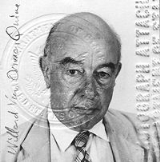
Willard Van Orman Quine

Encyclopedia
Willard Van Orman Quine (June 25, 1908 – December 25, 2000) (known to intimates as "Van") was an American philosopher and logician in the analytic tradition
. From 1930 until his death 70 years later, Quine was continuously affiliated with Harvard University
in one way or another, first as a student, then as a professor of philosophy and a teacher of mathematics
, and finally as a professor emeritus who published or revised several books in retirement. He filled the Edgar Pierce Chair of Philosophy at Harvard from 1956 to 1978. A recent poll conducted among philosophers named Quine one of the five most important philosophers of the past two centuries. He won the first Schock Prize in Logic and Philosophy in 1993, for "his systematical and penetrating discussions of how learning of language and communication are based on socially available evidence and of the consequences of this for theories on knowledge and linguistic meaning."
Quine falls squarely into the analytic philosophy tradition while also being the main proponent of the view that philosophy is not merely conceptual analysis. His major writings include "Two Dogmas of Empiricism
" (1951), which attacked the distinction between analytic and synthetic proposition
s and advocated a form of semantic holism
, and Word and Object
(1960), which further developed these positions and introduced the notorious indeterminacy of translation
thesis. He also developed an influential naturalized epistemology
that tried to provide "an improved scientific explanation of how we have developed elaborate scientific theories on the basis of meager sensory input." He is also important in philosophy of science
for his "systematic attempt to understand science from within the resources of science itself" and for his conception of philosophy as continuous with science. This led to his famous quip that "philosophy of science is philosophy enough." In philosophy of mathematics
, he and his Harvard colleage Hilary Putnam
developed the "Quine-Putnam indispensability thesis," an argument for the reality of mathematical entities.
, Ohio
where he lived with his parents and older brother Robert C. His father, Cloyd R., was a manufacturing entrepreneur and his mother, Harriett E. (also known as "Hattie" according to the 1920 census), was a schoolteacher and later a housewife. He received his B.A. in mathematics and philosophy from Oberlin College
in 1930 and his Ph.D. in philosophy from Harvard University
in 1932. His thesis supervisor was Alfred North Whitehead
. He was then appointed a Harvard Junior Fellow, which excused him from having to teach for four years. During the academic year 1932–33, he travelled in Europe thanks to a Sheldon fellowship, meeting Polish logicians (including Alfred Tarski
) and members of the Vienna Circle
(including Rudolf Carnap
).
It was through Quine's good offices that Alfred Tarski
was invited to attend the September 1939 Unity of Science
Congress in Cambridge. To attend that Congress, Tarski sailed for the USA on the last ship to leave Gdańsk
before the Third Reich invaded Poland. Tarski survived the war and worked another 44 years in the USA.
During World War II, Quine lectured on logic in Brazil, in Portuguese, and served in the United States Navy in a military intelligence
role, deciphering messages from German submarines, and reaching the rank of Lieutenant Commander.
At Harvard, Quine helped supervise the Harvard theses of, among others, Donald Davidson
, David Lewis, Daniel Dennett
, Gilbert Harman
, Dagfinn Føllesdal
, Hao Wang, Hugues LeBlanc and Henry Hiz. For the academic year 1964-1965, Quine was a Fellow on the faculty in the Center for Advanced Studies at Wesleyan University
.
Quine had four children by two marriages. Guitarist Robert Quine
was his nephew.
; a general defense of the status quo
against efforts to remodel society by 'underprivileged groups'; and an argument against publicly funded education.
Quine, like many philosophers in the Anglo-American "analytic" tradition, was critical of Jacques Derrida
; in 1992, Quine led an unsuccessful petition to stop Cambridge University from granting Derrida an honorary degree. Such criticism was, according to Derrida, directed at Derrida "no doubt because [Derrida's methods, called] 'deconstructions', query or put into question a good many divisions and distinctions, for example the distinction between the pretended neutrality of philosophical discourse, on the one hand, and existential passions and drives on the other, between what is public and what is private, and so on." Quine regarded Derrida's work as pseudophilosophy
or sophistry.
and set theory
. Only after WWII did he, by virtue of seminal papers on ontology
, epistemology and language, emerge as a major philosopher. By the 1960s, he had worked out his "naturalized epistemology" whose aim was to answer all substantive questions of knowledge and meaning using the methods and tools of the natural sciences. Quine roundly rejected the notion that there should be a "first philosophy", a theoretical standpoint somehow prior to natural science and capable of justifying it. These views are intrinsic to his naturalism.
Quine could lecture in French, Spanish, Portuguese and German, as well as his native English. But like the logical positivists, he evinced little interest in the philosophical canon: only once did he teach a course in the history of philosophy, on Hume. Quine has an Erdős number
of 3.
, Nelson Goodman
and Alfred Tarski
, among others, led Quine to doubt the tenability of the distinction between "analytic" statements — those true simply by the meanings of their words, such as "All bachelors are unmarried" — and "synthetic" statements, those true or false by virtue of facts about the world, such as "There is a cat on the mat." This distinction was central to logical positivism
. Although Quine is not normally associated with verificationism, some philosophers believe the tenet is not incompatible with his general philosophy of language, citing his Harvard colleague B.F. Skinner, and his analysis of language in Verbal Behavior
.
Like other Analytic
philosophers before him, Quine accepted the definition
of "analytic" as "true in virtue of meaning alone". Unlike them, however, he concluded that ultimately the definition was circular
. In other words, Quine accepted that analytic statements are those that are true by definition, then argued that the notion of truth by definition was unsatisfactory.
Quine's chief objection to analyticity is with the notion of synonymy (sameness of meaning), a sentence being analytic, just in case it substitutes a synonym for one "black" in a proposition like "All black things are black" (or any other logical truth
). The objection to synonymy hinges upon the problem of collateral information. We intuitively feel that there is a distinction between "All unmarried men are bachelors" and "There have been black dogs", but a competent English speaker will assent to both sentences under all conditions since such speakers also have access to collateral information bearing on the historical existence of black dogs. Quine maintains that there is no distinction between universally known collateral information and conceptual or analytic truths.
Another approach to Quine's objection to analyticity and synonymy emerges from the modal notion of logical possibility
. A traditional Wittgensteinian view of meaning held that each meaningful sentence was associated with a region in the space of possible worlds. Quine finds the notion of such a space problematic, arguing that there is no distinction between those truths which are universally and confidently believed and those which are necessarily true.
and other extensions of Quine's work are ontological relativity and the related doctrine
of confirmation holism
. The premise of confirmation holism
is that all theories (and the propositions derived from them) are under-determined by empirical data (data, sensory-data, evidence); although some theories are not justifiable, failing to fit with the data or being unworkably complex, there are many equally justifiable alternatives. While the Greeks' assumption that (unobservable) Homeric gods exist is false, and our supposition of (unobservable) electromagnetic waves is true, both are to be justified solely by their ability to explain our observations.
Quine concluded his "Two Dogmas of Empiricism
" as follows:
Quine's ontological relativism
(evident in the passage above) led him to agree with Pierre Duhem
that for any collection of empirical evidence, there would always be many theories able to account for it. However, Duhem's holism
is much more restricted and limited than Quine's. For Duhem, underdetermination applies only to physics
or possibly to natural science
, while for Quine it applies to all of human knowledge. Thus, while it is possible to verify or falsify
whole theories, it is not possible to verify or falsify individual statements. Almost any particular statements can be saved, given sufficiently radical modifications of the containing theory. For Quine, scientific thought forms a coherent
web in which any part could be altered in the light of empirical evidence, and in which no empirical evidence could force the revision of a given part.
Quine's writings have led to the wide acceptance of instrumentalism
in the philosophy of science
.
is an old puzzle in philosophy, which Quine captured eloquently when he wrote,
More directly, the controversy goes,
Quine resists the temptation to say that non-referring terms are meaningless for reasons made clear above. Instead he tells us that we must first determine whether our terms refer or not before we know the proper way to understand them. However, Czesław Lejewski criticizes this belief for reducing the matter to empirical discovery when it seems we should have a formal distinction between referring and non-referring terms or elements of our domain. Lejewski writes further,
Lejewski then goes on to offer a description of free logic
, which he claims accommodates an answer to the problem.
Lejewski also points out that free logic additionally can handle the problem of the empty set for statements like . Quine had considered the problem of the empty set unrealistic, which left Lejewski unsatisfied.
Quine confined logic to classical bivalent first-order logic
, hence to truth and falsity under any (nonempty) universe of discourse. Hence the following were not logic for Quine:
Quine wrote three undergraduate texts on logic:
Mathematical Logic is based on Quine's graduate teaching during the 1930s and 40s. It shows that much of what Principia Mathematica
took more than 1000 pages to say can be said in 250 pages. The proofs are concise, even cryptic. The last chapter, on Gödel's incompleteness theorem and Tarski's indefinability theorem
, along with the article Quine (1946), became a launching point for Raymond Smullyan
's later lucid exposition of these and related results.
Quine's work in logic gradually became dated in some respects. Techniques he did not teach and discuss include analytic tableaux, recursive function
s, and model theory
. His treatment of metalogic
left something to be desired. For example, Mathematical Logic does not include any proofs of soundness
and completeness
. Early in his career, the notation of his writings on logic was often idiosyncratic. His later writings nearly always employed the now-dated notation of Principia Mathematica
. Set against all this are the simplicity of his preferred method (as exposited in his Methods of Logic) for determining the satisfiability of quantified formulas, the richness of his philosophical and linguistic insights, and the fine prose in which he expressed them.
Most of Quine's original work in formal logic from 1960 onwards was on variants of his predicate functor logic
, one of several ways that have been proposed for doing logic without quantifiers. For a comprehensive treatment of predicate functor logic and its history, see Quine (1976). For an introduction, see chpt. 45 of his Methods of Logic.
Quine was very warm to the possibility that formal logic would eventually be applied outside of philosophy and mathematics. He wrote several papers on the sort of Boolean algebra employed in electrical engineering
, and with Edward J. McCluskey
, devised the Quine–McCluskey algorithm of reducing Boolean equations to a minimum covering sum of prime implicants.
that Quine was most innovative. He always maintained that mathematics required set theory and that set theory was quite distinct from logic. He flirted with Nelson Goodman
's nominalism
for a while, but backed away when he failed to find a nominalist grounding of mathematics.
Over the course of his career, Quine proposed three variants of axiomatic set theory, each including the axiom of extensionality
:
All three set theories admit a universal class, but since they are free of any hierarchy
of types, they have no need for a distinct universal class at each type level.
Quine's set theory and its background logic were driven by a desire to minimize posits; each innovation is pushed as far as it can be pushed before further innovations are introduced. For Quine, there is but one connective, the Sheffer stroke
, and one quantifier, the universal quantifier. All polyadic predicates can be reduced to one dyadic predicate, interpretable as set membership. His rules of proof were limited to modus ponens
and substitution. He preferred conjunction
to either disjunction or the conditional
, because conjunction has the least semantic ambiguity. He was delighted to discover early in his career that all of first order logic and set theory could be grounded in a mere two primitive notions: set abstraction and inclusion
. For an elegant introduction to the parsimony of Quine's approach to logic, see his "New Foundations for Mathematical Logic," ch. 5 in his From a Logical Point of View.
epistemology. According to Quine, normative epistemology is the trend that assigns ought claims to conditions of knowledge. This approach, he argued, has failed to give us any real understanding of the necessary and sufficient conditions for knowledge. Quine recommended that, as an alternative, we look to natural sciences like psychology for a full explanation of knowledge. Thus, we must totally replace our entire epistemological paradigm. Quine's proposal is extremely controversial among contemporary philosophers and has several important critics, with Jaegwon Kim
the most prominent among them.
Analytic philosophy
Analytic philosophy is a generic term for a style of philosophy that came to dominate English-speaking countries in the 20th century...
. From 1930 until his death 70 years later, Quine was continuously affiliated with Harvard University
Harvard University
Harvard University is a private Ivy League university located in Cambridge, Massachusetts, United States, established in 1636 by the Massachusetts legislature. Harvard is the oldest institution of higher learning in the United States and the first corporation chartered in the country...
in one way or another, first as a student, then as a professor of philosophy and a teacher of mathematics
Mathematics
Mathematics is the study of quantity, space, structure, and change. Mathematicians seek out patterns and formulate new conjectures. Mathematicians resolve the truth or falsity of conjectures by mathematical proofs, which are arguments sufficient to convince other mathematicians of their validity...
, and finally as a professor emeritus who published or revised several books in retirement. He filled the Edgar Pierce Chair of Philosophy at Harvard from 1956 to 1978. A recent poll conducted among philosophers named Quine one of the five most important philosophers of the past two centuries. He won the first Schock Prize in Logic and Philosophy in 1993, for "his systematical and penetrating discussions of how learning of language and communication are based on socially available evidence and of the consequences of this for theories on knowledge and linguistic meaning."
Quine falls squarely into the analytic philosophy tradition while also being the main proponent of the view that philosophy is not merely conceptual analysis. His major writings include "Two Dogmas of Empiricism
Two Dogmas of Empiricism
W. V. Quine's paper Two Dogmas of Empiricism, published in 1951, is one of the most celebrated papers of twentieth century philosophy in the analytic tradition. According to Harvard professor of philosophy Peter Godfrey-Smith, this "paper [is] sometimes regarded as the most important in all of...
" (1951), which attacked the distinction between analytic and synthetic proposition
Proposition
In logic and philosophy, the term proposition refers to either the "content" or "meaning" of a meaningful declarative sentence or the pattern of symbols, marks, or sounds that make up a meaningful declarative sentence...
s and advocated a form of semantic holism
Semantic holism
Semantic holism is a doctrine in the philosophy of language to the effect that a certain part of language, be it a term or a complete sentence, can only be understood through its relations to a larger segment of language. There is substantial controversy, however, as to exactly what the larger...
, and Word and Object
Word and Object
Word and Object is a 1960 book of epistemology by Willard Van Orman Quine. In it, Quine develops his thesis of the Indeterminacy of translation....
(1960), which further developed these positions and introduced the notorious indeterminacy of translation
Indeterminacy of translation
The indeterminacy of translation is a thesis propounded by 20th century analytic philosopher W. V. Quine. The classic statement of this thesis can be found in his 1960 book Word and Object, which gathered together and refined much of Quine's previous work on subjects other than formal logic and set...
thesis. He also developed an influential naturalized epistemology
Naturalized epistemology
Naturalized epistemology is a collection of philosophic views concerned with the theory of knowledge that emphasize the role of natural scientific methods. This shared emphasis on scientific methods of studying knowledge shifts focus to the empirical processes of knowledge acquisition and away from...
that tried to provide "an improved scientific explanation of how we have developed elaborate scientific theories on the basis of meager sensory input." He is also important in philosophy of science
Philosophy of science
The philosophy of science is concerned with the assumptions, foundations, methods and implications of science. It is also concerned with the use and merit of science and sometimes overlaps metaphysics and epistemology by exploring whether scientific results are actually a study of truth...
for his "systematic attempt to understand science from within the resources of science itself" and for his conception of philosophy as continuous with science. This led to his famous quip that "philosophy of science is philosophy enough." In philosophy of mathematics
Philosophy of mathematics
The philosophy of mathematics is the branch of philosophy that studies the philosophical assumptions, foundations, and implications of mathematics. The aim of the philosophy of mathematics is to provide an account of the nature and methodology of mathematics and to understand the place of...
, he and his Harvard colleage Hilary Putnam
Hilary Putnam
Hilary Whitehall Putnam is an American philosopher, mathematician and computer scientist, who has been a central figure in analytic philosophy since the 1960s, especially in philosophy of mind, philosophy of language, philosophy of mathematics, and philosophy of science...
developed the "Quine-Putnam indispensability thesis," an argument for the reality of mathematical entities.
Biography
According to his autobiography, The Time of My Life (1986), Quine grew up in AkronAkron, Ohio
Akron , is the fifth largest city in the U.S. state of Ohio and the county seat of Summit County. It is located in the Great Lakes region approximately south of Lake Erie along the Little Cuyahoga River. As of the 2010 census, the city had a population of 199,110. The Akron Metropolitan...
, Ohio
Ohio
Ohio is a Midwestern state in the United States. The 34th largest state by area in the U.S.,it is the 7th‑most populous with over 11.5 million residents, containing several major American cities and seven metropolitan areas with populations of 500,000 or more.The state's capital is Columbus...
where he lived with his parents and older brother Robert C. His father, Cloyd R., was a manufacturing entrepreneur and his mother, Harriett E. (also known as "Hattie" according to the 1920 census), was a schoolteacher and later a housewife. He received his B.A. in mathematics and philosophy from Oberlin College
Oberlin College
Oberlin College is a private liberal arts college in Oberlin, Ohio, noteworthy for having been the first American institution of higher learning to regularly admit female and black students. Connected to the college is the Oberlin Conservatory of Music, the oldest continuously operating...
in 1930 and his Ph.D. in philosophy from Harvard University
Harvard University
Harvard University is a private Ivy League university located in Cambridge, Massachusetts, United States, established in 1636 by the Massachusetts legislature. Harvard is the oldest institution of higher learning in the United States and the first corporation chartered in the country...
in 1932. His thesis supervisor was Alfred North Whitehead
Alfred North Whitehead
Alfred North Whitehead, OM FRS was an English mathematician who became a philosopher. He wrote on algebra, logic, foundations of mathematics, philosophy of science, physics, metaphysics, and education...
. He was then appointed a Harvard Junior Fellow, which excused him from having to teach for four years. During the academic year 1932–33, he travelled in Europe thanks to a Sheldon fellowship, meeting Polish logicians (including Alfred Tarski
Alfred Tarski
Alfred Tarski was a Polish logician and mathematician. Educated at the University of Warsaw and a member of the Lwow-Warsaw School of Logic and the Warsaw School of Mathematics and philosophy, he emigrated to the USA in 1939, and taught and carried out research in mathematics at the University of...
) and members of the Vienna Circle
Vienna Circle
The Vienna Circle was an association of philosophers gathered around the University of Vienna in 1922, chaired by Moritz Schlick, also known as the Ernst Mach Society in honour of Ernst Mach...
(including Rudolf Carnap
Rudolf Carnap
Rudolf Carnap was an influential German-born philosopher who was active in Europe before 1935 and in the United States thereafter. He was a major member of the Vienna Circle and an advocate of logical positivism....
).
It was through Quine's good offices that Alfred Tarski
Alfred Tarski
Alfred Tarski was a Polish logician and mathematician. Educated at the University of Warsaw and a member of the Lwow-Warsaw School of Logic and the Warsaw School of Mathematics and philosophy, he emigrated to the USA in 1939, and taught and carried out research in mathematics at the University of...
was invited to attend the September 1939 Unity of Science
Unity of science
The unity of science is a thesis in philosophy of science that says that all the sciences form a unified whole.Even though, for example, physics and politics are distinct disciplines, the thesis of the unity of science says that in principle they must be part of a unified intellectual endeavor,...
Congress in Cambridge. To attend that Congress, Tarski sailed for the USA on the last ship to leave Gdańsk
Gdansk
Gdańsk is a Polish city on the Baltic coast, at the centre of the country's fourth-largest metropolitan area.The city lies on the southern edge of Gdańsk Bay , in a conurbation with the city of Gdynia, spa town of Sopot, and suburban communities, which together form a metropolitan area called the...
before the Third Reich invaded Poland. Tarski survived the war and worked another 44 years in the USA.
During World War II, Quine lectured on logic in Brazil, in Portuguese, and served in the United States Navy in a military intelligence
Military intelligence
Military intelligence is a military discipline that exploits a number of information collection and analysis approaches to provide guidance and direction to commanders in support of their decisions....
role, deciphering messages from German submarines, and reaching the rank of Lieutenant Commander.
At Harvard, Quine helped supervise the Harvard theses of, among others, Donald Davidson
Donald Davidson (philosopher)
Donald Herbert Davidson was an American philosopher born in Springfield, Massachusetts, who served as Slusser Professor of Philosophy at the University of California, Berkeley from 1981 to 2003 after having also held teaching appointments at Stanford University, Rockefeller University, Princeton...
, David Lewis, Daniel Dennett
Daniel Dennett
Daniel Clement Dennett is an American philosopher, writer and cognitive scientist whose research centers on the philosophy of mind, philosophy of science and philosophy of biology, particularly as those fields relate to evolutionary biology and cognitive science. He is currently the Co-director of...
, Gilbert Harman
Gilbert Harman
Gilbert Harman is a contemporary American philosopher, teaching at Princeton University, who has published widely in linguistics, semantics, cognitive science, philosophy of mind, ethics, moral psychology, epistemology, statistical learning theory, and metaphysics. He and George Miller...
, Dagfinn Føllesdal
Dagfinn Føllesdal
Dagfinn Føllesdal is the Clarence Irving Lewis Professor of Philosophy at Stanford University, and professor emeritus at the University of Oslo....
, Hao Wang, Hugues LeBlanc and Henry Hiz. For the academic year 1964-1965, Quine was a Fellow on the faculty in the Center for Advanced Studies at Wesleyan University
Wesleyan University
Wesleyan University is a private liberal arts college founded in 1831 and located in Middletown, Connecticut. According to the Carnegie Foundation for the Advancement of Teaching, Wesleyan is the only Baccalaureate College in the nation that emphasizes undergraduate instruction in the arts and...
.
Quine had four children by two marriages. Guitarist Robert Quine
Robert Quine
Robert Wolfe Quine was an American guitarist, known for his innovative guitar solos.A native of Akron, Ohio, Quine worked with a wide range of musicians, though he himself remained relatively unknown in comparison...
was his nephew.
Political beliefs
Quine was politically conservative, but the bulk of his writing was in technical areas of philosophy removed from direct political issues. He did, however, argue at points for several conservative positions: a defense of moral censorship; an argument in favor of limitations on democratic civil rightsCivil rights
Civil and political rights are a class of rights that protect individuals' freedom from unwarranted infringement by governments and private organizations, and ensure one's ability to participate in the civil and political life of the state without discrimination or repression.Civil rights include...
; a general defense of the status quo
Status quo
Statu quo, a commonly used form of the original Latin "statu quo" – literally "the state in which" – is a Latin term meaning the current or existing state of affairs. To maintain the status quo is to keep the things the way they presently are...
against efforts to remodel society by 'underprivileged groups'; and an argument against publicly funded education.
Quine, like many philosophers in the Anglo-American "analytic" tradition, was critical of Jacques Derrida
Jacques Derrida
Jacques Derrida was a French philosopher, born in French Algeria. He developed the critical theory known as deconstruction and his work has been labeled as post-structuralism and associated with postmodern philosophy...
; in 1992, Quine led an unsuccessful petition to stop Cambridge University from granting Derrida an honorary degree. Such criticism was, according to Derrida, directed at Derrida "no doubt because [Derrida's methods, called] 'deconstructions', query or put into question a good many divisions and distinctions, for example the distinction between the pretended neutrality of philosophical discourse, on the one hand, and existential passions and drives on the other, between what is public and what is private, and so on." Quine regarded Derrida's work as pseudophilosophy
Pseudophilosophy
Pseudophilosophy is a term applied to philosophical ideas or systems which are claimed not to meet mainstream academic standards. The term is almost always used pejoratively and is often contentious...
or sophistry.
Work
Quine's Ph.D. thesis and early publications were on formal logicFormal logic
Classical or traditional system of determining the validity or invalidity of a conclusion deduced from two or more statements...
and set theory
Set theory
Set theory is the branch of mathematics that studies sets, which are collections of objects. Although any type of object can be collected into a set, set theory is applied most often to objects that are relevant to mathematics...
. Only after WWII did he, by virtue of seminal papers on ontology
Ontology
Ontology is the philosophical study of the nature of being, existence or reality as such, as well as the basic categories of being and their relations...
, epistemology and language, emerge as a major philosopher. By the 1960s, he had worked out his "naturalized epistemology" whose aim was to answer all substantive questions of knowledge and meaning using the methods and tools of the natural sciences. Quine roundly rejected the notion that there should be a "first philosophy", a theoretical standpoint somehow prior to natural science and capable of justifying it. These views are intrinsic to his naturalism.
Quine could lecture in French, Spanish, Portuguese and German, as well as his native English. But like the logical positivists, he evinced little interest in the philosophical canon: only once did he teach a course in the history of philosophy, on Hume. Quine has an Erdős number
Erdos number
The Erdős number describes the "collaborative distance" between a person and mathematician Paul Erdős, as measured by authorship of mathematical papers.The same principle has been proposed for other eminent persons in other fields.- Overview :...
of 3.
Rejection of the analytic-synthetic distinction
In the 1930s and 40s, discussions with Rudolf CarnapRudolf Carnap
Rudolf Carnap was an influential German-born philosopher who was active in Europe before 1935 and in the United States thereafter. He was a major member of the Vienna Circle and an advocate of logical positivism....
, Nelson Goodman
Nelson Goodman
Henry Nelson Goodman was an American philosopher, known for his work on counterfactuals, mereology, the problem of induction, irrealism and aesthetics.-Career:...
and Alfred Tarski
Alfred Tarski
Alfred Tarski was a Polish logician and mathematician. Educated at the University of Warsaw and a member of the Lwow-Warsaw School of Logic and the Warsaw School of Mathematics and philosophy, he emigrated to the USA in 1939, and taught and carried out research in mathematics at the University of...
, among others, led Quine to doubt the tenability of the distinction between "analytic" statements — those true simply by the meanings of their words, such as "All bachelors are unmarried" — and "synthetic" statements, those true or false by virtue of facts about the world, such as "There is a cat on the mat." This distinction was central to logical positivism
Logical positivism
Logical positivism is a philosophy that combines empiricism—the idea that observational evidence is indispensable for knowledge—with a version of rationalism incorporating mathematical and logico-linguistic constructs and deductions of epistemology.It may be considered as a type of analytic...
. Although Quine is not normally associated with verificationism, some philosophers believe the tenet is not incompatible with his general philosophy of language, citing his Harvard colleague B.F. Skinner, and his analysis of language in Verbal Behavior
Verbal Behavior (book)
Verbal Behavior is a 1957 book by psychologist B.F. Skinner, in which he analyzes human behavior, encompassing what is traditionally called language, linguistics, or speech...
.
Like other Analytic
Analytic philosophy
Analytic philosophy is a generic term for a style of philosophy that came to dominate English-speaking countries in the 20th century...
philosophers before him, Quine accepted the definition
Definition
A definition is a passage that explains the meaning of a term , or a type of thing. The term to be defined is the definiendum. A term may have many different senses or meanings...
of "analytic" as "true in virtue of meaning alone". Unlike them, however, he concluded that ultimately the definition was circular
Circular definition
A circular definition is one that uses the term being defined as a part of the definition or assumes a prior understanding of the term being defined. Either the audience must already know the meaning of the key term, or the definition is deficient in including the term to be defined in the...
. In other words, Quine accepted that analytic statements are those that are true by definition, then argued that the notion of truth by definition was unsatisfactory.
Quine's chief objection to analyticity is with the notion of synonymy (sameness of meaning), a sentence being analytic, just in case it substitutes a synonym for one "black" in a proposition like "All black things are black" (or any other logical truth
Logical truth
Logical truth is one of the most fundamental concepts in logic, and there are different theories on its nature. A logical truth is a statement which is true and remains true under all reinterpretations of its components other than its logical constants. It is a type of analytic statement.Logical...
). The objection to synonymy hinges upon the problem of collateral information. We intuitively feel that there is a distinction between "All unmarried men are bachelors" and "There have been black dogs", but a competent English speaker will assent to both sentences under all conditions since such speakers also have access to collateral information bearing on the historical existence of black dogs. Quine maintains that there is no distinction between universally known collateral information and conceptual or analytic truths.
Another approach to Quine's objection to analyticity and synonymy emerges from the modal notion of logical possibility
Logical possibility
A logically possible proposition is one that can be asserted without implying a logical contradiction. This is to say that a proposition is logically possible if there is some coherent way for the world to be, under which the proposition would be true...
. A traditional Wittgensteinian view of meaning held that each meaningful sentence was associated with a region in the space of possible worlds. Quine finds the notion of such a space problematic, arguing that there is no distinction between those truths which are universally and confidently believed and those which are necessarily true.
Confirmation holism and ontological relativity
The central theses underlying the indeterminacy of translationIndeterminacy of translation
The indeterminacy of translation is a thesis propounded by 20th century analytic philosopher W. V. Quine. The classic statement of this thesis can be found in his 1960 book Word and Object, which gathered together and refined much of Quine's previous work on subjects other than formal logic and set...
and other extensions of Quine's work are ontological relativity and the related doctrine
Doctrine
Doctrine is a codification of beliefs or a body of teachings or instructions, taught principles or positions, as the body of teachings in a branch of knowledge or belief system...
of confirmation holism
Confirmation holism
Confirmation holism, also called epistemological holism is the claim that a single scientific theory cannot be tested in isolation; a test of one theory always depends on other theories and hypotheses....
. The premise of confirmation holism
Holism
Holism is the idea that all the properties of a given system cannot be determined or explained by its component parts alone...
is that all theories (and the propositions derived from them) are under-determined by empirical data (data, sensory-data, evidence); although some theories are not justifiable, failing to fit with the data or being unworkably complex, there are many equally justifiable alternatives. While the Greeks' assumption that (unobservable) Homeric gods exist is false, and our supposition of (unobservable) electromagnetic waves is true, both are to be justified solely by their ability to explain our observations.
Quine concluded his "Two Dogmas of Empiricism
Two Dogmas of Empiricism
W. V. Quine's paper Two Dogmas of Empiricism, published in 1951, is one of the most celebrated papers of twentieth century philosophy in the analytic tradition. According to Harvard professor of philosophy Peter Godfrey-Smith, this "paper [is] sometimes regarded as the most important in all of...
" as follows:
As an empiricist I continue to think of the conceptual scheme of science as a tool, ultimately, for predicting future experience in the light of past experience. Physical objects are conceptually imported into the situation as convenient intermediaries not by definition in terms of experience, but simply as irreducible posits comparable, epistemologically, to the gods of HomerHomerIn the Western classical tradition Homer , is the author of the Iliad and the Odyssey, and is revered as the greatest ancient Greek epic poet. These epics lie at the beginning of the Western canon of literature, and have had an enormous influence on the history of literature.When he lived is...
. . . For my part I do, qua lay physicist, believe in physical objects and not in Homer's gods; and I consider it a scientific error to believe otherwise. But in point of epistemological footing, the physical objects and the gods differ only in degree and not in kind. Both sorts of entities enter our conceptions only as cultural posits.
Quine's ontological relativism
Relativism
Relativism is the concept that points of view have no absolute truth or validity, having only relative, subjective value according to differences in perception and consideration....
(evident in the passage above) led him to agree with Pierre Duhem
Pierre Duhem
Pierre Maurice Marie Duhem was a French physicist, mathematician and philosopher of science, best known for his writings on the indeterminacy of experimental criteria and on scientific development in the Middle Ages...
that for any collection of empirical evidence, there would always be many theories able to account for it. However, Duhem's holism
Holism
Holism is the idea that all the properties of a given system cannot be determined or explained by its component parts alone...
is much more restricted and limited than Quine's. For Duhem, underdetermination applies only to physics
Physics
Physics is a natural science that involves the study of matter and its motion through spacetime, along with related concepts such as energy and force. More broadly, it is the general analysis of nature, conducted in order to understand how the universe behaves.Physics is one of the oldest academic...
or possibly to natural science
Natural science
The natural sciences are branches of science that seek to elucidate the rules that govern the natural world by using empirical and scientific methods...
, while for Quine it applies to all of human knowledge. Thus, while it is possible to verify or falsify
Falsifiability
Falsifiability or refutability of an assertion, hypothesis or theory is the logical possibility that it can be contradicted by an observation or the outcome of a physical experiment...
whole theories, it is not possible to verify or falsify individual statements. Almost any particular statements can be saved, given sufficiently radical modifications of the containing theory. For Quine, scientific thought forms a coherent
Coherentism
There are two distinct types of coherentism. One refers to the coherence theory of truth. The other refers to the coherence theory of justification. The coherentist theory of justification characterizes epistemic justification as a property of a belief only if that belief is a member of a coherent...
web in which any part could be altered in the light of empirical evidence, and in which no empirical evidence could force the revision of a given part.
Quine's writings have led to the wide acceptance of instrumentalism
Instrumentalism
In the philosophy of science, instrumentalism is the view that a scientific theory is a useful instrument in understanding the world. A concept or theory should be evaluated by how effectively it explains and predicts phenomena, as opposed to how accurately it describes objective...
in the philosophy of science
Philosophy of science
The philosophy of science is concerned with the assumptions, foundations, methods and implications of science. It is also concerned with the use and merit of science and sometimes overlaps metaphysics and epistemology by exploring whether scientific results are actually a study of truth...
.
Existence and Its Contrary
The problem of non-referring namesEmpty name
In the philosophy of language, an empty name is a proper name that has no referent.The problem of empty names is that empty names have a meaning that it seems they shouldn't have. The name "Pegasus" is empty; there is nothing to which it refers. Yet though there is no Pegasus, we know what the...
is an old puzzle in philosophy, which Quine captured eloquently when he wrote,
- "A curious thing about the ontological problem is its simplicity. It can be put into three Anglo-Saxon monosyllables: 'What is there?' It can be answered, moreover, in a word—'Everything'—and everyone will accept this answer as true."
More directly, the controversy goes,
- "How can we talk about PegasusPegasusPegasus is one of the best known fantastical as well as mythological creatures in Greek mythology. He is a winged divine horse, usually white in color. He was sired by Poseidon, in his role as horse-god, and foaled by the Gorgon Medusa. He was the brother of Chrysaor, born at a single birthing...
? To what does the word 'Pegasus' refer? If our answer is, 'Something,' then we seem to believe in mystical entities; if our answer is, 'nothing', then we seem to talk about nothing and what sense can be made of this? Certainly when we said that Pegasus was a mythological winged horse we make sense, and moreover we speak the truth! If we speak the truth, this must be truth about something. So we cannot be speaking of nothing."
Quine resists the temptation to say that non-referring terms are meaningless for reasons made clear above. Instead he tells us that we must first determine whether our terms refer or not before we know the proper way to understand them. However, Czesław Lejewski criticizes this belief for reducing the matter to empirical discovery when it seems we should have a formal distinction between referring and non-referring terms or elements of our domain. Lejewski writes further,
- "This state of affairs does not seem to be very satisfactory. The idea that some of our rules of inference should depend on empirical information, which may not be forthcoming, is so foreign to the character of logical inquiry that a thorough re-examination of the two inferences [existential generalization and universal instantiation] may prove worth our while."
Lejewski then goes on to offer a description of free logic
Free logic
A free logic is a logic with fewer existential presuppositions than classical logic. Free logics may allow for terms that do not denote any object. Free logics may also allow models that have an empty domain...
, which he claims accommodates an answer to the problem.
Lejewski also points out that free logic additionally can handle the problem of the empty set for statements like
. Quine had considered the problem of the empty set unrealistic, which left Lejewski unsatisfied.Logic
Over the course of his career, Quine published numerous technical and expository papers on formal logic, some of which are reprinted in his Selected Logic Papers and in The Ways of Paradox.Quine confined logic to classical bivalent first-order logic
First-order logic
First-order logic is a formal logical system used in mathematics, philosophy, linguistics, and computer science. It goes by many names, including: first-order predicate calculus, the lower predicate calculus, quantification theory, and predicate logic...
, hence to truth and falsity under any (nonempty) universe of discourse. Hence the following were not logic for Quine:
- Higher order logic and set theory. He famously referred to higher order logic as "set theory in disguise";
- Much of what Principia MathematicaPrincipia MathematicaThe Principia Mathematica is a three-volume work on the foundations of mathematics, written by Alfred North Whitehead and Bertrand Russell and published in 1910, 1912, and 1913...
included in logic was not logic for Quine. - Formal systems involving intensionIntensionIn linguistics, logic, philosophy, and other fields, an intension is any property or quality connoted by a word, phrase or other symbol. In the case of a word, it is often implied by the word's definition...
al notions, especially modalityModal logicModal logic is a type of formal logic that extends classical propositional and predicate logic to include operators expressing modality. Modals — words that express modalities — qualify a statement. For example, the statement "John is happy" might be qualified by saying that John is...
. Quine was especially hostile to modal logic with quantificationQuantificationQuantification has several distinct senses. In mathematics and empirical science, it is the act of counting and measuring that maps human sense observations and experiences into members of some set of numbers. Quantification in this sense is fundamental to the scientific method.In logic,...
, a battle he largely lost when Saul KripkeSaul KripkeSaul Aaron Kripke is an American philosopher and logician. He is a professor emeritus at Princeton and teaches as a Distinguished Professor of Philosophy at the CUNY Graduate Center...
's relational semanticsKripke semanticsKripke semantics is a formal semantics for non-classical logic systems created in the late 1950s and early 1960s by Saul Kripke. It was first made for modal logics, and later adapted to intuitionistic logic and other non-classical systems...
became canonical for modal logicModal logicModal logic is a type of formal logic that extends classical propositional and predicate logic to include operators expressing modality. Modals — words that express modalities — qualify a statement. For example, the statement "John is happy" might be qualified by saying that John is...
s.
Quine wrote three undergraduate texts on logic:
- Elementary Logic. While teaching an introductory course in 1940, Quine discovered that extant texts for philosophy students did not do justice to quantification theory or first-order predicate logic. Quine wrote this book in 6 weeks as an ad hocAd hocAd hoc is a Latin phrase meaning "for this". It generally signifies a solution designed for a specific problem or task, non-generalizable, and not intended to be able to be adapted to other purposes. Compare A priori....
solution to his teaching needs.
- Methods of Logic. The four editions of this book resulted from a more advanced undergraduate course in logic Quine taught from the end of WWII until his 1978 retirement.
- Philosophy of Logic. A concise and witty undergraduate treatment of a number of Quinian themes, such as the prevalence of use-mention confusions, the dubiousness of quantified modal logicModal logicModal logic is a type of formal logic that extends classical propositional and predicate logic to include operators expressing modality. Modals — words that express modalities — qualify a statement. For example, the statement "John is happy" might be qualified by saying that John is...
, and the non-logical character of higher-order logic.
Mathematical Logic is based on Quine's graduate teaching during the 1930s and 40s. It shows that much of what Principia Mathematica
Principia Mathematica
The Principia Mathematica is a three-volume work on the foundations of mathematics, written by Alfred North Whitehead and Bertrand Russell and published in 1910, 1912, and 1913...
took more than 1000 pages to say can be said in 250 pages. The proofs are concise, even cryptic. The last chapter, on Gödel's incompleteness theorem and Tarski's indefinability theorem
Tarski's indefinability theorem
Tarski's undefinability theorem, stated and proved by Alfred Tarski in 1936, is an important limitative result in mathematical logic, the foundations of mathematics, and in formal semantics...
, along with the article Quine (1946), became a launching point for Raymond Smullyan
Raymond Smullyan
Raymond Merrill Smullyan is an American mathematician, concert pianist, logician, Taoist philosopher, and magician.Born in Far Rockaway, New York, his first career was stage magic. He then earned a BSc from the University of Chicago in 1955 and his Ph.D. from Princeton University in 1959...
's later lucid exposition of these and related results.
Quine's work in logic gradually became dated in some respects. Techniques he did not teach and discuss include analytic tableaux, recursive function
Recursive function
Recursive function may refer to:*Recursion , a procedure or subroutine, implemented in a programming language, whose implementation references itself*A total computable function, a function which is defined for all possible inputs...
s, and model theory
Model theory
In mathematics, model theory is the study of mathematical structures using tools from mathematical logic....
. His treatment of metalogic
Metalogic
Metalogic is the study of the metatheory of logic. While logic is the study of the manner in which logical systems can be used to decide the correctness of arguments, metalogic studies the properties of the logical systems themselves...
left something to be desired. For example, Mathematical Logic does not include any proofs of soundness
Soundness
In mathematical logic, a logical system has the soundness property if and only if its inference rules prove only formulas that are valid with respect to its semantics. In most cases, this comes down to its rules having the property of preserving truth, but this is not the case in general. The word...
and completeness
Completeness
In general, an object is complete if nothing needs to be added to it. This notion is made more specific in various fields.-Logical completeness:In logic, semantic completeness is the converse of soundness for formal systems...
. Early in his career, the notation of his writings on logic was often idiosyncratic. His later writings nearly always employed the now-dated notation of Principia Mathematica
Principia Mathematica
The Principia Mathematica is a three-volume work on the foundations of mathematics, written by Alfred North Whitehead and Bertrand Russell and published in 1910, 1912, and 1913...
. Set against all this are the simplicity of his preferred method (as exposited in his Methods of Logic) for determining the satisfiability of quantified formulas, the richness of his philosophical and linguistic insights, and the fine prose in which he expressed them.
Most of Quine's original work in formal logic from 1960 onwards was on variants of his predicate functor logic
Predicate functor logic
In mathematical logic, predicate functor logic is one of several ways to express first-order logic by purely algebraic means, i.e., without quantified variables. PFL employs a small number of algebraic devices called predicate functors that operate on terms to yield terms...
, one of several ways that have been proposed for doing logic without quantifiers. For a comprehensive treatment of predicate functor logic and its history, see Quine (1976). For an introduction, see chpt. 45 of his Methods of Logic.
Quine was very warm to the possibility that formal logic would eventually be applied outside of philosophy and mathematics. He wrote several papers on the sort of Boolean algebra employed in electrical engineering
Electrical engineering
Electrical engineering is a field of engineering that generally deals with the study and application of electricity, electronics and electromagnetism. The field first became an identifiable occupation in the late nineteenth century after commercialization of the electric telegraph and electrical...
, and with Edward J. McCluskey
Edward J. McCluskey
Edward J. McCluskey in Orange, New Jersey, is a Professor Emeritus at Stanford University. He is a pioneer in the field of Electrical Engineering.-Biography:...
, devised the Quine–McCluskey algorithm of reducing Boolean equations to a minimum covering sum of prime implicants.
Set theory
While his contributions to logic include elegant expositions and a number of technical results, it is in set theorySet theory
Set theory is the branch of mathematics that studies sets, which are collections of objects. Although any type of object can be collected into a set, set theory is applied most often to objects that are relevant to mathematics...
that Quine was most innovative. He always maintained that mathematics required set theory and that set theory was quite distinct from logic. He flirted with Nelson Goodman
Nelson Goodman
Henry Nelson Goodman was an American philosopher, known for his work on counterfactuals, mereology, the problem of induction, irrealism and aesthetics.-Career:...
's nominalism
Nominalism
Nominalism is a metaphysical view in philosophy according to which general or abstract terms and predicates exist, while universals or abstract objects, which are sometimes thought to correspond to these terms, do not exist. Thus, there are at least two main versions of nominalism...
for a while, but backed away when he failed to find a nominalist grounding of mathematics.
Over the course of his career, Quine proposed three variants of axiomatic set theory, each including the axiom of extensionality
Axiom of extensionality
In axiomatic set theory and the branches of logic, mathematics, and computer science that use it, the axiom of extensionality, or axiom of extension, is one of the axioms of Zermelo-Fraenkel set theory.- Formal statement :...
:
- New FoundationsNew FoundationsIn mathematical logic, New Foundations is an axiomatic set theory, conceived by Willard Van Orman Quine as a simplification of the theory of types of Principia Mathematica. Quine first proposed NF in a 1937 article titled "New Foundations for Mathematical Logic"; hence the name...
, NF, creates and manipulates sets using a single axiom schema for set admissibility, namely an axiom schema of stratified comprehension, whereby all individuals satisfying a stratified formula compose a set. A stratified formula is one that type theoryType theoryIn mathematics, logic and computer science, type theory is any of several formal systems that can serve as alternatives to naive set theory, or the study of such formalisms in general...
would allow, were the ontologyOntologyOntology is the philosophical study of the nature of being, existence or reality as such, as well as the basic categories of being and their relations...
to include types. However, Quine's set theory does not feature types. The metamathematics of NF are curious. NF allows many "large" sets the now-canonical ZFC set theory does not allow, even sets for which the axiom of choice does not hold. Since the axiom of choice holds for all finite sets, the failure of this axiom in NF proves that NF includes infinite sets. The (relative) consistency of NF is an open question. A modification of NF, NFUNew FoundationsIn mathematical logic, New Foundations is an axiomatic set theory, conceived by Willard Van Orman Quine as a simplification of the theory of types of Principia Mathematica. Quine first proposed NF in a 1937 article titled "New Foundations for Mathematical Logic"; hence the name...
, due to R. B. Jensen and admitting urelements (entities that can be members of sets but that lack elements), turns out to be consistent relative to Peano arithmetic, thus vindicating the intuition behind NF. NF and NFU are the only Quinian set theories with a following. For a derivation of foundational mathematics in NF, see Rosser (1953); - The set theory of Mathematical Logic is NF augmented by the proper classes of Von Neumann–Bernays–Gödel set theoryVon Neumann–Bernays–Gödel set theoryIn the foundations of mathematics, von Neumann–Bernays–Gödel set theory is an axiomatic set theory that is a conservative extension of the canonical axiomatic set theory ZFC. A statement in the language of ZFC is provable in NBG if and only if it is provable in ZFC. The ontology of NBG includes...
, except axiomatized in a much simpler way; - The set theory of Set Theory and Its Logic does away with stratification and is almost entirely derived from a single axiom schema. Quine derived the foundations of mathematics once again. This book includes the definitive exposition of Quine's theory of virtual sets and relations, and surveyed axiomatic set theory as it stood circa 1960. However, Fraenkel, Bar-HillelYehoshua Bar-HillelYehoshua Bar-Hillel was an Israeli philosopher, mathematician, and linguist at the Hebrew University of Jerusalem, best known for his pioneering work in machine translation and formal linguistics.- Biography :...
and LevyAzriel LevyAzriel Levy is an Israeli mathematician, logician, and a professor emeritus at the Hebrew University of Jerusalem....
(1973) do a better job of surveying set theory as it stood at mid-century.
All three set theories admit a universal class, but since they are free of any hierarchy
Hierarchy
A hierarchy is an arrangement of items in which the items are represented as being "above," "below," or "at the same level as" one another...
of types, they have no need for a distinct universal class at each type level.
Quine's set theory and its background logic were driven by a desire to minimize posits; each innovation is pushed as far as it can be pushed before further innovations are introduced. For Quine, there is but one connective, the Sheffer stroke
Sheffer stroke
In Boolean functions and propositional calculus, the Sheffer stroke, named after Henry M. Sheffer, written "|" , "Dpq", or "↑", denotes a logical operation that is equivalent to the negation of the conjunction operation, expressed in ordinary language as "not both"...
, and one quantifier, the universal quantifier. All polyadic predicates can be reduced to one dyadic predicate, interpretable as set membership. His rules of proof were limited to modus ponens
Modus ponens
In classical logic, modus ponendo ponens or implication elimination is a valid, simple argument form. It is related to another valid form of argument, modus tollens. Both Modus Ponens and Modus Tollens can be mistakenly used when proving arguments...
and substitution. He preferred conjunction
Logical conjunction
In logic and mathematics, a two-place logical operator and, also known as logical conjunction, results in true if both of its operands are true, otherwise the value of false....
to either disjunction or the conditional
Conditional
Conditional may refer to:*Causal conditional, if X then Y, where X is a cause of Y*Conditional mood , a verb form in many languages*Conditional probability, the probability of an event A given that another event B has occurred...
, because conjunction has the least semantic ambiguity. He was delighted to discover early in his career that all of first order logic and set theory could be grounded in a mere two primitive notions: set abstraction and inclusion
Inclusion
Inclusion may refer to:- Metallurgy :*Inclusion , a type of metal casting defect*Inclusions in Aluminium Alloys, solid particles in liquid aluminium alloy- Social inclusion of persons :...
. For an elegant introduction to the parsimony of Quine's approach to logic, see his "New Foundations for Mathematical Logic," ch. 5 in his From a Logical Point of View.
Quine's epistemology
Just as he challenged the dominant analytic-synthetic distinction, Quine also took aim at traditional normativeNormative
Normative has specialized contextual meanings in several academic disciplines. Generically, it means relating to an ideal standard or model. In practice, it has strong connotations of relating to a typical standard or model ....
epistemology. According to Quine, normative epistemology is the trend that assigns ought claims to conditions of knowledge. This approach, he argued, has failed to give us any real understanding of the necessary and sufficient conditions for knowledge. Quine recommended that, as an alternative, we look to natural sciences like psychology for a full explanation of knowledge. Thus, we must totally replace our entire epistemological paradigm. Quine's proposal is extremely controversial among contemporary philosophers and has several important critics, with Jaegwon Kim
Jaegwon Kim
Jaegwon Kim is a Korean American philosopher currently working at Brown University. He is best known for his work on mental causation and the mind-body problem. Key themes in his work include: a rejection of Cartesian metaphysics, the limitations of strict psychophysical identity, supervenience,...
the most prominent among them.
In popular culture
- A computer programComputer programA computer program is a sequence of instructions written to perform a specified task with a computer. A computer requires programs to function, typically executing the program's instructions in a central processor. The program has an executable form that the computer can use directly to execute...
whose output is its source code is named a "quine" after W.V. Quine.
Selected books
- 1951 (1940). Mathematical Logic. Harvard Univ. Press. ISBN 0-674-55451-5.
- 1966. Selected Logic Papers. New York: Random House.
- 1970 (2nd ed., 1978). With J. S. Ullian. The Web of Belief. New York: Random House.
- 1980 (1941). Elementary Logic. Harvard Univ. Press. ISBN 0-674-24451-6.
- 1982 (1950). Methods of Logic. Harvard Univ. Press.
- 1980 (1953). From a Logical Point of View. Harvard Univ. Press. ISBN 0-674-32351-3. Contains "Two dogmas of Empiricism."
- 1960 Word and ObjectWord and ObjectWord and Object is a 1960 book of epistemology by Willard Van Orman Quine. In it, Quine develops his thesis of the Indeterminacy of translation....
. MIT Press; ISBN 0-262-67001-1. The closest thing Quine wrote to a philosophical treatise. Chpt. 2 sets out the indeterminacy of translationIndeterminacy of translationThe indeterminacy of translation is a thesis propounded by 20th century analytic philosopher W. V. Quine. The classic statement of this thesis can be found in his 1960 book Word and Object, which gathered together and refined much of Quine's previous work on subjects other than formal logic and set...
thesis. - 1974 (1971) The Roots of ReferenceThe Roots of ReferenceThe Roots of Reference is a 1974 book by philosopher Willard Van Orman Quine. In it, Quine expands on earlier concepts about the inscrutability of reference and examines problems with traditional empiricism, arguing for a naturalized epistemology based on holism.-Background and content:Quine's...
. Open Court Publishing Company ISBN 0-8126-9101-6 (developed from Quine's Carus LecturesCarus LecturesThe Carus Lectures are a prestigious series of three lectures presented over three consecutive days in plenary sessions at a divisional meeting of the American Philosophical Association. The series was founded in 1925 with John Dewey as the inaugural presenter. The series was scheduled irregularly...
) - 1976 (1966). The Ways of Paradox. Harvard Univ. Press.
- 1969 Ontological Relativity and Other Essays. Columbia Univ. Press. ISBN 0-231-08357-2. Contains chapters on ontological relativity, naturalized epistemologyNaturalized epistemologyNaturalized epistemology is a collection of philosophic views concerned with the theory of knowledge that emphasize the role of natural scientific methods. This shared emphasis on scientific methods of studying knowledge shifts focus to the empirical processes of knowledge acquisition and away from...
and natural kindNatural kindIn philosophy, a natural kind is a "natural" grouping, not an artificial one. Or, it is something that a set of things has in common which distinguishes it from other things as a real set rather than as a group of things arbitrarily lumped together by a person or group of people.If any natural...
s. - 1969 (1963). Set Theory and Its Logic. Harvard Univ. Press.
- 1985 The Time of My Life – An Autobiography. Cambridge, The MIT Press. ISBN 0-262-17003-5. 1986: Harvard Univ. Press.
- 1986 (1970). The Philosophy of Logic. Harvard Univ. Press.
- 1987 Quiddities: An Intermittently Philosophical Dictionary. Harvard Univ. Press. ISBN 0-14-012522-1. A work of essays, many subtly humorous, for lay readers, very revealing of the breadth of his interests.
- 1992 (1990). Pursuit of Truth. Harvard Univ. Press. A short, lively synthesis of his thought for advanced students and general readers not fooled by its simplicity. ISBN 0-674-73951-5.
Important articles
- 1946, "Concatenation as a basis for arithmetic." Reprinted in his Selected Logic Papers. Harvard Univ. Press.
- 1948, "On What There Is", Review of Metaphysics. Reprinted in his 1953 From a Logical Point of View. Harvard University Press.
- 1951, "Two Dogmas of EmpiricismTwo Dogmas of EmpiricismW. V. Quine's paper Two Dogmas of Empiricism, published in 1951, is one of the most celebrated papers of twentieth century philosophy in the analytic tradition. According to Harvard professor of philosophy Peter Godfrey-Smith, this "paper [is] sometimes regarded as the most important in all of...
", The Philosophical Review 60: 20–43. Reprinted in his 1953 From a Logical Point of View. Harvard University Press. - 1956, "Quantifiers and Propositional Attitudes," Journal of Philosophy 53. Reprinted in his 1976 Ways of Paradox. Harvard Univ. Press: 185–96.
- 1969, "Epistemology Naturalized" in Ontological Relativity and Other Essays. New York: Columbia University Press: 69–90.
See also
- Douglas HofstadterDouglas HofstadterDouglas Richard Hofstadter is an American academic whose research focuses on consciousness, analogy-making, artistic creation, literary translation, and discovery in mathematics and physics...
- Hold come what mayHold come what mayHold come what may is a phrase popularized by the late Harvard philosophy professor, Willard Van Orman Quine. Beliefs that are "held come what may" are beliefs one is unwilling to give up, regardless of any evidence with which one might be presented...
- List of American philosophers
Further reading
- Gibson, Roger F., 1982/86. The Philosophy of W.V. Quine: An Expository Essay. Tampa: University of South Florida.
- ————, 1988. Enlightened Empiricism: An Examination of W. V. Quine's Theory of Knowledge Tampa: University of South Florida.
- ————, ed., 2004. The Cambridge Companion to Quine. Cambridge University Press.
- ————, 2004. Quintessence: Basic Readings from the Philosophy of W. V. Quine. Harvard Univ. Press.
- ———— and Barrett, R., eds., 1990. Perspectives on Quine. Oxford: Blackwell.
- Gochet, PaulPaul GochetPaul Gochet was a Belgian logician and philosopher, emeritus professor of the University of Liège. His research is mainly in the fields of logic and analytic philosophy. He is now best known for his works on Quine's philosophy....
, 1978. Quine en perspective, Paris, Flammarion. - Godfrey-Smith, PeterPeter Godfrey-SmithPeter Godfrey-Smith is a professor of philosophy at Harvard University. Born in Australia in 1965, he received a Ph.D. in philosophy from UCSD in 1991, and joined Harvard in 2006 after previous positions at Stanford University and Australian National University...
, 2003. Theory and Reality: An Introduction to the Philosophy of Science. - Grattan-Guinness, IvorIvor Grattan-GuinnessIvor Grattan-Guinness, born 23 June 1941, in Bakewell, in England, is a historian of mathematics and logic.He gained his Bachelor degree as a Mathematics Scholar at Wadham College, Oxford, got an M.Sc in Mathematical Logic and the Philosophy of Science at the London School of Economics in 1966...
, 2000. The Search for Mathematical Roots 1870–1940. Princeton University Press. - Grice, PaulPaul GriceHerbert Paul Grice , usually publishing under the name H. P. Grice, H...
and Peter Strawson. "In Defense of a Dogma". The Philosophical Review 65 (1965). - Hahn, L. E., and Schilpp, P. A., eds., 1986. The Philosophy of W. V. O. Quine (The Library of Living Philosophers). Open Court.
- Köhler, Dieter, 1999/2003. Sinnesreize, Sprache und Erfahrung: eine Studie zur Quineschen Erkenntnistheorie. Ph.D. thesis, Univ. of Heidelberg.
- Putnam, HilaryHilary PutnamHilary Whitehall Putnam is an American philosopher, mathematician and computer scientist, who has been a central figure in analytic philosophy since the 1960s, especially in philosophy of mind, philosophy of language, philosophy of mathematics, and philosophy of science...
. "The Greatest Logical Positivist." Reprinted in Realism with a Human Face, ed. James Conant. Cambridge, MA: Harvard University Press, 1990. - Rosser, John Barkley, 1953.
- Valore, Paolo, 2001. Questioni di ontologia quineana, Milano: Cusi.
External links
- Willard Van Orman Quine—Philosopher and Mathematician
- Willard Van Orman Quine at the Stanford Encyclopedia of PhilosophyStanford Encyclopedia of PhilosophyThe Stanford Encyclopedia of Philosophy is a freely-accessible online encyclopedia of philosophy maintained by Stanford University. Each entry is written and maintained by an expert in the field, including professors from over 65 academic institutions worldwide...
- Quine's Philosophy of Science at the Internet Encyclopedia of PhilosophyInternet Encyclopedia of PhilosophyThe Internet Encyclopedia of Philosophy is a free online encyclopedia on philosophical topics and philosophers founded by James Fieser in 1995. The current general editors are James Fieser and Bradley Dowden...
- Quine's New Foundations at the Stanford Encyclopedia of PhilosophyStanford Encyclopedia of PhilosophyThe Stanford Encyclopedia of Philosophy is a freely-accessible online encyclopedia of philosophy maintained by Stanford University. Each entry is written and maintained by an expert in the field, including professors from over 65 academic institutions worldwide...
- Obituary from The Guardian
- "Two Dogmas of Empiricism"
- "On Simple Theories Of A Complex World"
- What is Quine's Ontology?