


Nucleoid

Encyclopedia
Cell (biology)
The cell is the basic structural and functional unit of all known living organisms. It is the smallest unit of life that is classified as a living thing, and is often called the building block of life. The Alberts text discusses how the "cellular building blocks" move to shape developing embryos....
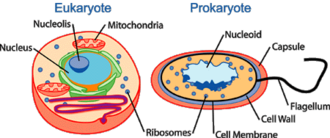
of a prokaryote
Prokaryote
The prokaryotes are a group of organisms that lack a cell nucleus , or any other membrane-bound organelles. The organisms that have a cell nucleus are called eukaryotes. Most prokaryotes are unicellular, but a few such as myxobacteria have multicellular stages in their life cycles...
that contains all or most of the genetic material
Genome
In modern molecular biology and genetics, the genome is the entirety of an organism's hereditary information. It is encoded either in DNA or, for many types of virus, in RNA. The genome includes both the genes and the non-coding sequences of the DNA/RNA....
. In contrast to the nucleus
Cell nucleus
In cell biology, the nucleus is a membrane-enclosed organelle found in eukaryotic cells. It contains most of the cell's genetic material, organized as multiple long linear DNA molecules in complex with a large variety of proteins, such as histones, to form chromosomes. The genes within these...
of a eukaryotic
Eukaryote
A eukaryote is an organism whose cells contain complex structures enclosed within membranes. Eukaryotes may more formally be referred to as the taxon Eukarya or Eukaryota. The defining membrane-bound structure that sets eukaryotic cells apart from prokaryotic cells is the nucleus, or nuclear...
cell, it is not surrounded by a nuclear membrane. The genome
Genome
In modern molecular biology and genetics, the genome is the entirety of an organism's hereditary information. It is encoded either in DNA or, for many types of virus, in RNA. The genome includes both the genes and the non-coding sequences of the DNA/RNA....
of prokaryotic organisms generally is a circular, double-stranded piece of DNA
DNA
Deoxyribonucleic acid is a nucleic acid that contains the genetic instructions used in the development and functioning of all known living organisms . The DNA segments that carry this genetic information are called genes, but other DNA sequences have structural purposes, or are involved in...
, of which multiple copies may exist at any time. The length of a genome widely varies, but generally is at least a few million base pairs.
A genophore is the DNA of a prokaryote. It is commonly referred to as a prokaryotic chromosome
Chromosome
A chromosome is an organized structure of DNA and protein found in cells. It is a single piece of coiled DNA containing many genes, regulatory elements and other nucleotide sequences. Chromosomes also contain DNA-bound proteins, which serve to package the DNA and control its functions.Chromosomes...
. The term "chromosome" is misleading for a genophore because the genophore lacks chromatin
Chromatin
Chromatin is the combination of DNA and proteins that make up the contents of the nucleus of a cell. The primary functions of chromatin are; to package DNA into a smaller volume to fit in the cell, to strengthen the DNA to allow mitosis and meiosis and prevent DNA damage, and to control gene...
. The genophore is compacted through a mechanism known as supercoiling, whereas a chromosome is compacted via chromatin. The genophore is circular in most prokaryotes, and linear in very few. The circular nature of the genophore allows replication to occur without telomeres. Genophores are generally of a much smaller size than Eukaryotic chromosomes. A genophore of a true organism can be as small as 580,073 base pairs (Mycoplasma genitalium
Mycoplasma genitalium
Mycoplasma genitalium is a small parasitic bacterium that lives on the ciliated epithelial cells of the primate genital and respiratory tracts. M. genitalium is the smallest known genome that can constitute a cell, and the second-smallest bacterium after the recently-discovered endosymbiont...
). Many eukaryotes (such as plants and animals) carry genophores in organelles such as mitochondria and chloroplasts. These organelles are very similar to true prokaryotes.
Visualization
The nucleoid can be clearly visualized on an electron micrograph at high magnificationMagnification
Magnification is the process of enlarging something only in appearance, not in physical size. This enlargement is quantified by a calculated number also called "magnification"...
, where, although its appearance may differ, it is clearly visible against the cytosol
Cytosol
The cytosol or intracellular fluid is the liquid found inside cells, that is separated into compartments by membranes. For example, the mitochondrial matrix separates the mitochondrion into compartments....
. Sometimes even strands of what is thought to be DNA are visible. By staining with the Feulgen stain
Feulgen stain
Feulgen stain is a staining technique discovered by Robert Feulgen and used in histology to identify chromosomal material or DNA in cell specimens. It depends on acid hydrolysis of DNA, therefore fixating agents using strong acids should be avoided....
, which specifically stains DNA, the nucleoid can also be seen under a light microscope. The DNA-intercalating stains DAPI
DAPI
DAPI or 4',6-diamidino-2-phenylindole is a fluorescent stain that binds strongly to A-T rich regions in DNA. It is used extensively in fluorescence microscopy...
and ethidium bromide
Ethidium bromide
Ethidium bromide is an intercalating agent commonly used as a fluorescent tag in molecular biology laboratories for techniques such as agarose gel electrophoresis. It is commonly abbreviated as "EtBr", which is also an abbreviation for bromoethane...
are widely used for fluorescence microscopy of nucleoids.
Composition
Experimental evidence suggests that the nucleoid is largely composed of DNA, about 60%, with a small amount of RNARNA
Ribonucleic acid , or RNA, is one of the three major macromolecules that are essential for all known forms of life....
and protein
Protein
Proteins are biochemical compounds consisting of one or more polypeptides typically folded into a globular or fibrous form, facilitating a biological function. A polypeptide is a single linear polymer chain of amino acids bonded together by peptide bonds between the carboxyl and amino groups of...
. The latter two constituents are likely to be mainly messenger RNA
Messenger RNA
Messenger RNA is a molecule of RNA encoding a chemical "blueprint" for a protein product. mRNA is transcribed from a DNA template, and carries coding information to the sites of protein synthesis: the ribosomes. Here, the nucleic acid polymer is translated into a polymer of amino acids: a protein...
and the transcription factor
Transcription factor
In molecular biology and genetics, a transcription factor is a protein that binds to specific DNA sequences, thereby controlling the flow of genetic information from DNA to mRNA...
proteins found regulating the bacterial genome. Proteins helping to maintain the supercoiled structure of the nucleic acid are known as nucleoid proteins or nucleoid-associated proteins and are distinct from histone
Histone
In biology, histones are highly alkaline proteins found in eukaryotic cell nuclei that package and order the DNA into structural units called nucleosomes. They are the chief protein components of chromatin, acting as spools around which DNA winds, and play a role in gene regulation...
s of eukaryotic nuclei. In contrast to histones, the DNA-binding proteins of the nucleoid do not form nucleosomes, in which DNA is wrapped around a protein core. Instead, these proteins often use other mechanisms to promote compaction such as DNA looping.