


Plastid

Encyclopedia
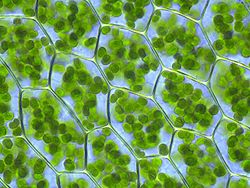
Organelle
In cell biology, an organelle is a specialized subunit within a cell that has a specific function, and is usually separately enclosed within its own lipid bilayer....
s found in the cells of plants and algae. Plastids are the site of manufacture and storage of important chemical compounds used by the cell. Plastids often contain pigments
Biological pigment
Biological pigments, also known simply as pigments or biochromes are substances produced by living organisms that have a color resulting from selective color absorption. Biological pigments include plant pigments and flower pigments...
used in photosynthesis, and the types of pigments present can change or determine the cell
Cell (biology)
The cell is the basic structural and functional unit of all known living organisms. It is the smallest unit of life that is classified as a living thing, and is often called the building block of life. The Alberts text discusses how the "cellular building blocks" move to shape developing embryos....
's color.
they possess dsDNA molecule which is circular like prokaryotes.
Plastids in plants
Plastids are responsible for photosynthesisPhotosynthesis
Photosynthesis is a chemical process that converts carbon dioxide into organic compounds, especially sugars, using the energy from sunlight. Photosynthesis occurs in plants, algae, and many species of bacteria, but not in archaea. Photosynthetic organisms are called photoautotrophs, since they can...
, storage of products like starch
Starch
Starch or amylum is a carbohydrate consisting of a large number of glucose units joined together by glycosidic bonds. This polysaccharide is produced by all green plants as an energy store...
and for the synthesis have the ability to differentiate
Cellular differentiation
In developmental biology, cellular differentiation is the process by which a less specialized cell becomes a more specialized cell type. Differentiation occurs numerous times during the development of a multicellular organism as the organism changes from a simple zygote to a complex system of...
, or redifferentiate, between these and other forms. All plastids are derived from proplastids (formerly "eoplasts", eo-: dawn, early), which are present in the meristem
Meristem
A meristem is the tissue in most plants consisting of undifferentiated cells , found in zones of the plant where growth can take place....
atic regions of the plant. Proplastids and young chloroplasts commonly divide by binary fission, but more mature chloroplasts also have this capacity.

Plant
Plants are living organisms belonging to the kingdom Plantae. Precise definitions of the kingdom vary, but as the term is used here, plants include familiar organisms such as trees, flowers, herbs, bushes, grasses, vines, ferns, mosses, and green algae. The group is also called green plants or...
s,plastids may differentiate
Cellular differentiation
In developmental biology, cellular differentiation is the process by which a less specialized cell becomes a more specialized cell type. Differentiation occurs numerous times during the development of a multicellular organism as the organism changes from a simple zygote to a complex system of...
into several forms, depending upon which function they need to play in the cell. Undifferentiated plastids (proplastids) may develop into any of the following plastids:
- ChloroplastChloroplastChloroplasts are organelles found in plant cells and other eukaryotic organisms that conduct photosynthesis. Chloroplasts capture light energy to conserve free energy in the form of ATP and reduce NADP to NADPH through a complex set of processes called photosynthesis.Chloroplasts are green...
s green plastids: for photosynthesisPhotosynthesisPhotosynthesis is a chemical process that converts carbon dioxide into organic compounds, especially sugars, using the energy from sunlight. Photosynthesis occurs in plants, algae, and many species of bacteria, but not in archaea. Photosynthetic organisms are called photoautotrophs, since they can...
; see also etioplastEtioplastEtioplasts are chloroplasts that have not been exposed to light. They are usually found in flowering plants grown in the dark. If a plant is kept out of light for several days, its normal chloroplasts will actually convert into etioplasts. Etioplasts lack active pigment and can technically be...
s, the predecessors of chloroplasts - ChromoplastChromoplastChromoplasts are plastids responsible for pigment synthesis and storage. They, like all other plastids , are organelles found in specific photosynthetic eukaryotic species....
s/coloured plastids: for pigment synthesis and storage - Gerontoplasts: control the dismantling of the photosynthetic apparatus during senescenceSenescenceSenescence or biological aging is the change in the biology of an organism as it ages after its maturity. Such changes range from those affecting its cells and their function to those affecting the whole organism...
- LeucoplastLeucoplastLeucoplasts are a category of plastid and as such are organelles found in plant cells. They are non-pigmented, in contrast to other plastids such as the chloroplast....
s colourless plastids: for monoterpeneTerpeneTerpenes are a large and diverse class of organic compounds, produced by a variety of plants, particularly conifers, though also by some insects such as termites or swallowtail butterflies, which emit terpenes from their osmeterium. They are often strong smelling and thus may have had a protective...
synthesis; leucoplasts sometimes differentiate into more specialized plastids:- AmyloplastAmyloplastAmyloplasts are non-pigmented organelles found in some plant cells. They are responsible for the synthesis and storage of starch granules, through the polymerization of glucose. Amyloplasts also convert this starch back into sugar when the plant needs energy...
s: for starchStarchStarch or amylum is a carbohydrate consisting of a large number of glucose units joined together by glycosidic bonds. This polysaccharide is produced by all green plants as an energy store...
storage and detecting gravity - ElaioplastElaioplastElaioplasts are a type of leucoplast that is specialized for the storage of lipids in plants. Elaioplasts house oil body deposits as rounded plastoglobuli, which are essentially fat droplets....
s: for storing fatFatFats consist of a wide group of compounds that are generally soluble in organic solvents and generally insoluble in water. Chemically, fats are triglycerides, triesters of glycerol and any of several fatty acids. Fats may be either solid or liquid at room temperature, depending on their structure... - Proteinoplast/aleuronoplasts: for storing and modifying proteinProteinProteins are biochemical compounds consisting of one or more polypeptides typically folded into a globular or fibrous form, facilitating a biological function. A polypeptide is a single linear polymer chain of amino acids bonded together by peptide bonds between the carboxyl and amino groups of...
- Amyloplast
Each plastid creates multiple copies of the ds circular 75–250 kilobase
Base pair
In molecular biology and genetics, the linking between two nitrogenous bases on opposite complementary DNA or certain types of RNA strands that are connected via hydrogen bonds is called a base pair...
plastome
Plastome
The plastome is the genetic material that is found in plastids in plant cells . It composes part of the entire genome of photosynthetic organisms....
. The number of genome copies per plastid is flexible, ranging from more than 1000 in rapidly dividing cells
Cell division
Cell division is the process by which a parent cell divides into two or more daughter cells . Cell division is usually a small segment of a larger cell cycle. This type of cell division in eukaryotes is known as mitosis, and leaves the daughter cell capable of dividing again. The corresponding sort...
, which, in general, contain few plastids, to 100 or fewer in mature cells, where plastid divisions has given rise to a large number of plastids. The plastome contains about 100 gene
Gene
A gene is a molecular unit of heredity of a living organism. It is a name given to some stretches of DNA and RNA that code for a type of protein or for an RNA chain that has a function in the organism. Living beings depend on genes, as they specify all proteins and functional RNA chains...
s encoding ribosomal and transfer ribonucleic acids (rRNAs and tRNAs) as well as protein
Protein
Proteins are biochemical compounds consisting of one or more polypeptides typically folded into a globular or fibrous form, facilitating a biological function. A polypeptide is a single linear polymer chain of amino acids bonded together by peptide bonds between the carboxyl and amino groups of...
s involved in photosynthesis
Photosynthesis
Photosynthesis is a chemical process that converts carbon dioxide into organic compounds, especially sugars, using the energy from sunlight. Photosynthesis occurs in plants, algae, and many species of bacteria, but not in archaea. Photosynthetic organisms are called photoautotrophs, since they can...
and plastid gene transcription
Transcription (genetics)
Transcription is the process of creating a complementary RNA copy of a sequence of DNA. Both RNA and DNA are nucleic acids, which use base pairs of nucleotides as a complementary language that can be converted back and forth from DNA to RNA by the action of the correct enzymes...
and translation
Translation
Translation is the communication of the meaning of a source-language text by means of an equivalent target-language text. Whereas interpreting undoubtedly antedates writing, translation began only after the appearance of written literature; there exist partial translations of the Sumerian Epic of...
. However, these proteins only represent a small fraction of the total protein set-up necessary to build and maintain the structure and function of a particular type of plastid. Nuclear
Cell nucleus
In cell biology, the nucleus is a membrane-enclosed organelle found in eukaryotic cells. It contains most of the cell's genetic material, organized as multiple long linear DNA molecules in complex with a large variety of proteins, such as histones, to form chromosomes. The genes within these...
genes encode the vast majority of plastid proteins, and the expression of plastid genes and nuclear genes is tightly co-regulated to allow proper development of plastids in relation to cell differentiation.
Plastid DNA exists as large protein-DNA complexes associated with the inner envelope membrane
Inner membrane
The inner membrane is the biological membrane of an organelle or Gram-negative bacteria that is within an outer membrane....
and called 'plastid nucleoids'. Each nucleoid particle may contain more than 10 copies of the plastid DNA. The proplastid contains a single nucleoid located in the centre of the plastid. The developing plastid has many nucleoids, localized at the periphery of the plastid, bound to the inner envelope membrane. During the development of proplastids to chloroplasts, and when plastids convert from one type to another, nucleoids change in morphology, size and location within the organelle. The remodelling of nucleoids is believed to occur by modifications to the composition and abundance of nucleoid proteins.
Many plastids, particularly those responsible for photosynthesis, possess numerous internal membrane layers.
In plant cell
Plant cell
Plant cells are eukaryotic cells that differ in several key respects from the cells of other eukaryotic organisms. Their distinctive features include:...
s, long thin protuberances called stromule
Stromule
Stromules are microscopic structures found in plant cells. Stromules are highly dynamic structures extending from the surface of all plastid types, including proplastids, chloroplasts, etioplasts, leucoplasts, amyloplasts, and chromoplasts...
s sometimes form and extend from the main plastid body into the cytosol
Cytosol
The cytosol or intracellular fluid is the liquid found inside cells, that is separated into compartments by membranes. For example, the mitochondrial matrix separates the mitochondrion into compartments....
and interconnect several plastids. Proteins, and presumably smaller molecules, can move within stromule
Stromule
Stromules are microscopic structures found in plant cells. Stromules are highly dynamic structures extending from the surface of all plastid types, including proplastids, chloroplasts, etioplasts, leucoplasts, amyloplasts, and chromoplasts...
s. Most cultured cells that are relatively large compared to other plant cells have very long and abundant stromules that extend to the cell periphery.
Plastids in algae
In algaeAlgae
Algae are a large and diverse group of simple, typically autotrophic organisms, ranging from unicellular to multicellular forms, such as the giant kelps that grow to 65 meters in length. They are photosynthetic like plants, and "simple" because their tissues are not organized into the many...
, the term leucoplast is used for all unpigmented plastids and their function differs from the leucoplasts of plants. Etioplast
Etioplast
Etioplasts are chloroplasts that have not been exposed to light. They are usually found in flowering plants grown in the dark. If a plant is kept out of light for several days, its normal chloroplasts will actually convert into etioplasts. Etioplasts lack active pigment and can technically be...
s, amyloplast
Amyloplast
Amyloplasts are non-pigmented organelles found in some plant cells. They are responsible for the synthesis and storage of starch granules, through the polymerization of glucose. Amyloplasts also convert this starch back into sugar when the plant needs energy...
s and chromoplast
Chromoplast
Chromoplasts are plastids responsible for pigment synthesis and storage. They, like all other plastids , are organelles found in specific photosynthetic eukaryotic species....
s are plant-specific and do not occur in algae. Plastids in algae
Algae
Algae are a large and diverse group of simple, typically autotrophic organisms, ranging from unicellular to multicellular forms, such as the giant kelps that grow to 65 meters in length. They are photosynthetic like plants, and "simple" because their tissues are not organized into the many...
and hornworts may also differ from plant plastids in that they contain pyrenoid
Pyrenoid
In cell biology, pyrenoids are organelles, centers of carbon dioxide fixation within the chloroplasts of algae and hornworts. Pyrenoids are not membrane-bound, but specialized areas of the plastid that contain high levels of ribulose-1,5-bisphosphate carboxylase/oxygenase .RubisCO fixes carbon...
s.
Glaucocystophytic algae contain muroplasts, which are similar to chloroplasts except that they have a cell wall that is similar to that of prokaryote
Prokaryote
The prokaryotes are a group of organisms that lack a cell nucleus , or any other membrane-bound organelles. The organisms that have a cell nucleus are called eukaryotes. Most prokaryotes are unicellular, but a few such as myxobacteria have multicellular stages in their life cycles...
s. Rhydophytic algae contain rhydoplasts, which are red chloroplasts that allow the algae to photosynthesise to a depth of up to 268 m.
Inheritance of plastids
Most plants inherit the plastids from only one parent. In general, angiosperms inherit plastids from the female gamete, whereas many gymnosperms inherit plastids from the male pollen. AlgaeAlgae
Algae are a large and diverse group of simple, typically autotrophic organisms, ranging from unicellular to multicellular forms, such as the giant kelps that grow to 65 meters in length. They are photosynthetic like plants, and "simple" because their tissues are not organized into the many...
also inherit plastids from only one parent. The plastid DNA of the other parent is, thus, completely lost.
In normal intraspecific crossings (resulting in normal hybrids of one species), the inheritance of plastid DNA appears to be quite strictly 100% uniparental. In interspecific hybridisations, however, the inheritance of plastids appears to be more erratic. Although plastids inherit mainly maternally in interspecific hybridisations, there are many reports of hybrids of flowering plants that contain plastids of the father.
Approximately 20% of angiosperms, including alfalfa (Medicago), normally show biparental inheritance of plastids.
Origin of plastids
Plastids are thought to have originated from endosymbiotic cyanobacteria. They developed around 1500 million years ago and allowed eukaryotes to carry out oxygenic photosynthesis. Due to a split-up into three evolutionary lineages, the plastids are named differently: chloroplasts in green algaeGreen algae
The green algae are the large group of algae from which the embryophytes emerged. As such, they form a paraphyletic group, although the group including both green algae and embryophytes is monophyletic...
and plant
Plant
Plants are living organisms belonging to the kingdom Plantae. Precise definitions of the kingdom vary, but as the term is used here, plants include familiar organisms such as trees, flowers, herbs, bushes, grasses, vines, ferns, mosses, and green algae. The group is also called green plants or...
s, rhodoplasts in red algae and cyanelles in the glaucophyte
Glaucophyte
The glaucophytes, also known as glaucocystophytes or glaucocystids, are a small group of freshwater microscopic algae. Together with the red algae and green algae plus land plants , they form the Archaeplastida...
s. The plastids differ by their pigmentation, but also in ultrastructure. The chloroplasts, e.g., have lost all phycobilisomes, the light-harvesting complexes found in cyanobacteria, red algae, and glaucophytes, but — only in plants and in closely related green algae — contain stroma and grana thylakoid
Thylakoid
A thylakoid is a membrane-bound compartment inside chloroplasts and cyanobacteria. They are the site of the light-dependent reactions of photosynthesis. Thylakoids consist of a thylakoid membrane surrounding a thylakoid lumen. Chloroplast thylakoids frequently form stacks of disks referred to as...
s. The glaucocystophycean plastid — in contrast to the chloroplasts and the rhodoplasts — is still surrounded by the remains of the cyanobacterial cell wall. All these primary plastids are surrounded by two membranes.
Complex plastids start by secondary endosymbiosis, when a eukaryote
Eukaryote
A eukaryote is an organism whose cells contain complex structures enclosed within membranes. Eukaryotes may more formally be referred to as the taxon Eukarya or Eukaryota. The defining membrane-bound structure that sets eukaryotic cells apart from prokaryotic cells is the nucleus, or nuclear...
engulfs a red or green alga and retains the algal plastid, which is typically surrounded by more than two membranes. In some cases these plastids may be reduced in their metabolic and/or photosynthetic capacity. Algae with complex plastids derived by secondary endosymbiosis of a red alga include the heterokont
Heterokont
The heterokonts or stramenopiles are a major line of eukaryotes currently containing more than 100,000 known species. Most are algae, ranging from the giant multicellular kelp to the unicellular diatoms, which are a primary component of plankton...
s, haptophyte
Haptophyte
The haptophytes, classified either as the Prymnesiophyta or Haptophyta, are a division of algae.The term "Haptophyceae" is sometimes used. This ending implies classification at a lower level...
s, cryptomonads, and most dinoflagellate
Dinoflagellate
The dinoflagellates are a large group of flagellate protists. Most are marine plankton, but they are common in fresh water habitats as well. Their populations are distributed depending on temperature, salinity, or depth...
s (= rhodoplasts). Those that endosymbiosed a green alga include the euglenid
Euglenid
Euglenoids are one of the best-known groups of flagellates, commonly found in freshwater especially when it is rich in organic materials, with a few marine and endosymbiotic members. Most euglenids are unicellular. Many euglenids have chloroplasts and produce energy through photosynthesis, but...
s and chlorarachniophyte
Chlorarachniophyte
Chlorarachniophytes are a small group of algae occasionally found in tropical oceans. They are typically mixotrophic, ingesting bacteria and smaller protists as well as conducting photosynthesis. Normally they have the form of small amoebae, with branching cytoplasmic extensions that capture prey...
s (= chloroplasts). The Apicomplexa
Apicomplexa
The Apicomplexa are a large group of protists, most of which possess a unique organelle called apicoplast and an apical complex structure involved in penetrating a host's cell. They are unicellular, spore-forming, and exclusively parasites of animals. Motile structures such as flagella or...
, a phylum of obligate parasitic protozoa including the causative agents of malaria (Plasmodium
Plasmodium
Plasmodium is a genus of parasitic protists. Infection by these organisms is known as malaria. The genus Plasmodium was described in 1885 by Ettore Marchiafava and Angelo Celli. Currently over 200 species of this genus are recognized and new species continue to be described.Of the over 200 known...
spp.), toxoplasmosis
Toxoplasmosis
Toxoplasmosis is a parasitic disease caused by the protozoan Toxoplasma gondii. The parasite infects most genera of warm-blooded animals, including humans, but the primary host is the felid family. Animals are infected by eating infected meat, by ingestion of feces of a cat that has itself...
(Toxoplasma gondii
Toxoplasma gondii
Toxoplasma gondii is a species of parasitic protozoa in the genus Toxoplasma. The definitive host of T. gondii is the cat, but the parasite can be carried by many warm-blooded animals . Toxoplasmosis, the disease of which T...
), and many other human or animal diseases also harbor a complex plastid (although this organelle has been lost in some apicomplexans, such as Cryptosporidium parvum
Cryptosporidium parvum
Cryptosporidium parvum is one of several protozoal species that cause cryptosporidiosis, a parasitic disease of the mammalian intestinal tract....
, which causes cryptosporidiosis
Cryptosporidiosis
Cryptosporidiosis, also known as crypto, is a parasitic disease caused by Cryptosporidium, a protozoan parasite in the phylum Apicomplexa. It affects the intestines of mammals and is typically an acute short-term infection...
). The 'apicoplast
Apicoplast
An apicoplast is a derived non-photosynthetic plastid found in most Apicomplexa, including malaria parasites such as Plasmodium falciparum, but not in others such as Cryptosporidium. It originated from an algae through secondary endosymbiosis...
' is no longer capable of photosynthesis, but is an essential organelle, and a promising target for antiparasitic drug development.
Some dinoflagellates and sea slugs, in particular of the genus Elysia
Elysia
Elysia may signify:*Elysia , a deathcore band*Elysia , a genus of gastropods*Elysium, a section of the underworld containing the Elysian Fields*Elysia, pure heart.*Elysia, a gas giant in Metroid Prime 3: Corruption....
, take up algae as food and keep the plastid of the digested alga to profit from the photosynthesis; after a while, the plastids are also digested. These captured plastids are known as kleptoplastids
Kleptoplasty
Kleptoplasty or kleptoplastidy is a symbiotic phenomenon whereby plastids from algae are sequestered by host organisms. The alga is eaten normally and partially digested, leaving the plastid intact. The plastids are maintained within the host, temporarily retaining functional photosynthesis for use...
.
Sources
- A Novel View of Chloroplast Structure: contains fluorescence images of chloroplastChloroplastChloroplasts are organelles found in plant cells and other eukaryotic organisms that conduct photosynthesis. Chloroplasts capture light energy to conserve free energy in the form of ATP and reduce NADP to NADPH through a complex set of processes called photosynthesis.Chloroplasts are green...
s and stromuleStromuleStromules are microscopic structures found in plant cells. Stromules are highly dynamic structures extending from the surface of all plastid types, including proplastids, chloroplasts, etioplasts, leucoplasts, amyloplasts, and chromoplasts...
s as well as an easy to read chapter.
External links
- Transplastomic plants for biocontainment (biological confinement of transgenes) — Co-extra research project on coexistence and traceability of GM and non-GM supply chains