


Orangery

Encyclopedia

Greenhouse
A greenhouse is a building in which plants are grown. These structures range in size from small sheds to very large buildings...
or conservatory
Conservatory (greenhouse)
A conservatory is a room having glass roof and walls, typically attached to a house on only one side, used as a greenhouse or a sunroom...
. The name reflects the original use of the building as a place where citrus trees were often wintered in tubs under cover, surviving through harsh frosts though not expected to flower and fruit. The orangery provided a luxurious extension of the normal range and season of woody plants, extending the protection which had long been afforded by the warmth offered from a brick fruit wall
Walled garden
A walled garden is specifically a garden enclosed by high walls for horticultural rather than security purposes, though traditionally all gardens have been hedged about or walled for protection from animal or human intruders...
. A century after the use for orange
Orange (fruit)
An orange—specifically, the sweet orange—is the citrus Citrus × sinensis and its fruit. It is the most commonly grown tree fruit in the world....
and lime
Lime (fruit)
Lime is a term referring to a number of different citrus fruits, both species and hybrids, which are typically round, green to yellow in color, 3–6 cm in diameter, and containing sour and acidic pulp. Limes are a good source of vitamin C. Limes are often used to accent the flavors of foods and...
trees had been established, other varieties of tender plants, shrub
Shrub
A shrub or bush is distinguished from a tree by its multiple stems and shorter height, usually under 5–6 m tall. A large number of plants may become either shrubs or trees, depending on the growing conditions they experience...
s and exotic plants also came to be housed in the orangery, which often gained a stove for the upkeep of these delicate plants in the cold winters of northern Europe
Europe
Europe is, by convention, one of the world's seven continents. Comprising the westernmost peninsula of Eurasia, Europe is generally 'divided' from Asia to its east by the watershed divides of the Ural and Caucasus Mountains, the Ural River, the Caspian and Black Seas, and the waterways connecting...
.
The orangery originated from the Renaissance gardens of Italy, when glass-making technology enabled sufficient expanses of clear glass to be produced. In the north, the Dutch led the way in developing expanses of window glass in orangeries, though the engravings illustrating Dutch manuals showed solid roofs, whether beamed or vaulted, and in providing stove heat rather than open fires. This soon created a situation where orangeries became symbols of status among the wealthy. The glazed roof, which afforded sunlight to plants that were not dormant, was a development of the early nineteenth century. The orangery at Dyrham Park
Dyrham Park
Dyrham Park is a baroque mansion in an ancient deer park near the village of Dyrham in Gloucestershire, England. For the history of the manor of Dyrham, see main article Dyrham.-Description:...
, Gloucestershire, which had been provided with a slate roof as originally built about 1702, was given a glazed one about a hundred years later, after Humphrey Repton remarked that it was dark; though it was built to shelter oranges, it has always simply been called the "greenhouse" in modern times.
The Orangerie at the Palace of the Louvre
Palais du Louvre
The Louvre Palace , on the Right Bank of the Seine in Paris, is a former royal palace situated between the Tuileries Gardens and the church of Saint-Germain l'Auxerrois...
, 1617, inspired imitations that culminated in Europe's largest orangery, designed by Jules Hardouin-Mansart for Louis XIV's 3000 orange trees at Versailles
Palace of Versailles
The Palace of Versailles , or simply Versailles, is a royal château in Versailles in the Île-de-France region of France. In French it is the Château de Versailles....
, whose dimensions of 508 by 42 feet (12.8 m) were not eclipsed until, from the development of the modern greenhouse in the 1840s, were quickly overshadowed by the architecture in glass of Joseph Paxton
Joseph Paxton
Sir Joseph Paxton was an English gardener and architect, best known for designing The Crystal Palace.-Early life:...
. Notable for his design of the Crystal Palace
The Crystal Palace
The Crystal Palace was a cast-iron and glass building originally erected in Hyde Park, London, England, to house the Great Exhibition of 1851. More than 14,000 exhibitors from around the world gathered in the Palace's of exhibition space to display examples of the latest technology developed in...
, his "great conservatory" at Chatsworth House
Chatsworth House
Chatsworth House is a stately home in North Derbyshire, England, northeast of Bakewell and west of Chesterfield . It is the seat of the Duke of Devonshire, and has been home to his family, the Cavendish family, since Bess of Hardwick settled at Chatsworth in 1549.Standing on the east bank of the...
was an orangery and glass house of monumental proportions.
The orangery, however, was not just a greenhouse but a symbol of prestige and wealth and a feature of the garden, in the same way as a summerhouse
Summer house
A summer house or summerhouse has traditionally referred to a building or shelter used for relaxation in warm weather. This would often take the form of a small, roofed building on the grounds of a larger one, but could also be built in a garden or park, often designed to provide cool shady places...
, folly
Folly
In architecture, a folly is a building constructed primarily for decoration, but either suggesting by its appearance some other purpose, or merely so extravagant that it transcends the normal range of garden ornaments or other class of building to which it belongs...
or "Grecian temple". Owners would conduct their guests there on tours of the garden to admire not only the fruits within but the architecture without. Often the orangery would contain fountains, grottos, and an area in which to entertain in inclement weather.
Earliest examples
As early as 1545 an orangery was built in Padua, Italy. The first orangeries were not as well thought-out or as ornate as our modern versions; most had no heating and in the very cold nights had to have open fires to keep them warm.In England, John Parkinson
John Parkinson
John Parkinson may refer to:*John Parkinson , English herbalist*John B. Parkinson , American architect in Los Angeles*John Parkinson , British Labour Party MP for Wigan, 1918–1941...
introduced the orangery to the readers of his Paradisus in Sole (1628), under the heading "Oranges". The trees might be planted against a brick wall and enclosed in winter with a plank shed covered with "cerecloth", a waxed precursor of tarpaulin. "For that purpose, some keepe them in great square boxes, and lift them to and fro by iron hooks on the sides, or cause them to be rowled by trundels, or small wheeles under them, to place them in a house or close gallery" — which must have been thought handsomer than the alternative.
The building of orangeries became most widely fashionable after the end of the Eighty Years' War in 1648. The countries that started this trend were France, Germany, and the Netherlands, these countries being the ones that saw merchants begin importing large numbers of orange trees, banana plants, and pomegranates to cultivate for their beauty and scent.
Construction materials
The need to build these [orangeries] came from two areas: the need to house such delicate plants, also the image status from the wealthy, both however were constricted in their choice of materials available for the task, if they were south facing then they were constructed with brick or stone bases, brick or stone pillars with a corbelled gutter arrangement and mainly had large tall windows to benefit from the warm sunlight in the afternoons, if north facing then very heavy on the solid walls and much smaller windows to be able to keep the rooms warm. Insulation at these times was one of the biggest concerns for the building of these orangeries, straw became the main material used, also many had wooden shutters fitted to keep in the warmth.Early orangeries
The first examples were basic constructions and could be removed during summer. Notably not only noblemen but also wealthy merchants, e.g. those of NurembergNuremberg
Nuremberg[p] is a city in the German state of Bavaria, in the administrative region of Middle Franconia. Situated on the Pegnitz river and the Rhine–Main–Danube Canal, it is located about north of Munich and is Franconia's largest city. The population is 505,664...
, used to cultivate citrus plants in orangeries. Some orangeries were built using the garden wall as the main wall of the new Orangery, but as orangeries became more and more popular they started to become more and more influenced by Garden Designers and Architects, which led to the connection between the house and Architectural Orangery Design. This became further influenced by the increased demand for beautiful exotic plants in the garden, which could be grown and looked after in the orangeries.
This created the increased demand in Garden design for the wealthy to have their own exotic private gardens, further fuelling the status of the Orangery becoming even more the symbol of the elite. This in turn created the need for orangeries to be constructed using even better techniques such as underfloor heating and the ability to have opening widows in the roofs for ventilation. Creating microclimates for the propagation of more and more exotic plants for the private gardens that were becoming creations of beauty all around Europe.
Continental European Orangeries
France
- Versailles OrangerieVersailles OrangerieThe Versailles Orangerie was built by Jules Hardouin-Mansart between 1684 and 1686, that is to say, before work on the castle had even begun. It is an example of many such prestigious extensions of grand gardens in Europe designed both to shelter tender plants and impress visitors...
, in the gardens of the Palace of Versailles - StrasbourgStrasbourgStrasbourg is the capital and principal city of the Alsace region in eastern France and is the official seat of the European Parliament. Located close to the border with Germany, it is the capital of the Bas-Rhin département. The city and the region of Alsace are historically German-speaking,...
, park of the Orangerie - Tuileries: Orangerie in the Tuileries Gardens, Paris
Belgium
- LaekenRoyal Greenhouses of LaekenThe Royal Greenhouses of Laeken , are a vast complex of monumental heated greenhouses in the park of the Royal Castle of Laeken in Brussels and one of the major tourist attractions of the city. The complex was commissioned by King Leopold II of Belgium and designed by Alphonse Balat...
, Orangerie of the Royal Castle of Laeken (ca. 1820)
Germany
- Düsseldorf-BenrathDüsseldorf-BenrathBenrath is a part of Düsseldorf in the south of the city. It has been a part of Düsseldorf since 1929.-History:The name Benrath came from the "Knights of Benrode". The settlement was mentioned for the first time in 1222 in a document from Cologne where Everhard de Benrode is named as an attestor...
, Orangerie - FuldaFuldaFulda is a city in Hesse, Germany; it is located on the river Fulda and is the administrative seat of the Fulda district .- Early Middle Ages :...
, Orangerie - GeraGeraGera, the third-largest city in the German state of Thuringia , lies in east Thuringia on the river Weiße Elster, approximately 60 kilometres to the south of the city of Leipzig and 80 kilometres to the east of Erfurt...
, Orangery and "Küchengarten" - HanoverHanoverHanover or Hannover, on the river Leine, is the capital of the federal state of Lower Saxony , Germany and was once by personal union the family seat of the Hanoverian Kings of Great Britain, under their title as the dukes of Brunswick-Lüneburg...
, a part of the Herrenhausen GardensHerrenhausen GardensThe Herrenhausen Gardens , located in Lower Saxony's capital of Hanover are made up of the Great Garden , the Berggarten, the Georgengarten and the Welfengarten. The gardens are a heritage of the Kings of Hanover.The Great Garden has always been one of the most distinguished baroque formal gardens... - IngolstadtIngolstadtIngolstadt is a city in the Free State of Bavaria, in the Federal Republic of Germany. It is located along the banks of the Danube River, in the center of Bavaria. As at 31 March 2011, Ingolstadt had 125.407 residents...
, Orangerie in Harderstraße 10 - Orangerie (Kassel)Orangerie (Kassel)The Orangerie is a Orangery in Kassel. It was built under Landgrave Charles between 1703 and 1711. Since then, it forms the northern corner of the Karlsaue park. Today it is used as an astronomy and physical cabinet.- History :...
, Orangerie - PhilippsthalPhilippsthal (Werra)Philippsthal is a market community in Hersfeld-Rotenburg district in eastern Hesse, Germany, right at the boundary with Thuringia.-Location:Philippsthal lies between the outliers of the Rhön and the Thuringian Forest on the river Werra...
, Orangerie - PotsdamPotsdamPotsdam is the capital city of the German federal state of Brandenburg and part of the Berlin/Brandenburg Metropolitan Region. It is situated on the River Havel, southwest of Berlin city centre....
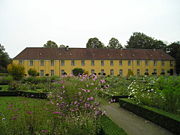
, Orangerieschloss (illustration, above right) - Bronnbach abbey in Wertheim am MainWertheim am MainWertheim is a town in southwestern Germany, in the state of Baden-Württemberg with a population of 24,202. It is located on the confluence of the rivers Tauber and Main.It is known for its wine, castle and medieval town centre.-Geography:...
, (1773–1775)
Russia
- Peterhof, Bolshaya Kamennya Oranzhereya
- Tsarskoe Selo, Bolshaya Oranzhereya (1762, 1820)
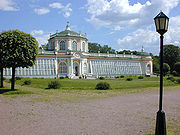
- KuskovoKuskovoKuskovo was the summer country house and estate of the Sheremetev family. Built in the mid-18th century, it was originally situated several miles to the east of Moscow but now is part of the East District of the city. It was one of the first great summer country estates of the Russian nobility,...
, MoscowMoscowMoscow is the capital, the most populous city, and the most populous federal subject of Russia. The city is a major political, economic, cultural, scientific, religious, financial, educational, and transportation centre of Russia and the continent...
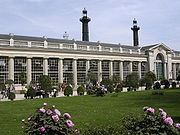
, Oranzhereya (illustration, right)
Sweden
- Finspång CastleFinspång CastleFinspång Castle is situated in Finspång, the province of Östergötland, Sweden....
, Sweden, Orangerie (1832) - Nynäs Slott, Manorial Estate (Castle) and Orangery, Nynäs, Sweden
Orangeries in the United Kingdom
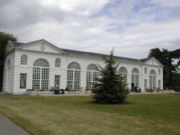
Kensington Palace
Kensington Palace is a royal residence set in Kensington Gardens in the Royal Borough of Kensington and Chelsea in London, England. It has been a residence of the British Royal Family since the 17th century and is the official London residence of the Duke and Duchess of Cambridge, the Duke and...
(1761) is the earliest surviving work there by Sir William Chambers
William Chambers (architect)
Sir William Chambers was a Scottish architect, born in Gothenburg, Sweden, where his father was a merchant. Between 1740 and 1749 he was employed by the Swedish East India Company making several voyages to China where he studied Chinese architecture and decoration.Returning to Europe, he studied...
. At 28 m (92 ft) long, it was the largest glasshouse in Britain when it was built. Though it was designed as an arcade with end pavilions to winter oranges, the light levels under its solid roof were too low for it to be successful.
- Royal Botanic Gardens, Kew: The Orangery
The Orangery at Margam Park, Wales, was built between 1787 and 1793 to house a large collection of orange, lemon and citron trees inherited by Thomas Mansel Talbot. The original house has been razed, but the surviving orangery, at 327 feet (99.7 m), is the longest one in Wales.
- Margam Park: Orangery
There is an orangery dating from about 1700 at Kenwood House
Kenwood House
Kenwood House is a former stately home, in Hampstead, London, on the northern boundary of Hampstead Heath. It is managed by English Heritage.-History:...
in London
London
London is the capital city of :England and the :United Kingdom, the largest metropolitan area in the United Kingdom, and the largest urban zone in the European Union by most measures. Located on the River Thames, London has been a major settlement for two millennia, its history going back to its...
, and a slightly earlier one at Montacute
Montacute
Montacute is a small village and civil parish in Somerset, England, west of Yeovil. The village has a population of 680 . The name Montacute is thought by some to derive from the Latin "Mons Acutus", referring to the small but still quite acute hill dominating the village to the west.The village...
. Other orangeries in the hands of the National Trust
National Trust for Places of Historic Interest or Natural Beauty
The National Trust for Places of Historic Interest or Natural Beauty, usually known as the National Trust, is a conservation organisation in England, Wales and Northern Ireland...
are at Hanbury Hall
Hanbury Hall
Hanbury Hall was built by the chancery lawyer Thomas Vernon in the early 18th century. Thomas Vernon was the great grandson of the first Vernon to come to Hanbury, Worcestershire, Rev Richard Vernon...
, Worcestershire; Ickworth House
Ickworth House
Ickworth House is a country house outside Bury St. Edmunds, Suffolk, England. It is a neoclassical structure topped by a giant rotunda in a park extending to 1800 acres. It is in the care of the National Trust, and, as part of the Ickworth House, Park & Garden property, is open to the...
, Suffolk, where it forms part of the garden front of the dwelling wings; Powis Castle
Powis Castle
Powis Castle is a medieval castle, fortress and grand country mansion located near the town of Welshpool, in Powys, Mid Wales.The residence of the Earl of Powis, the castle is known for its extensive, attractive formal gardens, terraces, parkland, deerpark and landscaped estate...
, Montgomeryshire, a central feature on the late-eighteenth-century terraces; Saltram House
Saltram House
Saltram House is a George II era mansion located in Plympton, Plymouth, England. The house that can be seen today is the work of Robert Adam, who altered the original Tudor house on two occasions. The saloon is sometimes cited as one of Adam's finest interiors...
, Devon, probably to a Robert Adam
Robert Adam
Robert Adam was a Scottish neoclassical architect, interior designer and furniture designer. He was the son of William Adam , Scotland's foremost architect of the time, and trained under him...
design; Seaton Delaval Hall
Seaton Delaval Hall
Seaton Delaval Hall is a Grade I listed country house in Northumberland, England. It is near the coast just north of Newcastle upon Tyne. Located between Seaton Sluice and Seaton Delaval, it was designed by Sir John Vanbrugh in 1718 for Admiral George Delaval and is now owned by the National...
, Northumberland; and Blickling
Blickling
Blickling is a village and civil parish in the Broadland district of Norfolk, England, about north-west of Aylsham on the B1354 road. According to the 2001 census it had a population of 136 and covers . Since the 17th century the village has been concentrated in two areas, around the church and...
, Norfolk.
A recent orangery was constructed in 1970 by Victor Montagu in his formal Italianate gardens at Mapperton, Dorset.
There is also a famous Orangery belonging to the First Duke of Borks, located in Bedlington, Northumberland. It was built in the late 19th Century and refurbished after being destroyed in the war. It is notable for it's automatic garage door and excellent Orange production.
A recent and notable Orangery, has been constructed by the [Talksport] north east football correspondent [Graham Courtney] at his 5 bedroomed house in [Durham City]. The extensive work included additional renovations to the garage of the house and the installation of a new boiler.
Orangeries in the United States
In the United States, the earliest partially-intact surviving orangery is at the Tayloe house in Mount Airy, VirginiaMount Airy, Richmond County, Virginia
Mount Airy, near Warsaw in Richmond County, Virginia, built in 1758-62, is a mid-Georgian plantation house, the first built in the manner of a neo-Palladian villa. It was constructed for Colonel John Tayloe II, perhaps the richest Virginia planter of his generation...
but today it is an overgrown ruin, consisting only of one major wall and portions of the others' foundations. A ruined orangery can also be seen at the gardens of Eyre Hall in Northampton County, Virginia
Northampton County, Virginia
As of the census of 2010, there were 12,389 people, 5,321 households, and 3,543 families residing in the county. The population density was 63 people per square mile . There were 6,547 housing units at an average density of 32 per square mile...
.
The oldest-known extant orangery in American can be seen at the Wye Plantation
Wye House
Wye House is a large Southern frame plantation house located in Talbot County, Maryland, seven miles northwest of Easton. It was listed for preservation on the National Register of Historic Places in 1970.-History:...
, near Tunis Mills (Easton), Maryland. This orangery sits behind the main house and consists of a large open room with two smaller wings added at some point after the initial construction. The south-facing wall consists of large triple-hung windows. A second story was traditionally part of the style of orangeries at the time of its construction in the middle to late 18th century as a way of further insulating the main section where the plants were kept. According to the current resident, Ms. Tilghman (a descendent of the Lloyd family), it served as a billiards room for the family. This plantation is also notable as having been the home of Frederick Douglass
Frederick Douglass
Frederick Douglass was an American social reformer, orator, writer and statesman. After escaping from slavery, he became a leader of the abolitionist movement, gaining note for his dazzling oratory and incisive antislavery writing...
as a young slave boy. The orangery is described in the book Glass Houses, as is the orangery at the Tayloe house.
Ms. Tilghman notes that plants are still stored inside the building in winter, but a frame has been constructed to hold the houseplants, and the whole of the frame is covered with plastic to keep in moisture. In this way, the plants do not have to be watered through the entire winter.
Another orangery stands at Hampton National Historic Site
Hampton National Historic Site
Hampton National Historic Site, in the Hampton area north of Towson, Baltimore County, Maryland, United States, preserves a remnant of a vast 18th-century estate, including a Georgian manor house, gardens, grounds, and the original stone slave quarters. The estate was owned by the Ridgely family...
near Towson, Maryland
Towson, Maryland
Towson is an unincorporated community and a census-designated place in Baltimore County, Maryland, United States. The population was 55,197 at the 2010 census...
. Originally built in 1820, it was part of one of the most extensive collections of citrus trees in the U.S. by the mid-19th century. The current structure is a reconstruction built in the 1970s to replace the original, which burned in 1926.
The orangery at the Battersea Historic Site in Petersburg, VA is currently under restoration. Originally built between 1823-1841, it was converted into a garage in a later period.
An 18th-century style orangery was built in the 1980s at the Tower Hill Botanic Garden
Tower Hill Botanic Garden
The , in Boylston, Massachusetts, USA, is a 132 acre botanical garden with spectacular views of Mount Wachusett and the Wachusett Reservoir. It is located approximately 8 miles north of central Worcester...
in Boylston, Massachusetts. Another early 19th century example can also be seen at Dumbarton Oaks
Dumbarton Oaks
Dumbarton Oaks is the conventional name for the Dumbarton Oaks Research Library and Collection, situated on a historic property in the Georgetown neighborhood of Washington, D.C. The institution is administered by the Trustees for Harvard University. Its founders, Robert Woods Bliss and his wife...
in Washington, D.C. It was built in 1810, and is now used to house gardenias, oleander and citrus plants during the winter.
See also
- ConservatoryConservatory (greenhouse)A conservatory is a room having glass roof and walls, typically attached to a house on only one side, used as a greenhouse or a sunroom...
- CupolaCupolaIn architecture, a cupola is a small, most-often dome-like, structure on top of a building. Often used to provide a lookout or to admit light and air, it usually crowns a larger roof or dome....
- DaylightingDaylightingDaylighting is the practice of placing windows or other openings and reflective surfaces so that during the day natural light provides effective internal lighting. Particular attention is given to daylighting while designing a building when the aim is to maximize visual comfort or to reduce energy...
- Roof lanternRoof lanternA roof lantern is a daylighting cupola architectural element. Architectural lanterns are atop a larger roof and provide natural light into the space or room below. In contemporary use it is an architectural skylight structure...