

Fulda

Encyclopedia
Fulda (ˈfʊlda) is a city in Hesse
, Germany
; it is located on the river Fulda and is the administrative seat of the Fulda district
(Kreis).
monastery of Fulda was founded in 744 by Saint Sturm
, a disciple of Saint Boniface
, as one of Boniface's outposts in the reorganization of the church in Germany. It later served as a base from which missionaries could accompany Charlemagne
's armies in their political and military campaign to fully conquer and convert pagan Saxony.
The initial grant for the abbey was signed by Carloman
, the son of Charles Martel
. The support of the Mayors of the Palace
and later, the early Pippinid and Carolingian
rulers, was important to Boniface's success. Fulda also received support from many of the leading families of the Carolingian world. Sturm, whose tenure as abbot lasted from 747 until 779, was most likely related to the Agilolfing dukes of Bavaria
. Fulda also received large and constant donations from the Etichonids, a leading family in Alsatia, and the Conradines, predecessors of the Salian Holy Roman Emperors
. Under Sturm, the donations Fulda received from these and other important families helped in the establishment of daughter houses Johannesberg and Petersberg near Fulda.
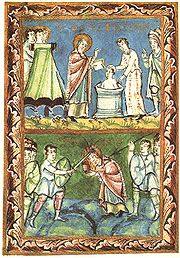 by the Frisian
s, the relics of Saint Boniface were brought back to Fulda. Because of the stature this afforded the monastery, the donations increased, and Fulda could establish daughter houses further away, for example in Hamelin
. Meanwhile Saint Lullus
, successor of Boniface as archbishop of Mainz
, tried to absorb the abbey into his archbishopric, but failed. This was one reason that he founded Hersfeld Abbey
, to limit the attempts of the enlargement of Fulda.
Between 790 and 819 the community rebuilt the main monastery church to more fittingly house the relics. They based their new basilica on the original 4th-century (since demolished) Old Saint Peter's Basilica
in Rome, using the transept
and crypt
plan of that great pilgrimage church to frame their own saint as the "Apostle to the Germans". The crypt of the original abbey church still holds those relics, but the church itself has been subsumed into a Baroque
renovation. A small, 9th century chapel remains standing within walking distance of the church, as do the foundations of a later women's abbey.
The great scholar Rabanus Maurus
was abbot from 822 to 842.
From its foundation, the abbey Fulda and its territory was based on an Imperial grant, and therefore was a sovereign principality subject only to the German emperor. Fulda was made a bishopric in 1752 and the prince-abbots were given the additional title of prince-bishop. The prince-abbots (and later prince-bishops) ruled Fulda and the surrounding region until the bishopric was forcibly dissolved by Napoleon in 1802.
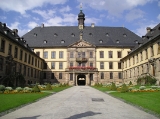
The city went through a baroque building campaign in the 18th century, resulting in the current “Baroque City” status. This included a remodeling of the Dom
(Cathedral) of Fulda (1704–1712) and of the Stadtschloss (Castle-Palace, 1707–1712) by Johann Dientzenhofer
. The city parish church, St. Blasius, was built between 1771–1785.
In 1764 a porcelain
factory was started in Fulda under Prince-Bishop, Prince-Abbot Heinrich von Bibra
, but shortly after his death it was closed down in 1789 by his successor, Prince-Bishop, Prince-Abbot Adalbert von Harstall.
Because of its quality and rarity, this porcelain is much prized by collectors.
, a traditional east-west invasion route used by Napoleon and others. During the Cold War
, the former East/West
German border passed just east of Fulda, and large Soviet and East German forces were stationed in the area as it was considered to be a potential invasion route against the German Democratic Republic
and the Eastern bloc countries generally.
The U.S. Army stationed the 14th and later the 11th Armored Cavalry Regiments in the city and surrounding areas as the screening force for the U.S. V Corps.
with: Como
, Italy
(1960) Arles
, France
(1964) Sergiyev Posad
, Moscow Oblast
, Russia
(1991) Wilmington, Delaware
, USA
(1997) Litoměřice
, Czech Republic
(2001)
Hesse
Hesse or Hessia is both a cultural region of Germany and the name of an individual German state.* The cultural region of Hesse includes both the State of Hesse and the area known as Rhenish Hesse in the neighbouring Rhineland-Palatinate state...
, Germany
Germany
Germany , officially the Federal Republic of Germany , is a federal parliamentary republic in Europe. The country consists of 16 states while the capital and largest city is Berlin. Germany covers an area of 357,021 km2 and has a largely temperate seasonal climate...
; it is located on the river Fulda and is the administrative seat of the Fulda district
Fulda (district)
Fulda is a Kreis in the north-east of Hesse, Germany. Neighboring districts are Hersfeld-Rotenburg, Wartburgkreis, Schmalkalden-Meiningen, Rhön-Grabfeld, Bad Kissingen, Main-Kinzig, Vogelsbergkreis.-History:...
(Kreis).
Early Middle Ages
The BenedictineBenedictine
Benedictine refers to the spirituality and consecrated life in accordance with the Rule of St Benedict, written by Benedict of Nursia in the sixth century for the cenobitic communities he founded in central Italy. The most notable of these is Monte Cassino, the first monastery founded by Benedict...
monastery of Fulda was founded in 744 by Saint Sturm
Saint Sturm
Saint Sturm was a disciple of Saint Boniface and founder and first abbot of the Benedictine monastery and abbey of Fulda in 742 or 744...
, a disciple of Saint Boniface
Saint Boniface
Saint Boniface , the Apostle of the Germans, born Winfrid, Wynfrith, or Wynfryth in the kingdom of Wessex, probably at Crediton , was a missionary who propagated Christianity in the Frankish Empire during the 8th century. He is the patron saint of Germany and the first archbishop of Mainz...
, as one of Boniface's outposts in the reorganization of the church in Germany. It later served as a base from which missionaries could accompany Charlemagne
Charlemagne
Charlemagne was King of the Franks from 768 and Emperor of the Romans from 800 to his death in 814. He expanded the Frankish kingdom into an empire that incorporated much of Western and Central Europe. During his reign, he conquered Italy and was crowned by Pope Leo III on 25 December 800...
's armies in their political and military campaign to fully conquer and convert pagan Saxony.
The initial grant for the abbey was signed by Carloman
Carloman, son of Charles Martel
Carloman was the eldest son of Charles Martel, major domo or mayor of the palace and duke of the Franks, and his wife Chrotrud. On Charles' death , Carloman and his brother Pippin the Short succeeded to their father's legal positions, Carloman in Austrasia, and Pippin in Neustria...
, the son of Charles Martel
Charles Martel
Charles Martel , also known as Charles the Hammer, was a Frankish military and political leader, who served as Mayor of the Palace under the Merovingian kings and ruled de facto during an interregnum at the end of his life, using the title Duke and Prince of the Franks. In 739 he was offered the...
. The support of the Mayors of the Palace
Mayor of the Palace
Mayor of the Palace was an early medieval title and office, also called majordomo, from the Latin title maior domus , used most notably in the Frankish kingdoms in the 7th and 8th centuries....
and later, the early Pippinid and Carolingian
Carolingian
The Carolingian dynasty was a Frankish noble family with origins in the Arnulfing and Pippinid clans of the 7th century AD. The name "Carolingian", Medieval Latin karolingi, an altered form of an unattested Old High German *karling, kerling The Carolingian dynasty (known variously as the...
rulers, was important to Boniface's success. Fulda also received support from many of the leading families of the Carolingian world. Sturm, whose tenure as abbot lasted from 747 until 779, was most likely related to the Agilolfing dukes of Bavaria
Bavaria
Bavaria, formally the Free State of Bavaria is a state of Germany, located in the southeast of Germany. With an area of , it is the largest state by area, forming almost 20% of the total land area of Germany...
. Fulda also received large and constant donations from the Etichonids, a leading family in Alsatia, and the Conradines, predecessors of the Salian Holy Roman Emperors
Holy Roman Empire
The Holy Roman Empire was a realm that existed from 962 to 1806 in Central Europe.It was ruled by the Holy Roman Emperor. Its character changed during the Middle Ages and the Early Modern period, when the power of the emperor gradually weakened in favour of the princes...
. Under Sturm, the donations Fulda received from these and other important families helped in the establishment of daughter houses Johannesberg and Petersberg near Fulda.
Frisians
The Frisians are a Germanic ethnic group native to the coastal parts of the Netherlands and Germany. They are concentrated in the Dutch provinces of Friesland and Groningen and, in Germany, East Frisia and North Frisia, that was a part of Denmark until 1864. They inhabit an area known as Frisia...
s, the relics of Saint Boniface were brought back to Fulda. Because of the stature this afforded the monastery, the donations increased, and Fulda could establish daughter houses further away, for example in Hamelin
Hamelin
Hamelin is a town on the river Weser in Lower Saxony, Germany. It is the capital of the district of Hamelin-Pyrmont and has a population of 58,696 ....
. Meanwhile Saint Lullus
Lullus
Saint Lullus was the first permanent archbishop of Mainz, succeeding Saint Boniface, and first abbot of the Benedictine Hersfeld Abbey.-Monk to archbishop:...
, successor of Boniface as archbishop of Mainz
Mainz
Mainz under the Holy Roman Empire, and previously was a Roman fort city which commanded the west bank of the Rhine and formed part of the northernmost frontier of the Roman Empire...
, tried to absorb the abbey into his archbishopric, but failed. This was one reason that he founded Hersfeld Abbey
Hersfeld Abbey
Hersfeld Abbey was an important Benedictine imperial abbey in the town of Bad Hersfeld in Hesse , Germany, at the confluence of the rivers Geisa, Haune and Fulda.-History:...
, to limit the attempts of the enlargement of Fulda.
Between 790 and 819 the community rebuilt the main monastery church to more fittingly house the relics. They based their new basilica on the original 4th-century (since demolished) Old Saint Peter's Basilica
Old Saint Peter's Basilica
Old Saint Peter's Basilica was the building that stood, from the 4th to 16th centuries, on the spot where the Basilica of Saint Peter stands today in Rome. Construction of the Basilica, built over the historical site of the Circus of Nero, began during the reign of emperor Constantine I...
in Rome, using the transept
Transept
For the periodical go to The Transept.A transept is a transverse section, of any building, which lies across the main body of the building. In Christian churches, a transept is an area set crosswise to the nave in a cruciform building in Romanesque and Gothic Christian church architecture...
and crypt
Crypt
In architecture, a crypt is a stone chamber or vault beneath the floor of a burial vault possibly containing sarcophagi, coffins or relics....
plan of that great pilgrimage church to frame their own saint as the "Apostle to the Germans". The crypt of the original abbey church still holds those relics, but the church itself has been subsumed into a Baroque
Baroque
The Baroque is a period and the style that used exaggerated motion and clear, easily interpreted detail to produce drama, tension, exuberance, and grandeur in sculpture, painting, literature, dance, and music...
renovation. A small, 9th century chapel remains standing within walking distance of the church, as do the foundations of a later women's abbey.
The great scholar Rabanus Maurus
Rabanus Maurus
Rabanus Maurus Magnentius , also known as Hrabanus or Rhabanus, was a Frankish Benedictine monk, the archbishop of Mainz in Germany and a theologian. He was the author of the encyclopaedia De rerum naturis . He also wrote treatises on education and grammar and commentaries on the Bible...
was abbot from 822 to 842.
From its foundation, the abbey Fulda and its territory was based on an Imperial grant, and therefore was a sovereign principality subject only to the German emperor. Fulda was made a bishopric in 1752 and the prince-abbots were given the additional title of prince-bishop. The prince-abbots (and later prince-bishops) ruled Fulda and the surrounding region until the bishopric was forcibly dissolved by Napoleon in 1802.
The city went through a baroque building campaign in the 18th century, resulting in the current “Baroque City” status. This included a remodeling of the Dom
Fulda Cathedral
Fulda Cathedral is the former abbey church of Fulda Abbey and the burial place of Saint Boniface. Since 1752 it has also been the cathedral of the Diocese of Fulda, of which the Prince-Abbots of Fulda were created bishops. The abbey was dissolved in 1802 but the diocese and its cathedral have...
(Cathedral) of Fulda (1704–1712) and of the Stadtschloss (Castle-Palace, 1707–1712) by Johann Dientzenhofer
Johann Dientzenhofer
Johann Dientzenhofer was a builder and architect during the Baroque period in Germany.Johann was born in St. Margarethen near Rosenheim, Bavaria, a member of the famous Dientzenhofer family of German architects, who were among the leading builders in the Bohemian and German Baroque which included...
. The city parish church, St. Blasius, was built between 1771–1785.
In 1764 a porcelain
Porcelain
Porcelain is a ceramic material made by heating raw materials, generally including clay in the form of kaolin, in a kiln to temperatures between and...
factory was started in Fulda under Prince-Bishop, Prince-Abbot Heinrich von Bibra
Heinrich von Bibra
Heinrich von Bibra , Prince-Bishop, Prince-Abbot of Fulda was Prince-Bishop from 1759 to 1788.-Biography:...
, but shortly after his death it was closed down in 1789 by his successor, Prince-Bishop, Prince-Abbot Adalbert von Harstall.
Because of its quality and rarity, this porcelain is much prized by collectors.
Cold War importance
Fulda lends its name to the Fulda GapFulda Gap
The Fulda Gap is a region of lower elevation between the former East German border and Frankfurt am Main, Germany. Named for the town of Fulda, the Fulda Gap was strategically important during the Cold War...
, a traditional east-west invasion route used by Napoleon and others. During the Cold War
Cold War
The Cold War was the continuing state from roughly 1946 to 1991 of political conflict, military tension, proxy wars, and economic competition between the Communist World—primarily the Soviet Union and its satellite states and allies—and the powers of the Western world, primarily the United States...
, the former East/West
West Germany
West Germany is the common English, but not official, name for the Federal Republic of Germany or FRG in the period between its creation in May 1949 to German reunification on 3 October 1990....
German border passed just east of Fulda, and large Soviet and East German forces were stationed in the area as it was considered to be a potential invasion route against the German Democratic Republic
German Democratic Republic
The German Democratic Republic , informally called East Germany by West Germany and other countries, was a socialist state established in 1949 in the Soviet zone of occupied Germany, including East Berlin of the Allied-occupied capital city...
and the Eastern bloc countries generally.
The U.S. Army stationed the 14th and later the 11th Armored Cavalry Regiments in the city and surrounding areas as the screening force for the U.S. V Corps.
Twin towns — sister cities
Fulda is twinnedTown twinning
Twin towns and sister cities are two of many terms used to describe the cooperative agreements between towns, cities, and even counties in geographically and politically distinct areas to promote cultural and commercial ties.- Terminology :...
with: Como
Como
Como is a city and comune in Lombardy, Italy.It is the administrative capital of the Province of Como....
, Italy
Italy
Italy , officially the Italian Republic languages]] under the European Charter for Regional or Minority Languages. In each of these, Italy's official name is as follows:;;;;;;;;), is a unitary parliamentary republic in South-Central Europe. To the north it borders France, Switzerland, Austria and...
(1960) Arles
Arles
Arles is a city and commune in the south of France, in the Bouches-du-Rhône department, of which it is a subprefecture, in the former province of Provence....
, France
France
The French Republic , The French Republic , The French Republic , (commonly known as France , is a unitary semi-presidential republic in Western Europe with several overseas territories and islands located on other continents and in the Indian, Pacific, and Atlantic oceans. Metropolitan France...
(1964) Sergiyev Posad
Sergiyev Posad
Sergiyev Posad is a city and the administrative center of Sergiyevo-Posadsky District of Moscow Oblast, Russia. It grew in the 15th century around one of the greatest of Russian monasteries, the Trinity Lavra established by St. Sergius of Radonezh. The town status was granted to it in 1742...
, Moscow Oblast
Moscow Oblast
Moscow Oblast , or Podmoskovye , is a federal subject of Russia . Its area, at , is relatively small compared to other federal subjects, but it is one of the most densely populated regions in the country and, with the 2010 population of 7,092,941, is the second most populous federal subject...
, Russia
Russia
Russia or , officially known as both Russia and the Russian Federation , is a country in northern Eurasia. It is a federal semi-presidential republic, comprising 83 federal subjects...
(1991) Wilmington, Delaware
Wilmington, Delaware
Wilmington is the largest city in the state of Delaware, United States, and is located at the confluence of the Christina River and Brandywine Creek, near where the Christina flows into the Delaware River. It is the county seat of New Castle County and one of the major cities in the Delaware Valley...
, USA
United States
The United States of America is a federal constitutional republic comprising fifty states and a federal district...
(1997) Litoměřice
Litomerice
Litoměřice is a town at the junction of the rivers Elbe and Ohře in the north part of the Czech Republic, approximately 64 km northwest of Prague....
, Czech Republic
Czech Republic
The Czech Republic is a landlocked country in Central Europe. The country is bordered by Poland to the northeast, Slovakia to the east, Austria to the south, and Germany to the west and northwest....
(2001)
People
- Adam of FuldaAdam of FuldaAdam of Fulda was a German musical author of the second half of the 15th century. He was born in Fulda and died in Wittenberg....
- Tobias SammetTobias SammetTobias Sammet is the vocalist and primary songwriter of the German Power metal band Edguy, as well as the creator of the metal opera Avantasia and a member of the metal project Final Chapter. He also made guest appearances on the Rob Rock album Holy Hell and the metal opera Aina...
- Martin HohmannMartin HohmannMartin Hohmann is a German lawyer and politician without party affiliation. He was a member of the German Parliament for the centre-right Christian Democratic Union , from 1998 until 2005....
- Ferdinand Braun
- Sebastian KehlSebastian KehlSebastian Walter Kehl is a German footballer who plays as a defensive midfielder for Borussia Dortmund. He is naturally left footed and has also occasionally appeared at left back...
- Franz Kaspar (or Caspar) Lieblein
- Max SternMax Stern (businessman)Max Stern was an entrepreneur who established and built the Hartz Mountain Corporation, which eventually became one of America's most-successful privately held companies.-Early life and education:...
- Dirk Sauer
- Fr. Gereon Karl Goldmann
- EdguyEdguy-Demos, AFM years :Edguy was founded in 1992 by 14-year-old students Tobias Sammet, Jens Ludwig, Dominik Storch and Dirk Sauer. The name "Edguy" was an affectionate epithet for Mr. Edgar Siedschlag, their math teacher at the time. In 1994, the band released two demos, Evil Minded and Children of...