


Onigiri

Encyclopedia
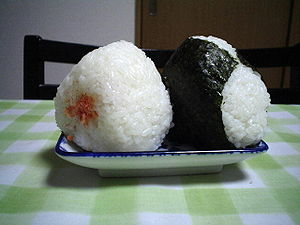
Japanese cuisine
Japanese cuisine has developed over the centuries as a result of many political and social changes throughout Japan. The cuisine eventually changed with the advent of the Medieval age which ushered in a shedding of elitism with the age of shogun rule...
made from white rice
White rice
White rice is the name given to milled rice that has had its husk, bran, and germ removed. This alters the flavour, texture and appearance of the rice and helps prevent spoilage and extend its storage life. After milling, the rice is polished, resulting in a seed with a bright, white, shiny...
formed into triangular or oval shapes and often wrapped in nori
Nori
is the Japanese name for various edible seaweed species of the red alga Porphyra including most notably P. yezoensis and P. tenera, sometimes called laver. Finished products are made by a shredding and rack-drying process that resembles papermaking...
(seaweed). Traditionally, an onigiri is filled with pickled ume
Ume
Prunus mume, with the common names including Chinese plum and Japanese apricot, is an Asian tree species classified in the Armeniaca section of the genus Prunus. The flower, long a beloved subject in the traditional painting of East Asia, is usually translated as plum blossom. This distinct tree...
(umeboshi
Umeboshi
Umeboshi are pickled ume fruits common in Japan. Ume is a species of fruit-bearing tree in the genus Prunus, which is often called a plum but is actually more closely related to the apricot. Umeboshi are a popular kind of tsukemono and are extremely sour and salty...
), salted salmon
Salmon
Salmon is the common name for several species of fish in the family Salmonidae. Several other fish in the same family are called trout; the difference is often said to be that salmon migrate and trout are resident, but this distinction does not strictly hold true...
, katsuobushi
Katsuobushi
is the Japanese name for dried, fermented, and smoked skipjack tuna .Shaved Katsuobushi and dried kelp - kombu - are the main ingredients of dashi, a broth that forms the basis of many soups and sauces in Japanese cuisine.Katsuobushi's distinct umami flavor comes from its high...
, kombu
Kombu
Kombu or konbu , also called dashima or haidai , is edible kelp from the family Laminariaceae widely eaten in East Asia....
, tarako
Tarako (food)
, in Japanese cuisine, is a salted roe food, usually made from Alaska pollock, although actually means cod in Japanese.Tarako is served in a number of ways:*Plain *As a filling for onigiri*As a pasta sauce...
, or any other salty or sour ingredient as a natural preservative
Preservative
A preservative is a naturally occurring or synthetically produced substance that is added to products such as foods, pharmaceuticals, paints, biological samples, wood, etc. to prevent decomposition by microbial growth or by undesirable chemical changes....
. Because of the popularity of onigiri in Japan
Japan
Japan is an island nation in East Asia. Located in the Pacific Ocean, it lies to the east of the Sea of Japan, China, North Korea, South Korea and Russia, stretching from the Sea of Okhotsk in the north to the East China Sea and Taiwan in the south...
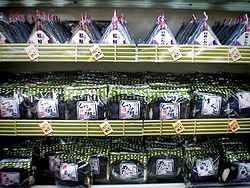
, most convenience store
Convenience store
A convenience store, corner store, corner shop, commonly called a bodega in Spanish-speaking areas of the United States, is a small store or shop in a built up area that stocks a range of everyday items such as groceries, toiletries, alcoholic and soft drinks, and may also offer money order and...
s stock their onigiri with various fillings and flavors. There are even specialized shops whose only products are onigiri for take out.
Overview
Sushi
is a Japanese food consisting of cooked vinegared rice combined with other ingredients . Neta and forms of sushi presentation vary, but the ingredient which all sushi have in common is shari...
. Onigiri is made with plain rice (sometimes lightly salted), while sushi is made of rice with vinegar
Vinegar
Vinegar is a liquid substance consisting mainly of acetic acid and water, the acetic acid being produced through the fermentation of ethanol by acetic acid bacteria. Commercial vinegar is produced either by fast or slow fermentation processes. Slow methods generally are used with traditional...
, sugar and salt. Onigiri makes rice portable and easy to eat as well as preserving it, while sushi originated as a way of preserving fish
Fish (food)
Fish is a food consumed by many species, including humans. The word "fish" refers to both the animal and to the food prepared from it. Fish has been an important source of protein for humans throughout recorded history.-Terminology:...
.
Onigiri are also found in many convenience stores in Hong Kong
Hong Kong
Hong Kong is one of two Special Administrative Regions of the People's Republic of China , the other being Macau. A city-state situated on China's south coast and enclosed by the Pearl River Delta and South China Sea, it is renowned for its expansive skyline and deep natural harbour...
, mainland China
Mainland China
Mainland China, the Chinese mainland or simply the mainland, is a geopolitical term that refers to the area under the jurisdiction of the People's Republic of China . According to the Taipei-based Mainland Affairs Council, the term excludes the PRC Special Administrative Regions of Hong Kong and...
, Taiwan
Taiwan
Taiwan , also known, especially in the past, as Formosa , is the largest island of the same-named island group of East Asia in the western Pacific Ocean and located off the southeastern coast of mainland China. The island forms over 99% of the current territory of the Republic of China following...
and South Korea
South Korea
The Republic of Korea , , is a sovereign state in East Asia, located on the southern portion of the Korean Peninsula. It is neighbored by the People's Republic of China to the west, Japan to the east, North Korea to the north, and the East China Sea and Republic of China to the south...
. In Korean
Korean language
Korean is the official language of the country Korea, in both South and North. It is also one of the two official languages in the Yanbian Korean Autonomous Prefecture in People's Republic of China. There are about 78 million Korean speakers worldwide. In the 15th century, a national writing...
, it is called "jumeok bap" (Hangul
Hangul
Hangul,Pronounced or ; Korean: 한글 Hangeul/Han'gŭl or 조선글 Chosŏn'gŭl/Joseongeul the Korean alphabet, is the native alphabet of the Korean language. It is a separate script from Hanja, the logographic Chinese characters which are also sometimes used to write Korean...
: 주먹밥) or "samgak gimbap
Gimbap
Gimbap or kimbap is a popular Korean dish made from steamed white rice and various other ingredients, rolled in gim and served in bite-size slices...
" (Hangul
Hangul
Hangul,Pronounced or ; Korean: 한글 Hangeul/Han'gŭl or 조선글 Chosŏn'gŭl/Joseongeul the Korean alphabet, is the native alphabet of the Korean language. It is a separate script from Hanja, the logographic Chinese characters which are also sometimes used to write Korean...
: 삼각김밥), literally "fist-rice" or "triangle-seaweed-rice," respectively.
History
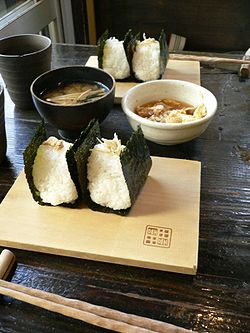
The Murasaki Shikibu Diary
The Diary of Lady Murasaki records the daily life of the Heian era lady-in-waiting and writer, Lady Murasaki Shikibu, author of The Tale of Genji...
, she writes of people eating rice balls. At that time, onigiri were called tonjiki and often consumed at outdoor picnic lunches. Other writings, dating back as far as the seventeenth century, state that many samurai
Samurai
is the term for the military nobility of pre-industrial Japan. According to translator William Scott Wilson: "In Chinese, the character 侍 was originally a verb meaning to wait upon or accompany a person in the upper ranks of society, and this is also true of the original term in Japanese, saburau...
stored rice
Rice
Rice is the seed of the monocot plants Oryza sativa or Oryza glaberrima . As a cereal grain, it is the most important staple food for a large part of the world's human population, especially in East Asia, Southeast Asia, South Asia, the Middle East, and the West Indies...
balls wrapped in bamboo
Bamboo
Bamboo is a group of perennial evergreens in the true grass family Poaceae, subfamily Bambusoideae, tribe Bambuseae. Giant bamboos are the largest members of the grass family....
leaves as a quick lunchtime meal during war, but the origins of onigiri are much earlier even than Lady Murasaki. Before the use of chopsticks
Chopsticks
Chopsticks are small, often tapered, sticks used in pairs of equal length as the traditional eating utensils of China and its diaspora, Japan, Korea, Vietnam and Northern provinces of Laos, Thailand and Burma. Generally believed to have originated in ancient China, they can also be found in some...
became widespread, in the Nara period
Nara period
The of the history of Japan covers the years from AD 710 to 794. Empress Gemmei established the capital of Heijō-kyō . Except for 5 years , when the capital was briefly moved again, it remained the capital of Japanese civilization until Emperor Kammu established a new capital, Nagaoka-kyō, in 784...
, rice was often rolled into a small ball so that it could be easily picked up. In the Heian period
Heian period
The is the last division of classical Japanese history, running from 794 to 1185. The period is named after the capital city of Heian-kyō, or modern Kyōto. It is the period in Japanese history when Buddhism, Taoism and other Chinese influences were at their height...
, rice was also made into small rectangular shapes known as tonjiki so that they could be piled onto a plate and easily eaten.
From the Kamakura period
Kamakura period
The is a period of Japanese history that marks the governance by the Kamakura Shogunate, officially established in 1192 in Kamakura by the first shogun Minamoto no Yoritomo....
to the early Edo period
Edo period
The , or , is a division of Japanese history which was ruled by the shoguns of the Tokugawa family, running from 1603 to 1868. The political entity of this period was the Tokugawa shogunate....
, onigiri was used as a quick meal. This made sense as cooks simply had to think about making enough onigiri and did not have to concern themselves with serving. These onigiri were simply balls of rice flavored with salt
Salt
In chemistry, salts are ionic compounds that result from the neutralization reaction of an acid and a base. They are composed of cations and anions so that the product is electrically neutral...
. Nori
Nori
is the Japanese name for various edible seaweed species of the red alga Porphyra including most notably P. yezoensis and P. tenera, sometimes called laver. Finished products are made by a shredding and rack-drying process that resembles papermaking...
did not become widely available until the Genroku era
Genroku
was a after Jōkyō and before Hōei. This period spanned the years from September 1688 through March 1704. The reigning emperor was .The years of Genroku are generally considered to be the Golden Age of the Edo Period. The previous hundred years of peace and seclusion in Japan had created relative...
in the mid-Edo period, when the farming of nori and fashioning it into sheets became widespread.
It was believed that onigiri could not be mass produced as the hand-rolling technique was considered too difficult for a machine to replicate. In the 1980s, however, a machine that made triangular onigiri was devised. This was initially met with skepticism because, rather than having the filling traditionally rolled inside, the flavoring was simply put into a hole in the onigiri, and the hole was hidden by nori. Since the onigiri made by this machine came with nori already applied to the rice ball, over time the nori became unpleasantly moist and sticky, clinging to the rice. A packaging improvement allowed the nori to be stored separately from the rice. Before eating, the diner could open the packet of nori and wrap the onigiri. The limitation of the machines that required using a hole for filling the onigiri instead of rolling the filling with the rice actually made new flavors of onigiri easier to produce as this cooking process did not require changes from ingredient to ingredient. Modern mechanically wrapped onigiri are specially folded so that the plastic wrapping is actually folded between the nori and rice to act as a moisture barrier. When the packaging is pulled open at both ends, the nori and rice come into contact.