

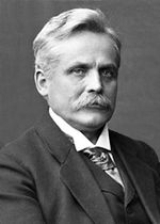
Wilhelm Wien

Encyclopedia
Wilhelm Carl Werner Otto Fritz Franz Wien (ˈviːn; 13 January 1864 – 30 August 1928) was a German physicist
who, in 1893, used theories about heat
and electromagnetism
to deduce Wien's displacement law
, which calculates the emission of a blackbody at any temperature from the emission at any one reference temperature.
He also formulated an expression for the black-body radiation which is correct in the photon-gas limit. His arguments were based on the notion of adiabatic invariance
, and were instrumental for the formulation of quantum mechanics
. Wien received the 1911 Nobel Prize for his work on heat radiation.
(now Primorsk, Russia) as the son of landowner Carl Wien. In 1866, his family moved to Drachstein, in Rastenburg
(Rastembork).
In 1879, Wien went to school in Rastenburg and from 1880-1882 he attended the city school of Heidelberg
. In 1882 he attended the University of Göttingen and the University of Berlin. From 1883-85, he worked in the laboratory of Hermann von Helmholtz
and, in 1886, he received his Ph.D.
with a thesis on the diffraction of light
upon metals and on the influence of various materials upon the color
of refracted light.
From 1896 to 1899, Wien lectured at the prestigious RWTH Aachen University.
In 1900 he went to the University of Würzburg
and became successor of Wilhelm Conrad Röntgen
.
, who was a colleague of Wien's, did not believe in empirical laws, so using electromagnetism and thermodynamics, he proposed a theoretical basis for Wien's law, which became the Wien-Planck law. However, Wien's law was only valid at high frequencies, and underestimated the radiancy at low frequencies. Planck corrected the theory and proposed what is now called Planck's law, which led to the development of quantum theory
. However, Wien's other empirical formulation , called Wien's displacement law
, is still very useful, as it relates the peak wavelength emitted by a body (λmax), to the temperature of the body (T). In 1900 (following the work of George Frederick Charles Searle
), he assumed that the entire mass of matter is of electromagnetic origin and proposed the formula for the relation between electromagnetic mass and electromagnetic energy.
While studying streams of ionized gas, Wien, in 1898, identified a positive particle equal in mass to the hydrogen
atom
. Wien, with this work, laid the foundation of mass spectrometry
. J. J. Thomson
refined Wien's apparatus and conducted further experiments in 1913 then, after work by Ernest Rutherford
in 1919, Wien's particle was accepted and named the proton
.
In 1911, Wien was awarded the Nobel Prize in Physics
for "for his discoveries regarding the laws governing the radiation of heat"
Physics
Physics is a natural science that involves the study of matter and its motion through spacetime, along with related concepts such as energy and force. More broadly, it is the general analysis of nature, conducted in order to understand how the universe behaves.Physics is one of the oldest academic...
who, in 1893, used theories about heat
Heat
In physics and thermodynamics, heat is energy transferred from one body, region, or thermodynamic system to another due to thermal contact or thermal radiation when the systems are at different temperatures. It is often described as one of the fundamental processes of energy transfer between...
and electromagnetism
Electromagnetism
Electromagnetism is one of the four fundamental interactions in nature. The other three are the strong interaction, the weak interaction and gravitation...
to deduce Wien's displacement law
Wien's displacement law
Wien's displacement law states that the wavelength distribution of thermal radiation from a black body at any temperature has essentially the same shape as the distribution at any other temperature, except that each wavelength is displaced on the graph...
, which calculates the emission of a blackbody at any temperature from the emission at any one reference temperature.
He also formulated an expression for the black-body radiation which is correct in the photon-gas limit. His arguments were based on the notion of adiabatic invariance
Adiabatic invariant
An adiabatic invariant is a property of a physical system that stays constant when changes occur slowly.In thermodynamics, an adiabatic process is a change that occurs without heat flow, and slowly compared to the time to reach equilibrium. In an adiabatic process, the system is in equilibrium at...
, and were instrumental for the formulation of quantum mechanics
Quantum mechanics
Quantum mechanics, also known as quantum physics or quantum theory, is a branch of physics providing a mathematical description of much of the dual particle-like and wave-like behavior and interactions of energy and matter. It departs from classical mechanics primarily at the atomic and subatomic...
. Wien received the 1911 Nobel Prize for his work on heat radiation.
Early years
Wien was born at Gaffken near Fischhausen (Rybaki), Province of PrussiaProvince of Prussia
The Province of Prussia was a province of the Kingdom of Prussia from 1829-1878 created out of the provinces of East Prussia and West Prussia....
(now Primorsk, Russia) as the son of landowner Carl Wien. In 1866, his family moved to Drachstein, in Rastenburg
Ketrzyn
Kętrzyn , is a town in northeastern Poland with 28,351 inhabitants . Situated in the Warmian-Masurian Voivodeship , Kętrzyn was previously in Olsztyn Voivodeship . It is the capital of Kętrzyn County...
(Rastembork).
In 1879, Wien went to school in Rastenburg and from 1880-1882 he attended the city school of Heidelberg
Heidelberg
-Early history:Between 600,000 and 200,000 years ago, "Heidelberg Man" died at nearby Mauer. His jaw bone was discovered in 1907; with scientific dating, his remains were determined to be the earliest evidence of human life in Europe. In the 5th century BC, a Celtic fortress of refuge and place of...
. In 1882 he attended the University of Göttingen and the University of Berlin. From 1883-85, he worked in the laboratory of Hermann von Helmholtz
Hermann von Helmholtz
Hermann Ludwig Ferdinand von Helmholtz was a German physician and physicist who made significant contributions to several widely varied areas of modern science...
and, in 1886, he received his Ph.D.
Doctor of Philosophy
Doctor of Philosophy, abbreviated as Ph.D., PhD, D.Phil., or DPhil , in English-speaking countries, is a postgraduate academic degree awarded by universities...
with a thesis on the diffraction of light
Light
Light or visible light is electromagnetic radiation that is visible to the human eye, and is responsible for the sense of sight. Visible light has wavelength in a range from about 380 nanometres to about 740 nm, with a frequency range of about 405 THz to 790 THz...
upon metals and on the influence of various materials upon the color
Color
Color or colour is the visual perceptual property corresponding in humans to the categories called red, green, blue and others. Color derives from the spectrum of light interacting in the eye with the spectral sensitivities of the light receptors...
of refracted light.
From 1896 to 1899, Wien lectured at the prestigious RWTH Aachen University.
In 1900 he went to the University of Würzburg
University of Würzburg
The University of Würzburg is a university in Würzburg, Germany, founded in 1402. The university is a member of the distinguished Coimbra Group.-Name:...
and became successor of Wilhelm Conrad Röntgen
Wilhelm Conrad Röntgen
Wilhelm Conrad Röntgen was a German physicist, who, on 8 November 1895, produced and detected electromagnetic radiation in a wavelength range today known as X-rays or Röntgen rays, an achievement that earned him the first Nobel Prize in Physics in 1901....
.
Career
In 1896 Wien empirically determined a distribution law of blackbody radiation, later named after him: Wien's law. Max PlanckMax Planck
Max Karl Ernst Ludwig Planck, ForMemRS, was a German physicist who actualized the quantum physics, initiating a revolution in natural science and philosophy. He is regarded as the founder of the quantum theory, for which he received the Nobel Prize in Physics in 1918.-Life and career:Planck came...
, who was a colleague of Wien's, did not believe in empirical laws, so using electromagnetism and thermodynamics, he proposed a theoretical basis for Wien's law, which became the Wien-Planck law. However, Wien's law was only valid at high frequencies, and underestimated the radiancy at low frequencies. Planck corrected the theory and proposed what is now called Planck's law, which led to the development of quantum theory
Quantum mechanics
Quantum mechanics, also known as quantum physics or quantum theory, is a branch of physics providing a mathematical description of much of the dual particle-like and wave-like behavior and interactions of energy and matter. It departs from classical mechanics primarily at the atomic and subatomic...
. However, Wien's other empirical formulation
, called Wien's displacement lawWien's displacement law
Wien's displacement law states that the wavelength distribution of thermal radiation from a black body at any temperature has essentially the same shape as the distribution at any other temperature, except that each wavelength is displaced on the graph...
, is still very useful, as it relates the peak wavelength emitted by a body (λmax), to the temperature of the body (T). In 1900 (following the work of George Frederick Charles Searle
George Frederick Charles Searle
George Frederick Charles Searle was a British physicist and teacher, and a Fellow of the Royal Society.-Biography:Searle was born in Oakington, Cambridgeshire, England....
), he assumed that the entire mass of matter is of electromagnetic origin and proposed the formula
for the relation between electromagnetic mass and electromagnetic energy.While studying streams of ionized gas, Wien, in 1898, identified a positive particle equal in mass to the hydrogen
Hydrogen
Hydrogen is the chemical element with atomic number 1. It is represented by the symbol H. With an average atomic weight of , hydrogen is the lightest and most abundant chemical element, constituting roughly 75% of the Universe's chemical elemental mass. Stars in the main sequence are mainly...
atom
Atom
The atom is a basic unit of matter that consists of a dense central nucleus surrounded by a cloud of negatively charged electrons. The atomic nucleus contains a mix of positively charged protons and electrically neutral neutrons...
. Wien, with this work, laid the foundation of mass spectrometry
Mass spectrometry
Mass spectrometry is an analytical technique that measures the mass-to-charge ratio of charged particles.It is used for determining masses of particles, for determining the elemental composition of a sample or molecule, and for elucidating the chemical structures of molecules, such as peptides and...
. J. J. Thomson
J. J. Thomson
Sir Joseph John "J. J." Thomson, OM, FRS was a British physicist and Nobel laureate. He is credited for the discovery of the electron and of isotopes, and the invention of the mass spectrometer...
refined Wien's apparatus and conducted further experiments in 1913 then, after work by Ernest Rutherford
Ernest Rutherford
Ernest Rutherford, 1st Baron Rutherford of Nelson OM, FRS was a New Zealand-born British chemist and physicist who became known as the father of nuclear physics...
in 1919, Wien's particle was accepted and named the proton
Proton
The proton is a subatomic particle with the symbol or and a positive electric charge of 1 elementary charge. One or more protons are present in the nucleus of each atom, along with neutrons. The number of protons in each atom is its atomic number....
.
In 1911, Wien was awarded the Nobel Prize in Physics
Nobel Prize in Physics
The Nobel Prize in Physics is awarded once a year by the Royal Swedish Academy of Sciences. It is one of the five Nobel Prizes established by the will of Alfred Nobel in 1895 and awarded since 1901; the others are the Nobel Prize in Chemistry, Nobel Prize in Literature, Nobel Peace Prize, and...
for "for his discoveries regarding the laws governing the radiation of heat"
See also
- Wien's distribution law
- History of special relativityHistory of special relativityThe history of special relativity consists of many theoretical results and empirical findings obtained by Albert Michelson, Hendrik Lorentz, Henri Poincaré and others...
- Mass–energy equivalence
Publications
- Lehrbuch der Hydrodynamik (1900)
- Aus dem Leben und Wirken eines Physikers (1930, memoir)