

Odometer

Encyclopedia
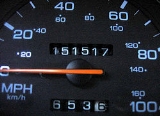
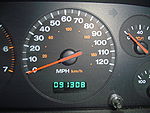
An odometer or odograph is an instrument that indicates distance
traveled by a vehicle, such as a bicycle or automobile. The device may be electronic, mechanical, or a combination of the two. The word derives from the Greek
words hodós ("path" or "gateway") and métron ("measure"). In countries where Imperial units or US customary units are used, it is sometimes called a mileometer or milometer, or, colloquially, a tripometer.
(NH 6. 61-62) and Strabo
(11.8.9). Both authors list the distances of routes traveled by Alexander the Great (r. 336-323 BC) as measured by his bematist
s Diognetus and Baeton. However, the high precision of the bematists's measurements rather indicates the use of a mechanical device. For example, the section between the cities Hecatompylos and Alexandria Areion, which later became a part of the silk road
, was given by Alexander's bematists as 529 English miles
long, that is with a deviation of 0.4% from the actual distance (531 English miles). From the nine surviving bematists' measurements in Pliny's Naturalis Historia eight show a deviation of less than 5% from the actual distance, three of them being within 1%. Since these minor discrepancies can be adequately explained by slight changes in the tracks of roads during the last 2300 years, the overall accuracy of the measurements implies that the bematists already must have used a sophisticated device for measuring distances, although there is no direct mentioning of such a device.
An odometer for measuring distance was first described by Vitruvius
around 27 and 23 BC, although the actual inventor may have been Archimedes of Syracuse (c. 287 BC – c. 212 BC) during the First Punic War
. Hero of Alexandria
(10 AD - 70 AD) describes a similar device in chapter 34 of his Dioptra. The machine was also used in the time of Roman Emperor Commodus
(c. 192 AD), although after this point in time there seems to be a gap between its use in Roman times and that of the 15th century in Western Europe. Some researchers have speculated that the device might have included technology similar to that of the Greek Antikythera mechanism
.
The odometer of Vitruvius was based on chariot wheels of 4 feet (1.2 m) diameter turning 400 times in one Roman mile
(about 1400 m). For each revolution a pin on the axle engaged a 400 tooth cogwheel thus turning it one complete revolution per mile. This engaged another gear with holes along the circumference, where pebbles (calculus
) were located, that were to drop one by one into a box. The distance traveled would thus be given simply by counting the number of pebbles. Whether this instrument was ever built at the time is disputed. Leonardo da Vinci
later tried to build it himself according to the description, but failed. However, in 1981 engineer Andre Sleewyck built his own replica, replacing the square-toothed gear designs of da Vinci with the triangular, pointed teeth found in the Antikythera mechanism. With this modification, the Vitruvius odometer functioned perfectly.
 The odometer was also later invented in ancient China, possibly by the profuse inventor and early scientist Zhang Heng
(78 AD – 139 AD) of the Han Dynasty
(202 BC–220 AD). Zhang Heng is often accredited with the invention of the first odometer device in China. By the 3rd century (during the Three Kingdoms
Period), the Chinese had termed the device as the 'jì lĭ gŭ chē' (記里鼓車) , or 'li
-recording drum carriage' (Note: the modern measurement of li = 500 m/1640 ft). Chinese texts of the 3rd century tell of the mechanical carriage's functions, and as one li is traversed, a mechanical-driven wooden figure strikes a drum, and when ten li is traversed, another wooden figure would strike a gong or a bell with its mechanical-operated arm.
Despite its association with Zhang Heng or even the later Ma Jun
(c. 200–265), there is evidence to suggest that the invention of the odometer was a gradual process in Han Dynasty China that centered around the huang men court people (i.e. eunuchs, palace officials, attendants and familiars, actors, acrobats, etc.) that would follow the musical procession of the royal 'drum-chariot'. The historian Joseph Needham
asserts that it is no surprise this social group would have been responsible for such a device, since there is already other evidence of their craftsmenship with mechanical toys to delight the emperor and the court. There is speculation that some time in the 1st century BC (during the Western Han Dynasty), the beating of drums and gongs were mechanically-driven by working automatically off the rotation of the road-wheels. This might have actually been the design of one Loxia Hong (c. 110 BC), yet by 125 AD the mechanical odometer carriage in China was already known (depicted in a mural of the Xiao Tang Shan Tomb).
The odometer was used also in subsequent periods of Chinese history. In the historical text of the Jin Shu (635 AD), the oldest part of the compiled text, the book known as the Cui Bao (c. 300 AD), recorded the use of the odometer, providing description (and interestingly enough attributing it to the Western Han era, from 202 BC–9 AD). The passage in the Jin Shu expanded upon this, explaining that it took a similar form to the mechanical device of the South Pointing Chariot
invented by Ma Jun
(200–265, see also differential gear). As recorded in the Song Shi of the Song Dynasty
(960-1279 AD), the odometer and South Pointing Chariot were combined into one wheeled device by engineers of the 9th century, 11th century, and 12th century (refer to South Pointing Chariot
). The Sun Tzu Suan Ching (Master Sun's Mathematical Manual), dated from the 3rd century to 5th century, presented a mathematical problem for students involving the odometer. It involved a given distance between two cities, the small distance needed for one rotation of the carriage's wheel, and the posed question of how many rotations the wheels would have in all if the carriage was to travel between point A and B.
(960–1279), also mentioned the odometer used in that period. However, unlike written sources of earlier periods, it provided a much more thoroughly detailed description of the device that harkens back to its ancient form (Wade-Giles
spelling):
What follows is a long dissertation made by the Chief Chamberlain Lu Daolong on the ranging measurements and sizes of wheels and gears, along with a concluding description at the end of how the device ultimately functions:
[Note: the measurement of the Chinese-mile unit, the li, was changed over time, as the li in Song times differed from the length of a li in Han times.]
invented the pascaline. Though not an odometer, the pascaline utilized gears to compute measurements. Each gear contained 10 teeth. The first gear advanced the next gear one position when moved one complete revolution, the same principle employed on modern mechanical odometers.
Odometers were developed for ships in 1698 with the odometer invented by the Englishman Thomas Savery
. Benjamin Franklin
, U.S. statesman and the first Postmaster General
, built a prototype odometer in 1775 that he attached to his carriage to help measure the mileage of postal routes. In 1847, William Clayton, a Mormon pioneer, invented the Roadometer, which he attached to a wagon used by American settlers heading west. The Roadometer recorded the distance traveled each day by the wagon trains. The Roadometer used two gears and was an early example of an odometer with pascaline-style gears in actual use.
In 1895 Curtis Hussey Veeder invented the Cyclometer. The Cyclometer was a mechanical device that counted the number of rotations of a bicycle wheel. A flexible cable transmitted the number of rotations of the wheel to an analog odometer visible to the rider, which converted the wheel rotations into the number of miles traveled according to a predetermined formula.
In 1903 Arthur P.
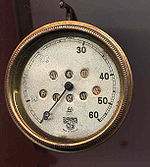
and Charles H. Warner, two brothers from Beloit, Wisconsin, introduced their patented Auto-meter. The Auto-Meter used a magnet attached to a rotating shaft to induce a magnetic pull upon a thin metal disk. Measuring this pull provided accurate measurements of both distance and speed information to automobile drivers in a single instrument. The Warners sold their company in 1912 to the Stewart & Clark Company of Chicago. The new firm was renamed the Stewart-Warner Corporation. By 1925, Stewart-Warner odometers and trip meters were standard equipment on the vast majority of automobiles and motorcycles manufactured in the United States.
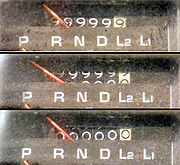 Most modern cars include a trip meter (trip odometer). Unlike the odometer, a trip meter is reset at any point in a journey, making it possible to record the distance traveled in any particular journey or part of a journey. It was traditionally a purely mechanical device but, in most modern vehicles, it is now electronic. Luxury vehicles often have multiple trip meters. Most trip meters will show a maximum value of 999.9. The trip meter may be used to record the distance traveled on each tank of fuel, making it very easy to accurately track the energy efficiency of the vehicle; another common use is resetting it to zero at each instruction in a sequence of driving directions, to be sure when one has arrived at the next turn.
is to tamper with the reading on an odometer; this is often referred to as clocking. This is done to make a car appear to have been driven less than it really has been, and thus increase its apparent market value. Many new cars sold today use digital
odometers that store the mileage in the vehicle's engine control module making it difficult (but not impossible) to manipulate the mileage electronically. With mechanical odometers, the speedometer
can be removed from the car dash board and the digits wound back, or the drive cable can be disconnected and connected to another odometer/speedometer pair while on the road. Modern odometers now add mileage driven in reverse to the total as if driven forward, to accurately reflect the true total wear and tear on the vehicle (older vehicles could be driven in reverse to subtract mileage).
The resale value of a vehicle is often strongly influenced by the number of miles or kilometres a passenger vehicle has on the odometer, yet odometers are inherently insecure because they are under the control of their owners. Many jurisdictions have chosen to enact laws which penalize people who are found to commit odometer fraud
. In the US (and many other countries), vehicle mechanics are also required to keep records of the odometer any time a vehicle is serviced. Companies such as Carfax
then use this data to help potential car buyers detect whether odometer rollback has occurred.
receiver (GPSr
) with an odometer mode serves as a very accurate pedometer
for outdoor activities. While not truly counting steps (no pendulum
is involved) an advanced GPS odometer can accurately reveal the distance traveled to within 1/100 of a mile
(depending on the model, perhaps 1/1000 of a mile). 1/1000 of a mile is approximately the distance of a single pace or 2 steps (1.609 m). Precise metric odometers have a precision of 1/100 or 1/1000 km, 10 or 1 metre(s) respectively.
A GPS with odometer mode is also an excellent and inexpensive means to verify proper operation of both the speedometer and odometer mounted in a vehicle.
collected per distance unit of travel. This may become increasingly important with the increasing presence of gas burning vehicles & very fuel efficient electric models.
Distance
Distance is a numerical description of how far apart objects are. In physics or everyday discussion, distance may refer to a physical length, or an estimation based on other criteria . In mathematics, a distance function or metric is a generalization of the concept of physical distance...
traveled by a vehicle, such as a bicycle or automobile. The device may be electronic, mechanical, or a combination of the two. The word derives from the Greek
Ancient Greek
Ancient Greek is the stage of the Greek language in the periods spanning the times c. 9th–6th centuries BC, , c. 5th–4th centuries BC , and the c. 3rd century BC – 6th century AD of ancient Greece and the ancient world; being predated in the 2nd millennium BC by Mycenaean Greek...
words hodós ("path" or "gateway") and métron ("measure"). In countries where Imperial units or US customary units are used, it is sometimes called a mileometer or milometer, or, colloquially, a tripometer.
History
Classical Era
Possibly the first evidence for the use of an odometer can be found in the works of PlinyPliny the Elder
Gaius Plinius Secundus , better known as Pliny the Elder, was a Roman author, naturalist, and natural philosopher, as well as naval and army commander of the early Roman Empire, and personal friend of the emperor Vespasian...
(NH 6. 61-62) and Strabo
Strabo
Strabo, also written Strabon was a Greek historian, geographer and philosopher.-Life:Strabo was born to an affluent family from Amaseia in Pontus , a city which he said was situated the approximate equivalent of 75 km from the Black Sea...
(11.8.9). Both authors list the distances of routes traveled by Alexander the Great (r. 336-323 BC) as measured by his bematist
Bematist
Bematists , were specialists in ancient Greece who were trained to measure distances by counting their steps.-Measurements of Alexander's bematists:...
s Diognetus and Baeton. However, the high precision of the bematists's measurements rather indicates the use of a mechanical device. For example, the section between the cities Hecatompylos and Alexandria Areion, which later became a part of the silk road
Silk Road
The Silk Road or Silk Route refers to a historical network of interlinking trade routes across the Afro-Eurasian landmass that connected East, South, and Western Asia with the Mediterranean and European world, as well as parts of North and East Africa...
, was given by Alexander's bematists as 529 English miles
Mile
A mile is a unit of length, most commonly 5,280 feet . The mile of 5,280 feet is sometimes called the statute mile or land mile to distinguish it from the nautical mile...
long, that is with a deviation of 0.4% from the actual distance (531 English miles). From the nine surviving bematists' measurements in Pliny's Naturalis Historia eight show a deviation of less than 5% from the actual distance, three of them being within 1%. Since these minor discrepancies can be adequately explained by slight changes in the tracks of roads during the last 2300 years, the overall accuracy of the measurements implies that the bematists already must have used a sophisticated device for measuring distances, although there is no direct mentioning of such a device.
An odometer for measuring distance was first described by Vitruvius
Vitruvius
Marcus Vitruvius Pollio was a Roman writer, architect and engineer, active in the 1st century BC. He is best known as the author of the multi-volume work De Architectura ....
around 27 and 23 BC, although the actual inventor may have been Archimedes of Syracuse (c. 287 BC – c. 212 BC) during the First Punic War
First Punic War
The First Punic War was the first of three wars fought between Ancient Carthage and the Roman Republic. For 23 years, the two powers struggled for supremacy in the western Mediterranean Sea, primarily on the Mediterranean island of Sicily and its surrounding waters but also to a lesser extent in...
. Hero of Alexandria
Hero of Alexandria
Hero of Alexandria was an ancient Greek mathematician and engineerEnc. Britannica 2007, "Heron of Alexandria" who was active in his native city of Alexandria, Roman Egypt...
(10 AD - 70 AD) describes a similar device in chapter 34 of his Dioptra. The machine was also used in the time of Roman Emperor Commodus
Commodus
Commodus , was Roman Emperor from 180 to 192. He also ruled as co-emperor with his father Marcus Aurelius from 177 until his father's death in 180. His name changed throughout his reign; see changes of name for earlier and later forms. His accession as emperor was the first time a son had succeeded...
(c. 192 AD), although after this point in time there seems to be a gap between its use in Roman times and that of the 15th century in Western Europe. Some researchers have speculated that the device might have included technology similar to that of the Greek Antikythera mechanism
Antikythera mechanism
The Antikythera mechanism is an ancient mechanical computer designed to calculate astronomical positions. It was recovered in 1900–1901 from the Antikythera wreck. Its significance and complexity were not understood until decades later. Its time of construction is now estimated between 150 and 100...
.
The odometer of Vitruvius was based on chariot wheels of 4 feet (1.2 m) diameter turning 400 times in one Roman mile
Mile
A mile is a unit of length, most commonly 5,280 feet . The mile of 5,280 feet is sometimes called the statute mile or land mile to distinguish it from the nautical mile...
(about 1400 m). For each revolution a pin on the axle engaged a 400 tooth cogwheel thus turning it one complete revolution per mile. This engaged another gear with holes along the circumference, where pebbles (calculus
Calculus
Calculus is a branch of mathematics focused on limits, functions, derivatives, integrals, and infinite series. This subject constitutes a major part of modern mathematics education. It has two major branches, differential calculus and integral calculus, which are related by the fundamental theorem...
) were located, that were to drop one by one into a box. The distance traveled would thus be given simply by counting the number of pebbles. Whether this instrument was ever built at the time is disputed. Leonardo da Vinci
Leonardo da Vinci
Leonardo di ser Piero da Vinci was an Italian Renaissance polymath: painter, sculptor, architect, musician, scientist, mathematician, engineer, inventor, anatomist, geologist, cartographer, botanist and writer whose genius, perhaps more than that of any other figure, epitomized the Renaissance...
later tried to build it himself according to the description, but failed. However, in 1981 engineer Andre Sleewyck built his own replica, replacing the square-toothed gear designs of da Vinci with the triangular, pointed teeth found in the Antikythera mechanism. With this modification, the Vitruvius odometer functioned perfectly.
Ancient China
Zhang Heng
Zhang Heng was a Chinese astronomer, mathematician, inventor, geographer, cartographer, artist, poet, statesman, and literary scholar from Nanyang, Henan. He lived during the Eastern Han Dynasty of China. He was educated in the capital cities of Luoyang and Chang'an, and began his career as a...
(78 AD – 139 AD) of the Han Dynasty
Han Dynasty
The Han Dynasty was the second imperial dynasty of China, preceded by the Qin Dynasty and succeeded by the Three Kingdoms . It was founded by the rebel leader Liu Bang, known posthumously as Emperor Gaozu of Han. It was briefly interrupted by the Xin Dynasty of the former regent Wang Mang...
(202 BC–220 AD). Zhang Heng is often accredited with the invention of the first odometer device in China. By the 3rd century (during the Three Kingdoms
Three Kingdoms
The Three Kingdoms period was a period in Chinese history, part of an era of disunity called the "Six Dynasties" following immediately the loss of de facto power of the Han Dynasty rulers. In a strict academic sense it refers to the period between the foundation of the state of Wei in 220 and the...
Period), the Chinese had termed the device as the 'jì lĭ gŭ chē' (記里鼓車) , or 'li
Li (unit)
The li is a traditional Chinese unit of distance, which has varied considerably over time but now has a standardized length of 500 meters or half a kilometer...
-recording drum carriage' (Note: the modern measurement of li = 500 m/1640 ft). Chinese texts of the 3rd century tell of the mechanical carriage's functions, and as one li is traversed, a mechanical-driven wooden figure strikes a drum, and when ten li is traversed, another wooden figure would strike a gong or a bell with its mechanical-operated arm.
Despite its association with Zhang Heng or even the later Ma Jun
Ma Jun
Ma Jun , style name Deheng , was a Chinese mechanical engineer and government official during the Three Kingdoms era of China...
(c. 200–265), there is evidence to suggest that the invention of the odometer was a gradual process in Han Dynasty China that centered around the huang men court people (i.e. eunuchs, palace officials, attendants and familiars, actors, acrobats, etc.) that would follow the musical procession of the royal 'drum-chariot'. The historian Joseph Needham
Joseph Needham
Noel Joseph Terence Montgomery Needham, CH, FRS, FBA , also known as Li Yuese , was a British scientist, historian and sinologist known for his scientific research and writing on the history of Chinese science. He was elected a fellow of the Royal Society in 1941, and as a fellow of the British...
asserts that it is no surprise this social group would have been responsible for such a device, since there is already other evidence of their craftsmenship with mechanical toys to delight the emperor and the court. There is speculation that some time in the 1st century BC (during the Western Han Dynasty), the beating of drums and gongs were mechanically-driven by working automatically off the rotation of the road-wheels. This might have actually been the design of one Loxia Hong (c. 110 BC), yet by 125 AD the mechanical odometer carriage in China was already known (depicted in a mural of the Xiao Tang Shan Tomb).
The odometer was used also in subsequent periods of Chinese history. In the historical text of the Jin Shu (635 AD), the oldest part of the compiled text, the book known as the Cui Bao (c. 300 AD), recorded the use of the odometer, providing description (and interestingly enough attributing it to the Western Han era, from 202 BC–9 AD). The passage in the Jin Shu expanded upon this, explaining that it took a similar form to the mechanical device of the South Pointing Chariot
South Pointing Chariot
The south-pointing chariot was an ancient Chinese two-wheeled vehicle that carried a movable pointer to indicate the south, no matter how the chariot turned. Usually, the pointer took the form of a doll or figure with an outstretched arm...
invented by Ma Jun
Ma Jun
Ma Jun , style name Deheng , was a Chinese mechanical engineer and government official during the Three Kingdoms era of China...
(200–265, see also differential gear). As recorded in the Song Shi of the Song Dynasty
Song Dynasty
The Song Dynasty was a ruling dynasty in China between 960 and 1279; it succeeded the Five Dynasties and Ten Kingdoms Period, and was followed by the Yuan Dynasty. It was the first government in world history to issue banknotes or paper money, and the first Chinese government to establish a...
(960-1279 AD), the odometer and South Pointing Chariot were combined into one wheeled device by engineers of the 9th century, 11th century, and 12th century (refer to South Pointing Chariot
South Pointing Chariot
The south-pointing chariot was an ancient Chinese two-wheeled vehicle that carried a movable pointer to indicate the south, no matter how the chariot turned. Usually, the pointer took the form of a doll or figure with an outstretched arm...
). The Sun Tzu Suan Ching (Master Sun's Mathematical Manual), dated from the 3rd century to 5th century, presented a mathematical problem for students involving the odometer. It involved a given distance between two cities, the small distance needed for one rotation of the carriage's wheel, and the posed question of how many rotations the wheels would have in all if the carriage was to travel between point A and B.
Song Dynasty odometer
The historical text of the Song Shi (1345 AD), recording the people and events of the Chinese Song DynastySong Dynasty
The Song Dynasty was a ruling dynasty in China between 960 and 1279; it succeeded the Five Dynasties and Ten Kingdoms Period, and was followed by the Yuan Dynasty. It was the first government in world history to issue banknotes or paper money, and the first Chinese government to establish a...
(960–1279), also mentioned the odometer used in that period. However, unlike written sources of earlier periods, it provided a much more thoroughly detailed description of the device that harkens back to its ancient form (Wade-Giles
Wade-Giles
Wade–Giles , sometimes abbreviated Wade, is a romanization system for the Mandarin Chinese language. It developed from a system produced by Thomas Wade during the mid-19th century , and was given completed form with Herbert Giles' Chinese–English dictionary of 1892.Wade–Giles was the most...
spelling):
The odometer. [The mile-measuring carriage] is painted red, with pictures of flowers and birds on the four sides, and constructed in two storeys, handsomely adorned with carvings. At the completion of every li, the wooden figure of a man in the lower storey strikes a drum; at the completion of every ten li, the wooden figure in the upper storey strikes a bell. The carriage-pole ends in a phoenix-head, and the carriage is drawn by four horses. The escort was formerly of 18 men, but in the 4th year of the Yung-Hsi reign-period (987 AD) the emperor Thai Tsung increased it to 30. In the 5th year of the Thien-Sheng reign-period (1027 AD) the Chief Chamberlain Lu Tao-lung presented specifications for the construction of odometers as follows:
What follows is a long dissertation made by the Chief Chamberlain Lu Daolong on the ranging measurements and sizes of wheels and gears, along with a concluding description at the end of how the device ultimately functions:
The vehicle should have a single pole and two wheels. On the body are two storeys, each containing a carved wooden figure holding a drumstick. The road-wheels are each 6 ft in diameter, and 18 ft in circumference, one evolution covering 3 paces. According to ancient standards the pace was equal to 6 ft and 300 paces to a li; but now the li is reckoned as 360 paces of 5 ft each.
[Note: the measurement of the Chinese-mile unit, the li, was changed over time, as the li in Song times differed from the length of a li in Han times.]
The vehicle wheel (li lun) is attached to the left road-wheel; it has a diameter of 1.38 ft with a circumference of 4.14 ft, and has 18 cogs (chhih) 2.3 inches apart. There is also a lower horizontal wheel (hsia phing lun), of diameter 4.14 ft and circumference 12.42 ft, with 54 cogs, the same distance apart as those on the vertical wheel (2.3 inches). (This engages with the former.)
Upon a vertical shaft turning with this wheel, there is fixed a bronze "turning-like-the-wind wheel" (hsuan feng lun) which has (only) 3 cogs, the distance between these being 1.2 inches. (This turns the following one.) In the middle is a horizontal wheel, 4 ft in diameter, and 12 ft circumference, with 100 cogs, the distance between these cogs being the same as on the "turning-like-the-wind wheel" (1.2 inches).
Next, there is fixed (on the same shaft) a small horizontal wheel (hsiao phing lun) 3.3 inches in diameter and 1 ft in circumference, having 10 cogs 1.5 inches apart. (Engaging with this) there is an upper horizontal wheel (shang phing lun) having a diameter of 3.3 ft and a circumference of 10 ft, with 100 cogs, the same distance apart as those of the small horizontal wheel (1.5 inches).
When the middle horizontal wheel has made 1 revolution, the carriage will have gone 1 li and the wooden figure in the lower story will strike the drum. When the upper horizontal wheel has made 1 revolution, the carriage will have gone 10 li and the figure in the upper storey will strike the bell. The number of wheels used, great and small, is 8 inches in all, with a total of 285 teeth. Thus the motion is transmitted as if by the links of a chain, the "dog-teeth" mutually engaging with each other, so that by due revolution everything comes back to its original starting point (ti hsiang kou so, chhuan ya hsiang chih, chou erh fu shih).
Subsequent Developments
Odometers were first developed in the 1600s for wagons and other horse-drawn vehicles in order to measure distances traveled. In 1645 Blaise PascalBlaise Pascal
Blaise Pascal , was a French mathematician, physicist, inventor, writer and Catholic philosopher. He was a child prodigy who was educated by his father, a tax collector in Rouen...
invented the pascaline. Though not an odometer, the pascaline utilized gears to compute measurements. Each gear contained 10 teeth. The first gear advanced the next gear one position when moved one complete revolution, the same principle employed on modern mechanical odometers.
Odometers were developed for ships in 1698 with the odometer invented by the Englishman Thomas Savery
Thomas Savery
Thomas Savery was an English inventor, born at Shilstone, a manor house near Modbury, Devon, England.-Career:Savery became a military engineer, rising to the rank of Captain by 1702, and spent his free time performing experiments in mechanics...
. Benjamin Franklin
Benjamin Franklin
Dr. Benjamin Franklin was one of the Founding Fathers of the United States. A noted polymath, Franklin was a leading author, printer, political theorist, politician, postmaster, scientist, musician, inventor, satirist, civic activist, statesman, and diplomat...
, U.S. statesman and the first Postmaster General
United States Postmaster General
The United States Postmaster General is the Chief Executive Officer of the United States Postal Service. The office, in one form or another, is older than both the United States Constitution and the United States Declaration of Independence...
, built a prototype odometer in 1775 that he attached to his carriage to help measure the mileage of postal routes. In 1847, William Clayton, a Mormon pioneer, invented the Roadometer, which he attached to a wagon used by American settlers heading west. The Roadometer recorded the distance traveled each day by the wagon trains. The Roadometer used two gears and was an early example of an odometer with pascaline-style gears in actual use.
In 1895 Curtis Hussey Veeder invented the Cyclometer. The Cyclometer was a mechanical device that counted the number of rotations of a bicycle wheel. A flexible cable transmitted the number of rotations of the wheel to an analog odometer visible to the rider, which converted the wheel rotations into the number of miles traveled according to a predetermined formula.
In 1903 Arthur P.
Arthur Pratt Warner
Arthur Pratt Warner was primarily known for his successes as an inventor, businessman, and pioneer aviator. He claimed such inventions as the electric brake and the speedometer. He was born in Jacksonville, Florida. His family lived in Wisconsin from 1871 to 1877, returned to the state in 1881,...
and Charles H. Warner, two brothers from Beloit, Wisconsin, introduced their patented Auto-meter. The Auto-Meter used a magnet attached to a rotating shaft to induce a magnetic pull upon a thin metal disk. Measuring this pull provided accurate measurements of both distance and speed information to automobile drivers in a single instrument. The Warners sold their company in 1912 to the Stewart & Clark Company of Chicago. The new firm was renamed the Stewart-Warner Corporation. By 1925, Stewart-Warner odometers and trip meters were standard equipment on the vast majority of automobiles and motorcycles manufactured in the United States.
Trip meters
Clocking and legality
A common form of fraudFraud
In criminal law, a fraud is an intentional deception made for personal gain or to damage another individual; the related adjective is fraudulent. The specific legal definition varies by legal jurisdiction. Fraud is a crime, and also a civil law violation...
is to tamper with the reading on an odometer; this is often referred to as clocking. This is done to make a car appear to have been driven less than it really has been, and thus increase its apparent market value. Many new cars sold today use digital
Digital
A digital system is a data technology that uses discrete values. By contrast, non-digital systems use a continuous range of values to represent information...
odometers that store the mileage in the vehicle's engine control module making it difficult (but not impossible) to manipulate the mileage electronically. With mechanical odometers, the speedometer
Speedometer
A speedometer is a gauge that measures and displays the instantaneous speed of a land vehicle. Now universally fitted to motor vehicles, they started to be available as options in the 1900s, and as standard equipment from about 1910 onwards. Speedometers for other vehicles have specific names...
can be removed from the car dash board and the digits wound back, or the drive cable can be disconnected and connected to another odometer/speedometer pair while on the road. Modern odometers now add mileage driven in reverse to the total as if driven forward, to accurately reflect the true total wear and tear on the vehicle (older vehicles could be driven in reverse to subtract mileage).
The resale value of a vehicle is often strongly influenced by the number of miles or kilometres a passenger vehicle has on the odometer, yet odometers are inherently insecure because they are under the control of their owners. Many jurisdictions have chosen to enact laws which penalize people who are found to commit odometer fraud
Odometer fraud
Odometer fraud, also referred to as "busting miles" or "clocking" is the illegal practice of rolling back odometers to make it appear that vehicles have lower mileage than they actually do...
. In the US (and many other countries), vehicle mechanics are also required to keep records of the odometer any time a vehicle is serviced. Companies such as Carfax
Carfax (company)
Carfax, Inc. is a commercial web-based service that supplies vehicle history reports to individuals and businesses on used cars and light trucks for the American and Canadian marketplaces.-History:...
then use this data to help potential car buyers detect whether odometer rollback has occurred.
GPS used as odometer
Recently, exercise enthusiasts have observed that an advanced Global Positioning SystemGlobal Positioning System
The Global Positioning System is a space-based global navigation satellite system that provides location and time information in all weather, anywhere on or near the Earth, where there is an unobstructed line of sight to four or more GPS satellites...
receiver (GPSr
GPS navigation device
A GPS navigation device is any device that receives Global Positioning System signals for the purpose of determining the device's current location on Earth...
) with an odometer mode serves as a very accurate pedometer
Pedometer
A pedometer is a device, usually portable and electronic or electromechanical, that counts each step a person takes by detecting the motion of the person's hips...
for outdoor activities. While not truly counting steps (no pendulum
Pendulum
A pendulum is a weight suspended from a pivot so that it can swing freely. When a pendulum is displaced from its resting equilibrium position, it is subject to a restoring force due to gravity that will accelerate it back toward the equilibrium position...
is involved) an advanced GPS odometer can accurately reveal the distance traveled to within 1/100 of a mile
Mile
A mile is a unit of length, most commonly 5,280 feet . The mile of 5,280 feet is sometimes called the statute mile or land mile to distinguish it from the nautical mile...
(depending on the model, perhaps 1/1000 of a mile). 1/1000 of a mile is approximately the distance of a single pace or 2 steps (1.609 m). Precise metric odometers have a precision of 1/100 or 1/1000 km, 10 or 1 metre(s) respectively.
A GPS with odometer mode is also an excellent and inexpensive means to verify proper operation of both the speedometer and odometer mounted in a vehicle.
Odometer tax
This would be a road vehicle taxTax
To tax is to impose a financial charge or other levy upon a taxpayer by a state or the functional equivalent of a state such that failure to pay is punishable by law. Taxes are also imposed by many subnational entities...
collected per distance unit of travel. This may become increasingly important with the increasing presence of gas burning vehicles & very fuel efficient electric models.
See also
- CounterCounterIn digital logic and computing, a counter is a device which stores the number of times a particular event or process has occurred, often in relationship to a clock signal.- Electronic counters :...
- HubometerHubometerA hubometer , or hubodometer or simply hubo, is a device mounted on the axle of an automobile or other vehicle that measures distance traveled....
- Surveyor's wheelSurveyor's wheelA surveyor's wheel, also called a clickwheel, hodometer, waywiser, trundle wheel, measuring wheel, or perambulator is a device for measuring distance.-Origin:...
- TachographTachographA tachograph is a device fitted to a vehicle that automatically records its speed and distance, together with the driver's activity selected from a choice of modes. The drive mode is activated automatically when the vehicle is in motion, and modern tachograph heads usually default to the other work...
- TachometerTachometerA tachometer is an instrument measuring the rotation speed of a shaft or disk, as in a motor or other machine. The device usually displays the revolutions per minute on a calibrated analogue dial, but digital displays are increasingly common...
- TaximeterTaximeterA taximeter is a mechanical or electronic device installed in taxicabs and auto rickshaws that calculates passenger fares based on a combination of distance travelled and waiting time...
External links
- Vitruvius' description
- Vitruvius' description - Project GutenbergProject GutenbergProject Gutenberg is a volunteer effort to digitize and archive cultural works, to "encourage the creation and distribution of eBooks". Founded in 1971 by Michael S. Hart, it is the oldest digital library. Most of the items in its collection are the full texts of public domain books...
- Shockwave-Animation: The Odometer of Vitruv
- History of the Odometer
- Odometry in Determination of the Position of an Autonomous Mobile Vehicle
- DLand Pro A digital odometer's manufacturer
- Relojería LEO A digital odometer's manufacturer
- "How Odometers Work" by Karim Nice