

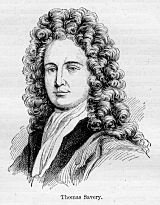
Thomas Savery

Encyclopedia
Thomas Savery was an English
inventor, born at Shilstone, a manor house
near Modbury
, Devon
, England
.
and which was dismissed by the Admiralty following a negative report by the Surveyor of the Navy
, Edmund Dummer
.
Savery also worked for the Sick and Hurt Commissioners
, contracting the supply of medicines to the Navy Stock Company, which was connected with the Society of Apothecaries. His duties on their behalf took him to Dartmouth, which is probably how he came into contact with Thomas Newcomen
.
, "A new invention for raiseing of water and occasioning motion to all sorts of mill work by the impellent force of fire, which will be of great use and advantage for drayning mines, serveing townes with water, and for the working of all sorts of mills where they have not the benefitt of water nor constant windes." He demonstrated it to the Royal Society
on 14 June 1699. The patent has no illustrations or even description, but in 1702 Savery described the machine in his book The Miner's Friend; or, An Engine to Raise Water by Fire, in which he claimed that it could pump water out of mines
.
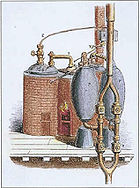 Savery's engine had no piston
, and no moving parts except from the taps. It was operated by first raising steam in the boiler; the steam was then admitted to the working vessel, allowing it to blow out through a downpipe into the water that was to be raised. When the system was hot and therefore full of steam the tap between the boiler and the working vessel was shut, and if necessary the outside of the vessel was cooled. This made the steam inside it condense, creating a partial vacuum, and atmospheric pressure
pushed water up the downpipe until the vessel was full. At this point the tap below the vessel was closed, and the tap between it and the up-pipe opened, and more steam was admitted from the boiler. As the steam pressure built up, it forced the water from the vessel up the up-pipe to the top of the mine.
Savery took great care to stress how powerful his engine was, and was the first to use the term "horsepower
". However, his engine had four serious problems. First, every time water was admitted to the working vessel much of the heat was wasted in warming up the water that was being pumped. Secondly, the second stage of the process required high-pressure steam to force the water up, and the engine's solder
ed joints were barely capable of withstanding high pressure steam and needed frequent repair. Thirdly, although this engine used positive steam pressure to push water up out of the engine (with no theoretical limit to the height to which water could be lifted by a single high-pressure engine) practical and safety considerations meant that in practice, to clear water from a deep mine would have needed a series of moderate-pressure engines all the way from the bottom level to the surface. Fourthly, water was pushed up into the engine only by atmospheric pressure (working against a condensed-steam 'vacuum'), so the engine had to be no more than about 30 feet (9.1 m) above the water level – requiring it to be installed, operated, and maintained far down in the mine.
was passed which extended his protection for a further 21 years. This Act became known as the "Fire Engine Act". The protection was extended to Scotland in 1701 by an Act of Parliament which granted to Mr James Smith of Whitehill the sole right to use in Scotland Savery's invention of "an engyne or invention for raiseing of water and occasioning motion of mill-work by the force of fire." The protection was to terminate at the same time as that in England.
Savery's patent covered all engines that raised water by fire and Newcomen was forced to go into partnership with Savery. By 1712, arrangements had been made with Newcomen to develop Newcomen's more advanced design of steam engine
, which was marketed under Savery's patent. Newcomen's engine worked purely by atmospheric pressure, thereby avoiding the dangers of high-pressure steam, and used the piston concept invented in 1690 by the Frenchman Denis Papin
to produce the first steam engine capable of raising water from deep mines.
After his death in 1715 Savery's patent and Act of Parliament became vested in a company, The Proprietors of the Invention for Raising Water by Fire. This company issued licences to others for the building and operation of Newcomen engines, charging as much as £420 per year patent royalties for the construction of steam engines. In one case a colliery paid the Proprietors £200 per year and half their net profits "in return for their services in keeping the engine going".
The Fire Engine Act did not expire until 1733, four years after the death of Newcomen.
One of his engines was set up at York Buildings
in London
. According to later descriptions this produced steam 'eight or ten times stronger than common air' (i.e. 8-10 atmosphere
s), but blew open the joints of the machine, forcing him to solder
the joints with spelter
.
Another was built to control the water supply at Hampton Court, while another at Campden House in Kensington
operated for 18 years.
A few Savery engines were tried in mines, an unsuccessful attempt being made to use one to clear water from a pool called Broad Waters in Wednesbury
(then in Staffordshire
) and nearby coal mines. This had been covered by a sudden eruption of water some years before. However the engine could not be 'brought to answer'. The quantity of steam raised was so great as 'rent the whole machine to pieces'. The engine was laid aside, and the scheme for raising water was dropped as impracticable. This may have been in about 1705.
Another engine was proposed in 1706 by George Sparrow at Newbold
near Chesterfield
, where a landowner was having difficulty in obtaining the consent of his neighbours for a sough
to drain his coal. Nothing came of this, perhaps due to the explosion of the Broad Waters engine. It is also possible that an engine was tried at Wheal Vor
, a copper mine in Cornwall.
was a successful development of it.
England
England is a country that is part of the United Kingdom. It shares land borders with Scotland to the north and Wales to the west; the Irish Sea is to the north west, the Celtic Sea to the south west, with the North Sea to the east and the English Channel to the south separating it from continental...
inventor, born at Shilstone, a manor house
Manor house
A manor house is a country house that historically formed the administrative centre of a manor, the lowest unit of territorial organisation in the feudal system in Europe. The term is applied to country houses that belonged to the gentry and other grand stately homes...
near Modbury
Modbury
Modbury is a town and parish in the South Hams region of the English county of Devon. It is situated on the A379 road, which links it to Plymouth and Kingsbridge...
, Devon
Devon
Devon is a large county in southwestern England. The county is sometimes referred to as Devonshire, although the term is rarely used inside the county itself as the county has never been officially "shired", it often indicates a traditional or historical context.The county shares borders with...
, England
England
England is a country that is part of the United Kingdom. It shares land borders with Scotland to the north and Wales to the west; the Irish Sea is to the north west, the Celtic Sea to the south west, with the North Sea to the east and the English Channel to the south separating it from continental...
.
Career
Savery became a military engineer, rising to the rank of Captain by 1702, and spent his free time performing experiments in mechanics. In 1696 he took out a patent for a machine for polishing glass or marble and another for "rowing of ships with greater ease and expedicion than hitherto beene done by any other" which involved paddle-wheels driven by a capstanCapstan
Capstan may refer to:*Capstan , a rotating machine used to control or apply force to another element*Capstan , rotating spindles used to move recording tape through the mechanism of a tape recorder...
and which was dismissed by the Admiralty following a negative report by the Surveyor of the Navy
Surveyor of the Navy
The Surveyor to the Navy was a civilian officer in the Royal Navy. He was a member of the Navy Board from the inauguration of that body in 1546, and held overall responsibility for the design of British warships, although until 1745 the actual design work for warships built at each Royal Dockyard...
, Edmund Dummer
Edmund Dummer (naval engineer)
Edmund Dummer was an English naval engineer and shipbuilder who, as Surveyor of the Navy, founded the Royal Navy dockyard at , Plymouth and extended that at Portsmouth. His survey of the Royal Navy Dockyards is a valuable and well-known historic document...
.
Savery also worked for the Sick and Hurt Commissioners
Sick and Hurt Commissioners
The Sick and Hurt Commissioners were responsible for medical services in the British Royal Navy from 1715 to 1806...
, contracting the supply of medicines to the Navy Stock Company, which was connected with the Society of Apothecaries. His duties on their behalf took him to Dartmouth, which is probably how he came into contact with Thomas Newcomen
Thomas Newcomen
Thomas Newcomen was an ironmonger by trade and a Baptist lay preacher by calling. He was born in Dartmouth, Devon, England, near a part of the country noted for its tin mines. Flooding was a major problem, limiting the depth at which the mineral could be mined...
.
First steam engine mechanism
On 2 July 1698 Savery patented an early steam engineSteam engine
A steam engine is a heat engine that performs mechanical work using steam as its working fluid.Steam engines are external combustion engines, where the working fluid is separate from the combustion products. Non-combustion heat sources such as solar power, nuclear power or geothermal energy may be...
, "A new invention for raiseing of water and occasioning motion to all sorts of mill work by the impellent force of fire, which will be of great use and advantage for drayning mines, serveing townes with water, and for the working of all sorts of mills where they have not the benefitt of water nor constant windes." He demonstrated it to the Royal Society
Royal Society
The Royal Society of London for Improving Natural Knowledge, known simply as the Royal Society, is a learned society for science, and is possibly the oldest such society in existence. Founded in November 1660, it was granted a Royal Charter by King Charles II as the "Royal Society of London"...
on 14 June 1699. The patent has no illustrations or even description, but in 1702 Savery described the machine in his book The Miner's Friend; or, An Engine to Raise Water by Fire, in which he claimed that it could pump water out of mines
Mining
Mining is the extraction of valuable minerals or other geological materials from the earth, from an ore body, vein or seam. The term also includes the removal of soil. Materials recovered by mining include base metals, precious metals, iron, uranium, coal, diamonds, limestone, oil shale, rock...
.
Pistonless pump
A Pistonless pump is a type of pump designed to move fluids without any moving parts other than three chamber valves.The pump contains a chamber which has a valved inlet from the fluid to be pumped, a valved outlet - both of these at the bottom of the pump, and a pressurant inlet at the top of the...
, and no moving parts except from the taps. It was operated by first raising steam in the boiler; the steam was then admitted to the working vessel, allowing it to blow out through a downpipe into the water that was to be raised. When the system was hot and therefore full of steam the tap between the boiler and the working vessel was shut, and if necessary the outside of the vessel was cooled. This made the steam inside it condense, creating a partial vacuum, and atmospheric pressure
Atmospheric pressure
Atmospheric pressure is the force per unit area exerted into a surface by the weight of air above that surface in the atmosphere of Earth . In most circumstances atmospheric pressure is closely approximated by the hydrostatic pressure caused by the weight of air above the measurement point...
pushed water up the downpipe until the vessel was full. At this point the tap below the vessel was closed, and the tap between it and the up-pipe opened, and more steam was admitted from the boiler. As the steam pressure built up, it forced the water from the vessel up the up-pipe to the top of the mine.
Savery took great care to stress how powerful his engine was, and was the first to use the term "horsepower
Horsepower
Horsepower is the name of several units of measurement of power. The most common definitions equal between 735.5 and 750 watts.Horsepower was originally defined to compare the output of steam engines with the power of draft horses in continuous operation. The unit was widely adopted to measure the...
". However, his engine had four serious problems. First, every time water was admitted to the working vessel much of the heat was wasted in warming up the water that was being pumped. Secondly, the second stage of the process required high-pressure steam to force the water up, and the engine's solder
Solder
Solder is a fusible metal alloy used to join together metal workpieces and having a melting point below that of the workpiece.Soft solder is what is most often thought of when solder or soldering are mentioned and it typically has a melting range of . It is commonly used in electronics and...
ed joints were barely capable of withstanding high pressure steam and needed frequent repair. Thirdly, although this engine used positive steam pressure to push water up out of the engine (with no theoretical limit to the height to which water could be lifted by a single high-pressure engine) practical and safety considerations meant that in practice, to clear water from a deep mine would have needed a series of moderate-pressure engines all the way from the bottom level to the surface. Fourthly, water was pushed up into the engine only by atmospheric pressure (working against a condensed-steam 'vacuum'), so the engine had to be no more than about 30 feet (9.1 m) above the water level – requiring it to be installed, operated, and maintained far down in the mine.
Fire Engine Act
Savery's original patent of July 1698 gave 14 years' protection; the next year, 1699, an Act of ParliamentAct of Parliament
An Act of Parliament is a statute enacted as primary legislation by a national or sub-national parliament. In the Republic of Ireland the term Act of the Oireachtas is used, and in the United States the term Act of Congress is used.In Commonwealth countries, the term is used both in a narrow...
was passed which extended his protection for a further 21 years. This Act became known as the "Fire Engine Act". The protection was extended to Scotland in 1701 by an Act of Parliament which granted to Mr James Smith of Whitehill the sole right to use in Scotland Savery's invention of "an engyne or invention for raiseing of water and occasioning motion of mill-work by the force of fire." The protection was to terminate at the same time as that in England.
Savery's patent covered all engines that raised water by fire and Newcomen was forced to go into partnership with Savery. By 1712, arrangements had been made with Newcomen to develop Newcomen's more advanced design of steam engine
Newcomen steam engine
The atmospheric engine invented by Thomas Newcomen in 1712, today referred to as a Newcomen steam engine , was the first practical device to harness the power of steam to produce mechanical work. Newcomen engines were used throughout Britain and Europe, principally to pump water out of mines,...
, which was marketed under Savery's patent. Newcomen's engine worked purely by atmospheric pressure, thereby avoiding the dangers of high-pressure steam, and used the piston concept invented in 1690 by the Frenchman Denis Papin
Denis Papin
Denis Papin was a French physicist, mathematician and inventor, best known for his pioneering invention of the steam digester, the forerunner of the steam engine and of the pressure cooker.-Life in France:...
to produce the first steam engine capable of raising water from deep mines.
After his death in 1715 Savery's patent and Act of Parliament became vested in a company, The Proprietors of the Invention for Raising Water by Fire. This company issued licences to others for the building and operation of Newcomen engines, charging as much as £420 per year patent royalties for the construction of steam engines. In one case a colliery paid the Proprietors £200 per year and half their net profits "in return for their services in keeping the engine going".
The Fire Engine Act did not expire until 1733, four years after the death of Newcomen.
Application of the engine
A newspaper in March 1702 announced that Savery's engines were ready for use and might be seen on Wednesday and Saturday afternoons at his workhouse in Salisbury Court, London, over against the Old Playhouse.One of his engines was set up at York Buildings
York Buildings Company
The York Buildings Company was an English company in the late 17th and early 18th centuries.-Waterworks:The full name of the company was The Governor and Company for raising the Thames Water at York Buildings...
in London
London
London is the capital city of :England and the :United Kingdom, the largest metropolitan area in the United Kingdom, and the largest urban zone in the European Union by most measures. Located on the River Thames, London has been a major settlement for two millennia, its history going back to its...
. According to later descriptions this produced steam 'eight or ten times stronger than common air' (i.e. 8-10 atmosphere
Atmosphere (unit)
The standard atmosphere is an international reference pressure defined as 101325 Pa and formerly used as unit of pressure. For practical purposes it has been replaced by the bar which is 105 Pa...
s), but blew open the joints of the machine, forcing him to solder
Solder
Solder is a fusible metal alloy used to join together metal workpieces and having a melting point below that of the workpiece.Soft solder is what is most often thought of when solder or soldering are mentioned and it typically has a melting range of . It is commonly used in electronics and...
the joints with spelter
Spelter
Spelter, while sometimes used merely as a synonym for zinc, is often used to identify a zinc alloy. In this sense it might be an alloy of equal parts copper and zinc, i.e. a brass, used for hard soldering and brazing, or as an alloy, containing lead, that is used instead of bronze...
.
Another was built to control the water supply at Hampton Court, while another at Campden House in Kensington
Kensington
Kensington is a district of west and central London, England within the Royal Borough of Kensington and Chelsea. An affluent and densely-populated area, its commercial heart is Kensington High Street, and it contains the well-known museum district of South Kensington.To the north, Kensington is...
operated for 18 years.
A few Savery engines were tried in mines, an unsuccessful attempt being made to use one to clear water from a pool called Broad Waters in Wednesbury
Wednesbury
Wednesbury is a market town in England's Black Country, part of the Sandwell metropolitan borough in West Midlands, near the source of the River Tame. Similarly to the word Wednesday, it is pronounced .-Pre-Medieval and Medieval times:...
(then in Staffordshire
Staffordshire
Staffordshire is a landlocked county in the West Midlands region of England. For Eurostat purposes, the county is a NUTS 3 region and is one of four counties or unitary districts that comprise the "Shropshire and Staffordshire" NUTS 2 region. Part of the National Forest lies within its borders...
) and nearby coal mines. This had been covered by a sudden eruption of water some years before. However the engine could not be 'brought to answer'. The quantity of steam raised was so great as 'rent the whole machine to pieces'. The engine was laid aside, and the scheme for raising water was dropped as impracticable. This may have been in about 1705.
Another engine was proposed in 1706 by George Sparrow at Newbold
Newbold, Derbyshire
Newbold is a village north of Chesterfield, a market town in the English county of Derbyshire. In 2001 in had a population of just under 8,000....
near Chesterfield
Chesterfield
Chesterfield is a market town and a borough of Derbyshire, England. It lies north of Derby, on a confluence of the rivers Rother and Hipper. Its population is 70,260 , making it Derbyshire's largest town...
, where a landowner was having difficulty in obtaining the consent of his neighbours for a sough
Sough
A sough is an underground channel for draining water out of a mine. Its ability to drain a mine depends on the bottom of the mine being higher than a neighbouring valley...
to drain his coal. Nothing came of this, perhaps due to the explosion of the Broad Waters engine. It is also possible that an engine was tried at Wheal Vor
Wheal Vor
Wheal Vor was a metalliferous mine about two miles north west of Helston and one mile north of the village of Breage in the west of Cornwall, England, U.K. It is considered to be part of the Mount's Bay mining district. Until the mid–19th century the mine was notable for its willingness to try out...
, a copper mine in Cornwall.
Inspiration for later work
Several later pumping systems may be based on Savery's pump. For example, the twin-chamber pulsometer steam pumpPulsometer steam pump
The Pulsometer steam pump is a pistonless pump which was patented in 1872 by American Charles Henry Hall. In 1875 a British Engineer bought the patent rights of the Pulsometer and it was introduced to the market soon thereafter. The invention was inspired by the Savery steam pump invented by...
was a successful development of it.
Further reading
- There are countless modern day reprints: , , .
- Reprinted in Appendix B of: