


Nabonidus Chronicle

Encyclopedia
Babylonia
Babylonia was an ancient cultural region in central-southern Mesopotamia , with Babylon as its capital. Babylonia emerged as a major power when Hammurabi Babylonia was an ancient cultural region in central-southern Mesopotamia (present-day Iraq), with Babylon as its capital. Babylonia emerged as...
n text, part of a larger series of Babylonian Chronicles
Babylonian Chronicles
The Babylonian Chronicles are many series of tablets recording major events in Babylonian history. They are thus one of the first steps in the development of ancient historiography...
incribed in cuneiform
Cuneiform
Cuneiform can refer to:*Cuneiform script, an ancient writing system originating in Mesopotamia in the 4th millennium BC*Cuneiform , three bones in the human foot*Cuneiform Records, a music record label...
script on clay tablet
Clay tablet
In the Ancient Near East, clay tablets were used as a writing medium, especially for writing in cuneiform, throughout the Bronze Age and well into the Iron Age....
s. It deals primarily with the reign of Nabonidus
Nabonidus
Nabonidus was the last king of the Neo-Babylonian Empire, reigning from 556-539 BCE.-Historiography on Nabonidus:...
, the last king of the Neo-Babylonian Empire
Neo-Babylonian Empire
The Neo-Babylonian Empire or Second Babylonian Empire was a period of Mesopotamian history which began in 626 BC and ended in 539 BC. During the preceding three centuries, Babylonia had been ruled by their fellow Akkadian speakers and northern neighbours, Assyria. Throughout that time Babylonia...
, covers the conquest of Babylon by the Persian
Achaemenid Empire
The Achaemenid Empire , sometimes known as First Persian Empire and/or Persian Empire, was founded in the 6th century BCE by Cyrus the Great who overthrew the Median confederation...
king Cyrus the Great
Cyrus the Great
Cyrus II of Persia , commonly known as Cyrus the Great, also known as Cyrus the Elder, was the founder of the Achaemenid Empire. Under his rule, the empire embraced all the previous civilized states of the ancient Near East, expanded vastly and eventually conquered most of Southwest Asia and much...
, and ends with the start of the reign of Cyrus's son Cambyses
Cambyses II of Persia
Cambyses II son of Cyrus the Great , was a king of kings of the Achaemenid Empire. Cambyses's grandfather was Cambyses I, king of Anshan. Following Cyrus the Great's conquest of the Near East and Central Asia, Cambyses II further expanded the empire into Egypt during the Late Period by defeating...
, spanning a period from 556 BC to some time after 539 BC. It provides a rare contemporary account of Cyrus's rise to power and is the main source of information on this period; Amélie Kuhrt
Amélie Kuhrt
Amélie Kuhrt FBA is a historian and specialist in the history of the ancient Near East.Professor Emerita at University College London, she specialises in the social, cultural and political history of the region from c.3000-100 BC, especially the Assyrian, Babylonian, Persian and Seleucid empires....
describes it as "the most reliable and sober [ancient] account of the fall of Babylon."
Description of the tablet
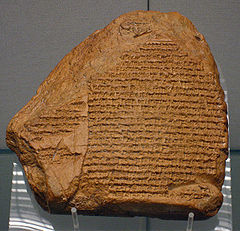
The Nabonidus Chronicle is preserved on a single clay tablet now kept at the British MuseumBritish Museum
The British Museum is a museum of human history and culture in London. Its collections, which number more than seven million objects, are amongst the largest and most comprehensive in the world and originate from all continents, illustrating and documenting the story of human culture from its...
in London
London
London is the capital city of :England and the :United Kingdom, the largest metropolitan area in the United Kingdom, and the largest urban zone in the European Union by most measures. Located on the River Thames, London has been a major settlement for two millennia, its history going back to its...
. Like the other Babylonian Chronicles, it lists in an annalistic (year-by-year) fashion the key events of each year, such as the accession and deaths of kings, major military events, and notable religious occurrences. It follows a standard pattern of reporting only events of immediate relevance to Babylonia, making it of somewhat limited utility as a source for a wider history of the region. The tablet itself is fairly large, measuring 140 mm wide by 140 mm long, but is significantly damaged with its bottom and most of the left-hand side missing. The text was composed in two columns on each side, originally consisting of some 300-400 lines. What remains is extremely fragmentary; little more than 75 lines of text are still legible. The missing portions consist of most of the first and fourth columns, along with the bottom of the second and the top of the third. There appears to have been a colophon
Colophon (publishing)
In publishing, a colophon is either:* A brief description of publication or production notes relevant to the edition, in modern books usually located at the reverse of the title page, but can also sometimes be located at the end of the book, or...
at the bottom of the tablet, but it too is largely missing.
The chronicle is thought to have been copied by a scribe during the Seleucid period (4th-1st century BC) but the original text was probably written during the late 6th or early 5th century BC. Similarities with the Nabonassar to Shamash-shum-ukin Chronicle, another of the Babylonian Chronicles, suggest that the same scribe may have been responsible for both chronicles. If so, it may date to the reign of Darius I of Persia
Darius I of Persia
Darius I , also known as Darius the Great, was the third king of kings of the Achaemenid Empire...
(c. 549 BC–486 BC). Although the writing is of a good standard, the copying was decidedly imperfect and the scribe made a number of errors that are visible in the text.
The tablet was acquired by the British Museum in 1879 from the antiquities dealers Spartali & Co
Spartali & Co
Spartali & Co was a Greek import/export company active in London, Liverpool, Manchester and Marseille, with its headquarters in the Anatolian city of Smyrna, in the second half of the 19th century. Along with several other Greek-owned merchant companies, it acted as a terminal and starting point...
. Its original place of discovery is unknown, though it has been presumed that it came from the ruins of Babylon
Babylon
Babylon was an Akkadian city-state of ancient Mesopotamia, the remains of which are found in present-day Al Hillah, Babil Province, Iraq, about 85 kilometers south of Baghdad...
. It possibly represents part of an official collection of annals in the possession of the Achaemenid governors of Babylon. The text, known at the time as "the Annals of Nabonidus", was first discussed in print by Sir Henry Rawlinson in the Athenaeum
Athenaeum (magazine)
The Athenaeum was a literary magazine published in London from 1828 to 1921. It had a reputation for publishing the very best writers of the age....
magazine of 14 February 1880, with the first English translation being published two years later. It has since been translated by a number of scholars, notably Sidney Smith
Sidney Smith
Sidney Smith may refer to:*Sir William Sidney Smith , British admiral, always known as Sir Sidney Smith*Sidney Smith , lawyer and politician in Upper Canada*Sidney Irving Smith , American zoologist...
, A. Leo Oppenheim
A. Leo Oppenheim
A Leo Oppenheim , one of the most distinguished Assyriologists of his generation was editor-in-charge of the Chicago Assyrian Dictionary of the Oriental Institute 1955-1974 and John A. Wilson Professor of Oriental Studies at the University of Chicago.Oppenheim was born in Vienna, where he received...
, Albert Kirk Grayson, Jean-Jacques Glassner, and Amélie Kuhrt
Amélie Kuhrt
Amélie Kuhrt FBA is a historian and specialist in the history of the ancient Near East.Professor Emerita at University College London, she specialises in the social, cultural and political history of the region from c.3000-100 BC, especially the Assyrian, Babylonian, Persian and Seleucid empires....
.
Text
The text of the chronicle begins presumably with the accession of Nabonidus in 556 BC, though the start of the text is so poorly preserved that none of this portion is legible. It mentions campaigns by Nabonidus against a place named Hume and unnamed localities in "the West" (Arabia?). Cyrus's pillaging of EcbatanaEcbatana
Ecbatana is supposed to be the capital of Astyages , which was taken by the Persian emperor Cyrus the Great in the sixth year of Nabonidus...
, the capital of Astyages
Astyages
Astyages Astyages Astyages (spelled by Herodotus as Ἀστυάγης - Astyages; by Ctesias as Astyigas; by Diodorus as Aspadas; Akkadian: Ištumegu, was the last king of the Median Empire, r...
, is recorded in the sixth year of the reign of Nabonidus. The chronicle goes on to describe in several entries the self-imposed exile of Nabonidus in the Arabian oasis of Tema
Tayma
Tayma is a large oasis with a long history of settlement, located in northwestern Saudi Arabia at the point where the trade route between Yathrib and Dumah begins to cross the Nefud desert...
and the disruption that this caused to the Akitu
Assyrian new year
Assyrian new year may refer to* Akitu, the Assyrian-Babylonian new year festival.* Assyrian New Year, an Assyrian nationalist festival reintroduced in the 1950s...
(New Year) festival for a period of ten years. The king spent ten years in Arabia and left Babylonia administered by his son, Bel-shar-usur (Belshazzar
Belshazzar
Belshazzar, or Balthazar , was a 6th century BC prince of Babylon, the son of Nabonidus and the last king of Babylon according to the Book of Daniel . Like his father, it is believed by many scholars that he was an Assyrian. In Daniel Belshazzar, or Balthazar , was a 6th century BC prince of...
of the Book of Daniel
Book of Daniel
The Book of Daniel is a book in the Hebrew Bible. The book tells of how Daniel, and his Judean companions, were inducted into Babylon during Jewish exile, and how their positions elevated in the court of Nebuchadnezzar. The court tales span events that occur during the reigns of Nebuchadnezzar,...
in the Old Testament
Old Testament
The Old Testament, of which Christians hold different views, is a Christian term for the religious writings of ancient Israel held sacred and inspired by Christians which overlaps with the 24-book canon of the Masoretic Text of Judaism...
). The eighth year is purposefully left blank; apparently the scribe did not have any significant events to record for that year. Another campaign by Cyrus is recorded in the ninth year, possibly representing his attack on Lydia
Lydia
Lydia was an Iron Age kingdom of western Asia Minor located generally east of ancient Ionia in the modern Turkish provinces of Manisa and inland İzmir. Its population spoke an Anatolian language known as Lydian....
and capture of Sardis
Sardis
Sardis or Sardes was an ancient city at the location of modern Sart in Turkey's Manisa Province...
.
Much of the rest of the text is fragmentary. A possible reference to fighting and Persia appears in what is presumably the entry for the sixteenth year. A long surviving section describes the events of Nabonidus's seventeenth and final year as king, when Cyrus invaded and conquered Babylonia. The celebration of the Akitu festival is recorded, indicating Nabonidus's return to Babylon. The chronicle provides no information on why Cyrus chose to invade Babylonia at that time but records that the gods of various cities "entered Babylon", apparently referring to an in-gathering of cultic statues in advance of the Persian invasion – perhaps a measure taken by Nabonidus to prevent the Persians capturing the divine idols. It provides a terse description of the Battle of Opis
Battle of Opis
The Battle of Opis, fought in September 539 BC, was a major engagement between the armies of Persia under Cyrus the Great and the Neo-Babylonian Empire under Nabonidus during the Persian invasion of Mesopotamia. At the time, Babylonia was the last major power in western Asia that was not yet under...
, in which the Persians decisively defeated Nabonidus's army, massacred the retreating Babylonians and took a great haul of loot. The Persian army went on to capture the cities of Sippar
Sippar
Sippar was an ancient Near Eastern city on the east bank of the Euphrates river, located at the site of modern Tell Abu Habbah in Iraq's Babil Governorate, some 60 km north of Babylon and 30 km southeast of Baghdad....
and Babylon itself without further conflict. Cyrus is reported to have been received with joy by the city's inhabitants and appointed local governors. The gods that had previously been brought to Babylon were returned to their home cities on the orders of Cyrus. The legible portion of the text ends with a lengthy period of mourning for the lately deceased king's wife (presumably meaning the wife of Cyrus, as Nabonidus was no longer king by this time) and a mention of Cambyses, the son of Cyrus. Only a few scattered words are legible in the remainder of the tablet.
Analysis
The Nabonidus Chronicle appears to have been composed by the (Babylonian) priests of MardukMarduk
Marduk was the Babylonian name of a late-generation god from ancient Mesopotamia and patron deity of the city of Babylon, who, when Babylon became the political center of the Euphrates valley in the time of Hammurabi , started to...
, the chief god of Babylon. It has been characterised as "a piece of propaganda at Cyrus's service" and as possibly "the result of the propaganda of the priesthood of Marduk to vilify Nabonidus". Julye Bidmead attributes the priests' hostility to Nabonidus's unsuccessful attempts to introduce the worship of the moon god Sîn
Sin (mythology)
Sin or Nanna was the god of the moon in Mesopotamian mythology. Nanna is a Sumerian deity, the son of Enlil and Ninlil, and became identified with Semitic Sin. The two chief seats of Nanna's/Sin's worship were Ur in the south of Mesopotamia and Harran in the north.- Name :The original meaning of...
. In particular, the chronicle repeatedly asserts that the Akitu festival could not be held because of Nabonidus's absence. This is dubious, as others could have participated in the celebration in Nabonidus's place. The chronicle is seen as part of a series of pro-Persian documents, including the Cyrus cylinder
Cyrus cylinder
The Cyrus Cylinder is an ancient clay cylinder, now broken into several fragments, on which is written a declaration in Akkadian cuneiform script in the name of the Achaemenid king Cyrus the Great. It dates from the 6th century BC and was discovered in the ruins of Babylon in Mesopotamia in 1879...
and Verse Account of Nabonidus, that attack Nabonidus for alleged religious infidelity and contrast his actions to those of Cyrus and Cambyses.
External links
- Image and description of the Nabonidus Chronicle (British MuseumBritish MuseumThe British Museum is a museum of human history and culture in London. Its collections, which number more than seven million objects, are amongst the largest and most comprehensive in the world and originate from all continents, illustrating and documenting the story of human culture from its...
) - Catalogue entry for the Nabonidus Chronicle (British Museum)
- Mesopotamian chronicles: Nabonidus Chronicle