


Tayma

Encyclopedia
Tayma is a large oasis
with a long history of settlement, located in northwestern Saudi Arabia
at the point where the trade route between Yathrib (Medina
) and Dumah
(al-Jawf) begins to cross the Nefud
desert. Tayma is located 264 km southeast of the city of Tabouk, and about 400 km north of Medina
.
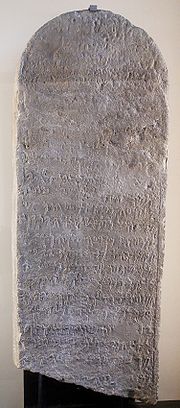 Recent archaeological discoveries show that Tayma has been inhabited since the Bronze Age
. In 2010, the Saudi Commission for Tourism & Antiquities
announced the discovery of a rock near Tayma bearing an inscription of Egyptian pharaoh Ramesses III
. This was the first confirmed find of a hieroglyphic
inscription on Saudi soil. Based on this discovery, researchers have hypothesized that Tayma was part of an important land route between the Red Sea
coast of the Arabian Peninsula
and the Nile Valley
.
The oldest mention of the oais city appears as "Tiamat" in Assyrian inscriptions dating as far back as the 8th century BCE. The oasis developed into a prosperous city, rich in water wells and handsome buildings. Tiglath-pileser III
received tribute from Tayma, and Sennacherib named one of Nineveh
's gates as the Desert Gate, recording that "the gifts of the Sumu'anite and the Teymeite enter through it." It was rich and proud enough in the 7th century BCE for Jeremiah
to prophesy against it (Jeremiah 25:23). It was ruled then by a local Arab
dynasty, known as the Qedarite
s. The names of two 8th-century BCE queens, Shamsi
and Zabibei
, are recorded.
In 539 BCE, Nabonidus
retired to Tayma for worship and looking for prophecies, entrusting the kingship of Babylon to his son. From this we can recognize Tayma as being an important place.
Cuneiform
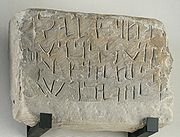
inscriptions possibly dating from the 6th century BCE have been recovered from Tayma. It is mentioned several times in the Old Testament. The biblical eponym
is apparently Tema, one of the sons of Ishmael.
According to Arab tradition, Tayma was inhabited by a Jewish community during the late classical period, though whether these were exiled Judea
ns or the Arab descendants of converts is unclear.
Tayma and neighboring Khaybar
were visited by Benjamin of Tudela
some time around 1170. Benjamin was a Jew from Tudela
in Spain. He travelled to Persia and Arabia in the 12th century.
In the summer of 1181 Raynald of Châtillon
attacked a Muslim caravan near Tayma, despite a truce between Sultan Saladin
and king Baldwin IV of Jerusalem
, during a raid of the Red Sea area.
 The site was first investigated and mapped by Charles M. Dougherty in 1877.
The Tayma stele discovered by Charles Huber in 1883, now at the Louvre
, lists the gods of Tayma in the 6th century BCE: Ṣalm of Maḥram and Shingala and Ashira. This Ashira may be Athirat/Asherah
.
Archeological investigation of the site, under the auspices of the German Archaeological Institute
, is ongoing.
Oasis
In geography, an oasis or cienega is an isolated area of vegetation in a desert, typically surrounding a spring or similar water source...
with a long history of settlement, located in northwestern Saudi Arabia
Saudi Arabia
The Kingdom of Saudi Arabia , commonly known in British English as Saudi Arabia and in Arabic as as-Sa‘ūdiyyah , is the largest state in Western Asia by land area, constituting the bulk of the Arabian Peninsula, and the second-largest in the Arab World...
at the point where the trade route between Yathrib (Medina
Medina
Medina , or ; also transliterated as Madinah, or madinat al-nabi "the city of the prophet") is a city in the Hejaz region of western Saudi Arabia, and serves as the capital of the Al Madinah Province. It is the second holiest city in Islam, and the burial place of the Islamic Prophet Muhammad, and...
) and Dumah
Dumat Al-Jandal
Dumat al-Jundal , is the name for an ancient city of ruins located in North Western Saudi Arabia in the Al Jawf province its located 37KM away from Sakakah. The name Dumat al-Jandal means literally "Dumah of the Stone", since this was the territory of Dumah, one of the twelve sons of Ishmael...
(al-Jawf) begins to cross the Nefud
Nefud
An Nafud or Al-Nefud or The Nefud is a desert in the northern part of the Arabian Peninsula at , occupying a great oval depression...
desert. Tayma is located 264 km southeast of the city of Tabouk, and about 400 km north of Medina
Medina
Medina , or ; also transliterated as Madinah, or madinat al-nabi "the city of the prophet") is a city in the Hejaz region of western Saudi Arabia, and serves as the capital of the Al Madinah Province. It is the second holiest city in Islam, and the burial place of the Islamic Prophet Muhammad, and...
.
History
Bronze Age
The Bronze Age is a period characterized by the use of copper and its alloy bronze as the chief hard materials in the manufacture of some implements and weapons. Chronologically, it stands between the Stone Age and Iron Age...
. In 2010, the Saudi Commission for Tourism & Antiquities
Saudi Commission for Tourism & Antiquities
Saudi Commission for Tourism & Antiquities is state-run organization, devoted for developing tourism sector in the Kingdom of Saudi Arabia with particular focus on encouraging and supporting domestic tourism through sponsoring and conducting tourism events across the country...
announced the discovery of a rock near Tayma bearing an inscription of Egyptian pharaoh Ramesses III
Ramesses III
Usimare Ramesses III was the second Pharaoh of the Twentieth Dynasty and is considered to be the last great New Kingdom king to wield any substantial authority over Egypt. He was the son of Setnakhte and Queen Tiy-Merenese. Ramesses III is believed to have reigned from March 1186 to April 1155 BCE...
. This was the first confirmed find of a hieroglyphic
Egyptian hieroglyphs
Egyptian hieroglyphs were a formal writing system used by the ancient Egyptians that combined logographic and alphabetic elements. Egyptians used cursive hieroglyphs for religious literature on papyrus and wood...
inscription on Saudi soil. Based on this discovery, researchers have hypothesized that Tayma was part of an important land route between the Red Sea
Red Sea
The Red Sea is a seawater inlet of the Indian Ocean, lying between Africa and Asia. The connection to the ocean is in the south through the Bab el Mandeb strait and the Gulf of Aden. In the north, there is the Sinai Peninsula, the Gulf of Aqaba, and the Gulf of Suez...
coast of the Arabian Peninsula
Arabian Peninsula
The Arabian Peninsula is a land mass situated north-east of Africa. Also known as Arabia or the Arabian subcontinent, it is the world's largest peninsula and covers 3,237,500 km2...
and the Nile Valley
Nile
The Nile is a major north-flowing river in North Africa, generally regarded as the longest river in the world. It is long. It runs through the ten countries of Sudan, South Sudan, Burundi, Rwanda, Democratic Republic of the Congo, Tanzania, Kenya, Ethiopia, Uganda and Egypt.The Nile has two major...
.
The oldest mention of the oais city appears as "Tiamat" in Assyrian inscriptions dating as far back as the 8th century BCE. The oasis developed into a prosperous city, rich in water wells and handsome buildings. Tiglath-pileser III
Tiglath-Pileser III
Tiglath-Pileser III was a prominent king of Assyria in the eighth century BC and is widely regarded as the founder of the Neo-Assyrian Empire. Tiglath-Pileser III seized the Assyrian throne during a civil war and killed the royal family...
received tribute from Tayma, and Sennacherib named one of Nineveh
Nineveh
Nineveh was an ancient Assyrian city on the eastern bank of the Tigris River, and capital of the Neo Assyrian Empire. Its ruins are across the river from the modern-day major city of Mosul, in the Ninawa Governorate of Iraq....
's gates as the Desert Gate, recording that "the gifts of the Sumu'anite and the Teymeite enter through it." It was rich and proud enough in the 7th century BCE for Jeremiah
Jeremiah
Jeremiah Hebrew:יִרְמְיָה , Modern Hebrew:Yirməyāhū, IPA: jirməˈjaːhu, Tiberian:Yirmĭyahu, Greek:Ἰερεμίας), meaning "Yahweh exalts", or called the "Weeping prophet" was one of the main prophets of the Hebrew Bible...
to prophesy against it (Jeremiah 25:23). It was ruled then by a local Arab
Arab
Arab people, also known as Arabs , are a panethnicity primarily living in the Arab world, which is located in Western Asia and North Africa. They are identified as such on one or more of genealogical, linguistic, or cultural grounds, with tribal affiliations, and intra-tribal relationships playing...
dynasty, known as the Qedarite
Qedarite
The Qedarites were a largely nomadic, ancient Arab tribal confederation...
s. The names of two 8th-century BCE queens, Shamsi
Samsi
Samsi was an Arab queen who reigned in the 8th century BCE. As an ally of Rakhianu of Damascus, she fought the Assyrian king Tiglath-Pileser III in 732 BCE. After her forces were defeated, she fled the battlefield. Later, she went to Assyria to pay tribute to the king and was permitted to reign,...
and Zabibei
Zabiba
Zabiba is an Arabic word. Derived from the word zabīb meaning "raisin", it can refer to:*Zabibe, the name of an 8th century queen who was a vassal of the Assyrian empire...
, are recorded.
In 539 BCE, Nabonidus
Nabonidus
Nabonidus was the last king of the Neo-Babylonian Empire, reigning from 556-539 BCE.-Historiography on Nabonidus:...
retired to Tayma for worship and looking for prophecies, entrusting the kingship of Babylon to his son. From this we can recognize Tayma as being an important place.
Cuneiform
Cuneiform
Cuneiform can refer to:*Cuneiform script, an ancient writing system originating in Mesopotamia in the 4th millennium BC*Cuneiform , three bones in the human foot*Cuneiform Records, a music record label...
inscriptions possibly dating from the 6th century BCE have been recovered from Tayma. It is mentioned several times in the Old Testament. The biblical eponym
Eponym
An eponym is the name of a person or thing, whether real or fictitious, after which a particular place, tribe, era, discovery, or other item is named or thought to be named...
is apparently Tema, one of the sons of Ishmael.
According to Arab tradition, Tayma was inhabited by a Jewish community during the late classical period, though whether these were exiled Judea
Judea
Judea or Judæa was the name of the mountainous southern part of the historic Land of Israel from the 8th century BCE to the 2nd century CE, when Roman Judea was renamed Syria Palaestina following the Jewish Bar Kokhba revolt.-Etymology:The...
ns or the Arab descendants of converts is unclear.
Tayma and neighboring Khaybar
Khaybar
Khaybar is the name of an oasis some 153 km to the north of Medina , Saudi Arabia. It was inhabited by Jews before the rise of Islam, and was conquered by Muhammad in 629 AD.-Pre-Islamic Khaybar:...
were visited by Benjamin of Tudela
Benjamin of Tudela
Benjamin of Tudela was a medieval Jewish traveler who visited Europe, Asia, and Africa in the 12th century. His vivid descriptions of western Asia preceded those of Marco Polo by a hundred years...
some time around 1170. Benjamin was a Jew from Tudela
Tudela, Navarre
Tudela is a municipality in Spain, the second city of the autonomous community of Navarre. Its population is around 35,000. Tudela is sited in the Ebro valley. Fast trains running on two-track electrified railways serve the city and two freeways join close to it...
in Spain. He travelled to Persia and Arabia in the 12th century.
In the summer of 1181 Raynald of Châtillon
Raynald of Chatillon
Raynald of Châtillon was a knight who served in the Second Crusade and remained in the Holy Land after its defeat...
attacked a Muslim caravan near Tayma, despite a truce between Sultan Saladin
Saladin
Ṣalāḥ ad-Dīn Yūsuf ibn Ayyūb , better known in the Western world as Saladin, was an Arabized Kurdish Muslim, who became the first Sultan of Egypt and Syria, and founded the Ayyubid dynasty. He led Muslim and Arab opposition to the Franks and other European Crusaders in the Levant...
and king Baldwin IV of Jerusalem
Baldwin IV of Jerusalem
Baldwin IV of Jerusalem , called the Leper or the Leprous, the son of Amalric I of Jerusalem and his first wife, Agnes of Courtenay, was king of Jerusalem from 1174 to 1185. His full sister was Queen Sibylla of Jerusalem and his nephew through this sister was the child-king Baldwin V...
, during a raid of the Red Sea area.
Archaeology
The Tayma stele discovered by Charles Huber in 1883, now at the Louvre
Louvre
The Musée du Louvre – in English, the Louvre Museum or simply the Louvre – is one of the world's largest museums, the most visited art museum in the world and a historic monument. A central landmark of Paris, it is located on the Right Bank of the Seine in the 1st arrondissement...
, lists the gods of Tayma in the 6th century BCE: Ṣalm of Maḥram and Shingala and Ashira. This Ashira may be Athirat/Asherah
Asherah
Asherah , in Semitic mythology, is a Semitic mother goddess, who appears in a number of ancient sources including Akkadian writings by the name of Ashratum/Ashratu and in Hittite as Asherdu or Ashertu or Aserdu or Asertu...
.
Archeological investigation of the site, under the auspices of the German Archaeological Institute
German Archaeological Institute
The German Archaeological Institute is an institution of research within the field of archaeology , and a "scientific corporation", with parentage of the federal Foreign Office of Germany-Origin:...
, is ongoing.
Points of interest
- Qasr Al-Ablaq castle is located on the southwest side of the city. It was built by Jewish poet and warrior Samuel ibn 'Adiya and his grandfather 'Adiya in the 6th century CE.
- The Qasr Al-Hamra palace was built in the 7th century BCE.
- Tayma has an archaeologically significant perimeter wall built around 3 sides of the old city in the 6th century BCE.
- Qasr Al-Radhm
- Haddaj Well
- Cemeteries
- Many Aramaic, Lihyanite, ThamudicThamudicThamudic is an Old North Arabian dialect known from pre-Islamic inscriptions scattered across the Arabian desert and the Sinai. Dating to between the 4th century BC and the 3rd or 4th century AD, they were incorrectly named after the Thamud people, with whom they are not directly...
, Nabataean language inscriptions, around Tayma - Qasr Al-Bejaidi
- Al-Hadiqah Mound
- Many museums. Although Tayma has museums of its own such as the "Tayma Museum of Archaeology and Ethnography", many artifacts from its history have been spread to other museums. Early finds such as the "Tayma Stele" are at the Louvre in Paris among others while large museums of national importance in Saudi Arabia, such as the National Museum of Saudi ArabiaNational Museum of Saudi ArabiaThe National Museum of Saudi Arabia is a major national museum in Saudi Arabia. Established in 1999, it is part of the King Abdul Aziz Historical Centre in Riyadh.- The building :...
in Riyadh and the Jeddah Regional Museum of Archaeology and EthnographyJeddah Regional Museum of Archaeology and EthnographyThe Jeddah Regional Museum of Archaeology and Ethnography is a major museum in Jeddah, Saudi Arabia.- The building :The Museum is in the historic Khuzam Palace in the Al-Nuzlah al-Yamaniyah quarter in the south of Jeddah...
also have significant collections of items from or related to ancient Tayma.
External links
- Deutsches Archäologisches Institut: Tayma
- Nabatea: The 12 Tribes of Ishmael: Tema
- about Jouf district
- Verse account of Nabonidus, translation at Livius.org
- Chronicle of Nabonidus, translation at Livius.org
- Travel through the province of Tabuk, Splendid Arabia: A travel site with photos and routes