


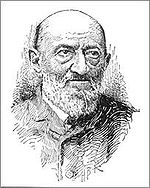
Moritz Steinschneider

Encyclopedia
Bibliographer
"A bibliographer is a person who describes and lists books and other publications, with particular attention to such characteristics as authorship, publication date, edition, typography, etc. The result of this endeavor is a bibliography...
and Orientalist
Oriental studies
Oriental studies is the academic field of study that embraces Near Eastern and Far Eastern societies and cultures, languages, peoples, history and archaeology; in recent years the subject has often been turned into the newer terms of Asian studies and Middle Eastern studies...
. He received his early instruction in Hebrew from his father, Jacob Steinschneider (b. 1782; d. March, 1856), who was not only an expert Talmudist, but was also well versed in secular science
Science
Science is a systematic enterprise that builds and organizes knowledge in the form of testable explanations and predictions about the universe...
. The house of the elder Steinschneider was the rendezvous of a few progressive Hebraist
Hebraist
A Hebraist is a specialist in Hebrew and Hebraic studies. Specifically, British and German scholars of the 18th and 19th centuries who were involved in the study of Hebrew language and literature were commonly known by this designation, at a time when Hebrew was little understood outside practicing...
s, among who was his brother-in-law, the physician and writer Gideon Brecher
Gideon Brecher
Gideon Brecher , also known as "Gedaliah Ben Eliezer", was an Austrian physician and writer.Brecher was the uncle, by marriage, to Austrian bibliographer and Orientalist Moritz Steinschneider....
.
Steinschneider means "stonecutter
Stonecutter
A Stonecutter is a person who carries on the trade of stonecutting or stonemasonry.Stonecutter or Stonecutters may also refer to:* Stonecutter, one of twelve magical Swords in the Books of the Swords series...
", or more literally, stone tailor. This likely identifies the profession of gem cutter.
Education
At the age of six Steinschneider was sent to the public school, which was unheard-of at that time for a Jewish child; and at the age of thirteen he became the pupil of RabbiRabbi
In Judaism, a rabbi is a teacher of Torah. This title derives from the Hebrew word רבי , meaning "My Master" , which is the way a student would address a master of Torah...
Nahum Trebitsch
Nahum Trebitsch
Menahem Nahum Trebitsch was a Czech rabbi.He was a son of Selig Trebitsch, ḥazzan at the Old New Synagogue, and he received a thorough Talmudical training at the yeshiva of Jacob Günsberg...
, whom he followed to Mikulov
Mikulov
Mikulov is a town in the South Moravian Region of the Czech Republic with a population of 7,608 . It is located directly on the border with Lower Austria. Mikulov is located at the edge of a hilly area and the three Nové Mlýny reservoirs...
, Moravia
Moravia
Moravia is a historical region in Central Europe in the east of the Czech Republic, and one of the former Czech lands, together with Bohemia and Silesia. It takes its name from the Morava River which rises in the northwest of the region...
in 1832. The following year, in order to continue his Talmudic studies, he went to Prague
Prague
Prague is the capital and largest city of the Czech Republic. Situated in the north-west of the country on the Vltava river, the city is home to about 1.3 million people, while its metropolitan area is estimated to have a population of over 2.3 million...
, where he remained until 1836, attending simultaneously the lectures at the Normal School.
In 1836 Steinschneider went to Vienna
Vienna
Vienna is the capital and largest city of the Republic of Austria and one of the nine states of Austria. Vienna is Austria's primary city, with a population of about 1.723 million , and is by far the largest city in Austria, as well as its cultural, economic, and political centre...
to continue his studies, and, on the advice of his friend Leopold Dukes
Leopold Dukes
Leopold Dukes was a Hungarian critic of Jewish literature.-Biography:Dukes spent about 20 years in England, and from his researches in the Bodleian library and the British Museum Dukes was able to complete the work of Leopold Zunz...
, he devoted himself especially to Oriental and Neo-Hebrew
Hebrew language
Hebrew is a Semitic language of the Afroasiatic language family. Culturally, is it considered by Jews and other religious groups as the language of the Jewish people, though other Jewish languages had originated among diaspora Jews, and the Hebrew language is also used by non-Jewish groups, such...
literatures, and most particularly to bibliography
Bibliography
Bibliography , as a practice, is the academic study of books as physical, cultural objects; in this sense, it is also known as bibliology...
, which would become his principal focus. His countryman Abraham Benisch
Abraham Benisch
Abraham Benisch was a Hebraist and journalist.He studied medicine at Vienna but abandoned his studies and moved to England in 1841. He was the editor of the Jewish Chronicle, 1854-69 and 1875-8 and zealously promoted the cause of his fellow Jews...
and Moravian Albert Löwyhttp://www.jewishencyclopedia.com/articles/10161-lowy-albert also were studying there at the time. In Lowry's room in 1838 they inaugurated among intimate (and life-long) friends, a proto-Zionist
Zionism
Zionism is a Jewish political movement that, in its broadest sense, has supported the self-determination of the Jewish people in a sovereign Jewish national homeland. Since the establishment of the State of Israel, the Zionist movement continues primarily to advocate on behalf of the Jewish state...
society called "Die Einheit". The society's objective was to promote the welfare of the Jewish people, and in order to realize this objective, they advocated the civilization of Palestine by Austrian Jews. Their objective however, had to be kept secret for fear it would be put down by the government; England became regarded as the country likely to welcome the new movement. In 1841 Lowy was sent to London as an emissary of the Students' Jewish National Society; Benisch also arrived in England the same year. Somewhat abandoned, Steinschneider would later withdrew from the society completely in 1842, viewing the scheme as impractical compared to his studies.
As a Jew on the continent, Steinschneider was prevented from entering the Oriental Academy; and for the same reason he was unable even to obtain permission to make extracts from the Hebrew books and manuscripts in the Imperial Library, Vienna. In spite of these drawbacks he continued his studies in Arabic
Arabic language
Arabic is a name applied to the descendants of the Classical Arabic language of the 6th century AD, used most prominently in the Quran, the Islamic Holy Book...
, Syriac, and Hebrew with Professor Kaerle at the Catholic Theological Faculty of the university. He had at this juncture the intention of adopting the rabbinical career. In Vienna, as formerly in Prague, he earned a livelihood by giving lessons, teaching Italian
Italian language
Italian is a Romance language spoken mainly in Europe: Italy, Switzerland, San Marino, Vatican City, by minorities in Malta, Monaco, Croatia, Slovenia, France, Libya, Eritrea, and Somalia, and by immigrant communities in the Americas and Australia...
among other subjects.
University career
For political reasons he was compelled to leave Vienna and decided to go to Berlin; but, being unable to obtain the necessary passport, he remained in LeipzigLeipzig
Leipzig Leipzig has always been a trade city, situated during the time of the Holy Roman Empire at the intersection of the Via Regia and Via Imperii, two important trade routes. At one time, Leipzig was one of the major European centres of learning and culture in fields such as music and publishing...
. At the university there he continued the study of Arabic under Professor Fleischer. At this time he began the translation of the Qur'an
Qur'an
The Quran , also transliterated Qur'an, Koran, Alcoran, Qur’ān, Coran, Kuran, and al-Qur’ān, is the central religious text of Islam, which Muslims consider the verbatim word of God . It is regarded widely as the finest piece of literature in the Arabic language...
into Hebrew and collaborated with Franz Delitzsch
Franz Delitzsch
Franz Delitzsch was a German Lutheran theologian and Hebraist. Born in Leipzig, he held the professorship of theology at the University of Rostock from 1846 to 1850, at the University of Erlangen until 1867, and after that at the University of Leipzig until his death...
in editing Aaron ben Elijah
Aaron ben Elijah
Aaron ben Elijah , the Latter, of Nicomedia is often considered to be the most prominent Karaite theologian...
's 'Etz Chayyim (Leipzig, 1841); but the rules of the Austrian censorship
Censorship
thumb|[[Book burning]] following the [[1973 Chilean coup d'état|1973 coup]] that installed the [[Military government of Chile |Pinochet regime]] in Chile...
did not permit the publication of his name as coeditor. While in Leipzig he contributed a number of articles on Jewish and Arabic literature to Pierer's Universal Encyklopädie.
Having at length secured the necessary passport, Steinschneider in 1839 proceeded to Berlin, where he attended the university lectures of Franz Bopp
Franz Bopp
Franz Bopp was a German linguist known for extensive comparative work on Indo-European languages.-Biography:...
on comparative philology and the history of Oriental literatures. At the same time he made the acquaintance of Leopold Zunz
Leopold Zunz
Leopold Zunz was a German Reform rabbi and writer, the founder of what has been termed "Jewish Studies" or "Judaic Studies" , the critical investigation of Jewish literature, hymnology and ritual...
and Abraham Geiger
Abraham Geiger
Abraham Geiger was a German rabbi and scholar who led the founding of Reform Judaism...
. In 1842 he returned to Prague, and in 1845 he followed Michael Sachs
Michael Sachs
Michael Sachs was a German rabbi from Glogau , Silesia.He was one of the first Jewish graduates from the modern universities, earning a Ph.D. degree in 1836. He was appointed Rabbi in Prague in 1836, and in Berlin in 1844...
to Berlin; but the Orthodox
Orthodox Judaism
Orthodox Judaism , is the approach to Judaism which adheres to the traditional interpretation and application of the laws and ethics of the Torah as legislated in the Talmudic texts by the Sanhedrin and subsequently developed and applied by the later authorities known as the Gaonim, Rishonim, and...
tendencies of the latter caused Steinschneider to abandon definitely his intention of becoming a rabbi
Rabbi
In Judaism, a rabbi is a teacher of Torah. This title derives from the Hebrew word רבי , meaning "My Master" , which is the way a student would address a master of Torah...
. At this time he was employed as a reporter of the National-Zeitung at the sessions of the National Assembly in Frankfurt am Main and as correspondent of the Prager Zeitung
Prager Zeitung
The Prager Zeitung is a German newspaper in the Czech Republic issued weekly in Prague. It is one of the largest non-Czech newspapers published in the Czech Republic.- See also :* *...
. In 1844, together with David Cassel
David Cassel
David Cassel was a German historian and Jewish theologian.-Life:Cassel was born in Gross-Glogau, a city in Prussian Silesia with a large Jewish community. He graduated from its gymnasium....
, he drafted the Plan der Real-Encyclopädie des Judenthums, a prospectus of which work was published in the Literaturblatt des Orients; but the project was not carried through by Steinscheider.
On March 17, 1848, Steinschneider, after many difficulties, succeeded in becoming a Prussian
Kingdom of Prussia
The Kingdom of Prussia was a German kingdom from 1701 to 1918. Until the defeat of Germany in World War I, it comprised almost two-thirds of the area of the German Empire...
citizen. The same year he was charged with the preparation of the catalogue of the Hebrew books in the Bodleian Library
Bodleian Library
The Bodleian Library , the main research library of the University of Oxford, is one of the oldest libraries in Europe, and in Britain is second in size only to the British Library...
, Oxford (Catalogus Librorum Hebræorum in Bibliotheca Bodleiana, Berlin, 1852-60), a work which was to occupy him thirteen years, in the course of which he spent four summers in Oxford
Oxford
The city of Oxford is the county town of Oxfordshire, England. The city, made prominent by its medieval university, has a population of just under 165,000, with 153,900 living within the district boundary. It lies about 50 miles north-west of London. The rivers Cherwell and Thames run through...
.
In 1850 he received from the University of Leipzig
University of Leipzig
The University of Leipzig , located in Leipzig in the Free State of Saxony, Germany, is one of the oldest universities in the world and the second-oldest university in Germany...
the degree of Ph.D. In 1859 he was appointed lecturer at the Veitel-Heine Ephraim'sche Lehranstalt in Berlin, where his lectures were attended by both Jewish and Christian
Christianity
Christianity is a monotheistic religion based on the life and teachings of Jesus as presented in canonical gospels and other New Testament writings...
students. From 1860 to 1869 he served as representative of the Jewish community at the administration, before the tribunals of the city, of the oath More judaico, never omitting the opportunity to protest against this remnant of medieval prejudice. From 1869 to 1890 he was director of the Jüdische Mädchen-Schule (school for girls of the Jewish community), and in 1869 he was appointed assistant ("Hilfsarbeiter") in the Royal Library, Berlin. From 1859 to 1882 he edited the periodical Hebräische Bibliographie. In 1872 and 1876 he refused calls to the Hochschule für die Wissenschaft des Judenthums in Berlin and the Landesrabbiner-Schule in Budapest, respectively, holding that the proper institutions for the cultivation of Jewish science
Jewish Science (disambiguation)
The term Jewish Science may refer to any of the following:* Wissenschaft des Judentums, the "science of Judaism" as a critical-scholarly approach to understanding Jewish texts which flourished in the 19th century, and which underlies modern academic Jewish studies* Jewish Science, founded by Alfred G...
were not the Jewish theological seminaries, but the universities.
His field of activity
He chose fields far removed from that of theology proper, e.g., mathematicsMathematics
Mathematics is the study of quantity, space, structure, and change. Mathematicians seek out patterns and formulate new conjectures. Mathematicians resolve the truth or falsity of conjectures by mathematical proofs, which are arguments sufficient to convince other mathematicians of their validity...
, philology
Philology
Philology is the study of language in written historical sources; it is a combination of literary studies, history and linguistics.Classical philology is the philology of Greek and Classical Latin...
, natural history
Natural history
Natural history is the scientific research of plants or animals, leaning more towards observational rather than experimental methods of study, and encompasses more research published in magazines than in academic journals. Grouped among the natural sciences, natural history is the systematic study...
, and medicine
Medicine
Medicine is the science and art of healing. It encompasses a variety of health care practices evolved to maintain and restore health by the prevention and treatment of illness....
, to display the part which the Jews
Jews
The Jews , also known as the Jewish people, are a nation and ethnoreligious group originating in the Israelites or Hebrews of the Ancient Near East. The Jewish ethnicity, nationality, and religion are strongly interrelated, as Judaism is the traditional faith of the Jewish nation...
had taken in the general history of civilization (Kulturgeschichte). While Zunz
Zunz
Zunz, Zuntz is a Yiddish surname: , Belgian pharmacologist* Leopold Zunz , German Reform rabbi* Gerhard Jack Zunz , British civil engineer- Zuntz :* Nathan Zuntz , German physiologist...
had laid the foundations of Jewish science, Steinschneider completed many essential parts of the structure. He was the first to give a systematic survey of Jewish literature
Jewish literature
Jewish Literature refers to works written by Jews on Jewish themes, literary works of various themes written in Jewish languages, or literary works in other languages written by Jewish writers. Ancient Jewish literature includes Biblical literature and rabbinic literature...
down to the end of the eighteenth century, and to publish catalogues of the Hebrew books and manuscripts which are found in the public libraries of Europe. The Bodleian catalogue laid the foundation of his reputation as the greatest Jewish bibliographer. This and the catalogues of the libraries of Leiden, Munich
Munich
Munich The city's motto is "" . Before 2006, it was "Weltstadt mit Herz" . Its native name, , is derived from the Old High German Munichen, meaning "by the monks' place". The city's name derives from the monks of the Benedictine order who founded the city; hence the monk depicted on the city's coat...
, Hamburg
Hamburg
-History:The first historic name for the city was, according to Claudius Ptolemy's reports, Treva.But the city takes its modern name, Hamburg, from the first permanent building on the site, a castle whose construction was ordered by the Emperor Charlemagne in AD 808...
, and Berlin, as well as the twenty-one volumes of his Hebräische Bibliographie, form a mine of information of Jewish history and literature.
One of his most important original works is Die Hebräischen Übersetzungen des Mittelalters und die Juden als Dolmetscher: Ein Beitrag zur Literaturgeschichte des Mittelalters; meistenteils nach Handschriftlichen Quellen, Berlin, 1893, planned in 1849. While writing on Jewish literature for Ersch and Gruber
Gruber
Gruber is a German surname, referring to a person from a pit, mine or depression. It is the most common surname in Austria .-People:People whose family name is or was Gruber:...
's Allgemeine Encyklopädie der Wissenschaften und Künste (1844-47), he became conscious of the lack of sources on the influence of foreign works on Jewish literature. He determined to supplement the monographs of Huet
Huet
Huet may refer to:People:* Alfred Huet du Pavillon , a botanist* Conrad Busken Huet , Dutch literary critic* Cristobal Huet , goaltender for the Chicago Blackhawks ice hockey team* Edmond Huet, Paris Metro engineer...
, Jourdain
Jourdain
Jourdain is a surname.People with the surname Jourdain:* Francis Charles Robert Jourdain , British ornithologist and oologist* Francis Jourdain , painter...
, Wüstenfeld, and Johann Georg Wenrich on the history of translations by one having the Neo-Hebrew literature as its subject. In 1880 the Institut de France
Institut de France
The Institut de France is a French learned society, grouping five académies, the most famous of which is the Académie française.The institute, located in Paris, manages approximately 1,000 foundations, as well as museums and chateaux open for visit. It also awards prizes and subsidies, which...
offered a prize for a complete bibliography of the Hebrew translation
Translation
Translation is the communication of the meaning of a source-language text by means of an equivalent target-language text. Whereas interpreting undoubtedly antedates writing, translation began only after the appearance of written literature; there exist partial translations of the Sumerian Epic of...
s of the Middle Ages
Middle Ages
The Middle Ages is a periodization of European history from the 5th century to the 15th century. The Middle Ages follows the fall of the Western Roman Empire in 476 and precedes the Early Modern Era. It is the middle period of a three-period division of Western history: Classic, Medieval and Modern...
; Steinschneider won it with two monographs written in French
French language
French is a Romance language spoken as a first language in France, the Romandy region in Switzerland, Wallonia and Brussels in Belgium, Monaco, the regions of Quebec and Acadia in Canada, and by various communities elsewhere. Second-language speakers of French are distributed throughout many parts...
in 1884 and 1886. His Übersetzungen is an enlarged translation into German of these.
Steinschneider wrote with equal facility in German, Latin, French, Italian, and Hebrew; his style was not popular, intended only "for readers who know something, and who wish to increase their knowledge"; but, curiously enough, he did not hesitate to write, together with Horwitz
Horwitz
-People:*Bernhard Horwitz chess player*Brian Horwitz, American major league baseball outfielder* Harry Moses Horwitz, aka Moe Howard of the Three Stooges.* Jerome Lester Horwitz, aka Curly Howard of the Three Stooges....
, a little reader for school-children, Imre Binah (1846), and other elementary school-books for the Sassoon
Sassoon
Sassoon may refer to:*Sassoon Other uses:* Sassoon Eskell , Iraqi statesman and financier* Siegfried Sassoon, English poet and author* Sassoon * David Sassoon Library, in Mumbai, India* Sassoon Docks, in Mumbai, India...
School of the Beni-Israel at Bombay. In 1839 he wrote Eine Uebersicht der Wissenschaften und Künste Welche in Stunden der Liebe Nicht Uebersehen Sind for Saphir
Saphir
Saphir is the name of a French elevator research rocket and means "sapphire" in the French language. The Saphir was used between 1965 and 1967 and had a payload capacity of 365 kilograms. The rocket could reach a maximum height of 1000 kilometers, had a takeoff thrust of 280 kilonewtons, a takeoff...
's Pester Tageblatt, and in 1846 Manna
Manna
Manna or Manna wa Salwa , sometimes or archaically spelled mana, is the name of an edible substance that God provided for the Israelites during their travels in the desert according to the Bible.It was said to be sweet to the taste, like honey....
, a volume of poems, adaptations of Hebrew poetry, which he dedicated to his fiancée, Augusta Auerbach, whom he married in 1848.
Works
The following is a list of the more important independent works of Steinschneider, arranged in chronological order:- 'Etz Chayyim, Ahron ben Elias aus Nikomedien des Karäer's System der Religionsphilosophie, etc., edited together with Franz DelitzschFranz DelitzschFranz Delitzsch was a German Lutheran theologian and Hebraist. Born in Leipzig, he held the professorship of theology at the University of Rostock from 1846 to 1850, at the University of Erlangen until 1867, and after that at the University of Leipzig until his death...
. Leipzig, 1841. - Die Fremdsprachlichen Elemente im Neuhebräischen. Prague, 1845.
- Imre Binah: Spruchbuch für Jüdische Schulen, edited together with A. Horwitz. Berlin, 1847.
- Manna (adaptations of Hebrew poetry from the eleventh to the thirteenth century). Berlin, 1847.
- Jüdische Literatur, in Ersch and Gruber, "Encyc." section ii, part 27, pp. 357-376, Leipzig, 1850 (English version, by William Spottiswoode, Jewish Literature from the Eighth to the Eighteenth Century, London, 1857; Hebrew version, by Henry MalterHenry MalterHenry Malter was an American rabbi and scholar.- Life :He was educated at the Zabno elementary school, and at the universities of Berlin and Heidelberg...
, Sifrut Yisrael, Wilna, 1899). - Catalogus Librorum Hebræorum in Bibliotheca Bodleiana. Berlin, 1852-60.
- Die Schriften des Dr. Zunz. Berlin, 1857.
- Alphabetum Siracidis ... in Integrum Restitutum et Emendatum, etc. Berlin, 1858.
- Catalogus Codicum Hebræorum Bibliothecæ Academiæ Lugduno-Batavæ (with 10 lithograph tables containing specimens from Karaite authors). Leiden, 1858.
- Bibliographisches Handbuch über die Theoretische und Praktische Literatur für Hebräische Sprachkunde. Leipsic, 1859 (with corrections and additions, ib. 1896).
- Reshit ha-Limmud, a systematic Hebrew primer for D. Sassoon's Benevolent Institution at Bombay. Berlin, 1860.
- Zur Pseudoepigraphischen Literatur, Insbesondere der Geheimen Wissenschaften des Mittelalters. Aus Hebräischen und Arabischen Quellen. Berlin, 1862.
- Alfarabi des Arabischen Philosophen Leben und Schriften, etc. St. PetersburgSaint PetersburgSaint Petersburg is a city and a federal subject of Russia located on the Neva River at the head of the Gulf of Finland on the Baltic Sea...
, 1869. - Die Hebräischen Handschriften der Königlichen Hof- und Staatsbibliothek in München (in the "Sitzungsberichte der-Philosophisch-Historischen Klasse der Königlichen Akademie der Wissenschaften in München"). Munich, 1875.
- Polemische und Apologetische Literatur in Arabischer Sprache Zwischen Muslimen, Christen und Juden. Leipzig, 1877.
- Catalog der Hebräischen Handschriften in der Stadtbibliothek zu Hamburg. HamburgHamburg-History:The first historic name for the city was, according to Claudius Ptolemy's reports, Treva.But the city takes its modern name, Hamburg, from the first permanent building on the site, a castle whose construction was ordered by the Emperor Charlemagne in AD 808...
, 1878. - Die Arabischen Übersetzungen aus dem Griechischen. Berlin, 1889-96.
- Die Hebräischen Übersetzungen des Mittelalters und die-Juden als Dolmetscher, etc. Berlin, 1893.
- Verzeichniss der Hebräischen Handschriften der Königlichen Bibliothek zu Berlin. Part i, Berlin, 1897; part ii, ib. 1901.
- Die Arabische Literatur der Juden. Frankfurt am Main, 1902.
Besides a great number of contributions, in widely differing forms, to the works of others (see Steinschneider Festschrift, pp. xi-xiv), the following independent essays of Steinschneider deserve special mention:
- "Ueber die Volksliteratur der Juden", in R. Gosche's Archiv für Literaturgeschichte, 1871:
- "Constantinus Africanus und seine arabischen Quellen", in Virchows Archiv für pathol. Anatomie, vol. xxxvii;
- "Donnolo: Pharmakologische Fragmente aus dem 10. Jahrhundert", ib.;
- "Die Toxologischen Schriften der Araber bis zum Ende des XII. Jahrhunderts", ib. lii (also printed separately);
- "Gifte und Ihre Heilung: Eine Abhandlung des Moses Maimonides", ib. lvii;
- "Gab Es eine Hebräische Kurzschrift?" in Archiv für Stenographie, 1877 (reprint of the article "Abbre viaturen", prepared by Steinschneider for the proposed "Real-Encyclopädie des Judenthums", see above);
- "Jüdische Typographie und Jüdischer Buchhandel" with D. Cassel, in Ersch and Gruber, Encyc. section ii, part 28, pp. 21-94;
- "Die Metaphysik des Aristoteles in Jüdischer Bearbeitung", in the Zunz Jubelschrift, 1886;
- "Jehuda Mosconi", in Berliner's Magazin, 1876;
- "Islam und Judenthum", ib. 1880;
- "Ueber Bildung und den Einfluss des Reisens auf Bildung" (two lectures delivered in the Verein Junger Kaufleute; reproduced in the Virchow-Wattenbach "Sammlung Gemeinverständlicher Wissenschaftlicher Vorträge", 1894);
- "Lapidarien: Ein Culturgeschichtlicher Versuch", in the Kohut Memorial Volume, 1896;
- "Jüdisch-Deutsche Literatur", in Neuman's Serapeum, 1848-49;
- "Jüdisch-Deutsche Literatur und Jüdisch-Deutsch", ib. 1864, 1866, 1869;
- articles on Arabia, Arabic, Arabic literatureArabic literatureArabic literature is the writing produced, both prose and poetry, by writers in the Arabic language. The Arabic word used for literature is adab which is derived from a meaning of etiquette, and implies politeness, culture and enrichment....
, the caliphCaliphThe Caliph is the head of state in a Caliphate, and the title for the ruler of the Islamic Ummah, an Islamic community ruled by the Shari'ah. It is a transcribed version of the Arabic word which means "successor" or "representative"...
s, the Qur'anQur'anThe Quran , also transliterated Qur'an, Koran, Alcoran, Qur’ān, Coran, Kuran, and al-Qur’ān, is the central religious text of Islam, which Muslims consider the verbatim word of God . It is regarded widely as the finest piece of literature in the Arabic language...
, the Muslim religion, and Muslim sects in the second edition (1839-43) of Pierer's Universallexikon; - "Letteratura Italiana dei Giudei", in Il Vessillo Israelitico, 1877-80;
- "Letteratura Anti-giudaica in Lingua Italiana", ib. 1881-83;
- "Zur Geschichte der Übersetzungen aus dem Indischen in's Arabische", in Z. D. M. G. 1870-71;
- "Hebräische Drucke in Deutschland", in Ludwig Geiger's Zeitschrift für die Geschichte der Juden in Deutschland, 1886-92;
- "Abraham Judaeus-Savasorda und Ibn Esra", in Schlömilch's Zeitschrift für Mathematik und Physik, 1867;
- "Abraham ibn Esra", ib. 1880.
Characteristic is Steinschneider's philosophic testament in the preface to his Arabische Literatur der Juden, in which he who laid the main foundation of the study of Jewish literature and history did not hesitate, at the age of eighty-six, to formulate an agnostic confession de foi.