

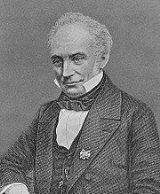
Franz Bopp

Encyclopedia
Germany
Germany , officially the Federal Republic of Germany , is a federal parliamentary republic in Europe. The country consists of 16 states while the capital and largest city is Berlin. Germany covers an area of 357,021 km2 and has a largely temperate seasonal climate...
linguist
Linguistics
Linguistics is the scientific study of human language. Linguistics can be broadly broken into three categories or subfields of study: language form, language meaning, and language in context....
known for extensive comparative work on Indo-European languages.
Biography
He was born at MainzMainz
Mainz under the Holy Roman Empire, and previously was a Roman fort city which commanded the west bank of the Rhine and formed part of the northernmost frontier of the Roman Empire...
, but owing to the political disarray of the time, his parents moved to Aschaffenburg
Aschaffenburg
Aschaffenburg is a city in northwest Bavaria, Germany. The town of Aschaffenburg is not considered part of the district of Aschaffenburg, but is the administrative seat.Aschaffenburg is known as the Tor zum Spessart or "gate to the Spessart"...
in Bavaria
Bavaria
Bavaria, formally the Free State of Bavaria is a state of Germany, located in the southeast of Germany. With an area of , it is the largest state by area, forming almost 20% of the total land area of Germany...
. There, he received a liberal education at the Lyceum, and Karl J. Windischmann
Karl Joseph Hieronymus Windischmann
Karl Joseph Hieronymus Windischmann was a German philosopher and anthropologist.He attended the Gymnasium in Mainz, and in 1772 took the course in philosophy at the university there. He continued this course at Würzburg, where he also studied the natural sciences and medicine until 1796...
drew his attention to the languages and literature of the East (Windischmann, along with Georg Friedrich Creuzer
Georg Friedrich Creuzer
Georg Friedrich Creuzer was a German philologist and archaeologist.He was born at Marburg, the son of a bookbinder...
, Johann Joseph von Görres
Johann Joseph von Görres
Johann Joseph von Görres was a German writer and journalist.-Early life:Görres was born at Koblenz. His father was moderately well off, and sent his son to a Latin college under the direction of the Roman Catholic clergy...
, and the brothers Schlegel, expressed great enthusiasm for Indian wisdom and philosophy). Moreover, Friedrich Schlegel
Karl Wilhelm Friedrich von Schlegel
Karl Wilhelm Friedrich Schlegel was a German poet, critic and scholar. With his older brother, August Wilhelm Schlegel, he was a critical leader of German Romanticism.-Life and work:...
's book, Über die Sprache und Weisheit der Indier (On the Speech and Wisdom of the Indians, Heidelberg, 1808), which had just begun to exert a powerful influence on the minds of German philosophers and historians, could not fail to stimulate also Bopp's interest in the sacred language of the Hindu
Hindu
Hindu refers to an identity associated with the philosophical, religious and cultural systems that are indigenous to the Indian subcontinent. As used in the Constitution of India, the word "Hindu" is also attributed to all persons professing any Indian religion...
s.
In 1812, he went to Paris
Paris
Paris is the capital and largest city in France, situated on the river Seine, in northern France, at the heart of the Île-de-France region...
at the expense of the Bavarian government, with a view to devoting himself vigorously to the study of Sanskrit
Sanskrit
Sanskrit , is a historical Indo-Aryan language and the primary liturgical language of Hinduism, Jainism and Buddhism.Buddhism: besides Pali, see Buddhist Hybrid Sanskrit Today, it is listed as one of the 22 scheduled languages of India and is an official language of the state of Uttarakhand...
. There he enjoyed the society of such eminent men as Antoine-Léonard de Chézy (his primary instructor), Silvestre de Sacy
Silvestre de Sacy
Antoine Isaac, Baron Silvestre de Sacy , was a French linguist and orientalist. His son, Ustazade Silvestre de Sacy, became a journalist.-Early life:...
, Louis Mathieu Langlès, and, above all, of Alexander Hamilton
Alexander Hamilton (linguist)
Alexander Hamilton was a British linguist who was one of the first Europeans to study the Sanskrit language. He taught the language to most of the earliest European scholars of Indo-European linguistics....
(1762–1824), cousin of the U.S. statesman, who had acquired, when in India
India
India , officially the Republic of India , is a country in South Asia. It is the seventh-largest country by geographical area, the second-most populous country with over 1.2 billion people, and the most populous democracy in the world...
, an acquaintance with Sanskrit, and had brought out, along with Langlès, a descriptive catalogue of the Sanskrit manuscripts of the Imperial library.
In the library, Bopp had access not only to the rich collection of Sanskrit manuscripts (mostly brought from India by Jean François Pons
Jean François Pons
Jean François Pons was a French Jesuit who pioneered the study of Sanskrit in the West.He published a survey of Sanskrit literature in 1743, where he described the language as "admirable for its harmony, copiousness, and energy", reporting on the parsimonity of the native grammatical tradition,...
in the early 18th century) but also to the Sanskrit books which had up to that time been issued from the Calcutta and Serampore
Serampore
Serampore is a city and a municipality in Hooghly district in the Indian state of West Bengal. It is a part of the area covered by Kolkata Metropolitan Development Authority. It is a pre-colonial town on the right bank of the Hoogli River...
presses.
He spent five years of laborious study, almost living in the libraries of Paris, and unmoved by the turmoils that agitated all the world around him, comprising Napoleon's escape, the Waterloo
Battle of Waterloo
The Battle of Waterloo was fought on Sunday 18 June 1815 near Waterloo in present-day Belgium, then part of the United Kingdom of the Netherlands...
campaign and the Restoration
Bourbon Restoration
The Bourbon Restoration is the name given to the period following the successive events of the French Revolution , the end of the First Republic , and then the forcible end of the First French Empire under Napoleon – when a coalition of European powers restored by arms the monarchy to the...
.
Career
The first paper from his years of study in Paris appeared in Frankfurt am MainFrankfurt
Frankfurt am Main , commonly known simply as Frankfurt, is the largest city in the German state of Hesse and the fifth-largest city in Germany, with a 2010 population of 688,249. The urban area had an estimated population of 2,300,000 in 2010...
in 1816, under the title of Über das Conjugationssystem der Sanskritsprache in Vergleichung mit jenem der griechischen, lateinischen, persischen und germanischen Sprache (On the Conjugation System of Sanskrit in comparison with that of Greek, Latin, Persian and Germanic) (Windischmann contributed a preface). In this first book Bopp entered at once the path on which he would focus the philological researches of his whole subsequent life. He did not need to prove the common parentage of Sanskrit with Persian
Persian language
Persian is an Iranian language within the Indo-Iranian branch of the Indo-European languages. It is primarily spoken in Iran, Afghanistan, Tajikistan and countries which historically came under Persian influence...
, Greek
Greek language
Greek is an independent branch of the Indo-European family of languages. Native to the southern Balkans, it has the longest documented history of any Indo-European language, spanning 34 centuries of written records. Its writing system has been the Greek alphabet for the majority of its history;...
, Latin
Latin
Latin is an Italic language originally spoken in Latium and Ancient Rome. It, along with most European languages, is a descendant of the ancient Proto-Indo-European language. Although it is considered a dead language, a number of scholars and members of the Christian clergy speak it fluently, and...
and German
German language
German is a West Germanic language, related to and classified alongside English and Dutch. With an estimated 90 – 98 million native speakers, German is one of the world's major languages and is the most widely-spoken first language in the European Union....
, for previous scholars had long established that; but he aimed to trace the common origin of those languages' grammatical
Grammar
In linguistics, grammar is the set of structural rules that govern the composition of clauses, phrases, and words in any given natural language. The term refers also to the study of such rules, and this field includes morphology, syntax, and phonology, often complemented by phonetics, semantics,...
forms, of their inflection
Inflection
In grammar, inflection or inflexion is the modification of a word to express different grammatical categories such as tense, grammatical mood, grammatical voice, aspect, person, number, gender and case...
s from composition – a task which no predecessor had attempted. By a historical analysis of those forms, as applied to the verb, he furnished the first trustworthy materials for a history of the languages compared.
After a brief sojourn in Germany, Bopp travelled to London where he made the acquaintance of Sir Charles Wilkins and H. T. Colebrooke
Henry Thomas Colebrooke
Henry Thomas Colebrooke was an English orientalist.-Biography:Henry Thomas Colebrooke, third son of Sir George Colebrooke, 2nd Baronet, was born in London. He was educated at home; and when only fifteen he had made considerable attainments in classics and mathematics...
. He also became friends with Wilhelm von Humboldt
Wilhelm von Humboldt
Friedrich Wilhelm Christian Karl Ferdinand Freiherr von Humboldt was a German philosopher, government functionary, diplomat, and founder of Humboldt Universität. He is especially remembered as a linguist who made important contributions to the philosophy of language and to the theory and practice...
, then Prussia
Prussia
Prussia was a German kingdom and historic state originating out of the Duchy of Prussia and the Margraviate of Brandenburg. For centuries, the House of Hohenzollern ruled Prussia, successfully expanding its size by way of an unusually well-organized and effective army. Prussia shaped the history...
n ambassador at the Court of St. James's
Court of St. James's
The Court of St James's is the royal court of the United Kingdom. It previously had the same function in the Kingdom of England and in the Kingdom of Great Britain .-Overview:...
, to whom he taught in Sanskrit. He brought out, in the Annals of Oriental Literature (London, 1820), an essay entitled, "Analytical Comparison of the Sanskrit, Greek, Latin and Teutonic Languages", in which he extended to all parts of the grammar what he had done in his first book for the verb alone. He had previously published a critical edition, with a Latin translation and notes, of the story of Nala and Damayanti (London, 1819), the most beautiful episode of the Mahabharata
Mahabharata
The Mahabharata is one of the two major Sanskrit epics of ancient India and Nepal, the other being the Ramayana. The epic is part of itihasa....
. Other episodes of the Mahabharata – Indralokâgama, and three others (Berlin, 1824); Diluvium, and three others (Berlin, 1829); a new edition of Nala (Berlin, 1832) – followed in due course, all of which, with A. W. Schlegel
August Wilhelm von Schlegel
August Wilhelm Schlegel was a German poet, translator, critic, and a foremost leader of German Romanticism. His translations of Shakespeare made the English dramatist's works into German classics.-Life and work:Schlegel was born at Hanover, where his father, Johann Adolf Schlegel, was a Lutheran...
's edition of the Bhagavad Gita
Bhagavad Gita
The ' , also more simply known as Gita, is a 700-verse Hindu scripture that is part of the ancient Sanskrit epic, the Mahabharata, but is frequently treated as a freestanding text, and in particular, as an Upanishad in its own right, one of the several books that constitute general Vedic tradition...
(1823), proved excellent aids in initiating the early student into the reading of Sanskrit texts. On the publication, in Calcutta, of the whole Mahabharata, Bopp discontinued editing Sanskrit texts and confined himself thenceforth exclusively to grammatical investigations.
After a short residence at Göttingen, Bopp gained, on the recommendation of Humboldt, appointment to the chair of Sanskrit and comparative grammar at Berlin
Humboldt University of Berlin
The Humboldt University of Berlin is Berlin's oldest university, founded in 1810 as the University of Berlin by the liberal Prussian educational reformer and linguist Wilhelm von Humboldt, whose university model has strongly influenced other European and Western universities...
in 1821, which he occupied for the rest of his life. He also became a member of the Royal Prussian Academy the following year.
He brought out in 1827 his Ausführliches Lehrgebäude der Sanskritsprache, on which he had worked since 1821. Bopp started work on a new edition in Latin, for the following year, completed in 1832; a shorter grammar appeared in 1834. At the same time he compiled a Sanskrit and Latin glossary (1830) in which, more especially in the second and third editions (1847 and 1868-71), he also took account of the cognate languages. His chief activity, however, centred on the elaboration of his Comparative Grammar, which appeared in six parts at considerable intervals (Berlin, 1833, 1835, 1842, 1847, 1849, 1852), under the title Vergleichende Grammatik des Sanskrit, Zend, Griechischen, Lateinischen, Litthauischen, Altslawischen, Gotischen und Deutschen (Comparative Grammar of Sanskrit, Zend (Avestan), Greek, Latin, Lithuanian, Old Slavonic, Gothic and German).
How carefully Bopp matured this work emerges from the series of monographs printed in the Transactions of the Berlin Academy (1824–1831), which preceded it. They bear the general title, Vergleichende Zergliederung des Sanskrits und der mit ihm verwandten Sprachen (Comparative Analysis of Sanskrit and its related Languages). Two other essays (on the "Numerals", 1835) followed the publication of the first part of the Comparative Grammar. Old Slavonian
Old Slavonic
Old Slavonic may refer to:*Old Church Slavonic language*Common Slavonic language...
began to take its stand among the languages compared from the second part onwards. E. B. Eastwick
Edward Backhouse Eastwick
Edward Backhouse Eastwick CB was a British orientalist, diplomat and Conservative Member of Parliament....
translated the work into English in 1845. A second German edition, thoroughly revised (1856–1861), also covered Old Armenian
Armenian language
The Armenian language is an Indo-European language spoken by the Armenian people. It is the official language of the Republic of Armenia as well as in the region of Nagorno-Karabakh. The language is also widely spoken by Armenian communities in the Armenian diaspora...
.
In his Comparative Grammar Bopp set himself a threefold task:
- to give a description of the original grammatical structure of the languages as deduced from their intercomparison
- to trace their phonetic laws, and
- to investigate the origin of their grammatical forms.
The first and second points remained dependent upon the third. As Bopp based his research on the best available sources and incorporated every new item of information that came to light, his work continued to widen and deepen in the making. Witness his monographs on the vowel system in the Teutonic languages (1836), on the Celtic languages (1839), on the Old Prussian
Old Prussian language
Prussian is an extinct Baltic language, once spoken by the inhabitants of the original territory of Prussia in an area of what later became East Prussia and eastern parts of...
(1853) and Albanian language
Albanian language
Albanian is an Indo-European language spoken by approximately 7.6 million people, primarily in Albania and Kosovo but also in other areas of the Balkans in which there is an Albanian population, including western Macedonia, southern Montenegro, southern Serbia and northwestern Greece...
s (Über das Albanesische in seinen verwandtschaftlichen Beziehungen, Vienna, 1854), on the accent in Sanskrit and Greek (1854), on the relationship of the Malayo-Polynesian
Malayo-Polynesian languages
The Malayo-Polynesian languages are a subgroup of the Austronesian languages, with approximately 385.5 million speakers. These are widely dispersed throughout the island nations of Southeast Asia and the Pacific Ocean, with a smaller number in continental Asia...
with the Indo-European languages (1840), and on the Caucasian languages (1846). In the two latter, the impetus of his genius led him on a wrong track.
Evaluations
Critics have charged Bopp with neglecting the study of the native Sanskrit grammars, but in those early days of Sanskrit studies the great libraries of Europe did not hold the requisite materials; if they had, those materials would have demanded his full attention for years, while such grammars as those of Charles WilkinsCharles Wilkins
Sir Charles Wilkins, KH, FRS , was an English typographer and Orientalist, notable as the first translator of Bhagavad Gita into English, and as the creator of the first Devanagari typeface....
and Henry Thomas Colebrooke
Henry Thomas Colebrooke
Henry Thomas Colebrooke was an English orientalist.-Biography:Henry Thomas Colebrooke, third son of Sir George Colebrooke, 2nd Baronet, was born in London. He was educated at home; and when only fifteen he had made considerable attainments in classics and mathematics...
, from which Bopp derived his grammatical knowledge, had all used native grammars as a basis. The further charge that Bopp, in his Comparative Grammar, gave undue prominence to Sanskrit stands disproved by his own words; for, as early as the year 1820, he gave it as his opinion that frequently the cognate languages serve to elucidate grammatical forms lost in Sanskrit (Annals of Or. Lit. i. 3), – an opinion which he further developed in all his subsequent writings.
Encyclopædia Britannica
Encyclopædia Britannica
The Encyclopædia Britannica , published by Encyclopædia Britannica, Inc., is a general knowledge English-language encyclopaedia that is available in print, as a DVD, and on the Internet. It is written and continuously updated by about 100 full-time editors and more than 4,000 expert...
(11th edition of 1911) assesses Bopp and his work as follows:
- Bopp's researches, carried with wonderful penetration into the most minute and almost microscopical details of linguistic phenomena, have led to the opening up of a wide and distant view into the original seats, the closer or more distant affinity, and the tenets, practices and domestic usages of the ancient Indo-European nations, and the science of comparative grammar may truly be said to date from his earliest publication. In grateful recognition of that fact, on the fiftieth anniversary (May 16, 1866) of the date of Windischmann's preface to that work, a fund called Die Bopp-Stiftung, for the promotion of the study of Sanskrit and comparative grammar, was established at Berlin, to which liberal contributions were made by his numerous pupils and admirers in all parts of the globe. Bopp lived to see the results of his labours everywhere accepted, and his name justly celebrated. But he died, on the 23rd of October 1867, in poverty, though his genuine kindliness and unselfishness, his devotion to his family and friends, and his rare modesty, endeared him to all who knew him.
English scholar Russell Martineau, who had studied under Bopp, gave the following tribute: “Bopp must, more or less, directly or indirectly, be the teacher of all who at the present day study, not this language or that language, but language itself — study it either as a universal function of man, subjected, like his other mental or physical functions, to law and order, or else as an historical development, worked out by a never ceasing course of education from one form into another.”
Martineau also wrote: “Bopp's Sanskrit studies and Sanskrit publications are the solid foundations upon which his system of comparative grammar was erected, and without which that could not have been perfect. For that purpose, far more than a mere dictionary knowledge of Sanskrit was required. The resemblances which he detected between Sanskrit and the Western cognate tongues existed in the syntax, the combination of words in the sentence and the various devices which only actual reading of the literature could disclose, far more than in the mere vocabulary. As a comparative grammarian he was much more than as a Sanskrit scholar,” and yet “it is surely much that he made the grammar, formerly a maze of Indian subtilty, as simple and attractive as that of Greek or Latin, introduced the study of the easier works of Sanskrit literature and trained (personally or by his books) pupils who could advance far higher, invade even the most intricate parts of the literature and make the Vedas intelligible. The great truth which his Comparative Grammar established was that of the mutual relations of the connected languages. Affinities had before him been observed between Latin and German, between German and Slavonic, etc., yet all attempts to prove one the parent of the other had been found preposterous.”