

Monarda

Encyclopedia
Monarda is a genus
consisting of roughly 16 species
of erect, herbaceous
, annual
or perennial
plants in the family
Lamiaceae
. The genus is endemic to North America
. Ranging in height from 1 to 3 feet (0.2 to 0.9 m), the plants have an equal spread, with slender and long-tapering (lanceolate
) leaves
. The leaves are opposite
on the stem
, smooth
to sparsely hairy, with lightly serrated margins, and ranging from 3 to 6 inches (7 to 14 cm) in length. In all species, the leaves, when crushed, exude a spicy, highly fragrant oil
. Of the species examined in one study
, M. didyma
(Oswego Tea) was found to contain the highest concentration of this oil.
Common names include bee balm, horsemint, oswego tea, and bergamot, the last one due to the leaves' fragrance resembling that of Citrus bergamia
fruits. The genus
was named for Nicolás Monardes
, who wrote a book in 1574 describing plants found in the New World
.
and perennial
upright growing herbaceous plant
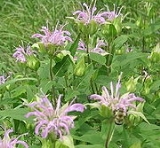
s with lanceolate to ovate shaped leaves. The flowers are tubular with bilateral symmetry and bilabiate; with upper lips narrow and the lower ones broader and spreading or deflexed. The flowers are single or in some cultivated forms double, generally hermaphroditic with two stamens. Plants bloom in mid- to late summer and the flowers are produced in dense profusion at the ends of the stem and/or in the stem axils. The flowers typically are crowded into head-like clusters with leafy bracts. Flower colors vary, with wild forms of the plant having crimson-red to red, pink and light purple hues. M. didyma
has bright, carmine red blossoms; M. fistulosa
—the "true" wild bergamot—has smokey pink flowers. M. citriodora and M. pectinata have light lavender to lilac-colored blooms and have slightly decreased flower quantities. Both species are commonly referred to as "Lemon Mint." "M. didyma" species can grow up to 6 feet tall. Seed collected from hybrids—as with most hybridized plants—does not produce identical plants to the parent. A number of hybrids also occur in the wild.
and Monarda didyma
) have a long history of use as a medicinal plants by many Native Americans
including the Blackfoot
, Menominee
, Ojibwa
and Winnebago
. The Blackfoot Indians recognized the strong antiseptic
action of these plants, and used poultice
s of the plant for skin infections and minor wounds. A tea made from the plant was also used to treat mouth and throat infections caused by dental caries
and gingivitis
. Bee balm is the natural source of the antiseptic Thymol
, the primary active ingredient in modern commercial mouthwash
formulas. The Winnebago used a tea made from bee balm as a general stimulant
. Bee balm was also used as a carminative
herb by Native Americans to treat excessive flatulence. An infusion
of crushed Monarda leaves in boiling water has been used to treat headaches and fevers.
Although somewhat bitter, due to the thymol content in the leaves and buds, the plant tastes like a mix of spearmint
and peppermint
with oregano
. Bee balm was traditionally used by Native Americans as a seasoning
for wild game
, particularly birds. The plants are widespread across North America and can be found in moist meadows, hillsides, and forest clearings up to 5000 feet (1,524 m) in elevation.
es disrupt established plants on occasion, but the plants are in general highly resistant to most wilts and viruses and are not easily damaged. Slugs however can be a serious pest early in the season, consuming all growth as it first emerges.
Used most frequently in areas in need of naturalization
, Monarda is often used in beds and borders to encourage and increase the appearance of hummingbird
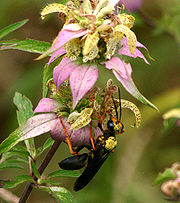
s, pollinating insects, predatory/parasitic insects that hunt garden pests, and because of oils present in its roots is sometimes used as a companion plant around small vegetable crops susceptible to subterranean pests. Bee balm is considered a good plant to grow with tomatoes, ostensibly improving both health and flavor. While seed should be stratified briefly before starting, seed may be cast directly or started in coldframes or greenhouses at soil temperatures approaching 70 °F (21.1 °C). Generally, propagation
occurs by hardwood and softwood cuttings, root cuttings, layering, and division; the latter, quite frequently, is the most popular method out of necessity: the plant should be divided every 3 to 5 years to reduce spread, keep the central core of the plant healthy, preclude root rot, and improve air circulation about the foliage.
There are over 50 commercial cultivars and hybrids, ranging in color from candy-apple red to pure white to deep blue, but these plants tend to be smaller than wild species, and often developed to combat climatic or pest conditions. Other hybrids have been developed to produce essential oil
s for food, flavoring, or medicine.
 Monarda species are used as food plants by the larva
e of some Lepidoptera
species including case-bearers of the genus Coleophora
including C. heinrichella (feeds exclusively on M. fistulosa), C. monardae (feeds exclusively on Monarda spp) and C. monardella (feeds exclusively on M. fistulosa).
Mentheae of the subfamily Nepetoideae. Molecular phylogenetic studies of this tribe have been poorly sampled
, and relationships
within it remain unclear. Blephilia
and Pycnanthemum
are close relatives of Monarda, but they might not be the closest. Monarda is divided into two distinct subgenera: Monarda and Cheilyctis. These are easily distinguished by several characters.
Genus
In biology, a genus is a low-level taxonomic rank used in the biological classification of living and fossil organisms, which is an example of definition by genus and differentia...
consisting of roughly 16 species
Species
In biology, a species is one of the basic units of biological classification and a taxonomic rank. A species is often defined as a group of organisms capable of interbreeding and producing fertile offspring. While in many cases this definition is adequate, more precise or differing measures are...
of erect, herbaceous
Herbaceous plant
A herbaceous plant is a plant that has leaves and stems that die down at the end of the growing season to the soil level. They have no persistent woody stem above ground...
, annual
Annual plant
An annual plant is a plant that usually germinates, flowers, and dies in a year or season. True annuals will only live longer than a year if they are prevented from setting seed...
or perennial
Perennial plant
A perennial plant or simply perennial is a plant that lives for more than two years. The term is often used to differentiate a plant from shorter lived annuals and biennials. The term is sometimes misused by commercial gardeners or horticulturalists to describe only herbaceous perennials...
plants in the family
Family (biology)
In biological classification, family is* a taxonomic rank. Other well-known ranks are life, domain, kingdom, phylum, class, order, genus, and species, with family fitting between order and genus. As for the other well-known ranks, there is the option of an immediately lower rank, indicated by the...
Lamiaceae
Lamiaceae
The mints, taxonomically known as Lamiaceae or Labiatae, are a family of flowering plants. They have traditionally been considered closely related to Verbenaceae, but in the 1990s, phylogenetic studies suggested that many genera classified in Verbenaceae belong instead in Lamiaceae...
. The genus is endemic to North America
North America
North America is a continent wholly within the Northern Hemisphere and almost wholly within the Western Hemisphere. It is also considered a northern subcontinent of the Americas...
. Ranging in height from 1 to 3 feet (0.2 to 0.9 m), the plants have an equal spread, with slender and long-tapering (lanceolate
Leaf shape
In botany, leaf shape is characterised with the following terms :* Acicular : Slender and pointed, needle-like* Acuminate : Tapering to a long point...
) leaves
Leaf
A leaf is an organ of a vascular plant, as defined in botanical terms, and in particular in plant morphology. Foliage is a mass noun that refers to leaves as a feature of plants....
. The leaves are opposite
Phyllotaxis
In botany, phyllotaxis or phyllotaxy is the arrangement of leaves on a plant stem .- Pattern structure :...
on the stem
Plant stem
A stem is one of two main structural axes of a vascular plant. The stem is normally divided into nodes and internodes, the nodes hold buds which grow into one or more leaves, inflorescence , conifer cones, roots, other stems etc. The internodes distance one node from another...
, smooth
Glabrousness
Glabrousness is the technical term for an anatomically atypical lack of hair, down, or similar structures...
to sparsely hairy, with lightly serrated margins, and ranging from 3 to 6 inches (7 to 14 cm) in length. In all species, the leaves, when crushed, exude a spicy, highly fragrant oil
Essential oil
An essential oil is a concentrated hydrophobic liquid containing volatile aroma compounds from plants. Essential oils are also known as volatile oils, ethereal oils or aetherolea, or simply as the "oil of" the plant from which they were extracted, such as oil of clove...
. Of the species examined in one study
Research
Research can be defined as the scientific search for knowledge, or as any systematic investigation, to establish novel facts, solve new or existing problems, prove new ideas, or develop new theories, usually using a scientific method...
, M. didyma
Monarda didyma
Monarda didyma is an aromatic herb in the family Lamiaceae, native to eastern North America from Maine west to Ohio and south to northern Georgia. Its name is derived from its odor, which is considered similar to that of the bergamot orange...
(Oswego Tea) was found to contain the highest concentration of this oil.
Common names include bee balm, horsemint, oswego tea, and bergamot, the last one due to the leaves' fragrance resembling that of Citrus bergamia
Bergamot orange
Citrus bergamia, the Bergamot orange, is a fragrant fruit the size of an orange, with a yellow colour similar to a lemon. Genetic research into the ancestral origins of extant citrus cultivars recently matched the bergamot as a likely hybrid of Citrus limetta and Citrus aurantium...
fruits. The genus
Genus
In biology, a genus is a low-level taxonomic rank used in the biological classification of living and fossil organisms, which is an example of definition by genus and differentia...
was named for Nicolás Monardes
Nicolás Monardes
Nicolás Bautista Monardes was a Spanish physician and botanist.The genus Monarda was named for him.Monardes published several books of varying importance. In Diálogo llamado pharmacodilosis , he examines humanism and suggests studying several classical authors, principally Pedanius Dioscorides...
, who wrote a book in 1574 describing plants found in the New World
New World
The New World is one of the names used for the Western Hemisphere, specifically America and sometimes Oceania . The term originated in the late 15th century, when America had been recently discovered by European explorers, expanding the geographical horizon of the people of the European middle...
.
Description
Monarda species include annualAnnual plant
An annual plant is a plant that usually germinates, flowers, and dies in a year or season. True annuals will only live longer than a year if they are prevented from setting seed...
and perennial
Perennial plant
A perennial plant or simply perennial is a plant that lives for more than two years. The term is often used to differentiate a plant from shorter lived annuals and biennials. The term is sometimes misused by commercial gardeners or horticulturalists to describe only herbaceous perennials...
upright growing herbaceous plant
Herbaceous plant
A herbaceous plant is a plant that has leaves and stems that die down at the end of the growing season to the soil level. They have no persistent woody stem above ground...
s with lanceolate to ovate shaped leaves. The flowers are tubular with bilateral symmetry and bilabiate; with upper lips narrow and the lower ones broader and spreading or deflexed. The flowers are single or in some cultivated forms double, generally hermaphroditic with two stamens. Plants bloom in mid- to late summer and the flowers are produced in dense profusion at the ends of the stem and/or in the stem axils. The flowers typically are crowded into head-like clusters with leafy bracts. Flower colors vary, with wild forms of the plant having crimson-red to red, pink and light purple hues. M. didyma
Monarda didyma
Monarda didyma is an aromatic herb in the family Lamiaceae, native to eastern North America from Maine west to Ohio and south to northern Georgia. Its name is derived from its odor, which is considered similar to that of the bergamot orange...
has bright, carmine red blossoms; M. fistulosa
Monarda fistulosa
Wild bergamot or Bee Balm is a wildflower in the mint family widespread and abundant as a native plant in much of North America. This plant, with showy summer-blooming white flowers, is often used as a honey plant, medicinal plant, and garden ornamental...
—the "true" wild bergamot—has smokey pink flowers. M. citriodora and M. pectinata have light lavender to lilac-colored blooms and have slightly decreased flower quantities. Both species are commonly referred to as "Lemon Mint." "M. didyma" species can grow up to 6 feet tall. Seed collected from hybrids—as with most hybridized plants—does not produce identical plants to the parent. A number of hybrids also occur in the wild.
Uses
Several bee balm species (Monarda fistulosaMonarda fistulosa
Wild bergamot or Bee Balm is a wildflower in the mint family widespread and abundant as a native plant in much of North America. This plant, with showy summer-blooming white flowers, is often used as a honey plant, medicinal plant, and garden ornamental...
and Monarda didyma
Monarda didyma
Monarda didyma is an aromatic herb in the family Lamiaceae, native to eastern North America from Maine west to Ohio and south to northern Georgia. Its name is derived from its odor, which is considered similar to that of the bergamot orange...
) have a long history of use as a medicinal plants by many Native Americans
Indigenous peoples of the Americas
The indigenous peoples of the Americas are the pre-Columbian inhabitants of North and South America, their descendants and other ethnic groups who are identified with those peoples. Indigenous peoples are known in Canada as Aboriginal peoples, and in the United States as Native Americans...
including the Blackfoot
Blackfoot
The Blackfoot Confederacy or Niitsítapi is the collective name of three First Nations in Alberta and one Native American tribe in Montana....
, Menominee
Menominee
Some placenames use other spellings, see also Menomonee and Menomonie.The Menominee are a nation of Native Americans living in Wisconsin. The Menominee, along with the Ho-Chunk, are the only tribes that are indigenous to what is now Wisconsin...
, Ojibwa
Ojibwa
The Ojibwe or Chippewa are among the largest groups of Native Americans–First Nations north of Mexico. They are divided between Canada and the United States. In Canada, they are the third-largest population among First Nations, surpassed only by Cree and Inuit...
and Winnebago
Winnebago
Winnebago can refer to:* The former name of the Ho-Chunk tribe of Native Americans with reservations in Nebraska, Iowa, and Wisconsin*A popular brand of recreational vehicles, manufactured by Winnebago Industries, of Forest City, Iowa...
. The Blackfoot Indians recognized the strong antiseptic
Antiseptic
Antiseptics are antimicrobial substances that are applied to living tissue/skin to reduce the possibility of infection, sepsis, or putrefaction...
action of these plants, and used poultice
Poultice
A poultice, also called cataplasm, is a soft moist mass, often heated and medicated, that is spread on cloth over the skin to treat an aching, inflamed, or painful part of the body. It can be used on wounds such as cuts...
s of the plant for skin infections and minor wounds. A tea made from the plant was also used to treat mouth and throat infections caused by dental caries
Caries
Caries is a progressive destruction of any kind of bone structure, including the skull, ribs and other bones, or the teeth. Caries can be caused by osteomyelitis, which is a microorganism disease. A disease that involves caries is mastoiditis, an inflammation of the mastoid process, in which the...
and gingivitis
Gingivitis
Gingivitis is a term used to describe non-destructive periodontal disease. The most common form of gingivitis is in response to bacterial biofilms adherent to tooth surfaces, termed plaque-induced gingivitis, and is the most common form of periodontal disease...
. Bee balm is the natural source of the antiseptic Thymol
Thymol
Thymol is a natural monoterpene phenol derivative of cymene, C10H14O, isomeric with carvacrol, found in oil of thyme, and extracted from Thymus vulgaris and various other kinds of plants as a white crystalline substance of a pleasant aromatic odor and strong antiseptic properties...
, the primary active ingredient in modern commercial mouthwash
Mouthwash
Mouthwash or mouth rinse is a product used to enhance oral hygiene. Some manufacturers of mouthwash claim that antiseptic and anti-plaque mouth rinse kill the bacterial plaque causing cavities, gingivitis, and bad breath. Anti-cavity mouth rinse uses fluoride to protect against tooth decay...
formulas. The Winnebago used a tea made from bee balm as a general stimulant
Stimulant
Stimulants are psychoactive drugs which induce temporary improvements in either mental or physical function or both. Examples of these kinds of effects may include enhanced alertness, wakefulness, and locomotion, among others...
. Bee balm was also used as a carminative
Carminative
A carminative, also known as carminativum , is a herb or preparation that either prevents formation of gas in the gastrointestinal tract or facilitates the expulsion of said gas, thereby combating flatulence...
herb by Native Americans to treat excessive flatulence. An infusion
Infusion
An infusion is the outcome of steeping plants with desired chemical compounds or flavors in water or oil.-History:The first recorded use of essential oils was in the 10th or 11th century by the Persian polymath Avicenna, possibly in The Canon of Medicine.-Preparation techniques:An infusion is very...
of crushed Monarda leaves in boiling water has been used to treat headaches and fevers.
Although somewhat bitter, due to the thymol content in the leaves and buds, the plant tastes like a mix of spearmint
Spearmint
Mentha spicata syn. M. cordifolia is a species of mint native to much of Europe and southwest Asia, though its exact natural range is uncertain due to extensive early cultivation. It grows in wet soils...
and peppermint
Peppermint
Peppermint is a hybrid mint, a cross between the watermint and spearmint . The plant, indigenous to Europe, is now widespread in cultivation throughout all regions of the world...
with oregano
Oregano
Oregano – scientifically named Origanum vulgare by Carolus Linnaeus – is a common species of Origanum, a genus of the mint family . It is native to warm-temperate western and southwestern Eurasia and the Mediterranean region.Oregano is a perennial herb, growing from 20–80 cm tall,...
. Bee balm was traditionally used by Native Americans as a seasoning
Seasoning
Seasoning is the process of imparting flavor to, or improving the flavor of, food.- General meaning :Seasonings include herbs and spices, which are themselves frequently referred to as "seasonings"...
for wild game
Game (food)
Game is any animal hunted for food or not normally domesticated. Game animals are also hunted for sport.The type and range of animals hunted for food varies in different parts of the world. This will be influenced by climate, animal diversity, local taste and locally accepted view about what can or...
, particularly birds. The plants are widespread across North America and can be found in moist meadows, hillsides, and forest clearings up to 5000 feet (1,524 m) in elevation.
Cultivation
Monarda plants prefer full sun and moist yet well-drained soil. Plants established in partial shade or filtered sun have higher incidences of rapid horizontal spread and flower less. An aggressive plant in the southeastern United States, bergamots can grow in a wide variety of soil conditions, although in dry soils some species and cultivars can be somewhat stunted. Powdery mildew, rust, and (rarely) tobacco mosaic virusTobacco mosaic virus
Tobacco mosaic virus is a positive-sense single stranded RNA virus that infects plants, especially tobacco and other members of the family Solanaceae. The infection causes characteristic patterns on the leaves . TMV was the first virus to be discovered...
es disrupt established plants on occasion, but the plants are in general highly resistant to most wilts and viruses and are not easily damaged. Slugs however can be a serious pest early in the season, consuming all growth as it first emerges.
Used most frequently in areas in need of naturalization
Naturalisation (biology)
In biology, naturalisation is any process by which a non-native organism spreads into the wild and its reproduction is sufficient to maintain its population. Such populations are said to be naturalised....
, Monarda is often used in beds and borders to encourage and increase the appearance of hummingbird
Hummingbird
Hummingbirds are birds that comprise the family Trochilidae. They are among the smallest of birds, most species measuring in the 7.5–13 cm range. Indeed, the smallest extant bird species is a hummingbird, the 5-cm Bee Hummingbird. They can hover in mid-air by rapidly flapping their wings...
s, pollinating insects, predatory/parasitic insects that hunt garden pests, and because of oils present in its roots is sometimes used as a companion plant around small vegetable crops susceptible to subterranean pests. Bee balm is considered a good plant to grow with tomatoes, ostensibly improving both health and flavor. While seed should be stratified briefly before starting, seed may be cast directly or started in coldframes or greenhouses at soil temperatures approaching 70 °F (21.1 °C). Generally, propagation
Plant propagation
Plant propagation is the process of creating new plants from a variety of sources: seeds, cuttings, bulbs and other plant parts. Plant propagation can also refer to the artificial or natural dispersal of plants.-Sexual propagation :...
occurs by hardwood and softwood cuttings, root cuttings, layering, and division; the latter, quite frequently, is the most popular method out of necessity: the plant should be divided every 3 to 5 years to reduce spread, keep the central core of the plant healthy, preclude root rot, and improve air circulation about the foliage.
There are over 50 commercial cultivars and hybrids, ranging in color from candy-apple red to pure white to deep blue, but these plants tend to be smaller than wild species, and often developed to combat climatic or pest conditions. Other hybrids have been developed to produce essential oil
Essential oil
An essential oil is a concentrated hydrophobic liquid containing volatile aroma compounds from plants. Essential oils are also known as volatile oils, ethereal oils or aetherolea, or simply as the "oil of" the plant from which they were extracted, such as oil of clove...
s for food, flavoring, or medicine.
Ecology
Larva
A larva is a distinct juvenile form many animals undergo before metamorphosis into adults. Animals with indirect development such as insects, amphibians, or cnidarians typically have a larval phase of their life cycle...
e of some Lepidoptera
Lepidoptera
Lepidoptera is a large order of insects that includes moths and butterflies . It is one of the most widespread and widely recognizable insect orders in the world, encompassing moths and the three superfamilies of butterflies, skipper butterflies, and moth-butterflies...
species including case-bearers of the genus Coleophora
Coleophora
Coleophora is a very large genus of moths of the family Coleophoridae. It contains some 1,350 described species. The genus is represented on all continents, but the majority are found in the Nearctic and Palaearctic regions...
including C. heinrichella (feeds exclusively on M. fistulosa), C. monardae (feeds exclusively on Monarda spp) and C. monardella (feeds exclusively on M. fistulosa).
Taxonomy
Monarda is in the tribeTribe (biology)
In biology, a tribe is a taxonomic rank between family and genus. It is sometimes subdivided into subtribes.Some examples include the tribes: Canini, Acalypheae, Hominini, Bombini, and Antidesmeae.-See also:* Biological classification* Rank...
Mentheae of the subfamily Nepetoideae. Molecular phylogenetic studies of this tribe have been poorly sampled
Sample (material)
In general, a sample is a limited quantity of something which is intended to be similar to and represent a larger amount of that thing. The things could be countable objects such as individual items available as units for sale, or a material not countable as individual items. Samples of countable...
, and relationships
Phylogenetic tree
A phylogenetic tree or evolutionary tree is a branching diagram or "tree" showing the inferred evolutionary relationships among various biological species or other entities based upon similarities and differences in their physical and/or genetic characteristics...
within it remain unclear. Blephilia
Blephilia
Blephilia is a genus of three species of flowering plants in the family Lamiaceae. They are all herbaceous plants native to eastern North America. The species are most often found in thin woods and in granite and limestone soils...
and Pycnanthemum
Pycnanthemum
Pycnanthemum is a genus of plants in the mint family . They are commonly known as mountain mints , though "the Mountain Mint" may also be any locally common species in particular. Some are known as koellias, after an obsolete genus name.All of the approximately 20 species in this genus are native...
are close relatives of Monarda, but they might not be the closest. Monarda is divided into two distinct subgenera: Monarda and Cheilyctis. These are easily distinguished by several characters.
Selected species
|
Monarda punctata Monarda punctata is a herbaceous plant in the mint family, Lamiaceae, that is native to the United States and northeastern Mexico. Common names include Spotted Beebalm and Horsemint.... L. – Spotted Beebalm |
Formerly placed here
- Blephilia ciliata (L.) Benth. (as M. ciliata L.)
- Blephilia hirsuta (Pursh) Benth. (as M. ciliata Pursh)