

Tobacco mosaic virus

Encyclopedia
Tobacco mosaic virus is a positive-sense single stranded RNA virus
that infects plants, especially tobacco
and other members of the family Solanaceae
. The infection
causes characteristic patterns (mottling and discoloration) on the leaves
(hence the name). TMV was the first virus
to be discovered. Although it was known from the late 19th century that an infectious disease
was damaging tobacco crops, it was not until 1930 that the infectious agent was determined to be a virus.
first described the tobacco mosaic disease that could be transferred between plants, similar to bacteria
l infections. In 1892, Dmitri Ivanovsky gave the first concrete evidence for the existence of a non-bacterial infectious agent, showing that infected sap remained infectious even after filtering through finest Chamberland filter
candle
s. Later, in 1903, Ivanovsky published a paper describing abnormal crystal intracellular inclusions in the host cells of the affected tobacco plants and argued the connection between these inclusions and the infectious agent. However, Ivanovsky remained rather convinced, despite repeated failures to produce evidence, that the causal agent was an unculturable bacterium, too small to be retained on the employed Chamberland filter
s and to be detected in the light microscope. In 1898, Martinus Beijerinck
independently replicated Ivanovsky's filtration experiments and then showed that the infectious agent was able to reproduce and multiply in the host cells of the tobacco plant. Beijerinck coined the term of "virus" to indicate that the causal agent of tobacco mosaic disease was of non-bacterial nature. Tobacco mosaic virus was the first virus to be crystallized. It was achieved by Wendell Meredith Stanley
in 1935 who also showed that TMV remains active even after crystallization. For his work, he was awarded 1/4 of the Nobel Prize in Chemistry
in 1946, even though it was later shown some of his conclusions (in particular, that the crystals were pure protein, and assembled by autocatalysis
) were incorrect. The first electron microscopical images of TMV were made in 1939 by Gustav Kausche, Edgar Pfankuch and Helmut Ruska
- the brother of Nobel Prize winner Ernst Ruska
. In 1955, Heinz Fraenkel-Conrat and Robley Williams showed that purified TMV RNA and its capsid
(coat) protein assemble by themselves to functional viruses, indicating that this is the most stable structure (the one with the lowest free energy).
The crystallographer
Rosalind Franklin
worked for Stanley for about a month at Berkeley
, and later designed and built a model of TMV for the 1958 World's Fair at Brussels
. In 1958, she speculated that the virus was hollow, not solid, and hypothesized that the RNA
of TMV is single-stranded. This conjecture was proven to be correct after her death and is now known to be the + strand. The investigations of tobacco mosaic disease and subsequent discovery of its viral nature were instrumental in the establishment of the general concepts of virology
.
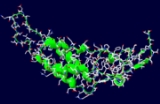
 Tobacco mosaic virus has a rod-like appearance. Its capsid is made from 2130 molecules of coat protein (see image to the left) and one molecule of genomic single strand RNA 6400 bases long. The coat protein self-assembles into the rod like helical structure (16.3 proteins per helix turn) around the RNA which forms a hairpin loop structure (see the electron micrograph
above). The protein monomer consists of 158 amino acids which are assembled into four main alpha-helices, which are joined by a prominent loop proximal to the axis of the virion. Virions are ~300 nm in length and ~18 nm in diameter. Negatively stained electron microphotographs show a distinct inner channel of ~4 nm. The RNA is located at a radius of ~6 nm and is protected from the action of cellular enzymes by the coat protein. There are three RNA nucleotides per protein monomer. X-ray fiber diffraction
structure of the intact virus was studied based on an electron density
map at 3.6 Å resolution.
TMV has an index of refraction of about 1.57.
. For its smooth entry, TMV produces a 30 kDa
movement protein
called P30 which enlarge the plasmodesmata. TMV most likely moves from cell-to-cell as a complex of the RNA, P30, and replicase proteins.
It can also spread through phloem
for longer distance movement within the plant. Moreover, TMV can be transmitted from one plant to another by direct contact. Although TMV does not have defined transmission vectors, the virus can be easily transmitted from the infected hosts to the healthy plants, by human handling.
and an RNA-dependent RNA polymerase
(RdRp), as well as the movement protein. Thus TMV can replicate its own genome. After the coat protein and RNA genome of TMV have been synthesized, they spontaneously assemble into complete TMV virions in a highly organized process. The protomers come together to form disks composed of two layers of protomers arranged in a helical spiral. The helical capsid grows by the addition of protomers to the end of the rod. As the rod lengthens, the RNA passes through a channel in its center and forms a loop at the growing end. In this way the RNA can easily fit as a spiral into the interior of the helical capsid.
. It is known to infect members of nine plant families, and at least 125 individual species, including tobacco, tomato
, pepper
(all members of the useful Solanaceae
), cucumber
s, and a number of ornamental flowers. There are many different strains. The first symptom of this virus disease is a light green coloration between the veins of young leaves
. This is followed quickly by the development of a "mosaic" or mottled pattern of light and dark green areas in the leaves. Rugosity may also be seen where the infected plant leaves display small localized random wrinkles. These symptoms develop quickly and are more pronounced on younger leaves. Mosaic does not result in plant death, but if infection occurs early in the season, plants are stunted. Lower leaves are subjected to "mosaic burn" especially during periods of hot and dry weather. In these cases, large dead areas develop in the leaves. This constitutes one of the most destructive phases of tobacco mosaic virus infection. Infected leaves may be crinkled, puckered, or elongated. However, if TMV infects crops like grape and apple, it is almost symptomless.
, TMV can sustain its stable form. All it needs is a host to infect. If necessary, greenhouses and botanical gardens would provide the most favorable condition for TMV to spread out, due to the high population density of possible hosts and the constant temperature throughout the year.
In the past 10 years, the application of genetic engineering on a host plant genome has been developed to allow the host plant to produce the TMV coat protein within their cells. It was hypothesized that the TMV genome will be re-coated rapidly upon entering the host cell, thus it prevents the initiation of TMV replication. Later it was found that the mechanism that protects the host from viral genome insertion is through gene silencing.
In some cases, spraying milk on the host plant is known to inhibit the TMV infection.
(including X-ray diffraction), virus assembly and disassembly, and so on, are fundamentally due to the large quantities that can be obtained, plus the fact that it does not infect animals. After growing a few infected tobacco plants in a greenhouse
and a few simple laboratory procedures, a scientist can easily produce several grams of virus. As a result of this, TMV can be treated almost as an organic chemical, rather than an infective agent.
RNA virus
An RNA virus is a virus that has RNA as its genetic material. This nucleic acid is usually single-stranded RNA but may be double-stranded RNA...
that infects plants, especially tobacco
Tobacco
Tobacco is an agricultural product processed from the leaves of plants in the genus Nicotiana. It can be consumed, used as a pesticide and, in the form of nicotine tartrate, used in some medicines...
and other members of the family Solanaceae
Solanaceae
Solanaceae are a family of flowering plants that include a number of important agricultural crops as well as many toxic plants. The name of the family comes from the Latin Solanum "the nightshade plant", but the further etymology of that word is unclear...
. The infection
Infection
An infection is the colonization of a host organism by parasite species. Infecting parasites seek to use the host's resources to reproduce, often resulting in disease...
causes characteristic patterns (mottling and discoloration) on the leaves
Leaf
A leaf is an organ of a vascular plant, as defined in botanical terms, and in particular in plant morphology. Foliage is a mass noun that refers to leaves as a feature of plants....
(hence the name). TMV was the first virus
Virus
A virus is a small infectious agent that can replicate only inside the living cells of organisms. Viruses infect all types of organisms, from animals and plants to bacteria and archaea...
to be discovered. Although it was known from the late 19th century that an infectious disease
Infectious disease
Infectious diseases, also known as communicable diseases, contagious diseases or transmissible diseases comprise clinically evident illness resulting from the infection, presence and growth of pathogenic biological agents in an individual host organism...
was damaging tobacco crops, it was not until 1930 that the infectious agent was determined to be a virus.
History
In 1886, Adolf MayerAdolf Mayer
Adolf Eduard Mayer was a German agricultural chemist whose work on tobacco mosaic disease played an important role in the discovery of tobacco mosaic virus and viruses in general....
first described the tobacco mosaic disease that could be transferred between plants, similar to bacteria
Bacteria
Bacteria are a large domain of prokaryotic microorganisms. Typically a few micrometres in length, bacteria have a wide range of shapes, ranging from spheres to rods and spirals...
l infections. In 1892, Dmitri Ivanovsky gave the first concrete evidence for the existence of a non-bacterial infectious agent, showing that infected sap remained infectious even after filtering through finest Chamberland filter
Chamberland filter
A Chamberland filter, also known as a Pasteur-Chamberland filter, is a porcelain water filter invented by Charles Chamberland in 1884. It is similar to the Berkefeld filter in principle.-Design:...
candle
Candle
A candle is a solid block or cylinder of wax with an embedded wick, which is lit to provide light, and sometimes heat.Today, most candles are made from paraffin. Candles can also be made from beeswax, soy, other plant waxes, and tallow...
s. Later, in 1903, Ivanovsky published a paper describing abnormal crystal intracellular inclusions in the host cells of the affected tobacco plants and argued the connection between these inclusions and the infectious agent. However, Ivanovsky remained rather convinced, despite repeated failures to produce evidence, that the causal agent was an unculturable bacterium, too small to be retained on the employed Chamberland filter
Chamberland filter
A Chamberland filter, also known as a Pasteur-Chamberland filter, is a porcelain water filter invented by Charles Chamberland in 1884. It is similar to the Berkefeld filter in principle.-Design:...
s and to be detected in the light microscope. In 1898, Martinus Beijerinck
Martinus Beijerinck
Martinus Willem Beijerinck was a Dutch microbiologist and botanist. Born in Amsterdam, Beijerinck studied at the Technical School of Delft, where he was awarded the degree of Chemical Engineer in 1872. He obtained his Doctor of Science degree from the University of Leiden in 1877...
independently replicated Ivanovsky's filtration experiments and then showed that the infectious agent was able to reproduce and multiply in the host cells of the tobacco plant. Beijerinck coined the term of "virus" to indicate that the causal agent of tobacco mosaic disease was of non-bacterial nature. Tobacco mosaic virus was the first virus to be crystallized. It was achieved by Wendell Meredith Stanley
Wendell Meredith Stanley
Wendell Meredith Stanley was an American biochemist, virologist and Nobel laureate.-Biography:Stanley was born in Ridgeville, Indiana, and earned a BS in Chemistry at Earlham College in Richmond, Indiana. He then studied at the University of Illinois, gaining an MS in science in 1927 followed by...
in 1935 who also showed that TMV remains active even after crystallization. For his work, he was awarded 1/4 of the Nobel Prize in Chemistry
Nobel Prize in Chemistry
The Nobel Prize in Chemistry is awarded annually by the Royal Swedish Academy of Sciences to scientists in the various fields of chemistry. It is one of the five Nobel Prizes established by the will of Alfred Nobel in 1895, awarded for outstanding contributions in chemistry, physics, literature,...
in 1946, even though it was later shown some of his conclusions (in particular, that the crystals were pure protein, and assembled by autocatalysis
Autocatalysis
A single chemical reaction is said to have undergone autocatalysis, or be autocatalytic, if the reaction product itself is the catalyst for that reaction....
) were incorrect. The first electron microscopical images of TMV were made in 1939 by Gustav Kausche, Edgar Pfankuch and Helmut Ruska
Helmut Ruska
Helmut Ruska was a German physician and biologist from Heidelberg. After earning his medical degree, he spent several years working as a physician at hospitals in Heidelberg and Berlin...
- the brother of Nobel Prize winner Ernst Ruska
Ernst Ruska
Ernst August Friedrich Ruska was a German physicist who won the Nobel Prize in Physics in 1986 for his work in electron optics, including the design of the first electron microscope.Ruska was born in Heidelberg...
. In 1955, Heinz Fraenkel-Conrat and Robley Williams showed that purified TMV RNA and its capsid
Capsid
A capsid is the protein shell of a virus. It consists of several oligomeric structural subunits made of protein called protomers. The observable 3-dimensional morphological subunits, which may or may not correspond to individual proteins, are called capsomeres. The capsid encloses the genetic...
(coat) protein assemble by themselves to functional viruses, indicating that this is the most stable structure (the one with the lowest free energy).
The crystallographer
Crystallographer
Crystallographer could refer to someone who practices:*X-ray crystallography*Crystallography...
Rosalind Franklin
Rosalind Franklin
Rosalind Elsie Franklin was a British biophysicist and X-ray crystallographer who made critical contributions to the understanding of the fine molecular structures of DNA, RNA, viruses, coal and graphite...
worked for Stanley for about a month at Berkeley
University of California, Berkeley
The University of California, Berkeley , is a teaching and research university established in 1868 and located in Berkeley, California, USA...
, and later designed and built a model of TMV for the 1958 World's Fair at Brussels
Brussels
Brussels , officially the Brussels Region or Brussels-Capital Region , is the capital of Belgium and the de facto capital of the European Union...
. In 1958, she speculated that the virus was hollow, not solid, and hypothesized that the RNA
RNA
Ribonucleic acid , or RNA, is one of the three major macromolecules that are essential for all known forms of life....
of TMV is single-stranded. This conjecture was proven to be correct after her death and is now known to be the + strand. The investigations of tobacco mosaic disease and subsequent discovery of its viral nature were instrumental in the establishment of the general concepts of virology
Virology
Virology is the study of viruses and virus-like agents: their structure, classification and evolution, their ways to infect and exploit cells for virus reproduction, the diseases they cause, the techniques to isolate and culture them, and their use in research and therapy...
.
Structure
Electron microscope
An electron microscope is a type of microscope that uses a beam of electrons to illuminate the specimen and produce a magnified image. Electron microscopes have a greater resolving power than a light-powered optical microscope, because electrons have wavelengths about 100,000 times shorter than...
above). The protein monomer consists of 158 amino acids which are assembled into four main alpha-helices, which are joined by a prominent loop proximal to the axis of the virion. Virions are ~300 nm in length and ~18 nm in diameter. Negatively stained electron microphotographs show a distinct inner channel of ~4 nm. The RNA is located at a radius of ~6 nm and is protected from the action of cellular enzymes by the coat protein. There are three RNA nucleotides per protein monomer. X-ray fiber diffraction
Fiber diffraction
Fiber diffraction is a subarea of scattering, an area in which molecular structure is determined from scattering data . In fiber diffraction the scattering pattern does not change, as the sample is rotated about a unique axis...
structure of the intact virus was studied based on an electron density
Electron density
Electron density is the measure of the probability of an electron being present at a specific location.In molecules, regions of electron density are usually found around the atom, and its bonds...
map at 3.6 Å resolution.
Physicochemical properties
TMV is a thermostable virus. On a dried leaf, it can withstand up to 120 degrees Fahrenheit (50 °C) for 30 minutes.TMV has an index of refraction of about 1.57.
Disease cycle
TMV does not have a distinct over-wintering structure. Rather, it will over-winter in infected tobacco stalks and leaves in the soil, on the surface of contaminated seed (TMV can even survive in contaminated tobacco products for many years). With the direct contact with host plants through its vectors (normally insects such as aphids and leaf hoppers), TMV will go through the infection process and then the replication process.Infection
After its multiplication, it enters the neighboring cells through plasmodesmataPlasmodesmata
Plasmodesmata are microscopic channels which traverse the cell walls of plant cells and some algal cells, enabling transport and communication between them. Species that have plasmodesmata include members of the Charophyceae, Charales and Coleochaetales , as well as all embryophytes, better known...
. For its smooth entry, TMV produces a 30 kDa
Atomic mass unit
The unified atomic mass unit or dalton is a unit that is used for indicating mass on an atomic or molecular scale. It is defined as one twelfth of the rest mass of an unbound neutral atom of carbon-12 in its nuclear and electronic ground state, and has a value of...
movement protein
Movement Proteins
Successful infection of a plant by a plant virus depends on its ability to move from the cell initially infected to neighbouring cells in order to spread infection. Unlike animal cells, plant cells have robust cell walls, which viruses cannot easily penetrate...
called P30 which enlarge the plasmodesmata. TMV most likely moves from cell-to-cell as a complex of the RNA, P30, and replicase proteins.
It can also spread through phloem
Phloem
In vascular plants, phloem is the living tissue that carries organic nutrients , in particular, glucose, a sugar, to all parts of the plant where needed. In trees, the phloem is the innermost layer of the bark, hence the name, derived from the Greek word "bark"...
for longer distance movement within the plant. Moreover, TMV can be transmitted from one plant to another by direct contact. Although TMV does not have defined transmission vectors, the virus can be easily transmitted from the infected hosts to the healthy plants, by human handling.
Replication
Following entry into its host via mechanical inoculation, TMV uncoats itself to release its viral RNA strand. Then the viral genome will further replicate to produce multiple mRNAs. The resulting mRNAs encode several proteins, including the coat proteinCapsid
A capsid is the protein shell of a virus. It consists of several oligomeric structural subunits made of protein called protomers. The observable 3-dimensional morphological subunits, which may or may not correspond to individual proteins, are called capsomeres. The capsid encloses the genetic...
and an RNA-dependent RNA polymerase
RNA-dependent RNA polymerase
RNA-dependent RNA polymerase , , or RNA replicase, is an enzyme that catalyzes the replication of RNA from an RNA template...
(RdRp), as well as the movement protein. Thus TMV can replicate its own genome. After the coat protein and RNA genome of TMV have been synthesized, they spontaneously assemble into complete TMV virions in a highly organized process. The protomers come together to form disks composed of two layers of protomers arranged in a helical spiral. The helical capsid grows by the addition of protomers to the end of the rod. As the rod lengthens, the RNA passes through a channel in its center and forms a loop at the growing end. In this way the RNA can easily fit as a spiral into the interior of the helical capsid.
Host and symptoms
Like other plant pathogenic viruses, TMV has a very wide host range and has different effects depending on the host being infected. The tobacco mosaic virus has been known to cause a production loss for flue cured tobacco of up to two percent in North CarolinaNorth Carolina
North Carolina is a state located in the southeastern United States. The state borders South Carolina and Georgia to the south, Tennessee to the west and Virginia to the north. North Carolina contains 100 counties. Its capital is Raleigh, and its largest city is Charlotte...
. It is known to infect members of nine plant families, and at least 125 individual species, including tobacco, tomato
Tomato
The word "tomato" may refer to the plant or the edible, typically red, fruit which it bears. Originating in South America, the tomato was spread around the world following the Spanish colonization of the Americas, and its many varieties are now widely grown, often in greenhouses in cooler...
, pepper
Capsicum
Capsicum is a genus of flowering plants in the nightshade family, Solanaceae. Its species are native to the Americas where they have been cultivated for thousands of years, but they are now also cultivated worldwide, used as spices, vegetables, and medicines - and have become are a key element in...
(all members of the useful Solanaceae
Solanaceae
Solanaceae are a family of flowering plants that include a number of important agricultural crops as well as many toxic plants. The name of the family comes from the Latin Solanum "the nightshade plant", but the further etymology of that word is unclear...
), cucumber
Cucumber
The cucumber is a widely cultivated plant in the gourd family Cucurbitaceae, which includes squash, and in the same genus as the muskmelon. The plant is a creeping vine which bears cylindrical edible fruit when ripe. There are three main varieties of cucumber: "slicing", "pickling", and...
s, and a number of ornamental flowers. There are many different strains. The first symptom of this virus disease is a light green coloration between the veins of young leaves
Leaves
-History:Vocalist Arnar Gudjonsson was formerly the guitarist with Mower, and he was joined by Hallur Hallsson , Arnar Ólafsson , Bjarni Grímsson , and Andri Ásgrímsson . Late in 2001 they played with Emiliana Torrini and drew early praise from the New York Times...
. This is followed quickly by the development of a "mosaic" or mottled pattern of light and dark green areas in the leaves. Rugosity may also be seen where the infected plant leaves display small localized random wrinkles. These symptoms develop quickly and are more pronounced on younger leaves. Mosaic does not result in plant death, but if infection occurs early in the season, plants are stunted. Lower leaves are subjected to "mosaic burn" especially during periods of hot and dry weather. In these cases, large dead areas develop in the leaves. This constitutes one of the most destructive phases of tobacco mosaic virus infection. Infected leaves may be crinkled, puckered, or elongated. However, if TMV infects crops like grape and apple, it is almost symptomless.
Transference to humans
Consumption of tobacco products infected with the tobacco mosaic virus has not been found to have any effect on humans.Environment
TMV is known as one of the most stable viruses. It has a very wide survival range. As long as the surrounding temperature remains below approximately 40 degrees CelsiusCelsius
Celsius is a scale and unit of measurement for temperature. It is named after the Swedish astronomer Anders Celsius , who developed a similar temperature scale two years before his death...
, TMV can sustain its stable form. All it needs is a host to infect. If necessary, greenhouses and botanical gardens would provide the most favorable condition for TMV to spread out, due to the high population density of possible hosts and the constant temperature throughout the year.
Treatment/management
One of the common control methods for TMV is sanitation, which includes removing infected plants, and washing hands in between each planting. Crop rotation should also be employed to avoid infected soil/seed beds for at least 2 years. As for any plant disease, looking for resistant strains against TMV may also be advised. Furthermore, the cross protection method can be administered, where the stronger strain of TMV infection is inhibited by infecting the host plant with mild strain of TMV, similar to the effect of a vaccine.In the past 10 years, the application of genetic engineering on a host plant genome has been developed to allow the host plant to produce the TMV coat protein within their cells. It was hypothesized that the TMV genome will be re-coated rapidly upon entering the host cell, thus it prevents the initiation of TMV replication. Later it was found that the mechanism that protects the host from viral genome insertion is through gene silencing.
In some cases, spraying milk on the host plant is known to inhibit the TMV infection.
Scientific and Environmental Impact
The large amount of literature about TMV and its choice for many pioneering investigations in structural biologyStructural biology
Structural biology is a branch of molecular biology, biochemistry, and biophysics concerned with the molecular structure of biological macromolecules, especially proteins and nucleic acids, how they acquire the structures they have, and how alterations in their structures affect their function...
(including X-ray diffraction), virus assembly and disassembly, and so on, are fundamentally due to the large quantities that can be obtained, plus the fact that it does not infect animals. After growing a few infected tobacco plants in a greenhouse
Greenhouse
A greenhouse is a building in which plants are grown. These structures range in size from small sheds to very large buildings...
and a few simple laboratory procedures, a scientist can easily produce several grams of virus. As a result of this, TMV can be treated almost as an organic chemical, rather than an infective agent.
Investigational uses
Due to its cylindrical high aspect ratio, self-assembling nature, and ability to incorporate metal coatings (nickel and cobalt) into its shell, TMV is an ideal candidate to be incorporated into battery electrodes. Addition of TMV to a battery electrode increases the reactive surface area by an order of magnitude, resulting in an increase in the battery's capacity by up to 6 times compared to a planar electrode geometry.Further reading
- Flue-cured tobacco field manual published R.J.Reynolds Tobacco Company, Winston-Salem, North Carolina, 1995
External links
- Tobacco Mosaic Virus-Details
- Description of plant viruses - TMV - contains information on symptoms, hosts species, purification etc.
- Further information
- Electron microscope image of TM