


Microsoft SQL Server

Encyclopedia
Microsoft SQL Server is a relational database server
, developed by Microsoft
: It is a software product whose primary function is to store and retrieve data as requested by other software applications, be it those on the same computer or those running on another computer across a network (including the Internet). There are at least a dozen different editions of Microsoft SQL Server aimed at different audiences and for different workloads (ranging from small applications that store and retrieve data on the same computer, to millions of users and computers that access huge amounts of data from the Internet at the same time).
True to its namesake, Microsoft SQL Server's primary query language
s are T-SQL
and ANSI SQL
.
Prior to version 7.0 the code base for MS SQL Server was sold by Sybase SQL Server to Microsoft, and was Microsoft's entry to the enterprise-level database market, competing against Oracle
, IBM
, and, later, Sybase
. Microsoft, Sybase and Ashton-Tate
originally teamed up to create and market the first version named SQL Server 1.0 for OS/2
(about 1989) which was essentially the same as Sybase SQL Server 3.0 on Unix
, VMS, etc. Microsoft SQL Server 4.2 was shipped around 1992 (available bundled with IBM OS/2
version 1.3). Later Microsoft SQL Server 4.21 for Windows NT was released at the same time as Windows NT 3.1. Microsoft SQL Server v6.0 was the first version designed for NT, and did not include any direction from Sybase.
About the time Windows NT
was released, Sybase and Microsoft parted ways and each pursued their own design and marketing schemes. Microsoft negotiated exclusive rights to all versions of SQL Server written for Microsoft operating systems. Later, Sybase changed the name of its product to Adaptive Server Enterprise
to avoid confusion with Microsoft SQL Server. Until 1994, Microsoft's SQL Server carried three Sybase copyright notices as an indication of its origin.
Since parting ways, several revisions have been done independently. SQL Server 7.0 was a rewrite from the legacy Sybase code. It was succeeded by SQL Server 2000, which was the first edition to be launched in a variant for the IA-64 architecture.
In the ten years since release of Microsoft's previous SQL Server product (SQL Server 2000), advancements have been made in performance, the client IDE tools, and several complementary systems that are packaged with SQL Server 2005. These include: an ETL
tool (SQL Server Integration Services or SSIS
), a Reporting Server
, an OLAP
and data mining
server (Analysis Services
), and several messaging technologies, specifically Service Broker and Notification Services.
data, in addition to relational data
. For this purpose, it defined an
that could be used either as a data type in database columns or as literals in queries. XML columns can be associated with XSD schemas; XML data being stored is verified against the schema. XML is converted to an internal binary data type before being stored in the database. Specialized indexing methods were made available for XML data. XML data is queried using XQuery
; Common Language Runtime
(CLR) integration was a main feature with this edition, enabling one to write SQL code as Managed Code by the CLR. SQL Server 2005 added some extensions to the T-SQL language to allow embedding XQuery queries in T-SQL. In addition, it also defines a new extension to XQuery, called XML DML, that allows query-based modifications to XML data. SQL Server 2005 also allows a database server to be exposed over web service
s using Tabular Data Stream
(TDS) packets encapsulated within SOAP (protocol) requests. When the data is accessed over web services, results are returned as XML.
For relational data, T-SQL has been augmented with error handling features (try/catch) and support for recursive queries with CTEs (Common Table Expressions). SQL Server 2005 has also been enhanced with new indexing algorithms, syntax and better error recovery systems. Data pages are checksum
med for better error resiliency, and optimistic concurrency support has been added for better performance. Permissions and access control have been made more granular and the query processor handles concurrent execution of queries in a more efficient way. Partitions on tables and indexes are supported natively, so scaling out a database onto a cluster
is easier. SQL CLR was introduced with SQL Server 2005 to let it integrate with the .NET Framework.
SQL Server 2005 introduced "MARS" (Multiple Active Results Sets), a method of allowing usage of database connections for multiple purposes.
SQL Server 2005 introduced DMVs (Dynamic Management Views), which are specialized views and functions that return server state information that can be used to monitor the health of a server instance, diagnose problems, and tune performance.
SQL Server 2005 introduced Database Mirroring, but it was not fully supported until the first Service Pack release (SP1). In the initial release (RTM) of SQL Server 2005, database mirroring was available, but unsupported. In order to implement database mirroring in the RTM version, you had to apply trace flag 1400 at startup. Database mirroring is a high availability option that provides redundancy and failover capabilities at the database level. Failover can be performed manually or can be configured for automatic failover. Automatic failover requires a witness partner and an operating mode of synchronous (also known as high-safety or full safety).
, self organizing, and self maintaining with the development of SQL Server Always On technologies, to provide near-zero downtime. SQL Server 2008 also includes support for structured and semi-structured data, including digital media formats for pictures, audio, video and other multimedia data. In current versions, such multimedia data can be stored as BLOBs
(binary large objects), but they are generic bitstreams. Intrinsic awareness of multimedia data will allow specialized functions to be performed on them. According to Paul Flessner, senior Vice President, Server Applications, Microsoft Corp.
, SQL Server 2008 can be a data storage backend for different varieties of data: XML, email, time/calendar, file, document, spatial, etc as well as perform search, query, analysis, sharing, and synchronization across all data types.
Other new data types include specialized date and time types and a Spatial data type for location-dependent data. Better support for unstructured and semi-structured data is provided using the new FILESTREAM data type, which can be used to reference any file stored on the file system. Structured data and metadata about the file is stored in SQL Server database, whereas the unstructured component is stored in the file system. Such files can be accessed both via Win32 file handling APIs as well as via SQL Server using T-SQL; doing the latter accesses the file data as a BLOB. Backing up and restoring the database backs up or restores the referenced files as well. SQL Server 2008 also natively supports hierarchical data, and includes T-SQL constructs to directly deal with them, without using recursive queries.
The Full-text search
functionality has been integrated with the database engine. According to a Microsoft technical article, this simplifies management and improves performance.
Spatial data will be stored in two types. A "Flat Earth" (GEOMETRY or planar) data type represents geospatial data which has been projected from its native, spherical, coordinate system into a plane. A "Round Earth" data type (GEOGRAPHY) uses an ellipsoidal model in which the Earth is defined as a single continuous entity which does not suffer from the singularities such as the international dateline, poles, or map projection zone "edges". Approximately 70 methods are available to represent spatial operations for the Open Geospatial Consortium
Simple Features for SQL, Version 1.1.
SQL Server includes better compression features, which also helps in improving scalability. It enhanced the indexing algorithms and introduced the notion of filtered indexes. It also includes Resource Governor that allows reserving resources for certain users or workflows. It also includes capabilities for transparent encryption of data (TDE) as well as compression of backups. SQL Server 2008 supports the ADO.NET Entity Framework
and the reporting tools, replication, and data definition will be built around the Entity Data Model. SQL Server Reporting Services
will gain charting capabilities from the integration of the data visualization products from Dundas Data Visualization, Inc.
, which was acquired by Microsoft. On the management side, SQL Server 2008 includes the Declarative Management Framework which allows configuring policies and constraints, on the entire database or certain tables, declaratively. The version of SQL Server Management Studio
included with SQL Server 2008 supports IntelliSense
for SQL queries against a SQL Server 2008 Database Engine. SQL Server 2008 also makes the databases available via Windows PowerShell
providers and management functionality available as Cmdlets, so that the server and all the running instances can be managed from Windows PowerShell
.
system branded as Master Data Services, a central management of master data entities and hierarchies.
Also Multi Server Management, a centralized console to manage multiple SQL Server 2008 instances and services including relational databases, Reporting Services, Analysis Services & Integration Services.
SQL Server 2008 R2 includes a number of new services, including PowerPivot for Excel and SharePoint, Master Data Services, StreamInsight, Report Builder 3.0, Reporting Services Add-in for SharePoint, a Data-tier function in Visual Studio that enables packaging of tiered databases as part of an application, and a SQL Server Utility named UC (Utility Control Point), part of AMSM (Application and Multi-Server Management) that is used to manage multiple SQL Servers.
The first SQL Server 2008 R2 service pack (Service Pack 1) was released on July 11, 2011.
summit on October 11, Microsoft announced that the next major version of SQL Server, codenamed Denali, would be SQL Server 2012. The release date is set to the first half of 2012.
Enterprise: SQL Server Enterprise Edition includes both the core database engine and add-on services, with a range of tools for creating and managing a SQL Server cluster. It can manage databases as large as 524 petabyte
s and address 2 terabyte
s of memory and supports 8 physical processors.
Standard: SQL Server Standard edition includes the core database engine, along with the stand-alone services. It differs from Enterprise edition in that it supports fewer active instances (number of nodes in a cluster) and does not include some high-availability functions such as hot-add memory (allowing memory to be added while the server is still running), and parallel indexes.
Web: SQL Server Web Edition is a low-TCO
option for Web hosting.
Workgroup: SQL Server Workgroup Edition includes the core database functionality but does not include the additional services.
Express
: SQL Server Express Edition is a scaled down, free edition of SQL Server, which includes the core database engine. While there are no limitations on the number of databases or users supported, it is limited to using one processor, 1 GB memory and 4 GB database files (10 GB database files from SQL Server Express 2008 R2). The entire database is stored in a single
. It is intended as a replacement for MSDE
. Two additional editions provide a superset of features not in the original Express Edition. The first is SQL Server Express with Tools, which includes SQL Server Management Studio
Basic. SQL Server Express with Advanced Services adds full-text search capability and reporting services.
version of Microsoft SQL Server, presented as software as a service
on Azure Services Platform
.
Compact (SQL CE)
: The compact edition is an embedded database engine. Unlike the other editions of SQL Server, the SQL CE engine is based on SQL Mobile (initially designed for use with hand-held devices) and does not share the same binaries. Due to its small size (1 MB DLL footprint), it has a markedly reduced feature set compared to the other editions. For example, it supports a subset of the standard data types, does not support stored procedures or Views or multiple-statement batches (among other limitations). It is limited to 4 GB maximum database size and cannot be run as a Windows service, Compact Edition must be hosted by the application using it. The 3.5 version includes considerable work that supports ADO.NET Synchronization Services.
Developer: SQL Server Developer Edition includes the same features as SQL Server Datacenter Edition, but is limited by the license to be only used as a development and test system, and not as production server. This edition is available to download by students free of charge as a part of Microsoft
's DreamSpark
program.
Embedded (SSEE)
: SQL Server 2005 Embedded Edition is a specially configured named instance of the SQL Server Express database engine which can be accessed only by certain Windows Services.
Evaluation: SQL Server Evaluation Edition, also known as the Trial Edition, has all the features of the Enterprise Edition, but is limited to 180 days, after which the tools will continue to run, but the server services will stop.
Fast Track: SQL Server Fast Track is specifically for enterprise-scale data warehousing storage and business intelligence processing, and runs on reference-architecture hardware that is optimized for Fast Track.
Parallel Data Warehouse (PDW): A massively parallel processing
(MPP) SQL Server appliance optimized for large-scale data warehousing
such as hundreds of terabytes.
(TDS). TDS is an application layer protocol, used to transfer data between a database server and a client. Initially designed and developed by Sybase Inc. for their Sybase SQL Server relational database engine in 1984, and later by Microsoft in Microsoft SQL Server, TDS packets can be encased in other physical transport dependent protocols, including TCP/IP, Named pipe
s, and Shared memory
. Consequently, access to SQL Server is available over these protocols. In addition, the SQL Server API is also exposed over web service
s.
, which is a collection of tables with typed
columns. SQL Server supports different data types, including primary types such as Integer, Float, Decimal, Char (including character strings), Varchar (variable length character strings), binary (for unstructured blobs
of data), Text (for textual data) among others. The rounding
of floats to integers uses either Symmetric Arithmetic Rounding or Symmetric Round Down (Fix) depending on arguments:
Microsoft SQL Server also allows user-defined composite types (UDTs) to be defined and used. It also makes server statistics available as virtual tables and views (called Dynamic Management Views or DMVs). In addition to tables, a database can also contain other objects including views
, stored procedure
s, indexes
and constraints, along with a transaction log. A SQL Server database can contain a maximum of 231 objects, and can span multiple OS-level files with a maximum file size of 220 TB
. The data in the database are stored in primary data files with an extension
Storage space allocated to a database is divided into sequentially numbered pages, each 8 KB in size. A page is the basic unit of I/O for SQL Server operations. A page is marked with a 96-byte header which stores metadata about the page including the page number, page type, free space on the page and the ID of the object that owns it. Page type defines the data contained in the page - data stored in the database, index, allocation map which holds information about how pages are allocated to tables and indexes, change map which holds information about the changes made to other pages since last backup or logging, or contain large data types such as image or text. While page is the basic unit of an I/O operation, space is actually managed in terms of an extent which consists of 8 pages. A database object can either span all 8 pages in an extent ("uniform extent") or share an extent with up to 7 more objects ("mixed extent"). A row in a database table cannot span more than one page, so is limited to 8 KB in size. However, if the data exceeds 8 KB and the row contains Varchar or Varbinary data, the data in those columns are moved to a new page (or possibly a sequence of pages, called an Allocation unit) and replaced with a pointer to the data.
For physical storage of a table, its rows are divided into a series of partitions (numbered 1 to n). The partition size is user defined; by default all rows are in a single partition. A table is split into multiple partitions in order to spread a database over a cluster
. Rows in each partition are stored in either B-tree
or heap
structure. If the table has an associated index
to allow fast retrieval of rows, the rows are stored in-order according to their index values, with a B-tree providing the index. The data is in the leaf node of the leaves, and other nodes storing the index values for the leaf data reachable from the respective nodes. If the index is non-clustered, the rows are not sorted according to the index keys. An indexed view
has the same storage structure as an indexed table. A table without an index is stored in an unordered heap structure. Both heaps and B-trees can span multiple allocation units.
to minimize disc I/O. Any 8 KB page can be buffered in-memory, and the set of all pages currently buffered is called the buffer cache. The amount of memory available to SQL Server decides how many pages will be cached in memory. The buffer cache is managed by the Buffer Manager. Either reading from or writing to any page copies it to the buffer cache. Subsequent reads or writes are redirected to the in-memory copy, rather than the on-disc version. The page is updated on the disc by the Buffer Manager only if the in-memory cache has not been referenced for some time. While writing pages back to disc, asynchronous I/O is used whereby the I/O operation is done in a background thread so that other operations do not have to wait for the I/O operation to complete. Each page is written along with its checksum
when it is written. When reading the page back, its checksum is computed again and matched with the stored version to ensure the page has not been damaged or tampered with in the meantime.
-compliant, i.e. it uses transactions to ensure that the database will always revert to a known consistent state on failure. Each transaction may consist of multiple SQL statements all of which will only make a permanent change to the database if the last statement in the transaction (a COMMIT statement) completes successfully. If the COMMIT successfully completes the transaction is safely on disk.
SQL Server implements transactions using a write-ahead log.
Any changes made to any page will update the in-memory cache of the page, simultaneously all the operations performed will be written to a log, along with the transaction ID which the operation was a part of.
Each log entry is identified by an increasing Log Sequence Number (LSN) which is used to ensure that all changes are written to the data files. Also during a log restore it is used to check that no logs are duplicated or skipped.
SQL Server requires that the log is written onto the disc before the data page is written back. It must also ensure that all operations in a transaction are written to the log before any COMMIT operation is
reported as completed.
At a later point the server will checkpoint the database and ensure that all pages in the data files have the state of their contents synchronised to a point at or after the LSN that the checkpoint started.
When completed the checkpoint marks that portion of the log file as complete and may free it (see Simple transaction logging vs Full transaction logging).
This enables SQL Server to ensure integrity of the data, even if the system fails.
On failure the database log has to be replayed to ensure the data files are in a consistent state.
All pages stored in the roll forward part of the log (not marked as completed) are rewritten to the database, when the end of the log is reached all open transactions are rolled back using the roll back portion of the
log file.
The database engine usually checkpoints quite frequently. However, in a heavily loaded database this can have a significant performance impact. It is possible to reduce the frequency of checkpoints or disable them completely but the rollforward during a recovery will take much longer
and optimistic concurrency
. When pessimistic concurrency control is being used, SQL Server controls concurrent access by using locks. Locks can be either shared or exclusive. Exclusive lock grants the user exclusive access to the data - no other user can access the data as long as the lock is held. Shared locks are used when some data is being read - multiple users can read from data locked with a shared lock, but not acquire an exclusive lock. The latter would have to wait for all shared locks to be released. Locks can be applied on different levels of granularity - on entire tables, pages, or even on a per-row basis on tables. For indexes, it can either be on the entire index or on index leaves. The level of granularity to be used is defined on a per-database basis by the database administrator. While a fine grained locking system allows more users to use the table or index simultaneously, it requires more resources. So it does not automatically turn into higher performing solution. SQL Server also includes two more lightweight mutual exclusion
solutions - latches and spinlocks - which are less robust than locks but are less resource intensive. SQL Server uses them for DMVs and other resources that are usually not busy. SQL Server also monitors all worker threads that acquire locks to ensure that they do not end up in deadlock
s - in case they do, SQL Server takes remedial measures, which in many cases is to kill one of the threads entangled in a deadlock and rollback the transaction it started. To implement locking, SQL Server contains the Lock Manager. The Lock Manager maintains an in-memory table that manages the database objects and locks, if any, on them along with other metadata about the lock. Access to any shared object is mediated by the lock manager, which either grants access to the resource or blocks it.
SQL Server also provides the optimistic concurrency control mechanism, which is similar to the multiversion concurrency control
used in other databases. The mechanism allows a new version of a row to be created whenever the row is updated, as opposed to overwriting the row, i.e., a row is additionally identified by the ID of the transaction that created the version of the row. Both the old as well as the new versions of the row are stored and maintained, though the old versions are moved out of the database into a system database identified as
called T-SQL, a dialect Microsoft SQL Server shares with Sybase SQL Server
due to its legacy. The query declaratively specifies what is to be retrieved. It is processed by the query processor, which figures out the sequence of steps that will be necessary to retrieve the requested data. The sequence of actions necessary to execute a query is called a query plan. There might be multiple ways to process the same query. For example, for a query that contains a join
statement and a select
statement, executing join on both the tables and then executing select on the results would give the same result as selecting from each table and then executing the join, but result in different execution plans. In such case, SQL Server chooses the plan that is expected to yield the results in the shortest possible time. This is called query optimization
and is performed by the query processor itself.
SQL Server includes a cost-based query optimizer which tries to optimize on the cost, in terms of the resources it will take to execute the query. Given a query, then the query optimizer looks at the database schema
, the database statistics and the system load at that time. It then decides which sequence to access the tables referred in the query, which sequence to execute the operations and what access method to be used to access the tables. For example, if the table has an associated index, whether the index should be used or not - if the index is on a column which is not unique for most of the columns (low "selectivity"), it might not be worthwhile to use the index to access the data. Finally, it decides whether to execute the query concurrently
or not. While a concurrent execution is more costly in terms of total processor time, because the execution is actually split to different processors might mean it will execute faster. Once a query plan is generated for a query, it is temporarily cached. For further invocations of the same query, the cached plan is used. Unused plans are discarded after some time.
SQL Server also allows stored procedure
s to be defined. Stored procedures are parameterized T-SQL queries, that are stored in the server itself (and not issued by the client application as is the case with general queries). Stored procedures can accept values sent by the client as input parameters, and send back results as output parameters. They can call defined functions, and other stored procedures, including the same stored procedure (up to a set number of times). They can be selectively provided access to
. Unlike other queries, stored procedures have an associated name, which is used at runtime to resolve into the actual queries. Also because the code need not be sent from the client every time (as it can be accessed by name), it reduces network traffic and somewhat improves performance. Execution plans for stored procedures are also cached as necessary.
. Unlike most other applications that use .NET Framework, SQL Server itself hosts the .NET Framework runtime
, i.e., memory, threading and resource management requirements of .NET Framework are satisfied by SQLOS itself, rather than the underlying Windows operating system. SQLOS provides deadlock detection and resolution services for .NET code as well. With SQL CLR, stored procedure
s and triggers can be written in any managed
.NET language, including C# and VB.NET. Managed code
can also be used to define UDT's (user defined types), which can persist in the database. Managed code
is compiled to .NET assemblies and after being verified for type safety
, registered at the database. After that, they can be invoked like any other procedure. However, only a subset of the Base Class Library
is available, when running code under SQL CLR. Most APIs relating to user interface
functionality are not available.
When writing code for SQL CLR, data stored in SQL Server databases can be accessed using the ADO.NET
APIs like any other managed application
that accesses SQL Server data. However, doing that creates a new database session, different from the one in which the code is executing. To avoid this, SQL Server provides some enhancements to the ADO.NET
provider that allows the connection to be redirected to the same session which already hosts the running code. Such connections are called context connections and are set by setting
API, including classes to work with tabular data or a single row of data as well as classes to work with internal metadata about the data stored in the database. It also provides access to the XML features in SQL Server, including XQuery
support. These enhancements are also available in T-SQL Procedures in consequence of the introduction of the new XML Datatype (query,value,nodes functions).
and presents their own API to control and interact with them.
Transaction replication: Each transaction made to the publisher database (master database) is synced out to subscribers, who update their databases with the transaction. Transactional replication synchronizes databases in near real time.
Merge replication: Changes made at both the publisher and subscriber databases are tracked, and periodically the changes are synchronized bi-directionally between the publisher and the subscribers. If the same data has been modified differently in both the publisher and the subscriber databases, synchronization will result in a conflict which has to be resolved - either manually or by using pre-defined policies. rowguid needs to be configured on a column if merge replication is configured.
Snapshot replication: Snapshot replication published a copy of the entire database (the then-snapshot of the data) and replicates out to the subscribers. Further changes to the snapshot are not tracked.
and data mining
capabilities for SQL Server databases. The OLAP engine supports MOLAP
, ROLAP
and HOLAP
storage modes for data. Analysis Services supports the XML for Analysis standard as the underlying communication protocol. The cube data can be accessed using MDX
and LINQ queries.
Data mining specific functionality is exposed via the DMX
query language. Analysis Services includes various algorithms - Decision trees
, clustering algorithm, Naive Bayes algorithm, time series analysis, sequence clustering algorithm, linear and logistic regression
analysis, and neural network
s - for use in data mining.
. Reporting services features a web services interface to support the development of custom reporting applications. Reports are created as RDL
files.
Reports can be designed using recent versions of Microsoft Visual Studio
(Visual Studio.NET 2003, 2005, and 2008) with Business Intelligence Development Studio
, installed or with the included Report Builder. Once created, RDL files can be rendered in a variety of formats including Excel, PDF, CSV
, XML
, TIFF (and other image formats), and HTML Web Archive.
capabilities for SQL Server for data warehousing
needs. Integration Services includes GUI tools to build data extraction workflow
s integration various functionality such as extracting data from various sources, querying data, transforming data including aggregating, duplication and merging data, and then loading the transformed data onto other sources, or sending e-mails detailing the status of the operation as defined by the user.
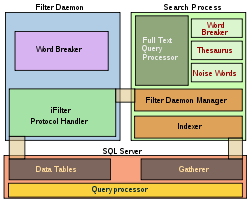 SQL Server Full Text Search service is a specialized indexing and querying service for unstructured text stored in SQL Server databases. The full text search index can be created on any column with character based text data. It allows for words to be searched for in the text columns. While it can be performed with the SQL
The Full Text Search engine is divided into two processes - the Filter Daemon process (
document is stored as an unstructured binary file in a database). The iFilters are hosted by the Filter Daemon process. Once the text is extracted, the Filter Daemon process breaks it up into a sequence of words and hands it over to the indexer. The indexer filters out noise words, i.e., words like A, And etc., which occur frequently and are not useful for search. With the remaining words, an inverted index
is created, associating each word with the columns they were found in. SQL Server itself includes a Gatherer component that monitors changes to tables and invokes the indexer in case of updates.
When a full text query is received by the SQL Server query processor, it is handed over to the FTS query processor in the Search process. The FTS query processor breaks up the query into the constituent words, filters out the noise words, and uses an inbuilt thesaurus
to find out the linguistic variants for each word. The words are then queried against the inverted index and a rank of their accurateness is computed. The results are returned to the client via the SQL Server process.
to create and run a set of SQL statements as a script. Such scripts are stored as a
SQLCMD was introduced with SQL Server 2005 and this continues with SQL Server 2008. Its predecessor for earlier versions was OSQL and ISQL, which is functionally equivalent as it pertains to TSQL execution, and many of the command line parameters are identical, although SQLCMD adds extra versatility.
includes native support for data programming with Microsoft SQL Server. It can be used to write and debug code to be executed by SQL CLR. It also includes a data designer that can be used to graphically create, view or edit database schemas. Queries can be created either visually or using code. SSMS 2008 onwards, provides intellisense
for SQL queries as well.
is a GUI
tool included with SQL Server 2005 and later for configuring, managing, and administering all components within Microsoft SQL Server. The tool includes both script editors and graphical tools that work with objects and features of the server. SQL Server Management Studio replaces Enterprise Manager
as the primary management interface for Microsoft SQL Server since SQL Server 2005. A version of SQL Server Management Studio is also available for SQL Server Express Edition, for which it is known as SQL Server Management Studio Express (SSMSE).
A central feature of SQL Server Management Studio is the Object Explorer, which allows the user to browse, select, and act upon any of the objects within the server. It can be used to visually observe and analyze query plans and optimize the database performance, among others. SQL Server Management Studio can also be used to create a new database, alter any existing database schema by adding or modifying tables and indexes, or analyze performance. It includes the query windows which provide a GUI based interface to write and execute queries sam.
(BIDS) is the IDE
from Microsoft
used for developing data analysis and Business Intelligence
solutions utilizing the Microsoft SQL Server Analysis Services, Reporting Services
and Integration Services
. It is based on the Microsoft Visual Studio
development environment but is customized with the SQL Server services-specific extensions and project types, including tools, controls and projects for reports (using Reporting Services), Cubes
and data mining
structures (using Analysis Services).
implementation, support for mirrored SQL Server databases, full support for all data types supported by SQL Server, asynchronous operations, query notifications, encryption
support, as well as receiving multiple result sets in a single database session. SQL Native Client is used under the hood by SQL Server plug-ins for other data access technologies, including ADO
or OLE DB
. The SQL Native Client can also be directly used, bypassing the generic data access layers.
Relational database management system
A relational database management system is a database management system that is based on the relational model as introduced by E. F. Codd. Most popular databases currently in use are based on the relational database model....
, developed by Microsoft
Microsoft
Microsoft Corporation is an American public multinational corporation headquartered in Redmond, Washington, USA that develops, manufactures, licenses, and supports a wide range of products and services predominantly related to computing through its various product divisions...
: It is a software product whose primary function is to store and retrieve data as requested by other software applications, be it those on the same computer or those running on another computer across a network (including the Internet). There are at least a dozen different editions of Microsoft SQL Server aimed at different audiences and for different workloads (ranging from small applications that store and retrieve data on the same computer, to millions of users and computers that access huge amounts of data from the Internet at the same time).
True to its namesake, Microsoft SQL Server's primary query language
Query language
Query languages are computer languages used to make queries into databases and information systems.Broadly, query languages can be classified according to whether they are database query languages or information retrieval query languages...
s are T-SQL
Transact-SQL
Transact-SQL is Microsoft's and Sybase's proprietary extension to SQL. SQL, often expanded to Structured Query Language, is a standardized computer language that was originally developed by IBM for querying, altering and defining relational databases, using declarative statements...
and ANSI SQL
SQL
SQL is a programming language designed for managing data in relational database management systems ....
.
Genesis
| Version | Year | Release Name | Codename |
|---|---|---|---|
| 1.0 (OS/2 OS/2 OS/2 is a computer operating system, initially created by Microsoft and IBM, then later developed by IBM exclusively. The name stands for "Operating System/2," because it was introduced as part of the same generation change release as IBM's "Personal System/2 " line of second-generation personal... ) |
1989 | SQL Server 1.0 (16bit) |
- |
| 1.1 (OS/2 OS/2 OS/2 is a computer operating system, initially created by Microsoft and IBM, then later developed by IBM exclusively. The name stands for "Operating System/2," because it was introduced as part of the same generation change release as IBM's "Personal System/2 " line of second-generation personal... ) |
1991 | SQL Server 1.1 (16bit) |
- |
| 4.21 (WinNT Windows NT Windows NT is a family of operating systems produced by Microsoft, the first version of which was released in July 1993. It was a powerful high-level-language-based, processor-independent, multiprocessing, multiuser operating system with features comparable to Unix. It was intended to complement... ) |
1993 | SQL Server 4.21 | SQLNT |
| 6.0 | 1995 | SQL Server 6.0 | SQL95 |
| 6.5 | 1996 | SQL Server 6.5 | Hydra |
| 7.0 | 1998 | SQL Server 7.0 | Sphinx |
| - | 1999 | SQL Server 7.0 OLAP OLAP In computing, online analytical processing, or OLAP , is an approach to swiftly answer multi-dimensional analytical queries. OLAP is part of the broader category of business intelligence, which also encompasses relational reporting and data mining... Tools |
Plato |
| 8.0 | 2000 | SQL Server 2000 | Shiloh |
| 8.0 | 2003 | SQL Server 2000 64-bit Edition |
Liberty |
| 9.0 | 2005 | SQL Server 2005 | Yukon |
| 10.0 | 2008 | SQL Server 2008 | Katmai |
| 10.25 | 2010 | SQL Azure | Matrix (aka CloudDB) |
| 10.5 | 2010 | SQL Server 2008 R2 | Kilimanjaro (aka KJ) |
| 11.0 | SQL Server 2012 | Denali |
Prior to version 7.0 the code base for MS SQL Server was sold by Sybase SQL Server to Microsoft, and was Microsoft's entry to the enterprise-level database market, competing against Oracle
Oracle database
The Oracle Database is an object-relational database management system produced and marketed by Oracle Corporation....
, IBM
IBM
International Business Machines Corporation or IBM is an American multinational technology and consulting corporation headquartered in Armonk, New York, United States. IBM manufactures and sells computer hardware and software, and it offers infrastructure, hosting and consulting services in areas...
, and, later, Sybase
Sybase
Sybase, an SAP company, is an enterprise software and services company offering software to manage, analyze, and mobilize information, using relational databases, analytics and data warehousing solutions and mobile applications development platforms....
. Microsoft, Sybase and Ashton-Tate
Ashton-Tate
Ashton-Tate was a US based software company best known for developing the popular dBASE database application. Ashton-Tate grew from a small garage-based company to become a multinational corporation...
originally teamed up to create and market the first version named SQL Server 1.0 for OS/2
OS/2
OS/2 is a computer operating system, initially created by Microsoft and IBM, then later developed by IBM exclusively. The name stands for "Operating System/2," because it was introduced as part of the same generation change release as IBM's "Personal System/2 " line of second-generation personal...
(about 1989) which was essentially the same as Sybase SQL Server 3.0 on Unix
Unix
Unix is a multitasking, multi-user computer operating system originally developed in 1969 by a group of AT&T employees at Bell Labs, including Ken Thompson, Dennis Ritchie, Brian Kernighan, Douglas McIlroy, and Joe Ossanna...
, VMS, etc. Microsoft SQL Server 4.2 was shipped around 1992 (available bundled with IBM OS/2
OS/2
OS/2 is a computer operating system, initially created by Microsoft and IBM, then later developed by IBM exclusively. The name stands for "Operating System/2," because it was introduced as part of the same generation change release as IBM's "Personal System/2 " line of second-generation personal...
version 1.3). Later Microsoft SQL Server 4.21 for Windows NT was released at the same time as Windows NT 3.1. Microsoft SQL Server v6.0 was the first version designed for NT, and did not include any direction from Sybase.
About the time Windows NT
Windows NT
Windows NT is a family of operating systems produced by Microsoft, the first version of which was released in July 1993. It was a powerful high-level-language-based, processor-independent, multiprocessing, multiuser operating system with features comparable to Unix. It was intended to complement...
was released, Sybase and Microsoft parted ways and each pursued their own design and marketing schemes. Microsoft negotiated exclusive rights to all versions of SQL Server written for Microsoft operating systems. Later, Sybase changed the name of its product to Adaptive Server Enterprise
Adaptive Server Enterprise
Adaptive Server Enterprise is Sybase Corporation's flagship enterprise-class relational model database server product. ASE is predominantly used on the Unix platform but is also available for Windows.-History:...
to avoid confusion with Microsoft SQL Server. Until 1994, Microsoft's SQL Server carried three Sybase copyright notices as an indication of its origin.
Since parting ways, several revisions have been done independently. SQL Server 7.0 was a rewrite from the legacy Sybase code. It was succeeded by SQL Server 2000, which was the first edition to be launched in a variant for the IA-64 architecture.
In the ten years since release of Microsoft's previous SQL Server product (SQL Server 2000), advancements have been made in performance, the client IDE tools, and several complementary systems that are packaged with SQL Server 2005. These include: an ETL
Extract, transform, load
Extract, transform and load is a process in database usage and especially in data warehousing that involves:* Extracting data from outside sources* Transforming it to fit operational needs...
tool (SQL Server Integration Services or SSIS
SQL Server Integration Services
SQL Server Integration Services is a component of the Microsoft SQL Server database software that can be used to perform a broad range of data migration tasks....
), a Reporting Server
SQL Server Reporting Services
SQL Server Reporting Services is a server-based report generation software system from Microsoft. It can be used to prepare and deliver a variety of interactive and printed reports. It is administered via a web interface...
, an OLAP
OLAP
In computing, online analytical processing, or OLAP , is an approach to swiftly answer multi-dimensional analytical queries. OLAP is part of the broader category of business intelligence, which also encompasses relational reporting and data mining...
and data mining
Data mining
Data mining , a relatively young and interdisciplinary field of computer science is the process of discovering new patterns from large data sets involving methods at the intersection of artificial intelligence, machine learning, statistics and database systems...
server (Analysis Services
Microsoft Analysis Services
Microsoft SQL Server Analysis Services is part of Microsoft SQL Server, a database management system. Microsoft has included a number of services in SQL Server related to business intelligence and data warehousing. These services include Integration Services and Analysis Services...
), and several messaging technologies, specifically Service Broker and Notification Services.
SQL Server 2005
SQL Server 2005 (codename Yukon), released in October 2005, is the successor to SQL Server 2000. It included native support for managing XMLXML
Extensible Markup Language is a set of rules for encoding documents in machine-readable form. It is defined in the XML 1.0 Specification produced by the W3C, and several other related specifications, all gratis open standards....
data, in addition to relational data
Relational database
A relational database is a database that conforms to relational model theory. The software used in a relational database is called a relational database management system . Colloquial use of the term "relational database" may refer to the RDBMS software, or the relational database itself...
. For this purpose, it defined an
xml data typeData type
In computer programming, a data type is a classification identifying one of various types of data, such as floating-point, integer, or Boolean, that determines the possible values for that type; the operations that can be done on values of that type; the meaning of the data; and the way values of...
that could be used either as a data type in database columns or as literals in queries. XML columns can be associated with XSD schemas; XML data being stored is verified against the schema. XML is converted to an internal binary data type before being stored in the database. Specialized indexing methods were made available for XML data. XML data is queried using XQuery
XQuery
- Features :XQuery provides the means to extract and manipulate data from XML documents or any data source that can be viewed as XML, such as relational databases or office documents....
; Common Language Runtime
Common Language Runtime
The Common Language Runtime is the virtual machine component of Microsoft's .NET framework and is responsible for managing the execution of .NET programs. In a process known as just-in-time compilation, the CLR compiles the intermediate language code known as CIL into the machine instructions...
(CLR) integration was a main feature with this edition, enabling one to write SQL code as Managed Code by the CLR. SQL Server 2005 added some extensions to the T-SQL language to allow embedding XQuery queries in T-SQL. In addition, it also defines a new extension to XQuery, called XML DML, that allows query-based modifications to XML data. SQL Server 2005 also allows a database server to be exposed over web service
Web service
A Web service is a method of communication between two electronic devices over the web.The W3C defines a "Web service" as "a software system designed to support interoperable machine-to-machine interaction over a network". It has an interface described in a machine-processable format...
s using Tabular Data Stream
Tabular Data Stream
Tabular Data Stream is an application layer protocol, used to transfer data between a database server and a client. It was initially designed and developed by Sybase Inc...
(TDS) packets encapsulated within SOAP (protocol) requests. When the data is accessed over web services, results are returned as XML.
For relational data, T-SQL has been augmented with error handling features (try/catch) and support for recursive queries with CTEs (Common Table Expressions). SQL Server 2005 has also been enhanced with new indexing algorithms, syntax and better error recovery systems. Data pages are checksum
Checksum
A checksum or hash sum is a fixed-size datum computed from an arbitrary block of digital data for the purpose of detecting accidental errors that may have been introduced during its transmission or storage. The integrity of the data can be checked at any later time by recomputing the checksum and...
med for better error resiliency, and optimistic concurrency support has been added for better performance. Permissions and access control have been made more granular and the query processor handles concurrent execution of queries in a more efficient way. Partitions on tables and indexes are supported natively, so scaling out a database onto a cluster
Cluster (computing)
A computer cluster is a group of linked computers, working together closely thus in many respects forming a single computer. The components of a cluster are commonly, but not always, connected to each other through fast local area networks...
is easier. SQL CLR was introduced with SQL Server 2005 to let it integrate with the .NET Framework.
SQL Server 2005 introduced "MARS" (Multiple Active Results Sets), a method of allowing usage of database connections for multiple purposes.
SQL Server 2005 introduced DMVs (Dynamic Management Views), which are specialized views and functions that return server state information that can be used to monitor the health of a server instance, diagnose problems, and tune performance.
SQL Server 2005 introduced Database Mirroring, but it was not fully supported until the first Service Pack release (SP1). In the initial release (RTM) of SQL Server 2005, database mirroring was available, but unsupported. In order to implement database mirroring in the RTM version, you had to apply trace flag 1400 at startup. Database mirroring is a high availability option that provides redundancy and failover capabilities at the database level. Failover can be performed manually or can be configured for automatic failover. Automatic failover requires a witness partner and an operating mode of synchronous (also known as high-safety or full safety).
SQL Server 2008
The next version of SQL Server, SQL Server 2008, was released (RTM) on August 6, 2008 and aims to make data management self-tuningSelf-tuning
In control theory a self-tuning system is capable of optimizing its own internal running parameters in order to maximize or minimize the fulfillment of an objective function; typically the maximization of efficiency or error minimization....
, self organizing, and self maintaining with the development of SQL Server Always On technologies, to provide near-zero downtime. SQL Server 2008 also includes support for structured and semi-structured data, including digital media formats for pictures, audio, video and other multimedia data. In current versions, such multimedia data can be stored as BLOBs
Binary large object
A blob is a collection of binary data stored as a single entity in a database management system. Blobs are typically images, audio or other multimedia objects, though sometimes binary executable code is stored as a blob...
(binary large objects), but they are generic bitstreams. Intrinsic awareness of multimedia data will allow specialized functions to be performed on them. According to Paul Flessner, senior Vice President, Server Applications, Microsoft Corp.
Microsoft
Microsoft Corporation is an American public multinational corporation headquartered in Redmond, Washington, USA that develops, manufactures, licenses, and supports a wide range of products and services predominantly related to computing through its various product divisions...
, SQL Server 2008 can be a data storage backend for different varieties of data: XML, email, time/calendar, file, document, spatial, etc as well as perform search, query, analysis, sharing, and synchronization across all data types.
Other new data types include specialized date and time types and a Spatial data type for location-dependent data. Better support for unstructured and semi-structured data is provided using the new FILESTREAM data type, which can be used to reference any file stored on the file system. Structured data and metadata about the file is stored in SQL Server database, whereas the unstructured component is stored in the file system. Such files can be accessed both via Win32 file handling APIs as well as via SQL Server using T-SQL; doing the latter accesses the file data as a BLOB. Backing up and restoring the database backs up or restores the referenced files as well. SQL Server 2008 also natively supports hierarchical data, and includes T-SQL constructs to directly deal with them, without using recursive queries.
The Full-text search
Full text search
In text retrieval, full text search refers to techniques for searching a single computer-stored document or a collection in a full text database...
functionality has been integrated with the database engine. According to a Microsoft technical article, this simplifies management and improves performance.
Spatial data will be stored in two types. A "Flat Earth" (GEOMETRY or planar) data type represents geospatial data which has been projected from its native, spherical, coordinate system into a plane. A "Round Earth" data type (GEOGRAPHY) uses an ellipsoidal model in which the Earth is defined as a single continuous entity which does not suffer from the singularities such as the international dateline, poles, or map projection zone "edges". Approximately 70 methods are available to represent spatial operations for the Open Geospatial Consortium
Open Geospatial Consortium
The Open Geospatial Consortium , an international voluntary consensus standards organization, originated in 1994. In the OGC, more than 400 commercial, governmental, nonprofit and research organizations worldwide collaborate in a consensus process encouraging development and implementation of open...
Simple Features for SQL, Version 1.1.
SQL Server includes better compression features, which also helps in improving scalability. It enhanced the indexing algorithms and introduced the notion of filtered indexes. It also includes Resource Governor that allows reserving resources for certain users or workflows. It also includes capabilities for transparent encryption of data (TDE) as well as compression of backups. SQL Server 2008 supports the ADO.NET Entity Framework
ADO.NET Entity Framework
ADO.NET Entity Framework is an object-relational mapping framework for the .NET Framework.-Overview:ADO.NET Entity Framework abstracts the relational schema of the data that is stored in a database and presents its conceptual schema to the application...
and the reporting tools, replication, and data definition will be built around the Entity Data Model. SQL Server Reporting Services
SQL Server Reporting Services
SQL Server Reporting Services is a server-based report generation software system from Microsoft. It can be used to prepare and deliver a variety of interactive and printed reports. It is administered via a web interface...
will gain charting capabilities from the integration of the data visualization products from Dundas Data Visualization, Inc.
Dundas Data Visualization, Inc.
Dundas Data Visualization, Inc. formerly known as Dundas Software Ltd is a commercial software development company with headquarters in Toronto, Ontario, Canada. They are mostly known for their Dundas Components product . Currently Dundas Data Visualization produces Data Visualization and Dashboard...
, which was acquired by Microsoft. On the management side, SQL Server 2008 includes the Declarative Management Framework which allows configuring policies and constraints, on the entire database or certain tables, declaratively. The version of SQL Server Management Studio
SQL Server Management Studio
SQL Server Management Studio is a tool included with Microsoft SQL Server 2005 and later versions for configuring, managing, and administering all components within Microsoft SQL Server...
included with SQL Server 2008 supports IntelliSense
IntelliSense
IntelliSense is Microsoft's implementation of autocompletion, best known for its use in the Microsoft Visual Studio integrated development environment...
for SQL queries against a SQL Server 2008 Database Engine. SQL Server 2008 also makes the databases available via Windows PowerShell
Windows PowerShell
Windows PowerShell is Microsoft's task automation framework, consisting of a command-line shell and associated scripting language built on top of, and integrated with the .NET Framework...
providers and management functionality available as Cmdlets, so that the server and all the running instances can be managed from Windows PowerShell
Windows PowerShell
Windows PowerShell is Microsoft's task automation framework, consisting of a command-line shell and associated scripting language built on top of, and integrated with the .NET Framework...
.
SQL Server 2008 R2
SQL Server 2008 R2 (formerly codenamed SQL Server "Kilimanjaro") was announced at TechEd 2009, and was released to manufacturing on April 21, 2010. SQL Server 2008 R2 adds certain features to SQL Server 2008 including a master data managementMaster Data Management
In computing, master data management comprises a set of processes and tools that consistently defines and manages the non-transactional data entities of an organization...
system branded as Master Data Services, a central management of master data entities and hierarchies.
Also Multi Server Management, a centralized console to manage multiple SQL Server 2008 instances and services including relational databases, Reporting Services, Analysis Services & Integration Services.
SQL Server 2008 R2 includes a number of new services, including PowerPivot for Excel and SharePoint, Master Data Services, StreamInsight, Report Builder 3.0, Reporting Services Add-in for SharePoint, a Data-tier function in Visual Studio that enables packaging of tiered databases as part of an application, and a SQL Server Utility named UC (Utility Control Point), part of AMSM (Application and Multi-Server Management) that is used to manage multiple SQL Servers.
The first SQL Server 2008 R2 service pack (Service Pack 1) was released on July 11, 2011.
SQL Server 2012
At the 2011 PASSProfessional Association for SQL Server
The Professional Association for SQL Server, also known as PASS, is the global community for Microsoft SQL Server professionals. An independent, not-for-profit, user-run association, PASS was founded in 1999 with funds from Microsoft and Computer Associates...
summit on October 11, Microsoft announced that the next major version of SQL Server, codenamed Denali, would be SQL Server 2012. The release date is set to the first half of 2012.
Editions
Microsoft makes SQL Server available in multiple editions, with different feature sets and targeting different users. These editions are:Mainstream editions
Datacenter: SQL Server 2008 R2 Datacenter is the full-featured edition of SQL Server and is designed for datacenters that need the high levels of application support and scalability. It supports 256 logical processors and virtually unlimited memory. Comes with StreamInsight Premium edition.Enterprise: SQL Server Enterprise Edition includes both the core database engine and add-on services, with a range of tools for creating and managing a SQL Server cluster. It can manage databases as large as 524 petabyte
Petabyte
A petabyte is a unit of information equal to one quadrillion bytes, or 1000 terabytes. The unit symbol for the petabyte is PB...
s and address 2 terabyte
Terabyte
The terabyte is a multiple of the unit byte for digital information. The prefix tera means 1012 in the International System of Units , and therefore 1 terabyte is , or 1 trillion bytes, or 1000 gigabytes. 1 terabyte in binary prefixes is 0.9095 tebibytes, or 931.32 gibibytes...
s of memory and supports 8 physical processors.
Standard: SQL Server Standard edition includes the core database engine, along with the stand-alone services. It differs from Enterprise edition in that it supports fewer active instances (number of nodes in a cluster) and does not include some high-availability functions such as hot-add memory (allowing memory to be added while the server is still running), and parallel indexes.
Web: SQL Server Web Edition is a low-TCO
Total cost of ownership
Total cost of ownership is a financial estimate whose purpose is to help consumers and enterprise managers determine direct and indirect costs of a product or system...
option for Web hosting.
Workgroup: SQL Server Workgroup Edition includes the core database functionality but does not include the additional services.
Express
SQL Server Express
Microsoft SQL Server Express, a freely downloadable and distributable version of Microsoft's SQL Server relational database management system, comprises a database specifically targeted for embedded and smaller-scale applications.- Capabilities :...
: SQL Server Express Edition is a scaled down, free edition of SQL Server, which includes the core database engine. While there are no limitations on the number of databases or users supported, it is limited to using one processor, 1 GB memory and 4 GB database files (10 GB database files from SQL Server Express 2008 R2). The entire database is stored in a single
.mdf file, and thus making it suitable for XCOPY deploymentXCOPY deployment
XCOPY deployment, or xcopy installation, is a term used to describe a software application's installation into a Microsoft Windows system simply by copying files...
. It is intended as a replacement for MSDE
MSDE
Microsoft SQL Server Data Engine is a relational database management system developed by Microsoft. It is a scaled-down version of Microsoft SQL Server 7.0 or 2000 which is free for non-commercial use as well as certain limited commercial use...
. Two additional editions provide a superset of features not in the original Express Edition. The first is SQL Server Express with Tools, which includes SQL Server Management Studio
SQL Server Management Studio
SQL Server Management Studio is a tool included with Microsoft SQL Server 2005 and later versions for configuring, managing, and administering all components within Microsoft SQL Server...
Basic. SQL Server Express with Advanced Services adds full-text search capability and reporting services.
Specialized editions
Azure: Microsoft SQL Azure Database is the cloud-basedCloud computing
Cloud computing is the delivery of computing as a service rather than a product, whereby shared resources, software, and information are provided to computers and other devices as a utility over a network ....
version of Microsoft SQL Server, presented as software as a service
Software as a Service
Software as a service , sometimes referred to as "on-demand software," is a software delivery model in which software and its associated data are hosted centrally and are typically accessed by users using a thin client, normally using a web browser over the Internet.SaaS has become a common...
on Azure Services Platform
Azure Services Platform
The Windows Azure Platform is a Microsoft cloud platform used to build, host and scale web applications through Microsoft data centers. Windows Azure Platform is thus classified as platform as a service and forms part of Microsoft's cloud computing strategy, along with their software as a service...
.
Compact (SQL CE)
SQL Server Compact
Microsoft SQL Server Compact is a compact relational database produced by Microsoft for applications that run on mobile devices and desktops. Prior to the introduction of the desktop platform, it was known as SQL Server for Windows CE and SQL Server Mobile Edition...
: The compact edition is an embedded database engine. Unlike the other editions of SQL Server, the SQL CE engine is based on SQL Mobile (initially designed for use with hand-held devices) and does not share the same binaries. Due to its small size (1 MB DLL footprint), it has a markedly reduced feature set compared to the other editions. For example, it supports a subset of the standard data types, does not support stored procedures or Views or multiple-statement batches (among other limitations). It is limited to 4 GB maximum database size and cannot be run as a Windows service, Compact Edition must be hosted by the application using it. The 3.5 version includes considerable work that supports ADO.NET Synchronization Services.
Developer: SQL Server Developer Edition includes the same features as SQL Server Datacenter Edition, but is limited by the license to be only used as a development and test system, and not as production server. This edition is available to download by students free of charge as a part of Microsoft
Microsoft
Microsoft Corporation is an American public multinational corporation headquartered in Redmond, Washington, USA that develops, manufactures, licenses, and supports a wide range of products and services predominantly related to computing through its various product divisions...
's DreamSpark
DreamSpark
DreamSpark is a program set up by Microsoft to provide students with software design and development tools at no charge. The program was originally available for university/college students in Belarus, Belgium, China, Finland, France, Germany, India, Spain, Sweden, Switzerland, Tunisia, the U.K....
program.
Embedded (SSEE)
Windows Internal Database
Windows Internal Database is a variant of SQL Server Express 2005 that is included with Windows Server 2008 and Windows Server 2008 R2, and is included with other free Microsoft products released after 2007 that require an SQL Server database backend...
: SQL Server 2005 Embedded Edition is a specially configured named instance of the SQL Server Express database engine which can be accessed only by certain Windows Services.
Evaluation: SQL Server Evaluation Edition, also known as the Trial Edition, has all the features of the Enterprise Edition, but is limited to 180 days, after which the tools will continue to run, but the server services will stop.
Fast Track: SQL Server Fast Track is specifically for enterprise-scale data warehousing storage and business intelligence processing, and runs on reference-architecture hardware that is optimized for Fast Track.
Parallel Data Warehouse (PDW): A massively parallel processing
Massively parallel
Massively parallel is a description which appears in computer science, life sciences, medical diagnostics, and other fields.A massively parallel computer is a distributed memory computer system which consists of many individual nodes, each of which is essentially an independent computer in itself,...
(MPP) SQL Server appliance optimized for large-scale data warehousing
Data warehouse
In computing, a data warehouse is a database used for reporting and analysis. The data stored in the warehouse is uploaded from the operational systems. The data may pass through an operational data store for additional operations before it is used in the DW for reporting.A data warehouse...
such as hundreds of terabytes.
Protocol layer
Protocol layer implements the external interface to SQL Server. All operations that can be invoked on SQL Server are communicated to it via a Microsoft-defined format, called Tabular Data StreamTabular Data Stream
Tabular Data Stream is an application layer protocol, used to transfer data between a database server and a client. It was initially designed and developed by Sybase Inc...
(TDS). TDS is an application layer protocol, used to transfer data between a database server and a client. Initially designed and developed by Sybase Inc. for their Sybase SQL Server relational database engine in 1984, and later by Microsoft in Microsoft SQL Server, TDS packets can be encased in other physical transport dependent protocols, including TCP/IP, Named pipe
Named pipe
In computing, a named pipe is an extension to the traditional pipe concept on Unix and Unix-like systems, and is one of the methods of inter-process communication. The concept is also found in Microsoft Windows, although the semantics differ substantially...
s, and Shared memory
Shared memory
In computing, shared memory is memory that may be simultaneously accessed by multiple programs with an intent to provide communication among them or avoid redundant copies. Depending on context, programs may run on a single processor or on multiple separate processors...
. Consequently, access to SQL Server is available over these protocols. In addition, the SQL Server API is also exposed over web service
Web service
A Web service is a method of communication between two electronic devices over the web.The W3C defines a "Web service" as "a software system designed to support interoperable machine-to-machine interaction over a network". It has an interface described in a machine-processable format...
s.
Data storage
The main unit of data storage is a databaseDatabase
A database is an organized collection of data for one or more purposes, usually in digital form. The data are typically organized to model relevant aspects of reality , in a way that supports processes requiring this information...
, which is a collection of tables with typed
Type system
A type system associates a type with each computed value. By examining the flow of these values, a type system attempts to ensure or prove that no type errors can occur...
columns. SQL Server supports different data types, including primary types such as Integer, Float, Decimal, Char (including character strings), Varchar (variable length character strings), binary (for unstructured blobs
Binary large object
A blob is a collection of binary data stored as a single entity in a database management system. Blobs are typically images, audio or other multimedia objects, though sometimes binary executable code is stored as a blob...
of data), Text (for textual data) among others. The rounding
Rounding
Rounding a numerical value means replacing it by another value that is approximately equal but has a shorter, simpler, or more explicit representation; for example, replacing $23.4476 with $23.45, or the fraction 312/937 with 1/3, or the expression √2 with 1.414.Rounding is often done on purpose to...
of floats to integers uses either Symmetric Arithmetic Rounding or Symmetric Round Down (Fix) depending on arguments:
SELECT Round(2.5, 0) gives 3.Microsoft SQL Server also allows user-defined composite types (UDTs) to be defined and used. It also makes server statistics available as virtual tables and views (called Dynamic Management Views or DMVs). In addition to tables, a database can also contain other objects including views
View (database)
In database theory, a view consists of a stored query accessible as a virtual table in a relational database or a set of documents in a document-oriented database composed of the result set of a query or map and reduce functions...
, stored procedure
Stored procedure
A stored procedure is a subroutine available to applications that access a relational database system. A stored procedure is actually stored in the database data dictionary.Typical uses for stored procedures include data validation or access control mechanisms...
s, indexes
Index (database)
A database index is a data structure that improves the speed of data retrieval operations on a database table at the cost of slower writes and increased storage space...
and constraints, along with a transaction log. A SQL Server database can contain a maximum of 231 objects, and can span multiple OS-level files with a maximum file size of 220 TB
Terabyte
The terabyte is a multiple of the unit byte for digital information. The prefix tera means 1012 in the International System of Units , and therefore 1 terabyte is , or 1 trillion bytes, or 1000 gigabytes. 1 terabyte in binary prefixes is 0.9095 tebibytes, or 931.32 gibibytes...
. The data in the database are stored in primary data files with an extension
.mdf. Secondary data files, identified with a .ndf extension, are used to store optional metadata. Log files are identified with the .ldf extension.Storage space allocated to a database is divided into sequentially numbered pages, each 8 KB in size. A page is the basic unit of I/O for SQL Server operations. A page is marked with a 96-byte header which stores metadata about the page including the page number, page type, free space on the page and the ID of the object that owns it. Page type defines the data contained in the page - data stored in the database, index, allocation map which holds information about how pages are allocated to tables and indexes, change map which holds information about the changes made to other pages since last backup or logging, or contain large data types such as image or text. While page is the basic unit of an I/O operation, space is actually managed in terms of an extent which consists of 8 pages. A database object can either span all 8 pages in an extent ("uniform extent") or share an extent with up to 7 more objects ("mixed extent"). A row in a database table cannot span more than one page, so is limited to 8 KB in size. However, if the data exceeds 8 KB and the row contains Varchar or Varbinary data, the data in those columns are moved to a new page (or possibly a sequence of pages, called an Allocation unit) and replaced with a pointer to the data.
For physical storage of a table, its rows are divided into a series of partitions (numbered 1 to n). The partition size is user defined; by default all rows are in a single partition. A table is split into multiple partitions in order to spread a database over a cluster
Cluster Computing
Cluster Computing: the Journal of Networks, Software Tools and Applications is a journal for parallel processing, distributed computing systems, and computer communication networks....
. Rows in each partition are stored in either B-tree
B-tree
In computer science, a B-tree is a tree data structure that keeps data sorted and allows searches, sequential access, insertions, and deletions in logarithmic time. The B-tree is a generalization of a binary search tree in that a node can have more than two children...
or heap
Heap (data structure)
In computer science, a heap is a specialized tree-based data structure that satisfies the heap property: if B is a child node of A, then key ≥ key. This implies that an element with the greatest key is always in the root node, and so such a heap is sometimes called a max-heap...
structure. If the table has an associated index
Index (database)
A database index is a data structure that improves the speed of data retrieval operations on a database table at the cost of slower writes and increased storage space...
to allow fast retrieval of rows, the rows are stored in-order according to their index values, with a B-tree providing the index. The data is in the leaf node of the leaves, and other nodes storing the index values for the leaf data reachable from the respective nodes. If the index is non-clustered, the rows are not sorted according to the index keys. An indexed view
View (database)
In database theory, a view consists of a stored query accessible as a virtual table in a relational database or a set of documents in a document-oriented database composed of the result set of a query or map and reduce functions...
has the same storage structure as an indexed table. A table without an index is stored in an unordered heap structure. Both heaps and B-trees can span multiple allocation units.
Buffer management
SQL Server buffers pages in RAMRam
-Animals:*Ram, an uncastrated male sheep*Ram cichlid, a species of freshwater fish endemic to Colombia and Venezuela-Military:*Battering ram*Ramming, a military tactic in which one vehicle runs into another...
to minimize disc I/O. Any 8 KB page can be buffered in-memory, and the set of all pages currently buffered is called the buffer cache. The amount of memory available to SQL Server decides how many pages will be cached in memory. The buffer cache is managed by the Buffer Manager. Either reading from or writing to any page copies it to the buffer cache. Subsequent reads or writes are redirected to the in-memory copy, rather than the on-disc version. The page is updated on the disc by the Buffer Manager only if the in-memory cache has not been referenced for some time. While writing pages back to disc, asynchronous I/O is used whereby the I/O operation is done in a background thread so that other operations do not have to wait for the I/O operation to complete. Each page is written along with its checksum
Checksum
A checksum or hash sum is a fixed-size datum computed from an arbitrary block of digital data for the purpose of detecting accidental errors that may have been introduced during its transmission or storage. The integrity of the data can be checked at any later time by recomputing the checksum and...
when it is written. When reading the page back, its checksum is computed again and matched with the stored version to ensure the page has not been damaged or tampered with in the meantime.
Logging and Transaction
SQL Server ensures that any change to the data is ACIDACID
In computer science, ACID is a set of properties that guarantee database transactions are processed reliably. In the context of databases, a single logical operation on the data is called a transaction...
-compliant, i.e. it uses transactions to ensure that the database will always revert to a known consistent state on failure. Each transaction may consist of multiple SQL statements all of which will only make a permanent change to the database if the last statement in the transaction (a COMMIT statement) completes successfully. If the COMMIT successfully completes the transaction is safely on disk.
SQL Server implements transactions using a write-ahead log.
Any changes made to any page will update the in-memory cache of the page, simultaneously all the operations performed will be written to a log, along with the transaction ID which the operation was a part of.
Each log entry is identified by an increasing Log Sequence Number (LSN) which is used to ensure that all changes are written to the data files. Also during a log restore it is used to check that no logs are duplicated or skipped.
SQL Server requires that the log is written onto the disc before the data page is written back. It must also ensure that all operations in a transaction are written to the log before any COMMIT operation is
reported as completed.
At a later point the server will checkpoint the database and ensure that all pages in the data files have the state of their contents synchronised to a point at or after the LSN that the checkpoint started.
When completed the checkpoint marks that portion of the log file as complete and may free it (see Simple transaction logging vs Full transaction logging).
This enables SQL Server to ensure integrity of the data, even if the system fails.
On failure the database log has to be replayed to ensure the data files are in a consistent state.
All pages stored in the roll forward part of the log (not marked as completed) are rewritten to the database, when the end of the log is reached all open transactions are rolled back using the roll back portion of the
log file.
The database engine usually checkpoints quite frequently. However, in a heavily loaded database this can have a significant performance impact. It is possible to reduce the frequency of checkpoints or disable them completely but the rollforward during a recovery will take much longer
Concurrency and locking
SQL Server allows multiple clients to use the same database concurrently. As such, it needs to control concurrent access to shared data, to ensure data integrity - when multiple clients update the same data, or clients attempt to read data that is in the process of being changed by another client. SQL Server provides two modes of concurrency control: pessimistic concurrencyConcurrency control
In information technology and computer science, especially in the fields of computer programming , operating systems , multiprocessors, and databases, concurrency control ensures that correct results for concurrent operations are generated, while getting those results as quickly as possible.Computer...
and optimistic concurrency
Optimistic concurrency control
In the field of relational database management systems, optimistic concurrency control is a concurrency control method that assumes that multiple transactions can complete without affecting each other, and that therefore transactions can proceed without locking the data resources that they affect...
. When pessimistic concurrency control is being used, SQL Server controls concurrent access by using locks. Locks can be either shared or exclusive. Exclusive lock grants the user exclusive access to the data - no other user can access the data as long as the lock is held. Shared locks are used when some data is being read - multiple users can read from data locked with a shared lock, but not acquire an exclusive lock. The latter would have to wait for all shared locks to be released. Locks can be applied on different levels of granularity - on entire tables, pages, or even on a per-row basis on tables. For indexes, it can either be on the entire index or on index leaves. The level of granularity to be used is defined on a per-database basis by the database administrator. While a fine grained locking system allows more users to use the table or index simultaneously, it requires more resources. So it does not automatically turn into higher performing solution. SQL Server also includes two more lightweight mutual exclusion
Mutual exclusion
Mutual exclusion algorithms are used in concurrent programming to avoid the simultaneous use of a common resource, such as a global variable, by pieces of computer code called critical sections. A critical section is a piece of code in which a process or thread accesses a common resource...
solutions - latches and spinlocks - which are less robust than locks but are less resource intensive. SQL Server uses them for DMVs and other resources that are usually not busy. SQL Server also monitors all worker threads that acquire locks to ensure that they do not end up in deadlock
Deadlock
A deadlock is a situation where in two or more competing actions are each waiting for the other to finish, and thus neither ever does. It is often seen in a paradox like the "chicken or the egg"...
s - in case they do, SQL Server takes remedial measures, which in many cases is to kill one of the threads entangled in a deadlock and rollback the transaction it started. To implement locking, SQL Server contains the Lock Manager. The Lock Manager maintains an in-memory table that manages the database objects and locks, if any, on them along with other metadata about the lock. Access to any shared object is mediated by the lock manager, which either grants access to the resource or blocks it.
SQL Server also provides the optimistic concurrency control mechanism, which is similar to the multiversion concurrency control
Multiversion concurrency control
Multiversion concurrency control , in the database field of computer science, is a concurrency control method commonly used by database management systems to provide concurrent access to the database and in programming languages to implement transactional memory.For instance, a database will...
used in other databases. The mechanism allows a new version of a row to be created whenever the row is updated, as opposed to overwriting the row, i.e., a row is additionally identified by the ID of the transaction that created the version of the row. Both the old as well as the new versions of the row are stored and maintained, though the old versions are moved out of the database into a system database identified as
Tempdb. When a row is in the process of being updated, any other requests are not blocked (unlike locking) but are executed on the older version of the row. If the other request is an update statement, it will result in two different versions of the rows - both of them will be stored by the database, identified by their respective transaction IDs.Data retrieval
The main mode of retrieving data from an SQL Server database is querying for it. The query is expressed using a variant of SQLSQL
SQL is a programming language designed for managing data in relational database management systems ....
called T-SQL, a dialect Microsoft SQL Server shares with Sybase SQL Server
Adaptive Server Enterprise
Adaptive Server Enterprise is Sybase Corporation's flagship enterprise-class relational model database server product. ASE is predominantly used on the Unix platform but is also available for Windows.-History:...
due to its legacy. The query declaratively specifies what is to be retrieved. It is processed by the query processor, which figures out the sequence of steps that will be necessary to retrieve the requested data. The sequence of actions necessary to execute a query is called a query plan. There might be multiple ways to process the same query. For example, for a query that contains a join
Join (SQL)
An SQL join clause combines records from two or more tables in a database. It creates a set that can be saved as a table or used as is. A JOIN is a means for combining fields from two tables by using values common to each. ANSI standard SQL specifies four types of JOINs: INNER, OUTER, LEFT, and RIGHT...
statement and a select
Select (SQL)
The SQL SELECT statement returns a result set of records from one or more tables.A SELECT statement retrieves zero or more rows from one or more database tables or database views. In most applications, SELECT is the most commonly used Data Manipulation Language command...
statement, executing join on both the tables and then executing select on the results would give the same result as selecting from each table and then executing the join, but result in different execution plans. In such case, SQL Server chooses the plan that is expected to yield the results in the shortest possible time. This is called query optimization
Query optimization
Query optimization is a function of many relational database management systems in which multiple query plans for satisfying a query are examined and a good query plan is identified. This may or not be the absolute best strategy because there are many ways of doing plans. There is a trade-off...
and is performed by the query processor itself.
SQL Server includes a cost-based query optimizer which tries to optimize on the cost, in terms of the resources it will take to execute the query. Given a query, then the query optimizer looks at the database schema
Database schema
A database schema of a database system is its structure described in a formal language supported by the database management system and refers to the organization of data to create a blueprint of how a database will be constructed...
, the database statistics and the system load at that time. It then decides which sequence to access the tables referred in the query, which sequence to execute the operations and what access method to be used to access the tables. For example, if the table has an associated index, whether the index should be used or not - if the index is on a column which is not unique for most of the columns (low "selectivity"), it might not be worthwhile to use the index to access the data. Finally, it decides whether to execute the query concurrently
Concurrent computing
Concurrent computing is a form of computing in which programs are designed as collections of interacting computational processes that may be executed in parallel...
or not. While a concurrent execution is more costly in terms of total processor time, because the execution is actually split to different processors might mean it will execute faster. Once a query plan is generated for a query, it is temporarily cached. For further invocations of the same query, the cached plan is used. Unused plans are discarded after some time.
SQL Server also allows stored procedure
Stored procedure
A stored procedure is a subroutine available to applications that access a relational database system. A stored procedure is actually stored in the database data dictionary.Typical uses for stored procedures include data validation or access control mechanisms...
s to be defined. Stored procedures are parameterized T-SQL queries, that are stored in the server itself (and not issued by the client application as is the case with general queries). Stored procedures can accept values sent by the client as input parameters, and send back results as output parameters. They can call defined functions, and other stored procedures, including the same stored procedure (up to a set number of times). They can be selectively provided access to
Access control
Access control refers to exerting control over who can interact with a resource. Often but not always, this involves an authority, who does the controlling. The resource can be a given building, group of buildings, or computer-based information system...
. Unlike other queries, stored procedures have an associated name, which is used at runtime to resolve into the actual queries. Also because the code need not be sent from the client every time (as it can be accessed by name), it reduces network traffic and somewhat improves performance. Execution plans for stored procedures are also cached as necessary.
SQL CLR
Microsoft SQL Server 2005 includes a component named SQL CLR ("Common Language Runtime") via which it integrates with .NET Framework.NET Framework
The .NET Framework is a software framework that runs primarily on Microsoft Windows. It includes a large library and supports several programming languages which allows language interoperability...
. Unlike most other applications that use .NET Framework, SQL Server itself hosts the .NET Framework runtime
Common Language Runtime
The Common Language Runtime is the virtual machine component of Microsoft's .NET framework and is responsible for managing the execution of .NET programs. In a process known as just-in-time compilation, the CLR compiles the intermediate language code known as CIL into the machine instructions...
, i.e., memory, threading and resource management requirements of .NET Framework are satisfied by SQLOS itself, rather than the underlying Windows operating system. SQLOS provides deadlock detection and resolution services for .NET code as well. With SQL CLR, stored procedure
Stored procedure
A stored procedure is a subroutine available to applications that access a relational database system. A stored procedure is actually stored in the database data dictionary.Typical uses for stored procedures include data validation or access control mechanisms...
s and triggers can be written in any managed
Managed code
Managed code is a term coined by Microsoft to identify computer program code that requires and will only execute under the "management" of a Common Language Runtime virtual machine ....
.NET language, including C# and VB.NET. Managed code
Managed code
Managed code is a term coined by Microsoft to identify computer program code that requires and will only execute under the "management" of a Common Language Runtime virtual machine ....
can also be used to define UDT's (user defined types), which can persist in the database. Managed code
Managed code
Managed code is a term coined by Microsoft to identify computer program code that requires and will only execute under the "management" of a Common Language Runtime virtual machine ....
is compiled to .NET assemblies and after being verified for type safety
Type safety
In computer science, type safety is the extent to which a programming language discourages or prevents type errors. A type error is erroneous or undesirable program behaviour caused by a discrepancy between differing data types...
, registered at the database. After that, they can be invoked like any other procedure. However, only a subset of the Base Class Library
Base Class Library
The Base Class Library is a standard library available to all languages using the .NET Framework. .NET includes the BCL in order to encapsulate a large number of common functions, such as file reading and writing, graphic rendering, database interaction, and XML document manipulation, which makes...
is available, when running code under SQL CLR. Most APIs relating to user interface
User interface
The user interface, in the industrial design field of human–machine interaction, is the space where interaction between humans and machines occurs. The goal of interaction between a human and a machine at the user interface is effective operation and control of the machine, and feedback from the...
functionality are not available.
When writing code for SQL CLR, data stored in SQL Server databases can be accessed using the ADO.NET
ADO.NET
ADO.NET is a set of computer software components that programmers can use to access data and data services. It is a part of the base class library that is included with the Microsoft .NET Framework. It is commonly used by programmers to access and modify data stored in relational database systems,...
APIs like any other managed application
Managed code
Managed code is a term coined by Microsoft to identify computer program code that requires and will only execute under the "management" of a Common Language Runtime virtual machine ....
that accesses SQL Server data. However, doing that creates a new database session, different from the one in which the code is executing. To avoid this, SQL Server provides some enhancements to the ADO.NET
ADO.NET
ADO.NET is a set of computer software components that programmers can use to access data and data services. It is a part of the base class library that is included with the Microsoft .NET Framework. It is commonly used by programmers to access and modify data stored in relational database systems,...
provider that allows the connection to be redirected to the same session which already hosts the running code. Such connections are called context connections and are set by setting
context connection parameter to true in the connection string. SQL Server also provides several other enhancements to the ADO.NETADO.NET
ADO.NET is a set of computer software components that programmers can use to access data and data services. It is a part of the base class library that is included with the Microsoft .NET Framework. It is commonly used by programmers to access and modify data stored in relational database systems,...
API, including classes to work with tabular data or a single row of data as well as classes to work with internal metadata about the data stored in the database. It also provides access to the XML features in SQL Server, including XQuery
XQuery
- Features :XQuery provides the means to extract and manipulate data from XML documents or any data source that can be viewed as XML, such as relational databases or office documents....
support. These enhancements are also available in T-SQL Procedures in consequence of the introduction of the new XML Datatype (query,value,nodes functions).
Services
SQL Server also includes an assortment of add-on services. While these are not essential for the operation of the database system, they provide value added services on top of the core database management system. These services either run as a part of some SQL Server component or out-of-process as Windows ServiceWindows Service
On Microsoft Windows operating systems, a Windows service is a long-running executable that performs specific functions and which is designed not to require user intervention. Windows services can be configured to start when the operating system is booted and run in the background as long as...
and presents their own API to control and interact with them.
Service Broker
Used inside an instance, it is used to provide an asynchronous programming environment. For cross instance applications, Service Broker communicates over TCP/IP and allows the different components to be synchronized together, via exchange of messages. The Service Broker, which runs as a part of the database engine, provides a reliable messaging and message queuing platform for SQL Server applications.Replication Services
SQL Server Replication Services are used by SQL Server to replicate and synchronize database objects, either in entirety or a subset of the objects present, across replication agents, which might be other database servers across the network, or database caches on the client side. Replication follows a publisher/subscriber model, i.e., the changes are sent out by one database server ("publisher") and are received by others ("subscribers"). SQL Server supports three different types of replication:Transaction replication: Each transaction made to the publisher database (master database) is synced out to subscribers, who update their databases with the transaction. Transactional replication synchronizes databases in near real time.
Merge replication: Changes made at both the publisher and subscriber databases are tracked, and periodically the changes are synchronized bi-directionally between the publisher and the subscribers. If the same data has been modified differently in both the publisher and the subscriber databases, synchronization will result in a conflict which has to be resolved - either manually or by using pre-defined policies. rowguid needs to be configured on a column if merge replication is configured.
Snapshot replication: Snapshot replication published a copy of the entire database (the then-snapshot of the data) and replicates out to the subscribers. Further changes to the snapshot are not tracked.
Analysis Services
SQL Server Analysis Services adds OLAPOLAP
In computing, online analytical processing, or OLAP , is an approach to swiftly answer multi-dimensional analytical queries. OLAP is part of the broader category of business intelligence, which also encompasses relational reporting and data mining...
and data mining
Data mining
Data mining , a relatively young and interdisciplinary field of computer science is the process of discovering new patterns from large data sets involving methods at the intersection of artificial intelligence, machine learning, statistics and database systems...
capabilities for SQL Server databases. The OLAP engine supports MOLAP
MOLAP
MOLAP stands for Multidimensional Online Analytical Processing.MOLAP is an alternative to the ROLAP technology...
, ROLAP
ROLAP
ROLAP stands for Relational Online Analytical Processing.ROLAP is an alternative to the MOLAP technology...
and HOLAP
HOLAP
HOLAP is a combination of ROLAP and MOLAP which are other possible implementations of OLAP. HOLAP allows storing part of the data in a MOLAP store and another part of the data in a ROLAP store, allowing a tradeoff of the advantages of each...
storage modes for data. Analysis Services supports the XML for Analysis standard as the underlying communication protocol. The cube data can be accessed using MDX
Multidimensional Expressions
Multidimensional Expressions is a query language for OLAP databases, much like SQL is a query language for relational databases. It is also a calculation language, with syntax similar to spreadsheet formulas.-Background:...
and LINQ queries.
Data mining specific functionality is exposed via the DMX
Data Mining Extensions
Data Mining Extensions is a query language for Data Mining Models supported by Microsoft's SQL Server Analysis Services product.Like SQL, it supports a data definition language, data manipulation language and a data query language, all three with SQL-like syntax.Whereas SQL statements operate on...
query language. Analysis Services includes various algorithms - Decision trees
Decision tree learning
Decision tree learning, used in statistics, data mining and machine learning, uses a decision tree as a predictive model which maps observations about an item to conclusions about the item's target value. More descriptive names for such tree models are classification trees or regression trees...
, clustering algorithm, Naive Bayes algorithm, time series analysis, sequence clustering algorithm, linear and logistic regression
Regression analysis
In statistics, regression analysis includes many techniques for modeling and analyzing several variables, when the focus is on the relationship between a dependent variable and one or more independent variables...
analysis, and neural network
Neural network
The term neural network was traditionally used to refer to a network or circuit of biological neurons. The modern usage of the term often refers to artificial neural networks, which are composed of artificial neurons or nodes...
s - for use in data mining.
Reporting Services
SQL Server Reporting Services is a report generation environment for data gathered from SQL Server databases. It is administered via a web interfaceWorld Wide Web
The World Wide Web is a system of interlinked hypertext documents accessed via the Internet...
. Reporting services features a web services interface to support the development of custom reporting applications. Reports are created as RDL
Report Definition Language
Report Definition Language is a standard proposed by Microsoft for defining reports.RDL is an XML application primarily used with Microsoft SQL Server Reporting Services. RDL is usually written using Visual Studio, although there are also third-party tools; it may also be created or edited by...
files.
Reports can be designed using recent versions of Microsoft Visual Studio
Microsoft Visual Studio
Microsoft Visual Studio is an integrated development environment from Microsoft. It is used to develop console and graphical user interface applications along with Windows Forms applications, web sites, web applications, and web services in both native code together with managed code for all...
(Visual Studio.NET 2003, 2005, and 2008) with Business Intelligence Development Studio
Business Intelligence Development Studio
Business Intelligence Development Studio is the IDE from Microsoft used for developing data analysis and Business Intelligence solutions utilizing the Microsoft SQL Server Analysis Services, Reporting Services and Integration Services...
, installed or with the included Report Builder. Once created, RDL files can be rendered in a variety of formats including Excel, PDF, CSV
Comma-separated values
A comma-separated values file stores tabular data in plain-text form. As a result, such a file is easily human-readable ....
, XML
XML
Extensible Markup Language is a set of rules for encoding documents in machine-readable form. It is defined in the XML 1.0 Specification produced by the W3C, and several other related specifications, all gratis open standards....
, TIFF (and other image formats), and HTML Web Archive.
Notification Services
Originally introduced as a post-release add-on for SQL Server 2000, Notification Services was bundled as part of the Microsoft SQL Server platform for the first and only time with SQL Server 2005. with Sql Server 2005, SQL Server Notification Services is a mechanism for generating data-driven notifications, which are sent to Notification Services subscribers. A subscriber registers for a specific event or transaction (which is registered on the database server as a trigger); when the event occurs, Notification Services can use one of three methods to send a message to the subscriber informing about the occurrence of the event. These methods include SMTP, SOAP, or by writing to a file in the filesystem. Notification Services was discontinued by Microsoft with the release of SQL Server 2008 in August 2008, and is no longer an officially supported component of the SQL Server database platform.Integration Services
SQL Server Integration Services is used to integrate data from different data sources. It is used for the ETLExtract, transform, load
Extract, transform and load is a process in database usage and especially in data warehousing that involves:* Extracting data from outside sources* Transforming it to fit operational needs...
capabilities for SQL Server for data warehousing
Data warehouse
In computing, a data warehouse is a database used for reporting and analysis. The data stored in the warehouse is uploaded from the operational systems. The data may pass through an operational data store for additional operations before it is used in the DW for reporting.A data warehouse...
needs. Integration Services includes GUI tools to build data extraction workflow
Workflow
A workflow consists of a sequence of connected steps. It is a depiction of a sequence of operations, declared as work of a person, a group of persons, an organization of staff, or one or more simple or complex mechanisms. Workflow may be seen as any abstraction of real work...
s integration various functionality such as extracting data from various sources, querying data, transforming data including aggregating, duplication and merging data, and then loading the transformed data onto other sources, or sending e-mails detailing the status of the operation as defined by the user.
Full Text Search Service
LIKE operator, using SQL Server Full Text Search service can be more efficient. Full allows for inexact matching of the source string, indicated by a Rank value which can range from 0 to 1000 - a higher rank means a more accurate match. It also allows linguistic matching ("inflectional search"), i.e., linguistic variants of a word (such as a verb in a different tense) will also be a match for a given word (but with a lower rank than an exact match). Proximity searches are also supported, i.e., if the words searched for do not occur in the sequence they are specified in the query but are near each other, they are also considered a match. T-SQL exposes special operators that can be used to access the FTS capabilities.The Full Text Search engine is divided into two processes - the Filter Daemon process (
msftefd.exe) and the Search process (msftesql.exe). These processes interact with the SQL Server. The Search process includes the indexer (that creates the full text indexes) and the full text query processor. The indexer scans through text columns in the database. It can also index through binary columns, and use iFilters to extract meaningful text from the binary blob (for example, when a Microsoft WordMicrosoft Word
Microsoft Word is a word processor designed by Microsoft. It was first released in 1983 under the name Multi-Tool Word for Xenix systems. Subsequent versions were later written for several other platforms including IBM PCs running DOS , the Apple Macintosh , the AT&T Unix PC , Atari ST , SCO UNIX,...
document is stored as an unstructured binary file in a database). The iFilters are hosted by the Filter Daemon process. Once the text is extracted, the Filter Daemon process breaks it up into a sequence of words and hands it over to the indexer. The indexer filters out noise words, i.e., words like A, And etc., which occur frequently and are not useful for search. With the remaining words, an inverted index
Inverted index
In computer science, an inverted index is an index data structure storing a mapping from content, such as words or numbers, to its locations in a database file, or in a document or a set of documents...
is created, associating each word with the columns they were found in. SQL Server itself includes a Gatherer component that monitors changes to tables and invokes the indexer in case of updates.
When a full text query is received by the SQL Server query processor, it is handed over to the FTS query processor in the Search process. The FTS query processor breaks up the query into the constituent words, filters out the noise words, and uses an inbuilt thesaurus
Thesaurus
A thesaurus is a reference work that lists words grouped together according to similarity of meaning , in contrast to a dictionary, which contains definitions and pronunciations...
to find out the linguistic variants for each word. The words are then queried against the inverted index and a rank of their accurateness is computed. The results are returned to the client via the SQL Server process.
SQLCMD
SQLCMD is a command line application that comes with Microsoft SQL Server, and exposes the management features of SQL Server. It allows SQL queries to be written and executed from the command prompt. It can also act as a scripting languageScripting language
A scripting language, script language, or extension language is a programming language that allows control of one or more applications. "Scripts" are distinct from the core code of the application, as they are usually written in a different language and are often created or at least modified by the...
to create and run a set of SQL statements as a script. Such scripts are stored as a
.sql file, and are used either for management of databases or to create the database schema during the deployment of a database.SQLCMD was introduced with SQL Server 2005 and this continues with SQL Server 2008. Its predecessor for earlier versions was OSQL and ISQL, which is functionally equivalent as it pertains to TSQL execution, and many of the command line parameters are identical, although SQLCMD adds extra versatility.
Visual Studio
Microsoft Visual StudioMicrosoft Visual Studio
Microsoft Visual Studio is an integrated development environment from Microsoft. It is used to develop console and graphical user interface applications along with Windows Forms applications, web sites, web applications, and web services in both native code together with managed code for all...
includes native support for data programming with Microsoft SQL Server. It can be used to write and debug code to be executed by SQL CLR. It also includes a data designer that can be used to graphically create, view or edit database schemas. Queries can be created either visually or using code. SSMS 2008 onwards, provides intellisense
IntelliSense
IntelliSense is Microsoft's implementation of autocompletion, best known for its use in the Microsoft Visual Studio integrated development environment...
for SQL queries as well.
SQL Server Management Studio
SQL Server Management StudioSQL Server Management Studio
SQL Server Management Studio is a tool included with Microsoft SQL Server 2005 and later versions for configuring, managing, and administering all components within Microsoft SQL Server...
is a GUI
Gui
Gui or guee is a generic term to refer to grilled dishes in Korean cuisine. These most commonly have meat or fish as their primary ingredient, but may in some cases also comprise grilled vegetables or other vegetarian ingredients. The term derives from the verb, "gupda" in Korean, which literally...
tool included with SQL Server 2005 and later for configuring, managing, and administering all components within Microsoft SQL Server. The tool includes both script editors and graphical tools that work with objects and features of the server. SQL Server Management Studio replaces Enterprise Manager
Enterprise Manager
Enterprise Manager is the primary administrative tool for Microsoft SQL Server 2000 and provides a MMC–based user interface that allows users to:*Define groups of servers running Microsoft SQL Server.*Register individual servers in a group....
as the primary management interface for Microsoft SQL Server since SQL Server 2005. A version of SQL Server Management Studio is also available for SQL Server Express Edition, for which it is known as SQL Server Management Studio Express (SSMSE).
A central feature of SQL Server Management Studio is the Object Explorer, which allows the user to browse, select, and act upon any of the objects within the server. It can be used to visually observe and analyze query plans and optimize the database performance, among others. SQL Server Management Studio can also be used to create a new database, alter any existing database schema by adding or modifying tables and indexes, or analyze performance. It includes the query windows which provide a GUI based interface to write and execute queries sam.
Business Intelligence Development Studio
Business Intelligence Development StudioBusiness Intelligence Development Studio
Business Intelligence Development Studio is the IDE from Microsoft used for developing data analysis and Business Intelligence solutions utilizing the Microsoft SQL Server Analysis Services, Reporting Services and Integration Services...
(BIDS) is the IDE
Integrated development environment
An integrated development environment is a software application that provides comprehensive facilities to computer programmers for software development...
from Microsoft
Microsoft
Microsoft Corporation is an American public multinational corporation headquartered in Redmond, Washington, USA that develops, manufactures, licenses, and supports a wide range of products and services predominantly related to computing through its various product divisions...
used for developing data analysis and Business Intelligence
Business intelligence
Business intelligence mainly refers to computer-based techniques used in identifying, extracting, and analyzing business data, such as sales revenue by products and/or departments, or by associated costs and incomes....
solutions utilizing the Microsoft SQL Server Analysis Services, Reporting Services
SQL Server Reporting Services
SQL Server Reporting Services is a server-based report generation software system from Microsoft. It can be used to prepare and deliver a variety of interactive and printed reports. It is administered via a web interface...
and Integration Services
SQL Server Integration Services
SQL Server Integration Services is a component of the Microsoft SQL Server database software that can be used to perform a broad range of data migration tasks....
. It is based on the Microsoft Visual Studio
Microsoft Visual Studio
Microsoft Visual Studio is an integrated development environment from Microsoft. It is used to develop console and graphical user interface applications along with Windows Forms applications, web sites, web applications, and web services in both native code together with managed code for all...
development environment but is customized with the SQL Server services-specific extensions and project types, including tools, controls and projects for reports (using Reporting Services), Cubes
OLAP cube
An OLAP cube is a data structure that allows fast analysis of data. It can also be defined as the capability of manipulating and analyzing data from multiple perspectives...
and data mining
Data mining
Data mining , a relatively young and interdisciplinary field of computer science is the process of discovering new patterns from large data sets involving methods at the intersection of artificial intelligence, machine learning, statistics and database systems...
structures (using Analysis Services).
T-SQL
T-SQL (Transact-SQL) is the primary means of programming and managing SQL Server. It exposes keywords for the operations that can be performed on SQL Server, including creating and altering database schemas, entering and editing data in the database as well as monitoring and managing the server itself. Client applications that consume data or manage the server will leverage SQL Server functionality by sending T-SQL queries and statements which are then processed by the server and results (or errors) returned to the client application. SQL Server allows it to be managed using T-SQL. For this it exposes read-only tables from which server statistics can be read. Management functionality is exposed via system-defined stored procedures which can be invoked from T-SQL queries to perform the management operation. It is also possible to create linked Server using T-SQL. Linked server allows operation to multiple server as one query.SQL Native Client
SQL Native Client is the native client side data access library for Microsoft SQL Server, version 2005 onwards. It natively implements support for the SQL Server features including the Tabular Data StreamTabular Data Stream
Tabular Data Stream is an application layer protocol, used to transfer data between a database server and a client. It was initially designed and developed by Sybase Inc...
implementation, support for mirrored SQL Server databases, full support for all data types supported by SQL Server, asynchronous operations, query notifications, encryption
Encryption
In cryptography, encryption is the process of transforming information using an algorithm to make it unreadable to anyone except those possessing special knowledge, usually referred to as a key. The result of the process is encrypted information...
support, as well as receiving multiple result sets in a single database session. SQL Native Client is used under the hood by SQL Server plug-ins for other data access technologies, including ADO
ActiveX Data Objects
Microsoft's ActiveX Data Objects is a set of Component Object Model objects for accessing data sources. A part of MDAC, it provides a middleware layer between programming languages and OLE DB...
or OLE DB
OLE DB
OLE DB is an API designed by Microsoft for accessing data from a variety of sources in an uniform manner. It is a set of interfaces implemented using the Component Object Model ; it is otherwise unrelated to OLE...
. The SQL Native Client can also be directly used, bypassing the generic data access layers.
See also
- Comparison of relational database management systemsComparison of relational database management systemsThe following tables compare general and technical information for a number of relational database management systems. Please see the individual products' articles for further information. This article is not all-inclusive or necessarily up to date...
- List of object-relational database management systemsComparison of object-relational database management systemsThe following Database Management Systems have at least some object-relational features. They vary widely in their completeness and the approaches taken....
- Database management systemDatabase management systemA database management system is a software package with computer programs that control the creation, maintenance, and use of a database. It allows organizations to conveniently develop databases for various applications by database administrators and other specialists. A database is an integrated...
- List of relational database management systems
- Microsoft SQL Server Compare ToolsMicrosoft SQL Server Compare ToolsThis is a list of notable Microsoft SQL Server Compare Tools that are used to compare the schemas and/or data of differing Microsoft SQL Server databases.- General information :The following tools are available as Freeware....