
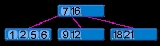
B-tree

Encyclopedia
In computer science
, a B-tree is a tree data structure that keeps data sorted and allows searches, sequential access, insertions, and deletions in logarithmic time. The B-tree is a generalization of a binary search tree
in that a node can have more than two children. Unlike self-balancing binary search tree
s, the B-tree is optimized for systems that read and write large blocks of data. It is commonly used in database
s and filesystems.
s, but may waste some space, since nodes are not entirely full. The lower and upper bounds on the number of child nodes are typically fixed for a particular implementation. For example, in a 2-3 B-tree (often simply referred to as a 2-3 tree
), each internal node may have only 2 or 3 child nodes.
Each internal node of a B-tree will contain a number of keys. Usually, the number of keys is chosen to vary between and
and  . In practice, the keys take up the most space in a node. The factor of 2 will guarantee that nodes can be split or combined. If an internal node has
  keys, then adding a key to that node can be accomplished by splitting the
  key node into two
  key nodes and adding the key to the parent node. Each split node has the required minimum number of keys. Similarly, if an internal node and its neighbor each have
  keys, then a key may be deleted from the internal node by combining with its neighbor. Deleting the key would make the internal node have
  keys; joining the neighbor would add
  keys plus one more key brought down from the neighbor's parent. The result is an entirely full node of
  keys.
keys.
The number of branches (or child nodes) from a node will be one more than the number of keys stored in the node. In a 2-3 B-tree, the internal nodes will store either one key (with two child nodes) or two keys (with three child nodes). A B-tree is sometimes described with the parameters —
—  or simply with the highest branching order,
  .
.
A B-tree is kept balanced by requiring that all leaf nodes are at the same depth. This depth will increase slowly as elements are added to the tree, but an increase in the overall depth is infrequent, and results in all leaf nodes being one more node further away from the root.
B-trees have substantial advantages over alternative implementations when node access times far exceed access times within nodes, because then the cost of accessing the node may be amortized over multiple operations within the node. This usually occurs when the nodes are in secondary storage such as disk drives. By maximizing the number of child nodes within each internal node, the height of the tree decreases and the number of expensive node accesses is reduced. In addition, rebalancing the tree occurs less often. The maximum number of child nodes depends on the information that must be stored for each child node and the size of a full disk block or an analogous size in secondary storage. While 2-3 B-trees are easier to explain, practical B-trees using secondary storage want a large number of child nodes to improve performance.
and the B*-tree.
and Ed McCreight
invented the B-tree while working at Boeing Research Labs
in 1971 , but they did not explain what, if anything, the B stands for. Douglas Comer
explains:
Donald Knuth speculates on the etymology of B-trees in his May, 1980 lecture on the topic "CS144C classroom lecture about disk storage and B-trees", suggesting the "B" may have originated from Boeing or from Bayer's name.
. A binary search of a sorted table with records, for example, can be done in
  comparisons. If the table had 1,000,000 records, then a specific record could be located with about 20 comparisons:
  .
.
Large databases have historically been kept on disk drives. The time to read a record on a disk drive can dominate the time needed to compare keys once the record is available. The time to read a record from a disk drive involves a seek time and a rotational delay. The seek time may be 0 to 20 or more milliseconds, and the rotational delay averages about half the rotation period. For a 7200 RPM drive, the rotation period is 8.33 milliseconds. For a drive such as the Seagate ST3500320NS, the track-to-track seek time is 0.8 milliseconds and the average reading seek time is 8.5 milliseconds. For simplicity, assume reading from disk takes about 10 milliseconds.
Naively, then, the time to locate one record out of a million would take 20 disk reads times 10 milliseconds per disk read, which is 0.2 seconds.
The time won't be that bad because individual records are grouped together in a disk block. A disk block might be 16 kilobytes. If each record is 160 bytes, then 100 records could be stored in each block. The disk read time above was actually for an entire block. Once the disk head is in position, one or more disk blocks can be read with little delay. With 100 records per block, the last 6 or so comparisons don't need to do any disk reads—the comparisons are all within the last disk block read.
To speed the search further, the first 13 to 14 comparisons (which each required a disk access) must be sped up.
. In the example above, initial disk reads narrowed the search range by a factor of two. That can be improved substantially by creating an auxiliary index that contains the first record in each disk block (sometimes called a sparse index). This auxiliary index would be 1% of the size of the original database, but it can be searched more quickly. Finding an entry in the auxiliary index would tell us which block to search in the main database; after searching the auxiliary index, we would have to search only that one block of the main database—at a cost of one more disk read. The index would hold 10,000 entries, so it would take at most 14 comparisons. Like the main database, the last 6 or so comparisons in the aux index would be on the same disk block. The index could be searched in about 8 disk reads, and the desired record could be accessed in 9 disk reads.
The trick of creating an auxiliary index can be repeated to make an auxiliary index to the auxiliary index. That would make an aux-aux index that would need only 100 entries and would fit in one disk block.
Instead of reading 14 disk blocks to find the desired record, we only need to read 3 blocks. Reading and searching the first (and only) block of the aux-aux index identifies the relevant block in aux-index. Reading and searching that aux-index block identifies the relevant block in the main database. Instead of 150 milliseconds, we need only 30 milliseconds to get the record.
The auxiliary indices have turned the search problem from a binary search requiring roughly disk reads to one requiring only
  disk reads where
  is the blocking factor (the number of entries per block:
  entries per block;
  reads).
In practice, if the main database is being frequently searched, the aux-aux index and much of the aux index may reside in a disk cache
, so they would not incur a disk read.
Deleting records from a database doesn't cause much trouble. The index can stay the same, and the record can just be marked as deleted. The database stays in sorted order. If there are a lot of deletions, then the searching and storage become less efficient.
Insertions are a disaster in a sorted sequential file because room for the inserted record must be made. Inserting a record before the first record in the file requires shifting all of the records down one. Such an operation is just too expensive to be practical.
A trick is to leave some space lying around to be used for insertions. Instead of densely storing all the records in a block, the block can have some free space to allow for subsequent insertions. Those records would be marked as if they were "deleted" records.
Now, both insertions and deletions are fast as long as space is available on a block. If an insertion won't fit on the block, then some free space on some nearby block must be found and the auxiliary indices adjusted. The hope is enough space is nearby that a lot of blocks do not need to be reorganized. Alternatively, some out-of-sequence disk blocks may be used.
In addition, a B-tree minimizes waste by making sure the interior nodes are at least ½ full. A B-tree can handle an arbitrary number of insertions and deletions.
, , and others define the order of B-tree as the minimum number of keys in a non-root node. points out that terminology is ambiguous because the maximum number of keys is not clear. An order 3 B-tree might hold a maximum of 6 keys or a maximum of 7 keys. avoids the problem by defining the order to be maximum number of children (which is one more than the maximum number of keys).
The term leaf is also inconsistent. considered the leaf level to be the lowest level of keys, but Knuth considered the leaf level to be one level below the lowest keys. There are many possible implementation choices. In some designs, the leaves may hold the entire data record; in other designs, the leaves may only hold pointers to the data record. Those choices are not fundamental to the idea of a B-tree.
There are also unfortunate choices like using the variable to represent the number of children when
  could be confused with the number of keys.
For simplicity, most authors assume there are a fixed number of keys that fit in a node. The basic assumption is the key size is fixed and the node size is fixed. In practice, variable length keys may be employed.
Each internal node’s elements act as separation values which divide its subtrees. For example, if an internal node has 3 child nodes (or subtrees) then it must have 2 separation values or elements: a1 and a2. All values in the leftmost subtree will be less than a1, all values in the middle subtree will be between a1 and a2, and all values in the rightmost subtree will be greater than a2.
Internal nodes
The root node
Leaf nodes
A B-tree of depth n+1 can hold about U times as many items as a B-tree of depth n, but the cost of search, insert, and delete operations grows with the depth of the tree. As with any balanced tree, the cost grows much more slowly than the number of elements.
Some balanced trees store values only at leaf nodes, and use different kinds of nodes for leaf nodes and internal nodes. B-trees keep values in every node in the tree, and may use the same structure for all nodes. However, since leaf nodes never have children, the B-trees benefit from improved performance if they use a specialized structure.
The worst case height of a B-Tree is:
where is the maximum number of children a node can have.
. Starting at the root, the tree is recursively traversed from top to bottom. At each level, the search chooses the child pointer (subtree) whose separation values are on either side of the search value.
Binary search is typically (but not necessarily) used within nodes to find the separation values and child tree of interest.
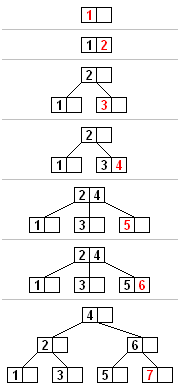 All insertions start at a leaf node. To insert a new element
Search the tree to find the leaf node where the new element should be added. Insert the new element into that node with the following steps:
If the splitting goes all the way up to the root, it creates a new root with a single separator value and two children, which is why the lower bound on the size of internal nodes does not apply to the root. The maximum number of elements per node is U−1. When a node is split, one element moves to the parent, but one element is added. So, it must be possible to divide the maximum number U−1 of elements into two legal nodes. If this number is odd, then U=2L and one of the new nodes contains (U−2)/2 = L−1 elements, and hence is a legal node, and the other contains one more element, and hence it is legal too. If U−1 is even, then U=2L−1, so there are 2L−2 elements in the node. Half of this number is L−1, which is the minimum number of elements allowed per node.
An improved algorithm supports a single pass down the tree from the root to the node where the insertion will take place, splitting any full nodes encountered on the way. This prevents the need to recall the parent nodes into memory, which may be expensive if the nodes are on secondary storage. However, to use this improved algorithm, we must be able to send one element to the parent and split the remaining U−2 elements into two legal nodes, without adding a new element. This requires U = 2L rather than U = 2L−1, which accounts for why some textbooks impose this requirement in defining B-trees.
The algorithm below uses the former strategy.
There are two special cases to consider when deleting an element:
The procedures for these cases are in order below.
In the first case, both of the two child nodes to the left and right of the deleted element have the minimum number of elements, namely L−1. They can then be joined into a single node with 2L−2 elements, a number which does not exceed U−1 and so is a legal node. Unless it is known that this particular B-tree does not contain duplicate data, we must then also (recursively) delete the element in question from the new node.
In the second case, one of the two child nodes contains more than the minimum number of elements. Then a new separator for those subtrees must be found. Note that the largest element in the left subtree is still less than the separator. Likewise, the smallest element in the right subtree is the smallest element which is still greater than the separator. Both of those elements are in leaf nodes, and either can be the new separator for the two subtrees.
The only other case to account for is when the root has no elements and one child. In this case it is sufficient to replace it with its only child.
For example, if the leaf nodes have maximum size 4 and the initial collection is the integers 1 through 24, we would initially construct 4 leaf nodes containing 5 values each and 1 which contains 4 values:
We build the next level up from the leaves by taking the last element from each leaf node except the last one. Again, each node except the last will contain one extra value. In the example, suppose the internal nodes contain at most 2 values (3 child pointers). Then the next level up of internal nodes would be:
This process is continued until we reach a level with only one node and it is not overfilled. In the example only the root level remains:
Computer science
Computer science or computing science is the study of the theoretical foundations of information and computation and of practical techniques for their implementation and application in computer systems...
, a B-tree is a tree data structure that keeps data sorted and allows searches, sequential access, insertions, and deletions in logarithmic time. The B-tree is a generalization of a binary search tree
Binary search tree
In computer science, a binary search tree , which may sometimes also be called an ordered or sorted binary tree, is a node-based binary tree data structurewhich has the following properties:...
in that a node can have more than two children. Unlike self-balancing binary search tree
Self-balancing binary search tree
In computer science, a self-balancing binary search tree is any node based binary search tree that automatically keeps its height small in the face of arbitrary item insertions and deletions....
s, the B-tree is optimized for systems that read and write large blocks of data. It is commonly used in database
Database
A database is an organized collection of data for one or more purposes, usually in digital form. The data are typically organized to model relevant aspects of reality , in a way that supports processes requiring this information...
s and filesystems.
Overview
In B-trees, internal (non-leaf) nodes can have a variable number of child nodes within some pre-defined range. When data is inserted or removed from a node, its number of child nodes changes. In order to maintain the pre-defined range, internal nodes may be joined or split. Because a range of child nodes is permitted, B-trees do not need re-balancing as frequently as other self-balancing search treeSelf-balancing binary search tree
In computer science, a self-balancing binary search tree is any node based binary search tree that automatically keeps its height small in the face of arbitrary item insertions and deletions....
s, but may waste some space, since nodes are not entirely full. The lower and upper bounds on the number of child nodes are typically fixed for a particular implementation. For example, in a 2-3 B-tree (often simply referred to as a 2-3 tree
2-3 tree
In computer science, a 2-3 tree is a type of data structure, a tree where every node with children has either two children and one data element or three children and two data elements...
), each internal node may have only 2 or 3 child nodes.
Each internal node of a B-tree will contain a number of keys. Usually, the number of keys is chosen to vary between
and . In practice, the keys take up the most space in a node. The factor of 2 will guarantee that nodes can be split or combined. If an internal node has keys, then adding a key to that node can be accomplished by splitting the key node into two key nodes and adding the key to the parent node. Each split node has the required minimum number of keys. Similarly, if an internal node and its neighbor each have keys, then a key may be deleted from the internal node by combining with its neighbor. Deleting the key would make the internal node have keys; joining the neighbor would add keys plus one more key brought down from the neighbor's parent. The result is an entirely full node of keys.The number of branches (or child nodes) from a node will be one more than the number of keys stored in the node. In a 2-3 B-tree, the internal nodes will store either one key (with two child nodes) or two keys (with three child nodes). A B-tree is sometimes described with the parameters
— or simply with the highest branching order, .A B-tree is kept balanced by requiring that all leaf nodes are at the same depth. This depth will increase slowly as elements are added to the tree, but an increase in the overall depth is infrequent, and results in all leaf nodes being one more node further away from the root.
B-trees have substantial advantages over alternative implementations when node access times far exceed access times within nodes, because then the cost of accessing the node may be amortized over multiple operations within the node. This usually occurs when the nodes are in secondary storage such as disk drives. By maximizing the number of child nodes within each internal node, the height of the tree decreases and the number of expensive node accesses is reduced. In addition, rebalancing the tree occurs less often. The maximum number of child nodes depends on the information that must be stored for each child node and the size of a full disk block or an analogous size in secondary storage. While 2-3 B-trees are easier to explain, practical B-trees using secondary storage want a large number of child nodes to improve performance.
Variants
The term B-tree may refer to a specific design or it may refer to a general class of designs. In the narrow sense, a B-tree stores keys in its internal nodes but need not store those keys in the records at the leaves. The general class includes variations such as the B+-treeB+ tree
In computer science, a B+ tree or B plus tree is a type of tree which represents sorted data in a way that allows for efficient insertion, retrieval and removal of records, each of which is identified by a key. It is a dynamic, multilevel index, with maximum and minimum bounds on the number of...
and the B*-tree.
- In the B+-tree, copies of the keys are stored in the internal nodes; the keys and records are stored in leaves; in addition, a leaf node may include a pointer to the next leaf node to speed sequential access.
- The B*-tree balances more neighboring internal nodes to keep the internal nodes more densely packed. This variant requires non-root nodes to be at least 2/3 full instead of 1/2. To maintain this, instead of immediately splitting up a node when it gets full, its keys are shared with a node next to it. When both nodes are full, then the two nodes are split into three.
- Counted B-trees store, with each pointer within the tree, the number of nodes in the subtree below that pointer. This allows rapid searches for the Nth record in key order, or counting the number of records between any two records, and various other related operations.
Etymology unknown
Rudolf BayerRudolf Bayer
Rudolf Bayer has been Professor of Informatics at the Technical University of Munich since 1972. He is noted for inventing three data sorting structures: the B-tree , the UB-tree and the red-black tree.Bayer is a recipient of 2001 ACM SIGMOD Edgar F. Codd Innovations Award.-External links:*...
and Ed McCreight
Edward M. McCreight
Edward Meyers McCreight is an American computer scientist. He co-invented the B-tree with Rudolf Bayer while at Boeing,co-designed the Xerox Alto workstation,...
invented the B-tree while working at Boeing Research Labs
Boeing
The Boeing Company is an American multinational aerospace and defense corporation, founded in 1916 by William E. Boeing in Seattle, Washington. Boeing has expanded over the years, merging with McDonnell Douglas in 1997. Boeing Corporate headquarters has been in Chicago, Illinois since 2001...
in 1971 , but they did not explain what, if anything, the B stands for. Douglas Comer
Douglas Comer
Douglas Earl Comer is a writer and professor best known for his work in the early development of the Internet.- Education and career :...
explains:
The origin of "B-tree" has never been explained by the authors. As we shall see, "balanced," "broad," or "bushy" might apply. Others suggest that the "B" stands for Boeing. Because of his contributions, however, it seems appropriate to think of B-trees as "Bayer"-trees.
Donald Knuth speculates on the etymology of B-trees in his May, 1980 lecture on the topic "CS144C classroom lecture about disk storage and B-trees", suggesting the "B" may have originated from Boeing or from Bayer's name.
Time to search a sorted file
Usually, sorting and searching algorithms have been characterized by the number of comparison operations that must be performed using order notationBig O notation
In mathematics, big O notation is used to describe the limiting behavior of a function when the argument tends towards a particular value or infinity, usually in terms of simpler functions. It is a member of a larger family of notations that is called Landau notation, Bachmann-Landau notation, or...
. A binary search of a sorted table with
records, for example, can be done in comparisons. If the table had 1,000,000 records, then a specific record could be located with about 20 comparisons: .Large databases have historically been kept on disk drives. The time to read a record on a disk drive can dominate the time needed to compare keys once the record is available. The time to read a record from a disk drive involves a seek time and a rotational delay. The seek time may be 0 to 20 or more milliseconds, and the rotational delay averages about half the rotation period. For a 7200 RPM drive, the rotation period is 8.33 milliseconds. For a drive such as the Seagate ST3500320NS, the track-to-track seek time is 0.8 milliseconds and the average reading seek time is 8.5 milliseconds. For simplicity, assume reading from disk takes about 10 milliseconds.
Naively, then, the time to locate one record out of a million would take 20 disk reads times 10 milliseconds per disk read, which is 0.2 seconds.
The time won't be that bad because individual records are grouped together in a disk block. A disk block might be 16 kilobytes. If each record is 160 bytes, then 100 records could be stored in each block. The disk read time above was actually for an entire block. Once the disk head is in position, one or more disk blocks can be read with little delay. With 100 records per block, the last 6 or so comparisons don't need to do any disk reads—the comparisons are all within the last disk block read.
To speed the search further, the first 13 to 14 comparisons (which each required a disk access) must be sped up.
An index speeds the search
A significant improvement can be made with an indexIndex (database)
A database index is a data structure that improves the speed of data retrieval operations on a database table at the cost of slower writes and increased storage space...
. In the example above, initial disk reads narrowed the search range by a factor of two. That can be improved substantially by creating an auxiliary index that contains the first record in each disk block (sometimes called a sparse index). This auxiliary index would be 1% of the size of the original database, but it can be searched more quickly. Finding an entry in the auxiliary index would tell us which block to search in the main database; after searching the auxiliary index, we would have to search only that one block of the main database—at a cost of one more disk read. The index would hold 10,000 entries, so it would take at most 14 comparisons. Like the main database, the last 6 or so comparisons in the aux index would be on the same disk block. The index could be searched in about 8 disk reads, and the desired record could be accessed in 9 disk reads.
The trick of creating an auxiliary index can be repeated to make an auxiliary index to the auxiliary index. That would make an aux-aux index that would need only 100 entries and would fit in one disk block.
Instead of reading 14 disk blocks to find the desired record, we only need to read 3 blocks. Reading and searching the first (and only) block of the aux-aux index identifies the relevant block in aux-index. Reading and searching that aux-index block identifies the relevant block in the main database. Instead of 150 milliseconds, we need only 30 milliseconds to get the record.
The auxiliary indices have turned the search problem from a binary search requiring roughly
disk reads to one requiring only disk reads where is the blocking factor (the number of entries per block: entries per block; reads).In practice, if the main database is being frequently searched, the aux-aux index and much of the aux index may reside in a disk cache
Page cache
In computing, page cache, sometimes ambiguously called disk cache, is a "transparent" buffer of disk-backed pages kept in main memory by the operating system for quicker access. Page cache is typically implemented in kernels with the paging memory management, and is completely transparent to...
, so they would not incur a disk read.
Insertions and deletions cause trouble
If the database does not change, then compiling the index is simple to do, and the index need never be changed. If there are changes, then managing the database and its index becomes more complicated.Deleting records from a database doesn't cause much trouble. The index can stay the same, and the record can just be marked as deleted. The database stays in sorted order. If there are a lot of deletions, then the searching and storage become less efficient.
Insertions are a disaster in a sorted sequential file because room for the inserted record must be made. Inserting a record before the first record in the file requires shifting all of the records down one. Such an operation is just too expensive to be practical.
A trick is to leave some space lying around to be used for insertions. Instead of densely storing all the records in a block, the block can have some free space to allow for subsequent insertions. Those records would be marked as if they were "deleted" records.
Now, both insertions and deletions are fast as long as space is available on a block. If an insertion won't fit on the block, then some free space on some nearby block must be found and the auxiliary indices adjusted. The hope is enough space is nearby that a lot of blocks do not need to be reorganized. Alternatively, some out-of-sequence disk blocks may be used.
The B-tree uses all those ideas
The B-tree uses all of the above ideas:- It keeps records in sorted order for sequential traversing
- It uses a hierarchical index to minimize the number of disk reads
- It uses partially-full blocks to speed insertions and deletions
- The index is elegantly adjusted with a recursive algorithm
In addition, a B-tree minimizes waste by making sure the interior nodes are at least ½ full. A B-tree can handle an arbitrary number of insertions and deletions.
Terminology
The terminology used for B-trees is inconsistent in the literature:- Unfortunately, the literature on B-trees is not uniform in its use of terms relating to B-Trees.
, , and others define the order of B-tree as the minimum number of keys in a non-root node. points out that terminology is ambiguous because the maximum number of keys is not clear. An order 3 B-tree might hold a maximum of 6 keys or a maximum of 7 keys. avoids the problem by defining the order to be maximum number of children (which is one more than the maximum number of keys).
The term leaf is also inconsistent. considered the leaf level to be the lowest level of keys, but Knuth considered the leaf level to be one level below the lowest keys. There are many possible implementation choices. In some designs, the leaves may hold the entire data record; in other designs, the leaves may only hold pointers to the data record. Those choices are not fundamental to the idea of a B-tree.
There are also unfortunate choices like using the variable
to represent the number of children when could be confused with the number of keys.For simplicity, most authors assume there are a fixed number of keys that fit in a node. The basic assumption is the key size is fixed and the node size is fixed. In practice, variable length keys may be employed.
Definition
According to Knuth's definition, a B-tree of order m (the maximum number of children for each node) is a tree which satisfies the following properties:- Every node has at most m children.
- Every node (except root) has at least children.
- The root has at least two children if it is not a leaf node.
- All leaves appear in the same level, and carry information.
- A non-leaf node with k children contains k−1 keys.
Each internal node’s elements act as separation values which divide its subtrees. For example, if an internal node has 3 child nodes (or subtrees) then it must have 2 separation values or elements: a1 and a2. All values in the leftmost subtree will be less than a1, all values in the middle subtree will be between a1 and a2, and all values in the rightmost subtree will be greater than a2.
Internal nodes
- Internal nodes are all nodes except for leaf nodes and the root node. They are usually represented as an ordered set of elements and child pointers. Every internal node contains a maximum of U children and a minimum of L children. Thus, the number of elements is always 1 less than the number of child pointers (the number of elements is between L−1 and U−1). U must be either 2L or 2L−1; therefore each internal node is at least half full. The relationship between U and L implies that two half-full nodes can be joined to make a legal node, and one full node can be split into two legal nodes (if there’s room to push one element up into the parent). These properties make it possible to delete and insert new values into a B-tree and adjust the tree to preserve the B-tree properties.
The root node
- The root node’s number of children has the same upper limit as internal nodes, but has no lower limit. For example, when there are fewer than L−1 elements in the entire tree, the root will be the only node in the tree, with no children at all.
Leaf nodes
- Leaf nodes have the same restriction on the number of elements, but have no children, and no child pointers.
A B-tree of depth n+1 can hold about U times as many items as a B-tree of depth n, but the cost of search, insert, and delete operations grows with the depth of the tree. As with any balanced tree, the cost grows much more slowly than the number of elements.
Some balanced trees store values only at leaf nodes, and use different kinds of nodes for leaf nodes and internal nodes. B-trees keep values in every node in the tree, and may use the same structure for all nodes. However, since leaf nodes never have children, the B-trees benefit from improved performance if they use a specialized structure.
Best case and worst case heights
The best case height of a B-Tree is:
The worst case height of a B-Tree is:

where
is the maximum number of children a node can have.Algorithms
Warning: the discussion below uses "element", "value", "key", "separator", and "separation value" to mean essentially the same thing. The terms are not clearly defined. There are some subtle issues at the root and leaves.Search
Searching is similar to searching a binary search treeBinary search tree
In computer science, a binary search tree , which may sometimes also be called an ordered or sorted binary tree, is a node-based binary tree data structurewhich has the following properties:...
. Starting at the root, the tree is recursively traversed from top to bottom. At each level, the search chooses the child pointer (subtree) whose separation values are on either side of the search value.
Binary search is typically (but not necessarily) used within nodes to find the separation values and child tree of interest.
Insertion
Search the tree to find the leaf node where the new element should be added. Insert the new element into that node with the following steps:
- If the node contains fewer than the maximum legal number of elements, then there is room for the new element. Insert the new element in the node, keeping the node's elements ordered.
- Otherwise the node is full, evenly split it into two nodes so:
- A single median is chosen from among the leaf's elements and the new element.
- Values less than the median are put in the new left node and values greater than the median are put in the new right node, with the median acting as a separation value.
- The separation value is inserted in the node's parent, which may cause it to be split, and so on. If the node has no parent (i.e., the node was the root), create a new root above this node (increasing the height of the tree).
If the splitting goes all the way up to the root, it creates a new root with a single separator value and two children, which is why the lower bound on the size of internal nodes does not apply to the root. The maximum number of elements per node is U−1. When a node is split, one element moves to the parent, but one element is added. So, it must be possible to divide the maximum number U−1 of elements into two legal nodes. If this number is odd, then U=2L and one of the new nodes contains (U−2)/2 = L−1 elements, and hence is a legal node, and the other contains one more element, and hence it is legal too. If U−1 is even, then U=2L−1, so there are 2L−2 elements in the node. Half of this number is L−1, which is the minimum number of elements allowed per node.
An improved algorithm supports a single pass down the tree from the root to the node where the insertion will take place, splitting any full nodes encountered on the way. This prevents the need to recall the parent nodes into memory, which may be expensive if the nodes are on secondary storage. However, to use this improved algorithm, we must be able to send one element to the parent and split the remaining U−2 elements into two legal nodes, without adding a new element. This requires U = 2L rather than U = 2L−1, which accounts for why some textbooks impose this requirement in defining B-trees.
Deletion
There are two popular strategies for deletion from a B-Tree.- Locate and delete the item, then restructure the tree to regain its invariants, OR
- Do a single pass down the tree, but before entering (visiting) a node, restructure the tree so that once the key to be deleted is encountered, it can be deleted without triggering the need for any further restructuring
The algorithm below uses the former strategy.
There are two special cases to consider when deleting an element:
- The element in an internal node may be a separator for its child nodes
- Deleting an element may put its node under the minimum number of elements and children
The procedures for these cases are in order below.
Deletion from a leaf node
- Search for the value to delete
- If the value's in a leaf node, simply delete it from the node
- If underflow happens, check siblings, and either transfer a key or fuse the siblings together
- If deletion happened from right child, retrieve the max value of left child if it has no underflow
- In vice-versa situation, retrieve the min element from right
Deletion from an internal node
Each element in an internal node acts as a separation value for two subtrees, and when such an element is deleted, two cases arise.In the first case, both of the two child nodes to the left and right of the deleted element have the minimum number of elements, namely L−1. They can then be joined into a single node with 2L−2 elements, a number which does not exceed U−1 and so is a legal node. Unless it is known that this particular B-tree does not contain duplicate data, we must then also (recursively) delete the element in question from the new node.
In the second case, one of the two child nodes contains more than the minimum number of elements. Then a new separator for those subtrees must be found. Note that the largest element in the left subtree is still less than the separator. Likewise, the smallest element in the right subtree is the smallest element which is still greater than the separator. Both of those elements are in leaf nodes, and either can be the new separator for the two subtrees.
- If the value is in an internal node, choose a new separator (either the largest element in the left subtree or the smallest element in the right subtree), remove it from the leaf node it is in, and replace the element to be deleted with the new separator
- This has deleted an element from a leaf node, and so is now equivalent to the previous case
Rebalancing after deletion
If deleting an element from a leaf node has brought it under the minimum size, some elements must be redistributed to bring all nodes up to the minimum. In some cases the rearrangement will move the deficiency to the parent, and the redistribution must be applied iteratively up the tree, perhaps even to the root. Since the minimum element count doesn't apply to the root, making the root be the only deficient node is not a problem. The algorithm to rebalance the tree is as follows:- If the right sibling has more than the minimum number of elements
- Add the separator to the end of the deficient node
- Replace the separator in the parent with the first element of the right sibling
- Append the first child of the right sibling as the last child of the deficient node
- Otherwise, if the left sibling has more than the minimum number of elements
- Add the separator to the start of the deficient node
- Replace the separator in the parent with the last element of the left sibling
- Insert the last child of the left sibling as the first child of the deficient node
- If both immediate siblings have only the minimum number of elements
- Create a new node with all the elements from the deficient node, all the elements from one of its siblings, and the separator in the parent between the two combined sibling nodes
- Remove the separator from the parent, and replace the two children it separated with the combined node
- If that brings the number of elements in the parent under the minimum, repeat these steps with that deficient node, unless it is the root, since the root is permitted to be deficient
The only other case to account for is when the root has no elements and one child. In this case it is sufficient to replace it with its only child.
Initial construction
In applications, it is frequently useful to build a B-tree to represent a large existing collection of data and then update it incrementally using standard B-tree operations. In this case, the most efficient way to construct the initial B-tree is not to insert every element in the initial collection successively, but instead to construct the initial set of leaf nodes directly from the input, then build the internal nodes from these. This approach to B-tree construction is called bulkloading. Initially, every leaf but the last one has one extra element, which will be used to build the internal nodes.For example, if the leaf nodes have maximum size 4 and the initial collection is the integers 1 through 24, we would initially construct 4 leaf nodes containing 5 values each and 1 which contains 4 values:
|
|
|
|
|
We build the next level up from the leaves by taking the last element from each leaf node except the last one. Again, each node except the last will contain one extra value. In the example, suppose the internal nodes contain at most 2 values (3 child pointers). Then the next level up of internal nodes would be:
|
|
|
|
|
|
|
This process is continued until we reach a level with only one node and it is not overfilled. In the example only the root level remains:
|
|
|
|
|
|
|
|
In filesystems
In addition to its use in databases, the B-tree is also used in filesystems to allow quick random access to an arbitrary block in a particular file. The basic problem is turning the file block address into a disk block (or perhaps to a cylinder-head-sector
Cylinder-head-sector
Cylinder-head-sector, also known as CHS, was an early method for giving addresses to each physical block of data on a hard disk drive. In the case of floppy drives, for which the same exact diskette medium can be truly low-level formatted to different capacities, this is still true.Though CHS...
) address.
Some operating systems require the user to allocate the maximum size of the file when the file is created. The file can then be allocated as contiguous disk blocks. Converting to a disk block: the operating system just adds the file block address to the starting disk block of the file. The scheme is simple, but the file cannot exceed its created size.
Other operating systems allow a file to grow. The resulting disk blocks may not be contiguous, so mapping logical blocks to physical blocks is more involved.
MS-DOS
MS-DOS
MS-DOS is an operating system for x86-based personal computers. It was the most commonly used member of the DOS family of operating systems, and was the main operating system for IBM PC compatible personal computers during the 1980s to the mid 1990s, until it was gradually superseded by operating...
, for example, used a simple File Allocation Table
File Allocation Table
File Allocation Table is a computer file system architecture now widely used on many computer systems and most memory cards, such as those used with digital cameras. FAT file systems are commonly found on floppy disks, flash memory cards, digital cameras, and many other portable devices because of...
(FAT). The FAT has an entry for each disk block,For FAT, what is called a "disk block" here is what the FAT documentation calls a "cluster", which is fixed-size group of one or more contiguous whole physical disk sectors
Cylinder-head-sector
Cylinder-head-sector, also known as CHS, was an early method for giving addresses to each physical block of data on a hard disk drive. In the case of floppy drives, for which the same exact diskette medium can be truly low-level formatted to different capacities, this is still true.Though CHS...
. For the purposes of this discussion, a cluster has no significant difference from a physical sector. and that entry identifies whether its block is used by a file and if so, which block (if any) is the next disk block of the same file. So, the allocation of each file is represented as a linked list
Linked list
In computer science, a linked list is a data structure consisting of a group of nodes which together represent a sequence. Under the simplest form, each node is composed of a datum and a reference to the next node in the sequence; more complex variants add additional links...
in the table. In order to find the disk address of file block
 , the operating system (or disk utility) must sequentially follow the file's linked list in the FAT. Worse, to find a free disk block, it must sequentially scan the FAT. For MS-DOS, that was not a huge penalty because the disks and files were small and the FAT had few entries and relatively short file chains. In the FAT12 filesystem (used on floppy disks and early hard disks), there were no more than 4,080 Two of these were reserved for special purposes, so only 4078 could actually represent disk blocks (clusters). entries, and the FAT would usually be resident in memory. As disks got bigger, the FAT architecture began to confront penalties. On a large disk using FAT, it may be necessary to perform disk reads to learn the disk location of a file block to be read or written.
TOPS-20
TOPS-20
The TOPS-20 operating system by Digital Equipment Corporation was the second proprietary OS for the PDP-10 mainframe computer. TOPS-20 began in 1969 as the TENEX operating system of Bolt, Beranek and Newman...
(and possibly TENEX
TENEX
TENEX may refer to:* The TENEX operating system , an operating system for the DEC PDP-10* Tekhsnabexport, a Russian company specializing in export of nuclear materials...
) used a 0 to 2 level tree that has similarities to a B-Tree. A disk block was 512 36-bit words. If the file fit in a 512 (
 ) word block, then the file directory would point to that physical disk block. If the file fit in
  words, then the directory would point to an aux index; the 512 words of that index would either be NULL (the block isn't allocated) or point to the physical address of the block. If the file fit in
  words, then the directory would point to a block holding an aux-aux index; each entry would either be NULL or point to an aux index. Consequently, the physical disk block for a
  word file could be located in two disk reads and read on the third.
Apple's filesystem HFS+, Microsoft's NTFS
NTFS
NTFS is the standard file system of Windows NT, including its later versions Windows 2000, Windows XP, Windows Server 2003, Windows Server 2008, Windows Vista, and Windows 7....
and some Linux
Linux
Linux is a Unix-like computer operating system assembled under the model of free and open source software development and distribution. The defining component of any Linux system is the Linux kernel, an operating system kernel first released October 5, 1991 by Linus Torvalds...
filesystems, such as btrfs
Btrfs
Btrfs is a GPL-licensed copy-on-write file system for Linux.Development began at Oracle Corporation in 2007....
and Ext4
Ext4
The ext4 or fourth extended filesystem is a journaling file system for Linux, developed as the successor to ext3.It was born as a series of backward compatible extensions to ext3, many of them originally developed by Cluster File Systems for the Lustre file system between 2003 and 2006, meant to...
, use B-trees.
B*-trees are used in the HFS
Hierarchical File System
Hierarchical File System is a file system developed by Apple Inc. for use in computer systems running Mac OS. Originally designed for use on floppy and hard disks, it can also be found on read-only media such as CD-ROMs...
and Reiser4
Reiser4
Reiser4 is a computer file system, successor to the ReiserFS file system, developed from scratch by Namesys and sponsored by DARPA as well as Linspire...
file system
File system
A file system is a means to organize data expected to be retained after a program terminates by providing procedures to store, retrieve and update data, as well as manage the available space on the device which contain it. A file system organizes data in an efficient manner and is tuned to the...
s.
Access concurrency
Lehman and Yao showed that all read locks could be avoided (and thus concurrent access greatly improved) by linking the tree blocks at each level together with a "next" pointer. This results in a tree structure where both insertion and search operations descend from the root to the leaf. Write locks are only required as a tree block is modified. This maximizes access concurrency by multiple users, an important consideration for databaseDatabase
A database is an organized collection of data for one or more purposes, usually in digital form. The data are typically organized to model relevant aspects of reality , in a way that supports processes requiring this information...
s and/or other B-Tree based ISAM
ISAM
ISAM stands for Indexed Sequential Access Method, a method for indexing data for fast retrieval. ISAM was originally developed by IBM for mainframe computers...
storage methods. The cost associated with this improvement is that empty pages cannot be removed from the btree during normal operations. (However, see for various strategies to implement node merging, and source code at.)
United States Patent 5283894, granted In 1994, appears to show a way to use a 'Meta Access Method' to allow concurrent B+Tree access and modification without locks. The technique accesses the tree 'upwards' for both searches and updates by means of additional in-memory indexes that point at the blocks in each level in the block cache. No reorganization for deletes is needed and there are no 'next' pointers in each block as in Lehman and Yao.
External links
- B-Tree animation applet by slady
- B-tree and UB-tree on Scholarpedia Curator: Dr Rudolf Bayer
- B-Trees: Balanced Tree Data Structures
- NIST's Dictionary of Algorithms and Data Structures: B-tree
- B-Tree Tutorial
- The InfinityDB BTree implementation
- Cache Oblivious B(+)-trees
- Dictionary of Algorithms and Data Structures entry for B*-tree
The source of this article is wikipedia, the free encyclopedia. The text of this article is licensed under the GFDL.
