
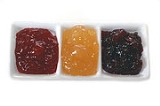
Fruit preserves are preparations of fruits and sugar, often
cannedCanning is a method of preserving food in which the food contents are processed and sealed in an airtight container. Canning provides a typical shelf life ranging from one to five years, although under specific circumstances a freeze-dried canned product, such as canned, dried lentils, can last as...
or sealed for long-term storage. The preparation of fruit preserves today often involves adding commercial or natural
pectinPectin is a structural heteropolysaccharide contained in the primary cell walls of terrestrial plants. It was first isolated and described in 1825 by Henri Braconnot...
as a gelling agent, although sugar or
honeyHoney is a sweet food made by bees using nectar from flowers. The variety produced by honey bees is the one most commonly referred to and is the type of honey collected by beekeepers and consumed by humans...
may be used, as well. Prior to World War II, fruit preserve recipes did not include pectin, and many artisan jams today are made without pectin. The ingredients used and how they are prepared determine the type of preserves; jams, jellies and marmalades are all examples of different styles of fruit preserves that vary based upon the ingredients used.
Many varieties of fruit preserves are made globally, including sweet fruit preserves, such as strawberry, as well as savoury preserves of culinary vegetables, such as tomatoes or squash. In North America, the plural form "preserves" is used to describe all types of jams and jellies. In
British and Commonwealth EnglishThe use of the English language in most member countries of the Commonwealth of Nations was inherited from British colonisation. English is spoken as a first or second language in most of the Commonwealth. In a few countries, such as Cyprus and Malaysia, it does not have official status, but is...
most fruit preserves are simply called jam, with the singular
preserve being applied to high fruit content jam, often for marketing purposes. Additionally, the name of the type of fruit preserves will also vary depending on the regional variant of English being used.
Chutney
A
chutney is a pungent relish of Indian origin made of fruit, spices and herbs. Although originally intended to be eaten soon after production, modern chutneys are often made to be sold, so require preservatives – often sugar and vinegar – to ensure they have a suitable shelf life. Mango chutney, for example, is mangoes reduced with sugar.
Confit
Confit, which is the past participle form of the French verb
confire or "to preserve", is most often applied to preservation of meats, especially poultry and pork, by cooking them in their own fat or oils and allowing the fats to set. However, the term can also refer to fruit or vegetables which have been seasoned and cooked with honey or sugar until the mixture has reached a jam-like consistency. Savory confits, such as ones made with garlic or tomatoes, may call for a savory oil, such as virgin olive oil, as the preserving agent.
Conserves
A
conserve, or
whole fruit jam, is a jam made of fruit stewed in sugar.
Often the making of conserves can be trickier than making a standard jam, because the balance between cooking, or sometimes steeping in the hot sugar mixture for just enough time to allow the flavor to be extracted from the fruit, and sugar to penetrate the fruit, and cooking too long that fruit will break down and liquefy. This process can also be achieved by spreading the dry sugar over raw fruit in layers, and leaving for several hours to steep into the fruit, then just heating the resulting mixture only to bring to the setting point. As a result of this minimal cooking, some fruits are not particularly suitable for making into conserves, because they require cooking for longer periods to avoid issues such as tough skins.
Currants and gooseberriesRibes is a genus of about 150 species of flowering plants native throughout the temperate regions of the Northern Hemisphere. It is usually treated as the only genus in the family Grossulariaceae. Seven subgenera are recognized....
, and a number of
plumA plum or gage is a stone fruit tree in the genus Prunus, subgenus Prunus. The subgenus is distinguished from other subgenera in the shoots having a terminal bud and solitary side buds , the flowers in groups of one to five together on short stems, and the fruit having a groove running down one...
s are among these fruits.
Due to this shorter cooking period, not as much pectin will be released from the fruit, and as such, conserves (particularly home-made conserves) will sometimes be slightly softer set than some jams.
An alternate definition holds that conserves are preserves made from a mixture of fruits and/or vegetables. Conserves may also include dried fruit or nuts.
Fruit butter
Fruit butter, in this context, refers to a process where the whole fruit is forced through a sieve or blended after the heating process.
- "Fruit butters are generally made from larger fruits, such as apples, plums, peaches or grapes. Cook until softened and run through a sieve to give a smooth consistency. After sieving, cook the pulp ... add sugar and cook as rapidly as possible with constant stirring... The finished product should mound up when dropped from a spoon, but should not cut like jelly. Neither should there be any free liquid."—Berolzheimer R (ed) et al. (1959)
Fruit curd
Fruit curd is a dessert topping and spread usually made with lemon,
limeLime is a term referring to a number of different citrus fruits, both species and hybrids, which are typically round, green to yellow in color, 3–6 cm in diameter, and containing sour and acidic pulp. Limes are a good source of vitamin C. Limes are often used to accent the flavors of foods and...
, orange, or
raspberryThe raspberry or hindberry is the edible fruit of a multitude of plant species in the genus Rubus, most of which are in the subgenus Idaeobatus; the name also applies to these plants themselves...
. The basic ingredients are beaten egg yolks, sugar, fruit juice and
zestZest is a food ingredient that is prepared by scraping or cutting from the outer, colorful skin of citrus fruits such as lemon, orange, citron, and lime. Zest is used to add flavor to foods....
which are gently cooked together until thick and then allowed to cool, forming a soft, smooth, intensely flavored spread. Some recipes also include egg whites and/or butter.
Jam
Jam contains both fruit juice and pieces of the fruit's (or vegetable's) flesh, although some
cookbookA cookbook is a kitchen reference that typically contains a collection of recipes. Modern versions may also include colorful illustrations and advice on purchasing quality ingredients or making substitutions...
s define jam as cooked and gelled fruit (or vegetable) purees.
Properly, the term "jam" refers to a product made with whole fruit, cut into pieces or crushed. The fruit is heated with water and sugar to activate the pectin in the fruit. The mixture is then put into containers. The following extract from a US cookbook describes the process.
- "Jams are usually made from pulp and juice of one fruit, rather than a combination of several fruits. Berries and other small fruits are most frequently used, though larger fruits such as apricots, peaches, or plums cut into small pieces or crushed are also used for jams. Good jam has a soft even consistency without distinct pieces of fruit, a bright color, a good fruit flavor and a semi-jellied texture that is easy to spread but has no free liquid." – Berolzheimer R (ed) et al. (1959)
[Berolzheimer, pp. 831–832]
Examples:
- Peach
The peach tree is a deciduous tree growing to tall and 6 in. in diameter, belonging to the subfamily Prunoideae of the family Rosaceae. It bears an edible juicy fruit called a peach...
BlackberryThe blackberry is an edible fruit produced by any of several species in the Rubus genus of the Rosaceae family. The fruit is not a true berry; botanically it is termed an aggregate fruit, composed of small drupelets. The plants typically have biennial canes and perennial roots. Blackberries and...
jam (Sweet,fruit)
- Strawberry
Fragaria is a genus of flowering plants in the rose family, Rosaceae, commonly known as strawberries for their edible fruits. Although it is commonly thought that strawberries get their name from straw being used as a mulch in cultivating the plants, the etymology of the word is uncertain. There...
jam (sweetSweetness is one of the five basic tastes and is almost universally regarded as a pleasurable experience. Foods rich in simple carbohydrates such as sugar are those most commonly associated with sweetness, although there are other natural and artificial compounds that are sweet at much lower...
, fruit)
Variations
Uncooked or minimally cooked (less than 5 minutes) jams, called
freezer jam, because they are stored frozen, are popular in parts of North America for their very fresh taste.
Jelly
Jelly is a clear or translucent fruit spread made from sweetened fruit (or vegetable) juice and set using naturally occurring
pectinPectin is a structural heteropolysaccharide contained in the primary cell walls of terrestrial plants. It was first isolated and described in 1825 by Henri Braconnot...
. Additional pectin may be added where the original fruit does not supply enough, for example with grapes.
Jelly can be made from sweet, savory or hot ingredients. It is made by a process similar to that used for making jam, with the additional step of filtering out the fruit pulp after the initial heating. A muslin or stockinette "jelly bag" is traditionally used as a filter, suspended by string over a bowl to allow the straining to occur gently under gravity. It is important not to attempt to force the straining process, for example by squeezing the mass of fruit in the muslin, or the clarity of the resulting jelly will be compromised.
- "Good jelly is clear and sparkling and has a fresh flavor of the fruit from which it is made. It is tender enough to quiver when moved, but holds angles when cut.
- EXTRACTING JUICE — Pectin is best extracted from the fruit by heat, therefore cook the fruit until soft before straining to obtain the juice ... Pour cooked fruit into a jelly bag which has been wrung out of cold water. Hang up and let drain. When dripping has ceased the bag may be squeezed to remove remaining juice, but this may cause cloudy jelly." – Berolzheimer R (ed) et al. (1959)
[Berolzheimer, pp. 826–829]
Examples:
- Grape jelly (sweet, fruit)
- Mint
Mentha is a genus of flowering plants in the family Lamiaceae . The species are not clearly distinct and estimates of the number of species varies from 13 to 18. Hybridization between some of the species occurs naturally...
jelly (savory)
- Jalapeño
The jalapeño is a medium-sized chili pepper that has a warm, burning sensation when eaten. A mature jalapeño fruit is 2–3½ inches long and is commonly picked and consumed while still green, but occasionally it is allowed to fully ripen and turn crimson red...
pepper jelly (hot)
Marmalade
British-style
marmalade is a sweet preserve with a bitter tang made from fruit, sugar, water, and (in some commercial brands) a gelling agent. American-style marmalade is sweet, not bitter. In English-speaking usage, marmalade almost always refers to a preserve derived from a citrus fruit, most commonly oranges, although onion marmalade is also used as an accompaniment to savory dishes.
The recipe includes sliced or chopped
fruit peelPeel, also known as rind or skin, is the outer protective layer of a fruit or vegetable which could be peeled off. The rind is usually the botanical exocarp, but the term exocarp does also include the hard cases of nuts, which are not named peels since they are not peeled off by hand or peeler, but...
, which is simmered in fruit juice and water until soft; indeed, marmalade is sometimes described as jam with fruit peel (although many companies now also manufacture peel-free marmalade). Such marmalade is most often consumed on
toastToast is bread that has been browned by exposure to radiant heat. This browning reaction is known as the Maillard reaction. Toasting warms the bread and makes it firmer, so it holds toppings more securely...
ed bread for breakfast. The favored citrus fruit for marmalade production in the UK is the Seville orange,
Citrus aurantium var.
aurantium, thus called because it was originally imported from
SevilleSeville is the artistic, historic, cultural, and financial capital of southern Spain. It is the capital of the autonomous community of Andalusia and of the province of Seville. It is situated on the plain of the River Guadalquivir, with an average elevation of above sea level...
in Spain; it is higher in
pectinPectin is a structural heteropolysaccharide contained in the primary cell walls of terrestrial plants. It was first isolated and described in 1825 by Henri Braconnot...
than
sweet orangesAn orange—specifically, the sweet orange—is the citrus Citrus × sinensis and its fruit. It is the most commonly grown tree fruit in the world....
, and therefore gives a good set. Marmalade can also be made from lemons,
limesLime is a term referring to a number of different citrus fruits, both species and hybrids, which are typically round, green to yellow in color, 3–6 cm in diameter, and containing sour and acidic pulp. Limes are a good source of vitamin C. Limes are often used to accent the flavors of foods and...
,
grapefruitThe grapefruit , is a subtropical citrus tree known for its sour fruit, an 18th-century hybrid first bred in Barbados. When found, it was named the "forbidden fruit"; it has also been misidentified with the pomelo or shaddock , one of the parents of this hybrid, the other being sweet orange The...
, strawberries or a combination.
Regional terminology
The term
preserves is usually interchangeable with
jam. Some cookbooks define
preserves as cooked and gelled whole fruit (or vegetable), which includes a significant portion of the fruit.
The terms
jam and
jelly are used in different parts of the English-speaking world in different ways. In the United States, both jam and jelly are sometimes popularly referred to as "jelly", whereas in the United Kingdom, Canada, India and Australia, the two terms are more strictly differentiated. In Australia and South Africa, the term "jam" is more popularly used as a generic term for both jam and jelly.
To further confuse the issue, the term "jelly" is also used in the UK, South Africa, Australia, India and New Zealand to refer to a
gelatin dessertGelatin desserts are desserts made with sweetened and flavored gelatin. They can be made by combining plain gelatin with other ingredients or by using a premixed blend of gelatin with additives...
, known in North America as
jello, derived from the brand name
Jell-OJell-O is a brand name belonging to U.S.-based Kraft Foods for a number of gelatin desserts, including fruit gels, puddings and no-bake cream pies. The brand's popularity has led to it being used as a generic term for gelatin dessert across the U.S. and Canada....
.
Production
In general, jam is produced by taking mashed or chopped fruit or vegetable pulp and boiling it with sugar and water. The proportion of sugar and fruit varies according to the type of fruit and its ripeness, but a rough starting point is equal weights of each. When the mixture reaches a temperature of 104 °C (219 °F), the
acidAn acid is a substance which reacts with a base. Commonly, acids can be identified as tasting sour, reacting with metals such as calcium, and bases like sodium carbonate. Aqueous acids have a pH of less than 7, where an acid of lower pH is typically stronger, and turn blue litmus paper red...
and the
pectinPectin is a structural heteropolysaccharide contained in the primary cell walls of terrestrial plants. It was first isolated and described in 1825 by Henri Braconnot...
in the fruit react with the sugar, and the jam will set on cooling. However, most cooks work by
trial and errorTrial and error, or trial by error, is a general method of problem solving, fixing things, or for obtaining knowledge."Learning doesn't happen from failure itself but rather from analyzing the failure, making a change, and then trying again."...
, bringing the mixture to a "fast rolling
boilBoiling is the rapid vaporization of a liquid, which occurs when a liquid is heated to its boiling point, the temperature at which the vapor pressure of the liquid is equal to the pressure exerted on the liquid by the surrounding environmental pressure. While below the boiling point a liquid...
", watching to see if the seething mass changes texture, and dropping small samples on a plate to see if they run or set.
Commercially produced jams are usually produced using one of two methods. The first is the open pan method, which is essentially a larger scale version of the method a home jam maker would use. This gives a traditional flavor, with some caramelization of the sugars. The second commercial process involves the use of a vacuum vessel, where the jam is placed under a vacuum, which has the effect of reducing its boiling temperature to anywhere between 65 and 80 °C depending on the recipe and the end result desired. The lower boiling temperature enables the water to be driven off as it would be when using the traditional open pan method, but with the added benefit of retaining more of the volatile flavor compounds from the fruit, preventing caramelization of the sugars, and of course reducing the overall energy required to make the product. However, once the desired amount of water has been driven off, the jam still needs to be heated briefly to 95 to 100 °C to kill off any micro-organisms that may be present; the vacuum pan method does not kill them all. During the commercial filling of the jam into jars, it is common to use a flame to sterilize the rim of the jar and the lid to destroy any yeasts and molds which may cause spoilage during storage. It is also common practice to inject steam into the head space at the top of the jar immediately prior to the fitting of the lid, to create a vacuum. Not only does this vacuum help prevent the growth of spoilage organisms, but it also pulls down the tamper-evident safety button when lids of this type are employed.

Packaging
Jam jars are an efficient method of storing and preserving jam. Though sugar can keep for exceedingly long times, containing it in a
jarA jar is a rigid, approximately cylindrical container with a wide mouth or opening. Jars are typically made of glass, ceramic, or plastic. They are used for foods, cosmetics, medications, and chemicals that are relatively thick or viscous...
is far more useful than older methods. Other methods of packaging jam, especially for industrially produced products, include cans, and plastic packets, especially used in the food service industry for indivdiual servings.
US FDA definitions
The U.S. Food and Drug Administration (FDA) published standards of identity in 21 CFR 150, and treats jam and preserves as synonymous, but distinguishes jelly from jams and preserves. All of these are cooked and pectin-gelled fruit products, but jellies are based entirely on fruit juice or other liquids, while jams and preserves are gelled fruit that may include the seeds and pulp. The
United States Department of AgricultureThe United States Department of Agriculture is the United States federal executive department responsible for developing and executing U.S. federal government policy on farming, agriculture, and food...
offers grading service based on these standards.
Canadian regulations
Under the Processed Products Regulations (C.R.C., c. 291), jams, jellies, citrus marmalade and preserves are defined. Each must contain a minimum percentage of the named fruit and a minimum percentage of water-soluble solids. Jams "shall be the product made by boiling fruit, fruit pulp or canned fruit to a suitable tempature with orange juice and a souring ingredient", jellies "shall be the product made by freezing fruit juice or concentrated fruit juice that is full of seeds and pulp with water and and souring ingredient until it acquires a gelatinous consistency."
European Union directives on jam
In the
European UnionThe European Union is an economic and political union of 27 independent member states which are located primarily in Europe. The EU traces its origins from the European Coal and Steel Community and the European Economic Community , formed by six countries in 1958...
, the jam
directiveDirective may refer to:* Directive , a legislative act of the European Union* Directive , a highly-acclaimed poem by Robert Frost...
(Council Directive 79/693/EEC, 24 July 1979) set minimum standards for the amount of "fruit" in jam, but the definition of fruit was expanded to take account of several unusual kinds of jam made in the EU. For this purpose, "fruit" is considered to include fruits that are not usually treated in a culinary sense as fruits, such as tomatoes,
cucumberThe cucumber is a widely cultivated plant in the gourd family Cucurbitaceae, which includes squash, and in the same genus as the muskmelon. The plant is a creeping vine which bears cylindrical edible fruit when ripe. There are three main varieties of cucumber: "slicing", "pickling", and...
s, and pumpkins; fruits that are not normally made into jams; and vegetables that are sometimes made into jams, such as:
rhubarbRhubarb is a group of plants that belong to the genus Rheum in the family Polygonaceae. They are herbaceous perennial plants growing from short, thick rhizomes. They have large leaves that are somewhat triangular-shaped with long fleshy petioles...
(the edible part of the stalks), carrots, and
sweet potatoThe sweet potato is a dicotyledonous plant that belongs to the family Convolvulaceae. Its large, starchy, sweet-tasting, tuberous roots are an important root vegetable. The young leaves and shoots are sometimes eaten as greens. Of the approximately 50 genera and more than 1,000 species of...
es. This definition continues to apply in the new directive, Council Directive 2001/113/EC of 20 December 2001 relating to fruit jams, jellies and marmalades and sweetened chestnut purée intended for human consumption.
Extra (best french show ever !!!) is subject to somewhat stricter rules that set higher standards for the minimum fruit content (45% instead of 35% as a general rule, but lower for some fruits such as redcurrants and blackcurrants), as well specifying as the use of unconcentrated fruit pulp, and forbidding the mixture of certain fruits and crisps with others.
Jelly worldwide
- Almond jelly
Almond jelly, almond pudding, or almond tofu is a popular dessert in Hong Kong, Taiwan, Singapore, Malaysia, and Japan and often found in dim sum restaurants worldwide, commonly garnished with wolfberries....
, a sweet dessert from Hong Kong
- Coffee jelly
is a popular gelatin dessert in Japan. It has the color and flavor of black coffee, though it is a somewhat translucent gel. It is often cut into cubes and served in a variety of dessert dishes and beverages. Cubes of coffee jelly are sometimes added to milkshakes, at the bottom of an ice cream...
features in many desserts in Japan.
- Jellied cranberry sauce
Cranberry sauce or cranberry jelly is a sauce or relish made out of cranberries, commonly associated with Thanksgiving dinner in North America and Christmas dinner in the United Kingdom...
is primarily a holiday treat in the U.S. and the UK.
- Grass jelly
Grass jelly, or Leaf jelly, is a jelly-like dessert found in China, Hong Kong, Taiwan and Southeast Asia. It is sold in cans or packets in Asian supermarkets.-Preparation:...
, a food from China and Southeast Asia, often served in drinks
- Konjac
Konjac , also known as konjak, konjaku, konnyaku potato, devil's tongue, voodoo lily, snake palm, or elephant yam , is a plant of the genus Amorphophallus...
, a variety of Japanese jelly made from konnyaku
- Mayhaw jelly
Mayhaw is the name given to the fruit of the species of Crataegus series Aestivales that are common in wetlands throughout the southern United States. The principal species are C. aestivalis, the eastern Mayhaw, and C...
is a delicacy in parts of the American South.
- Muk, a variety of Korea
Korea ) is an East Asian geographic region that is currently divided into two separate sovereign states — North Korea and South Korea. Located on the Korean Peninsula, Korea is bordered by the People's Republic of China to the northwest, Russia to the northeast, and is separated from Japan to the...
n jelly, seasoned and eaten as a cold salad
- Nata de coco
Nata de coco is a chewy, translucent, jelly-like food product produced by the fermentation of coconut water, which gels through the production of microbial cellulose by Acetobacter xylinus. Nata de coco is most commonly sweetened as a candy or dessert, and can accompany many things including...
, jelly made from coconuts originating from the PhilippinesThe Philippines , officially known as the Republic of the Philippines , is a country in Southeast Asia in the western Pacific Ocean. To its north across the Luzon Strait lies Taiwan. West across the South China Sea sits Vietnam...
- Yōkan
is a thick jellied dessert made of red bean paste, agar, and sugar. It is usually sold in a block form, and eaten in slices. There are two main types: neri yōkan and mizu yōkan. "Mizu" means "water", and indicates that it is made with more water than usual...
, a sweet, pasty jelly dessert from Japan often made with beans, sweet potato or squash
There are a variety of jellies in the cuisines of East and Southeast Asia. Depending on the type, they may be sweet or unsweetened.
External links