


Manchester Museum

Encyclopedia
The Manchester Museum is owned by the University of Manchester
. Sited on Oxford Road (A34) at the heart of the university's group of neo-Gothic
buildings, it provides access to about six million items from every continent and serves both as a resource for academic research
and teaching and as a regional public museum.
 Some of the main collections include:
Worldwide
New World
Eurasia and Africa
Oceania
Unfortunately by the 1860s both societies encountered financial difficulties and, on the advice of the great evolutionary biologist Thomas Huxley
, Owens College (now the University of Manchester) accepted responsibility for the collections in 1867. The college was then in Quay Street and the museum in Peter Street. The old museum was sold in 1875 after the college had moved to its new buildings in Oxford Street.
 The college commissioned Alfred Waterhouse
, the architect of London's Natural History Museum
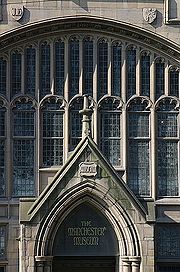
, to design a museum to house these collections for the benefit of students and the public on a new site in Oxford Road (then Oxford Street). The Manchester Museum was opened to the public in 1888. At the time all the scientific departments of the college were immediately adjacent.
Two subsequent extensions mirror the development of the collections. The 1912 'pavilion' was largely funded by Jesse Haworth, a local textile merchant, to house the archaeological and Egyptological collections acquired through excavations he had supported. The 1927 extension was built to house the ethnographic collections. The Gothic Revival street frontage which continues to the Whitworth Hall
has been ingeniously integrated by three generations of the Waterhouse family.
, the Wolfson Foundation
and other sponsors has enabled the Museum to undertake the refurbishment and building which opened in 2003.
Tyrannosaurus
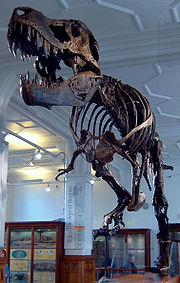
In 2004 the museum acquired a reproduction cast of a fossil Tyrannosaurus rex which is mounted in a running posture. "Stan" as he is called is based on the second most complete T. rex ever found and was excavated in 1992 in South Dakota
, USA by Stan Sacrison.
Recent projects
These include Alchemy (2003 to current), a project initiating and facilitating artists' access to the Manchester Museum and the University of Manchester. Funded by Arts Council England it offers four Alchemy Artist Fellowships, curates artist interventions in the permanent galleries and facilitate artists research and the loan of The Manchester Museum's collections for contemporary art projects. Alchemy is the Museum's first sustained research programme for artists. Through supporting artists research and the creation of new work, Alchemy aims to reinvigorate Museum displays, encourage diverse approaches and present alternative voices.
In August 2007, a new temporary exhibition Myths About Race was opened. Many Victorian institutions, including the Manchester Museum, are now viewed as having contributed to the same racist thinking that had justified slavery. As part of the Revealing Histories: Remembering Slavery project, it begins to explore the difficult and sensitive issues. Visitors are asked to question the displays in the rest of the Museum, and to help the Museum shape its future. Revealing Histories is part of a larger Greater Manchester initiative looking at the legacy and impacts of the slave trade.
In April 2008 a new exhibition opened at the museum lasting until April 2009, which had the Lindow Man
on display. This exhibit has already been seen at the British Museum
in London.
and Admiral Sir John Franklin
. The small collection made by Leopold H. Grindon which includes many cultivated plants is also important.
, Australia in 1952.
captured on Kersal Moor
in 1829 one of only three specimens known to be in existence is here. The remainder of the collections is of foreign origin and the collections of W. D. Hincks and John R. Dibb contributed great quantities of specimens, particularly of Coleoptera. Coleoptera number some 900,000 out of an approximate total 1,750,000. The Chrysomedinae-Cassidinae collection of Franz Spaeth is the finest collection in the world of tortoise-beetles.
's shell collections in 1825 and which also included the collection of Captain Thomas Brown
. Catalogue of type specimens was published in 2008.
Type material is mainly found in the collections of Alexander Abercrombie
(India), Robert Dukinfield Darbishire, Prof. Alfred Cort Haddon
(Torres Straits), Reverend James Hadfield
(Lifu, Loyalty Islands), Lewis John Shackleford (especially Marginella
), George Cooper Spence (especially African land snails and Urocoptis
and many specimens from Matthew William Kemble Connolly
and Hugh Berthon Preston), Frederick W. Townsend (Persian Gulf), syntype material from the Scottish National Antarctic Expedition
(1902–1904) and that received from the Smithsonian Institution
in 1973 in exchange.
Material from the collections of Alexander Abercrombie, Prof. Alfred Cort Haddon, Rev. James Hadfield, Lewis John Shackleford, Frederick W. Townsend and the Scottish National Antarctic Expedition
was described by James Cosmo Melvill II. who had close connections with The Manchester Museum; many species were described together with Robert Standen of the museum.
The bulk of James Cosmo Melvill's collection is housed in the National Museum of Wales, Cardiff and there is also type material in the Natural History Museum, London. The main collections from the Scottish National Antarctic Expedition described by Melvill are in the National Museums of Scotland
, Edinburgh. Types from Matthew William Kemble Connolly's collection are also to be found in the Natural History Museum, London and the National Museum of Wales, Cardiff. Types from Hugh Berthon Preston's collection are widespread as he dealt in specimens; many are found in other British, European and American museums. The Wollaston collection, described by Richard Thomas Lowe
, is distributed between the Natural History Museum (London), National Museum of Wales (Cardiff), Oxford University Museum of Natural History
and Cambridge University Museum of Zoology
. Type material from American authors including William Healey Dall, Henry Augustus Pilsbry
and Paul Bartsch
, is mainly to be found in the Smithsonian Institution (Washington DC), American Museum of Natural History
(New York) and the Philadelphia Academy of Natural Sciences.
University of Manchester
The University of Manchester is a public research university located in Manchester, United Kingdom. It is a "red brick" university and a member of the Russell Group of research-intensive British universities and the N8 Group...
. Sited on Oxford Road (A34) at the heart of the university's group of neo-Gothic
Gothic Revival architecture
The Gothic Revival is an architectural movement that began in the 1740s in England...
buildings, it provides access to about six million items from every continent and serves both as a resource for academic research
Research
Research can be defined as the scientific search for knowledge, or as any systematic investigation, to establish novel facts, solve new or existing problems, prove new ideas, or develop new theories, usually using a scientific method...
and teaching and as a regional public museum.
Outline of collections
Worldwide
- Archery - The Simon Archery Collection, ca. 2000 items, collected by Ingo Simon
- Armour
- Beetles (Coleoptera), ca. 900,000 specimens, collected by Hincks and others
New World
- Live frogFrogFrogs are amphibians in the order Anura , formerly referred to as Salientia . Most frogs are characterized by a short body, webbed digits , protruding eyes and the absence of a tail...
s and ancient pottery from The AmericasAmericasThe Americas, or America , are lands in the Western hemisphere, also known as the New World. In English, the plural form the Americas is often used to refer to the landmasses of North America and South America with their associated islands and regions, while the singular form America is primarily... - Cast of a fossilised Tyrannosaurus rexTyrannosaurusTyrannosaurus meaning "tyrant," and sauros meaning "lizard") is a genus of coelurosaurian theropod dinosaur. The species Tyrannosaurus rex , commonly abbreviated to T. rex, is a fixture in popular culture. It lived throughout what is now western North America, with a much wider range than other...
from South DakotaSouth DakotaSouth Dakota is a state located in the Midwestern region of the United States. It is named after the Lakota and Dakota Sioux American Indian tribes. Once a part of Dakota Territory, South Dakota became a state on November 2, 1889. The state has an area of and an estimated population of just over...
called "Stan", which was unveiled on 4 November 2004.
Eurasia and Africa
- Plants, coins and minerals from EuropeEuropeEurope is, by convention, one of the world's seven continents. Comprising the westernmost peninsula of Eurasia, Europe is generally 'divided' from Asia to its east by the watershed divides of the Ural and Caucasus Mountains, the Ural River, the Caspian and Black Seas, and the waterways connecting...
- Art from past civilisations of the Mediterranean
- Mammals and ancient EgyptAncient EgyptAncient Egypt was an ancient civilization of Northeastern Africa, concentrated along the lower reaches of the Nile River in what is now the modern country of Egypt. Egyptian civilization coalesced around 3150 BC with the political unification of Upper and Lower Egypt under the first pharaoh...
ian craftsmanship from AfricaAfricaAfrica is the world's second largest and second most populous continent, after Asia. At about 30.2 million km² including adjacent islands, it covers 6% of the Earth's total surface area and 20.4% of the total land area... - ButterfliesButterflyA butterfly is a mainly day-flying insect of the order Lepidoptera, which includes the butterflies and moths. Like other holometabolous insects, the butterfly's life cycle consists of four parts: egg, larva, pupa and adult. Most species are diurnal. Butterflies have large, often brightly coloured...
and carvings from IndiaIndiaIndia , officially the Republic of India , is a country in South Asia. It is the seventh-largest country by geographical area, the second-most populous country with over 1.2 billion people, and the most populous democracy in the world...
Oceania
- Birds and bark-cloth from the Pacific
- FossilFossilFossils are the preserved remains or traces of animals , plants, and other organisms from the remote past...
s and native art from AustraliaAustraliaAustralia , officially the Commonwealth of Australia, is a country in the Southern Hemisphere comprising the mainland of the Australian continent, the island of Tasmania, and numerous smaller islands in the Indian and Pacific Oceans. It is the world's sixth-largest country by total area...
, including the Emile ClementEmile ClementEmile Louis Bruno Clement was a prominent collector of ethnographic artifacts and natural history specimens from northwest Australia at the end of the nineteenth and early twentieth centuries.-Biography:...
collection from Bankfield MuseumBankfield MuseumBankfield Museum is a grade II listed historic house museum, incorporating a regimental museum and textiles gallery in Boothtown, Halifax, England...
Early history
The first collections were assembled by the Manchester Society of Natural History, formed in 1821, and in 1850 the collections of the Manchester Geological Society were added.Unfortunately by the 1860s both societies encountered financial difficulties and, on the advice of the great evolutionary biologist Thomas Huxley
Thomas Huxley
Thomas Henry Huxley PC FRS was an English biologist, known as "Darwin's Bulldog" for his advocacy of Charles Darwin's theory of evolution....
, Owens College (now the University of Manchester) accepted responsibility for the collections in 1867. The college was then in Quay Street and the museum in Peter Street. The old museum was sold in 1875 after the college had moved to its new buildings in Oxford Street.
Alfred Waterhouse
Alfred Waterhouse was a British architect, particularly associated with the Victorian Gothic Revival architecture. He is perhaps best known for his design for the Natural History Museum in London, and Manchester Town Hall, although he also built a wide variety of other buildings throughout the...
, the architect of London's Natural History Museum
Natural History Museum
The Natural History Museum is one of three large museums on Exhibition Road, South Kensington, London, England . Its main frontage is on Cromwell Road...
, to design a museum to house these collections for the benefit of students and the public on a new site in Oxford Road (then Oxford Street). The Manchester Museum was opened to the public in 1888. At the time all the scientific departments of the college were immediately adjacent.
Two subsequent extensions mirror the development of the collections. The 1912 'pavilion' was largely funded by Jesse Haworth, a local textile merchant, to house the archaeological and Egyptological collections acquired through excavations he had supported. The 1927 extension was built to house the ethnographic collections. The Gothic Revival street frontage which continues to the Whitworth Hall
Whitworth Hall
The Whitworth Hall on Oxford Road and Burlington Street in Chorlton-on-Medlock, Manchester, England is part of the University of Manchester. It has been listed Grade II* since 18 December 1963. The Hall lies at the south-east range of the Old Quadrangle of the University, with the Manchester Museum...
has been ingeniously integrated by three generations of the Waterhouse family.
Later twentieth century
The University Dental Hospital of Manchester once stood next to the Museum: when it moved to the present hospital building the earlier one was used for scientific teaching and later still by the Manchester Museum which still occupies it.Recent history
In 1997 the Museum was awarded a £12.5 million grant from the Heritage Lottery Fund and this, together with monies from the European Regional Development Fund, the University of Manchester, the Wellcome TrustWellcome Trust
The Wellcome Trust was established in 1936 as an independent charity funding research to improve human and animal health. With an endowment of around £13.9 billion, it is the United Kingdom's largest non-governmental source of funds for biomedical research...
, the Wolfson Foundation
Wolfson Foundation
The Wolfson Foundation is a charity that awards grants to support excellence in the fields of science and medicine, health, education and the arts & humanities.- Overview :...
and other sponsors has enabled the Museum to undertake the refurbishment and building which opened in 2003.
Tyrannosaurus
In 2004 the museum acquired a reproduction cast of a fossil Tyrannosaurus rex which is mounted in a running posture. "Stan" as he is called is based on the second most complete T. rex ever found and was excavated in 1992 in South Dakota
South Dakota
South Dakota is a state located in the Midwestern region of the United States. It is named after the Lakota and Dakota Sioux American Indian tribes. Once a part of Dakota Territory, South Dakota became a state on November 2, 1889. The state has an area of and an estimated population of just over...
, USA by Stan Sacrison.
Recent projects
These include Alchemy (2003 to current), a project initiating and facilitating artists' access to the Manchester Museum and the University of Manchester. Funded by Arts Council England it offers four Alchemy Artist Fellowships, curates artist interventions in the permanent galleries and facilitate artists research and the loan of The Manchester Museum's collections for contemporary art projects. Alchemy is the Museum's first sustained research programme for artists. Through supporting artists research and the creation of new work, Alchemy aims to reinvigorate Museum displays, encourage diverse approaches and present alternative voices.
In August 2007, a new temporary exhibition Myths About Race was opened. Many Victorian institutions, including the Manchester Museum, are now viewed as having contributed to the same racist thinking that had justified slavery. As part of the Revealing Histories: Remembering Slavery project, it begins to explore the difficult and sensitive issues. Visitors are asked to question the displays in the rest of the Museum, and to help the Museum shape its future. Revealing Histories is part of a larger Greater Manchester initiative looking at the legacy and impacts of the slave trade.
In April 2008 a new exhibition opened at the museum lasting until April 2009, which had the Lindow Man
Lindow man
Lindow Man, also known as Lindow II and as Pete Marsh, is the preserved bog body of a man discovered in a peat bog at Lindow Moss near Wilmslow in Cheshire, North West England. The body was found on 1 August 1984 by commercial peat-cutters...
on display. This exhibit has already been seen at the British Museum
British Museum
The British Museum is a museum of human history and culture in London. Its collections, which number more than seven million objects, are amongst the largest and most comprehensive in the world and originate from all continents, illustrating and documenting the story of human culture from its...
in London.
Archaeological collections
The major collecting areas in archaeology have been Western Europe (including the British Isles), the Mediterranean, Egypt and Western Asia. Large accessions of material from Egypt and Western Asia came from the excavations of Sir Flinders Petrie and subsequently archaeologists from the University have been involved in several expeditions to Western Asia and brought more finds into the Museum. The Egyptological collections begin with finds from Kahun and Gurob, presented in 1890 by Jesse Haworth and Martyn Kennard. By 1912 the growth of this area had been so great that a whole new wing was added to allow proper accommodation for the Egyptian material and Jesse Haworth made a major donation of funds for this purpose. In more recent times the Egyptian Mummy Research Project, begun in 1973, has yielded much information on health and social conditions in ancient Egypt and radiology and endoscopy have been used extensively. A redesign of the galleries in 1984/85 resulted in much improved displays.Botanical collections
The Manchester Herbarium contains upwards of 950,000 specimens collected during the 18th, 19th and 20th centuries and most countries are represented by at least some specimens. Accessions are still made to the Herbarium and many specialist enquiries are received there. Only a small part of the collection is exhibited. Important contributions came from the work of Charles Bailey and James Cosmo Melvill and some of the specimens of Carolus Linnæus are included, as are some from the expeditions of Charles DarwinCharles Darwin
Charles Robert Darwin FRS was an English naturalist. He established that all species of life have descended over time from common ancestry, and proposed the scientific theory that this branching pattern of evolution resulted from a process that he called natural selection.He published his theory...
and Admiral Sir John Franklin
John Franklin
Rear-Admiral Sir John Franklin KCH FRGS RN was a British Royal Navy officer and Arctic explorer. Franklin also served as governor of Tasmania for several years. In his last expedition, he disappeared while attempting to chart and navigate a section of the Northwest Passage in the Canadian Arctic...
. The small collection made by Leopold H. Grindon which includes many cultivated plants is also important.
Ethnological collections
These are mainly from Africa, Asia, Oceania and the Americas: the total number of artefacts is about 16,000. In order of size the African comes first with nearly half the total, then the Oceanian which has about a quarter; after these the Asian collection and finally the American. The first large donation of material came from Richard Dukinfield Darbishire (1826–1908), beginning in 1904/05. During his remaining years Darbishire gave about 700 items, including ceramics from Peru and fine Eskimo carvings. In 1922 the large Oceanian and American collection of Charles Heape was donated by the collector: this amounted to about 1500 items. It included a comprehensive collection of weapons and paddles from the Pacific islands, mainly collected by missionaries and others, though some of the items from the Aborigines of Victoria were acquired while Heape was resident there. He probably did not collect items directly but acquired them later. More recently there is the Lloyd collection of Japanese metalwork, carvings and ceramics: these were the bequest of R. W. Lloyd who was also a benefactor of the entomological department. There are also two collections obtained in the field by professional anthropologists: Frank Willett collected pottery, masks and ritual regalia in Nigeria in 1956; Peter Worsley collected basketry and other items from the Wanindiljaugwa people of Groote EylandtGroote Eylandt
Groote Eylandt is the largest island in the Gulf of Carpentaria in northeastern Australia. It is the homeland of, and is owned by, the Anindilyakwa people who speak the isolated Anindilyakwa language)....
, Australia in 1952.
Geological collections
The geological collections are of more than local importance and consist of more than 9,000 mineralogical specimens and several hundred thousand fossils. Approximately one twentieth of the collection is on exhibition and the remainder in storage but available for study by interested persons. Much of the collecting was done in the second half of the 19th century and notable among the collections are the David Homfray collection from the Cambrian and Ordovician strata of Wales; and the collections of George H. Hickling and D. M. S. Watson which are from the Silurian of the Dudley district, West Midlands and from the Old Red Sandstone. Many other specimens of great interest could be mentioned, such as the fossilised plants of the Coal Measures, the S. S. Buckman collection of ammonites, an ichthyosaur from Whitby and 40,000 mammalian bones from an excavation at Creswell Crags, Derbyshire. The David Forbes World Collection of minerals is in the Museum and since the 1920s there has been a policy of complementary collecting by the Museum and the University Department of Geology by which the Museum specialises in hard rock petrology.Numismatic collection
The first coins came to the Museum in 1895 from the businessman Reuben Spencer (d. 1901) and the rest of his collection of European coins and commemorative medals in various metals was donated in instalments. Alfred Güterbock (d. 1916)first deposited and then bequeathed a small but very fine collection of Greek gold, silver and copper coins, 380 in all, together with some Roman coins. In the next forty years four important benefactions were made: first in 1912 from William Smith Churchill (European coins of the 17th, 18th and 19th centuries); in 1925 William Smith Ogden's collection of antiquities, including large collections of Greek and Roman coins, was presented to the Museum; in 1939 Egbert Steinthal, honorary keeper of the coin room, presented his collection of English copper coins; and in 1958 came the bequest from Harold Raby of a magnificent collection of Greek and Roman coins. Harold Raby had succeeded Egbert Steinthal as honorary keeper and between them they were responsible for much work on the arrangement and identification of the coins.Simon Archery Collection
The nucleus of this collection of about 2,000 exhibits was formed by Ingo Simon and donated to the museum in 1946. Ingo Simon was an accomplished archer and spent many years researching the history of archery and the development of bows. From 1914 to 1933 he held the world record for a flight-shot at 462 yards; he died in 1964 and his widow Erna (lady world champion, 1937, d. 1973) endowed a trust to conserve and develop the collection. The collection includes artefacts from many countries including Great Britain, Brazil, Europe, India, Pakistan, Japan, Central Asia, Africa, and the Pacific islands.Entomological collections
The Museum holds collections of specimens from many countries of the world amounting to nearly three million specimens. 10,500 type specimens (of 2,300 species) are held and additions are frequently made to the collection. The Coleoptera represent about half the total number of specimens in the collection. About 1,250,000 specimens constitute the British collections and only a small proportion of the known species are unrepresented. Harry Britten, assistant keeper 1918–1938, had a leading role in the development of this side of the collection. Coleoptera, Diptera and Hymenoptera specimens amount to some 1,100,000 in total. Of the Manchester Moth (Euclemensia woodiella)Euclemensia woodiella
Euclemensia woodiella, the Manchester Tinea , is a yellow and brown British moth known by only three of examples, one of which is held by Manchester Museum, one by the Natural History Museum, London, and the type, which is in the Curtis Collection at Museum Victoria.At first placed in Pancalia or...
captured on Kersal Moor
Kersal Moor
Kersal Moor is a recreation area in Kersal, within the City of Salford, in Greater Manchester, England, consisting of eight hectares of moorland, bounded by Moor Lane, Heathlands Road, St...
in 1829 one of only three specimens known to be in existence is here. The remainder of the collections is of foreign origin and the collections of W. D. Hincks and John R. Dibb contributed great quantities of specimens, particularly of Coleoptera. Coleoptera number some 900,000 out of an approximate total 1,750,000. The Chrysomedinae-Cassidinae collection of Franz Spaeth is the finest collection in the world of tortoise-beetles.
Collection of molluscs
The Manchester Museum has the fourth largest molluscs collection in Britain with 166,000 lots. The collection grew around that of the Manchester Society for the Promotion of Natural History, which acquired one of William SwainsonWilliam Swainson
William John Swainson FLS, FRS , was an English ornithologist, malacologist, conchologist, entomologist and artist.-Life:...
's shell collections in 1825 and which also included the collection of Captain Thomas Brown
Thomas Brown (naturalist)
Captain Thomas Brown was a British naturalist and malacologist.Born in Perth, Scotland, he was educated at the Edinburgh High School. At the age of twenty, he joined the Forfar and Kincardine Militia, raising to the rank of captain in 1811. When he was quartered in Manchester, he became...
. Catalogue of type specimens was published in 2008.
Type material is mainly found in the collections of Alexander Abercrombie
Alexander Abercrombie
John Ralph Alexander Giles Abercrombie is a British pianist, composer, and mathematician. Hailing from London, he gave his professional debut recital at the Purcell Room in London in 1972....
(India), Robert Dukinfield Darbishire, Prof. Alfred Cort Haddon
Alfred Cort Haddon
Alfred Cort Haddon, Sc.D., FRS, FRGS was an influential British anthropologist and ethnologist.Initially a biologist, who achieved his most notable fieldwork, with W.H.R. Rivers, C.G. Seligman, Sidney Ray, Anthony Wilkin on the Torres Strait Islands...
(Torres Straits), Reverend James Hadfield
James Hadfield
James Hadfield or Hatfield attempted to assassinate George III of the United Kingdom in 1800 but was acquitted of attempted murder by reason of insanity....
(Lifu, Loyalty Islands), Lewis John Shackleford (especially Marginella
Marginella
Marginella is a genus of small tropical and warm-water sea snails, marine gastropod molluscs in the family Marginellidae, the margin snails. It is the type genus of the family.:...
), George Cooper Spence (especially African land snails and Urocoptis
Urocoptis
Urocoptis is a genus of air-breathing land snails, terrestrial pulmonate gastropod molluscs in the family Urocoptidae.Urocoptis is the type genus of the family Urocoptidae.- Further reading :...
and many specimens from Matthew William Kemble Connolly
Matthew William Kemble Connolly
Matthew William Kemble Connolly was a British army officer and malacologist.-Biography:Connolly was born at Bath, the son of Vice-Admiral Matthew Connolly, R.N., and his wife Harriet Kemble. He was educated at Haileybury College and went to RMA Sandhurst...
and Hugh Berthon Preston), Frederick W. Townsend (Persian Gulf), syntype material from the Scottish National Antarctic Expedition
Scottish National Antarctic Expedition
The Scottish National Antarctic Expedition , 1902–04, was organised and led by William Speirs Bruce, a natural scientist and former medical student from the University of Edinburgh. Although overshadowed in prestige terms by Robert Falcon Scott's concurrent Discovery Expedition, the SNAE completed...
(1902–1904) and that received from the Smithsonian Institution
Smithsonian Institution
The Smithsonian Institution is an educational and research institute and associated museum complex, administered and funded by the government of the United States and by funds from its endowment, contributions, and profits from its retail operations, concessions, licensing activities, and magazines...
in 1973 in exchange.
Material from the collections of Alexander Abercrombie, Prof. Alfred Cort Haddon, Rev. James Hadfield, Lewis John Shackleford, Frederick W. Townsend and the Scottish National Antarctic Expedition
Scottish National Antarctic Expedition
The Scottish National Antarctic Expedition , 1902–04, was organised and led by William Speirs Bruce, a natural scientist and former medical student from the University of Edinburgh. Although overshadowed in prestige terms by Robert Falcon Scott's concurrent Discovery Expedition, the SNAE completed...
was described by James Cosmo Melvill II. who had close connections with The Manchester Museum; many species were described together with Robert Standen of the museum.
The bulk of James Cosmo Melvill's collection is housed in the National Museum of Wales, Cardiff and there is also type material in the Natural History Museum, London. The main collections from the Scottish National Antarctic Expedition described by Melvill are in the National Museums of Scotland
National Museums of Scotland
National Museums Scotland is the organization that runs several national museums of Scotland. It is one of the country's National Collections, and holds internationally important collections of natural sciences, decorative arts, world cultures, science and technology, and Scottish history and...
, Edinburgh. Types from Matthew William Kemble Connolly's collection are also to be found in the Natural History Museum, London and the National Museum of Wales, Cardiff. Types from Hugh Berthon Preston's collection are widespread as he dealt in specimens; many are found in other British, European and American museums. The Wollaston collection, described by Richard Thomas Lowe
Richard Thomas Lowe
Richard Thomas Lowe was a British botanist, ichthyologist, malacologist, and clergyman. In 1825 he graduated from Christ's College, Cambridge and in the same year took holy orders. He became a clergyman in the Madeira Islands in 1832, where he was a part-time naturalist, extensively studying the...
, is distributed between the Natural History Museum (London), National Museum of Wales (Cardiff), Oxford University Museum of Natural History
Oxford University Museum of Natural History
The Oxford University Museum of Natural History, sometimes known simply as the Oxford University Museum, is a museum displaying many of the University of Oxford's natural history specimens, located on Parks Road in Oxford, England. It also contains a lecture theatre which is used by the...
and Cambridge University Museum of Zoology
Cambridge University Museum of Zoology
The Cambridge University Museum of Zoology is a museum of the University of Cambridge, located on the New Museums Site, just north of Dowing Street in central Cambridge, England....
. Type material from American authors including William Healey Dall, Henry Augustus Pilsbry
Henry Augustus Pilsbry
Henry Augustus Pilsbry was an American biologist, malacologist and carcinologist, among other areas of study. He was a dominant presence in many fields of invertebrate taxonomy for the better part of a century...
and Paul Bartsch
Paul Bartsch
Paul Bartsch was an American malacologist and carcinologist.Paul Bartsch emigrated to the U.S.A in 1880. He graduated from the University of Iowa with a B.S. in 1896, and M.S. in 1899, and PhD in 1905...
, is mainly to be found in the Smithsonian Institution (Washington DC), American Museum of Natural History
American Museum of Natural History
The American Museum of Natural History , located on the Upper West Side of Manhattan in New York City, United States, is one of the largest and most celebrated museums in the world...
(New York) and the Philadelphia Academy of Natural Sciences.
Notable members of staff
- Harry Britten, assistant keeper of Entomology, 1918–1938
- Rosalie David, Egyptologist
- William Boyd DawkinsWilliam Boyd DawkinsProfessor Sir William Boyd Dawkins, FRS, KBE was a British geologist and archaeologist. He was a member of the Geological Survey of Great Britain, Curator of the Manchester Museum and Professor of Geology at Owens College, Manchester. He is noted for his research on fossils and the antiquity of man...
, geologist and archaeologist. - Michael Eagar, geologist, deputy director 1977–87
- Walter Medley TattersallWalter Medley TattersallWalter Medley Tattersall was a British zoologist and marine biologist, famous for his study of mysids.He was born in Liverpool, the eldest son of a draper's family. He studied zoology at the University of Liverpool, where he graduated in 1901...
, zoologist, director 1909–22
Further reading
- The Manchester Museum. Derby: English Life, 1985 (24 pp.; col. illustrations and plan) ISBN 0-85101-249-3
- The Manchester Museum. Manchester: the Museum, 1998 (22 pp.; col. illustrations and plan)