

Principia Mathematica

Encyclopedia
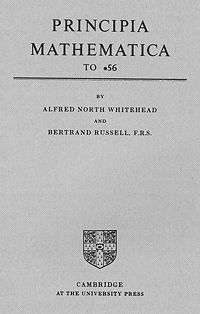
The Principia Mathematica is a three-volume work on the foundations of mathematics
Foundations of mathematics
Foundations of mathematics is a term sometimes used for certain fields of mathematics, such as mathematical logic, axiomatic set theory, proof theory, model theory, type theory and recursion theory...
, written by Alfred North Whitehead
Alfred North Whitehead
Alfred North Whitehead, OM FRS was an English mathematician who became a philosopher. He wrote on algebra, logic, foundations of mathematics, philosophy of science, physics, metaphysics, and education...
and Bertrand Russell
Bertrand Russell
Bertrand Arthur William Russell, 3rd Earl Russell, OM, FRS was a British philosopher, logician, mathematician, historian, and social critic. At various points in his life he considered himself a liberal, a socialist, and a pacifist, but he also admitted that he had never been any of these things...
and published in 1910, 1912, and 1913. In 1927, it appeared in a second edition with an important Introduction To the Second Edition, an Appendix A that replaced ✸9 and an all-new Appendix C.
PM, as it is often abbreviated, is an attempt to derive all mathematical truths from a well-defined set of axiom
Axiom
In traditional logic, an axiom or postulate is a proposition that is not proven or demonstrated but considered either to be self-evident or to define and delimit the realm of analysis. In other words, an axiom is a logical statement that is assumed to be true...
s and inference rules in symbolic logic
Mathematical logic
Mathematical logic is a subfield of mathematics with close connections to foundations of mathematics, theoretical computer science and philosophical logic. The field includes both the mathematical study of logic and the applications of formal logic to other areas of mathematics...
. One of the main inspirations and motivations for PM was Frege
Gottlob Frege
Friedrich Ludwig Gottlob Frege was a German mathematician, logician and philosopher. He is considered to be one of the founders of modern logic, and made major contributions to the foundations of mathematics. He is generally considered to be the father of analytic philosophy, for his writings on...
's earlier work on logic, which had led to paradoxes discovered by Russell. These were avoided in PM by building an elaborate system of types: a set of elements is of a different type than is each of its elements (a set is not an element; one element is not the set) and one cannot speak of the "set of all sets" and similar constructs, which would lead to paradox
Paradox
Similar to Circular reasoning, A paradox is a seemingly true statement or group of statements that lead to a contradiction or a situation which seems to defy logic or intuition...
es (see Russell's paradox
Russell's paradox
In the foundations of mathematics, Russell's paradox , discovered by Bertrand Russell in 1901, showed that the naive set theory created by Georg Cantor leads to a contradiction...
).
PM is not to be confused with Russell's 1903 Principles of Mathematics. PM states 'The present work was originally intended by us to be comprised in a second volume of Principles of Mathematics... But as we advanced, it became increasingly evident that the subject is a very much larger one than we had supposed; moreover on many fundamental questions which had been left obscure and doubtful in the former work, we have now arrived at what we believe to be satisfactory solutions.'
PM is widely considered by specialists in the subject to be one of the most important and seminal works in mathematical logic and philosophy
Philosophy
Philosophy is the study of general and fundamental problems, such as those connected with existence, knowledge, values, reason, mind, and language. Philosophy is distinguished from other ways of addressing such problems by its critical, generally systematic approach and its reliance on rational...
since Aristotle's
Aristotle
Aristotle was a Greek philosopher and polymath, a student of Plato and teacher of Alexander the Great. His writings cover many subjects, including physics, metaphysics, poetry, theater, music, logic, rhetoric, linguistics, politics, government, ethics, biology, and zoology...
Organon
Organon
The Organon is the name given by Aristotle's followers, the Peripatetics, to the standard collection of his six works on logic:* Categories* On Interpretation* Prior Analytics* Posterior Analytics...
. The Modern Library
Modern Library
The Modern Library is a publishing company. Founded in 1917 by Albert Boni and Horace Liveright as an imprint of their publishing company Boni & Liveright, it was purchased in 1925 by Bennett Cerf and Donald Klopfer...
placed it 23rd in a list of the top 100 English-language nonfiction books of the twentieth century.
Scope of foundations laid
The Principia covered only set theorySet theory
Set theory is the branch of mathematics that studies sets, which are collections of objects. Although any type of object can be collected into a set, set theory is applied most often to objects that are relevant to mathematics...
, cardinal numbers, ordinal numbers, and real numbers. Deeper theorems from real analysis
Real analysis
Real analysis, is a branch of mathematical analysis dealing with the set of real numbers and functions of a real variable. In particular, it deals with the analytic properties of real functions and sequences, including convergence and limits of sequences of real numbers, the calculus of the real...
were not included, but by the end of the third volume it was clear to experts that a large amount of known mathematics could in principle be developed in the adopted formalism. It was also clear how lengthy such a development would be.
A fourth volume on the foundations of geometry
Geometry
Geometry arose as the field of knowledge dealing with spatial relationships. Geometry was one of the two fields of pre-modern mathematics, the other being the study of numbers ....
had been planned, but the authors admitted to intellectual exhaustion upon completion of the third.
The construction of the theory of PM
As noted in the criticism of the theory by Kurt GödelKurt Gödel
Kurt Friedrich Gödel was an Austrian logician, mathematician and philosopher. Later in his life he emigrated to the United States to escape the effects of World War II. One of the most significant logicians of all time, Gödel made an immense impact upon scientific and philosophical thinking in the...
(below), unlike a Formalist
Formalism (mathematics)
In foundations of mathematics, philosophy of mathematics, and philosophy of logic, formalism is a theory that holds that statements of mathematics and logic can be thought of as statements about the consequences of certain string manipulation rules....
theory, the "logicistic" theory of PM has no "precise statement of the syntax of the formalism". Another observation is that almost immediately in the theory, interpretations (in the sense of model theory
Model theory
In mathematics, model theory is the study of mathematical structures using tools from mathematical logic....
) are presented in terms of truth-values for the behavior of the symbols "⊢" (assertion of truth), "~" (logical not), and "V" (logical inclusive OR).
Truth-values: PM embeds the notions of "truth" and "falsity" in the notion "primitive proposition". A raw (pure) Formalist
Formalism (mathematics)
In foundations of mathematics, philosophy of mathematics, and philosophy of logic, formalism is a theory that holds that statements of mathematics and logic can be thought of as statements about the consequences of certain string manipulation rules....
theory would not provide the meaning of the symbols that form a "primitive proposition"—the symbols themselves could be absolutely arbitrary and unfamiliar. The theory would specify only how the symbols behave based on the grammar of the theory. Then later, by assignment of "values", a model
Model theory
In mathematics, model theory is the study of mathematical structures using tools from mathematical logic....
would specify an interpretation of what the formulas are saying. Thus in the formal Kleene symbol set below, the "interpretation" of what the symbols commonly mean, and by implication how they end up being used, is given in parentheses, e.g., "¬ (not)". But this is not a pure Formalist theory.
The contemporary construction of a formal theory
The following formalist theory is offered as contrast to the logicistic theory of PM. A contemporary formal system would be constructed as follows:- Symbols used: This set is the starting set, and other symbols can appear but only by definition from these beginning symbols. A starting set might be the following set derived from Kleene 1952: logical symbols "→" (implies, IF-THEN, "⊃"), "&" (and), "V" (or), "¬" (not), "∀" (for all), "∃" (there exists); predicate symbol "=" (equals); function symbols "+" (arithmetic addition), "∙" (arithmetic multiplication), "'" (successor); individual symbol "0" (zero); variables "a", "b", "c", etc.; and parentheses "(" and ")".
- Symbol strings: The theory will build "strings" of these symbols by concatenationConcatenationIn computer programming, string concatenation is the operation of joining two character strings end-to-end. For example, the strings "snow" and "ball" may be concatenated to give "snowball"...
(juxtaposition). - Formation rules: The theory specifies the rules of syntax (rules of grammar) usually as a recursive definition that starts with "0" and specifies how to build acceptable strings or "well-formed formulas" (wffs). This includes a rule for "substitution". of strings for the symbols called "variables" (as opposed to the other symbol-types).
- Transformation rule(s): The axioms that specify the behaviors of the symbols and symbol sequences.
- Rule of inference, detachment, modus ponens : The rule that allows the theory to "detach" a "conclusion" from the "premises" that led up to it, and thereafter to discard the "premises" (symbols to the left of the line │, or symbols above the line if horizontal). If this were not the case, then substitution would result in longer and longer strings that have to be carried forward. Indeed, after the application of modus ponens, nothing is left but the conclusion, the rest disappears forever.
- Contemporary theories often specify as their first axiom the classical or modus ponensModus ponensIn classical logic, modus ponendo ponens or implication elimination is a valid, simple argument form. It is related to another valid form of argument, modus tollens. Both Modus Ponens and Modus Tollens can be mistakenly used when proving arguments...
or "the rule of detachment":- A, A ⊃ B │ B
- The symbol "│" is usually written as a horizontal line, here "⊃" means "implies". The symbols A and B are "stand-ins" for strings; this form of notation is called an "axiom schema" (i.e., there is an uncountable number of specific forms the notation could take). This can be read in a manner similar to IF-THEN but with a difference: given symbol string IF A and A implies B THEN B (and retain only B for further use). But observe that the symbols have no "interpretation" (e.g., no "truth table" or "truth values" or "truth functions") and modus ponens proceeds mechanistically, by grammar alone.
The logicistic construction of the theory of PM
The reader will observe both significant similarities, and similar differences, to a contemporary formal theory. Kleene states that "this deduction of mathematics from logic was offered as intuitive axiomatics. The axioms were intended to be believed, or at least to be accepted as plausible hypotheses concerning the world". Indeed, unlike a Formalist theory that manipulates symbols according to rules of grammar, PM introduces the notion of "truth-values", i.e., truth and falsity in the real-world sense, and the "assertion of truth" almost immediately as the fifth and sixth elements in the structure of the theory (PM 1962:4-36):- 1. Variables.
- 2. Uses of various letters.
- 3. The fundamental functions of propositions: "the Contradictory Function" symbolized by "~" and the "Logical Sum or Disjunctive Function" symbolized by "V" being taken as primitive and logical implication defined (the following example also used to illustrate 9. Definition below) as
-
- p ⊃ q ▪ = ▪ ~ p V q Df. (PM 1962:11)
- and logical product defined as
- p ▪ q ▪ = ▪ ~(~p V ~q) Df. (PM 1962:12)
- (See more about the confusing "dots" used as both a grammatical device and as to symbolize logical conjunction (logical AND) at the section on notation.)
- 4. Equivalence: Logical equivalence, not arithmetic equivalence: "≡" given as a demonstration of how the symbols are used, i.e., "Thus ' p ≡ q ' stands for '( p ⊃ q ) ▪ ( q ⊃ p )'." (PM 1962:7). Notice that to discuss a notation PM identifies a "meta"-notation with "[space] ... [space]":
- Logical equivalence appears again as a definition:
- p ≡ q ▪ = ▪ ( p ⊃ q ) ▪ ( q ⊃ p. ) (PM 1962:12),
- Notice the appearance of parentheses. This grammatical usage is not specified and appears sporadically; parentheses do play an important role in symbol strings, however, e.g., the notation "(x)" for the contemporary "∀x".
- 5. Truth-values: "The 'Truth-value' of a proposition is truth if it is true, and "falsehood if it is false" (this phrase is due to Frege) (PM 1962:7).
- 6. Assertion-sign: "'⊢ ▪ p may be read 'it is true that' ... thus '⊢ ︰ p ▪ ⊃ ▪ q ' means 'it is true that p implies q ', whereas '⊢ ︰ p ▪ ⊃ ⊢ ▪ q ' means ' p is true; therefore q is true'. The first of these does not necessarily involve the truth either of p or of q, while the second involves the truth of both" (PM 1962:92).
- 7. Inference: PM 's version of modus ponens. "[If] '⊢ ︰ p ' and '⊢ (p ⊃ q)' have occurred, then '⊢ ︰ q ' will occur if it is desired to put it on record. The process of the inference cannot be reduced to symbols. Its sole record is the occurrence of '⊢ ︰ p ' [in other words, the symbols on the left disappear or can be erased]" (PM 1962:9).
- 8. The Use of Dots: See the section on notation.
- 9. Definitions: These use the "=" sign with "Df" at the right end. See the section on notation.
- 10. Summary of preceding statements: brief discussion of the primitive ideas "~ p" and "p V q" and "⊢" prefixed to a proposition.
- 11. Primitive propositions: the axioms or postulates. This was significantly modified in the 2nd edition.
- 12. Propositional functions: The notion of "proposition" was significantly modified in the 2nd edition, including the introduction of "atomic" propositions linked by logical signs to form "molecular" propositions, and the use of substitution of molecular propositions into atomic or molecular propositions to create new expressions.
- 13. The range of values and total variation.
- 14. Ambiguous assertion and the real variable: This and the next two sections were modified or abandoned in the 2nd edition. In particular, the distinction between the concepts defined in sections 15. Definition and the real variable and 16 Propositions connecting real and apparent variables was abandoned in the second edition.
- 17. Formal implication and formal equivalence.
- 18. Identity: See the section on notation. The symbol "=" indicates "predicate" or arithmetic equality.
- 19. Classes and relations.
- 20. Various descriptive functions of relations.
- 21. Plural descriptive functions.
- 22. Unit classes.
Primitive ideas
Cf. PM 1962:90-94, for the first edition:- (1) Elementary propositions.
- (2) Elementary propositions of functions.
- (3) Assertion: introduces the notions of "truth" and "falsity".
- (4) Assertion of a propositional function.
- (5) Negation: "If p is any proposition, the proposition "not-p", or "p is false," will be represented by "~p" ".
- (6) Disjunction: "If p and q are any propositons, the proposition "p or q, i.e., "either p is true or q is true," where the alternatives are to be not mutually exclusive, will be represented by "p V q" ".
- (cf. section B)
Primitive propositions (Pp)
The first edition (see discusion relative to the second edition, below) begins with a definition of the sign "⊃"✸1.01. p ⊃ q ▪ = ▪ ~ p V q. Df.
✸1.1. Anything implied by a true elementary proposition is true. Pp modus ponens
(✸1.11 was abandoned in the second edition.)
✸1.2. ⊢ ︰ p V p ▪ ⊃ ▪ p. Pp principle of tautology
✸1.3. ⊢ ︰ q ▪ ⊃ ▪ p V q. Pp principle of addition
✸1.4. ⊢ ︰ p V q ▪ ⊃ ▪ q V p. Pp principle of permutation
✸1.5. ⊢ ︰ p V ( q V r ) ▪ ⊃ ▪ q V ( p V r ). Pp associative principle
✸1.6. ⊢ ︰ ▪ q ⊃ r ▪ ⊃ ︰ p V q ▪ ⊃ ▪ p V r. Pp principle of summation
✸1.7. If p is an elementary proposition, ~p is an elementary proposition. Pp
✸1.71. If p and q are elementary propositions, p V q is an elementary proposition. Pp
✸1.72. If φp and ψp are elementary propositional functions which take elementary propositions as arguments, φp V ψp is an elementary proposition. Pp
Together with the "Introduction to the Second Edition", the second edition's Appendix A abandons the entire section ✸9. This includes six primitive propositions ✸9 through ✸9.15 together with the Axioms of reducibility.
The revised theory is made difficult by the introduction of the Sheffer stroke
Sheffer stroke
In Boolean functions and propositional calculus, the Sheffer stroke, named after Henry M. Sheffer, written "|" , "Dpq", or "↑", denotes a logical operation that is equivalent to the negation of the conjunction operation, expressed in ordinary language as "not both"...
("|") to symbolize "incompatibility" (i.e., if both elementary propositions p and q are true, their "stroke" p | q is false), the contemporary logical NAND
Nand
NAND may stand for:*Nand , an Indian classical raga.*Logical NAND , a binary operation in logic.**NAND gate, an electronic gate that implements a logical NAND....
(not-AND). In the revised theory, the Introduction presents the notion of "atomic proposition", a "datum" that "belongs to the philosophical part of logic". These have no parts that are propositions and do not contain the notions "all" or "some". For example: "this is red", or "this is earlier than that". Such things can exist ad finitum, i.e., even an "infinite eunumeration" of them to replace "generality" (i.e., the notion of "for all"). PM then "advance[s] to molecular propositions" that are all linked by "the stroke". Definitions give equivalences for "~", "V", "⊃", and "▪".
The new introduction defines "elementary propositions" as atomic and molecular positions together. It then replaces all the primitive propositions ✸1.2 to ✸1.72 with a single primitive proposition framed in terms of the stroke:
- "If p, q, r are elementary propositions, given p and p|(q|r), we can infer r. This is a primitive proposition."
The new introduction keeps the notation for "there exists" (now recast as "sometimes true") and "for all" (recast as "always true"). Appendix A strengths the notion of "matrix" or "predicative function" (a "primitive idea", PM 1962:164) and presents four new Primitive propositions as ✸8.1–✸8.13.
✸88. Multiplicative axiom
✸102. Axiom of infinity
Notation used in PM
One author observes that "The notation in that work has been superseded by the subsequent development of logic during the 20th century, to the extent that the beginner has trouble reading PM at all"; while much of the symbolic content can be converted to modern notation, the original notation itself is "a subject of scholarly dispute", and some notation "embod[y] substantive logical doctrines so that it cannot simply be replaced by contemporary symbolism".Kurt Gödel
Kurt Gödel
Kurt Friedrich Gödel was an Austrian logician, mathematician and philosopher. Later in his life he emigrated to the United States to escape the effects of World War II. One of the most significant logicians of all time, Gödel made an immense impact upon scientific and philosophical thinking in the...
was harshly critical of the notation:
- "It is to be regretted that this first comprehensive and thorough-going presentation of a mathematical logic and the derivation of mathematics from it [is] so greatly lacking in formal precision in the foundations (contained in ✸1–✸21 of Principia [i.e., sections ✸1–✸5 (propositional logic), ✸8–14 (predicate logic with identity/equality), ✸20(introduction to set theory), and ✸21 (introduction to relations theory)]) that it represents in this respect a considerable step backwards as compared with Frege. What is missing, above all, is a precise statement of the syntax of the formalism. Syntactical considerations are omitted even in cases where they are necessary for the cogency of the proofs".
This is reflected in the example below of the symbols "p", "q", "r" and "⊃" that can be formed into the string "p ⊃ q ⊃ r". PM requires a definition of what this symbol-string means in terms of other symbols; in contemporary treatments the "formation rules" (syntactical rules leading to "well formed formulas") would have prevented the formation of this string.
Source of the notation: Chapter I "Preliminary Explanations of Ideas and Notations" begins with the source of the notation:
- "The notation adopted in the present work is based upon that of Peano, and the following explanations are to some extent modelled on those which he prefixes to his Formulario Mathematico [i.e., Peano 1889]. His use of dots as brackets is adopted, and so are many of his symbols" (PM 1927:4).
PM adopts the assertion sign "⊦" from Frege's 1879 Begriffsschrift:
- "(I)t may be read 'it is true that'"
Thus to assert a proposition p PM writes:
- "⊦▪ p." (PM 1927:92)
(Observe that, as in the original, the left dot is square and of greater size than the period on the right.)
An introduction to the notation of "Section A Mathematical Logic" (formulas ✸1–✸5.71)
PM 's dots are used in a manner similar to parentheses. Later in section ✸14, brackets "[ ]" appear, and in sections ✸20 and following, braces "{ }" appear. Whether these symbols have specific meanings or are just for visual clarification is unclear. More than one dot indicates the "depth" of the parentheses, e.g., "︰" , "︰▪" or "▪︰" , "︰︰", etc. Unfortunately for contemporary readers, the single dot (but also "︰", "︰▪", "︰︰", etc.) is used to symbolize "logical product" (contemporary logical AND often symbolized by "&" or "∧").
Logical implication is represented by Peano's "Ɔ" simplified to "⊃", logical negation is symbolized by an elongated tilde, i.e., "~" (contemporary "~" or "¬"), the logical OR by "⋁". The symbol "=" together with "Df" is used to indicate "is defined as", whereas in sections ✸13 and following, "=" is defined as (mathematically) "identical with", i.e., contemporary mathematical "equality" (cf. discussion in section ✸13). Logical equivalence is represented by "≡" (contemporary "if and only if"); "elementary" propositional functions are written in the customary way, e.g., "f(p)", but later the function sign appears directly before the variable without parenthesis e.g., "φx", "χx", etc.
Example, PM introduces the definition of "logical product" as follows:
- ✸3.01. p ▪ q ▪ = ▪ ~(~p ⋁ ~q) Df.
- where "p ▪ q" is the logical product of p and q.
- ✸3.02. p ⊃ q ⊃ r ▪ = ▪ p ⊃ q ▪ q ⊃ r Df.
- This definition serves merely to abbreviate proofs.
Translation of the formulas into contemporary symbols: Various authors use alternate symbols, so no definitive translation can be given. However, because of criticisms such as that of Kurt Gödel
Kurt Gödel
Kurt Friedrich Gödel was an Austrian logician, mathematician and philosopher. Later in his life he emigrated to the United States to escape the effects of World War II. One of the most significant logicians of all time, Gödel made an immense impact upon scientific and philosophical thinking in the...
below, the best contemporary treatments will be very precise with respect to the "formation rules" (the syntax) of the formulas.
The first formula might be converted into modern symbolism as follows:
- (p & q) =df (~(~p v ~q))
alternately
- (p & q) =df (¬(¬p v ¬q))
alternately
- (p ∧ q) =df (¬(¬p ⋁ ¬q))
etc.
The second formula might be converted as follows:
- (p → q → r) =df (p → q) & (q → r)
But note that this is not (logically) equivalent to (p → (q → r)) nor to ((p → q) → r), and these two are not logically equivalent either. The fact that such an ambiguous formula as p ⊃ q ⊃ r might appear as a result of the application of the formalism of PM reflects the harsh criticism of Kurt Gödel
Kurt Gödel
Kurt Friedrich Gödel was an Austrian logician, mathematician and philosopher. Later in his life he emigrated to the United States to escape the effects of World War II. One of the most significant logicians of all time, Gödel made an immense impact upon scientific and philosophical thinking in the...
.
An introduction to the notation of "Section B Theory of Apparent Variables" (formulas ✸8–✸14.34)
These sections concern what is now known as Predicate logicPredicate logic
In mathematical logic, predicate logic is the generic term for symbolic formal systems like first-order logic, second-order logic, many-sorted logic or infinitary logic. This formal system is distinguished from other systems in that its formulae contain variables which can be quantified...
, and Predicate logic
Predicate logic
In mathematical logic, predicate logic is the generic term for symbolic formal systems like first-order logic, second-order logic, many-sorted logic or infinitary logic. This formal system is distinguished from other systems in that its formulae contain variables which can be quantified...
with identity (equality).
- NB: As a result of criticism and advances, the second edition of PM (1927) replaces ✸9 with a new ✸8 (Appendix A). This new section eliminates the first edition's distinction between real and apparent variables, and it eliminates "the primitive idea 'assertion of a propositional function'. To add to the complexity of the treatment, ✸8 introduces the notion of substituting a "matrix", and the Sheffer strokeSheffer strokeIn Boolean functions and propositional calculus, the Sheffer stroke, named after Henry M. Sheffer, written "|" , "Dpq", or "↑", denotes a logical operation that is equivalent to the negation of the conjunction operation, expressed in ordinary language as "not both"...
:
-
-
-
- Matrix: In contemporary usage, PM 's matrix is (at least for propositional functionPropositional functionA propositional function in logic, is a statement expressed in a way that would assume the value of true or false, except that within the statement is a variable that is not defined or specified, which leaves the statement undetermined...
s), a truth tableTruth tableA truth table is a mathematical table used in logic—specifically in connection with Boolean algebra, boolean functions, and propositional calculus—to compute the functional values of logical expressions on each of their functional arguments, that is, on each combination of values taken by their...
, i.e., all truth-values of a propositional or predicate function. - Sheffer stroke: Is the contemporary logical NANDNandNAND may stand for:*Nand , an Indian classical raga.*Logical NAND , a binary operation in logic.**NAND gate, an electronic gate that implements a logical NAND....
(NOT-AND), i.e., "incompatibility", meaning:
- "Given two propositions p and q, then ' p | q ' means "proposition p is incompatible with proposition q, i.e., if both propositions p and q evaluate as false, then p | q evaluates as true." After section ✸8 the Sheffer stroke sees no usage.
- Matrix: In contemporary usage, PM 's matrix is (at least for propositional function
-
-
The Principia Mathematica is a three-volume work on the foundations of mathematics
Foundations of mathematics
Foundations of mathematics is a term sometimes used for certain fields of mathematics, such as mathematical logic, axiomatic set theory, proof theory, model theory, type theory and recursion theory...
, written by Alfred North Whitehead
Alfred North Whitehead
Alfred North Whitehead, OM FRS was an English mathematician who became a philosopher. He wrote on algebra, logic, foundations of mathematics, philosophy of science, physics, metaphysics, and education...
and Bertrand Russell
Bertrand Russell
Bertrand Arthur William Russell, 3rd Earl Russell, OM, FRS was a British philosopher, logician, mathematician, historian, and social critic. At various points in his life he considered himself a liberal, a socialist, and a pacifist, but he also admitted that he had never been any of these things...
and published in 1910, 1912, and 1913. In 1927, it appeared in a second edition with an important Introduction To the Second Edition, an Appendix A that replaced ✸9 and an all-new Appendix C.
PM, as it is often abbreviated, is an attempt to derive all mathematical truths from a well-defined set of axiom
Axiom
In traditional logic, an axiom or postulate is a proposition that is not proven or demonstrated but considered either to be self-evident or to define and delimit the realm of analysis. In other words, an axiom is a logical statement that is assumed to be true...
s and inference rules in symbolic logic
Mathematical logic
Mathematical logic is a subfield of mathematics with close connections to foundations of mathematics, theoretical computer science and philosophical logic. The field includes both the mathematical study of logic and the applications of formal logic to other areas of mathematics...
. One of the main inspirations and motivations for PM was Frege
Gottlob Frege
Friedrich Ludwig Gottlob Frege was a German mathematician, logician and philosopher. He is considered to be one of the founders of modern logic, and made major contributions to the foundations of mathematics. He is generally considered to be the father of analytic philosophy, for his writings on...
's earlier work on logic, which had led to paradoxes discovered by Russell. These were avoided in PM by building an elaborate system of types: a set of elements is of a different type than is each of its elements (a set is not an element; one element is not the set) and one cannot speak of the "set of all sets" and similar constructs, which would lead to paradox
Paradox
Similar to Circular reasoning, A paradox is a seemingly true statement or group of statements that lead to a contradiction or a situation which seems to defy logic or intuition...
es (see Russell's paradox
Russell's paradox
In the foundations of mathematics, Russell's paradox , discovered by Bertrand Russell in 1901, showed that the naive set theory created by Georg Cantor leads to a contradiction...
).
PM is not to be confused with Russell's 1903 Principles of Mathematics. PM states 'The present work was originally intended by us to be comprised in a second volume of Principles of Mathematics... But as we advanced, it became increasingly evident that the subject is a very much larger one than we had supposed; moreover on many fundamental questions which had been left obscure and doubtful in the former work, we have now arrived at what we believe to be satisfactory solutions.'
PM is widely considered by specialists in the subject to be one of the most important and seminal works in mathematical logic and philosophy
Philosophy
Philosophy is the study of general and fundamental problems, such as those connected with existence, knowledge, values, reason, mind, and language. Philosophy is distinguished from other ways of addressing such problems by its critical, generally systematic approach and its reliance on rational...
since Aristotle's
Aristotle
Aristotle was a Greek philosopher and polymath, a student of Plato and teacher of Alexander the Great. His writings cover many subjects, including physics, metaphysics, poetry, theater, music, logic, rhetoric, linguistics, politics, government, ethics, biology, and zoology...
Organon
Organon
The Organon is the name given by Aristotle's followers, the Peripatetics, to the standard collection of his six works on logic:* Categories* On Interpretation* Prior Analytics* Posterior Analytics...
. The Modern Library
Modern Library
The Modern Library is a publishing company. Founded in 1917 by Albert Boni and Horace Liveright as an imprint of their publishing company Boni & Liveright, it was purchased in 1925 by Bennett Cerf and Donald Klopfer...
placed it 23rd in a list of the top 100 English-language nonfiction books of the twentieth century.
Scope of foundations laid
The Principia covered only set theorySet theory
Set theory is the branch of mathematics that studies sets, which are collections of objects. Although any type of object can be collected into a set, set theory is applied most often to objects that are relevant to mathematics...
, cardinal numbers, ordinal numbers, and real numbers. Deeper theorems from real analysis
Real analysis
Real analysis, is a branch of mathematical analysis dealing with the set of real numbers and functions of a real variable. In particular, it deals with the analytic properties of real functions and sequences, including convergence and limits of sequences of real numbers, the calculus of the real...
were not included, but by the end of the third volume it was clear to experts that a large amount of known mathematics could in principle be developed in the adopted formalism. It was also clear how lengthy such a development would be.
A fourth volume on the foundations of geometry
Geometry
Geometry arose as the field of knowledge dealing with spatial relationships. Geometry was one of the two fields of pre-modern mathematics, the other being the study of numbers ....
had been planned, but the authors admitted to intellectual exhaustion upon completion of the third.
The construction of the theory of PM
As noted in the criticism of the theory by Kurt Gödel
Kurt Gödel
Kurt Friedrich Gödel was an Austrian logician, mathematician and philosopher. Later in his life he emigrated to the United States to escape the effects of World War II. One of the most significant logicians of all time, Gödel made an immense impact upon scientific and philosophical thinking in the...
(below), unlike a Formalist
Formalism (mathematics)
In foundations of mathematics, philosophy of mathematics, and philosophy of logic, formalism is a theory that holds that statements of mathematics and logic can be thought of as statements about the consequences of certain string manipulation rules....
theory, the "logicistic" theory of PM has no "precise statement of the syntax of the formalism". Another observation is that almost immediately in the theory, interpretations (in the sense of model theory
Model theory
In mathematics, model theory is the study of mathematical structures using tools from mathematical logic....
) are presented in terms of truth-values for the behavior of the symbols "⊢" (assertion of truth), "~" (logical not), and "V" (logical inclusive OR).
Truth-values: PM embeds the notions of "truth" and "falsity" in the notion "primitive proposition". A raw (pure) Formalist
Formalism (mathematics)
In foundations of mathematics, philosophy of mathematics, and philosophy of logic, formalism is a theory that holds that statements of mathematics and logic can be thought of as statements about the consequences of certain string manipulation rules....
theory would not provide the meaning of the symbols that form a "primitive proposition"—the symbols themselves could be absolutely arbitrary and unfamiliar. The theory would specify only how the symbols behave based on the grammar of the theory. Then later, by assignment of "values", a model
Model theory
In mathematics, model theory is the study of mathematical structures using tools from mathematical logic....
would specify an interpretation of what the formulas are saying. Thus in the formal Kleene symbol set below, the "interpretation" of what the symbols commonly mean, and by implication how they end up being used, is given in parentheses, e.g., "¬ (not)". But this is not a pure Formalist theory.
The contemporary construction of a formal theory
The following formalist theory is offered as contrast to the logicistic theory of PM. A contemporary formal system would be constructed as follows:- Symbols used: This set is the starting set, and other symbols can appear but only by definition from these beginning symbols. A starting set might be the following set derived from Kleene 1952: logical symbols "→" (implies, IF-THEN, "⊃"), "&" (and), "V" (or), "¬" (not), "∀" (for all), "∃" (there exists); predicate symbol "=" (equals); function symbols "+" (arithmetic addition), "∙" (arithmetic multiplication), "'" (successor); individual symbol "0" (zero); variables "a", "b", "c", etc.; and parentheses "(" and ")".
- Symbol strings: The theory will build "strings" of these symbols by concatenationConcatenationIn computer programming, string concatenation is the operation of joining two character strings end-to-end. For example, the strings "snow" and "ball" may be concatenated to give "snowball"...
(juxtaposition). - Formation rules: The theory specifies the rules of syntax (rules of grammar) usually as a recursive definition that starts with "0" and specifies how to build acceptable strings or "well-formed formulas" (wffs). This includes a rule for "substitution". of strings for the symbols called "variables" (as opposed to the other symbol-types).
- Transformation rule(s): The axioms that specify the behaviors of the symbols and symbol sequences.
- Rule of inference, detachment, modus ponens : The rule that allows the theory to "detach" a "conclusion" from the "premises" that led up to it, and thereafter to discard the "premises" (symbols to the left of the line │, or symbols above the line if horizontal). If this were not the case, then substitution would result in longer and longer strings that have to be carried forward. Indeed, after the application of modus ponens, nothing is left but the conclusion, the rest disappears forever.
- Contemporary theories often specify as their first axiom the classical or modus ponensModus ponensIn classical logic, modus ponendo ponens or implication elimination is a valid, simple argument form. It is related to another valid form of argument, modus tollens. Both Modus Ponens and Modus Tollens can be mistakenly used when proving arguments...
or "the rule of detachment":- A, A ⊃ B │ B
- The symbol "│" is usually written as a horizontal line, here "⊃" means "implies". The symbols A and B are "stand-ins" for strings; this form of notation is called an "axiom schema" (i.e., there is an uncountable number of specific forms the notation could take). This can be read in a manner similar to IF-THEN but with a difference: given symbol string IF A and A implies B THEN B (and retain only B for further use). But observe that the symbols have no "interpretation" (e.g., no "truth table" or "truth values" or "truth functions") and modus ponens proceeds mechanistically, by grammar alone.
The logicistic construction of the theory of PM
The reader will observe both significant similarities, and similar differences, to a contemporary formal theory. Kleene states that "this deduction of mathematics from logic was offered as intuitive axiomatics. The axioms were intended to be believed, or at least to be accepted as plausible hypotheses concerning the world". Indeed, unlike a Formalist theory that manipulates symbols according to rules of grammar, PM introduces the notion of "truth-values", i.e., truth and falsity in the real-world sense, and the "assertion of truth" almost immediately as the fifth and sixth elements in the structure of the theory (PM 1962:4-36):- 1. Variables.
- 2. Uses of various letters.
- 3. The fundamental functions of propositions: "the Contradictory Function" symbolized by "~" and the "Logical Sum or Disjunctive Function" symbolized by "V" being taken as primitive and logical implication defined (the following example also used to illustrate 9. Definition below) as
-
- p ⊃ q ▪ = ▪ ~ p V q Df. (PM 1962:11)
- and logical product defined as
- p ▪ q ▪ = ▪ ~(~p V ~q) Df. (PM 1962:12)
- (See more about the confusing "dots" used as both a grammatical device and as to symbolize logical conjunction (logical AND) at the section on notation.)
- 4. Equivalence: Logical equivalence, not arithmetic equivalence: "≡" given as a demonstration of how the symbols are used, i.e., "Thus ' p ≡ q ' stands for '( p ⊃ q ) ▪ ( q ⊃ p )'." (PM 1962:7). Notice that to discuss a notation PM identifies a "meta"-notation with "[space] ... [space]":
- Logical equivalence appears again as a definition:
- p ≡ q ▪ = ▪ ( p ⊃ q ) ▪ ( q ⊃ p. ) (PM 1962:12),
- Notice the appearance of parentheses. This grammatical usage is not specified and appears sporadically; parentheses do play an important role in symbol strings, however, e.g., the notation "(x)" for the contemporary "∀x".
- 5. Truth-values: "The 'Truth-value' of a proposition is truth if it is true, and "falsehood if it is false" (this phrase is due to Frege) (PM 1962:7).
- 6. Assertion-sign: "'⊢ ▪ p may be read 'it is true that' ... thus '⊢ ︰ p ▪ ⊃ ▪ q ' means 'it is true that p implies q ', whereas '⊢ ︰ p ▪ ⊃ ⊢ ▪ q ' means ' p is true; therefore q is true'. The first of these does not necessarily involve the truth either of p or of q, while the second involves the truth of both" (PM 1962:92).
- 7. Inference: PM 's version of modus ponens. "[If] '⊢ ︰ p ' and '⊢ (p ⊃ q)' have occurred, then '⊢ ︰ q ' will occur if it is desired to put it on record. The process of the inference cannot be reduced to symbols. Its sole record is the occurrence of '⊢ ︰ p ' [in other words, the symbols on the left disappear or can be erased]" (PM 1962:9).
- 8. The Use of Dots: See the section on notation.
- 9. Definitions: These use the "=" sign with "Df" at the right end. See the section on notation.
- 10. Summary of preceding statements: brief discussion of the primitive ideas "~ p" and "p V q" and "⊢" prefixed to a proposition.
- 11. Primitive propositions: the axioms or postulates. This was significantly modified in the 2nd edition.
- 12. Propositional functions: The notion of "proposition" was significantly modified in the 2nd edition, including the introduction of "atomic" propositions linked by logical signs to form "molecular" propositions, and the use of substitution of molecular propositions into atomic or molecular propositions to create new expressions.
- 13. The range of values and total variation.
- 14. Ambiguous assertion and the real variable: This and the next two sections were modified or abandoned in the 2nd edition. In particular, the distinction between the concepts defined in sections 15. Definition and the real variable and 16 Propositions connecting real and apparent variables was abandoned in the second edition.
- 17. Formal implication and formal equivalence.
- 18. Identity: See the section on notation. The symbol "=" indicates "predicate" or arithmetic equality.
- 19. Classes and relations.
- 20. Various descriptive functions of relations.
- 21. Plural descriptive functions.
- 22. Unit classes.
Primitive ideas
Cf. PM 1962:90-94, for the first edition:- (1) Elementary propositions.
- (2) Elementary propositions of functions.
- (3) Assertion: introduces the notions of "truth" and "falsity".
- (4) Assertion of a propositional function.
- (5) Negation: "If p is any proposition, the proposition "not-p", or "p is false," will be represented by "~p" ".
- (6) Disjunction: "If p and q are any propositons, the proposition "p or q, i.e., "either p is true or q is true," where the alternatives are to be not mutually exclusive, will be represented by "p V q" ".
- (cf. section B)
Primitive propositions (Pp)
The first edition (see discusion relative to the second edition, below) begins with a definition of the sign "⊃"✸1.01. p ⊃ q ▪ = ▪ ~ p V q. Df.
✸1.1. Anything implied by a true elementary proposition is true. Pp modus ponens
(✸1.11 was abandoned in the second edition.)
✸1.2. ⊢ ︰ p V p ▪ ⊃ ▪ p. Pp principle of tautology
✸1.3. ⊢ ︰ q ▪ ⊃ ▪ p V q. Pp principle of addition
✸1.4. ⊢ ︰ p V q ▪ ⊃ ▪ q V p. Pp principle of permutation
✸1.5. ⊢ ︰ p V ( q V r ) ▪ ⊃ ▪ q V ( p V r ). Pp associative principle
✸1.6. ⊢ ︰ ▪ q ⊃ r ▪ ⊃ ︰ p V q ▪ ⊃ ▪ p V r. Pp principle of summation
✸1.7. If p is an elementary proposition, ~p is an elementary proposition. Pp
✸1.71. If p and q are elementary propositions, p V q is an elementary proposition. Pp
✸1.72. If φp and ψp are elementary propositional functions which take elementary propositions as arguments, φp V ψp is an elementary proposition. Pp
Together with the "Introduction to the Second Edition", the second edition's Appendix A abandons the entire section ✸9. This includes six primitive propositions ✸9 through ✸9.15 together with the Axioms of reducibility.
The revised theory is made difficult by the introduction of the Sheffer stroke
Sheffer stroke
In Boolean functions and propositional calculus, the Sheffer stroke, named after Henry M. Sheffer, written "|" , "Dpq", or "↑", denotes a logical operation that is equivalent to the negation of the conjunction operation, expressed in ordinary language as "not both"...
("|") to symbolize "incompatibility" (i.e., if both elementary propositions p and q are true, their "stroke" p | q is false), the contemporary logical NAND
Nand
NAND may stand for:*Nand , an Indian classical raga.*Logical NAND , a binary operation in logic.**NAND gate, an electronic gate that implements a logical NAND....
(not-AND). In the revised theory, the Introduction presents the notion of "atomic proposition", a "datum" that "belongs to the philosophical part of logic". These have no parts that are propositions and do not contain the notions "all" or "some". For example: "this is red", or "this is earlier than that". Such things can exist ad finitum, i.e., even an "infinite eunumeration" of them to replace "generality" (i.e., the notion of "for all"). PM then "advance[s] to molecular propositions" that are all linked by "the stroke". Definitions give equivalences for "~", "V", "⊃", and "▪".
The new introduction defines "elementary propositions" as atomic and molecular positions together. It then replaces all the primitive propositions ✸1.2 to ✸1.72 with a single primitive proposition framed in terms of the stroke:
- "If p, q, r are elementary propositions, given p and p|(q|r), we can infer r. This is a primitive proposition."
The new introduction keeps the notation for "there exists" (now recast as "sometimes true") and "for all" (recast as "always true"). Appendix A strengths the notion of "matrix" or "predicative function" (a "primitive idea", PM 1962:164) and presents four new Primitive propositions as ✸8.1–✸8.13.
✸88. Multiplicative axiom
✸102. Axiom of infinity
Notation used in PM
One author observes that "The notation in that work has been superseded by the subsequent development of logic during the 20th century, to the extent that the beginner has trouble reading PM at all"; while much of the symbolic content can be converted to modern notation, the original notation itself is "a subject of scholarly dispute", and some notation "embod[y] substantive logical doctrines so that it cannot simply be replaced by contemporary symbolism".Kurt Gödel
Kurt Gödel
Kurt Friedrich Gödel was an Austrian logician, mathematician and philosopher. Later in his life he emigrated to the United States to escape the effects of World War II. One of the most significant logicians of all time, Gödel made an immense impact upon scientific and philosophical thinking in the...
was harshly critical of the notation:
- "It is to be regretted that this first comprehensive and thorough-going presentation of a mathematical logic and the derivation of mathematics from it [is] so greatly lacking in formal precision in the foundations (contained in ✸1–✸21 of Principia [i.e., sections ✸1–✸5 (propositional logic), ✸8–14 (predicate logic with identity/equality), ✸20(introduction to set theory), and ✸21 (introduction to relations theory)]) that it represents in this respect a considerable step backwards as compared with Frege. What is missing, above all, is a precise statement of the syntax of the formalism. Syntactical considerations are omitted even in cases where they are necessary for the cogency of the proofs".
This is reflected in the example below of the symbols "p", "q", "r" and "⊃" that can be formed into the string "p ⊃ q ⊃ r". PM requires a definition of what this symbol-string means in terms of other symbols; in contemporary treatments the "formation rules" (syntactical rules leading to "well formed formulas") would have prevented the formation of this string.
Source of the notation: Chapter I "Preliminary Explanations of Ideas and Notations" begins with the source of the notation:
- "The notation adopted in the present work is based upon that of Peano, and the following explanations are to some extent modelled on those which he prefixes to his Formulario Mathematico [i.e., Peano 1889]. His use of dots as brackets is adopted, and so are many of his symbols" (PM 1927:4).
PM adopts the assertion sign "⊦" from Frege's 1879 Begriffsschrift:
- "(I)t may be read 'it is true that'"
Thus to assert a proposition p PM writes:
- "⊦▪ p." (PM 1927:92)
(Observe that, as in the original, the left dot is square and of greater size than the period on the right.)
An introduction to the notation of "Section A Mathematical Logic" (formulas ✸1–✸5.71)
PM 's dots are used in a manner similar to parentheses. Later in section ✸14, brackets "[ ]" appear, and in sections ✸20 and following, braces "{ }" appear. Whether these symbols have specific meanings or are just for visual clarification is unclear. More than one dot indicates the "depth" of the parentheses, e.g., "︰" , "︰▪" or "▪︰" , "︰︰", etc. Unfortunately for contemporary readers, the single dot (but also "︰", "︰▪", "︰︰", etc.) is used to symbolize "logical product" (contemporary logical AND often symbolized by "&" or "∧").
Logical implication is represented by Peano's "Ɔ" simplified to "⊃", logical negation is symbolized by an elongated tilde, i.e., "~" (contemporary "~" or "¬"), the logical OR by "⋁". The symbol "=" together with "Df" is used to indicate "is defined as", whereas in sections ✸13 and following, "=" is defined as (mathematically) "identical with", i.e., contemporary mathematical "equality" (cf. discussion in section ✸13). Logical equivalence is represented by "≡" (contemporary "if and only if"); "elementary" propositional functions are written in the customary way, e.g., "f(p)", but later the function sign appears directly before the variable without parenthesis e.g., "φx", "χx", etc.
Example, PM introduces the definition of "logical product" as follows:
- ✸3.01. p ▪ q ▪ = ▪ ~(~p ⋁ ~q) Df.
- where "p ▪ q" is the logical product of p and q.
- ✸3.02. p ⊃ q ⊃ r ▪ = ▪ p ⊃ q ▪ q ⊃ r Df.
- This definition serves merely to abbreviate proofs.
Translation of the formulas into contemporary symbols: Various authors use alternate symbols, so no definitive translation can be given. However, because of criticisms such as that of Kurt Gödel
Kurt Gödel
Kurt Friedrich Gödel was an Austrian logician, mathematician and philosopher. Later in his life he emigrated to the United States to escape the effects of World War II. One of the most significant logicians of all time, Gödel made an immense impact upon scientific and philosophical thinking in the...
below, the best contemporary treatments will be very precise with respect to the "formation rules" (the syntax) of the formulas.
The first formula might be converted into modern symbolism as follows:
- (p & q) =df (~(~p v ~q))
alternately
- (p & q) =df (¬(¬p v ¬q))
alternately
- (p ∧ q) =df (¬(¬p ⋁ ¬q))
etc.
The second formula might be converted as follows:
- (p → q → r) =df (p → q) & (q → r)
But note that this is not (logically) equivalent to (p → (q → r)) nor to ((p → q) → r), and these two are not logically equivalent either. The fact that such an ambiguous formula as p ⊃ q ⊃ r might appear as a result of the application of the formalism of PM reflects the harsh criticism of Kurt Gödel
Kurt Gödel
Kurt Friedrich Gödel was an Austrian logician, mathematician and philosopher. Later in his life he emigrated to the United States to escape the effects of World War II. One of the most significant logicians of all time, Gödel made an immense impact upon scientific and philosophical thinking in the...
.
An introduction to the notation of "Section B Theory of Apparent Variables" (formulas ✸8–✸14.34)
These sections concern what is now known as Predicate logicPredicate logic
In mathematical logic, predicate logic is the generic term for symbolic formal systems like first-order logic, second-order logic, many-sorted logic or infinitary logic. This formal system is distinguished from other systems in that its formulae contain variables which can be quantified...
, and Predicate logic
Predicate logic
In mathematical logic, predicate logic is the generic term for symbolic formal systems like first-order logic, second-order logic, many-sorted logic or infinitary logic. This formal system is distinguished from other systems in that its formulae contain variables which can be quantified...
with identity (equality).
- NB: As a result of criticism and advances, the second edition of PM (1927) replaces ✸9 with a new ✸8 (Appendix A). This new section eliminates the first edition's distinction between real and apparent variables, and it eliminates "the primitive idea 'assertion of a propositional function'. To add to the complexity of the treatment, ✸8 introduces the notion of substituting a "matrix", and the Sheffer strokeSheffer strokeIn Boolean functions and propositional calculus, the Sheffer stroke, named after Henry M. Sheffer, written "|" , "Dpq", or "↑", denotes a logical operation that is equivalent to the negation of the conjunction operation, expressed in ordinary language as "not both"...
:
-
-
-
- Matrix: In contemporary usage, PM 's matrix is (at least for propositional functionPropositional functionA propositional function in logic, is a statement expressed in a way that would assume the value of true or false, except that within the statement is a variable that is not defined or specified, which leaves the statement undetermined...
s), a truth tableTruth tableA truth table is a mathematical table used in logic—specifically in connection with Boolean algebra, boolean functions, and propositional calculus—to compute the functional values of logical expressions on each of their functional arguments, that is, on each combination of values taken by their...
, i.e., all truth-values of a propositional or predicate function. - Sheffer stroke: Is the contemporary logical NANDNandNAND may stand for:*Nand , an Indian classical raga.*Logical NAND , a binary operation in logic.**NAND gate, an electronic gate that implements a logical NAND....
(NOT-AND), i.e., "incompatibility", meaning:
- "Given two propositions p and q, then ' p | q ' means "proposition p is incompatible with proposition q, i.e., if both propositions p and q evaluate as false, then p | q evaluates as true." After section ✸8 the Sheffer stroke sees no usage.
- Matrix: In contemporary usage, PM 's matrix is (at least for propositional function
-
-
The Principia Mathematica is a three-volume work on the foundations of mathematics
Foundations of mathematics
Foundations of mathematics is a term sometimes used for certain fields of mathematics, such as mathematical logic, axiomatic set theory, proof theory, model theory, type theory and recursion theory...
, written by Alfred North Whitehead
Alfred North Whitehead
Alfred North Whitehead, OM FRS was an English mathematician who became a philosopher. He wrote on algebra, logic, foundations of mathematics, philosophy of science, physics, metaphysics, and education...
and Bertrand Russell
Bertrand Russell
Bertrand Arthur William Russell, 3rd Earl Russell, OM, FRS was a British philosopher, logician, mathematician, historian, and social critic. At various points in his life he considered himself a liberal, a socialist, and a pacifist, but he also admitted that he had never been any of these things...
and published in 1910, 1912, and 1913. In 1927, it appeared in a second edition with an important Introduction To the Second Edition, an Appendix A that replaced ✸9 and an all-new Appendix C.
PM, as it is often abbreviated, is an attempt to derive all mathematical truths from a well-defined set of axiom
Axiom
In traditional logic, an axiom or postulate is a proposition that is not proven or demonstrated but considered either to be self-evident or to define and delimit the realm of analysis. In other words, an axiom is a logical statement that is assumed to be true...
s and inference rules in symbolic logic
Mathematical logic
Mathematical logic is a subfield of mathematics with close connections to foundations of mathematics, theoretical computer science and philosophical logic. The field includes both the mathematical study of logic and the applications of formal logic to other areas of mathematics...
. One of the main inspirations and motivations for PM was Frege
Gottlob Frege
Friedrich Ludwig Gottlob Frege was a German mathematician, logician and philosopher. He is considered to be one of the founders of modern logic, and made major contributions to the foundations of mathematics. He is generally considered to be the father of analytic philosophy, for his writings on...
's earlier work on logic, which had led to paradoxes discovered by Russell. These were avoided in PM by building an elaborate system of types: a set of elements is of a different type than is each of its elements (a set is not an element; one element is not the set) and one cannot speak of the "set of all sets" and similar constructs, which would lead to paradox
Paradox
Similar to Circular reasoning, A paradox is a seemingly true statement or group of statements that lead to a contradiction or a situation which seems to defy logic or intuition...
es (see Russell's paradox
Russell's paradox
In the foundations of mathematics, Russell's paradox , discovered by Bertrand Russell in 1901, showed that the naive set theory created by Georg Cantor leads to a contradiction...
).
PM is not to be confused with Russell's 1903 Principles of Mathematics. PM states 'The present work was originally intended by us to be comprised in a second volume of Principles of Mathematics... But as we advanced, it became increasingly evident that the subject is a very much larger one than we had supposed; moreover on many fundamental questions which had been left obscure and doubtful in the former work, we have now arrived at what we believe to be satisfactory solutions.'
PM is widely considered by specialists in the subject to be one of the most important and seminal works in mathematical logic and philosophy
Philosophy
Philosophy is the study of general and fundamental problems, such as those connected with existence, knowledge, values, reason, mind, and language. Philosophy is distinguished from other ways of addressing such problems by its critical, generally systematic approach and its reliance on rational...
since Aristotle's
Aristotle
Aristotle was a Greek philosopher and polymath, a student of Plato and teacher of Alexander the Great. His writings cover many subjects, including physics, metaphysics, poetry, theater, music, logic, rhetoric, linguistics, politics, government, ethics, biology, and zoology...
Organon
Organon
The Organon is the name given by Aristotle's followers, the Peripatetics, to the standard collection of his six works on logic:* Categories* On Interpretation* Prior Analytics* Posterior Analytics...
. The Modern Library
Modern Library
The Modern Library is a publishing company. Founded in 1917 by Albert Boni and Horace Liveright as an imprint of their publishing company Boni & Liveright, it was purchased in 1925 by Bennett Cerf and Donald Klopfer...
placed it 23rd in a list of the top 100 English-language nonfiction books of the twentieth century.
Scope of foundations laid
The Principia covered only set theorySet theory
Set theory is the branch of mathematics that studies sets, which are collections of objects. Although any type of object can be collected into a set, set theory is applied most often to objects that are relevant to mathematics...
, cardinal numbers, ordinal numbers, and real numbers. Deeper theorems from real analysis
Real analysis
Real analysis, is a branch of mathematical analysis dealing with the set of real numbers and functions of a real variable. In particular, it deals with the analytic properties of real functions and sequences, including convergence and limits of sequences of real numbers, the calculus of the real...
were not included, but by the end of the third volume it was clear to experts that a large amount of known mathematics could in principle be developed in the adopted formalism. It was also clear how lengthy such a development would be.
A fourth volume on the foundations of geometry
Geometry
Geometry arose as the field of knowledge dealing with spatial relationships. Geometry was one of the two fields of pre-modern mathematics, the other being the study of numbers ....
had been planned, but the authors admitted to intellectual exhaustion upon completion of the third.
The construction of the theory of PM
As noted in the criticism of the theory by Kurt Gödel
Kurt Gödel
Kurt Friedrich Gödel was an Austrian logician, mathematician and philosopher. Later in his life he emigrated to the United States to escape the effects of World War II. One of the most significant logicians of all time, Gödel made an immense impact upon scientific and philosophical thinking in the...
(below), unlike a Formalist
Formalism (mathematics)
In foundations of mathematics, philosophy of mathematics, and philosophy of logic, formalism is a theory that holds that statements of mathematics and logic can be thought of as statements about the consequences of certain string manipulation rules....
theory, the "logicistic" theory of PM has no "precise statement of the syntax of the formalism". Another observation is that almost immediately in the theory, interpretations (in the sense of model theory
Model theory
In mathematics, model theory is the study of mathematical structures using tools from mathematical logic....
) are presented in terms of truth-values for the behavior of the symbols "⊢" (assertion of truth), "~" (logical not), and "V" (logical inclusive OR).
Truth-values: PM embeds the notions of "truth" and "falsity" in the notion "primitive proposition". A raw (pure) Formalist
Formalism (mathematics)
In foundations of mathematics, philosophy of mathematics, and philosophy of logic, formalism is a theory that holds that statements of mathematics and logic can be thought of as statements about the consequences of certain string manipulation rules....
theory would not provide the meaning of the symbols that form a "primitive proposition"—the symbols themselves could be absolutely arbitrary and unfamiliar. The theory would specify only how the symbols behave based on the grammar of the theory. Then later, by assignment of "values", a model
Model theory
In mathematics, model theory is the study of mathematical structures using tools from mathematical logic....
would specify an interpretation of what the formulas are saying. Thus in the formal Kleene symbol set below, the "interpretation" of what the symbols commonly mean, and by implication how they end up being used, is given in parentheses, e.g., "¬ (not)". But this is not a pure Formalist theory.
The contemporary construction of a formal theory
The following formalist theory is offered as contrast to the logicistic theory of PM. A contemporary formal system would be constructed as follows:- Symbols used: This set is the starting set, and other symbols can appear but only by definition from these beginning symbols. A starting set might be the following set derived from Kleene 1952: logical symbols "→" (implies, IF-THEN, "⊃"), "&" (and), "V" (or), "¬" (not), "∀" (for all), "∃" (there exists); predicate symbol "=" (equals); function symbols "+" (arithmetic addition), "∙" (arithmetic multiplication), "'" (successor); individual symbol "0" (zero); variables "a", "b", "c", etc.; and parentheses "(" and ")".
- Symbol strings: The theory will build "strings" of these symbols by concatenationConcatenationIn computer programming, string concatenation is the operation of joining two character strings end-to-end. For example, the strings "snow" and "ball" may be concatenated to give "snowball"...
(juxtaposition). - Formation rules: The theory specifies the rules of syntax (rules of grammar) usually as a recursive definition that starts with "0" and specifies how to build acceptable strings or "well-formed formulas" (wffs). This includes a rule for "substitution". of strings for the symbols called "variables" (as opposed to the other symbol-types).
- Transformation rule(s): The axioms that specify the behaviors of the symbols and symbol sequences.
- Rule of inference, detachment, modus ponens : The rule that allows the theory to "detach" a "conclusion" from the "premises" that led up to it, and thereafter to discard the "premises" (symbols to the left of the line │, or symbols above the line if horizontal). If this were not the case, then substitution would result in longer and longer strings that have to be carried forward. Indeed, after the application of modus ponens, nothing is left but the conclusion, the rest disappears forever.
- Contemporary theories often specify as their first axiom the classical or modus ponensModus ponensIn classical logic, modus ponendo ponens or implication elimination is a valid, simple argument form. It is related to another valid form of argument, modus tollens. Both Modus Ponens and Modus Tollens can be mistakenly used when proving arguments...
or "the rule of detachment":- A, A ⊃ B │ B
- The symbol "│" is usually written as a horizontal line, here "⊃" means "implies". The symbols A and B are "stand-ins" for strings; this form of notation is called an "axiom schema" (i.e., there is an uncountable number of specific forms the notation could take). This can be read in a manner similar to IF-THEN but with a difference: given symbol string IF A and A implies B THEN B (and retain only B for further use). But observe that the symbols have no "interpretation" (e.g., no "truth table" or "truth values" or "truth functions") and modus ponens proceeds mechanistically, by grammar alone.
The logicistic construction of the theory of PM
The reader will observe both significant similarities, and similar differences, to a contemporary formal theory. Kleene states that "this deduction of mathematics from logic was offered as intuitive axiomatics. The axioms were intended to be believed, or at least to be accepted as plausible hypotheses concerning the world". Indeed, unlike a Formalist theory that manipulates symbols according to rules of grammar, PM introduces the notion of "truth-values", i.e., truth and falsity in the real-world sense, and the "assertion of truth" almost immediately as the fifth and sixth elements in the structure of the theory (PM 1962:4-36):- 1. Variables.
- 2. Uses of various letters.
- 3. The fundamental functions of propositions: "the Contradictory Function" symbolized by "~" and the "Logical Sum or Disjunctive Function" symbolized by "V" being taken as primitive and logical implication defined (the following example also used to illustrate 9. Definition below) as
-
- p ⊃ q ▪ = ▪ ~ p V q Df. (PM 1962:11)
- and logical product defined as
- p ▪ q ▪ = ▪ ~(~p V ~q) Df. (PM 1962:12)
- (See more about the confusing "dots" used as both a grammatical device and as to symbolize logical conjunction (logical AND) at the section on notation.)
- 4. Equivalence: Logical equivalence, not arithmetic equivalence: "≡" given as a demonstration of how the symbols are used, i.e., "Thus ' p ≡ q ' stands for '( p ⊃ q ) ▪ ( q ⊃ p )'." (PM 1962:7). Notice that to discuss a notation PM identifies a "meta"-notation with "[space] ... [space]":
- Logical equivalence appears again as a definition:
- p ≡ q ▪ = ▪ ( p ⊃ q ) ▪ ( q ⊃ p. ) (PM 1962:12),
- Notice the appearance of parentheses. This grammatical usage is not specified and appears sporadically; parentheses do play an important role in symbol strings, however, e.g., the notation "(x)" for the contemporary "∀x".
- 5. Truth-values: "The 'Truth-value' of a proposition is truth if it is true, and "falsehood if it is false" (this phrase is due to Frege) (PM 1962:7).
- 6. Assertion-sign: "'⊢ ▪ p may be read 'it is true that' ... thus '⊢ ︰ p ▪ ⊃ ▪ q ' means 'it is true that p implies q ', whereas '⊢ ︰ p ▪ ⊃ ⊢ ▪ q ' means ' p is true; therefore q is true'. The first of these does not necessarily involve the truth either of p or of q, while the second involves the truth of both" (PM 1962:92).
- 7. Inference: PM 's version of modus ponens. "[If] '⊢ ︰ p ' and '⊢ (p ⊃ q)' have occurred, then '⊢ ︰ q ' will occur if it is desired to put it on record. The process of the inference cannot be reduced to symbols. Its sole record is the occurrence of '⊢ ︰ p ' [in other words, the symbols on the left disappear or can be erased]" (PM 1962:9).
- 8. The Use of Dots: See the section on notation.
- 9. Definitions: These use the "=" sign with "Df" at the right end. See the section on notation.
- 10. Summary of preceding statements: brief discussion of the primitive ideas "~ p" and "p V q" and "⊢" prefixed to a proposition.
- 11. Primitive propositions: the axioms or postulates. This was significantly modified in the 2nd edition.
- 12. Propositional functions: The notion of "proposition" was significantly modified in the 2nd edition, including the introduction of "atomic" propositions linked by logical signs to form "molecular" propositions, and the use of substitution of molecular propositions into atomic or molecular propositions to create new expressions.
- 13. The range of values and total variation.
- 14. Ambiguous assertion and the real variable: This and the next two sections were modified or abandoned in the 2nd edition. In particular, the distinction between the concepts defined in sections 15. Definition and the real variable and 16 Propositions connecting real and apparent variables was abandoned in the second edition.
- 17. Formal implication and formal equivalence.
- 18. Identity: See the section on notation. The symbol "=" indicates "predicate" or arithmetic equality.
- 19. Classes and relations.
- 20. Various descriptive functions of relations.
- 21. Plural descriptive functions.
- 22. Unit classes.
Primitive ideas
Cf. PM 1962:90-94, for the first edition:- (1) Elementary propositions.
- (2) Elementary propositions of functions.
- (3) Assertion: introduces the notions of "truth" and "falsity".
- (4) Assertion of a propositional function.
- (5) Negation: "If p is any proposition, the proposition "not-p", or "p is false," will be represented by "~p" ".
- (6) Disjunction: "If p and q are any propositons, the proposition "p or q, i.e., "either p is true or q is true," where the alternatives are to be not mutually exclusive, will be represented by "p V q" ".
- (cf. section B)
Primitive propositions (Pp)
The first edition (see discusion relative to the second edition, below) begins with a definition of the sign "⊃"✸1.01. p ⊃ q ▪ = ▪ ~ p V q. Df.
✸1.1. Anything implied by a true elementary proposition is true. Pp modus ponens
(✸1.11 was abandoned in the second edition.)
✸1.2. ⊢ ︰ p V p ▪ ⊃ ▪ p. Pp principle of tautology
✸1.3. ⊢ ︰ q ▪ ⊃ ▪ p V q. Pp principle of addition
✸1.4. ⊢ ︰ p V q ▪ ⊃ ▪ q V p. Pp principle of permutation
✸1.5. ⊢ ︰ p V ( q V r ) ▪ ⊃ ▪ q V ( p V r ). Pp associative principle
✸1.6. ⊢ ︰ ▪ q ⊃ r ▪ ⊃ ︰ p V q ▪ ⊃ ▪ p V r. Pp principle of summation
✸1.7. If p is an elementary proposition, ~p is an elementary proposition. Pp
✸1.71. If p and q are elementary propositions, p V q is an elementary proposition. Pp
✸1.72. If φp and ψp are elementary propositional functions which take elementary propositions as arguments, φp V ψp is an elementary proposition. Pp
Together with the "Introduction to the Second Edition", the second edition's Appendix A abandons the entire section ✸9. This includes six primitive propositions ✸9 through ✸9.15 together with the Axioms of reducibility.
The revised theory is made difficult by the introduction of the Sheffer stroke
Sheffer stroke
In Boolean functions and propositional calculus, the Sheffer stroke, named after Henry M. Sheffer, written "|" , "Dpq", or "↑", denotes a logical operation that is equivalent to the negation of the conjunction operation, expressed in ordinary language as "not both"...
("|") to symbolize "incompatibility" (i.e., if both elementary propositions p and q are true, their "stroke" p | q is false), the contemporary logical NAND
Nand
NAND may stand for:*Nand , an Indian classical raga.*Logical NAND , a binary operation in logic.**NAND gate, an electronic gate that implements a logical NAND....
(not-AND). In the revised theory, the Introduction presents the notion of "atomic proposition", a "datum" that "belongs to the philosophical part of logic". These have no parts that are propositions and do not contain the notions "all" or "some". For example: "this is red", or "this is earlier than that". Such things can exist ad finitum, i.e., even an "infinite eunumeration" of them to replace "generality" (i.e., the notion of "for all"). PM then "advance[s] to molecular propositions" that are all linked by "the stroke". Definitions give equivalences for "~", "V", "⊃", and "▪".
The new introduction defines "elementary propositions" as atomic and molecular positions together. It then replaces all the primitive propositions ✸1.2 to ✸1.72 with a single primitive proposition framed in terms of the stroke:
- "If p, q, r are elementary propositions, given p and p|(q|r), we can infer r. This is a primitive proposition."
The new introduction keeps the notation for "there exists" (now recast as "sometimes true") and "for all" (recast as "always true"). Appendix A strengths the notion of "matrix" or "predicative function" (a "primitive idea", PM 1962:164) and presents four new Primitive propositions as ✸8.1–✸8.13.
✸88. Multiplicative axiom
✸102. Axiom of infinity
Notation used in PM
One author observes that "The notation in that work has been superseded by the subsequent development of logic during the 20th century, to the extent that the beginner has trouble reading PM at all"; while much of the symbolic content can be converted to modern notation, the original notation itself is "a subject of scholarly dispute", and some notation "embod[y] substantive logical doctrines so that it cannot simply be replaced by contemporary symbolism".Kurt Gödel
Kurt Gödel
Kurt Friedrich Gödel was an Austrian logician, mathematician and philosopher. Later in his life he emigrated to the United States to escape the effects of World War II. One of the most significant logicians of all time, Gödel made an immense impact upon scientific and philosophical thinking in the...
was harshly critical of the notation:
- "It is to be regretted that this first comprehensive and thorough-going presentation of a mathematical logic and the derivation of mathematics from it [is] so greatly lacking in formal precision in the foundations (contained in ✸1–✸21 of Principia [i.e., sections ✸1–✸5 (propositional logic), ✸8–14 (predicate logic with identity/equality), ✸20(introduction to set theory), and ✸21 (introduction to relations theory)]) that it represents in this respect a considerable step backwards as compared with Frege. What is missing, above all, is a precise statement of the syntax of the formalism. Syntactical considerations are omitted even in cases where they are necessary for the cogency of the proofs".
This is reflected in the example below of the symbols "p", "q", "r" and "⊃" that can be formed into the string "p ⊃ q ⊃ r". PM requires a definition of what this symbol-string means in terms of other symbols; in contemporary treatments the "formation rules" (syntactical rules leading to "well formed formulas") would have prevented the formation of this string.
Source of the notation: Chapter I "Preliminary Explanations of Ideas and Notations" begins with the source of the notation:
- "The notation adopted in the present work is based upon that of Peano, and the following explanations are to some extent modelled on those which he prefixes to his Formulario Mathematico [i.e., Peano 1889]. His use of dots as brackets is adopted, and so are many of his symbols" (PM 1927:4).
PM adopts the assertion sign "⊦" from Frege's 1879 Begriffsschrift:
- "(I)t may be read 'it is true that'"
Thus to assert a proposition p PM writes:
- "⊦▪ p." (PM 1927:92)
(Observe that, as in the original, the left dot is square and of greater size than the period on the right.)
An introduction to the notation of "Section A Mathematical Logic" (formulas ✸1–✸5.71)
PM 's dots are used in a manner similar to parentheses. Later in section ✸14, brackets "[ ]" appear, and in sections ✸20 and following, braces "{ }" appear. Whether these symbols have specific meanings or are just for visual clarification is unclear. More than one dot indicates the "depth" of the parentheses, e.g., "︰" , "︰▪" or "▪︰" , "︰︰", etc. Unfortunately for contemporary readers, the single dot (but also "︰", "︰▪", "︰︰", etc.) is used to symbolize "logical product" (contemporary logical AND often symbolized by "&" or "∧").
Logical implication is represented by Peano's "Ɔ" simplified to "⊃", logical negation is symbolized by an elongated tilde, i.e., "~" (contemporary "~" or "¬"), the logical OR by "⋁". The symbol "=" together with "Df" is used to indicate "is defined as", whereas in sections ✸13 and following, "=" is defined as (mathematically) "identical with", i.e., contemporary mathematical "equality" (cf. discussion in section ✸13). Logical equivalence is represented by "≡" (contemporary "if and only if"); "elementary" propositional functions are written in the customary way, e.g., "f(p)", but later the function sign appears directly before the variable without parenthesis e.g., "φx", "χx", etc.
Example, PM introduces the definition of "logical product" as follows:
- ✸3.01. p ▪ q ▪ = ▪ ~(~p ⋁ ~q) Df.
- where "p ▪ q" is the logical product of p and q.
- ✸3.02. p ⊃ q ⊃ r ▪ = ▪ p ⊃ q ▪ q ⊃ r Df.
- This definition serves merely to abbreviate proofs.
Translation of the formulas into contemporary symbols: Various authors use alternate symbols, so no definitive translation can be given. However, because of criticisms such as that of Kurt Gödel
Kurt Gödel
Kurt Friedrich Gödel was an Austrian logician, mathematician and philosopher. Later in his life he emigrated to the United States to escape the effects of World War II. One of the most significant logicians of all time, Gödel made an immense impact upon scientific and philosophical thinking in the...
below, the best contemporary treatments will be very precise with respect to the "formation rules" (the syntax) of the formulas.
The first formula might be converted into modern symbolism as follows:
- (p & q) =df (~(~p v ~q))
alternately
- (p & q) =df (¬(¬p v ¬q))
alternately
- (p ∧ q) =df (¬(¬p ⋁ ¬q))
etc.
The second formula might be converted as follows:
- (p → q → r) =df (p → q) & (q → r)
But note that this is not (logically) equivalent to (p → (q → r)) nor to ((p → q) → r), and these two are not logically equivalent either. The fact that such an ambiguous formula as p ⊃ q ⊃ r might appear as a result of the application of the formalism of PM reflects the harsh criticism of Kurt Gödel
Kurt Gödel
Kurt Friedrich Gödel was an Austrian logician, mathematician and philosopher. Later in his life he emigrated to the United States to escape the effects of World War II. One of the most significant logicians of all time, Gödel made an immense impact upon scientific and philosophical thinking in the...
.
An introduction to the notation of "Section B Theory of Apparent Variables" (formulas ✸8–✸14.34)
These sections concern what is now known as Predicate logicPredicate logic
In mathematical logic, predicate logic is the generic term for symbolic formal systems like first-order logic, second-order logic, many-sorted logic or infinitary logic. This formal system is distinguished from other systems in that its formulae contain variables which can be quantified...
, and Predicate logic
Predicate logic
In mathematical logic, predicate logic is the generic term for symbolic formal systems like first-order logic, second-order logic, many-sorted logic or infinitary logic. This formal system is distinguished from other systems in that its formulae contain variables which can be quantified...
with identity (equality).
- NB: As a result of criticism and advances, the second edition of PM (1927) replaces ✸9 with a new ✸8 (Appendix A). This new section eliminates the first edition's distinction between real and apparent variables, and it eliminates "the primitive idea 'assertion of a propositional function'. To add to the complexity of the treatment, ✸8 introduces the notion of substituting a "matrix", and the Sheffer strokeSheffer strokeIn Boolean functions and propositional calculus, the Sheffer stroke, named after Henry M. Sheffer, written "|" , "Dpq", or "↑", denotes a logical operation that is equivalent to the negation of the conjunction operation, expressed in ordinary language as "not both"...
:
-
-
-
- Matrix: In contemporary usage, PM 's matrix is (at least for propositional functionPropositional functionA propositional function in logic, is a statement expressed in a way that would assume the value of true or false, except that within the statement is a variable that is not defined or specified, which leaves the statement undetermined...
s), a truth tableTruth tableA truth table is a mathematical table used in logic—specifically in connection with Boolean algebra, boolean functions, and propositional calculus—to compute the functional values of logical expressions on each of their functional arguments, that is, on each combination of values taken by their...
, i.e., all truth-values of a propositional or predicate function. - Sheffer stroke: Is the contemporary logical NANDNandNAND may stand for:*Nand , an Indian classical raga.*Logical NAND , a binary operation in logic.**NAND gate, an electronic gate that implements a logical NAND....
(NOT-AND), i.e., "incompatibility", meaning:
- "Given two propositions p and q, then ' p | q ' means "proposition p is incompatible with proposition q, i.e., if both propositions p and q evaluate as false, then p | q evaluates as true." After section ✸8 the Sheffer stroke sees no usage.
- Matrix: In contemporary usage, PM 's matrix is (at least for propositional function
-
-
Section ✸10: The existential and universal "operators": PM adds "(x)" to represent the contemporary symbolism "for all x " i.e., " ∀x", and it uses a backwards serifed E to represent "there exists an x", i.e., "(Ǝx)", i.e., the contemporary "∃x". The typical notation would be similar to the following:
- "(x) ▪ φx" means "for all values of variable x, function φ evaluates to true"
- "(Ǝx) ▪ φx" means "for all values of variable x, function φ evaluates to true"
Sections ✸10, ✸11, ✸12: Properties of a variable extended to all individuals: section ✸10 introduces the notion of "a property" of a "variable". PM gives the example: φ is a function that indicates "is a Greek", and ψ indicates "is a man", and χ indicates "is a mortal" these functions then apply to a variable x. PM can now write, and evaluate:
- (x) ▪ ψx
The notation above means "for all x, x is a man". Given a collection of individuals, one can evaluate the above formula for truth or falsity. For example, given the restricted collection of individuals { Socrates, Plato, Russell, Zeus } the above evaluates to "true" if we allow for Zeus to be a man. But it fails for:
- (x) ▪ φx
because Russell is not Greek. And it fails for
- (x) ▪ χx
because Zeus is not a mortal.
Equipped with this notation PM can create formulas to express the following: "If all Greeks are men and if all men are mortals then all Greeks are mortals". (PM 1962:138) ▪ φx ⊃ ψx ︰ (x) ▪ ψx ⊃ χx ︰ ⊃ ︰ (x) ▪ φx ⊃ ψx
Another example: the formula:
- ✸10.01. (Ǝx) ▪ φx ▪ = ▪ ~(x) ▪ ~φx Df.
means "The symbols representing the assertion 'There exists at least one x that satisfies function φ' is defined by the symbols representing the assertion 'It's not true that, given all values of x, there are no values of x satisfying φ'".
The symbolisms ⊃x and "≡x" appear at ✸10.02 and ✸10.03. Both are abbreviations for universality (i.e., for all) that bind the variable x to the logical operator. Contemporary notation would have simply used parentheses outside of the equality ("=") sign:
- ✸10.02 φx ⊃x ψx ▪ = ▪ (x) ▪ φx ⊃ ψx Df
- Contemporary notation: ∀x(φ(x) → ψ(x)) (or a variant)
- ✸10.03 φx ≡x ψx ▪ = ▪ (x) ▪ φx ⊃ ψx Df
- Contemporary notation: ∀x(φ(x) ↔ ψ(x)) (or a variant)
PM attributes the first symbolism to Peano.
Section ✸11 applies this symbolism to two variables. Thus the following notations: ⊃x, ⊃y, ⊃x, y could all appear in a single formula.
Section ✸12 reintroduces the notion of "matrix" (contemporary truth table
Truth table
A truth table is a mathematical table used in logic—specifically in connection with Boolean algebra, boolean functions, and propositional calculus—to compute the functional values of logical expressions on each of their functional arguments, that is, on each combination of values taken by their...
), the notion of logical types, and in particular the notions of first-order and second-order functions and propositions.
New symbolism "φ ! x" represents any value of a first-order function. If a circumflex "^" is placed over a variable, then this is an "individual" value of y, meaning that "ŷ" indicates "individuals" (e.g., a row in a truth table); this distinction is necessary because of the matrix/extensional nature of propositional functions.
Now equipped with the matrix notion, PM can assert its controversial axiom of reducibility
Axiom of reducibility
The axiom of reducibility was introduced by Bertrand Russell as part of his ramified theory of types, an attempt to ground mathematics in first-order logic.- History: the problem of impredicativity :...
: a function of one or two variables (two being sufficient for PM 's use) where all its values are given (i.e., in its matrix) is (logically) equivalent ("≡") to some "predicative" function of the same variables. The one-variable definition is given below as an illustration of the notation (PM 1962:166-167):
✸12.1 ⊢︰ (Ǝ f) ︰ φx ▪ ≡x ▪ f ! x Pp;
-
- Pp is a "Primitive proposition" ("Propositions assumed without proof" (PM 1962:12, i.e., contemporary "axioms"), adding to the 7 defined in section ✸1 (starting with ✸1.1 modus ponensModus ponensIn classical logic, modus ponendo ponens or implication elimination is a valid, simple argument form. It is related to another valid form of argument, modus tollens. Both Modus Ponens and Modus Tollens can be mistakenly used when proving arguments...
). These are to be distinguished from the "primitive ideas" that include the assertion sign "⊢", negation "~", logical OR "V", the notions of "elementary proposition" and "elementary propositional function"; these are as close as PM comes to rules of notational formation, i.e., syntaxSyntaxIn linguistics, syntax is the study of the principles and rules for constructing phrases and sentences in natural languages....
.
- Pp is a "Primitive proposition" ("Propositions assumed without proof" (PM 1962:12, i.e., contemporary "axioms"), adding to the 7 defined in section ✸1 (starting with ✸1.1 modus ponens
This means: "We assert the truth of the following: There exists a function f with the property that: given all values of x, their evaluations in function φ (i.e., resulting their matrix) is logically equivalent to some f evaluated at those same values of x. (and vice versa, hence logical equivalence)". In other words: given a matrix determined by property φ applied to variable x, there exists a function f that, when applied to the x is logically equivalent to the matrix. Or: every matrix φx can be represented by a function f applied to x, and vice versa.
✸13: The identity operator "=" : This is a definition that uses the sign in two different ways, as noted by the quote from PM:
- ✸13.01. x = y ▪ = ︰ (φ) ︰ φ ! x ▪ ⊃ ▪ φ ! y Df
means:
- "This definition states that x and y are to be called identical when every predicativePredicativePredicative may mean:* Predicative * Predicative * Lacking impredicativity...
function satisfied by x is also satisfied by y ... Note that the second sign of equality in the above definition is combined with "Df", and thus is not really the same symbol as the sign of equality which is defined."
The not-equals sign "≠" makes its appearance as a definition at ✸13.02.
✸14: Descriptions:
- "A description is a phrase of the form "the term y which satisfies φŷ, where φŷ is some function satisfied by one and only one argument."
From this PM employes two new symbols, a forward "E" and an inverted iota "ɿ". Here is an example:
- ✸14.02. E ! ( ɿy) (φy) ▪ = ︰ ( Ǝb)︰φy ▪ ≡y ▪ y = b Df.
This has the meaning:
- "The y satisfying φŷ exists," which holds when, and only when φŷ is satisfied by one value of y and by no other value." (PM 1967:173-174)
Introduction to the notation of the theory of classes and relations
The text leaps from section ✸14 directly to the foundational sections ✸20 GENERAL THEORY OF CLASSES and ✸21 GENERAL THEORY OF RELATIONS. "Relations" are what known in contemporary set theorySet theory
Set theory is the branch of mathematics that studies sets, which are collections of objects. Although any type of object can be collected into a set, set theory is applied most often to objects that are relevant to mathematics...
as ordered pair
Ordered pair
In mathematics, an ordered pair is a pair of mathematical objects. In the ordered pair , the object a is called the first entry, and the object b the second entry of the pair...
s. Sections ✸20 and ✸22 introduce many of the symbols still in contemporary usage. These include the symbols "ε", "⊂", "∩", "∪", "–", "Λ", and "V": "ε" signifies "is an element of" (PM 1962:188); "⊂" (✸22.01) signifies "is contained in", "is a subset of"; "∩" (✸22.02) signifies the intersection (logical product) of classes (sets); "∪" (✸22.03) signifies the union (logical sum) of classes (sets); "–" (✸22.03) signifies negation of a class (set); "Λ" signifies the null class; and "V" signifies the universal class or universe of discourse.
Small Greek letters (other than "ε", "ι", "π", "φ", "ψ", "χ", and "θ") represent classes (e.g., "α", "β", "γ", "δ", etc.) (PM 1962:188):
- x ε α
- "The use of single letter in place of symbols such as ẑ(φz) or ẑ(φ ! z) is practicallly almost indispensable, since otherwise the notation rapidly becomes intolerably cumbrous. Thus ' x ε α' will mean ' x is a member of the class α'". (PM 1962:188)
- α ∪ –α = V
- The union of a set and its inverse is the universal (completed) set.
- α ∩ –α = Λ
- The intersection of a set and its inverse is the null (empty) set.
When applied to relations in section ✸23 CALCULUS OF RELATIONS, the symbols "⊂", "∩", "∪", and "–" acquire a dot: for example: "⊍", "∸".
The notion, and notation, of "a class" (set): In the first edition PM asserts that no new primitive ideas are necessary to define what is meant by "a class", and only two new "primitive propositions" called the axioms of reducibility
Axiom of reducibility
The axiom of reducibility was introduced by Bertrand Russell as part of his ramified theory of types, an attempt to ground mathematics in first-order logic.- History: the problem of impredicativity :...
for classes and relations respectively (PM 1962:25). But before this notion can be defined, PM feels it necessary to create a peculiar notation "ẑ(φz)" that it calls a "fictitious object". (PM 1962:188)
- ⊢ ︰ x ε ẑ(φz) ▪ ≡ ▪ (φx)
- "i.e., ' x is a member of the class determined by (φẑ)' is [logically] equivalent to ' x satisfies (φẑ),' or to '(φx) is true.'". (PM 1962:25)
At least PM can tell the reader how these fictitious objects behave, because "A class is wholly determinate when its membership is known, that is, there cannot be two different classses having he same membership" (PM 1962:26). This is symbolized by the following equality (similar to ✸13.01 above:
- ẑ(φz) = ẑ(ψz) ▪ ≡ ︰ (x) ︰ φx ▪ ≡ ▪ ψx
- "This last is the distinguishing characteristic of classes, and justifies us in treating ẑ(ψz) as the class determined by [the function] ψẑ." (PM 1962:188)
Perhaps the above can be made clearer by the discussion of classes in Introduction to the 2nd Edition, which disposes of the Axiom of Reducibility and replaces it with the notion: "All functions of functions are extensional" (PM 1962:xxxix), i.e.,
- φx ≡x ψx ▪ ⊃ ▪ (x) ︰ ƒ(φẑ) ≡ ▪ ƒ(ψẑ) (PM 1962:xxxix)
This has the reasonable meaning that "IF for all values of x the truth-values of the functions φ and ψ of x are [logically] equivalent, THEN the function ƒ of a given φẑ and ƒ of ψẑ are [logically] equivalent." PM asserts this is "obvious":
- "This is obvious, since φ can only occur in ƒ(φẑ) by the substitution of values of φ for p, q, r, ... in a [logical-] function, and, if φx ≡ ψx, the substitution of φx for p in a [logical-] function gives the same truth-value to the truth-function as the substitution of ψx. Consequently there is no longer any reason to distinguish between functions classes, for we have, in virtue of the above,
- φx ≡x ψx ▪ ⊃ ▪ (x) ︰ φẑ = ▪ ψẑ".
Observe the change to the equality "=" sign on the right. PM goes on to state that will continue to hang onto the notation "ẑ(φz)", but this is merely equivalent to φẑ, and this is a class. (all quotes: PM 1962:xxxix).
Consistency and criticisms
According to Carnap's "Logicist Foundations of Mathematics", Russell wanted a theory that could plausibly be said to derive all of mathematics from purely logical axioms. However, Principia Mathematica required, in addition to the basic axioms of type theory, three further axioms that seemed to not be true as mere matters of logic, namely the axiom of infinityAxiom of infinity
In axiomatic set theory and the branches of logic, mathematics, and computer science that use it, the axiom of infinity is one of the axioms of Zermelo-Fraenkel set theory...
, the axiom of choice, and the axiom of reducibility
Axiom of reducibility
The axiom of reducibility was introduced by Bertrand Russell as part of his ramified theory of types, an attempt to ground mathematics in first-order logic.- History: the problem of impredicativity :...
. Since the first two were existential axioms, Russell phrased mathematical statements depending on them as conditionals. But reducibility was required to be sure that the formal statements even properly express statements of real analysis, so that statements depending on it could not be reformulated as conditionals. Frank P. Ramsey
Frank P. Ramsey
Frank Plumpton Ramsey was a British mathematician who, in addition to mathematics, made significant and precocious contributions in philosophy and economics before his death at the age of 26...
tried to argue that Russell's ramification of the theory of types was unnecessary, so that reducibility could be removed, but these arguments seemed inconclusive.
Beyond the status of the axioms as logical truth
Logical truth
Logical truth is one of the most fundamental concepts in logic, and there are different theories on its nature. A logical truth is a statement which is true and remains true under all reinterpretations of its components other than its logical constants. It is a type of analytic statement.Logical...
s, the questions remained:
- whether a contradiction could be derived from the Principias axioms (the question of inconsistency), and
- whether there exists a mathematical statement which could neither be proven nor disproven in the system (the question of completenessCompletenessIn general, an object is complete if nothing needs to be added to it. This notion is made more specific in various fields.-Logical completeness:In logic, semantic completeness is the converse of soundness for formal systems...
).
Propositional logic itself was known to be consistent, but the same had not been established for Principias axioms of set theory. (See Hilbert's second problem
Hilbert's second problem
In mathematics, Hilbert's second problem was posed by David Hilbert in 1900 as one of his 23 problems. It asks for a proof that arithmetic is consistent – free of any internal contradictions....
.)
Gödel 1930, 1931
In 1930, Gödel's completeness theoremGödel's completeness theorem
Gödel's completeness theorem is a fundamental theorem in mathematical logic that establishes a correspondence between semantic truth and syntactic provability in first-order logic. It was first proved by Kurt Gödel in 1929....
showed that propositional logic itself was complete in a much weaker sense—that is, any sentence that is unprovable from a given set of axioms must actually be false in some model
Model theory
In mathematics, model theory is the study of mathematical structures using tools from mathematical logic....
of the axioms. However, this is not the stronger sense of completeness desired for Principia Mathematica, since a given system of axioms (such as those of Principia Mathematica) may have many models, in some of which a given statement is true and in others of which that statement is false, so that the statement is left undecided by the axioms.
Gödel's incompleteness theorems
Gödel's incompleteness theorems
Gödel's incompleteness theorems are two theorems of mathematical logic that establish inherent limitations of all but the most trivial axiomatic systems capable of doing arithmetic. The theorems, proven by Kurt Gödel in 1931, are important both in mathematical logic and in the philosophy of...
cast unexpected light on these two related questions.
Gödel's first incompleteness theorem showed that Principia could not be both consistent and complete. According to the theorem, for every sufficiently powerful logical system (such as Principia), there exists a statement G that essentially reads, "The statement G cannot be proved." Such a statement is a sort of Catch-22
Catch-22 (logic)
A Catch-22, coined by Joseph Heller in his novel Catch-22, is a logical paradox arising from a situation in which an individual needs something that can only be acquired with an action that will lead him to that very situation he is already in; therefore, the acquisition of this thing becomes...
: if G is provable, then it is false, and the system is therefore inconsistent; and if G is not provable, then it is true, and the system is therefore incomplete.
Gödel's second incompleteness theorem (1931) shows that no formal system
Formal system
In formal logic, a formal system consists of a formal language and a set of inference rules, used to derive an expression from one or more other premises that are antecedently supposed or derived . The axioms and rules may be called a deductive apparatus...
extending basic arithmetic can be used to prove its own consistency. Thus, the statement "there are no contradictions in the Principia system" cannot be proven in the Principia system unless there are contradictions in the system (in which case it can be proven both true and false).
Wittgenstein 1919, 1939
By the second edition of PM, Russell had removed his axiom of reducibility to a new axiom (although he does not state it as such). Gödel 1944:126 describes it this way: "This change is connected with the new axiom that functions can occur in propositions only "through their values", i.e., extensionally . . . [this is] quite unobjectionable even from the constructive standpoint . . . provided that quantifiers are always restricted to definite orders". This change from a quasi-intensional stance to a fully extensional stance also restricts predicate logicPredicate logic
In mathematical logic, predicate logic is the generic term for symbolic formal systems like first-order logic, second-order logic, many-sorted logic or infinitary logic. This formal system is distinguished from other systems in that its formulae contain variables which can be quantified...
to the second order, i.e. functions of functions: "We can decide that mathematics is to confine itself to functions of functions which obey the above assumption" (PM 2nd Edition p. 401, Appendix C).
This new proposal resulted in a dire outcome. An "extensional stance" and restriction to a second-order predicate logic means that a propositional function extended to all individuals such as "All 'x' are blue" now has to list all of the 'x' that satisfy (are true in) the proposition, listing them in a possibly infinite conjunction: e.g. x1 V x2 V . . . V xn V . . .. Ironically, this change came about as the result of criticism from Wittgenstein in his 1919 Tractatus Logico-Philosophicus. As described by Russell in the Preface to the 2nd edition of PM:
- "There is another course, recommended by Wittgenstein† (†Tractatus Logico-Philosophicus, *5.54ff) for philosophical reasons. This is to assume that functions of propositions are always truth-functions, and that a function can only occur in a proposition through its values. . . . [Working through the consequences] it appears that everything in Vol. I remains true . . . the theory of inductive cardinals and ordinals survives; but it seems that the theory of infinite Dedekindian and well-ordered series largely collapses, so that irrationals, and real numbers generally, can no longer be adequately dealt with. Also Cantor's proof that 2n > n breaks down unless n is finite." (PM 2nd edition reprinted 1962:xiv, also cf new Appendix C).
In other words, the fact that an infinite list cannot realistically be specified means that the concept of "number" in the infinite sense (i.e. the continuum) cannot be described by the new theory proposed in PM Second Edition.
Wittgenstein in his Lectures on the Foundations of Mathematics, Cambridge 1939 criticised Principia on various grounds, such as:
- It purports to reveal the fundamental basis for arithmetic. However, it is our everyday arithmetical practices such as counting which are fundamental; for if a persistent discrepancy arose between counting and Principia, this would be treated as evidence of an error in Principia (e.g., that Principia did not characterize numbers or addition correctly), not as evidence of an error in everyday counting.
- The calculating methods in Principia can only be used in practice with very small numbers. To calculate using large numbers (e.g., billions), the formulae would become too long, and some short-cut method would have to be used, which would no doubt rely on everyday techniques such as counting (or else on non-fundamental and hence questionable methods such as induction). So again Principia depends on everyday techniques, not vice versa.
Wittgenstein did, however, concede that Principia may nonetheless make some aspects of everyday arithmetic clearer.
Gödel 1944
In his 1944 Russell's mathematical logic, Gödel offers a "critical but sympathetic discussion of the logicistic order of ideas":- "It is to be regretted that this first comprehensive and thorough-going presentation of a mathematical logic and the derivation of mathematics from it [is] so greatly lacking in formal precision in the foundations (contained in *1-*21 of Principia) that it represents in this respect a considerable step backwards as compared with Frege. What is missing, above all, is a precise statement of the syntax of the formalism. Syntactical considerations are omitted even in cases where they are necessary for the cogency of the proofs . . . The matter is especially doubtful for the rule of substitution and of replacing defined symbols by their definiens . . . it is chiefly the rule of substitution which would have to be proved" (Gödel 1944:124
Quotations
- "From this proposition it will follow, when arithmetical addition has been defined, that 1+1=2." —Volume I, 1st edition, page 379 (page 362 in 2nd edition; page 360 in abridged version). (The proof is actually completed in Volume II, 1st edition, page 86, accompanied by the comment, "The above proposition is occasionally useful.")
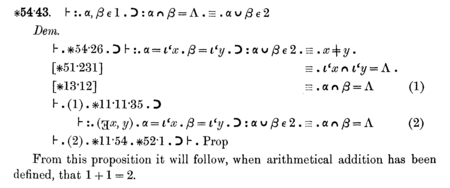
See also
- Axiomatic set theory
- BegriffsschriftBegriffsschriftBegriffsschrift is a book on logic by Gottlob Frege, published in 1879, and the formal system set out in that book...
- Boolean algebra (logic)
- Information Processing LanguageInformation Processing LanguageInformation Processing Language is a programming language developed by Allen Newell, Cliff Shaw, and Herbert Simon at RAND Corporation and the Carnegie Institute of Technology from about 1956...
External links
- Stanford Encyclopedia of PhilosophyStanford Encyclopedia of PhilosophyThe Stanford Encyclopedia of Philosophy is a freely-accessible online encyclopedia of philosophy maintained by Stanford University. Each entry is written and maintained by an expert in the field, including professors from over 65 academic institutions worldwide...
:- Principia Mathematica -- by A. D. Irvine.
- The Notation in Principia Mathematica -- by Bernard Linsky.
- Principia Mathematica online (University of Michigan Historical Math Collection):
- Proposition ✸54.43 in a more modern notation (MetamathMetamathMetamath is a computer-assisted proof checker. It has no specific logic embedded and can simply be regarded as a device to apply inference rules to formulas...
)