

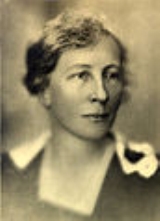
Lillian Moller Gilbreth

Encyclopedia
Lillian Moller Gilbreth was an American
psychologist
and industrial engineer. One of the first working female engineer
s holding a Ph.D.
, she is arguably the first true industrial/organizational psychologist
. She and her husband Frank Bunker Gilbreth, Sr. were efficiency experts who contributed to the study of industrial engineering
in fields such as motion study
and human factors
. The books Cheaper by the Dozen
and Belles on Their Toes
(written by their children Ernestine
and Frank Jr.
) are the story of their family life with their twelve children, and describe how they applied their interest in time and motion study
to the organization and daily activities of such an extremely large family.
She died on January 2, 1972 in Phoenix, Arizona
.
, California
. She was the second of ten children born to William Moller, a builder's supply merchant, and Annie Delger Moller, who were both of German descent. She was educated at home until she was nine years old, when her formal schooling began at a public elementary school, where she was required to start from the first grade (although she was rapidly promoted through the grades). She attended Oakland High School, where she was elected vice president of her senior class; she graduated with exemplary grades in May 1896.
Gilbreth started college at the University of California
shortly after, commuting by streetcar from her parents' Oakland home. She graduated from the University of California
in 1900 with a bachelor's degree
in English literature
and was the first female commencement speaker at the university. She originally pursued her master's degree
at Columbia University
, where she was exposed to the subject of psychology
through courses under Edward Thorndike
. However, she became ill and returned home, finishing her master's degree in literature at the University of California
in 1902. Her thesis was on Ben Jonson's
play Bartholomew Fair
.
Gilbreth completed a dissertation and attempted to obtain a doctorate
from the University of California
in 1911, but was not awarded the degree due to noncompliance with residency requirements for doctoral candidates; this dissertation was later published as The Psychology of Management
. Instead, since her immediate family had relocated to New England
by this time, she attended Brown University
and earned a Ph.D
in 1915, having written a second dissertation on efficient teaching methods called "Some Aspects of Eliminating Waste in Teaching". It was the first degree granted in industrial psychology.
and scientific management
.
, as Taylor formulated them, would be neither easy to implement nor sufficient; their implementation would require hard work by both engineers and psychologists to make them successful. Both Lillian and Frank Gilbreth believed that scientific management as formulated by Taylor fell short when it came to managing the human element on the shop floor. The Gilbreths helped formulate a constructive critique of Taylorism; this critique had the support of other successful managers.
Her work included the marketing research for Johnson & Johnson
in 1926 and her efforts to improve women’s spending decisions during the first years of the Great Depression
. She also helped companies such as Johnson & Johnson
and Macys with their management departments. In 1926, when Johnson & Johnson
hired Lillian as a consultant to do marketing research on sanitary napkins., the firm benefited in three ways. First, it could use her training as a psychologist in measuring and the analysis of attitudes and opinions. Second, it could give her the experience of an engineer who specializes in the interaction between bodies and material objects. Third, she would be a public image as a mother and a modern career woman to build consumer trust.
. Additionally, the Gilbreths did research on fatigue study, the forerunner to ergonomics
.
Gilbreth was instrumental in the development of the modern kitchen, creating the "work triangle" and linear kitchen layouts that are often used today.
In addition to having twelve children, writing books, helping companies with their management skills, and managing women consumers, Lillian was instrumental in the design of a desk in 1933 (in cooperation with IBM
) for display at the Chicago World’s Fair.
and his wife Lou Henry Hoover
, both of whom she had known in California; Gilbreth had presided over the Women's Branch of the Engineers' Hoover for President campaign. At the behest of Lou Henry Hoover
, Gilbreth joined the Girl Scouts
as a consultant in 1929, later becoming a member of the board of directors, and remained active in the organization for more than twenty years.
Under the Hoover administration, she worked became the head of the women's section of the President's Emergency Committee for Employment in 1930, where she worked to gain the cooperation of women's groups for reducing unemployment. During World War II
, she was an advisor to several governmental groups, providing expertise on education and labor (particularly women in the workforce) for organizations such as for the War Manpower Commission
, the Office of War Information, and the United States Navy
. In later years, she served on the Chemical Warfare Board and on Harry Truman's Civil Defense Advisory Council. During the Korean War
, she served on the Defense Advisory Committee on Women in the Services.
While residing in Providence, Rhode Island
, she and husband taught free two-week summer schools in scientific management
from 1913 to 1916. They later discussed teaching the "Gilbreth system" of motion study
to members of industry, but it was not until after her husband's death that she created a formal motion study course. Her first course began in January
1925, and it offered to "prepare a member of an organization, who has adequate training both in scientific method and in plant problems, to take charge of Motion Study work in that organization." Coursework included laboratory projects and field trips to private firms to witness the application of scientific management
. She ran a total of seven motion study courses out of her home in Montclair
, New Jersey
until 1930.
Meanwhile, Gilbreth had been lecturing at Purdue University
since 1925, where her husband had previously given annual lectures. This led to a visiting professorship in 1935, when she became the first female engineering professor at Purdue; she was granted full professorship in 1940, dividing her time between the departments of industrial engineering
, industrial psychology, home economics
, and the dean's office where she consulted on careers for women. In the School of Industrial Engineering, she help establish a time and motion study
laboratory, and transferred motion study techniques to the home economics department under the banner of "work simplification". She retired from Purdue in 1948.
Besides teaching at Purdue, she was also appointed Knapp Visiting Professor at the University of Wisconsin's School of Engineering, and taught at other universities including the Newark College of Engineering, Bryn Mawr College
, and Rutgers University
. She became resident lecturer at Massachusetts Institute of Technology
in 1964, at the age of 86.
, en route to Europe
with her chaperone, who was Frank's cousin. The couple married on October
19, 1904, in Oakland
, California
. As planned, they became the parents of twelve children, eleven of whom lived to adulthood.
The children of Frank Bunker Gilbreth and Lillian Moller Gilbreth were:
s from such schools as Princeton University
, Brown University
, and the University of Michigan
. She was named 1954 Alumna of the Year by the University of California's alumni association. She was accepted to the membership of the American Society of Mechanical Engineers
in 1926, becoming its second female member; the society later awarded both her and her husband (posthumously) the Henry Laurence Gantt Medal
in 1944 for her contributions to industrial engineering. In 1950, she was the first honorary member of the newly-created Society of Women Engineers
.
In 1965, she became the first woman elected to the National Academy of Engineering
. The next year, she received the Hoover Medal
, an engineering prize awarded jointly by five engineering societies, for her "contributions to motion study and to recognition of the principle that management engineering and human relations are intertwined.... Additionally, her unselfish application of energy and creative efforts in modifying industrial and home environments for the handicapped has resulted in full employment of their capabilities and elevation of their self-esteem".
issued a 40¢ Great Americans series
postage stamp in Gilbreth's honor, and she was lauded by the American Psychological Association
as the first psychologist to be so commemorated. (Psychologists Gary Brucato Jr. and John D. Hogan
later questioned this claim, noting that John Dewey
had appeared on an American stamp 17 years earlier. However, they also emphasized that Gilbreth was the first female psychologist to do so.) A comprehensive international list of psychologists on stamps (compiled by psychology historian Ludy T. Benjamin) indicates that Gilbreth was only the second female psychologist commemorated by a postage stamp in all the world, preceded only by Maria Montessori
in India
in 1970.
Multiple engineering awards have been named in her honor. The Lilian M. Gilbreth Lectureships were established in 2001 by the National Academy of Engineering
, to recognize outstanding young American engineers, while the highest honor bestowed by the Institute of Industrial Engineers
is the Frank and Lillian Gilbreth Industrial Engineering Award, for "those who have distinguished themselves through contributions to the welfare of mankind in the field of industrial engineering". At Purdue University
, the Lilian M. Gilbreth Distinguished Professor is an honor bestowed on a member of the industrial engineering department. Additionally, the Society of Women Engineers
awards the Lillian Moller Gilbreth Memorial Scholarship to deserving female engineering undergraduates.
Lillian and husband Frank have a permanent collection in the Smithsonian National Museum of American History, and her portrait hangs in the National Portrait Gallery
. Their papers are housed in The Frank and Lillian Gilbreth Library of Management at Purdue University
.
In 1941, Dr. Gilbreth was made an honorary member of Mortar Board by the Purdue University chapter of the esteemed national honor society.
United States
The United States of America is a federal constitutional republic comprising fifty states and a federal district...
psychologist
Psychologist
Psychologist is a professional or academic title used by individuals who are either:* Clinical professionals who work with patients in a variety of therapeutic contexts .* Scientists conducting psychological research or teaching psychology in a college...
and industrial engineer. One of the first working female engineer
Engineer
An engineer is a professional practitioner of engineering, concerned with applying scientific knowledge, mathematics and ingenuity to develop solutions for technical problems. Engineers design materials, structures, machines and systems while considering the limitations imposed by practicality,...
s holding a Ph.D.
Doctor of Philosophy
Doctor of Philosophy, abbreviated as Ph.D., PhD, D.Phil., or DPhil , in English-speaking countries, is a postgraduate academic degree awarded by universities...
, she is arguably the first true industrial/organizational psychologist
Industrial and organizational psychology
Industrial and organizational psychology is the scientific study of employees, workplaces, and organizations. Industrial and organizational psychologists contribute to an organization's success by improving the performance and well-being of its people...
. She and her husband Frank Bunker Gilbreth, Sr. were efficiency experts who contributed to the study of industrial engineering
Industrial engineering
Industrial engineering is a branch of engineering dealing with the optimization of complex processes or systems. It is concerned with the development, improvement, implementation and evaluation of integrated systems of people, money, knowledge, information, equipment, energy, materials, analysis...
in fields such as motion study
Time and motion study
A time and motion study is a business efficiency technique combining the Time Study work of Frederick Winslow Taylor with the Motion Study work of Frank and Lillian Gilbreth . It is a major part of scientific management...
and human factors
Human factors
Human factors science or human factors technologies is a multidisciplinary field incorporating contributions from psychology, engineering, industrial design, statistics, operations research and anthropometry...
. The books Cheaper by the Dozen
Cheaper by the Dozen
Cheaper by the Dozen is a biographical book written by Frank Bunker Gilbreth, Jr. and Ernestine Gilbreth Carey that tells the story of time and motion study and efficiency experts Frank Bunker Gilbreth and Lillian Moller Gilbreth, and their twelve children. The book focuses on the many years the...
and Belles on Their Toes
Belles on Their Toes
Belles on Their Toes is a 1950 book written by Frank Bunker Gilbreth, Jr. and Ernestine Gilbreth Carey. This book was the follow-up to the 1948 book Cheaper by the Dozen which covered the period before Frank Gilbreth Sr died. Belles on Their Toes was written about the family after the death of...
(written by their children Ernestine
Ernestine Gilbreth Carey
Ernestine Moller Gilbreth Carey was an American author.-Biography:Born in New York City, she was the daughter of Lillian Moller Gilbreth and Frank Bunker Gilbreth, early 20th-century pioneers of time and motion study and what would now be called organizational behavior...
and Frank Jr.
Frank Bunker Gilbreth, Jr.
Frank Bunker Gilbreth, Jr. was co-author, with his sister Ernestine, of Cheaper by the Dozen and Belles on Their Toes...
) are the story of their family life with their twelve children, and describe how they applied their interest in time and motion study
Time and motion study
A time and motion study is a business efficiency technique combining the Time Study work of Frederick Winslow Taylor with the Motion Study work of Frank and Lillian Gilbreth . It is a major part of scientific management...
to the organization and daily activities of such an extremely large family.
She died on January 2, 1972 in Phoenix, Arizona
Phoenix, Arizona
Phoenix is the capital, and largest city, of the U.S. state of Arizona, as well as the sixth most populated city in the United States. Phoenix is home to 1,445,632 people according to the official 2010 U.S. Census Bureau data...
.
Early life and education
Gilbreth was born in OaklandOakland, California
Oakland is a major West Coast port city on San Francisco Bay in the U.S. state of California. It is the eighth-largest city in the state with a 2010 population of 390,724...
, California
California
California is a state located on the West Coast of the United States. It is by far the most populous U.S. state, and the third-largest by land area...
. She was the second of ten children born to William Moller, a builder's supply merchant, and Annie Delger Moller, who were both of German descent. She was educated at home until she was nine years old, when her formal schooling began at a public elementary school, where she was required to start from the first grade (although she was rapidly promoted through the grades). She attended Oakland High School, where she was elected vice president of her senior class; she graduated with exemplary grades in May 1896.
Gilbreth started college at the University of California
University of California, Berkeley
The University of California, Berkeley , is a teaching and research university established in 1868 and located in Berkeley, California, USA...
shortly after, commuting by streetcar from her parents' Oakland home. She graduated from the University of California
University of California, Berkeley
The University of California, Berkeley , is a teaching and research university established in 1868 and located in Berkeley, California, USA...
in 1900 with a bachelor's degree
Bachelor's degree
A bachelor's degree is usually an academic degree awarded for an undergraduate course or major that generally lasts for three or four years, but can range anywhere from two to six years depending on the region of the world...
in English literature
English literature
English literature is the literature written in the English language, including literature composed in English by writers not necessarily from England; for example, Robert Burns was Scottish, James Joyce was Irish, Joseph Conrad was Polish, Dylan Thomas was Welsh, Edgar Allan Poe was American, J....
and was the first female commencement speaker at the university. She originally pursued her master's degree
Master's degree
A master's is an academic degree granted to individuals who have undergone study demonstrating a mastery or high-order overview of a specific field of study or area of professional practice...
at Columbia University
Columbia University
Columbia University in the City of New York is a private, Ivy League university in Manhattan, New York City. Columbia is the oldest institution of higher learning in the state of New York, the fifth oldest in the United States, and one of the country's nine Colonial Colleges founded before the...
, where she was exposed to the subject of psychology
Psychology
Psychology is the study of the mind and behavior. Its immediate goal is to understand individuals and groups by both establishing general principles and researching specific cases. For many, the ultimate goal of psychology is to benefit society...
through courses under Edward Thorndike
Edward Thorndike
Edward Lee "Ted" Thorndike was an American psychologist who spent nearly his entire career at Teachers College, Columbia University. His work on animal behavior and the learning process led to the theory of connectionism and helped lay the scientific foundation for modern educational psychology...
. However, she became ill and returned home, finishing her master's degree in literature at the University of California
University of California, Berkeley
The University of California, Berkeley , is a teaching and research university established in 1868 and located in Berkeley, California, USA...
in 1902. Her thesis was on Ben Jonson's
Ben Jonson
Benjamin Jonson was an English Renaissance dramatist, poet and actor. A contemporary of William Shakespeare, he is best known for his satirical plays, particularly Volpone, The Alchemist, and Bartholomew Fair, which are considered his best, and his lyric poems...
play Bartholomew Fair
Bartholomew Fair
Bartholomew Fayre: A Comedy is a comedy in five acts by Ben Jonson, the last written of his four great comedies. It was first staged on October 31, 1614 at the Hope Theatre by the Lady Elizabeth's Men...
.
Gilbreth completed a dissertation and attempted to obtain a doctorate
Doctorate
A doctorate is an academic degree or professional degree that in most countries refers to a class of degrees which qualify the holder to teach in a specific field, A doctorate is an academic degree or professional degree that in most countries refers to a class of degrees which qualify the holder...
from the University of California
University of California, Berkeley
The University of California, Berkeley , is a teaching and research university established in 1868 and located in Berkeley, California, USA...
in 1911, but was not awarded the degree due to noncompliance with residency requirements for doctoral candidates; this dissertation was later published as The Psychology of Management
The Psychology of Management
The Psychology of Management: The Function of the Mind in Determining, Teaching, and Installing Methods of Least Waste is a book written by Lillian Gilbreth which investigates the psychological aspects of scientific management, incorporating concepts of human relations and worker individuality into...
. Instead, since her immediate family had relocated to New England
New England
New England is a region in the northeastern corner of the United States consisting of the six states of Maine, New Hampshire, Vermont, Massachusetts, Rhode Island, and Connecticut...
by this time, she attended Brown University
Brown University
Brown University is a private, Ivy League university located in Providence, Rhode Island, United States. Founded in 1764 prior to American independence from the British Empire as the College in the English Colony of Rhode Island and Providence Plantations early in the reign of King George III ,...
and earned a Ph.D
Doctor of Philosophy
Doctor of Philosophy, abbreviated as Ph.D., PhD, D.Phil., or DPhil , in English-speaking countries, is a postgraduate academic degree awarded by universities...
in 1915, having written a second dissertation on efficient teaching methods called "Some Aspects of Eliminating Waste in Teaching". It was the first degree granted in industrial psychology.
Work
Lillian Gilbreth combined the perspectives of an engineer, a psychologist, a wife, and a mother; she helped industrial engineers see the importance of the psychological dimensions of work. She became the first American engineer ever to create a synthesis of psychologyPsychology
Psychology is the study of the mind and behavior. Its immediate goal is to understand individuals and groups by both establishing general principles and researching specific cases. For many, the ultimate goal of psychology is to benefit society...
and scientific management
Scientific management
Scientific management, also called Taylorism, was a theory of management that analyzed and synthesized workflows. Its main objective was improving economic efficiency, especially labor productivity. It was one of the earliest attempts to apply science to the engineering of processes and to management...
.
Psychology in scientific management
She and her husband were certain that the revolutionary ideas of Frederick Winslow TaylorFrederick Winslow Taylor
Frederick Winslow Taylor was an American mechanical engineer who sought to improve industrial efficiency. He is regarded as the father of scientific management and was one of the first management consultants...
, as Taylor formulated them, would be neither easy to implement nor sufficient; their implementation would require hard work by both engineers and psychologists to make them successful. Both Lillian and Frank Gilbreth believed that scientific management as formulated by Taylor fell short when it came to managing the human element on the shop floor. The Gilbreths helped formulate a constructive critique of Taylorism; this critique had the support of other successful managers.
Her work included the marketing research for Johnson & Johnson
Johnson & Johnson
Johnson & Johnson is an American multinational pharmaceutical, medical devices and consumer packaged goods manufacturer founded in 1886. Its common stock is a component of the Dow Jones Industrial Average and the company is listed among the Fortune 500....
in 1926 and her efforts to improve women’s spending decisions during the first years of the Great Depression
Great Depression
The Great Depression was a severe worldwide economic depression in the decade preceding World War II. The timing of the Great Depression varied across nations, but in most countries it started in about 1929 and lasted until the late 1930s or early 1940s...
. She also helped companies such as Johnson & Johnson
Johnson & Johnson
Johnson & Johnson is an American multinational pharmaceutical, medical devices and consumer packaged goods manufacturer founded in 1886. Its common stock is a component of the Dow Jones Industrial Average and the company is listed among the Fortune 500....
and Macys with their management departments. In 1926, when Johnson & Johnson
Johnson & Johnson
Johnson & Johnson is an American multinational pharmaceutical, medical devices and consumer packaged goods manufacturer founded in 1886. Its common stock is a component of the Dow Jones Industrial Average and the company is listed among the Fortune 500....
hired Lillian as a consultant to do marketing research on sanitary napkins., the firm benefited in three ways. First, it could use her training as a psychologist in measuring and the analysis of attitudes and opinions. Second, it could give her the experience of an engineer who specializes in the interaction between bodies and material objects. Third, she would be a public image as a mother and a modern career woman to build consumer trust.
Time, motion and fatigue study
She and her husband were partners in the management consulting firm of Gilbreth, Inc., which performed time and motion studyTime and motion study
A time and motion study is a business efficiency technique combining the Time Study work of Frederick Winslow Taylor with the Motion Study work of Frank and Lillian Gilbreth . It is a major part of scientific management...
. Additionally, the Gilbreths did research on fatigue study, the forerunner to ergonomics
Ergonomics
Ergonomics is the study of designing equipment and devices that fit the human body, its movements, and its cognitive abilities.The International Ergonomics Association defines ergonomics as follows:...
.
Domestic management and home economics
The Gilbreth children often took part in the experiments.Gilbreth was instrumental in the development of the modern kitchen, creating the "work triangle" and linear kitchen layouts that are often used today.
In addition to having twelve children, writing books, helping companies with their management skills, and managing women consumers, Lillian was instrumental in the design of a desk in 1933 (in cooperation with IBM
IBM
International Business Machines Corporation or IBM is an American multinational technology and consulting corporation headquartered in Armonk, New York, United States. IBM manufactures and sells computer hardware and software, and it offers infrastructure, hosting and consulting services in areas...
) for display at the Chicago World’s Fair.
Volunteer work and government service
Her government work began as a result of her longtime friendship with Herbert HooverHerbert Hoover
Herbert Clark Hoover was the 31st President of the United States . Hoover was originally a professional mining engineer and author. As the United States Secretary of Commerce in the 1920s under Presidents Warren Harding and Calvin Coolidge, he promoted partnerships between government and business...
and his wife Lou Henry Hoover
Lou Henry Hoover
Lou Henry Hoover was the wife of President of the United States Herbert Hoover and First Lady of the United States, 1929-1933. Mrs. Hoover was president of the Girl Scouts of the USA for two terms, 1922-1925 and 1935-1937....
, both of whom she had known in California; Gilbreth had presided over the Women's Branch of the Engineers' Hoover for President campaign. At the behest of Lou Henry Hoover
Lou Henry Hoover
Lou Henry Hoover was the wife of President of the United States Herbert Hoover and First Lady of the United States, 1929-1933. Mrs. Hoover was president of the Girl Scouts of the USA for two terms, 1922-1925 and 1935-1937....
, Gilbreth joined the Girl Scouts
Girl Scouts of the USA
The Girl Scouts of the United States of America is a youth organization for girls in the United States and American girls living abroad. It describes itself as "the world's preeminent organization dedicated solely to girls". It was founded by Juliette Gordon Low in 1912 and was organized after Low...
as a consultant in 1929, later becoming a member of the board of directors, and remained active in the organization for more than twenty years.
Under the Hoover administration, she worked became the head of the women's section of the President's Emergency Committee for Employment in 1930, where she worked to gain the cooperation of women's groups for reducing unemployment. During World War II
World War II
World War II, or the Second World War , was a global conflict lasting from 1939 to 1945, involving most of the world's nations—including all of the great powers—eventually forming two opposing military alliances: the Allies and the Axis...
, she was an advisor to several governmental groups, providing expertise on education and labor (particularly women in the workforce) for organizations such as for the War Manpower Commission
War Manpower Commission
The War Manpower Commission was a World War II agency of the United States Government charged with planning to balance the labor needs of agriculture, industry and the armed forces. It was created by President Franklin D. Roosevelt in Executive Order 9139 of April 18, 1942. Its chairman was Paul V...
, the Office of War Information, and the United States Navy
United States Navy
The United States Navy is the naval warfare service branch of the United States Armed Forces and one of the seven uniformed services of the United States. The U.S. Navy is the largest in the world; its battle fleet tonnage is greater than that of the next 13 largest navies combined. The U.S...
. In later years, she served on the Chemical Warfare Board and on Harry Truman's Civil Defense Advisory Council. During the Korean War
Korean War
The Korean War was a conventional war between South Korea, supported by the United Nations, and North Korea, supported by the People's Republic of China , with military material aid from the Soviet Union...
, she served on the Defense Advisory Committee on Women in the Services.
Teaching
Gilbreth had always been interested in teaching and education; as an undergraduate she took enough education courses to earn a teacher's certificate, and her second doctoral dissertation was on efficient teaching methods.While residing in Providence, Rhode Island
Providence, Rhode Island
Providence is the capital and most populous city of Rhode Island and was one of the first cities established in the United States. Located in Providence County, it is the third largest city in the New England region...
, she and husband taught free two-week summer schools in scientific management
Scientific management
Scientific management, also called Taylorism, was a theory of management that analyzed and synthesized workflows. Its main objective was improving economic efficiency, especially labor productivity. It was one of the earliest attempts to apply science to the engineering of processes and to management...
from 1913 to 1916. They later discussed teaching the "Gilbreth system" of motion study
Time and motion study
A time and motion study is a business efficiency technique combining the Time Study work of Frederick Winslow Taylor with the Motion Study work of Frank and Lillian Gilbreth . It is a major part of scientific management...
to members of industry, but it was not until after her husband's death that she created a formal motion study course. Her first course began in January
January
January is the first month of the year in the Julian and Gregorian calendars and one of seven months with the length of 31 days. The first day of the month is known as New Year's Day...
1925, and it offered to "prepare a member of an organization, who has adequate training both in scientific method and in plant problems, to take charge of Motion Study work in that organization." Coursework included laboratory projects and field trips to private firms to witness the application of scientific management
Scientific management
Scientific management, also called Taylorism, was a theory of management that analyzed and synthesized workflows. Its main objective was improving economic efficiency, especially labor productivity. It was one of the earliest attempts to apply science to the engineering of processes and to management...
. She ran a total of seven motion study courses out of her home in Montclair
Montclair, New Jersey
-Demographics:As of the census of 2000, there were 38,977 people, 15,020 households, and 9,687 families residing in the township. The population density was 6,183.6 people per square mile . There were 15,531 housing units at an average density of 2,464.0 per square mile...
, New Jersey
New Jersey
New Jersey is a state in the Northeastern and Middle Atlantic regions of the United States. , its population was 8,791,894. It is bordered on the north and east by the state of New York, on the southeast and south by the Atlantic Ocean, on the west by Pennsylvania and on the southwest by Delaware...
until 1930.
Meanwhile, Gilbreth had been lecturing at Purdue University
Purdue University
Purdue University, located in West Lafayette, Indiana, U.S., is the flagship university of the six-campus Purdue University system. Purdue was founded on May 6, 1869, as a land-grant university when the Indiana General Assembly, taking advantage of the Morrill Act, accepted a donation of land and...
since 1925, where her husband had previously given annual lectures. This led to a visiting professorship in 1935, when she became the first female engineering professor at Purdue; she was granted full professorship in 1940, dividing her time between the departments of industrial engineering
Industrial engineering
Industrial engineering is a branch of engineering dealing with the optimization of complex processes or systems. It is concerned with the development, improvement, implementation and evaluation of integrated systems of people, money, knowledge, information, equipment, energy, materials, analysis...
, industrial psychology, home economics
Home Economics
Home economics is the profession and field of study that deals with the economics and management of the home and community...
, and the dean's office where she consulted on careers for women. In the School of Industrial Engineering, she help establish a time and motion study
Time and motion study
A time and motion study is a business efficiency technique combining the Time Study work of Frederick Winslow Taylor with the Motion Study work of Frank and Lillian Gilbreth . It is a major part of scientific management...
laboratory, and transferred motion study techniques to the home economics department under the banner of "work simplification". She retired from Purdue in 1948.
Besides teaching at Purdue, she was also appointed Knapp Visiting Professor at the University of Wisconsin's School of Engineering, and taught at other universities including the Newark College of Engineering, Bryn Mawr College
Bryn Mawr College
Bryn Mawr College is a women's liberal arts college located in Bryn Mawr, a community in Lower Merion Township, Pennsylvania, ten miles west of Philadelphia. The name "Bryn Mawr" means "big hill" in Welsh....
, and Rutgers University
Rutgers University
Rutgers, The State University of New Jersey , is the largest institution for higher education in New Jersey, United States. It was originally chartered as Queen's College in 1766. It is the eighth-oldest college in the United States and one of the nine Colonial colleges founded before the American...
. She became resident lecturer at Massachusetts Institute of Technology
Massachusetts Institute of Technology
The Massachusetts Institute of Technology is a private research university located in Cambridge, Massachusetts. MIT has five schools and one college, containing a total of 32 academic departments, with a strong emphasis on scientific and technological education and research.Founded in 1861 in...
in 1964, at the age of 86.
Marriage and family
Lillian first met her future husband Frank Bunker Gilbreth, Sr. in June 1903 in Boston, MassachusettsMassachusetts
The Commonwealth of Massachusetts is a state in the New England region of the northeastern United States of America. It is bordered by Rhode Island and Connecticut to the south, New York to the west, and Vermont and New Hampshire to the north; at its east lies the Atlantic Ocean. As of the 2010...
, en route to Europe
Europe
Europe is, by convention, one of the world's seven continents. Comprising the westernmost peninsula of Eurasia, Europe is generally 'divided' from Asia to its east by the watershed divides of the Ural and Caucasus Mountains, the Ural River, the Caspian and Black Seas, and the waterways connecting...
with her chaperone, who was Frank's cousin. The couple married on October
October
October is the tenth month of the year in the Julian and Gregorian Calendars and one of seven months with a length of 31 days. The eighth month in the old Roman calendar, October retained its name after January and February were inserted into the calendar that had originally been created by the...
19, 1904, in Oakland
Oakland, California
Oakland is a major West Coast port city on San Francisco Bay in the U.S. state of California. It is the eighth-largest city in the state with a 2010 population of 390,724...
, California
California
California is a state located on the West Coast of the United States. It is by far the most populous U.S. state, and the third-largest by land area...
. As planned, they became the parents of twelve children, eleven of whom lived to adulthood.
The children of Frank Bunker Gilbreth and Lillian Moller Gilbreth were:
- Anne M. Gilbreth (September 9, 1905 – February 16, 1987) (age 81); married Robert E. Barney; three children (Peter, Frank, Robert).
- Mary Elizabeth Gilbreth (December 13, 1906 – January 31, 1912); died of diphtheria at age 6.
- Ernestine Gilbreth (April 4, 1908 – November 4, 2006) (age 98); married Charles E. Carey; two children (Charles E. Carey, Lillian Barley).
- Martha B. Gilbreth (November 5, 1909 – November 15, 1968) (age 59); married Richard E. Tallman; four children (Janet, Blair, Mary, Stephanie).
- Frank Bunker GilbrethFrank Bunker Gilbreth, Jr.Frank Bunker Gilbreth, Jr. was co-author, with his sister Ernestine, of Cheaper by the Dozen and Belles on Their Toes...
(March 27, 1911 – February 18, 2001) (age 89); married 1): Elizabeth Cauthen (1934–1954) 2): Mary Pringle Manigault (1954–2001); three children (one from first marriage: Betsy; two from second marriage: Rebecca, Dr. Edward Gilbreth). - William Gilbreth (December 18, 1912 – April 14, 1990) (age 77); married Jean Irvin; two children (Lillian, Bill Gilbreth).
- Lillian M. Gilbreth jr. (June 17, 1914 – June 23, 2001) (age 87); married Donald Dodge Johnson; two children (Julia, Dodge).
- Frederick M. Gilbreth (December 8, 1916; still living); married Jessie Blair Tallman; three children (Susan Kaseler, Frank Gilbreth, John Gilbreth).
- Daniel B. Gilbreth (September 17, 1917 – June 13, 2006) (age 88); married Irene Jensen; three children (David Gilbreth, Danny Gilbreth, Peggy).
- John M. Gilbreth (May 29, 1919 – December 25, 2002) (age 83); married Dorothy Girvan; three children (Peter Gilbreth, James Gilbreth, Deborah).
- Robert M. Gilbreth (July 4, 1920 – July 24, 2007) (age 87); married Barbara Filer; two children (Ann Gilbreth Wilson, Roy D. Gilbreth)
- Jane M. Gilbreth (June 22, 1922 – January 10, 2006) (age 83); married George Paul Heppes; two children (Laurie, Paula).
Awards and achievements
During her career, Gilbreth received numerous awards and honors, including 23 honorary degreeHonorary degree
An honorary degree or a degree honoris causa is an academic degree for which a university has waived the usual requirements, such as matriculation, residence, study, and the passing of examinations...
s from such schools as Princeton University
Princeton University
Princeton University is a private research university located in Princeton, New Jersey, United States. The school is one of the eight universities of the Ivy League, and is one of the nine Colonial Colleges founded before the American Revolution....
, Brown University
Brown University
Brown University is a private, Ivy League university located in Providence, Rhode Island, United States. Founded in 1764 prior to American independence from the British Empire as the College in the English Colony of Rhode Island and Providence Plantations early in the reign of King George III ,...
, and the University of Michigan
University of Michigan
The University of Michigan is a public research university located in Ann Arbor, Michigan in the United States. It is the state's oldest university and the flagship campus of the University of Michigan...
. She was named 1954 Alumna of the Year by the University of California's alumni association. She was accepted to the membership of the American Society of Mechanical Engineers
American Society of Mechanical Engineers
The American Society of Mechanical Engineers is a professional body, specifically an engineering society, focused on mechanical engineering....
in 1926, becoming its second female member; the society later awarded both her and her husband (posthumously) the Henry Laurence Gantt Medal
Henry Laurence Gantt Medal
The Henry Laurence Gantt Medal was established in 1929 by the American Society of Mechanical Engineers for "distinguished achievement in management and service to the community."- Winners :* 2000 - Paul Soros* 2001 - Roy Huffington...
in 1944 for her contributions to industrial engineering. In 1950, she was the first honorary member of the newly-created Society of Women Engineers
Society of Women Engineers
The Society of Women Engineers , founded in 1950, is a not-for-profit educational and service organization. SWE is the driving force that establishes engineering as a highly desirable career aspiration for women. SWE empowers women to succeed and advance in those aspirations and be recognized for...
.
In 1965, she became the first woman elected to the National Academy of Engineering
National Academy of Engineering
The National Academy of Engineering is a government-created non-profit institution in the United States, that was founded in 1964 under the same congressional act that led to the founding of the National Academy of Sciences...
. The next year, she received the Hoover Medal
Hoover Medal
The Hoover Medal is an American engineering prize.It has been given since 1930 for "outstanding extra-career services by engineers to humanity"...
, an engineering prize awarded jointly by five engineering societies, for her "contributions to motion study and to recognition of the principle that management engineering and human relations are intertwined.... Additionally, her unselfish application of energy and creative efforts in modifying industrial and home environments for the handicapped has resulted in full employment of their capabilities and elevation of their self-esteem".
Legacy
In 1984, the United States Postal ServiceUnited States Postal Service
The United States Postal Service is an independent agency of the United States government responsible for providing postal service in the United States...
issued a 40¢ Great Americans series
Great Americans series
The Great Americans series is a set of definitive stamps issued by the United States Postal Service, starting on December 27, 1980 with the 19¢ stamp depicting Sequoyah, and continuing through 2002, the final stamp being the 78¢ Alice Paul self-adhesive stamp. The series, noted for its simplicity...
postage stamp in Gilbreth's honor, and she was lauded by the American Psychological Association
American Psychological Association
The American Psychological Association is the largest scientific and professional organization of psychologists in the United States. It is the world's largest association of psychologists with around 154,000 members including scientists, educators, clinicians, consultants and students. The APA...
as the first psychologist to be so commemorated. (Psychologists Gary Brucato Jr. and John D. Hogan
John D. Hogan
John D. Hogan, born in 1939, is an American Psychologist and noted author on the history of Psychology. He is presently a Professor of Psychology at St. John's University in Jamaica, Queens, New York, where he taught since 1965...
later questioned this claim, noting that John Dewey
John Dewey
John Dewey was an American philosopher, psychologist and educational reformer whose ideas have been influential in education and social reform. Dewey was an important early developer of the philosophy of pragmatism and one of the founders of functional psychology...
had appeared on an American stamp 17 years earlier. However, they also emphasized that Gilbreth was the first female psychologist to do so.) A comprehensive international list of psychologists on stamps (compiled by psychology historian Ludy T. Benjamin) indicates that Gilbreth was only the second female psychologist commemorated by a postage stamp in all the world, preceded only by Maria Montessori
Maria Montessori
Maria Montessori was an Italian physician and educator, a noted humanitarian and devout Catholic best known for the philosophy of education which bears her name...
in India
India
India , officially the Republic of India , is a country in South Asia. It is the seventh-largest country by geographical area, the second-most populous country with over 1.2 billion people, and the most populous democracy in the world...
in 1970.
Multiple engineering awards have been named in her honor. The Lilian M. Gilbreth Lectureships were established in 2001 by the National Academy of Engineering
National Academy of Engineering
The National Academy of Engineering is a government-created non-profit institution in the United States, that was founded in 1964 under the same congressional act that led to the founding of the National Academy of Sciences...
, to recognize outstanding young American engineers, while the highest honor bestowed by the Institute of Industrial Engineers
Institute of Industrial Engineers
The Institute of Industrial Engineers is a professional society dedicated solely to the support of the industrial engineering profession and individuals involved with improving quality and productivity...
is the Frank and Lillian Gilbreth Industrial Engineering Award, for "those who have distinguished themselves through contributions to the welfare of mankind in the field of industrial engineering". At Purdue University
Purdue University
Purdue University, located in West Lafayette, Indiana, U.S., is the flagship university of the six-campus Purdue University system. Purdue was founded on May 6, 1869, as a land-grant university when the Indiana General Assembly, taking advantage of the Morrill Act, accepted a donation of land and...
, the Lilian M. Gilbreth Distinguished Professor is an honor bestowed on a member of the industrial engineering department. Additionally, the Society of Women Engineers
Society of Women Engineers
The Society of Women Engineers , founded in 1950, is a not-for-profit educational and service organization. SWE is the driving force that establishes engineering as a highly desirable career aspiration for women. SWE empowers women to succeed and advance in those aspirations and be recognized for...
awards the Lillian Moller Gilbreth Memorial Scholarship to deserving female engineering undergraduates.
Lillian and husband Frank have a permanent collection in the Smithsonian National Museum of American History, and her portrait hangs in the National Portrait Gallery
National Portrait Gallery (United States)
The National Portrait Gallery is an art gallery in Washington, D.C., administered by the Smithsonian Institution. Its collections focus on images of famous individual Americans.-Building:...
. Their papers are housed in The Frank and Lillian Gilbreth Library of Management at Purdue University
Purdue University
Purdue University, located in West Lafayette, Indiana, U.S., is the flagship university of the six-campus Purdue University system. Purdue was founded on May 6, 1869, as a land-grant university when the Indiana General Assembly, taking advantage of the Morrill Act, accepted a donation of land and...
.
In 1941, Dr. Gilbreth was made an honorary member of Mortar Board by the Purdue University chapter of the esteemed national honor society.
Selected bibliography
- The Psychology of Management: the Function of the Mind in Determining, Teaching and Installing Methods of Least WasteThe Psychology of ManagementThe Psychology of Management: The Function of the Mind in Determining, Teaching, and Installing Methods of Least Waste is a book written by Lillian Gilbreth which investigates the psychological aspects of scientific management, incorporating concepts of human relations and worker individuality into...
(1914) - Applied motion study; a collection of papers on the efficient method to industrial preparedness. (1917) with Frank B. Gilbreth
- Fatigue Study: The Elimination of Humanity's Greatest Unnecessary Waste; a First Step in Motion Study (1916) with Frank B. Gilbreth
- Motion Study for the Handicapped (1920) with Frank B. Gilbreth
- The Quest of the One Best Way: A Sketch of the Life of Frank Bunker Gilbreth (1925)
- The Home-maker and Her Job (1927)
- Living With Our Children (1928)
- Normal Lives for the Disabled (1948), with Edna Yost
- The Foreman in Manpower Management (1947), with Alice Rice Cook
- Management in the Home: Happier Living Through Saving Time and Energy (1954), with Orpha Mae Thomas and Eleanor Clymer
- As I Remember: An Autobiography (1998), published posthumously
Further reading
- Graham, Laurel D. 1994. "Critical Biography Without Subjects and Objects: An Encounter with Dr. Lillian Moller Gilbreth", The Sociological Quarterly 35:621–643.
- Lancaster, Jane. "O Pioneer", Brown Alumni Monthly 96(5) February 1996. Biography
- Sullivan, Sherry. 1995. "Management's Unsung Theorist: An Examination of the Works of Lillian M. Gilbreth", Biography 18: 31–41.
- Yost, Edna. 1949. Frank and Lillian Gilbreth, Partners for Life. Piscataway, New Jersey: Rutgers Univ. Press.
- Yost, Edna. 1943. "Lillian Moller Gilbreth", in American Women in Science. Philadelphia: Frederick A. Stokes.