
All Topics  
Ergonomics


   Email Print
   Bookmark   Link


Ergonomics


Ergonomics is the scientific discipline concerned with design
Design

Design is used both as a noun and a verb. The term is often tied to the various applied arts and engineering . As a verb, "to design" refers to the process of originating and planning for a product, structure, system, or component with intention....
ing according to human needs, and the profession that applies theory, principles, data and methods to design in order to optimize human well-being and overall system performance. The field is also called human engineering, and human factors
Human factors

Human factors is a term that covers:* The science of understanding the properties of human capability .* The application of this understanding to the design and development of systems and services ....
.

Ergonomic research is performed by those who study human capabilities in relationship to their work demands.


Discussion
Ask a question about 'Ergonomics'
Start a new discussion about 'Ergonomics'
Answer questions from other users
Full Discussion Forum


Recent Posts


Encyclopedia


Ergonomics is the scientific discipline concerned with design
Design

Design is used both as a noun and a verb. The term is often tied to the various applied arts and engineering . As a verb, "to design" refers to the process of originating and planning for a product, structure, system, or component with intention....
ing according to human needs, and the profession that applies theory, principles, data and methods to design in order to optimize human well-being and overall system performance. The field is also called human engineering, and human factors
Human factors

Human factors is a term that covers:* The science of understanding the properties of human capability .* The application of this understanding to the design and development of systems and services ....
.

Ergonomic research is performed by those who study human capabilities in relationship to their work demands. Information derived from these studies contributes to the design and evaluation of tasks, jobs, products, environments and systems in order to make them compatible with the needs, abilities and limitations of people.

Overview

Ergonomics is concerned with the ‘fit’ between people and their work. It takes account of the worker's capabilities and limitations in seeking to ensure that tasks, equipment, information and the environment suit each worker.

To assess the fit between a person and their work, ergonomists consider the job being done and the demands on the worker; the equipment used (its size, shape, and how appropriate it is for the task), and the information used (how it is presented, accessed, and changed). Ergonomics draws on many disciplines in its study of humans and their environments, including anthropometry
Anthropometry

Anthropometry , in physical anthropology, refers to the measurement of the human individual for the purposes of understanding human physical variation....
, biomechanics
Biomechanics

Biomechanics is the application of mechanical principles to living organisms. This includes bioengineering, the research and analysis of the mechanics of living organisms and the application of engineering principles to and from biological systems....
, mechanical engineering
Mechanical engineering

Mechanical Engineering is an engineering discipline that involves the application of physics#branches of physics for analysis, design, manufacturing, and maintenance of machine....
, industrial engineering
Industrial engineering

Industrial engineering is also known as operations management, management science, systems engineering, or manufacturing engineering; a distinction that seems to depend on the viewpoint or motives of the user....
, industrial design
Industrial design

Industrial design is an applied art whereby the aesthetics and usability of mass-produced Product may be improved for marketability and Manufacturing....
, kinesiology
Kinesiology

Kinesiology, also known as Human Kinetics, is the science of human movement. It focuses on how the body functions and moves. A kinesiological approach applies scientific based medical principles towards the analysis, preservation and enhancement of human movement in all settings and populations....
, physiology
Physiology

Physiology is the study of the mechanical, physical, and biochemical functions of living organisms. Physiology has traditionally been divided between plant physiology and animal and all living things physiology but the principles of physiology are universal, no matter what particular organism is being studied....
 and psychology
Psychology

Psychology is an academic and applied science discipline involving the science study of human mental functions and behavior. Occasionally it also relies on symbolic hermeneutics and critical theory, although these traditions are less pronounced than in other social sciences such as sociology....
.

Typically, an ergonomist will have a BA or BS in Psychology, Industrial/Mechanical Engineering or Health Sciences, and usually an MA, MS or PhD in a related discipline. Many universities offer Master of Science degrees in Ergonomics, while some offer Master of Ergonomics or Master of Human Factors degrees. In the 2000s, occupational therapists have been moving into the field of ergonomics and the field has been heralded as one of the top ten emerging practice areas.

Five aspects of ergonomics

There are five aspects of ergonomics: safety, comfort, ease of use, productivity/performance, and aesthetics. Based on these aspects of ergonomics, examples are given of how products or systems could benefit from redesign based on ergonomic principles.

  1. Safety - Medicine bottles: The print on them could be larger so that a sick person who may have impaired vision (due to sinuses, etc.) can more easily see the dosages and label. Ergonomics could design the print style, color and size for optimal viewing.
  2. Comfort - Alarm clock display: Some displays are harshly bright, drawing one’s eye to the light when surroundings are dark. Ergonomic principles could re-design this based on contrast principles.
  3. Ease of use - Street Signs: In a strange area, many times it is difficult to spot street signs. This could be addressed with the principles of visual detection in ergonomics.
  4. Productivity/performance - HD TV: The sound on HD TV is much lower than regular TV. So when you switch from HD to regular, the volume increases dramatically. Ergonomics recognizes that this difference in decibel level creates a difference in loudness and hurts human ears and this could be solved by evening out the decibel levels.
  5. Aesthetics - Signs in the workplace: Signage should be made consistent throughout the workplace to not only be aesthetically pleasing, but also so that information is easily accessible.


Domains

The International Ergonomics Association (IEA) divides ergonomics broadly into three domains:

  • Physical ergonomics: is concerned with human anatomical, anthropometric, physiological and biomechanical characteristics as they relate to physical activity. (Relevant topics include working postures, materials handling, repetitive movements, work related musculoskeletal disorders, workplace layout, safety and health.)
  • Cognitive ergonomics
    Cognitive ergonomics

    Cognitive ergonomics studies cognition in work settings, in order to optimize human well-being and system performance. It is a subset of the larger field of human factors and ergonomics....
    : is concerned with mental processes, such as perception, memory, reasoning, and motor response, as they affect interactions among humans and other elements of a system. (Relevant topics include mental workload, decision-making, skilled performance, human-computer interaction, human reliability, work stress and training as these may relate to human-system design.)
  • Organizational ergonomics: is concerned with the optimization of sociotechnical systems, including their organizational structures, policies, and processes.(Relevant topics include communication, crew resource management, work design, design of working times, teamwork, participatory design, community ergonomics, cooperative work, new work paradigms, virtual organizations, telework, and quality management.)


History

The foundations of the science of ergonomics appear to have been laid within the context of the culture of Ancient Greece
Ancient Greece

The term Ancient Greece refers to the period of History of Greece lasting from the Greek Dark Ages ca. 1100 BC and the Dorian invasion, to 146 BC and the Roman Republic conquest of Greece after the Battle of Corinth ....
. A good deal of evidence indicates that Hellenic civilization in the 5th century BCE used ergonomic principles in the design of their tools, jobs, and workplaces. One outstanding example of this can be found in the description Hippocrates gave of how a surgeon's workplace should be designed (see Marmaras, Poulakakis and Papakostopoulos, 1999) .

The term ergonomics is derived from the Greek words ergon [work] and nomos [natural laws] and first entered the modern lexicon when Wojciech Jastrzebowski
Wojciech Jastrzebowski

Wojciech Jastrzebowski , was a Poland biologist, author of the term "Ergonomics"....
 used the word in his 1857 article Rys ergonomji czyli nauki o pracy, opartej na prawdach poczerpnietych z Nauki Przyrody (The Outline of Ergonomics, i.e. Science of Work, Based on the Truths Taken from the Natural Science).

Later in the 19th century Frederick Winslow Taylor
Frederick Winslow Taylor

Frederick Winslow Taylor , widely known as F. W. Taylor, was an United States mechanical engineer who sought to improve industrial efficiency....
 pioneered the "Scientific Management
Scientific management

Scientific management is a theory of management that Analysis and Synthesis workflows, improving labour productivity. The core ideas of the theory were developed by Frederick Winslow Taylor in the 1880s and 1890s, and were first published in his monographs, Shop Management and The Principles of Scientific Management ....
" method, which proposed a way to find the optimum method for carrying out a given task. Taylor found that he could, for example, triple the amount of coal that workers were shoveling by incrementally reducing the size and weight of coal shovels until the fastest shoveling rate was reached. Frank and Lillian Gilbreth
Lillian Moller Gilbreth

Lillian Moller Gilbreth, Doctor of Philosophy, was one of the first working female engineers holding a Doctor of Philosophy. She was born in Oakland, California to William and Anne Moller....
 expanded Taylor's methods in the early 1900s to develop "Time and Motion Studies". They aimed to improve efficiency by eliminating unnecessary steps and actions. By applying this approach, the Gilbreths reduced the number of motions in bricklaying from 18 to 4.5, allowing bricklayers to increase their productivity from 120 to 350 bricks per hour.

World War II
World War II

World War II, or the Second World War , was a global military conflict which involved a Participants in World War II, including all of the great powers, organised into two opposing military alliances: the Allies of World War II and the Axis powers....
 marked the development of new and complex machines and weaponry, and these made new demands on operators' cognition. The decision-making, attention, situational awareness and hand-eye coordination of the machine's operator became key in the success or failure of a task. It was observed that fully functional aircraft, flown by the best-trained pilots, still crashed. In 1943, Alphonse Chapanis
Alphonse Chapanis

Alphonse Chapanis was a pioneer in the field of industrial design, and is widely considered one of the fathers of ergonomics or human factors - the science of ensuring that design takes account of human characteristics....
, a lieutenant in the U.S. Army, showed that this so-called "pilot error" could be greatly reduced when more logical and differentiable controls replaced confusing designs in airplane cockpits.

In the decades since the war, ergonomics has continued to flourish and diversify. The Space Age
Space Age

The Space Age is a contemporary period encompassing the activities related to the Space Race, space exploration, space technology, and the cultural developments influenced by these events....
 created new human factors issues such as weightlessness and extreme g-forces. How far could environments in space be tolerated, and what effects would they have on the mind and body? The dawn of the Information Age
Information Age

The Information Age is an idea that the current age will be characterised by the ability of individuals to transfer information freely, and to have instant access to knowledge that would have previously have been difficult or impossible to find....
 has resulted in the new ergonomics field of human-computer interaction (HCI). Likewise, the growing demand for and competition among consumer goods and electronics
Electronics

Electronics refers to the flow of charge through nonmetal electrical conductor , whereas electrical refers to the flow of charge through metal electrical conductor....
 has resulted in more companies including human factors in product design.

At home, work, or play new problems and questions must be resolved constantly. People come in all different shapes and sizes, and with different capabilities and limitations in strength, speed, judgment, and skills. All of these factors need to be considered in the design function. To solve design problems, physiology and psychology must be included with a engineering approach.

Applications

More than twenty technical subgroups within the Human Factors and Ergonomics Society (HFES) indicate the range of applications for ergonomics. Human factors engineering continues to be successfully applied in the fields of aerospace
Aerospace

Aerospace comprises the atmosphere of Earth and surrounding outer space. Typically the term is used to refer to the industry that researches, designs, manufactures, operates, and maintains vehicles moving through Aircraft and Space exploration....
, aging, health care, IT
Information technology

Information technology , as defined by the Information Technology Association of America , is "the study, design, development, implementation, support or management of computer-based information systems, particularly software applications and computer hardware." IT deals with the use of electronic computers and computer software to data conv...
, product design, transportation, training, nuclear and virtual environments, among others. Kim Vicente, a University of Toronto Professor of Ergonomics, argues that the nuclear disaster in Chernobyl
Chernobyl disaster

The Chernobyl disaster was a nuclear reactor accident in the Chernobyl Nuclear Power Plant in Ukraine, then part of the Soviet Union. It is considered to be the worst nuclear power plant disaster in history and the only level 7 instance on the International Nuclear Event Scale....
 is attributable to plant designers not paying enough attention to human factors. "The operators were trained but the complexity of the reactor and the control panels nevertheless outstripped their ability to grasp what they were seeing [during the prelude to the disaster]."

Physical ergonomics is important in the medical field, particularly to those diagnosed with physiological ailments or disorders such as arthritis
Arthritis

Arthritis is a group of conditions involving damage to the joints of the body. Arthritis is the leading cause of disability in people older than fifty-five years....
 (both chronic and temporary) or carpal tunnel syndrome
Carpal tunnel syndrome

Carpal tunnel syndrome , or median neuropathy at the wrist, is a medical condition in which the median nerve is compressed at the wrist, leading to paresthesias, numbness and muscle weakness in the hand....
. Pressure that is insignificant or imperceptible to those unaffected by these disorders may be very painful, or render a device unusable, for those who are. Many ergonomically designed products are also used or recommended to treat or prevent such disorders, and to treat pressure-related chronic pain
Chronic pain

Chronic pain is defined as pain that persists longer than the temporal course of natural healing, associated with a particular type of injury or disease process....
.

Human factors issues arise in simple systems and consumer products as well. Some examples include cellular telephones and other handheld devices that continue to shrink yet grow more complex (a phenomenon referred to as "creeping featurism"), millions of VCRs blinking "12:00" across the world because very few people can figure out how to program them, or alarm clocks that allow sleepy users to inadvertently turn off the alarm when they mean to hit 'snooze'. A user-centered design
User-centered design

In broad terms, user-centered design is a design philosophy and a process in which the needs, wants, and limitations of the end user of an user interface or document are given extensive attention at each stage of the design process....
 (UCD), also known as a systems approach or the usability engineering
Usability engineering

Usability engineering is a field that is concerned generally with human-computer interaction and specifically with making human-computer interfaces that have high Usability or user friendliness....
 lifecycle aims to improve the user-system.

Design of ergonomics experiments

There is a specific series of steps that should be used in order to properly design an ergonomics experiment. First, one should select a problem that has practical impact. The problem should support or test a current theory. The user should select one or a few dependent variable(s) which usually measures safety, health, and/or physiological performance. Independent variable(s) should also be chosen at different levels. Normally, this involves paid participants, the existing environment, equipment, and/or software. When testing the users, one should give careful instructions describing the method or task and then get voluntary consent. The user should recognize all the possible combinations and interactions to notice the many differences that could occur. Multiple observations and trials should be conducted and compared to maximize the best results. Once completed, redesigning within and between subjects should be done to vary the data. It is often that permission is needed from the Institutional Review Board before an experiment can be done. A mathematical model should be used so that the data will be clear once the experiment is completed.

The experiment starts with a pilot test. Make sure in advance that the subjects understand the test, the equipment works, and that the test is able to be finished within the given time. When the experiment actually begins, the subjects should be paid for their work. All times and other measurements should be carefully measured and recorded. Once all the data is compiled, it should be analyzed, reduced, and formatted in the right way. A report explaining the experiment should be written. It should often display statistics including an ANOVA table, plots, and means of central tendency. A final paper should be written and edited after numerous drafts to ensure an adequate report is the final product.

Ergonomics in the workplace

Outside of the discipline itself, the term 'ergonomics' is generally used to refer to physical ergonomics as it relates to the workplace (as in for example ergonomic chairs and keyboards
Ergonomic keyboard

File:ErgonomicMouse.jpgAn ergonomic keyboard is a computer keyboard designed with ergonomics considerations to minimize muscle strain and a host of related problems....
). Ergonomics in the workplace has to do largely with the safety of employees, both long and short-term. Ergonomics can help reduce costs by improving safety. This would decrease the money paid out in workers’ compensation. For example, over five million workers sustain overextension injuries per year. Through ergonomics, workplaces can be designed so that workers do not have to overextend themselves and the manufacturing industry could save billions in workers’ compensation.

Workplaces may either take the reactive or proactive approach when applying ergonomics practices. Reactive ergonomics is when something needs to be fixed, and corrective action is taken. Proactive ergonomics is the process of seeking areas that could be improved and fixing the issues before they become a large problem. Problems may be fixed through equipment design or task design. Equipment design changes the actual, physical devices used by people. Task design changes what people do with the equipment. Environmental design changes the environment in which people work, but not the physical equipment they use.

Fields of ergonomics


Engineering psychology

Engineering psychology is an interdisciplinary part of Ergonomics and studies the relationships of people to machines, with the intent of improving such relationships. This may involve redesigning equipment, changing the way people use machines, or changing the location in which the work takes place. Often, the work of an engineering psychologist is described as making the relationship more "user-friendly."

Engineering Psychology is an applied field of psychology
Psychology

Psychology is an academic and applied science discipline involving the science study of human mental functions and behavior. Occasionally it also relies on symbolic hermeneutics and critical theory, although these traditions are less pronounced than in other social sciences such as sociology....
 concerned with psychological factors in the design and use of equipment. Human factors
Human factors

Human factors is a term that covers:* The science of understanding the properties of human capability .* The application of this understanding to the design and development of systems and services ....
 is broader than engineering psychology, which is focused specifically on designing systems that accommodate the information-processing capabilities of the brain.

Macroergonomics

Macroergonomics is an approach to ergonomics that emphasizes a broad system view of design, examining organizational environments, culture, history, and work goals. It deals with the physical design of tools and the environment. It is the study of the society/technology interface and their consequences for relationships, processes, and institutions. It also deals with the optimization of the designs of organizational and work systems through the consideration of personnel, technological, and environmental variables and their interactions. The goal of macroergonomics is a completely efficient work system at both the macro- and micro-ergonomic level which results in improved productivity, and employee satisfaction, health, safety, and commitment. It analyzes the whole system, finds how each element should be placed in the system, and considers all aspects for a fully efficient system. A misplaced element in the system can lead to total failure.

History Macroergonomics, also known as organizational design and management factors, deals with the overall design of work systems. This domain did not begin to receive recognition as a sub-discipline of ergonomics until the beginning of the 1980s. The idea and current perspective of the discipline was the work of the U.S. Human Factors Society Select Committee on the Future of Human Factors, 1980-2000. This committee was formed to analyze trends in all aspects of life and to look at how they would impact ergonomics over the following 20 years. The developments they found include:
  1. Breakthroughs in technology that would change the nature of work, such as the desktop computer,
  2. The need for organizations to adapt to the expectations and needs of this more mature workforce,
  3. Differences between the post-World War II generation and the older generation regarding their expectations the nature of the new workplace,
  4. The inability of solely microergonomics to achieve reductions in lost-time accidents and injuries and increases in productivity,
  5. Increasing workplace liability litigation based on safety design deficiencies.
These predictions have become and continue to become reality. The macroergonomic intervention in the workplace has been particularly effective in establishing a work culture that promotes and sustains performance and safety improvements.

Methods
  • Cognitive Walk-through Method: This method is a usability inspection method in which the evaluators can apply user perspective to task scenarios to identify design problems. As applied to macroergonomics, evaluators are able to analyze the usability of work system designs to identify how well a work system is organized and how well the workflow is integrated.


  • Kansei Method: This is a method that transforms consumer’s responses to new products into design specifications. As applied to macroergonomics, this method can translate employee’s responses to changes to a work system into design specifications.


  • High Integration of Technology, Organization, and People (HITOP): This is a manual procedure done step-by-step to apply technological change to the workplace. It allows managers to be more aware of the human and organizational aspects of their technology plans, allowing them to efficiently integrate technology in these contexts.


  • Top Modeler: This model helps manufacturing companies identify the organizational changes needed when new technologies are being considered for their process.


  • Computer-integrated Manufacturing, Organization, and People System Design (CIMOP): This model allows for evaluating computer-integrated manufacturing, organization, and people system design based on knowledge of the system.


  • Anthropotechnology: This method considers analysis and design modification of systems for the efficient transfer of technology from one culture to another.


  • Systems Analysis Tool (SAT): This is a method to conduct systematic trade-off evaluations of work-system intervention alternatives.


  • Macroergonomic Analysis of Structure (MAS): This method analyzes the structure of work systems according to their compatibility with unique sociotechnical aspects.


  • Macroergonomic Analysis and Design (MEAD): This method assesses work-system processes by using a ten-step process.


Seating Ergonomics

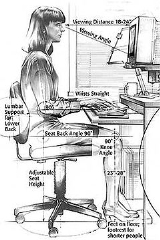
The best way to reduce pressure in the back is to be in a standing position. However, there are times when you need to sit. When sitting, the main part of the body weight is transferred to the seat. Some weight is also transferred to the floor, back rest, and armrests. Where the weight is transferred is the key to a good seat design. When the proper areas are not supported, sitting in a seat all day can put unwanted pressure on the back causing pain.

The lumbar (bottom five vertebrate in the spine) needs to be supported to decrease disc pressure. Providing both a seat back that inclines backwards and has a lumbar support is critical to prevent excessive low back pressures. The combination which minimizes pressure on the lower back is having a backrest inclination of 120 degrees and a lumbar support of 5 cm. The 120 degrees inclination means the angle between the seat and the backrest should be 120 degrees. The lumbar support of 5 cm means the chair backrest supports the lumbar by sticking out 5 cm in the lower back area.

Another key to reducing lumbar disc pressure is the use of armrests. They help by putting the force of your body not entirely on the seat and back rest, but putting some of this pressure on the armrests. Armrest needs to be adjustable in height to assure shoulders are not overstressed.

Organizations

The International Ergonomics Association (IEA) is a federation of ergonomics and human factors societies from around the world. The mission of the IEA is to elaborate and advance ergonomics science and practice, and to improve the quality of life by expanding its scope of application and contribution to society. As of September 2008, the International Ergonomics Association has 46 federated societies and 2 affiliated societies.

The International Society of Automotive Engineers
Society of Automotive Engineers

SAE International is a professional organization for mobility engineering professionals in the aerospace, automotive, and commercial vehicle industries....
 (SAE) is a professional organization for mobility engineering professionals in the aerospace, automotive, and commercial vehicle industries. The Society is a standards development organization for the engineering of powered vehicles of all kinds, including cars, trucks, boats, aircraft, and others. The Society of Automotive Engineers has established a number of standards used in the automotive industry and elsewhere. It encourages the design of vehicles in accordance with established Human Factors principles. It is one the most influential organizations with respect to Ergonomics work in Automotive Design. This society regularly holds conferences which address topics spanning all aspects of Human Factors/Ergonomics.

In the UK
United Kingdom

The United Kingdom of Great Britain and Northern Ireland, commonly known as the United Kingdom , the UK or Britain,is a sovereign state located off the northwestern coast of continental Europe....
 the professional body for ergonomists is the Ergonomics Society
Ergonomics Society

The Ergonomics Society is the United Kingdom-based professional society for ergonomists, human factors specialist and those involved in user-centred design....
 and in the USA it is the Human Factors and Ergonomics Society . In Europe professional certification is managed by the Centre for Registration of European Ergonomists (CREE). In the USA the Board of Certification in Professional Ergonomics performs this function.

See also

Related subjects
  • Back injury
    Back injury

    Back injuries often occur as a result in unfavorable pressures to the spine during day to day activity.Common thoughts on back injuries conclude that these are a result of incorrect lifting methods and posture....
  • Carpal tunnel syndrome
    Carpal tunnel syndrome

    Carpal tunnel syndrome , or median neuropathy at the wrist, is a medical condition in which the median nerve is compressed at the wrist, leading to paresthesias, numbness and muscle weakness in the hand....
  • Cognitive load
    Cognitive load

    Cognitive Load is a term that refers to the load on working memory during instruction.Instruction may be aimed at teaching learners problem solving skills, thinking and reasoning skills Many would agree that people learn better when they can build on what they already understand , but the more a person has to learn in a shorter amount of...
  • Human-computer interaction
  • Industrial noise
    Industrial noise

    Industrial noise is usually considered mainly from the point of view of environmental health and safety, rather than nuisance, as sustained exposure can cause permanent hearing damage....
  • Manual handling
    Manual handling

    Manual handling of loads , manual material handling or manutention involves the use of the human body to lift, lower, fill, empty, or carry loads....
  • Occupational health psychology
    Occupational health psychology

    Occupational health psychology is concerned with the psychosocial characteristics of workplaces that contribute to the development of health-related problems in people who work....
  • Repetitive strain injury
    Repetitive strain injury

    Repetitive strain injury , also known as Cumulative Trauma Disorder , occupational overuse syndrome, non-specific arm pain or work related upper limb disorder , is the most recent manifestation of illness concepts that link use of the arm to injury or disease....
Related fields
  • Anthropometrics
  • Environmental design
    Environmental design

    Environmental design is the process of addressing Natural environment parameters when devising plans, programs, policies, buildings, or products....
  • Industrial Design
    Industrial design

    Industrial design is an applied art whereby the aesthetics and usability of mass-produced Product may be improved for marketability and Manufacturing....
  • Industrial hygiene
  • Human factors
    Human factors

    Human factors is a term that covers:* The science of understanding the properties of human capability .* The application of this understanding to the design and development of systems and services ....
  • Light ergonomics
    Light ergonomics

    Light Ergonomics is defined as the relationship between the light source and the individual. Poor light can be divided into the following:*Insufficient light...
  • Occupational therapy
    Occupational therapy

    File:Occupational therapy psychiatric hospital.jpgOccupational Therapy, often abbreviated as "OT", incorporates meaningful and purposeful occupation to enable people with limitations or impairments to participate in everyday life....
  • Participatory Ergonomics
    Participatory Ergonomics

    Industrial Ergonomics programs seek to identify and correct factors that negatively impact the physical health of their workers. Participatory ergonomics programs seek to maximize the involvement of the workers in this process based on the simple fact that a worker is an expert on his or her job....
  • Systems engineering
    Systems engineering

    Systems engineering is an interdisciplinary field of engineering that focuses on how complex engineering projects should be designed and managed....
  • Systems psychology
    Systems psychology

    Systems psychology is a branch of applied psychology that studies human behaviour and experience in complex systems. It is inspired by systems theory and systems thinking, and based on the theoretical work of Roger Barker, Gregory Bateson, Humberto Maturana and others....
Related scientists
  • Shihab S. Asfour
    Shihab S. Asfour

    Shihab S. Asfour Ph.D. is a Professor and Chairman of the Industrial Engineering Department at the University of Miami in Coral Gables, Florida....
  • Savadi shiv Shankar
  • M. M. Ayoub
    M. M. Ayoub

    Dr. M.M. Ayoub is a retired P.W. Horn Professor of Industrial Engineering at Texas Tech University. He is a pioneer in the field of ergonomics, specifically relating to the application of mechanics to manual bulk material handling....
  • Henry Dreyfuss
    Henry Dreyfuss

    Henry Dreyfuss was an American industrial designer....
  • W. E. Hick
    W. E. Hick

    William Edmund Hick was a United Kingdom psychology, who was a pioneer in the new sciences of experimental psychology and ergonomics in the mid-20th century....
  • John Chris Jones
    John Chris Jones

    John Christopher Jones is a Welsh designer. He was born in 1927, in Aberystwyth, Wales. He studied engineering at the University of Cambridge, and went on to work for Associated Electrical Industries in Manchester, England....
  • K. Tara Smith
    K. Tara Smith

    K. Tara Smith is a United Kingdom human factors expert.K. Tara Smith is named after Tara Singh a close friend of his father?s. Smith is recognised as one of the most creative human factors practitioners in the UK....


Further reading

Books
  • Jan Dul and Bernard Weerdmeester, Ergonomics for Beginners - - A classic introduction on ergonomics - Original title: Vademecum Ergonomie (Dutch) -published and updated since 1960's
  • Stephen Pheasant, Bodyspace - - A classic exploration of ergonomics
  • Kim Vicente, The Human Factor Full of examples and statistics illustrating the gap between existing technology and the human mind, with suggestions to narrow it
  • Donald Norman, The Design of Everyday Things - - An entertaining user-centered critique of nearly every gadget out there (at the time it was published)
  • Liu, Y (2007). IOE 333. Course pack. Industrial and Operations Engineering 333 (Introduction to Ergonomics), University of Michigan, Ann Arbor, MI. Winter 2007
  • Wilson & Corlett, Evaluation of Human Work A practical ergonomics methodology. Warning: very technical and not a suitable 'intro' to ergonomics
  • Wickens and Hollands (200). Engineering Psychology and Human Performance. Discusses memory, attention, decision making, stress and human error, among other topics
  • Alvin R. Tilley & Henry Dreyfuss Associates (1993, 2002), The Measure of Man & Woman: Human Factors in Design A human factors design manual.
  • Valerie J Gawron (2000), Human Performance Measures Handbook Lawrence Erlbaum Associates - A useful summary of human performance measures.
  • Thomas J. Armstrong (2008), Chapter 10: Allowances, Localized Fatigue, Musculoskeletal Disorders, and Biomechanics (not yet published)


Peer-Reviewed Publications
(numbers between brackets are the ISI impact factor
Impact factor

The impact factor, often abbreviated IF, is a measure of the citations to scientific journal. It is frequently used as a proxy for the importance of a journal to its field....
 2001-2003)
  • Ergonomics (0.747)
  • Applied Ergonomics (0.738)
  • Human Factors (0.723)
  • International Journal of Industrial Ergonomics (0.395)
  • Human Factors and Ergonomics in Manufacturing (0.311)
  • Travail Humain (0.260)
  • Theoretical Issues in Ergonomics Science (-)
  • International Journal of Occupational Safety and Ergonomics (-)


Related software

  • 3D SSPP
  • ErgoFellow


External links


  • from European Agency for Safety and Health at Work
    European Agency for Safety and Health at Work

    The European Agency for Safety and Health at Work was set up in 1996 in Bilbao, Spain. Its mission is "to make Europe's workplaces safer, healthier and more productive....