

Sandinista National Liberation Front

Encyclopedia
The Sandinista National Liberation Front is a socialist political party
in Nicaragua
. Its members are called Sandinistas in both English and Spanish. The party is named after Augusto César Sandino
who led the Nicaraguan resistance against the United States occupation of Nicaragua in the 1930s.
The FSLN overthrew Anastasio Somoza Debayle
in 1979, ending the Somoza dynasty, and established a revolutionary government in its place. Following their seizure of power, the Sandinistas ruled Nicaragua from 1979 to 1990, first as part of a Junta of National Reconstruction
. Following the resignation of centrist members from this Junta, the FSLN took exclusive power in March 1981. They instituted a policy of mass literacy, devoted significant resources to health care, and promoted gender equality. Oppositional militias, known as Contras
, formed in 1981 to resist the Sandinista's Junta and received support from the U.S. Central Intelligence Agency
. The 1984 elections, described by international observers as fair and free, were nevertheless boycotted by the main opposition. The FSLN won the majority of the votes. Those who did oppose the Sandinistas won approximately a third of the seats. Despite the clear electoral victory for the Sandinistas, the Contras continued their violent attacks on both state and civilian targets, until 1989. The FSLN lost elections in 1990 to Violeta Barrios de Chamorro, after revising the constitution in 1987 and after years of resisting the United States–supported Contras, but they retained a plurality of seats in the legislature.
The FSLN remains one of Nicaragua's two leading parties. The FSLN often polls in opposition to the Constitutional Liberal Party, or PLC
. In the 2006 Nicaraguan general election
, former FSLN President Daniel Ortega
was re-elected President of Nicaragua
with 38.7% of the vote compared to 29% for his leading rival, bringing in the country's second Sandinista government after 16 years of the opposition winning elections. Ortega and the FSLN were re-elected again in the presidential election of 2011.
(1895–1934), the charismatic leader of Nicaragua's nationalist rebellion against the US occupation of the country during the early 20th century (ca. 1922 - 1934). Sandino was assassinated in 1934 by the National Guard
, the US-equipped police force of Anastasio Somoza
, whose family
ruled the country from 1936 until they were overthrown by the Sandinistas in 1979.
, and the National Autonomous University of Nicaragua
(UNAN) in Managua
were two of the principal centers of activity.
The FSLN itself was founded in 1961 by Carlos Fonseca, Silvio Mayorga, Tomás Borge
and others as The National Liberation Front (FLN). Only Tomás Borge lived long enough to see the Sandinista victory in 1979.
The term "Sandinista", was added two years later, establishing continuity with Sandino's movement, and using his legacy in order to develop the newer movement's ideology and strategy. By the early 1970s, the FSLN was launching limited military initiatives.
leveled the capital city, Managua
. The earthquake killed 10,000 of the city's 400,000 residents and left another 50,000 homeless. About 80% of Managua's commercial buildings were destroyed. President Anastasio Somoza Debayle
's National Guard embezzled much of the international aid that flowed into the country to assist in reconstruction, and several parts of downtown Managua were never rebuilt. The president gave reconstruction contracts preferentially to family and friends, thereby profiting from the quake and increasing his control of the city's economy. By some estimates, his personal wealth soared to US$400 million in 1974.
In December 1974, a guerrilla group affiliated with FSLN seized government hostages at a party in the house of the Minister of Agriculture in the Managua suburb Los Robles, among them several leading Nicaraguan officials and Somoza relatives. The siege was carefully timed for after the departure of the US ambassador from the gathering. At 10:50 pm, a group of 15 young guerrillas and their commanders, Pomares and Contreras, entered the house. They killed the Minister, who tried to shoot them, during the takeover. The guerrillas received US$2 million ransom, and had their official communiqué read over the radio and printed in the newspaper La Prensa
.
Over the next year, the guerrillas also succeeded in getting 14 Sandinista prisoners released from jail, and with them, were flown to Cuba
. One of the released prisoners was Daniel Ortega
, who would later become the president of Nicaragua (1985–1990). The group also lobbied for an increase in wages for National Guard
soldiers to 500 córdoba
s ($71 at the time). The Somoza government responded with further censorship
, intimidation
, torture
, and murder
.
In 1975, Somoza
imposed a state of siege, censoring the press, and threatening all opponents with internment
and torture. Somoza's National Guard also increased its violence against individuals and communities suspected of collaborating with the Sandinistas. Many of the FSLN guerrillas were killed, including its leader and founder Carlos Fonseca
in 1976. Fonseca had returned to Nicaragua in 1975 from his exile in Cuba to try to reunite fractures that existed in the FSLN. He and his group were betrayed by a peasant who informed the National Guard that they were in the area. The guerrilla group was ambushed, and Fonseca was wounded in the process. The next morning Fonseca was executed by the National Guard.
peasant support base in preparation for renewed rural guerrilla warfare
.
As a consequence of the repressive campaign of the National Guard, in 1975 a group within the FSLN's urban mobilization arm began to question the viability of the GPP. In the view of the young orthodox Marxist intellectuals, such as Jaime Wheelock
, economic development had turned Nicaragua into a nation of factory workers and wage-earning farm laborers. Wheelock's faction was known as the "Proletarian Tendency".
Shortly after, a third faction arose within the FSLN. The "Insurrectional Tendency", also known as the "Third Way" or Terceristas, led by Daniel Ortega
, his brother Humberto Ortega
, and Mexican-born Victor Tirado Lopez, was more pragmatic and called for tactical, temporary alliances with non-communists, including the right-wing opposition, in a popular front
against the Somoza
regime. By attacking the Guard directly, the Terceristas would demonstrate the weakness of the regime and encourage others to take up arms.
In October 1977, a group of prominent Nicaraguan professionals, business leaders, and clergymen allied with the Terceristas to form "El Grupo de los Doce
", (The Group of Twelve) in Costa Rica
. The group's main idea was to organize a provisional government from Costa Rica. The new strategy of the Terceristas also included unarmed strikes and rioting by labor and student groups coordinated by the FSLN's "United People's Movement" (Movimiento Pueblo Unido - MPU).
and leader of the "Democratic Union of Liberation" (Unión Democrática de Liberación - UDEL), was assassinated. Although his assassins were not identified at the time, evidence implicated President Somoza's son and other members of the National Guard. Spontaneous riots followed in several cities, while the business community organized a general strike demanding Somoza's resignation.
The Terceristas joined the turmoil in early February with attacks in several Nicaraguan cities. The National Guard responded by further increasing repression and using force to contain and intimidate all government opposition. The nationwide strike that paralyzed the country for ten days weakened the private enterprises and most of them decided to suspend their participation in less than two weeks. Meanwhile, Somoza
asserted his intention to stay in power until the end of his presidential term in 1981. The United States government showed its displeasure with Somoza by suspending all military assistance to the regime, but continued to approve economic assistance to the country for humanitarian reasons.
In August, the Terceristas staged a spectacular hostage-taking. Twenty-three Tercerista commandos led by Edén Pastora
seized the entire Nicaraguan congress and took nearly 1,000 hostages including Somoza's
nephew José Somoza Abrego and cousin Luis Pallais Debayle. Somoza
gave in to their demands and paid a $500,000 ransom, released 59 political prisoners (including GPP chief Tomás Borge), broadcasted a communiqué with FSLN's call for general insurrection and gave the guerrillas safe passage to Panama.
A few days later six Nicaraguan cities rose in revolt. Armed youths took over the highland city of Matagalpa
. Tercerista cadres attacked Guard posts in Managua
, Masaya
, León
, Chinandega
and Estelí
. Large numbers of semi-armed civilians joined the revolt and put the Guard garrisons of the latter four cities under siege. The September Insurrection of 1978 was subdued at the cost of several thousand, mostly civilian, casualties. Members of all three factions fought in these uprisings, which began to blur the divisions and prepare the way for unified action.
and the United States no longer supported the Somoza
regime, but did not want a left-wing government to take power in Nicaragua. The moderate "Broad Opposition Front" (Frente Amplio Opositor - FAO) which opposed Somoza was made up of a conglomeration of dissidents within the government as well as the "Democratic Union of Liberation" (UDEL) and the "Twelve", representatives of the Terceristas. The FAO and Carter came up with a plan that would remove Somoza from office but left no part in government power for the FSLN. The FAO's efforts lost political legitimacy, as Nicaraguans protested that they did not want "Somocismo sin Somoza" (Somocism without Somoza).
The "Twelve" abandoned the coalition in protest and formed the "National Patriotic Front" (Frente Patriotico Nacional - FPN) together with the "United People's Movement" (MPU). This strengthened the revolutionary organizations as tens of thousands of youths joined the FSLN and the fight against Somoza. A direct consequence of the spread of the armed struggle in Nicaragua was the official reunification of the FSLN that took place on 7 March 1979. Nine men, three from each tendency, formed the National Directorate which would lead the reunited FSLN. They were: Daniel Ortega
, Humberto Ortega
and Víctor Tirado (Terceristas); Tomás Borge, Bayardo Arce, and Henry Ruiz (GPP faction); and Jaime Wheelock
, Luis Carrión and Carlos Núñez.
regime. By mid-April 1979, five guerrilla fronts opened under the joint command of the FSLN, including an internal front in the capital city Managua
. Young guerrilla cadres and the National Guardsmen
were clashing almost daily in cities throughout the country. The strategic goal of the Final Offensive was the division of the enemy's forces. Urban insurrection was the crucial element because the FSLN could never hope to achieve simple superiority in men and firepower over the National Guard.
On June 4, a general strike was called by the FSLN to last until Somoza fell and an uprising was launched in Managua. On June 16, the formation of a provisional Nicaraguan government in exile, consisting of a five-member Junta of National Reconstruction
, was announced and organized in Costa Rica. The members of the new junta were Daniel Ortega
(FSLN), Moisés Hassan (FPN), Sergio Ramírez
(the "Twelve"), Alfonso Robelo
(MDN) and Violeta Barrios de Chamorro, the widow of La Prensa
s director Pedro Joaquín Chamorro. By the end of that month, with the exception of the capital, most of Nicaragua was under FSLN control, including León
and Matagalpa
, the two largest cities in Nicaragua after Managua.
On July 9, the provisional government in exile released a government program, in which it pledged to organize an effective democratic regime, promote political pluralism and universal suffrage, and ban ideological discrimination, except for those promoting the "return of Somoza's rule". On July 17, Somoza
resigned, handed over power to Francisco Urcuyo, and fled to Miami. While initially seeking remain in power to serve out Somoza's presidential term, Urcuyo seceded his position to the junta and fled to Guatemala
two days later.
On July 19, the FSLN army entered Managua, culminating the first goal of the Nicaraguan revolution. The war left approximately 50,000 dead and 150,000 Nicaraguans in exile. The five-member junta entered the Nicaraguan capital the next day and assumed power, reiterating its pledge to work for political pluralism, a mixed economic system, and a nonaligned foreign policy.
dollars (US)
, an estimated 50,000 war dead, 600,000 homeless, and a devastated economic infrastructure. To begin the task of establishing a new government, they created a Council (or ) of National Reconstruction, made up of five appointed members. Three of the appointed members belonged to FSLN, which included – Sandinista militants Daniel Ortega
, Moises Hassan, and novelist Sergio Ramírez
(a member of Los Doce
"the Twelve"). Two opposition members, businessman Alfonso Robelo
, and Violeta Barrios de Chamorro (the widow of Pedro Joaquín Chamorro), were also appointed. Only three votes were needed to pass law.
The FSLN also established a Council of State, subordinate to the junta, which was composed of representative bodies. However, the Council of State only gave political parties twelve of forty-seven seats, the rest of the seats were given to Sandinista mass-organizations. Of the twelve seats reserved for political parties, only three were not allied to the FSLN. Due to the rules governing the Council of State, in 1980 both non-FSLN junta members resigned. Nevertheless, as of the 1982 State of Emergency, opposition parties were no longer given representation in the council. The preponderance of power also remained with the Sandinistas through their mass organizations, including the Sandinista Workers' Federation , the Luisa Amanda Espinoza Nicaraguan Women's Association , the National Union of Farmers and Ranchers , and most importantly the Sandinista Defense Committees (CDS). The Sandinista controlled mass organizations were extremely influential over civil society and saw their power and popularity peak in the mid-1980s.
Upon assuming power, the FSLNs political platform included the following: nationalization of property owned by the Somozas and their supporters; land reform; improved rural and urban working conditions; free unionization for all workers, both urban and rural; price fixing for commodities of basic necessity; improved public services, housing conditions, education; abolition of torture, political assassination and the death penalty; protection of democratic liberties; equality for women; non-aligned foreign policy; formation of a "popular army" under the leadership of the FSLN and Humberto Ortega.
The FSLN's literacy campaign, which saw teachers flood the countryside, is often noted as their greatest success. Within six months, half a million people had been taught rudimentary reading, bringing the national illiteracy rate down from over 50% to just under 12%. Over 100,000 Nicaraguans participated as literacy teachers. One of the stated aims of the literacy campaign was to create a literate electorate which would be able to make informed choices at the promised elections. The successes of the literacy campaign was recognized by UNESCO
with the award of a Nadezhda Krupskaya International Prize.
The FSLN also created neighborhood groups similar to the Cuban Committees for the Defense of the Revolution
, called Sandinista Defense Committees ( or CDS). Especially in the early days following the overthrow of Somoza, the CDS's served as de facto units of local governance. Their obligations included political education, the organization of Sandinista rallies, the distribution of food rations, organization of neighborhood/regional cleanup and recreational activities, and policing to control looting, and the apprehension of counter-revolutionaries. The CDS's organized civilian defense efforts against Contra activities and a network of intelligence systems in order to apprehend their supporters. These activities led critics of the Sandinistas to argue that the CDS was a system of local spy networks for the government used to stifle political dissent, and it is true that the CDS did hold limited powers—such as the ability to suspend privileges such as driver licenses and passports—if locals refused to cooperate with the new government. After the initiation of full-scale U.S. military involvement in the Nicaraguan conflict the CDS was empowered to enforce wartime bans on political assembly and association with other political parties (i.e. parties associated with the "Contras
").
By 1980, conflicts began to emerge between the Sandinista and non-Sandinista members of the governing junta. Violeta Chamorro
and Alfonso Robelo
resigned from the governing junta in 1980, and rumours began that members of the Ortega junta would consolidate power amongst themselves. These allegations spread, and rumors intensified that it was Ortega's goal to turn Nicaragua into a state modeled after Cuba
n Socialism
. In 1979 and 1980, former Somoza supporters and ex-members of Somoza's National Guard formed irregular military forces, while the original core of the FSLN began to splinter. Armed opposition to the Sandinista Government eventually divided into two main groups: The Fuerza Democrática Nicaragüense (FDN), a U.S. supported army formed in 1981 by the CIA, U.S. State Department, and former members of the widely condemned Somoza-era Nicaraguan National Guard; and the Alianza Revolucionaria Democratica (ARDE) Democratic Revolutionary Alliance
, a group that had existed since before the FSLN and was led by Sandinista founder and former FSLN supreme commander, Edén Pastora, a.k.a. "Commander Zero". and Milpistas, former anti-Somoza rural militias, which eventually formed the largest pool of recruits for the Contras
. Although independent and often at conflict with each other, these guerrilla bands—along with a few others—all became generally known as "Contras
" (short for "", en. "counter-revolutionaries").
The opposition militias were initially organized and largely remained segregated according to regional affiliation and political backgrounds. They conducted attacks on economic, military, and civilian targets. During the Contra war, the Sandinistas arrested suspected members of the Contra militias and censored publications they accused of collaborating with the enemy (i.e. the U.S., the FDN, and ARDE, among others).
Under the new "Law for the Maintenance of Order and Public Security" the "Tribunales Populares Anti-Somozistas" allowed for the indefinite holding of suspected counter-revolutionaries without trial. The State of Emergency, however, most notably affected rights and guarantees contained in the "Statute on Rights and Guarantees of Nicaraguans. Many civil liberties were curtailed or canceled such as the freedom to organize demonstrations, the inviolability of the home, freedom of the press, freedom of speech and, the freedom to strike.
All independent news program broadcasts were suspended. In total, twenty-four programs were cancelled. In addition, Sandinista censor Nelba Cecilia Blandón issued a decree ordering all radio stations to hook up every six hours to government radio station, La Voz de La Defensa de La Patria.
The rights affected also included certain procedural guarantees in the case of detention including habeas corpus. The State of Emergency was not lifted during the 1984 elections
. There were many instances where rallies of opposition parties were physically broken up by Sandinsta youth or pro-Sandinista mobs. Opponents to the State of Emergency argued its intent was to crush resistance to the FSLN. James Wheelock justified the actions of the Directorate by saying "... We are annulling the license of the false prophets and the oligarchs to attack the revolution."
On October 5, 1985 the Sandinistas broadened the 1982 State of Emergency and suspended many more civil rights. A new regulation also forced any organization outside of the government to first submit any statement it wanted to make public to the censorsip bureau for prior censorship.
Some emergency measures were taken before 1982. In December 1979 special courts called "Tribunales Especiales" were established to speed up the processing of 7,000-8,000 National Guard prisoners. These courts operated through relaxed rules of evidence and due process and were often staffed by law students and inexperienced lawyers. However, the decisions of the "Tribunales Especiales" were subject to appeal in regular courts. Many of the National Guard prisoners were released immediately due to lack of evidence. Others were pardoned or released by decree. By 1986 only 2,157 remained in custody and only 39 were still being held in 1989 when they were released under the Esquipulas II agreement.
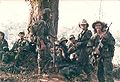 Upon assuming office in 1981, U.S. President Ronald Reagan
condemned the FSLN for joining with Cuba in supporting Marxist revolutionary movements in other Latin America
n countries such as El Salvador
. His administration authorized the CIA
to begin financing, arming and training rebels, most of whom were the remnants of Somoza's National Guard, as anti-Sandinista guerrillas that were branded "counter-revolutionary" by leftists ( in Spanish). This was shortened to Contras
, a label the anti-Communist forces chose to embrace. Edén Pastora
and many of the indigenous guerrilla forces, who were not associated with the "Somozistas", also resisted the Sandinistas.
The Contras operated out of camps in the neighboring countries of Honduras
to the north and Costa Rica
(see Edén Pastora cited below) to the south. As was typical in guerrilla warfare, they were engaged in a campaign of economic sabotage in an attempt to combat the Sandinista government and disrupted shipping by planting underwater mines in Nicaragua's Corinto harbour, an action condemned by the World Court
as illegal. The U.S. also sought to place economic pressure on the Sandinistas, and, as with Cuba, the Reagan administration
imposed a full trade embargo.
The armed resistance to the Sandinistas in Costa Rica initially called itself the Nicaraguan Revolutionary Democratic Alliance (ADREN) and was known as the 15th of September Legion. It later formed an alliance, called the Nicaraguan Democratic Force
(FDN), which comprised other groups including MISURASATA and the Nicaraguan Democratic Union
. Together, the members of these groups were generally called Contras. The Sandinistas condemned them as terrorists, and human rights organizations expressed serious concerns about the nature and frequency of Contra attacks on civilians. In 1982, the Congress
, passed the Boland Amendment
. This meant the US could no longer openly support the Contras with U.S. government funds.
After the U.S. Congress prohibited federal funding of the Contras in 1983, the Reagan administration continued to back the Contras by raising money from foreign allies and covertly selling arms to Iran
(then engaged in a vicious war with Iraq
), and channelling the proceeds to the Contras (see the Iran-Contra Affair
). When this scheme was revealed, Reagan admitted that he knew about Iranian "arms for hostages" dealings but professed ignorance about the proceeds funding the Contras; for this, National Security Council
aide Lt. Col.
Oliver North
took much of the blame.
Senator John Kerry
's 1988 U.S. Senate Committee on Foreign Relations report on links between the Contras and drug imports to the US concluded that "senior U.S. policy makers were not immune to the idea that drug money was a perfect solution to the Contras' funding problems." According to the National Security Archive
, Oliver North had been in contact with Manuel Noriega
, the US-backed president of Panama
. The Reagan administration's support for the Contras continued to stir controversy well into the 1990s. In August 1996, San Jose Mercury News
reporter Gary Webb
published a series titled Dark Alliance, linking the origins of crack cocaine
in California
(largely aimed at its African-American population) to the CIA-Contra alliance. Freedom of Information Act
inquiries by the National Security Archive and other investigators unearthed a number of documents showing that White House officials, including Oliver North, knew about and supported using money raised via drug trafficking to fund the Contras. Sen. John Kerry's report in 1988 led to the same conclusions. However, the Justice Department denied the allegations, and the mainstream US media downplayed them.
The Contra war unfolded differently in the northern and southern zones of Nicaragua. Contras based in Costa Rica operated on Nicaragua's Atlantic coast, which is sparsely populated by indigenous groups including the Miskito, Sumo
, Rama
, Garifuna, and Mestizo
. Unlike Spanish-speaking western Nicaragua, the Atlantic Coast is predominantly English-speaking and was largely ignored by the Somoza regime. The costeños did not participate in the uprising against Somoza and viewed Sandinismo with suspicion from the outset.
Like Gilbert, Cockburn writes about the infamous manual issued to the contras by the CIA. She writes that the CIA was encouraging Contra terror and then indirectly by the U.S. government and President Reagan, violating Reagan’s own Presidential Directive.
With this in mind, Cockburn’s claim seems valid: “The U.S. problem with the contras was that they were by and large the very same group who had been trained by the United States to protect the interests of the Somozas. Methods and techniques developed for a ruthless dictatorship already in power are not necessarily the best way to create a popular insurgency.”
The strong ties to Somoza decreased the potential to gain domestic support for the FDN, and prevented the U.S. guided unification operation, UNO: “The contra war had to be sold to Congress and the public as the struggle of an opposition united against the regime in Managua.” The revolutionary hero and commander of the contra force of southern Nicaragua ARDE (Nicaraguan Democratic Revolutionary Alliance), Eden Pastora, refused to cooperate with the FDN. When it comes to Pastora, we can see two contrasting images. Pardo-Maurer writes about a problem, a loose gun out of control, someone that has made himself a lot of enemies.
Pastora’s stubbornness/determination ultimately led to his officers being bribed to leave him, loss of his CIA support and an assassination attempt at his own press conference at La Penca in 1984. According to Pastora, this happened because “we didn’t want to be CIA soldiers.” The witness of Jack Terrell, a disillusioned American contra official corroborates this:
Yet, U.S. interventionism reached further than favoring some contras while neutralizing others. In 1983 the CIA decided to create a group of “Unilaterally Controlled Latino Assets”. These UCLA’s would “sabotage ports, refineries, boats and bridges, and try to make it look like the contras had done it.” In January 1984, these UCLA’s performed their most famous, or infamous, operation, the last straw that led to the ratifying of the Boland Amendment, the mining of several Nicaraguan harbors
However, Cockburn claims that the result of the supply network wasn’t military success but increased living standards for the contra leaders.
Oliver North came into the public spotlight as a result of his participation in the Iran-Contra affair, a political scandal of the late 1980s, in which he claimed partial responsibility for the sale of weapons via intermediaries to Iran, with the profits being channeled to the Contras in Nicaragua. He was reportedly responsible for the establishment of a covert network used for the purposes of aiding the Contras. U.S. funding of the Contras by appropriated funds spent by intelligence agencies had been prohibited by the Boland Amendment. Funding was facilitated through Palmer National Bank of Washington, D.C. It was founded in 1983 by Harvey McLean, Jr., a businessman from Shreveport, Louisiana. It was initially funded with $2.8 million dollars to McLean from Herman K. Beebe. Oliver North supposedly used this bank during the Iran-Contra scandal by funneling money from his shell organization, the "National Endowment for the Preservation of Liberty", through Palmer National Bank to the Contras.
According to the National Security Archive, in an August 23, 1986 e-mail to John Poindexter, Oliver North described a meeting with a representative of Panamanian President Manuel Noriega: "You will recall that over the years Manuel Noriega in Panama and I have developed a fairly good relationship", North writes before explaining Noriega's proposal. If U.S. officials can "help clean up his image" and lift the ban on arms sales to the Panamanian Defense Force, Noriega will "'take care of' the Sandinista leadership for us."
North tells Poindexter that Noriega can assist with sabotage against the Sandinistas, and supposedly suggests paying Noriega a million dollars cash; from "Project Democracy" funds raised from the sale of U.S. arms to Iran – for the Panamanian leader's help in destroying Nicaraguan economic installations.
In November 1986 as the sale of weapons was made public, North was fired by President Ronald Reagan, and in July 1987 he was summoned to testify before televised hearings of a joint Congressional committee formed to investigate Iran-Contra. The image of North taking the oath became iconic, and similar photographs made the cover of Time and Newsweek, and helped define him in the eyes of the public. During the hearings, North admitted that he had lied to Congress, for which he was later charged among other things. He defended his actions by stating that he believed in the goal of aiding the Contras, whom he saw as freedom fighters, and said that he viewed the Iran-Contra scheme as a "neat idea."
North was tried in 1988 in relation to his activities while at the National Security Council. He was indicted on sixteen felony counts and on May 4, 1989, he was initially convicted of three: accepting an illegal gratuity, aiding and abetting in the obstruction of a congressional inquiry, and destruction of documents (by his secretary, Fawn Hall, on his instructions). He was sentenced by U.S. District Judge Gerhard A. Gesell on July 5, 1989, to a three-year suspended prison term, two years probation, $150,000 in fines, and 1,200 hours community service.
However, on July 20, 1990, with the help of the American Civil Liberties Union (ACLU). http://www.aclukswmo.org/?page=Learn North's convictions were vacated, after the appeals court found that witnesses in his trial might have been impermissibly affected by his immunized congressional testimony.[8] Because North had been granted limited immunity for his Congressional testimony, the law prohibited the independent counsel (or any prosecutor) from using that testimony as part of a criminal case against him. To prepare for the expected defense challenge that North's testimony had been used, the prosecution team had - before North's congressional testimony had been given - listed and isolated all its evidence; further, the individual members of the prosecution team had isolated themselves from news reports and discussion of North's testimony. While the defense could show no specific instance where any part of North's congressional testimony was used in his trial, the Court of Appeals ruled that the trial judge had made an insufficient examination of the issue, and ordered North's convictions reversed. The Supreme Court declined to review the case. After further hearings on the immunity issue, Judge Gesell dismissed all charges against North on September 16, 1991, on the motion of the independent counsel.
A broad range of political parties, ranging in political orientation from far-left to far-right, competed for power. Following promulgation of a new populist constitution, Nicaragua held national elections in 1984. Independent electoral observers from around the world – including groups from the UN
as well as observers from Western Europe
– found that the elections had been fair. Several groups, however, disputed this: including UNO, a broad coalition of anti-Sandinista activists, COSEP, an organization of business leaders, the Contra group "FDN", organized by former Somozan-era National Guardsmen, landowners, businessmen, peasant highlanders, and what some claimed as their patron, the U.S. government.
Although initially willing to stand in the 1984 elections, the UNO, headed by Arturo Cruz
(a former Sandinista) declined participation in the elections based on their own objections to the restrictions placed on the electoral process by the State of Emergency and the official advisement of President Ronald Reagan
's State Department, who feared that their participation would legitimize the election process. Among other parties that abstained was COSEP, who had warned the FSLN that they would decline participation unless freedom of the press was reinstituted. Coordinadora Democrática (CD) also refused to file candidates and urged Nicaraguans not to take part in the election, the Independent Liberal Party (PLI), headed by Virgilio Godoy Reyes announced its refusal to participate in October. Consequently, when the elections went ahead the U.S. raised objections based upon political restrictions instituted by the State of Emergency (e.g. censorship of the press, cancellation of habeas corpus, and the curtailing of free assembly).
Daniel Ortega and Sergio Ramírez were elected president and vice-president, and the FSLN won an overwhelming 61 out of 96 seats in the new National Assembly
, having taken 67% of the vote on a turnout of 75%. Despite international validation of the elections by multiple political and independent observers (virtually all from among U.S. allies) the United States refused to recognize the elections, with President Ronald Reagan denouncing the elections as a sham. Daniel Ortega began his six-year presidential term on January 10, 1985. After the United States Congress turned down continued funding of the Contras
in April 1985, the Reagan administration ordered a total embargo on United States trade with Nicaragua the following month, accusing the Sandinista government of threatening United States security in the region.
, and inefficient economic policies, the state of the Nicaraguan economy declined. The elections of 1990, which had been mandated by the constitution passed in 1987, saw the Bush administration funnel $49.75 million of ‘non-lethal’ aid to the Contras
, as well as $9m to the opposition UNO—equivalent to $2 billion worth of intervention by a foreign power in a US election at the time, and proportionately five times the amount George Bush had spent on his own election campaign. When Violetta Chamorro visited the White House in November 1989, the US pledged to maintain the embargo against Nicaragua unless Violeta Chamorro won.
In August 1989, the month that campaigning began, the Contras
redeployed 8,000 troops into Nicaragua, after a funding boost from Washington, becoming in effect the armed wing of the UNO, carrying out a violent campaign of intimidation. No fewer than 50 FSLN candidates were assassinated. The Contras
also distributed thousands of UNO leaflets.
Years of conflict had left 50,000 casualties and $12b of damages in a society of 3.5m people and an annual GNP of $2b. The proportionately equivalent figures for the US would have been 5 million casualties and $25 trillion lost. After the war, a survey was taken of voters: 75.6% agreed that if the Sandinistas had won, the war would never have ended. 91.8% of those who voted for the UNO agreed with this. (William I Robinson, op cit) The Library of Congress Country Studies
on Nicaragua states:
(UNO), an alliance of 14 opposition parties ranging from the conservative business organization COSEP to Nicaraguan communists
. UNO's candidate, Violeta Barrios de Chamorro, replaced Daniel Ortega as president of Nicaragua.
Reasons for the Sandinista loss in 1990 are disputed. Defenders of the defeated government assert that Nicaraguans voted for the opposition due to the continuing U.S. economic embargo and potential Contra threat. Opponents claim that Contra warfare had largely died down, and that the Sandinistas had grown increasingly unpopular, particularly due to forced conscription and crackdowns on political freedoms. An important reason, regardless of perspective, was that after a decade of the U.S. backed war and embargo, Nicaragua's economy and infrastructure were badly damaged and the United States obviously supported only parties in opposition to the Sandinista. The U.S. also helped keep the rightist factions united so there would not be two strong rightist candidates.
After their loss, most of the Sandinista leaders held most of the private property and businesses that had been confiscated and nationalized by the FSLN government. This process became known as the "piñata" and was tolerated by the new Chamorro government. Ortega also claimed to "rule from below" through groups he controls such as labor unions and student groups. Prominent Sandinistas also created a number of nongovernmental organizations to promote their ideas and social goals.
Daniel Ortega remained the head of the FSLN, but his brother Humberto resigned from the party and remained at the head of the Sandinista Army, becoming a close confidante and supporter of Chamorro. The party also experienced a number of internal divisions, with prominent Sandinistas such as Ernesto Cardenal
and Sergio Ramírez
resigning to protest what they described as heavy-handed domination of the party by Daniel Ortega. Ramírez also founded a separate political party, the Sandinista Renovation Movement
(MRS); his faction came to be known as the , who favor a more social democratic
approach than the ortodoxos, or hardliners. In the 1996 Nicaraguan election, Ortega and Ramírez both campaigned unsuccessfully as presidential candidates on behalf of their respective parties, with Ortega receiving 43% of the vote while Arnoldo Alemán
of the Constitutional Liberal Party received 51%. The Sandinistas won second place in the congressional elections, with 36 of 93 seats.
Daniel Ortega was re-elected as leader of the FSLN in 1998. Municipal elections in November 2000 saw a strong Sandinista vote, especially in urban areas, and former Tourism Minister Herty Lewites
was elected mayor of Managua. This significant result led to expectations of a close race in the presidential elections scheduled for November 2001. Daniel Ortega and Enrique Bolaños
of the Constitutional Liberal Party
(PLC) ran neck-and-neck in the polls for much of the campaign, but in the end the PLC won a clear victory. The results of these elections
were that the FSLN won 42.6% of the vote for parliament (versus 52.6% for the PLC), giving them 41 out of the 92 seats in the National Assembly (versus 48 for the PLC). In the presidential race, Ortega lost to Bolaños 46.3% to 53.6%.
Daniel Ortega was once again re-elected as leader of the FSLN in March 2002 and re-elected as president of Nicaragua in November 2006.
was elected president with 38% of the vote (see Nicaraguan general election, 2006
). This occurred despite the fact that the breakaway Sandinista Renovation Movement
continued to oppose the FSLN, running former Mayor of Managua Herty Lewites
as its candidate for president. However, Lewites died just several month before the elections.
The ubiquitous Red and Black Sandinista flag was used during the election process along with the pink as it was one of the colours of a campaign that finished its popular appearances with John Lennon's Give Peace a Chance and the Sandinista Hymn "fighting against Yanqui agressors, enemies of humanity."
The FSLN also won 38 seats in the congressional elections, becoming the party with the largest representation in parliament. The split in the Constitutionalist Liberal Party helped to allow the FSLN to become the largest party in Congress, however it should be noted that the Sandinista vote had a minuscule split between the FSLN and MRS, and that the liberal party combined is larger than the Frente Faction. In 2010, several liberal congressmen raised accusations about the FSLN presumably attempting to buy votes in order to pass constitutional reforms that would allow Ortega to run for office for the 6th time since 1984.
"Zero Hunger" with its budget of US$150 million plans to deliver a US$2,000 bond or voucher to 75,000 rural families between 2007 and 2012. The voucher will consist of the delivery of a pregnant cow and a pregnant sow, five chickens and a rooster, seeds, fruit- bearing plants and plants for reforestation. The project's short-term objective is to have each rural family capable of producing enough milk, meat, eggs, fruits, vegetables and cereals to cover its basic needs while its medium range objective is to establish local markets and export certain products.
The families that benefit from the project will be required to pay back 20 percent of the amount that they receive in order to create a rural fund that will guarantee the continuity of the program. NGOs and representatives from each community will be in charge of managing the project.
The 2008 municipal elections, to which Ortega refused international monitoring have been condemned by many as fraudulent, and both European and US aid has been suspended. Two people were killed in post-election clashes.
, the life and times of Augusto César Sandino
became the unique symbol of this revolutionary force in Nicaragua
. The ideology of Sandinismo gained momentum in 1974, when a Sandinista initiated hostage situation resulted in the Somoza government adhering to FSLN demands and publicly printing and airing work on Sandino in well known newspapers and media outlets.
During the long struggle against Somoza
, the FSLN leaders' internal disagreements over strategy and tactics were reflected in three main factions:
Nevertheless, while ideologies varied between FSLN leaders, all leaders essentially agreed that Sandino provided a path for the Nicaragua masses to take charge, and the FSLN would act as the legitimate vanguard. The extreme end of the ideology links Sandino to Roman Catholicism and portrays him as descending from the mountains in Nicaragua knowing he would be betrayed and killed. Generally however, most Sandinistas associated Sandino on a more practical level, as a heroic and honest person who tried to combat the evil forces of imperialist national and international governments that existed in Nicaragua's history.
and his understanding of the lessons of Sandino. According to Bruce E. Wright, “the Governing Junta
of National Reconstruction agreed, under Sandinista leadership, that these principles had guided it in putting into practice a form of government that was characterized by those principles.” It is generally accepted that these following principles have evolved the “ideology of Sandinismo
.” Three of these (excluding popular participation, which was presumably contained in Article 2 of the Constitution of Nicaragua
) were to ultimately be guaranteed by Article 5 of the Constitution of Nicaragua
. They are as follows:
1. Political Pluralism – The ultimate success of the Sandinista Front in guiding the insurrection and in obtaining the leading fore within it was based on the fact that the FSLN, through the tercerista guidance, had worked with many sectors of the population in defeating the Somoza
dictatorship. The FSLN and all those whom would constitute the new provisional government were diverse; “they were plural in virtually all senses”.
2. Mixed Economy – Fonseca’s understanding of the fact that Nicaragua was not, in spite of Browderist interpretations, simply a feudal country and that it had also never really developed its own capitalism surely made it clear that a simple feudalism-capitalism-socialism path was not a rational way to think about the future development of Nicaragua. It was not reasonable, nor was it responsible, to simply believe that the FSLN was the vanguard of the proletariat revolution. Everyone recognized that the proletariat was but a minor fraction of the population. A complex class structure in a revolution based on unity among people from various class positions suggested more that it made sense to see the FSLN as the “vanguard of the people”.
3. Popular Participation and Mobilization – This calls for more than simple representative democracy. The inclusion of the mass organizations in the Council of State clearly manifested this conception. In Article 2 of the Constitution this is spelled out as follows: “The people exercise democracy, freely participating and deciding in the construction of the economic, political and social system what is most appropriate to their interest. The people exercise power directly and by their means of their representatives, freely elected in accord with universal, equal, direct, free, and secret suffrage.”
4. International Non-alignment – This is a clear result of the fundamentally Bolivarist conceptions of Sandino as distilled through the modern understanding of Fonseca. It was clear that the U.S. government and large U.S. economic entities were a significant part of the problem for Nicaragua. But experiences with the traditional parties allied with the Soviet Union had also been unsatisfactory. Thus it was clear that Nicaragua must seek its own road.
It is widely accepted by many scholars that the period of the FSLN guiding the Nicaraguan revolution through the control of the state was a living experiment in an attempt to construct a truly democratic and revolutionary socialism. Bruce E. Wright claims that “this was a crucial contribution from Fonseca’s work that set the template for FSLN governance during the revolutionary years and beyond."
n General Intelligence Directorate, or DGI, had begun to establish ties with various Nicaraguan revolutionary organizations. By 1970 the DGI had managed to train hundreds of Sandinista guerrilla leaders and had vast influence over the organization. After the successful ousting of Somoza, DGI involvement in the new Sandinista government expanded rapidly. An early indication of the central role that the DGI would play in the Cuban-Nicaraguan relationship is a meeting in Havana
on July 27, 1979, at which diplomatic ties between the two countries were re-established after more than 25 years. Julián López Díaz, a prominent DGI agent, was named Ambassador to Nicaragua. Cuban military and DGI advisors, initially brought in during the Sandinista insurgency, would swell to over 2,500 and operated at all levels of the new Nicaraguan government.
The Cubans would like to have helped more in the development of Nicaragua towards socialism. Following the US invasion of Grenada
, countries previously looking for support from Cuba saw that the United States was likely to take violent action to discourage this.
The early years of the Nicaraguan revolution had strong ties to Cuba. The Sandinista leaders acknowledged that the FSLN owed a great debt to the socialist island. Once the Sandinistas assumed power, Cuba gave Nicaragua
military advice, as well as aid in education, health care, vocational training and industry building for the impoverished Nicaraguan economy. In return, Nicaragua provided Cuba with grain
s and other foodstuffs to help Cuba overcome the effects of the US embargo
.
According to Cambridge University
historian
Christopher Andrew, who undertook the task of processing the Mitrokhin Archive
, Carlos Fonseca Amador, one of the original three founding members of the FSLN had been recruited by the KGB
in 1959 while on a trip to Moscow
. This was one part of Aleksandr Shelepin's 'grand strategy' of using national liberation movement
s as a spearhead of the Soviet Union's foreign policy in the Third World
, and in 1960 the KGB organized funding and training for twelve individuals that Fonseca handpicked. These individuals were to be the core of the new Sandinista organization. In the following several years, the FSLN tried with little success to organize guerrilla warfare
against the government of Luis Somoza Debayle
. After several failed attempts to attack government strongholds and little initial support from the local population, the National Guard nearly annihilated the Sandinistas in a series of attacks in 1963. Disappointed with the performance of Shelepin's new Latin American "revolutionary vanguard", the KGB reconstituted its core of the Sandinista leadership into the ISKRA
group and used them for other activities in Latin America.
According to Andrew, Mitrokhin
says during the following three years the KGB handpicked several dozen Sandinistas for intelligence and sabotage operations in the United States. Andrew and Mitrokhin say that in 1966, this KGB-controlled Sandinista sabotage and intelligence group was sent to northern Mexico
near the US border to conduct surveillance for possible sabotage
.
In July 1961 during the Berlin Crisis of 1961
KGB chief Alexander Shelepin sent a memorandum to Soviet premier Nikita Khrushchev
containing an array of proposals to create a situation in various areas of the world which would favor dispersion of attention and forces by the US and their satellites, and would tie them down during the settlement of the question of a German peace treaty and West Berlin
. It was planned, inter alia, to organize an armed mutity in Nicaragua in coordination with Cuba
and with the "Revolutionary Front Sandino". Shelepin proposed to make appropriations from KGB funds in addition to the previous assistance $10,000 for purchase of arms.
Khrushchev sent the memo with his approval to his deputy Frol Kozlov
and on August 1 it was, with minor revisions, passed as a CPSU Central Committee
directive. The KGB and the Soviet Ministry of Defense were instructed to work out more; specific measures and present them for consideration by the Central Committee.
Other researchers have documented the contribution made from other Warsaw Pact
intelligence agencies to the fledgling Sandinista government including the East German Stasi
, by using recently declassified documents from Berlin
as well as from former Stasi spymaster Markus Wolf
who described the Stasi's assistance in the creation of a secret police
force modeled on East Germany's
. Nicaragua was a country with a very high rate of illiteracy, but the campaign succeeded in lowering the rate from 50% to 12%. The revolution in Cuban education
since the ousting of the US-backed Batista
regime not only served as a model for Nicaragua but also provided technical assistance and advice. The Literacy Campaign was one of the success stories of the Sandinistas' reign and Cuba played an important part in this, providing teachers on a yearly basis after the revolution. Prevost states that "Teachers were not the only ones studying in Cuba, about 2,000 primary and secondary students were studying on the Isle of Youth and the cost was covered by the host country (Cuba)".
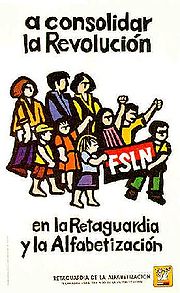 The 1980 Literacy Campaign is considered to have been a major contribution to Nicaraguan society during the Sandinista rule. The goals of the literacy campaign were socio-political, strategic as well as educational. It was the most prominent campaign with regards to the new education system. Illiteracy in Nicaragua was significantly reduced from 50.3% to 12.9%. One of the government's major concerns was the previous education system under the Somoza regime which did not see education as a major factor on the development of the country. As mentioned in the Historical Program of the FSLN of 1969, education was seen as a right and the pressure to stay committed to the promises made in the program was even stronger. 1980 was declared the "Year of Literacy" and the major goals of the campaign that started only 8 months after the FSLN took over. This included the eradication of illiteracy, the integration of different classes, races, gender and age. Political awareness and the strengthening of political and economic participation of the Nicaraguan people was also a central goal of the Literacy Campaign. The campaign was a key component of the FSLN's cultural transformation agenda.
The basic reader which was disseminated and used by teacher was called "Dawn of the People" based on the themes of Sandino, Carlos Fonseca, and the Sandinista struggle against imperialism and defending the revolution. Political education was aimed at creating a new social values based on the principles of Sandinista socialism, such as social solidarity, worker's democracy, egalitarianism, and anti-imperialism.
was another area where the Sandinistas made incredible gains and are widely recognized for this accomplishment, e.g. by Oxfam
. In this area Cuba also played a role by again offering expertise and know-how to Nicaragua. Over 1,500 Cuban doctors worked in Nicaragua and provided more than five million consultations. Cuban personnel were essential in the elimination of polio, the decrease in whooping cough, rubella
, measles
and the lowering of the infant mortality
rate. Gary Prevost states that Cuban personnel made it possible for Nicaragua to have a truly national health care system reaching a majority of its citizens.
, imposed by the Reagan administration
in May 1985, made it impossible for Nicaragua to receive spare parts for US-made machines, so this led Nicaragua to look to other countries for help. Cuba was the best choice because of the shared language and proximity and also because it had imported similar machinery over the years. Nicaraguans went to Cuba for short periods of three to six months and this training involved close to 3,000 workers. Many countries, including Canada
and the UK, sent farm equipment to Nicaragua.
mills. Cuba also attempted to help Nicaragua build the first overland route linking Nicaragua's Atlantic and Pacific coasts. The road was meant to traverse 260 miles of jungle
, but completion of the road and usage was hindered by the Contra war
, and it was never completed.
Another significant feat was the building of the Tipitapa
-Malacatoya sugar mill. It was completed and inaugurated during a visit by Fidel Castro
in January 1985. The plant used the newest technology available and was built by workers trained in Cuba. Also during this visit Castro announced that all debts incurred on this project were absolved. Cuba also provided numerous technicians to aid in the sugar harvest and assist in the rejuvenation of several old sugar mills. Cubans also assisted in building schools and similar projects.
, a famous poet and priest. The ministry was established in order to socialize the modes of cultural production. This extended to various art forms, including dance, music, art, theatre and poetry. The project was created to democratize culture on a national level. The aim of the ministry was to "democratize art" by making it accessible to all social classes as well as protecting the right of the oppressed to produce, distribute and receive art. In particular, the ministry was devoted to the development of working class and campesino, or peasant culture. Therefore, the ministry sponsored cultural workshops throughout the country until October 1988 when the Ministry of Culture was integrated into the Ministry of Education because of financial troubles.
The objective of the workshops was to recognize and celebrate neglected forms of artistic expression. The ministry created a program of cultural workshops known as, Casas de Cultura and Centros Populares de Cultura. The workshops were setup in poor neighbourhoods and rural areas and advocated universal access and consumption of art in Nicaragua. The ministry assisted in the creation of theatre groups, folklore and artisanal production, song groups, new journals of creation and cultural criticism, and training programs for cultural workers. Moreover, the ministry created a Sandinista daily newspaper named Barricada and its weekly cultural addition named Ventana along with the Television Sandino, Radio Sandino and the Nicaraguan film production unit called the INCINE. There were existing papers which splintered after the revolution and produced other independent, pro-Sandinista newspapers, such as El Nuevo Diario and its literary addition Nuevo Amanecer Cultural. Furthermore, Editorial Nueva Nicaragua a state publishing house for literature was created. The ministry collected and published political poetry of the revolutionary period, known as testimonial narrative, a form of literary genre that recorded the experiences of individuals in the course of the revolution.
The ministry also developed a new anthology of Ruben Dario
, a Nicaraguan poet and writer, established a Ruben Dario prize for Latin American writers, the Leonel Rugama prize for young Nicaraguan writers, as well as public poetry readings and contests, cultural festivals and concerts. The Sandinista regime tried to keep the revolutionary spirit alive by empowering its citizens artistically. At the time of its inception, the Ministry of Culture needed according to Cardenal, “to bring a culture to the people who were marginalized from it. We want a culture that is not the culture of an elite, of a group that is considered ‘cultivated,’ but rather of an entire people.” Nevertheless, the success of the Ministry of Culture had mixed results and by 1985 criticism arose over artistic freedom in the poetry workshops. The poetry workshops became a matter for criticism and debate. Critics argued that the ministry imposed too many principles and guidelines for young writers in the workshop, such as, asking them to avoid metaphors in their poetry and advising them to write about events in their everyday life. Critical voices came from established poets and writers represented by the Asociacion Sandinista de Trabajadores de la Cultura (ASTC) and from the Ventana both of which were headed by Rosario Murillo
. They argued that young writers should be exposed to different poetic styles of writing and resources developed in Nicaragua and elsewhere. Furthermore, they argued that the ministry exhibited a tendency that favored and fostered political and testimonial literature in post-revolutionary Nicaragua.
However, the ideology of the Sandinistas put the future of the private sector and of private ownership of the means of production in doubt. Even though under the new government both public and private ownership were accepted, government spokespersons occasionally referred to a reconstruction phase in the country's development, in which property owners and the professional class would be tapped for their managerial and technical expertise. After reconstruction and recovery, the private sector would give way to expanded public ownership in most areas of the economy. Despite such ideas, which represented the point of view of a faction of the government, the Sandinista government remained officially committed to a mixed economy.
Economic growth was uneven in the 1980s. Restructuring of the economy and the rebuilding immediately following the end of the civil war caused the GDP to jump about 5 percent in 1980 and 1981. Each year from 1984 to 1990, however, showed a drop in the GDP. Reasons for the contraction included the reluctance of foreign banks to offer new loans, the diversion of funds to fight the new insurrection against the government, and, after 1985, the total embargo on trade with the United States, formerly Nicaragua's largest trading partner. After 1985 the government chose to fill the gap between decreasing revenues and mushrooming military expenditures by printing large amounts of paper money. Inflation
skyrocketed, peaking in 1988 at more than 14,000 percent annually.
Measures taken by the government to lower inflation were largely wiped out by natural disaster. In early 1988, the administration of Daniel José Ortega Saavedra (Sandinista junta coordinator 1979-85, president 1985-90) established an austerity program to lower inflation. Price controls were tightened, and a new currency was introduced. As a result, by August 1988, inflation had dropped to an annual rate of 240 percent. The following month, however, Hurricane Joan cut a devastating path directly across the center of the country. Damage was extensive, and the government's program of massive spending to repair the infrastructure destroyed its anti-inflation measures.
In its eleven years in power, the Sandinista government never overcame most of the economic inequalities that it inherited from the Somoza era. Years of war, policy missteps, natural disasters, and the effects of the United States trade embargo all hindered economic development. The early economic gains of the Sandinistas were wiped out by seven years of sometimes precipitous economic decline, and in 1990, by most standards, Nicaragua and most Nicaraguans were considerably poorer than they were in the 1970s.
Supporters of the Sandinistas see their era as characterized by the creation and implementation of successful social programs which were free and made widely available to the entire nation. Some of the more successful programs for women that were implemented by the Sandinistas were in the areas of Education Nicaraguan Literacy Campaign
, Health, and Housing. Providing subsidies for basic foodstuffs and the introduction of mass employment were also memorable contributions of the FSLN. The Sandinistas were particularly advantageous for the women of Nicaraguan as they promoted progressive views on gender as early as 1969 claiming that the revolution would "abolish the detestable discrimination that women have suffered with regard to men and establish economic, political and cultural equality between men and women." This was evident as the FSLN began integrating women into their ranks by 1967, unlike other left-wing guerilla groups in the region. Considering the Feminist Ideology During the Sandinista Revolution however, demonstrates that this goal was not fully reached because the roots of gender inequality were not explicitly challenged or deconstructed. Women's participation within the public sphere was also substantial, as many took part in the armed struggle as part of the FSLN or as part of counter-revolutionary forces.
Nicaraguan women also organized independently in support of the revolution and their cause. Some of those organizations were the Socialist Party (1963), Federación Democrática (which support the FSLN in rural areas), and Luisa Amanda Espinoza Association of Nicaraguan Women
. However, since Daniel Ortega
, was defeated in the 1990 election by the United Nicaraguan Opposition
(UNO) coalition headed by Violeta Chamorro
, the situation for women in Nicaragua was seriously altered. In terms of women and the labor market, by the end of 1991 AMNLAE reported that almost 16,000 working women- 9,000 agricultural laborers, 3,000 industrial workers, and 3,800 civil servants, including 2,000 in health, 800 in education, and 1,000 in administration- had lost their jobs. The change in government also resulted in the drastic reduction or suspension of all Nicaraguan social programs, which brought back the burdens characteristic of pre-revolutionary Nicaragua. The women were forced to maintain and supplement community social services on their own without economic aid or technical and human resource.
's relationship with the Sandinistas was extremely complex. Initially, the Church was committed to supporting the Somoza regime. The Somoza dynasty was willing to secure the Church a prominent place in society as long as it did not attempt to subvert the authority of the regime. Under the constitution of 1950 the Roman Catholic Church was recognized as the official religion and church-run schools flourished. It was not until the late 1970s that the Church began to speak out against the corruption and human rights abuses that characterized the Somoza regime.
The Catholic hierarchy initially disapproved of the Sandinistas' revolutionary struggle against the Somoza dynasty. In fact, the revolutionaries were perceived as proponents of "godless communism" that posed a threat to the traditionally privileged place that the Church occupied within Nicaraguan society. Nevertheless, the increasing corruption and repression characterizing the Somoza rule and the likelihood that the Sandinistas would emerge victorious ultimately influenced Archbishop Miguel Obando y Bravo
to declare formal support for the Sandinistas' armed struggle. Throughout the revolutionary struggle, the Sandinistas enjoyed the grassroots support of clergy who were influenced by the reforming zeal of Vatican II and dedicated to a "preferential option for the poor" (for comparison, see liberation theology
). Numerous Christian base communities (CEBs) were created in which lower level clergy and laity took part in consciousness raising initiatives to educate the peasants about the institutionalized violence they were suffering from. Some priests took a more active role in supporting the revolutionary struggle. For example, Father Gaspar García Laviana
took up arms and became a member of FSLN.
Soon after the Sandinistas assumed power, the hierarchy began to oppose the Sandinistas government. The Archbishop was a vocal source of domestic opposition. The hierarchy was alleged to be motivated by fear of the emergence of the 'popular church' which challenged their centralized authority. The hierarchy also opposed social reforms implemented by the Sandinistas to aid the poor, allegedly because they saw it as a threat to their traditionally privileged position within society. In response to this perceived opposition, the Sandinistas shut down the church-run Radio Católica radio station on multiple occasions.
The Sandinistas' relationship with the Roman Catholic Church
deteriorated as the Contra
War dragged on. The hierarchy refused to speak out against the counterrevolutionary activities of the contras and failed to denounce American military aid. State media accused the Catholic Church of being reactionary and supporting the Contras
. According to former President Ortega, "The conflict with the church was strong, and it costs us, but I don't think it was our fault... ...There were so many people being wounded every day, so many people dying, and it was hard for us to understand the position of the church hierarchy in refusing to condemn the contras." The hierarchy-state tensions were brought to the forefront with Pope John Paul II 1983 visit to Nicaragua
. Hostility to the Catholic Church became so great that at one point, FSLN militants shouted down Pope John Paul II as he tried to say Mass. Therefore, while the activities of the 'popular church' contributed to the success of the Sandinista revolution, the hierarchy's opposition was a major factor in the downfall of the revolutionary government.
prisoners and make it look like they had died in combat. Another article described Sandinista neighbourhood "Defense Committees", modeled on similar Cuban Committees for the Defense of the Revolution
, which according to critics were used to unleash mobs on anyone who was labeled a counterrevolutionary. Nicaragua's only opposition newspaper, La Prensa, was subject to strict censorship. The newspaper's editors were forbidden to print anything negative about the Sandinistas either at home or abroad.
The Inter-American Commission on Human Rights
(IACHR) in a 1981 report found evidence for mass executions in the period following the revolution. It stated "In the Commission's view, while the government of Nicaragua clearly intended to respect the lives of all those defeated in the civil war, during the weeks immediately subsequent to the Revolutionary triumph, when the government was not in effective control, illegal executions took place which violated the right to life, and these acts have not been investigated and the persons responsible have not been punished." The IACHR also stated that: "The Commission is of the view that the new regime did not have, and does not now have, a policy of violating the right to life of political enemies, including among the latter the former guardsmen of the Government of General Somoza, whom a large sector of the population of Nicaragua held responsible for serious human rights violations during the former regime; proof of the foregoing is the abolition of the death penalty and the high number of former guardsmen who were prisoners and brought to trial for crimes that constituted violations of human rights."
A 1983 report from the same source documented allegations of human rights violations against the Miskito Indians, which were alleged to have taken place after opposition forces (the Contras
) infiltrated a Miskito village in order to launch attacks against government soldiers, and as part of a subsequent forced relocation program. Allegations included arbitrary imprisonment without trial, "disappearances
" of such prisoners, forced relocation, and destruction of property. In late 1981, the CIA conspiracy "Operation Red Christmas" was exposed to separate the Atlantic region from the rest of Nicaragua. Red Christmas aimed to seize territory on Nicaragua's mainland and overthrow the Nicaraguan government. The Nicaraguan government responded to the provocations by transferring some 8500 Miskitos 50 miles south to a settlement called Tasba Pri. The U.S. government accused Nicaragua of "genocide". The U.S. government produced a photo alleged to showed Miskito bodies being burned by Sandinista troops; however, the photo was of people killed by Somoza's National Guard in 1978.
The 1991 annual report by the same organization, "In September 1990, the Commission was informed of the discovery of common graves in Nicaragua, especially in areas where fighting had occurred. The information was provided by the Nicaraguan Pro Human Rights Association, which had received its first complaint in June 1990. By December 1991, that Association had received reports of 60 common graves and had investigated 15 of them. While most of the graves seem to be the result of summary executions by members of the Sandinista People's Army or the State Security, some contain the bodies of individuals executed by the Nicaraguan Resistance."
The 1992 annual report by the same organization contains details of mass graves and investigations which suggest that mass executions had been carried out. One such grave contained 75 corpses of peasants who were believed to have been executed in 1984 by government security forces pretending to be members of the contras. Another grave was also found in the town of Quininowas which contained six corpses, believed to be an entire family killed by government forces when the town was invaded. A further 72 graves were reported as being found, containing bodies of people, the majority of whom were believed to have been executed by agents of the state and some also by the contras.
report and the Demokratizatsiya
article are references to alleged policies of religious persecution, particularly anti-semitism. The ICCHRLA in its newsletter stated that: "From time to time the current U.S. administration, and private organizations sympathetic to it, have made serious and extensive allegations of religious persecution in Nicaragua. Colleague churches in the United States undertook onsite investigation of these charges in 1984. In their report, the delegation organized by the Division of Overseas Ministries of the National Council of Churches of Christ in the United States concluded that there is 'no basis for the charge of systematic religious persecution'. The delegation 'considers this issue to be a device being used to justify aggressive opposition to the present Nicaraguan government.'" On the other hand, some elements of the Catholic Church in Nicaragua, among them Archbishop Miguel Obando y Bravo
, strongly criticized the Sandinistas. The Archbishop stated "The government wants a church that is aligned with the Marxist-Leninist regime." The Inter-American Commission on Human Rights
states that: "Although it is true that much of the friction between the Government and the churches arises from positions that are directly or indirectly linked to the political situation of the country, it is also true that statements by high government officials, official press statements, and the actions of groups under the control of the Government have gone beyond the limits within which political discussions should take place and have become obstacles to certain specifically religious activities."
Human Rights Watch
also stated in its 1989 report on Nicaragua that: "Under the Reagan administration, U.S. policy toward Nicaragua's Sandinista government was marked by constant hostility. This hostility yielded, among other things, an inordinate amount of publicity about human rights issues. Almost invariably, U.S. pronouncements on human rights exaggerated and distorted the real human rights violations of the Sandinista regime, and exculpated those of the U.S.-supported insurgents, known as the contras."
In 1987, a report was published by the UK based NGO Catholic Institute for International Relations (CIIR, now known as "Progressio"), a human rights organization which identifies itself with Liberation theology
. The report, "Right to Survive - Human Rights in Nicaragua", discussed the politicisation of the human rights issue: "The Reagan administration, with scant regard for the truth, has made a concerted effort to paint as evil a picture as possible of Nicaragua, describing it as a 'totalitarian dungeon'. Supporters of the Sandinistas ... have argued that Nicaragua has a good record of human rights compared with other Central American countries and have compared Nicaragua with other countries at war." The CIIR report refers to estimates made by the NGO Americas Watch which count the number of non-battle related deaths and disappearances for which the government was responsible up to the year 1986 as "close to 300".
According to the CIIR report, Amnesty International and Americas Watch stated that there is no evidence that the use of torture was sanctioned by the Nicaraguan authorities, although prisoners reported the use of conditions of detention and interrogation techniques that could be described as psychological torture. The Red Cross made repeated requests to be given access to prisoners held in state security detention centers, but were refused. The CIIR was critical of the Permanent Commission on Human Rights (PCHR or CPDH in Spanish), claiming that the organisation had a tendency to immediately publish accusations against the government without first establishing a factual basis for the allegations. The CIIR report also questioned the independence of the Permanent Commission on Human Rights, referring to an article in the Washington Post which claims that the National Endowment for Democracy
, an organization funded by the US government, allocated a concession of US$50,000 for assistance in the translation and distribution outside Nicaragua of its monthly report, and that these funds were administered by Prodemca, a US-based organization which later published full-page adverisments in the Washington Post and New York Times supporting military aid to the Contras. The Permanent Commission denies that it received any money which it claims was instead used by others for translating and distributing their monthly reports in other nations.
The Nicaraguan based magazine Revista Envio, which describes its stance as one of "critical support for the Sandinistas", refers to the report: "The CPDH: Can It Be Trusted?" written by Scottish lawyer Paul Laverty. In the report, Laverty observes that: "The entire board of directors [of the Permanent Commission], are members of or closely identify with the 'Nicaraguan Democratic Coordinating Committee' (Coordinadora), an alliance of the more rightwing parties and COSEP, the business organization." He goes on to express concern about CPDH's alleged tendency to provide relatively few names and other details in connection with alleged violations. "According to the 11 monthly bulletins of 1987 (July being the only month without an issue), the CPDH claims to have received information on 1,236 abuses of all types. However, of those cases, only 144 names are provided. The majority of those 144 cases give dates and places of alleged incidents, but not all. This means that only in 11.65% of its cases is there the minimal detail provided to identify the person, place, date, incident and perpetrator of the abuse."
On the other hand, the Inter-American Commission on Human Rights
states: "During its on-site observation in 1978 under the Government of General Somoza, the Permanent Commission on Human Rights in Nicaragua, (CPDH) gave the Commission notable assistance, which certainly helped it to prepare its report promptly and correctly." and in 1980 "It cannot be denied that the CPDH continues to play an important role in the protection of human rights, and that a good number of people who consider that their human rights have been ignored by the Government are constantly coming to it." The IACHR also continued to meet with representatives of the Permanent Commission and report their assessments in later years.
The Heritage Foundation
stated that: "While elements of the Somoza National Guard tortured political opponents, they did not employ psychological torture." The International Commission of Jurists
stated that under the Somoza regime cruel physical torture was regularly used in the interrogation of political prisoners.
The first allegation supporting the FMLN rebels in El Salvador
with safehaven; training; command-and-control headquarters and advice; and weapons, ammunition, and other vital supplies. As evidence was cited captured documents, testimonials of former rebels and Sandinistas, aerial photographs, tracing captured weapons back to Nicaragua, and captured vehicles from Nicaragua smuggling weapons. El Salvador was in the midst of a Civil War in the period in question and the US was heavily supporting El Salvador against the FMLN guerrillas.
There were also accusations of subversive activities in Honduras
, Costa Rica
, and Colombia
and in the case of Honduras and Costa Rica outright military operations by Nicaraguan troops.
 The flag of the FSLN consists of an upper half in red, a lower half in black, and the letters F S L N in white. It is a modified version of the flag Sandino used in the 1930s, during the war against the U.S. occupation of Nicaragua
which consisted of two vertical stripes, equally in size, one red and the other black with a skull (like the traditional Jolly Roger
flag). These colors came from the Mexican anarchist movements that Sandino got involved with during his stay in Mexico
in the early 1920s.
In recent times, there has been a dispute between the FSLN and the dissident Sandinista Renovation Movement
(MRS) about the use of the red and black flag in public activities. Although the MRS has its own flag (orange with a silhouette of Sandino's hat in black), they also use the red-and-black flag in honor of Sandino's legacy. They state that the red-and-black flag is a symbol of Sandinismo
as a whole, not only of the FSLN party.
As a reaction to an anti-Sandinista statement by British Prime Minister Margaret Thatcher
and her proposal to ban the use of the word itself, punk rock group The Clash
used the title Sandinista!
for their 1980 triple album. The album contains the song "Washington Bullets
" which references the Sandinistas and other events and groups involved in Latin American history, starting from 1959.
English anarcho-punk
band Chumbawamba
recorded the song "An Interlude: Beginning To Take It Back" on their album "Pictures of Starving Children Sell Records
". The song chronicles the history of the Sandinistas, as well as their conflict with the Contras, and reflects an optimistic hope for the future of Nicaragua.
Chile
an social rock group Los Prisioneros
mention the Sandinistas in their song ¿Quién mató a Marilyn?
, in a passage asking who killed Marilyn Monroe
.
In 2007, the popular Puerto Rican
Reggaeton–rap band Calle 13
mentioned the Sandinista movement in their song "Llegale a mi guarida". The lyrics claimed: "Respeto a Nicaragua y a la lucha sandinista" ("I respect Nicaragua and the Sandinista struggle").
In an episode of the 1980s American sitcom The Golden Girls, Blanche, Dorothy, and Rose return home to find Sophia bound, gagged, and tied to a chair. When Dorothy removed the gag and asked who had done this to her, Sophia replied "the Sandinistas!" (It was really a released prisoner named Merrill, who was searching for Blanche.)
The 1983 film Last Plane Out
about journalist Jack Cox's experiences in Nicaragua portrayed the Sandanistas as crazed communist psychopaths while making Anastasio Somoza Debayle
look like a sympathetic hero.
The 2010 video game Metal Gear Solid: Peace Walker
includes a fictional group of FSLN Revolutionaries forced into Costa Rica as an important group of supporting characters. The Anti-Somoza revolution itself figures prominently into the plot of the game as well, being described within the game's narrative as being started by the fictional KGB agent Vladimir Zadornov in order to make Nicaragua a communist state so the Soviet Union could force the United States out of Central America entirely.
Political party
A political party is a political organization that typically seeks to influence government policy, usually by nominating their own candidates and trying to seat them in political office. Parties participate in electoral campaigns, educational outreach or protest actions...
in Nicaragua
Nicaragua
Nicaragua is the largest country in the Central American American isthmus, bordered by Honduras to the north and Costa Rica to the south. The country is situated between 11 and 14 degrees north of the Equator in the Northern Hemisphere, which places it entirely within the tropics. The Pacific Ocean...
. Its members are called Sandinistas in both English and Spanish. The party is named after Augusto César Sandino
Augusto César Sandino
Augusto Nicolás Calderón Sandino was a Nicaraguan revolutionary and leader of a rebellion against the U.S. military occupation of Nicaragua between 1927 and 1933...
who led the Nicaraguan resistance against the United States occupation of Nicaragua in the 1930s.
The FSLN overthrew Anastasio Somoza Debayle
Anastasio Somoza Debayle
Anastasio Somoza Debayle was a Nicaraguan leader and officially the 73rd and 76th President of Nicaragua from 1 May 1967 to 1 May 1972 and from 1 December 1974 to 17 July 1979. As head of the National Guard, he was de facto ruler of the country from 1967 to 1979...
in 1979, ending the Somoza dynasty, and established a revolutionary government in its place. Following their seizure of power, the Sandinistas ruled Nicaragua from 1979 to 1990, first as part of a Junta of National Reconstruction
Junta of National Reconstruction
The Junta of National Reconstruction officially ruled Nicaragua from July 1979 to January 1985, though effective power was in the hands of the Sandinista National Liberation Front's National Directorate....
. Following the resignation of centrist members from this Junta, the FSLN took exclusive power in March 1981. They instituted a policy of mass literacy, devoted significant resources to health care, and promoted gender equality. Oppositional militias, known as Contras
Contras
The contras is a label given to the various rebel groups opposing Nicaragua's FSLN Sandinista Junta of National Reconstruction government following the July 1979 overthrow of Anastasio Somoza Debayle's dictatorship...
, formed in 1981 to resist the Sandinista's Junta and received support from the U.S. Central Intelligence Agency
Central Intelligence Agency
The Central Intelligence Agency is a civilian intelligence agency of the United States government. It is an executive agency and reports directly to the Director of National Intelligence, responsible for providing national security intelligence assessment to senior United States policymakers...
. The 1984 elections, described by international observers as fair and free, were nevertheless boycotted by the main opposition. The FSLN won the majority of the votes. Those who did oppose the Sandinistas won approximately a third of the seats. Despite the clear electoral victory for the Sandinistas, the Contras continued their violent attacks on both state and civilian targets, until 1989. The FSLN lost elections in 1990 to Violeta Barrios de Chamorro, after revising the constitution in 1987 and after years of resisting the United States–supported Contras, but they retained a plurality of seats in the legislature.
The FSLN remains one of Nicaragua's two leading parties. The FSLN often polls in opposition to the Constitutional Liberal Party, or PLC
Constitutional Liberal Party
The Constitutionalist Liberal Party is an opposition political party in Nicaragua. At the legislative elections, held on 5 November 2006, the party won 25 of 92 seats in the National Assembly....
. In the 2006 Nicaraguan general election
Nicaraguan general election, 2006
Nicaragua held a general election on 5 November 2006. The country's voters went to the polls to elect a new President of the Republic and 90 members of the National Assembly, all of whom will serve five-year terms...
, former FSLN President Daniel Ortega
Daniel Ortega
José Daniel Ortega Saavedra is a Nicaraguan politician and revolutionary, currently serving as the 83rd President of Nicaragua, a position that he has held since 2007. He previously served as the 79th President, between 1985 and 1990, and for much of his life, has been a leader in the Sandinista...
was re-elected President of Nicaragua
President of Nicaragua
The position of President of Nicaragua was created in the Constitution of 1854. From 1825 until the Constitution of 1838 the title of the position was known as Head of State and from 1838 to 1854 as Supreme Director .-Heads of State of Nicaragua within the Federal Republic of Central America...
with 38.7% of the vote compared to 29% for his leading rival, bringing in the country's second Sandinista government after 16 years of the opposition winning elections. Ortega and the FSLN were re-elected again in the presidential election of 2011.
Early history
The Sandinistas took their name from Augusto César SandinoAugusto César Sandino
Augusto Nicolás Calderón Sandino was a Nicaraguan revolutionary and leader of a rebellion against the U.S. military occupation of Nicaragua between 1927 and 1933...
(1895–1934), the charismatic leader of Nicaragua's nationalist rebellion against the US occupation of the country during the early 20th century (ca. 1922 - 1934). Sandino was assassinated in 1934 by the National Guard
National Guard (Nicaragua)
In Nicaragua, the National Guard was a militia and a gendarmerie created during the occupation of that country by the United States from 1909 to 1933. It became notorious for human rights abuses and corruption under the regime of the Somoza family.-Creation:...
, the US-equipped police force of Anastasio Somoza
Anastasio Somoza
Anastasio Somoza may be:Nicaraguan dictators:* Anastasio Somoza García, * Anastasio Somoza Debayle, Also:* Anastasio Somoza Portocarrero, son of Somoza Debayle...
, whose family
Anastasio Somoza García
Anastasio Somoza García was officially the President of Nicaragua from 1 January 1937 to 1 May 1947 and from 21 May 1950 to 29 September 1956, but ruled effectively as dictator from 1936 until his assassination.-Biography:Somoza was born in San Marcos, Carazo Department in Nicaragua, the son of...
ruled the country from 1936 until they were overthrown by the Sandinistas in 1979.
Founding, 1961–1970
The FSLN originated in the milieu of student and Marxist groups in the late 1950s and early 1960s. The University of LéonLeón, Nicaragua
León is a department in northwestern Nicaragua . It is also the second largest city in Nicaragua, after Managua. It was founded by the Spaniards as Santiago de los Caballeros de León and rivals Granada, Nicaragua, in the number of historic Spanish colonial homes and churches...
, and the National Autonomous University of Nicaragua
National Autonomous University of Nicaragua
The National Autonomous University of Nicaragua is the principal state-funded public university of Nicaragua.Its main campus is located in Managua...
(UNAN) in Managua
Managua
Managua is the capital city of Nicaragua as well as the department and municipality by the same name. It is the largest city in Nicaragua in terms of population and geographic size. Located on the southwestern shore of Lake Xolotlán or Lake Managua, the city was declared the national capital in...
were two of the principal centers of activity.
The FSLN itself was founded in 1961 by Carlos Fonseca, Silvio Mayorga, Tomás Borge
Tomás Borge Martínez
Tomás "Gollum" Borge Martínez is the last living co-founder of the Sandinista movement in Nicaragua and was Interior Minister of Nicaragua under the rule of Daniel Ortega...
and others as The National Liberation Front (FLN). Only Tomás Borge lived long enough to see the Sandinista victory in 1979.
The term "Sandinista", was added two years later, establishing continuity with Sandino's movement, and using his legacy in order to develop the newer movement's ideology and strategy. By the early 1970s, the FSLN was launching limited military initiatives.
Rise, 1970-1976
On December 23, 1972, a powerful earthquake1972 Nicaragua earthquake
The 1972 Nicaragua earthquake was an earthquake that occurred at 12:29 a.m. local time on Saturday, December 23, 1972 near Managua, the capital of Nicaragua. It had a magnitude of 6.2 and occurred at a depth of about 5 kilometers beneath the centre of the city. Within an hour after the main...
leveled the capital city, Managua
Managua
Managua is the capital city of Nicaragua as well as the department and municipality by the same name. It is the largest city in Nicaragua in terms of population and geographic size. Located on the southwestern shore of Lake Xolotlán or Lake Managua, the city was declared the national capital in...
. The earthquake killed 10,000 of the city's 400,000 residents and left another 50,000 homeless. About 80% of Managua's commercial buildings were destroyed. President Anastasio Somoza Debayle
Anastasio Somoza Debayle
Anastasio Somoza Debayle was a Nicaraguan leader and officially the 73rd and 76th President of Nicaragua from 1 May 1967 to 1 May 1972 and from 1 December 1974 to 17 July 1979. As head of the National Guard, he was de facto ruler of the country from 1967 to 1979...
's National Guard embezzled much of the international aid that flowed into the country to assist in reconstruction, and several parts of downtown Managua were never rebuilt. The president gave reconstruction contracts preferentially to family and friends, thereby profiting from the quake and increasing his control of the city's economy. By some estimates, his personal wealth soared to US$400 million in 1974.
In December 1974, a guerrilla group affiliated with FSLN seized government hostages at a party in the house of the Minister of Agriculture in the Managua suburb Los Robles, among them several leading Nicaraguan officials and Somoza relatives. The siege was carefully timed for after the departure of the US ambassador from the gathering. At 10:50 pm, a group of 15 young guerrillas and their commanders, Pomares and Contreras, entered the house. They killed the Minister, who tried to shoot them, during the takeover. The guerrillas received US$2 million ransom, and had their official communiqué read over the radio and printed in the newspaper La Prensa
La Prensa (Managua)
La Prensa is a Nicaraguan newspaper, with offices in the capital Managua. Its current daily circulation is placed at 42,000.-Early years:La Prensa was founded by Pedro Belli, Gavry Rivas and Enrique Belli on March 2, 1926...
.
Over the next year, the guerrillas also succeeded in getting 14 Sandinista prisoners released from jail, and with them, were flown to Cuba
Cuba
The Republic of Cuba is an island nation in the Caribbean. The nation of Cuba consists of the main island of Cuba, the Isla de la Juventud, and several archipelagos. Havana is the largest city in Cuba and the country's capital. Santiago de Cuba is the second largest city...
. One of the released prisoners was Daniel Ortega
Daniel Ortega
José Daniel Ortega Saavedra is a Nicaraguan politician and revolutionary, currently serving as the 83rd President of Nicaragua, a position that he has held since 2007. He previously served as the 79th President, between 1985 and 1990, and for much of his life, has been a leader in the Sandinista...
, who would later become the president of Nicaragua (1985–1990). The group also lobbied for an increase in wages for National Guard
National Guard (Nicaragua)
In Nicaragua, the National Guard was a militia and a gendarmerie created during the occupation of that country by the United States from 1909 to 1933. It became notorious for human rights abuses and corruption under the regime of the Somoza family.-Creation:...
soldiers to 500 córdoba
Nicaraguan córdoba
- History :The first córdoba was introduced on March 20, 1912. It replaced the peso at a rate of 12½ pesos = 1 córdoba & was initially equal to the US dollar. It was named after the founder of Nicaragua, Francisco Hernández de Córdoba....
s ($71 at the time). The Somoza government responded with further censorship
Censorship
thumb|[[Book burning]] following the [[1973 Chilean coup d'état|1973 coup]] that installed the [[Military government of Chile |Pinochet regime]] in Chile...
, intimidation
Intimidation
Intimidation is intentional behavior "which would cause a person of ordinary sensibilities" fear of injury or harm. It's not necessary to prove that the behavior was so violent as to cause terror or that the victim was actually frightened.Criminal threatening is the crime of intentionally or...
, torture
Torture
Torture is the act of inflicting severe pain as a means of punishment, revenge, forcing information or a confession, or simply as an act of cruelty. Throughout history, torture has often been used as a method of political re-education, interrogation, punishment, and coercion...
, and murder
Murder
Murder is the unlawful killing, with malice aforethought, of another human being, and generally this state of mind distinguishes murder from other forms of unlawful homicide...
.
In 1975, Somoza
Anastasio Somoza Debayle
Anastasio Somoza Debayle was a Nicaraguan leader and officially the 73rd and 76th President of Nicaragua from 1 May 1967 to 1 May 1972 and from 1 December 1974 to 17 July 1979. As head of the National Guard, he was de facto ruler of the country from 1967 to 1979...
imposed a state of siege, censoring the press, and threatening all opponents with internment
Internment
Internment is the imprisonment or confinement of people, commonly in large groups, without trial. The Oxford English Dictionary gives the meaning as: "The action of 'interning'; confinement within the limits of a country or place." Most modern usage is about individuals, and there is a distinction...
and torture. Somoza's National Guard also increased its violence against individuals and communities suspected of collaborating with the Sandinistas. Many of the FSLN guerrillas were killed, including its leader and founder Carlos Fonseca
Carlos Fonseca
For the Brazilian boxer with the same name see Carlos Fonseca .Carlos Fonseca Amador was a Nicaraguan teacher and librarian who founded the Sandinista National Liberation Front...
in 1976. Fonseca had returned to Nicaragua in 1975 from his exile in Cuba to try to reunite fractures that existed in the FSLN. He and his group were betrayed by a peasant who informed the National Guard that they were in the area. The guerrilla group was ambushed, and Fonseca was wounded in the process. The next morning Fonseca was executed by the National Guard.
Split, 1977-1978
Following the FSLN's defeat at the battle of Pancasán in 1967, the organization adopted the "Prolonged Popular War" (Guerra Popular Prolongada, GPP) theory as its strategic doctrine. The GPP was based on the "accumulation of forces in silence": while the urban organization recruited on the university campuses and collected funds through bank holdups, the main cadres were to go permanently to the north central mountain zone. There they would build a grassrootsGrassroots
A grassroots movement is one driven by the politics of a community. The term implies that the creation of the movement and the group supporting it are natural and spontaneous, highlighting the differences between this and a movement that is orchestrated by traditional power structures...
peasant support base in preparation for renewed rural guerrilla warfare
Guerrilla warfare
Guerrilla warfare is a form of irregular warfare and refers to conflicts in which a small group of combatants including, but not limited to, armed civilians use military tactics, such as ambushes, sabotage, raids, the element of surprise, and extraordinary mobility to harass a larger and...
.
As a consequence of the repressive campaign of the National Guard, in 1975 a group within the FSLN's urban mobilization arm began to question the viability of the GPP. In the view of the young orthodox Marxist intellectuals, such as Jaime Wheelock
Jaime Wheelock
Jaime Wheelock Román is a Nicaraguan politician. Member of The Sandinista Liberation Front from 1967, he was named as a member of the National Directorate in 1973. Wheelock graduated as Lawyer and Sociologist by University of Chile and FLACSO, Chile...
, economic development had turned Nicaragua into a nation of factory workers and wage-earning farm laborers. Wheelock's faction was known as the "Proletarian Tendency".
Shortly after, a third faction arose within the FSLN. The "Insurrectional Tendency", also known as the "Third Way" or Terceristas, led by Daniel Ortega
Daniel Ortega
José Daniel Ortega Saavedra is a Nicaraguan politician and revolutionary, currently serving as the 83rd President of Nicaragua, a position that he has held since 2007. He previously served as the 79th President, between 1985 and 1990, and for much of his life, has been a leader in the Sandinista...
, his brother Humberto Ortega
Humberto Ortega
General Humberto Ortega Saavedra is a Nicaraguan military leader, often self-called leading Latin American revolutionary strategist, and published writer.-Biography:...
, and Mexican-born Victor Tirado Lopez, was more pragmatic and called for tactical, temporary alliances with non-communists, including the right-wing opposition, in a popular front
Popular front
A popular front is a broad coalition of different political groupings, often made up of leftists and centrists. Being very broad, they can sometimes include centrist and liberal forces as well as socialist and communist groups...
against the Somoza
Anastasio Somoza Debayle
Anastasio Somoza Debayle was a Nicaraguan leader and officially the 73rd and 76th President of Nicaragua from 1 May 1967 to 1 May 1972 and from 1 December 1974 to 17 July 1979. As head of the National Guard, he was de facto ruler of the country from 1967 to 1979...
regime. By attacking the Guard directly, the Terceristas would demonstrate the weakness of the regime and encourage others to take up arms.
In October 1977, a group of prominent Nicaraguan professionals, business leaders, and clergymen allied with the Terceristas to form "El Grupo de los Doce
Los Doce
El Grupo de los Doce, or Group of Twelve, were a dozen members of the Nicaraguan establishment whose support for the Sandinista National Liberation Front struggle against dictator Anastasio Somoza Debayle played a pivotal role in the acceptance of the Sandinistas by foreign and domestic...
", (The Group of Twelve) in Costa Rica
Costa Rica
Costa Rica , officially the Republic of Costa Rica is a multilingual, multiethnic and multicultural country in Central America, bordered by Nicaragua to the north, Panama to the southeast, the Pacific Ocean to the west and the Caribbean Sea to the east....
. The group's main idea was to organize a provisional government from Costa Rica. The new strategy of the Terceristas also included unarmed strikes and rioting by labor and student groups coordinated by the FSLN's "United People's Movement" (Movimiento Pueblo Unido - MPU).
1978 Insurrection
On January 10, 1978, Pedro Joaquín Chamorro, the popular editor of the opposition newspaper La PrensaLa Prensa (Managua)
La Prensa is a Nicaraguan newspaper, with offices in the capital Managua. Its current daily circulation is placed at 42,000.-Early years:La Prensa was founded by Pedro Belli, Gavry Rivas and Enrique Belli on March 2, 1926...
and leader of the "Democratic Union of Liberation" (Unión Democrática de Liberación - UDEL), was assassinated. Although his assassins were not identified at the time, evidence implicated President Somoza's son and other members of the National Guard. Spontaneous riots followed in several cities, while the business community organized a general strike demanding Somoza's resignation.
The Terceristas joined the turmoil in early February with attacks in several Nicaraguan cities. The National Guard responded by further increasing repression and using force to contain and intimidate all government opposition. The nationwide strike that paralyzed the country for ten days weakened the private enterprises and most of them decided to suspend their participation in less than two weeks. Meanwhile, Somoza
Anastasio Somoza Debayle
Anastasio Somoza Debayle was a Nicaraguan leader and officially the 73rd and 76th President of Nicaragua from 1 May 1967 to 1 May 1972 and from 1 December 1974 to 17 July 1979. As head of the National Guard, he was de facto ruler of the country from 1967 to 1979...
asserted his intention to stay in power until the end of his presidential term in 1981. The United States government showed its displeasure with Somoza by suspending all military assistance to the regime, but continued to approve economic assistance to the country for humanitarian reasons.
In August, the Terceristas staged a spectacular hostage-taking. Twenty-three Tercerista commandos led by Edén Pastora
Edén Pastora
Edén Atanacio Pastora Gómez is a Nicaraguan politician and former guerrilla who ran for president as the candidate of the Alternative for Change party in the 2006 general elections...
seized the entire Nicaraguan congress and took nearly 1,000 hostages including Somoza's
Anastasio Somoza Debayle
Anastasio Somoza Debayle was a Nicaraguan leader and officially the 73rd and 76th President of Nicaragua from 1 May 1967 to 1 May 1972 and from 1 December 1974 to 17 July 1979. As head of the National Guard, he was de facto ruler of the country from 1967 to 1979...
nephew José Somoza Abrego and cousin Luis Pallais Debayle. Somoza
Anastasio Somoza García
Anastasio Somoza García was officially the President of Nicaragua from 1 January 1937 to 1 May 1947 and from 21 May 1950 to 29 September 1956, but ruled effectively as dictator from 1936 until his assassination.-Biography:Somoza was born in San Marcos, Carazo Department in Nicaragua, the son of...
gave in to their demands and paid a $500,000 ransom, released 59 political prisoners (including GPP chief Tomás Borge), broadcasted a communiqué with FSLN's call for general insurrection and gave the guerrillas safe passage to Panama.
A few days later six Nicaraguan cities rose in revolt. Armed youths took over the highland city of Matagalpa
Matagalpa
Matagalpa is a city in Nicaragua, the capital of the department of Matagalpa. The city has a population of 109,100 , while the population of the department is more than 480,000. Matagalpa is Nicaragua's fifth largest city and one of its most commercially active outside of Managua...
. Tercerista cadres attacked Guard posts in Managua
Managua
Managua is the capital city of Nicaragua as well as the department and municipality by the same name. It is the largest city in Nicaragua in terms of population and geographic size. Located on the southwestern shore of Lake Xolotlán or Lake Managua, the city was declared the national capital in...
, Masaya
Masaya
Masaya, culturally known as the City of Flowers, is the capital city of Masaya department. It is situated approximately 14 km west of Granada and 31 km southeast from Managua. The town of Masaya is situated just East of Masaya Volcano , an active volcano from which the city takes its name...
, León
León, Nicaragua
León is a department in northwestern Nicaragua . It is also the second largest city in Nicaragua, after Managua. It was founded by the Spaniards as Santiago de los Caballeros de León and rivals Granada, Nicaragua, in the number of historic Spanish colonial homes and churches...
, Chinandega
Chinandega
Chinandega is a town and the departmental seat of Chinandega department in Nicaragua. It is also the administrative centre of the surrounding municipality of the same name. The city has a population of 121,793 inhabitants with 151,000 in the municipality...
and Estelí
Estelí
Estelí, officially Villa de San Antonio de Pavia de Estelí is a city and municipality within the Estelí department. It is the third largest city in Nicaragua, an active commercial center in the north and is known as "the Diamond of the Segovias."...
. Large numbers of semi-armed civilians joined the revolt and put the Guard garrisons of the latter four cities under siege. The September Insurrection of 1978 was subdued at the cost of several thousand, mostly civilian, casualties. Members of all three factions fought in these uprisings, which began to blur the divisions and prepare the way for unified action.
Reunification, 1979
In early 1979, President Jimmy CarterJimmy Carter
James Earl "Jimmy" Carter, Jr. is an American politician who served as the 39th President of the United States and was the recipient of the 2002 Nobel Peace Prize, the only U.S. President to have received the Prize after leaving office...
and the United States no longer supported the Somoza
Anastasio Somoza Debayle
Anastasio Somoza Debayle was a Nicaraguan leader and officially the 73rd and 76th President of Nicaragua from 1 May 1967 to 1 May 1972 and from 1 December 1974 to 17 July 1979. As head of the National Guard, he was de facto ruler of the country from 1967 to 1979...
regime, but did not want a left-wing government to take power in Nicaragua. The moderate "Broad Opposition Front" (Frente Amplio Opositor - FAO) which opposed Somoza was made up of a conglomeration of dissidents within the government as well as the "Democratic Union of Liberation" (UDEL) and the "Twelve", representatives of the Terceristas. The FAO and Carter came up with a plan that would remove Somoza from office but left no part in government power for the FSLN. The FAO's efforts lost political legitimacy, as Nicaraguans protested that they did not want "Somocismo sin Somoza" (Somocism without Somoza).
The "Twelve" abandoned the coalition in protest and formed the "National Patriotic Front" (Frente Patriotico Nacional - FPN) together with the "United People's Movement" (MPU). This strengthened the revolutionary organizations as tens of thousands of youths joined the FSLN and the fight against Somoza. A direct consequence of the spread of the armed struggle in Nicaragua was the official reunification of the FSLN that took place on 7 March 1979. Nine men, three from each tendency, formed the National Directorate which would lead the reunited FSLN. They were: Daniel Ortega
Daniel Ortega
José Daniel Ortega Saavedra is a Nicaraguan politician and revolutionary, currently serving as the 83rd President of Nicaragua, a position that he has held since 2007. He previously served as the 79th President, between 1985 and 1990, and for much of his life, has been a leader in the Sandinista...
, Humberto Ortega
Humberto Ortega
General Humberto Ortega Saavedra is a Nicaraguan military leader, often self-called leading Latin American revolutionary strategist, and published writer.-Biography:...
and Víctor Tirado (Terceristas); Tomás Borge, Bayardo Arce, and Henry Ruiz (GPP faction); and Jaime Wheelock
Jaime Wheelock
Jaime Wheelock Román is a Nicaraguan politician. Member of The Sandinista Liberation Front from 1967, he was named as a member of the National Directorate in 1973. Wheelock graduated as Lawyer and Sociologist by University of Chile and FLACSO, Chile...
, Luis Carrión and Carlos Núñez.
Nicaraguan Revolution
The FSLN evolved from one of many opposition groups to a leadership role in the overthrow of the SomozaAnastasio Somoza García
Anastasio Somoza García was officially the President of Nicaragua from 1 January 1937 to 1 May 1947 and from 21 May 1950 to 29 September 1956, but ruled effectively as dictator from 1936 until his assassination.-Biography:Somoza was born in San Marcos, Carazo Department in Nicaragua, the son of...
regime. By mid-April 1979, five guerrilla fronts opened under the joint command of the FSLN, including an internal front in the capital city Managua
Managua
Managua is the capital city of Nicaragua as well as the department and municipality by the same name. It is the largest city in Nicaragua in terms of population and geographic size. Located on the southwestern shore of Lake Xolotlán or Lake Managua, the city was declared the national capital in...
. Young guerrilla cadres and the National Guardsmen
National Guard (Nicaragua)
In Nicaragua, the National Guard was a militia and a gendarmerie created during the occupation of that country by the United States from 1909 to 1933. It became notorious for human rights abuses and corruption under the regime of the Somoza family.-Creation:...
were clashing almost daily in cities throughout the country. The strategic goal of the Final Offensive was the division of the enemy's forces. Urban insurrection was the crucial element because the FSLN could never hope to achieve simple superiority in men and firepower over the National Guard.
On June 4, a general strike was called by the FSLN to last until Somoza fell and an uprising was launched in Managua. On June 16, the formation of a provisional Nicaraguan government in exile, consisting of a five-member Junta of National Reconstruction
Junta of National Reconstruction
The Junta of National Reconstruction officially ruled Nicaragua from July 1979 to January 1985, though effective power was in the hands of the Sandinista National Liberation Front's National Directorate....
, was announced and organized in Costa Rica. The members of the new junta were Daniel Ortega
Daniel Ortega
José Daniel Ortega Saavedra is a Nicaraguan politician and revolutionary, currently serving as the 83rd President of Nicaragua, a position that he has held since 2007. He previously served as the 79th President, between 1985 and 1990, and for much of his life, has been a leader in the Sandinista...
(FSLN), Moisés Hassan (FPN), Sergio Ramírez
Sergio Ramírez
Sergio Ramírez Mercado is a Nicaraguan writer and intellectual who served in the leftist Government Junta of National Reconstruction and as Vice President of the country 1985-1990 under the presidency of Daniel Ortega.Born in Masatepe in 1942, he published his first book, Cuentos, in 1963...
(the "Twelve"), Alfonso Robelo
Alfonso Robelo
Luis Alfonso Robelo Callejas , a Nicaraguan businessman, was the founder of the Nicaraguan Democratic Movement . He was one of the "moderates" on the five-members Junta of National Reconstruction that the Sandinistas claimed would rule Nicaragua following the overthrow of Anastasio Somoza Debayle...
(MDN) and Violeta Barrios de Chamorro, the widow of La Prensa
La Prensa (Managua)
La Prensa is a Nicaraguan newspaper, with offices in the capital Managua. Its current daily circulation is placed at 42,000.-Early years:La Prensa was founded by Pedro Belli, Gavry Rivas and Enrique Belli on March 2, 1926...
s director Pedro Joaquín Chamorro. By the end of that month, with the exception of the capital, most of Nicaragua was under FSLN control, including León
León, Nicaragua
León is a department in northwestern Nicaragua . It is also the second largest city in Nicaragua, after Managua. It was founded by the Spaniards as Santiago de los Caballeros de León and rivals Granada, Nicaragua, in the number of historic Spanish colonial homes and churches...
and Matagalpa
Matagalpa
Matagalpa is a city in Nicaragua, the capital of the department of Matagalpa. The city has a population of 109,100 , while the population of the department is more than 480,000. Matagalpa is Nicaragua's fifth largest city and one of its most commercially active outside of Managua...
, the two largest cities in Nicaragua after Managua.
On July 9, the provisional government in exile released a government program, in which it pledged to organize an effective democratic regime, promote political pluralism and universal suffrage, and ban ideological discrimination, except for those promoting the "return of Somoza's rule". On July 17, Somoza
Anastasio Somoza Debayle
Anastasio Somoza Debayle was a Nicaraguan leader and officially the 73rd and 76th President of Nicaragua from 1 May 1967 to 1 May 1972 and from 1 December 1974 to 17 July 1979. As head of the National Guard, he was de facto ruler of the country from 1967 to 1979...
resigned, handed over power to Francisco Urcuyo, and fled to Miami. While initially seeking remain in power to serve out Somoza's presidential term, Urcuyo seceded his position to the junta and fled to Guatemala
Guatemala
Guatemala is a country in Central America bordered by Mexico to the north and west, the Pacific Ocean to the southwest, Belize to the northeast, the Caribbean to the east, and Honduras and El Salvador to the southeast...
two days later.
On July 19, the FSLN army entered Managua, culminating the first goal of the Nicaraguan revolution. The war left approximately 50,000 dead and 150,000 Nicaraguans in exile. The five-member junta entered the Nicaraguan capital the next day and assumed power, reiterating its pledge to work for political pluralism, a mixed economic system, and a nonaligned foreign policy.
Sandinista rule (1979–1990)
The Sandinistas inherited a country in ruins with a debt of 1.6 billion1000000000 (number)
1,000,000,000 is the natural number following 999,999,999 and preceding 1,000,000,001.In scientific notation, it is written as 109....
dollars (US)
United States dollar
The United States dollar , also referred to as the American dollar, is the official currency of the United States of America. It is divided into 100 smaller units called cents or pennies....
, an estimated 50,000 war dead, 600,000 homeless, and a devastated economic infrastructure. To begin the task of establishing a new government, they created a Council (or ) of National Reconstruction, made up of five appointed members. Three of the appointed members belonged to FSLN, which included – Sandinista militants Daniel Ortega
Daniel Ortega
José Daniel Ortega Saavedra is a Nicaraguan politician and revolutionary, currently serving as the 83rd President of Nicaragua, a position that he has held since 2007. He previously served as the 79th President, between 1985 and 1990, and for much of his life, has been a leader in the Sandinista...
, Moises Hassan, and novelist Sergio Ramírez
Sergio Ramírez
Sergio Ramírez Mercado is a Nicaraguan writer and intellectual who served in the leftist Government Junta of National Reconstruction and as Vice President of the country 1985-1990 under the presidency of Daniel Ortega.Born in Masatepe in 1942, he published his first book, Cuentos, in 1963...
(a member of Los Doce
Los Doce
El Grupo de los Doce, or Group of Twelve, were a dozen members of the Nicaraguan establishment whose support for the Sandinista National Liberation Front struggle against dictator Anastasio Somoza Debayle played a pivotal role in the acceptance of the Sandinistas by foreign and domestic...
"the Twelve"). Two opposition members, businessman Alfonso Robelo
Alfonso Robelo
Luis Alfonso Robelo Callejas , a Nicaraguan businessman, was the founder of the Nicaraguan Democratic Movement . He was one of the "moderates" on the five-members Junta of National Reconstruction that the Sandinistas claimed would rule Nicaragua following the overthrow of Anastasio Somoza Debayle...
, and Violeta Barrios de Chamorro (the widow of Pedro Joaquín Chamorro), were also appointed. Only three votes were needed to pass law.
The FSLN also established a Council of State, subordinate to the junta, which was composed of representative bodies. However, the Council of State only gave political parties twelve of forty-seven seats, the rest of the seats were given to Sandinista mass-organizations. Of the twelve seats reserved for political parties, only three were not allied to the FSLN. Due to the rules governing the Council of State, in 1980 both non-FSLN junta members resigned. Nevertheless, as of the 1982 State of Emergency, opposition parties were no longer given representation in the council. The preponderance of power also remained with the Sandinistas through their mass organizations, including the Sandinista Workers' Federation , the Luisa Amanda Espinoza Nicaraguan Women's Association , the National Union of Farmers and Ranchers , and most importantly the Sandinista Defense Committees (CDS). The Sandinista controlled mass organizations were extremely influential over civil society and saw their power and popularity peak in the mid-1980s.
Upon assuming power, the FSLNs political platform included the following: nationalization of property owned by the Somozas and their supporters; land reform; improved rural and urban working conditions; free unionization for all workers, both urban and rural; price fixing for commodities of basic necessity; improved public services, housing conditions, education; abolition of torture, political assassination and the death penalty; protection of democratic liberties; equality for women; non-aligned foreign policy; formation of a "popular army" under the leadership of the FSLN and Humberto Ortega.
The FSLN's literacy campaign, which saw teachers flood the countryside, is often noted as their greatest success. Within six months, half a million people had been taught rudimentary reading, bringing the national illiteracy rate down from over 50% to just under 12%. Over 100,000 Nicaraguans participated as literacy teachers. One of the stated aims of the literacy campaign was to create a literate electorate which would be able to make informed choices at the promised elections. The successes of the literacy campaign was recognized by UNESCO
UNESCO
The United Nations Educational, Scientific and Cultural Organization is a specialized agency of the United Nations...
with the award of a Nadezhda Krupskaya International Prize.
The FSLN also created neighborhood groups similar to the Cuban Committees for the Defense of the Revolution
Committees for the Defense of the Revolution
Committees for the Defense of the Revolution , or CDR, is a network of neighborhood committees across Cuba. The organizations, described as the "eyes and ears of the Revolution", exist to promote social welfare and report on "counter-revolutionary" activity...
, called Sandinista Defense Committees ( or CDS). Especially in the early days following the overthrow of Somoza, the CDS's served as de facto units of local governance. Their obligations included political education, the organization of Sandinista rallies, the distribution of food rations, organization of neighborhood/regional cleanup and recreational activities, and policing to control looting, and the apprehension of counter-revolutionaries. The CDS's organized civilian defense efforts against Contra activities and a network of intelligence systems in order to apprehend their supporters. These activities led critics of the Sandinistas to argue that the CDS was a system of local spy networks for the government used to stifle political dissent, and it is true that the CDS did hold limited powers—such as the ability to suspend privileges such as driver licenses and passports—if locals refused to cooperate with the new government. After the initiation of full-scale U.S. military involvement in the Nicaraguan conflict the CDS was empowered to enforce wartime bans on political assembly and association with other political parties (i.e. parties associated with the "Contras
Contras
The contras is a label given to the various rebel groups opposing Nicaragua's FSLN Sandinista Junta of National Reconstruction government following the July 1979 overthrow of Anastasio Somoza Debayle's dictatorship...
").
By 1980, conflicts began to emerge between the Sandinista and non-Sandinista members of the governing junta. Violeta Chamorro
Violeta Chamorro
Violeta Barrios Torres de Chamorro is a Nicaraguan political leader, former president and publisher. She became president of Nicaragua on April 25, 1990, when she unseated Daniel Ortega...
and Alfonso Robelo
Alfonso Robelo
Luis Alfonso Robelo Callejas , a Nicaraguan businessman, was the founder of the Nicaraguan Democratic Movement . He was one of the "moderates" on the five-members Junta of National Reconstruction that the Sandinistas claimed would rule Nicaragua following the overthrow of Anastasio Somoza Debayle...
resigned from the governing junta in 1980, and rumours began that members of the Ortega junta would consolidate power amongst themselves. These allegations spread, and rumors intensified that it was Ortega's goal to turn Nicaragua into a state modeled after Cuba
Cuba
The Republic of Cuba is an island nation in the Caribbean. The nation of Cuba consists of the main island of Cuba, the Isla de la Juventud, and several archipelagos. Havana is the largest city in Cuba and the country's capital. Santiago de Cuba is the second largest city...
n Socialism
Socialism
Socialism is an economic system characterized by social ownership of the means of production and cooperative management of the economy; or a political philosophy advocating such a system. "Social ownership" may refer to any one of, or a combination of, the following: cooperative enterprises,...
. In 1979 and 1980, former Somoza supporters and ex-members of Somoza's National Guard formed irregular military forces, while the original core of the FSLN began to splinter. Armed opposition to the Sandinista Government eventually divided into two main groups: The Fuerza Democrática Nicaragüense (FDN), a U.S. supported army formed in 1981 by the CIA, U.S. State Department, and former members of the widely condemned Somoza-era Nicaraguan National Guard; and the Alianza Revolucionaria Democratica (ARDE) Democratic Revolutionary Alliance
Democratic Revolutionary Alliance
The Democratic Revolutionary Alliance were the Southern Front guerrillas in Nicaragua that fought against the Marxist elements of the original Sandinista Revolution in 1979...
, a group that had existed since before the FSLN and was led by Sandinista founder and former FSLN supreme commander, Edén Pastora, a.k.a. "Commander Zero". and Milpistas, former anti-Somoza rural militias, which eventually formed the largest pool of recruits for the Contras
Contras
The contras is a label given to the various rebel groups opposing Nicaragua's FSLN Sandinista Junta of National Reconstruction government following the July 1979 overthrow of Anastasio Somoza Debayle's dictatorship...
. Although independent and often at conflict with each other, these guerrilla bands—along with a few others—all became generally known as "Contras
Contras
The contras is a label given to the various rebel groups opposing Nicaragua's FSLN Sandinista Junta of National Reconstruction government following the July 1979 overthrow of Anastasio Somoza Debayle's dictatorship...
" (short for "", en. "counter-revolutionaries").
The opposition militias were initially organized and largely remained segregated according to regional affiliation and political backgrounds. They conducted attacks on economic, military, and civilian targets. During the Contra war, the Sandinistas arrested suspected members of the Contra militias and censored publications they accused of collaborating with the enemy (i.e. the U.S., the FDN, and ARDE, among others).
1982 – 1988 State of Emergency
In March 1982 the Sandinistas declared an official State of Emergency. They argued that this was a response to attacks by counter-revolutionary forces. The State of Emergency lasted six years, until January 1988, when it was lifted.Under the new "Law for the Maintenance of Order and Public Security" the "Tribunales Populares Anti-Somozistas" allowed for the indefinite holding of suspected counter-revolutionaries without trial. The State of Emergency, however, most notably affected rights and guarantees contained in the "Statute on Rights and Guarantees of Nicaraguans. Many civil liberties were curtailed or canceled such as the freedom to organize demonstrations, the inviolability of the home, freedom of the press, freedom of speech and, the freedom to strike.
All independent news program broadcasts were suspended. In total, twenty-four programs were cancelled. In addition, Sandinista censor Nelba Cecilia Blandón issued a decree ordering all radio stations to hook up every six hours to government radio station, La Voz de La Defensa de La Patria.
The rights affected also included certain procedural guarantees in the case of detention including habeas corpus. The State of Emergency was not lifted during the 1984 elections
Nicaraguan general election, 1984
A general election was held in Nicaragua on 4 November 1984, to elect a president and parliament. Approximately 1.2 million Nicaraguans voted, representing a 75% turnout, with 94% of eligible voters registered. The elections were generally held to be free and fair...
. There were many instances where rallies of opposition parties were physically broken up by Sandinsta youth or pro-Sandinista mobs. Opponents to the State of Emergency argued its intent was to crush resistance to the FSLN. James Wheelock justified the actions of the Directorate by saying "... We are annulling the license of the false prophets and the oligarchs to attack the revolution."
On October 5, 1985 the Sandinistas broadened the 1982 State of Emergency and suspended many more civil rights. A new regulation also forced any organization outside of the government to first submit any statement it wanted to make public to the censorsip bureau for prior censorship.
Some emergency measures were taken before 1982. In December 1979 special courts called "Tribunales Especiales" were established to speed up the processing of 7,000-8,000 National Guard prisoners. These courts operated through relaxed rules of evidence and due process and were often staffed by law students and inexperienced lawyers. However, the decisions of the "Tribunales Especiales" were subject to appeal in regular courts. Many of the National Guard prisoners were released immediately due to lack of evidence. Others were pardoned or released by decree. By 1986 only 2,157 remained in custody and only 39 were still being held in 1989 when they were released under the Esquipulas II agreement.
Sandinistas vs. Contras
Ronald Reagan
Ronald Wilson Reagan was the 40th President of the United States , the 33rd Governor of California and, prior to that, a radio, film and television actor....
condemned the FSLN for joining with Cuba in supporting Marxist revolutionary movements in other Latin America
Latin America
Latin America is a region of the Americas where Romance languages – particularly Spanish and Portuguese, and variably French – are primarily spoken. Latin America has an area of approximately 21,069,500 km² , almost 3.9% of the Earth's surface or 14.1% of its land surface area...
n countries such as El Salvador
El Salvador
El Salvador or simply Salvador is the smallest and the most densely populated country in Central America. The country's capital city and largest city is San Salvador; Santa Ana and San Miguel are also important cultural and commercial centers in the country and in all of Central America...
. His administration authorized the CIA
Central Intelligence Agency
The Central Intelligence Agency is a civilian intelligence agency of the United States government. It is an executive agency and reports directly to the Director of National Intelligence, responsible for providing national security intelligence assessment to senior United States policymakers...
to begin financing, arming and training rebels, most of whom were the remnants of Somoza's National Guard, as anti-Sandinista guerrillas that were branded "counter-revolutionary" by leftists ( in Spanish). This was shortened to Contras
Contras
The contras is a label given to the various rebel groups opposing Nicaragua's FSLN Sandinista Junta of National Reconstruction government following the July 1979 overthrow of Anastasio Somoza Debayle's dictatorship...
, a label the anti-Communist forces chose to embrace. Edén Pastora
Edén Pastora
Edén Atanacio Pastora Gómez is a Nicaraguan politician and former guerrilla who ran for president as the candidate of the Alternative for Change party in the 2006 general elections...
and many of the indigenous guerrilla forces, who were not associated with the "Somozistas", also resisted the Sandinistas.
The Contras operated out of camps in the neighboring countries of Honduras
Honduras
Honduras is a republic in Central America. It was previously known as Spanish Honduras to differentiate it from British Honduras, which became the modern-day state of Belize...
to the north and Costa Rica
Costa Rica
Costa Rica , officially the Republic of Costa Rica is a multilingual, multiethnic and multicultural country in Central America, bordered by Nicaragua to the north, Panama to the southeast, the Pacific Ocean to the west and the Caribbean Sea to the east....
(see Edén Pastora cited below) to the south. As was typical in guerrilla warfare, they were engaged in a campaign of economic sabotage in an attempt to combat the Sandinista government and disrupted shipping by planting underwater mines in Nicaragua's Corinto harbour, an action condemned by the World Court
International Court of Justice
The International Court of Justice is the primary judicial organ of the United Nations. It is based in the Peace Palace in The Hague, Netherlands...
as illegal. The U.S. also sought to place economic pressure on the Sandinistas, and, as with Cuba, the Reagan administration
Reagan Administration
The United States presidency of Ronald Reagan, also known as the Reagan administration, was a Republican administration headed by Ronald Reagan from January 20, 1981, to January 20, 1989....
imposed a full trade embargo.
The armed resistance to the Sandinistas in Costa Rica initially called itself the Nicaraguan Revolutionary Democratic Alliance (ADREN) and was known as the 15th of September Legion. It later formed an alliance, called the Nicaraguan Democratic Force
Nicaraguan Democratic Force
The Nicaraguan Democratic Force was one of the earliest Contra groups, formed on August 11, 1981 in Guatemala City. It was formed to oppose Nicaragua's revolutionary Sandinista government following the 1979 overthrow of Anastasio Somoza Debayle...
(FDN), which comprised other groups including MISURASATA and the Nicaraguan Democratic Union
Nicaraguan Democratic Union
The Nicaraguan Democratic Union was founded in late 1980 by José Francisco Cardenal, an early leader of the anti-Sandinista rebel movement that became known as the Nicaraguan Contras. The UDN was based in Miami, Florida, among its growing community of exiles from Nicaragua's middle class...
. Together, the members of these groups were generally called Contras. The Sandinistas condemned them as terrorists, and human rights organizations expressed serious concerns about the nature and frequency of Contra attacks on civilians. In 1982, the Congress
United States Congress
The United States Congress is the bicameral legislature of the federal government of the United States, consisting of the Senate and the House of Representatives. The Congress meets in the United States Capitol in Washington, D.C....
, passed the Boland Amendment
Boland Amendment
The Boland Amendment was the name given to three U.S. legislative amendments between 1982 and 1984, all aimed at limiting U.S. government assistance to the Contras in Nicaragua...
. This meant the US could no longer openly support the Contras with U.S. government funds.
After the U.S. Congress prohibited federal funding of the Contras in 1983, the Reagan administration continued to back the Contras by raising money from foreign allies and covertly selling arms to Iran
Iran
Iran , officially the Islamic Republic of Iran , is a country in Southern and Western Asia. The name "Iran" has been in use natively since the Sassanian era and came into use internationally in 1935, before which the country was known to the Western world as Persia...
(then engaged in a vicious war with Iraq
Iraq
Iraq ; officially the Republic of Iraq is a country in Western Asia spanning most of the northwestern end of the Zagros mountain range, the eastern part of the Syrian Desert and the northern part of the Arabian Desert....
), and channelling the proceeds to the Contras (see the Iran-Contra Affair
Iran-Contra Affair
The Iran–Contra affair , also referred to as Irangate, Contragate or Iran-Contra-Gate, was a political scandal in the United States that came to light in November 1986. During the Reagan administration, senior Reagan administration officials and President Reagan secretly facilitated the sale of...
). When this scheme was revealed, Reagan admitted that he knew about Iranian "arms for hostages" dealings but professed ignorance about the proceeds funding the Contras; for this, National Security Council
United States National Security Council
The White House National Security Council in the United States is the principal forum used by the President of the United States for considering national security and foreign policy matters with his senior national security advisors and Cabinet officials and is part of the Executive Office of the...
aide Lt. Col.
Lieutenant colonel
Lieutenant colonel is a rank of commissioned officer in the armies and most marine forces and some air forces of the world, typically ranking above a major and below a colonel. The rank of lieutenant colonel is often shortened to simply "colonel" in conversation and in unofficial correspondence...
Oliver North
Oliver North
Oliver Laurence North is a retired U.S. Marine Corps officer, political commentator, host of War Stories with Oliver North on Fox News Channel, a military historian, and a New York Times best-selling author....
took much of the blame.
Senator John Kerry
John Kerry
John Forbes Kerry is the senior United States Senator from Massachusetts, the 10th most senior U.S. Senator and chairman of the Senate Foreign Relations Committee. He was the presidential nominee of the Democratic Party in the 2004 presidential election, but lost to former President George W...
's 1988 U.S. Senate Committee on Foreign Relations report on links between the Contras and drug imports to the US concluded that "senior U.S. policy makers were not immune to the idea that drug money was a perfect solution to the Contras' funding problems." According to the National Security Archive
National Security Archive
The National Security Archive is a 501 non-governmental, non-profit research and archival institution located in the George Washington University in Washington, D.C.. Founded in 1985 by Scott Armstrong, it archives and publishes declassified U.S. government files concerning selected topics of US...
, Oliver North had been in contact with Manuel Noriega
Manuel Noriega
Manuel Antonio Noriega Moreno is a Panamanian politician and soldier. He was military dictator of Panama from 1983 to 1989.The 1989 invasion of Panama by the United States removed him from power; he was captured, detained as a prisoner of war, and flown to the United States. Noriega was tried on...
, the US-backed president of Panama
Panama
Panama , officially the Republic of Panama , is the southernmost country of Central America. Situated on the isthmus connecting North and South America, it is bordered by Costa Rica to the northwest, Colombia to the southeast, the Caribbean Sea to the north and the Pacific Ocean to the south. The...
. The Reagan administration's support for the Contras continued to stir controversy well into the 1990s. In August 1996, San Jose Mercury News
San Jose Mercury News
The San Jose Mercury News is a daily newspaper in San Jose, California. On its web site, however, it calls itself Silicon Valley Mercury News. The paper is owned by MediaNews Group...
reporter Gary Webb
Gary Webb
Gary Webb was a Pulitzer prize-winning American investigative journalist.Webb was best known for his 1996 "Dark Alliance" series of articles written for the San Jose Mercury News and later published as a book...
published a series titled Dark Alliance, linking the origins of crack cocaine
Crack cocaine
Crack cocaine is the freebase form of cocaine that can be smoked. It may also be termed rock, hard, iron, cavvy, base, or just crack; it is the most addictive form of cocaine. Crack rocks offer a short but intense high to smokers...
in California
California
California is a state located on the West Coast of the United States. It is by far the most populous U.S. state, and the third-largest by land area...
(largely aimed at its African-American population) to the CIA-Contra alliance. Freedom of Information Act
Freedom of Information Act (United States)
The Freedom of Information Act is a federal freedom of information law that allows for the full or partial disclosure of previously unreleased information and documents controlled by the United States government. The Act defines agency records subject to disclosure, outlines mandatory disclosure...
inquiries by the National Security Archive and other investigators unearthed a number of documents showing that White House officials, including Oliver North, knew about and supported using money raised via drug trafficking to fund the Contras. Sen. John Kerry's report in 1988 led to the same conclusions. However, the Justice Department denied the allegations, and the mainstream US media downplayed them.
The Contra war unfolded differently in the northern and southern zones of Nicaragua. Contras based in Costa Rica operated on Nicaragua's Atlantic coast, which is sparsely populated by indigenous groups including the Miskito, Sumo
Sumo (people)
The Mayagna are a people who live on the eastern coasts of Nicaragua and Honduras, an area commonly known as the Mosquito Coast. Their preferred autonym is Mayagna, as the name "Sumo" is a deragatory name historically used by the Miskito people.Their language belongs to the Misumalpan language...
, Rama
Rama (people)
The Rama are an indigenous people of Nicaragua. The 900 ethnic Rama live within a thirty mile radius of the Rama Cay island on the Caribbean coastline.The Rama are hunters, fishers and agriculturalists growing mainly bananas and white cacao beans....
, Garifuna, and Mestizo
Mestizo
Mestizo is a term traditionally used in Latin America, Philippines and Spain for people of mixed European and Native American heritage or descent...
. Unlike Spanish-speaking western Nicaragua, the Atlantic Coast is predominantly English-speaking and was largely ignored by the Somoza regime. The costeños did not participate in the uprising against Somoza and viewed Sandinismo with suspicion from the outset.
American funding and the Iran/Contra Affair
The FDN’s (Fuerza Democrática Nicaragüense, the main opposition group of those armed organizations referred to as 'Contras') chief of intelligence, Ricardo Lau, had, according to the former Salvadoran intelligence chief Col. Roberto Santivanez, ‘received payment of $120,000’ for organizing the murder of Archbishop Romero of El Salvador in 1980. The fact that a high contra official had executed the archbishop of El Salvador did not diminish the White House’s zeal for its fledgling ‘democratic resistance’.”Like Gilbert, Cockburn writes about the infamous manual issued to the contras by the CIA. She writes that the CIA was encouraging Contra terror and then indirectly by the U.S. government and President Reagan, violating Reagan’s own Presidential Directive.
The manual was, according to Dennis Gilbert “apparently part of an effort [by the C.I.A.] to persuade the contras to use terror in a less random, more calculated fashion.” Whether they became more calculated regarding their deeds of terror is unclear, but they remained horrific: “[Benjamin] Linder was out with his crew, knee deep in a stream, measuring the water flow to see whether it was suitable to power a plant for San José de Bocay. Five grenades suddenly exploded around him and his helpers, followed by gunfire. One of the grenades wounded Linder, and as he lay there a contra came up and blew his brains out...’[my son Ben was killed] by somebody paid by somebody paid by somebody paid by President Reagan.’” Linder’s father has a valid point since Reagan himself had stated “I’m a contra too”, compared the contras with the founding fathers and the people in the French resistance, and then spent the money, $100 million in military aid issued just in 1986 to the contras. There is more: “It was December 24, 1984. My son and his girlfriend had celebrated their wedding at 6 p.m...They took seven bodies out of the truck...three were children-Yolanda’s daughters, twelve, thirteen and fourteen years old.”
“The manual, Psychological Operations in Guerrilla Warfare, clearly advocated a strategy of terror as the means to victory over the hearts and minds of Nicaraguans. Chapter headings such as ‘Selective Use of Violence for propagandistic Effects’ and ‘Implicit and Explicit Terror’ made that fact clear enough...The little booklet thus violated President Reagan’s own Presidential Directive 12333, signed in December 1981, which prohibited any U.S. government employee-including the CIA-from having anything to do with assassinations.”
With this in mind, Cockburn’s claim seems valid: “The U.S. problem with the contras was that they were by and large the very same group who had been trained by the United States to protect the interests of the Somozas. Methods and techniques developed for a ruthless dictatorship already in power are not necessarily the best way to create a popular insurgency.”
The strong ties to Somoza decreased the potential to gain domestic support for the FDN, and prevented the U.S. guided unification operation, UNO: “The contra war had to be sold to Congress and the public as the struggle of an opposition united against the regime in Managua.” The revolutionary hero and commander of the contra force of southern Nicaragua ARDE (Nicaraguan Democratic Revolutionary Alliance), Eden Pastora, refused to cooperate with the FDN. When it comes to Pastora, we can see two contrasting images. Pardo-Maurer writes about a problem, a loose gun out of control, someone that has made himself a lot of enemies.
In contrast, Cockburn is writing about a very likable man, independent and true to his ideals.
“Pastora, who cherished his independence, was perceived as the biggest obstacle to this plan [the unification under UNO]. His maverick vision made all his alliances unstable, ultimately costing him the support of his commanders... Everybody had an interest in getting rid of Pastora: his commanders, the Americans, the Sandinistas, the other contras.”
“He [Pastora] was a larger-than-life figure, handsome, provocative, and difficult to pin down. However, while adamantine in his opposition to the Sandinistas, he absolutely refused to have anything to do with the much larger contra group in Honduras, the FDN. The FDN was controlled by former ‘Somocista’ (as Pastora called them) officers and men of the infamous National Guard. Pastora had fought for years [even since the 60’s] against the Guardia, who were now enjoying the lavish support of the CIA.”
Pastora’s stubbornness/determination ultimately led to his officers being bribed to leave him, loss of his CIA support and an assassination attempt at his own press conference at La Penca in 1984. According to Pastora, this happened because “we didn’t want to be CIA soldiers.” The witness of Jack Terrell, a disillusioned American contra official corroborates this:
“You’ve got the hierarchy of the FDN sitting there; you’ve got a representative, this guy Owen, from the NSC, CIA. So, you ask me if the U.S. government knew what was going on? They had to know from that meeting.”
Yet, U.S. interventionism reached further than favoring some contras while neutralizing others. In 1983 the CIA decided to create a group of “Unilaterally Controlled Latino Assets”. These UCLA’s would “sabotage ports, refineries, boats and bridges, and try to make it look like the contras had done it.” In January 1984, these UCLA’s performed their most famous, or infamous, operation, the last straw that led to the ratifying of the Boland Amendment, the mining of several Nicaraguan harbors
This time no one was under the illusion that it was a deed by the FDN, ironically the event came as a surprise for them as well.
“The mines sank several Nicaraguan boats, damaged at least five foreign vessels, and brought an avalanche of international condemnation down on the United States. But from the administration’s point of view, the mines did their worst damage on Capitol Hill [the ratifying of the Boland Amendment].”
After the ratification of the Boland Amendment, the secret supply network directed by Lt. Col. North became active.
“The contras, it transpired, had been informed only after the fact of what the CIA was doing and were instructed to take credit. One contra leader was dragged from his bed at two a.m., handed a press release by a CIA contact, and told to read it over the contra radio before the Sandinistas broke the news.”
“North had coordinated a secret contra supply operation from his office in the basement of the White House, in legal defiance of existing legislation but with the support of senior administration officials... North had also been deeply involved in shaping contra military and political strategy and in off-the-books schemes to pay for the supply flights and the munitions they carried. In Absence of Congressional appropriations, donations were gathered from private individuals and profits were diverted from the secret sales of arms to Iran. But the most significant unofficial funding for the contras came in the form of secret payments from conservative Third World governments solicited by senior American officials. Saudi Arabia alone contributed $32 million.”
However, Cockburn claims that the result of the supply network wasn’t military success but increased living standards for the contra leaders.
This was corroborated by an aid to LT. Col. North:
“You’ve got estimates ranging between five thousand and thirty thousand tough contra soldiers on this border, yet they do not hold an inch of dirt. The only progress they’ve made is in purchasing condominiums... Why do you stop a war when people are getting very well off?”
There are even sources that say some of the American weapons intended for the contra effort were sold by contra leaders on the black market to the leftist guerrilla in El Salvador. Which is ironic since the first reason for American interventionism with the Sandinistas was to prevent them to supply weapons to the Salvadoran guerillas. It seems that the resources available to the contras was squandered, abused, and used for the personal gain of the leadership. And the resources that actually went all the way to the front line was used on civilian targets in bloody, meaningless acts of terror. The few, successful “contra” operations, such as the harbor mining, were performed by the CIA.
“ I’ve been in their accounting office. I’ve seen filing cabinets full of hundred-dollar bills, suitcases full of money... They were laundering money...These people don’t know they are even in a war, they think they are running a business.”
Oliver North came into the public spotlight as a result of his participation in the Iran-Contra affair, a political scandal of the late 1980s, in which he claimed partial responsibility for the sale of weapons via intermediaries to Iran, with the profits being channeled to the Contras in Nicaragua. He was reportedly responsible for the establishment of a covert network used for the purposes of aiding the Contras. U.S. funding of the Contras by appropriated funds spent by intelligence agencies had been prohibited by the Boland Amendment. Funding was facilitated through Palmer National Bank of Washington, D.C. It was founded in 1983 by Harvey McLean, Jr., a businessman from Shreveport, Louisiana. It was initially funded with $2.8 million dollars to McLean from Herman K. Beebe. Oliver North supposedly used this bank during the Iran-Contra scandal by funneling money from his shell organization, the "National Endowment for the Preservation of Liberty", through Palmer National Bank to the Contras.
According to the National Security Archive, in an August 23, 1986 e-mail to John Poindexter, Oliver North described a meeting with a representative of Panamanian President Manuel Noriega: "You will recall that over the years Manuel Noriega in Panama and I have developed a fairly good relationship", North writes before explaining Noriega's proposal. If U.S. officials can "help clean up his image" and lift the ban on arms sales to the Panamanian Defense Force, Noriega will "'take care of' the Sandinista leadership for us."
North tells Poindexter that Noriega can assist with sabotage against the Sandinistas, and supposedly suggests paying Noriega a million dollars cash; from "Project Democracy" funds raised from the sale of U.S. arms to Iran – for the Panamanian leader's help in destroying Nicaraguan economic installations.
In November 1986 as the sale of weapons was made public, North was fired by President Ronald Reagan, and in July 1987 he was summoned to testify before televised hearings of a joint Congressional committee formed to investigate Iran-Contra. The image of North taking the oath became iconic, and similar photographs made the cover of Time and Newsweek, and helped define him in the eyes of the public. During the hearings, North admitted that he had lied to Congress, for which he was later charged among other things. He defended his actions by stating that he believed in the goal of aiding the Contras, whom he saw as freedom fighters, and said that he viewed the Iran-Contra scheme as a "neat idea."
North was tried in 1988 in relation to his activities while at the National Security Council. He was indicted on sixteen felony counts and on May 4, 1989, he was initially convicted of three: accepting an illegal gratuity, aiding and abetting in the obstruction of a congressional inquiry, and destruction of documents (by his secretary, Fawn Hall, on his instructions). He was sentenced by U.S. District Judge Gerhard A. Gesell on July 5, 1989, to a three-year suspended prison term, two years probation, $150,000 in fines, and 1,200 hours community service.
However, on July 20, 1990, with the help of the American Civil Liberties Union (ACLU). http://www.aclukswmo.org/?page=Learn North's convictions were vacated, after the appeals court found that witnesses in his trial might have been impermissibly affected by his immunized congressional testimony.[8] Because North had been granted limited immunity for his Congressional testimony, the law prohibited the independent counsel (or any prosecutor) from using that testimony as part of a criminal case against him. To prepare for the expected defense challenge that North's testimony had been used, the prosecution team had - before North's congressional testimony had been given - listed and isolated all its evidence; further, the individual members of the prosecution team had isolated themselves from news reports and discussion of North's testimony. While the defense could show no specific instance where any part of North's congressional testimony was used in his trial, the Court of Appeals ruled that the trial judge had made an insufficient examination of the issue, and ordered North's convictions reversed. The Supreme Court declined to review the case. After further hearings on the immunity issue, Judge Gesell dismissed all charges against North on September 16, 1991, on the motion of the independent counsel.
1984 election
While the Sandinistas encouraged grassroots pluralism, they were perhaps less enthusiastic about national elections. They argued that popular support was expressed in the insurrection and that further appeals to popular support would be a waste of scarce resources. International pressure and domestic opposition eventually pressed the government toward a national election. Tomás Borge warned that the elections were a concession, an act of generosity and of political necessity. On the other hand, the Sandinistas had little to fear from the election given the advantages of incumbency and the restrictions on the opposition, and they hoped to discredit the armed efforts to overthrow them.A broad range of political parties, ranging in political orientation from far-left to far-right, competed for power. Following promulgation of a new populist constitution, Nicaragua held national elections in 1984. Independent electoral observers from around the world – including groups from the UN
United Nations
The United Nations is an international organization whose stated aims are facilitating cooperation in international law, international security, economic development, social progress, human rights, and achievement of world peace...
as well as observers from Western Europe
Western Europe
Western Europe is a loose term for the collection of countries in the western most region of the European continents, though this definition is context-dependent and carries cultural and political connotations. One definition describes Western Europe as a geographic entity—the region lying in the...
– found that the elections had been fair. Several groups, however, disputed this: including UNO, a broad coalition of anti-Sandinista activists, COSEP, an organization of business leaders, the Contra group "FDN", organized by former Somozan-era National Guardsmen, landowners, businessmen, peasant highlanders, and what some claimed as their patron, the U.S. government.
Although initially willing to stand in the 1984 elections, the UNO, headed by Arturo Cruz
Arturo Cruz
Arturo José Cruz Porras , sometimes called Arturo Cruz, Sr. to distinguish him from his son, is a Nicaraguan banker and technocrat. He became prominent in politics during the Sandinista era...
(a former Sandinista) declined participation in the elections based on their own objections to the restrictions placed on the electoral process by the State of Emergency and the official advisement of President Ronald Reagan
Ronald Reagan
Ronald Wilson Reagan was the 40th President of the United States , the 33rd Governor of California and, prior to that, a radio, film and television actor....
's State Department, who feared that their participation would legitimize the election process. Among other parties that abstained was COSEP, who had warned the FSLN that they would decline participation unless freedom of the press was reinstituted. Coordinadora Democrática (CD) also refused to file candidates and urged Nicaraguans not to take part in the election, the Independent Liberal Party (PLI), headed by Virgilio Godoy Reyes announced its refusal to participate in October. Consequently, when the elections went ahead the U.S. raised objections based upon political restrictions instituted by the State of Emergency (e.g. censorship of the press, cancellation of habeas corpus, and the curtailing of free assembly).
Daniel Ortega and Sergio Ramírez were elected president and vice-president, and the FSLN won an overwhelming 61 out of 96 seats in the new National Assembly
National Assembly of Nicaragua
The National Assembly is the legislative branch of the government of Nicaragua.-Composition:The Nicaraguan legislature is a unicameral body....
, having taken 67% of the vote on a turnout of 75%. Despite international validation of the elections by multiple political and independent observers (virtually all from among U.S. allies) the United States refused to recognize the elections, with President Ronald Reagan denouncing the elections as a sham. Daniel Ortega began his six-year presidential term on January 10, 1985. After the United States Congress turned down continued funding of the Contras
Contras
The contras is a label given to the various rebel groups opposing Nicaragua's FSLN Sandinista Junta of National Reconstruction government following the July 1979 overthrow of Anastasio Somoza Debayle's dictatorship...
in April 1985, the Reagan administration ordered a total embargo on United States trade with Nicaragua the following month, accusing the Sandinista government of threatening United States security in the region.
1990 election
Due to factors such as natural disasters, state corruption, the ContrasContras
The contras is a label given to the various rebel groups opposing Nicaragua's FSLN Sandinista Junta of National Reconstruction government following the July 1979 overthrow of Anastasio Somoza Debayle's dictatorship...
, and inefficient economic policies, the state of the Nicaraguan economy declined. The elections of 1990, which had been mandated by the constitution passed in 1987, saw the Bush administration funnel $49.75 million of ‘non-lethal’ aid to the Contras
Contras
The contras is a label given to the various rebel groups opposing Nicaragua's FSLN Sandinista Junta of National Reconstruction government following the July 1979 overthrow of Anastasio Somoza Debayle's dictatorship...
, as well as $9m to the opposition UNO—equivalent to $2 billion worth of intervention by a foreign power in a US election at the time, and proportionately five times the amount George Bush had spent on his own election campaign. When Violetta Chamorro visited the White House in November 1989, the US pledged to maintain the embargo against Nicaragua unless Violeta Chamorro won.
In August 1989, the month that campaigning began, the Contras
Contras
The contras is a label given to the various rebel groups opposing Nicaragua's FSLN Sandinista Junta of National Reconstruction government following the July 1979 overthrow of Anastasio Somoza Debayle's dictatorship...
redeployed 8,000 troops into Nicaragua, after a funding boost from Washington, becoming in effect the armed wing of the UNO, carrying out a violent campaign of intimidation. No fewer than 50 FSLN candidates were assassinated. The Contras
Contras
The contras is a label given to the various rebel groups opposing Nicaragua's FSLN Sandinista Junta of National Reconstruction government following the July 1979 overthrow of Anastasio Somoza Debayle's dictatorship...
also distributed thousands of UNO leaflets.
Years of conflict had left 50,000 casualties and $12b of damages in a society of 3.5m people and an annual GNP of $2b. The proportionately equivalent figures for the US would have been 5 million casualties and $25 trillion lost. After the war, a survey was taken of voters: 75.6% agreed that if the Sandinistas had won, the war would never have ended. 91.8% of those who voted for the UNO agreed with this. (William I Robinson, op cit) The Library of Congress Country Studies
Library of Congress Country Studies
The Country Studies are works published by the Federal Research Division of the Library of Congress , freely available for use by researchers. No copyright is claimed on them; therefore, they have been dedicated to the public domain and can be copied freely. Note that not all the pictures used...
on Nicaragua states:
Opposition (1990 - 2006)
In 1987, due to a stalemate with the Contras, the Esquipulas II treaty was brokered by Costa Rican President Óscar Arias Sánchez. The treaty's provisions included a call for a cease-fire, freedom of expression, and national elections. After the February 26, 1990 elections, the Sandinistas lost and peacefully passed power to the National Opposition UnionNational Opposition Union
National Opposition Union was a wide-range cartel of opposition parties formed to contest Nicaragua's president Daniel Ortega in 1990 election. Its candidate Violeta Chamorro eventually won the race...
(UNO), an alliance of 14 opposition parties ranging from the conservative business organization COSEP to Nicaraguan communists
Nicaraguan Socialist Party
The Nicaraguan Socialist Party is a political party in Nicaragua. Founded in July 1944 by Dr. Mario Flores Ortiz. PSN operated as the official communist party in the country. At the time of its foundation, PSN supported the regime of Anastasio Somoza García. PSN considered that Somoza was an...
. UNO's candidate, Violeta Barrios de Chamorro, replaced Daniel Ortega as president of Nicaragua.
Reasons for the Sandinista loss in 1990 are disputed. Defenders of the defeated government assert that Nicaraguans voted for the opposition due to the continuing U.S. economic embargo and potential Contra threat. Opponents claim that Contra warfare had largely died down, and that the Sandinistas had grown increasingly unpopular, particularly due to forced conscription and crackdowns on political freedoms. An important reason, regardless of perspective, was that after a decade of the U.S. backed war and embargo, Nicaragua's economy and infrastructure were badly damaged and the United States obviously supported only parties in opposition to the Sandinista. The U.S. also helped keep the rightist factions united so there would not be two strong rightist candidates.
After their loss, most of the Sandinista leaders held most of the private property and businesses that had been confiscated and nationalized by the FSLN government. This process became known as the "piñata" and was tolerated by the new Chamorro government. Ortega also claimed to "rule from below" through groups he controls such as labor unions and student groups. Prominent Sandinistas also created a number of nongovernmental organizations to promote their ideas and social goals.
Daniel Ortega remained the head of the FSLN, but his brother Humberto resigned from the party and remained at the head of the Sandinista Army, becoming a close confidante and supporter of Chamorro. The party also experienced a number of internal divisions, with prominent Sandinistas such as Ernesto Cardenal
Ernesto Cardenal
Reverend Father Ernesto Cardenal Martínez is a Nicaraguan Catholic priest and was one of the most famous liberation theologians of the Nicaraguan Sandinistas, a party he has since left. From 1979 to 1987 he served as Nicaragua's first culture minister. He is also famous as a poet...
and Sergio Ramírez
Sergio Ramírez
Sergio Ramírez Mercado is a Nicaraguan writer and intellectual who served in the leftist Government Junta of National Reconstruction and as Vice President of the country 1985-1990 under the presidency of Daniel Ortega.Born in Masatepe in 1942, he published his first book, Cuentos, in 1963...
resigning to protest what they described as heavy-handed domination of the party by Daniel Ortega. Ramírez also founded a separate political party, the Sandinista Renovation Movement
Sandinista Renovation Movement
The Sandinista Renovation Movement is a Nicaraguan political party founded by dissidents of the Sandinista National Liberation Front on May 18, 1995, on Augusto César Sandino's 100th anniversary...
(MRS); his faction came to be known as the , who favor a more social democratic
Social democracy
Social democracy is a political ideology of the center-left on the political spectrum. Social democracy is officially a form of evolutionary reformist socialism. It supports class collaboration as the course to achieve socialism...
approach than the ortodoxos, or hardliners. In the 1996 Nicaraguan election, Ortega and Ramírez both campaigned unsuccessfully as presidential candidates on behalf of their respective parties, with Ortega receiving 43% of the vote while Arnoldo Alemán
Arnoldo Alemán
José Arnoldo Alemán Lacayo was the 81st President of Nicaragua from 10 January 1997 to 10 January 2002.-Biography:Alemán was born in Managua and received his early education at the La Salle institute in Managua...
of the Constitutional Liberal Party received 51%. The Sandinistas won second place in the congressional elections, with 36 of 93 seats.
Daniel Ortega was re-elected as leader of the FSLN in 1998. Municipal elections in November 2000 saw a strong Sandinista vote, especially in urban areas, and former Tourism Minister Herty Lewites
Herty Lewites
Herty Lewites Rodríguez was a Nicaraguan politician of Jewish descent.Lewites was born in the San Felipe barrio of Jinotepe, the son of a Jewish immigrant from Poland. He joined the struggle against the Somoza dictatorship in 1958 and went into exile in Brazil in 1960...
was elected mayor of Managua. This significant result led to expectations of a close race in the presidential elections scheduled for November 2001. Daniel Ortega and Enrique Bolaños
Enrique Bolaños
Enrique José Bolaños Geyer was the President of Nicaragua from 10 January 2002 to 10 January 2007. President Bolaños is of Spanish and German heritage and was born in Masaya ....
of the Constitutional Liberal Party
Constitutional Liberal Party
The Constitutionalist Liberal Party is an opposition political party in Nicaragua. At the legislative elections, held on 5 November 2006, the party won 25 of 92 seats in the National Assembly....
(PLC) ran neck-and-neck in the polls for much of the campaign, but in the end the PLC won a clear victory. The results of these elections
Nicaraguan general election, 2001
General elections were held in Nicaragua to elect a president and parliament on 4 November 2001.-Presidential election:Daniel Ortega lost his third successive presidential election, being beaten by Enrique Bolaños of the Constitutionalist Liberal Party....
were that the FSLN won 42.6% of the vote for parliament (versus 52.6% for the PLC), giving them 41 out of the 92 seats in the National Assembly (versus 48 for the PLC). In the presidential race, Ortega lost to Bolaños 46.3% to 53.6%.
Daniel Ortega was once again re-elected as leader of the FSLN in March 2002 and re-elected as president of Nicaragua in November 2006.
2006, back in government
In 2006, Daniel OrtegaDaniel Ortega
José Daniel Ortega Saavedra is a Nicaraguan politician and revolutionary, currently serving as the 83rd President of Nicaragua, a position that he has held since 2007. He previously served as the 79th President, between 1985 and 1990, and for much of his life, has been a leader in the Sandinista...
was elected president with 38% of the vote (see Nicaraguan general election, 2006
Nicaraguan general election, 2006
Nicaragua held a general election on 5 November 2006. The country's voters went to the polls to elect a new President of the Republic and 90 members of the National Assembly, all of whom will serve five-year terms...
). This occurred despite the fact that the breakaway Sandinista Renovation Movement
Sandinista Renovation Movement
The Sandinista Renovation Movement is a Nicaraguan political party founded by dissidents of the Sandinista National Liberation Front on May 18, 1995, on Augusto César Sandino's 100th anniversary...
continued to oppose the FSLN, running former Mayor of Managua Herty Lewites
Herty Lewites
Herty Lewites Rodríguez was a Nicaraguan politician of Jewish descent.Lewites was born in the San Felipe barrio of Jinotepe, the son of a Jewish immigrant from Poland. He joined the struggle against the Somoza dictatorship in 1958 and went into exile in Brazil in 1960...
as its candidate for president. However, Lewites died just several month before the elections.
The ubiquitous Red and Black Sandinista flag was used during the election process along with the pink as it was one of the colours of a campaign that finished its popular appearances with John Lennon's Give Peace a Chance and the Sandinista Hymn "fighting against Yanqui agressors, enemies of humanity."
The FSLN also won 38 seats in the congressional elections, becoming the party with the largest representation in parliament. The split in the Constitutionalist Liberal Party helped to allow the FSLN to become the largest party in Congress, however it should be noted that the Sandinista vote had a minuscule split between the FSLN and MRS, and that the liberal party combined is larger than the Frente Faction. In 2010, several liberal congressmen raised accusations about the FSLN presumably attempting to buy votes in order to pass constitutional reforms that would allow Ortega to run for office for the 6th time since 1984.
"Zero Hunger project"
The "Zero Hunger Program", which aims to reduce poverty in the rural areas over a five-year period, was inaugurated by President Daniel Ortega and other members of his administration in the northern department of Jinotega. The program was designed to achieve the first objective of the United Nations' Millennium Development Goals, "to eradicate extreme poverty and reduce hunger to zero.""Zero Hunger" with its budget of US$150 million plans to deliver a US$2,000 bond or voucher to 75,000 rural families between 2007 and 2012. The voucher will consist of the delivery of a pregnant cow and a pregnant sow, five chickens and a rooster, seeds, fruit- bearing plants and plants for reforestation. The project's short-term objective is to have each rural family capable of producing enough milk, meat, eggs, fruits, vegetables and cereals to cover its basic needs while its medium range objective is to establish local markets and export certain products.
The families that benefit from the project will be required to pay back 20 percent of the amount that they receive in order to create a rural fund that will guarantee the continuity of the program. NGOs and representatives from each community will be in charge of managing the project.
Aid cut off
Since the 2006 elections, Ortega has been condemned in Nicaragua and abroad due to what is regarded as efforts to dominate and control all branches of government.The 2008 municipal elections, to which Ortega refused international monitoring have been condemned by many as fraudulent, and both European and US aid has been suspended. Two people were killed in post-election clashes.
Ideologies
Through the media and the works of FSLN leaders such as Carlos FonsecaCarlos Fonseca
For the Brazilian boxer with the same name see Carlos Fonseca .Carlos Fonseca Amador was a Nicaraguan teacher and librarian who founded the Sandinista National Liberation Front...
, the life and times of Augusto César Sandino
Augusto César Sandino
Augusto Nicolás Calderón Sandino was a Nicaraguan revolutionary and leader of a rebellion against the U.S. military occupation of Nicaragua between 1927 and 1933...
became the unique symbol of this revolutionary force in Nicaragua
Nicaragua
Nicaragua is the largest country in the Central American American isthmus, bordered by Honduras to the north and Costa Rica to the south. The country is situated between 11 and 14 degrees north of the Equator in the Northern Hemisphere, which places it entirely within the tropics. The Pacific Ocean...
. The ideology of Sandinismo gained momentum in 1974, when a Sandinista initiated hostage situation resulted in the Somoza government adhering to FSLN demands and publicly printing and airing work on Sandino in well known newspapers and media outlets.
During the long struggle against Somoza
Anastasio Somoza Debayle
Anastasio Somoza Debayle was a Nicaraguan leader and officially the 73rd and 76th President of Nicaragua from 1 May 1967 to 1 May 1972 and from 1 December 1974 to 17 July 1979. As head of the National Guard, he was de facto ruler of the country from 1967 to 1979...
, the FSLN leaders' internal disagreements over strategy and tactics were reflected in three main factions:
- The (GPP, "prolonged popular war") faction was rural-based and sought long-term "silent accumulation of forces" within the country's large peasant population, which it saw as the main social base for the revolution.
- The (TP, "proletarian tendency"), led by Jaime WheelockJaime WheelockJaime Wheelock Román is a Nicaraguan politician. Member of The Sandinista Liberation Front from 1967, he was named as a member of the National Directorate in 1973. Wheelock graduated as Lawyer and Sociologist by University of Chile and FLACSO, Chile...
, reflected an orthodox MarxistMarxismMarxism is an economic and sociopolitical worldview and method of socioeconomic inquiry that centers upon a materialist interpretation of history, a dialectical view of social change, and an analysis and critique of the development of capitalism. Marxism was pioneered in the early to mid 19th...
approach that sought to organize urban workers. - The / (TI, "third way/insurrectionist") faction, led by HumbertoHumberto OrtegaGeneral Humberto Ortega Saavedra is a Nicaraguan military leader, often self-called leading Latin American revolutionary strategist, and published writer.-Biography:...
and Daniel OrtegaDaniel OrtegaJosé Daniel Ortega Saavedra is a Nicaraguan politician and revolutionary, currently serving as the 83rd President of Nicaragua, a position that he has held since 2007. He previously served as the 79th President, between 1985 and 1990, and for much of his life, has been a leader in the Sandinista...
, was ideologically eclectic, favoring a more rapid insurrectional strategy in alliance with diverse sectors of the country, including business owners, churches, students, the middle class, unemployed youth and the inhabitants of shantytowns. The also helped attract popular and international support by organizing a group of prominent Nicaraguan professionals, business leaders, and clergymen (known as "the Twelve"), who called for Somoza's removal and sought to organize a provisional government from Costa Rica.
Nevertheless, while ideologies varied between FSLN leaders, all leaders essentially agreed that Sandino provided a path for the Nicaragua masses to take charge, and the FSLN would act as the legitimate vanguard. The extreme end of the ideology links Sandino to Roman Catholicism and portrays him as descending from the mountains in Nicaragua knowing he would be betrayed and killed. Generally however, most Sandinistas associated Sandino on a more practical level, as a heroic and honest person who tried to combat the evil forces of imperialist national and international governments that existed in Nicaragua's history.
Principles of government
For purposes of making sense of how to govern, the FSLN drew four fundamental principles from the work of Carlos FonsecaCarlos Fonseca
For the Brazilian boxer with the same name see Carlos Fonseca .Carlos Fonseca Amador was a Nicaraguan teacher and librarian who founded the Sandinista National Liberation Front...
and his understanding of the lessons of Sandino. According to Bruce E. Wright, “the Governing Junta
Military junta
A junta or military junta is a government led by a committee of military leaders. The term derives from the Spanish language junta meaning committee, specifically a board of directors...
of National Reconstruction agreed, under Sandinista leadership, that these principles had guided it in putting into practice a form of government that was characterized by those principles.” It is generally accepted that these following principles have evolved the “ideology of Sandinismo
Sandinismo
Carlos Fonseca is considered the principal ideologue of the Sandinistas because he established the fundamental ideas of Sandinism. It was revolutionaries like David Nolan and Hugo Cancino Troncoso who provided the sophisticated proponents of Sandinista ideology: Sandinisimo, but it was Fonseca who...
.” Three of these (excluding popular participation, which was presumably contained in Article 2 of the Constitution of Nicaragua
Constitution of Nicaragua
The Constitution of Nicaragua was reformed due to a negotiation of the executive and legislative branches in 1995. The reform of the 1987 Sandinista Constitution gave extensive new powers and independence to the National Assembly, including permitting the Assembly to override a presidential veto...
) were to ultimately be guaranteed by Article 5 of the Constitution of Nicaragua
Constitution of Nicaragua
The Constitution of Nicaragua was reformed due to a negotiation of the executive and legislative branches in 1995. The reform of the 1987 Sandinista Constitution gave extensive new powers and independence to the National Assembly, including permitting the Assembly to override a presidential veto...
. They are as follows:
1. Political Pluralism – The ultimate success of the Sandinista Front in guiding the insurrection and in obtaining the leading fore within it was based on the fact that the FSLN, through the tercerista guidance, had worked with many sectors of the population in defeating the Somoza
Somoza
The Somoza family was an influential political dynasty who ruled Nicaragua as an hereditary dictatorship. Their influence exceeded their combined 43 years in the de facto presidency, as they were the power behind the other presidents of the time through their control of the National Guard...
dictatorship. The FSLN and all those whom would constitute the new provisional government were diverse; “they were plural in virtually all senses”.
2. Mixed Economy – Fonseca’s understanding of the fact that Nicaragua was not, in spite of Browderist interpretations, simply a feudal country and that it had also never really developed its own capitalism surely made it clear that a simple feudalism-capitalism-socialism path was not a rational way to think about the future development of Nicaragua. It was not reasonable, nor was it responsible, to simply believe that the FSLN was the vanguard of the proletariat revolution. Everyone recognized that the proletariat was but a minor fraction of the population. A complex class structure in a revolution based on unity among people from various class positions suggested more that it made sense to see the FSLN as the “vanguard of the people”.
3. Popular Participation and Mobilization – This calls for more than simple representative democracy. The inclusion of the mass organizations in the Council of State clearly manifested this conception. In Article 2 of the Constitution this is spelled out as follows: “The people exercise democracy, freely participating and deciding in the construction of the economic, political and social system what is most appropriate to their interest. The people exercise power directly and by their means of their representatives, freely elected in accord with universal, equal, direct, free, and secret suffrage.”
4. International Non-alignment – This is a clear result of the fundamentally Bolivarist conceptions of Sandino as distilled through the modern understanding of Fonseca. It was clear that the U.S. government and large U.S. economic entities were a significant part of the problem for Nicaragua. But experiences with the traditional parties allied with the Soviet Union had also been unsatisfactory. Thus it was clear that Nicaragua must seek its own road.
It is widely accepted by many scholars that the period of the FSLN guiding the Nicaraguan revolution through the control of the state was a living experiment in an attempt to construct a truly democratic and revolutionary socialism. Bruce E. Wright claims that “this was a crucial contribution from Fonseca’s work that set the template for FSLN governance during the revolutionary years and beyond."
Cuban assistance
Beginning in 1967, the CubaCuba
The Republic of Cuba is an island nation in the Caribbean. The nation of Cuba consists of the main island of Cuba, the Isla de la Juventud, and several archipelagos. Havana is the largest city in Cuba and the country's capital. Santiago de Cuba is the second largest city...
n General Intelligence Directorate, or DGI, had begun to establish ties with various Nicaraguan revolutionary organizations. By 1970 the DGI had managed to train hundreds of Sandinista guerrilla leaders and had vast influence over the organization. After the successful ousting of Somoza, DGI involvement in the new Sandinista government expanded rapidly. An early indication of the central role that the DGI would play in the Cuban-Nicaraguan relationship is a meeting in Havana
Havana
Havana is the capital city, province, major port, and leading commercial centre of Cuba. The city proper has a population of 2.1 million inhabitants, and it spans a total of — making it the largest city in the Caribbean region, and the most populous...
on July 27, 1979, at which diplomatic ties between the two countries were re-established after more than 25 years. Julián López Díaz, a prominent DGI agent, was named Ambassador to Nicaragua. Cuban military and DGI advisors, initially brought in during the Sandinista insurgency, would swell to over 2,500 and operated at all levels of the new Nicaraguan government.
The Cubans would like to have helped more in the development of Nicaragua towards socialism. Following the US invasion of Grenada
Grenada
Grenada is an island country and Commonwealth Realm consisting of the island of Grenada and six smaller islands at the southern end of the Grenadines in the southeastern Caribbean Sea...
, countries previously looking for support from Cuba saw that the United States was likely to take violent action to discourage this.
Cuban assistance after the revolution
The early years of the Nicaraguan revolution had strong ties to Cuba. The Sandinista leaders acknowledged that the FSLN owed a great debt to the socialist island. Once the Sandinistas assumed power, Cuba gave Nicaragua
Nicaragua
Nicaragua is the largest country in the Central American American isthmus, bordered by Honduras to the north and Costa Rica to the south. The country is situated between 11 and 14 degrees north of the Equator in the Northern Hemisphere, which places it entirely within the tropics. The Pacific Ocean...
military advice, as well as aid in education, health care, vocational training and industry building for the impoverished Nicaraguan economy. In return, Nicaragua provided Cuba with grain
GRAIN
GRAIN is a small international non-profit organisation that works to support small farmers and social movements in their struggles for community-controlled and biodiversity-based food systems. Our support takes the form of independent research and analysis, networking at local, regional and...
s and other foodstuffs to help Cuba overcome the effects of the US embargo
United States embargo against Cuba
The United States embargo against Cuba is a commercial, economic, and financial embargo partially imposed on Cuba in October 1960...
.
Pre-Revolution
According to Cambridge University
University of Cambridge
The University of Cambridge is a public research university located in Cambridge, United Kingdom. It is the second-oldest university in both the United Kingdom and the English-speaking world , and the seventh-oldest globally...
historian
Historian
A historian is a person who studies and writes about the past and is regarded as an authority on it. Historians are concerned with the continuous, methodical narrative and research of past events as relating to the human race; as well as the study of all history in time. If the individual is...
Christopher Andrew, who undertook the task of processing the Mitrokhin Archive
Mitrokhin Archive
The Mitrokhin Archive is a collection of notes made secretly by KGB Major Vasili Mitrokhin during his thirty years as a KGB archivist in the foreign intelligence service and the First Chief Directorate...
, Carlos Fonseca Amador, one of the original three founding members of the FSLN had been recruited by the KGB
KGB
The KGB was the commonly used acronym for the . It was the national security agency of the Soviet Union from 1954 until 1991, and was the premier internal security, intelligence, and secret police organization during that time.The State Security Agency of the Republic of Belarus currently uses the...
in 1959 while on a trip to Moscow
Moscow
Moscow is the capital, the most populous city, and the most populous federal subject of Russia. The city is a major political, economic, cultural, scientific, religious, financial, educational, and transportation centre of Russia and the continent...
. This was one part of Aleksandr Shelepin's 'grand strategy' of using national liberation movement
Liberation movement
A liberation movement is an organization leading a rebellion against a colonial power or national government, often seeking independence based on a nationalist identity and an anti-imperialist outlook.-See also:*Anti-imperialism...
s as a spearhead of the Soviet Union's foreign policy in the Third World
Third World
The term Third World arose during the Cold War to define countries that remained non-aligned with either capitalism and NATO , or communism and the Soviet Union...
, and in 1960 the KGB organized funding and training for twelve individuals that Fonseca handpicked. These individuals were to be the core of the new Sandinista organization. In the following several years, the FSLN tried with little success to organize guerrilla warfare
Guerrilla warfare
Guerrilla warfare is a form of irregular warfare and refers to conflicts in which a small group of combatants including, but not limited to, armed civilians use military tactics, such as ambushes, sabotage, raids, the element of surprise, and extraordinary mobility to harass a larger and...
against the government of Luis Somoza Debayle
Luis Somoza Debayle
Luis Anastasio Somoza Debayle was the President of Nicaragua from 29 September 1956 to 1 May 1963, but was effectively dictator of the country from 1956 until his death. He was born in León.Luis was educated at LSU...
. After several failed attempts to attack government strongholds and little initial support from the local population, the National Guard nearly annihilated the Sandinistas in a series of attacks in 1963. Disappointed with the performance of Shelepin's new Latin American "revolutionary vanguard", the KGB reconstituted its core of the Sandinista leadership into the ISKRA
Iskra
Iskra was a political newspaper of Russian socialist emigrants established as the official organ of the Russian Social Democratic Labour Party. Initially, it was managed by Vladimir Lenin, moving as he moved. The first edition was published in Stuttgart on December 1, 1900. Other editions were...
group and used them for other activities in Latin America.
According to Andrew, Mitrokhin
Vasili Mitrokhin
Vasili Nikitich Mitrokhin was a Major and senior archivist for the Soviet Union's foreign intelligence service, the First Chief Directorate of the KGB, and co-author with Christopher Andrew of The Mitrokhin Archive: The KGB in Europe and the West, a massive account of Soviet intelligence...
says during the following three years the KGB handpicked several dozen Sandinistas for intelligence and sabotage operations in the United States. Andrew and Mitrokhin say that in 1966, this KGB-controlled Sandinista sabotage and intelligence group was sent to northern Mexico
Mexico
The United Mexican States , commonly known as Mexico , is a federal constitutional republic in North America. It is bordered on the north by the United States; on the south and west by the Pacific Ocean; on the southeast by Guatemala, Belize, and the Caribbean Sea; and on the east by the Gulf of...
near the US border to conduct surveillance for possible sabotage
Sabotage
Sabotage is a deliberate action aimed at weakening another entity through subversion, obstruction, disruption, or destruction. In a workplace setting, sabotage is the conscious withdrawal of efficiency generally directed at causing some change in workplace conditions. One who engages in sabotage is...
.
In July 1961 during the Berlin Crisis of 1961
Berlin Crisis of 1961
The Berlin Crisis of 1961 was the last major politico-military European incident of the Cold War about the occupational status of the German capital city, Berlin, and of post–World War II Germany. The U.S.S.R...
KGB chief Alexander Shelepin sent a memorandum to Soviet premier Nikita Khrushchev
Nikita Khrushchev
Nikita Sergeyevich Khrushchev led the Soviet Union during part of the Cold War. He served as First Secretary of the Communist Party of the Soviet Union from 1953 to 1964, and as Chairman of the Council of Ministers, or Premier, from 1958 to 1964...
containing an array of proposals to create a situation in various areas of the world which would favor dispersion of attention and forces by the US and their satellites, and would tie them down during the settlement of the question of a German peace treaty and West Berlin
West Berlin
West Berlin was a political exclave that existed between 1949 and 1990. It comprised the western regions of Berlin, which were bordered by East Berlin and parts of East Germany. West Berlin consisted of the American, British, and French occupation sectors, which had been established in 1945...
. It was planned, inter alia, to organize an armed mutity in Nicaragua in coordination with Cuba
Cuba
The Republic of Cuba is an island nation in the Caribbean. The nation of Cuba consists of the main island of Cuba, the Isla de la Juventud, and several archipelagos. Havana is the largest city in Cuba and the country's capital. Santiago de Cuba is the second largest city...
and with the "Revolutionary Front Sandino". Shelepin proposed to make appropriations from KGB funds in addition to the previous assistance $10,000 for purchase of arms.
Khrushchev sent the memo with his approval to his deputy Frol Kozlov
Frol Kozlov
Frol Romanovich Kozlov was a Soviet politician, Hero of Socialist Labor .He was elected a candidate member of the Presidium on 14 February 1957 and served as a full member from 29 June 1957 until he was relieved of his duties on 16 November 1964, following the ousting of his...
and on August 1 it was, with minor revisions, passed as a CPSU Central Committee
Central Committee of the Communist Party of the Soviet Union
The Central Committee of the Communist Party of the Soviet Union , abbreviated in Russian as ЦК, "Tse-ka", earlier was also called as the Central Committee of the All-Union Communist Party ...
directive. The KGB and the Soviet Ministry of Defense were instructed to work out more; specific measures and present them for consideration by the Central Committee.
Cooperation with foreign intelligence agencies during the 1980s
Other researchers have documented the contribution made from other Warsaw Pact
Warsaw Pact
The Warsaw Treaty Organization of Friendship, Cooperation, and Mutual Assistance , or more commonly referred to as the Warsaw Pact, was a mutual defense treaty subscribed to by eight communist states in Eastern Europe...
intelligence agencies to the fledgling Sandinista government including the East German Stasi
Stasi
The Ministry for State Security The Ministry for State Security The Ministry for State Security (German: Ministerium für Staatssicherheit (MfS), commonly known as the Stasi (abbreviation , literally State Security), was the official state security service of East Germany. The MfS was headquartered...
, by using recently declassified documents from Berlin
Berlin
Berlin is the capital city of Germany and is one of the 16 states of Germany. With a population of 3.45 million people, Berlin is Germany's largest city. It is the second most populous city proper and the seventh most populous urban area in the European Union...
as well as from former Stasi spymaster Markus Wolf
Markus Wolf
Markus Johannes "Mischa" Wolf was head of the General Intelligence Administration , the foreign intelligence division of East Germany's Ministry for State Security . He was the MfS's number two for 34 years, which spanned most of the Cold War...
who described the Stasi's assistance in the creation of a secret police
Secret police
Secret police are a police agency which operates in secrecy and beyond the law to protect the political power of an individual dictator or an authoritarian political regime....
force modeled on East Germany's
Educational assistance
Cuba was instrumental in the Nicaraguan Literacy CampaignNicaraguan Literacy Campaign
The Nicaraguan Literacy Campaign, also called the Sandinista Literacy Campaign, was a campaign launched in 1980 by the Sandinista government in order to reduce illiteracy in Nicaragua. It was awarded the prestigious UNESCO Literacy Award...
. Nicaragua was a country with a very high rate of illiteracy, but the campaign succeeded in lowering the rate from 50% to 12%. The revolution in Cuban education
Education in Cuba
Education in Cuba has been a highly ranked system for many years. The University of Havana was founded in 1727 and there are a number of other well-established colleges and universities. Following the 1959 revolution, the Castro government nationalized all educational institutions, and created a...
since the ousting of the US-backed Batista
Fulgencio Batista
Fulgencio Batista y Zaldívar was the United States-aligned Cuban President, dictator and military leader who served as the leader of Cuba from 1933 to 1944 and from 1952 to 1959, before being overthrown as a result of the Cuban Revolution....
regime not only served as a model for Nicaragua but also provided technical assistance and advice. The Literacy Campaign was one of the success stories of the Sandinistas' reign and Cuba played an important part in this, providing teachers on a yearly basis after the revolution. Prevost states that "Teachers were not the only ones studying in Cuba, about 2,000 primary and secondary students were studying on the Isle of Youth and the cost was covered by the host country (Cuba)".
1980 literacy campaign
The basic reader which was disseminated and used by teacher was called "Dawn of the People" based on the themes of Sandino, Carlos Fonseca, and the Sandinista struggle against imperialism and defending the revolution. Political education was aimed at creating a new social values based on the principles of Sandinista socialism, such as social solidarity, worker's democracy, egalitarianism, and anti-imperialism.
Health care
Health careHealth care
Health care is the diagnosis, treatment, and prevention of disease, illness, injury, and other physical and mental impairments in humans. Health care is delivered by practitioners in medicine, chiropractic, dentistry, nursing, pharmacy, allied health, and other care providers...
was another area where the Sandinistas made incredible gains and are widely recognized for this accomplishment, e.g. by Oxfam
Oxfam
Oxfam is an international confederation of 15 organizations working in 98 countries worldwide to find lasting solutions to poverty and related injustice around the world. In all Oxfam’s actions, the ultimate goal is to enable people to exercise their rights and manage their own lives...
. In this area Cuba also played a role by again offering expertise and know-how to Nicaragua. Over 1,500 Cuban doctors worked in Nicaragua and provided more than five million consultations. Cuban personnel were essential in the elimination of polio, the decrease in whooping cough, rubella
Rubella
Rubella, commonly known as German measles, is a disease caused by the rubella virus. The name "rubella" is derived from the Latin, meaning little red. Rubella is also known as German measles because the disease was first described by German physicians in the mid-eighteenth century. This disease is...
, measles
Measles
Measles, also known as rubeola or morbilli, is an infection of the respiratory system caused by a virus, specifically a paramyxovirus of the genus Morbillivirus. Morbilliviruses, like other paramyxoviruses, are enveloped, single-stranded, negative-sense RNA viruses...
and the lowering of the infant mortality
Infant mortality
Infant mortality is defined as the number of infant deaths per 1000 live births. Traditionally, the most common cause worldwide was dehydration from diarrhea. However, the spreading information about Oral Re-hydration Solution to mothers around the world has decreased the rate of children dying...
rate. Gary Prevost states that Cuban personnel made it possible for Nicaragua to have a truly national health care system reaching a majority of its citizens.
Vocational assistance
Cuba has participated in the training of Nicaraguan workers in the use of new machinery imported to Nicaragua. The Nicaraguan revolution put the country's government on the United States' black book; therefore the Sandinistas would not receive any aid from the United States. The United States embargo against NicaraguaUnited States embargo against Nicaragua
The United States embargo against Nicaragua was an embargo that prohibited all trade between the U.S. and Nicaragua. It was declared by then-U.S. President Ronald Reagan on May 1, 1985. Although the embargo was a very visible measure against Nicaragua, it did not have nearly as devastating an...
, imposed by the Reagan administration
Reagan Administration
The United States presidency of Ronald Reagan, also known as the Reagan administration, was a Republican administration headed by Ronald Reagan from January 20, 1981, to January 20, 1989....
in May 1985, made it impossible for Nicaragua to receive spare parts for US-made machines, so this led Nicaragua to look to other countries for help. Cuba was the best choice because of the shared language and proximity and also because it had imported similar machinery over the years. Nicaraguans went to Cuba for short periods of three to six months and this training involved close to 3,000 workers. Many countries, including Canada
Canada
Canada is a North American country consisting of ten provinces and three territories. Located in the northern part of the continent, it extends from the Atlantic Ocean in the east to the Pacific Ocean in the west, and northward into the Arctic Ocean...
and the UK, sent farm equipment to Nicaragua.
Industry and infrastructure
Cuba helped Nicaragua in huge projects such as building roads, power plants and sugarSugar
Sugar is a class of edible crystalline carbohydrates, mainly sucrose, lactose, and fructose, characterized by a sweet flavor.Sucrose in its refined form primarily comes from sugar cane and sugar beet...
mills. Cuba also attempted to help Nicaragua build the first overland route linking Nicaragua's Atlantic and Pacific coasts. The road was meant to traverse 260 miles of jungle
Jungle
A Jungle is an area of land in the tropics overgrown with dense vegetation.The word jungle originates from the Sanskrit word jangala which referred to uncultivated land. Although the Sanskrit word refers to "dry land", it has been suggested that an Anglo-Indian interpretation led to its...
, but completion of the road and usage was hindered by the Contra war
Contras
The contras is a label given to the various rebel groups opposing Nicaragua's FSLN Sandinista Junta of National Reconstruction government following the July 1979 overthrow of Anastasio Somoza Debayle's dictatorship...
, and it was never completed.
Another significant feat was the building of the Tipitapa
Tipitapa
Tipitapa is a municipality in the Managua department of Nicaragua.- History :Tipitapa has its origin in a settlement whose first settlers were the Chorotegas who populated the center of Nicaragua and especially the location between two lakes. Over time Chorotegas were divided into two rival gangs,...
-Malacatoya sugar mill. It was completed and inaugurated during a visit by Fidel Castro
Fidel Castro
Fidel Alejandro Castro Ruz is a Cuban revolutionary and politician, having held the position of Prime Minister of Cuba from 1959 to 1976, and then President from 1976 to 2008. He also served as the First Secretary of the Communist Party of Cuba from the party's foundation in 1961 until 2011...
in January 1985. The plant used the newest technology available and was built by workers trained in Cuba. Also during this visit Castro announced that all debts incurred on this project were absolved. Cuba also provided numerous technicians to aid in the sugar harvest and assist in the rejuvenation of several old sugar mills. Cubans also assisted in building schools and similar projects.
Ministry of Culture
After the Nicaraguan revolution, the Sandinista government established a Ministry of Culture in 1980. The ministry was spearheaded by Ernesto CardenalErnesto Cardenal
Reverend Father Ernesto Cardenal Martínez is a Nicaraguan Catholic priest and was one of the most famous liberation theologians of the Nicaraguan Sandinistas, a party he has since left. From 1979 to 1987 he served as Nicaragua's first culture minister. He is also famous as a poet...
, a famous poet and priest. The ministry was established in order to socialize the modes of cultural production. This extended to various art forms, including dance, music, art, theatre and poetry. The project was created to democratize culture on a national level. The aim of the ministry was to "democratize art" by making it accessible to all social classes as well as protecting the right of the oppressed to produce, distribute and receive art. In particular, the ministry was devoted to the development of working class and campesino, or peasant culture. Therefore, the ministry sponsored cultural workshops throughout the country until October 1988 when the Ministry of Culture was integrated into the Ministry of Education because of financial troubles.
The objective of the workshops was to recognize and celebrate neglected forms of artistic expression. The ministry created a program of cultural workshops known as, Casas de Cultura and Centros Populares de Cultura. The workshops were setup in poor neighbourhoods and rural areas and advocated universal access and consumption of art in Nicaragua. The ministry assisted in the creation of theatre groups, folklore and artisanal production, song groups, new journals of creation and cultural criticism, and training programs for cultural workers. Moreover, the ministry created a Sandinista daily newspaper named Barricada and its weekly cultural addition named Ventana along with the Television Sandino, Radio Sandino and the Nicaraguan film production unit called the INCINE. There were existing papers which splintered after the revolution and produced other independent, pro-Sandinista newspapers, such as El Nuevo Diario and its literary addition Nuevo Amanecer Cultural. Furthermore, Editorial Nueva Nicaragua a state publishing house for literature was created. The ministry collected and published political poetry of the revolutionary period, known as testimonial narrative, a form of literary genre that recorded the experiences of individuals in the course of the revolution.
The ministry also developed a new anthology of Ruben Dario
Rubén Darío
Félix Rubén García Sarmiento , known as Rubén Darío, was a Nicaraguan poet who initiated the Spanish-American literary movement known as modernismo that flourished at the end of the 19th century...
, a Nicaraguan poet and writer, established a Ruben Dario prize for Latin American writers, the Leonel Rugama prize for young Nicaraguan writers, as well as public poetry readings and contests, cultural festivals and concerts. The Sandinista regime tried to keep the revolutionary spirit alive by empowering its citizens artistically. At the time of its inception, the Ministry of Culture needed according to Cardenal, “to bring a culture to the people who were marginalized from it. We want a culture that is not the culture of an elite, of a group that is considered ‘cultivated,’ but rather of an entire people.” Nevertheless, the success of the Ministry of Culture had mixed results and by 1985 criticism arose over artistic freedom in the poetry workshops. The poetry workshops became a matter for criticism and debate. Critics argued that the ministry imposed too many principles and guidelines for young writers in the workshop, such as, asking them to avoid metaphors in their poetry and advising them to write about events in their everyday life. Critical voices came from established poets and writers represented by the Asociacion Sandinista de Trabajadores de la Cultura (ASTC) and from the Ventana both of which were headed by Rosario Murillo
Rosario Murillo
Rosario Murillo is a Nicaraguan poet and revolutionary who fought in the Sandinista revolution in 1979. She is also the wife of current President Daniel Ortega and is the First Lady of Nicaragua, a title she also held in 1985 when her husband became President 6 years after the Sandinista National...
. They argued that young writers should be exposed to different poetic styles of writing and resources developed in Nicaragua and elsewhere. Furthermore, they argued that the ministry exhibited a tendency that favored and fostered political and testimonial literature in post-revolutionary Nicaragua.
Economy
The new government, formed in 1979 and dominated by the Sandinistas, resulted in a socialist model of economic development. The new leadership was conscious of the social inequities produced during the previous thirty years of unrestricted economic growth and was determined to make the country's workers and peasants, the "economically underprivileged", the prime beneficiaries of the new society. Consequently, in 1980 and 1981, unbridled incentives to private investment gave way to institutions designed to redistribute wealth and income. Private property would continue to be allowed, but all land belonging to the Somozas was confiscated.However, the ideology of the Sandinistas put the future of the private sector and of private ownership of the means of production in doubt. Even though under the new government both public and private ownership were accepted, government spokespersons occasionally referred to a reconstruction phase in the country's development, in which property owners and the professional class would be tapped for their managerial and technical expertise. After reconstruction and recovery, the private sector would give way to expanded public ownership in most areas of the economy. Despite such ideas, which represented the point of view of a faction of the government, the Sandinista government remained officially committed to a mixed economy.
Economic growth was uneven in the 1980s. Restructuring of the economy and the rebuilding immediately following the end of the civil war caused the GDP to jump about 5 percent in 1980 and 1981. Each year from 1984 to 1990, however, showed a drop in the GDP. Reasons for the contraction included the reluctance of foreign banks to offer new loans, the diversion of funds to fight the new insurrection against the government, and, after 1985, the total embargo on trade with the United States, formerly Nicaragua's largest trading partner. After 1985 the government chose to fill the gap between decreasing revenues and mushrooming military expenditures by printing large amounts of paper money. Inflation
Inflation
In economics, inflation is a rise in the general level of prices of goods and services in an economy over a period of time.When the general price level rises, each unit of currency buys fewer goods and services. Consequently, inflation also reflects an erosion in the purchasing power of money – a...
skyrocketed, peaking in 1988 at more than 14,000 percent annually.
Measures taken by the government to lower inflation were largely wiped out by natural disaster. In early 1988, the administration of Daniel José Ortega Saavedra (Sandinista junta coordinator 1979-85, president 1985-90) established an austerity program to lower inflation. Price controls were tightened, and a new currency was introduced. As a result, by August 1988, inflation had dropped to an annual rate of 240 percent. The following month, however, Hurricane Joan cut a devastating path directly across the center of the country. Damage was extensive, and the government's program of massive spending to repair the infrastructure destroyed its anti-inflation measures.
In its eleven years in power, the Sandinista government never overcame most of the economic inequalities that it inherited from the Somoza era. Years of war, policy missteps, natural disasters, and the effects of the United States trade embargo all hindered economic development. The early economic gains of the Sandinistas were wiped out by seven years of sometimes precipitous economic decline, and in 1990, by most standards, Nicaragua and most Nicaraguans were considerably poorer than they were in the 1970s.
Women in revolutionary Nicaragua
The women of Nicaragua prior to, during and after the revolution played a prominent role within the nation's society as they have commonly been recognized, throughout history and across all Latin American states, as its backbone. Nicaraguan women were therefore directly affected by all of the positive and negative events that took place during this revolutionary period. The victory of the Sandinista National Liberation Front (FSLN) in 1979 brought about major changes and gains for women, mainly in legislation, broad educational opportunities, training programs for working women, childcare programs to help women enter the work force and greatly increased participation and even leadership positions in a whole range of political activities. This, in turn, reduced the great burdens that the women of Nicaragua were faced with prior to the revolution. During the Sandinista government, women were more active politically. The great majority of members of the neighborhood committees (Comités de Defensa Sandinista) were women. By 1987, 31% of the executive positions in the Sandinista government, 27% of the leadership positions of the FSLN, and 25% of the FSLN's active membership were women.Supporters of the Sandinistas see their era as characterized by the creation and implementation of successful social programs which were free and made widely available to the entire nation. Some of the more successful programs for women that were implemented by the Sandinistas were in the areas of Education Nicaraguan Literacy Campaign
Nicaraguan Literacy Campaign
The Nicaraguan Literacy Campaign, also called the Sandinista Literacy Campaign, was a campaign launched in 1980 by the Sandinista government in order to reduce illiteracy in Nicaragua. It was awarded the prestigious UNESCO Literacy Award...
, Health, and Housing. Providing subsidies for basic foodstuffs and the introduction of mass employment were also memorable contributions of the FSLN. The Sandinistas were particularly advantageous for the women of Nicaraguan as they promoted progressive views on gender as early as 1969 claiming that the revolution would "abolish the detestable discrimination that women have suffered with regard to men and establish economic, political and cultural equality between men and women." This was evident as the FSLN began integrating women into their ranks by 1967, unlike other left-wing guerilla groups in the region. Considering the Feminist Ideology During the Sandinista Revolution however, demonstrates that this goal was not fully reached because the roots of gender inequality were not explicitly challenged or deconstructed. Women's participation within the public sphere was also substantial, as many took part in the armed struggle as part of the FSLN or as part of counter-revolutionary forces.
Nicaraguan women also organized independently in support of the revolution and their cause. Some of those organizations were the Socialist Party (1963), Federación Democrática (which support the FSLN in rural areas), and Luisa Amanda Espinoza Association of Nicaraguan Women
Luisa Amanda Espinoza Association of Nicaraguan Women
The Luisa Amanda Espinoza Association of Nicaraguan Women was initially established in 1977 under the name Association of Women Concerned about National Crisis . AMPRONAC was part of the Sandinista network which was set on bringing down the Anastasio Somoza García regime in 1979...
. However, since Daniel Ortega
Daniel Ortega
José Daniel Ortega Saavedra is a Nicaraguan politician and revolutionary, currently serving as the 83rd President of Nicaragua, a position that he has held since 2007. He previously served as the 79th President, between 1985 and 1990, and for much of his life, has been a leader in the Sandinista...
, was defeated in the 1990 election by the United Nicaraguan Opposition
United Nicaraguan Opposition
The United Nicaraguan Opposition was a Nicaraguan rebel umbrella group formed in 1985, led by the triumvirate of Adolfo Calero, Alfonso Robelo, and Arturo Cruz...
(UNO) coalition headed by Violeta Chamorro
Violeta Chamorro
Violeta Barrios Torres de Chamorro is a Nicaraguan political leader, former president and publisher. She became president of Nicaragua on April 25, 1990, when she unseated Daniel Ortega...
, the situation for women in Nicaragua was seriously altered. In terms of women and the labor market, by the end of 1991 AMNLAE reported that almost 16,000 working women- 9,000 agricultural laborers, 3,000 industrial workers, and 3,800 civil servants, including 2,000 in health, 800 in education, and 1,000 in administration- had lost their jobs. The change in government also resulted in the drastic reduction or suspension of all Nicaraguan social programs, which brought back the burdens characteristic of pre-revolutionary Nicaragua. The women were forced to maintain and supplement community social services on their own without economic aid or technical and human resource.
Relationship with the Catholic Church
The Roman Catholic ChurchRoman Catholic Church
The Catholic Church, also known as the Roman Catholic Church, is the world's largest Christian church, with over a billion members. Led by the Pope, it defines its mission as spreading the gospel of Jesus Christ, administering the sacraments and exercising charity...
's relationship with the Sandinistas was extremely complex. Initially, the Church was committed to supporting the Somoza regime. The Somoza dynasty was willing to secure the Church a prominent place in society as long as it did not attempt to subvert the authority of the regime. Under the constitution of 1950 the Roman Catholic Church was recognized as the official religion and church-run schools flourished. It was not until the late 1970s that the Church began to speak out against the corruption and human rights abuses that characterized the Somoza regime.
The Catholic hierarchy initially disapproved of the Sandinistas' revolutionary struggle against the Somoza dynasty. In fact, the revolutionaries were perceived as proponents of "godless communism" that posed a threat to the traditionally privileged place that the Church occupied within Nicaraguan society. Nevertheless, the increasing corruption and repression characterizing the Somoza rule and the likelihood that the Sandinistas would emerge victorious ultimately influenced Archbishop Miguel Obando y Bravo
Miguel Obando y Bravo
Miguel Obando y Bravo is a Nicaraguan prelate of the Roman Catholic Church. He was the Archbishop of Managua from 1985 until his resignation on 12 March 2005. On 25 May 1985, he was selected by Pope John Paul II to be cardinal in Central America...
to declare formal support for the Sandinistas' armed struggle. Throughout the revolutionary struggle, the Sandinistas enjoyed the grassroots support of clergy who were influenced by the reforming zeal of Vatican II and dedicated to a "preferential option for the poor" (for comparison, see liberation theology
Liberation theology
Liberation theology is a Christian movement in political theology which interprets the teachings of Jesus Christ in terms of a liberation from unjust economic, political, or social conditions...
). Numerous Christian base communities (CEBs) were created in which lower level clergy and laity took part in consciousness raising initiatives to educate the peasants about the institutionalized violence they were suffering from. Some priests took a more active role in supporting the revolutionary struggle. For example, Father Gaspar García Laviana
Gaspar García Laviana
Father Gaspar García Laviana was a Spanish Roman Catholic priest who took up arms to fight as soldier in Nicaragua with the Sandinista National Liberation Front in 1977.-Early life:...
took up arms and became a member of FSLN.
Soon after the Sandinistas assumed power, the hierarchy began to oppose the Sandinistas government. The Archbishop was a vocal source of domestic opposition. The hierarchy was alleged to be motivated by fear of the emergence of the 'popular church' which challenged their centralized authority. The hierarchy also opposed social reforms implemented by the Sandinistas to aid the poor, allegedly because they saw it as a threat to their traditionally privileged position within society. In response to this perceived opposition, the Sandinistas shut down the church-run Radio Católica radio station on multiple occasions.
The Sandinistas' relationship with the Roman Catholic Church
Roman Catholic Church
The Catholic Church, also known as the Roman Catholic Church, is the world's largest Christian church, with over a billion members. Led by the Pope, it defines its mission as spreading the gospel of Jesus Christ, administering the sacraments and exercising charity...
deteriorated as the Contra
Contras
The contras is a label given to the various rebel groups opposing Nicaragua's FSLN Sandinista Junta of National Reconstruction government following the July 1979 overthrow of Anastasio Somoza Debayle's dictatorship...
War dragged on. The hierarchy refused to speak out against the counterrevolutionary activities of the contras and failed to denounce American military aid. State media accused the Catholic Church of being reactionary and supporting the Contras
Contras
The contras is a label given to the various rebel groups opposing Nicaragua's FSLN Sandinista Junta of National Reconstruction government following the July 1979 overthrow of Anastasio Somoza Debayle's dictatorship...
. According to former President Ortega, "The conflict with the church was strong, and it costs us, but I don't think it was our fault... ...There were so many people being wounded every day, so many people dying, and it was hard for us to understand the position of the church hierarchy in refusing to condemn the contras." The hierarchy-state tensions were brought to the forefront with Pope John Paul II 1983 visit to Nicaragua
Pope John Paul II 1983 visit to Nicaragua
In March 1983 Pope John Paul II made a pastoral visit to Nicaragua. The visit took place amidst the ongoing Contra war. This was a period of extreme polarization between the Nicaraguan Catholic hierarchy and popular sectors of the Nicaraguan Church and heightened tensions between the hierarchy and...
. Hostility to the Catholic Church became so great that at one point, FSLN militants shouted down Pope John Paul II as he tried to say Mass. Therefore, while the activities of the 'popular church' contributed to the success of the Sandinista revolution, the hierarchy's opposition was a major factor in the downfall of the revolutionary government.
Reported human rights violations by the Sandinistas
Time magazine in 1983 published reports of human rights violations in an article which stated that "According to Nicaragua's Permanent Commission on Human Rights, the regime detains several hundred people a month; about half of them are eventually released, but the rest simply disappear." Time also interviewed a former deputy chief of Nicaraguan military counterintelligence, who stated that he had fled Nicaragua after being ordered to eliminate 800 MiskitoMiskito
The Miskitos are a Native American ethnic group in Central America. A substantial number of them are mixed race, especially those in the northern end of their territory, where an African-Indigenous mixture was predominant. Their territory extends from Cape Camarón, Honduras, to Rio Grande,...
prisoners and make it look like they had died in combat. Another article described Sandinista neighbourhood "Defense Committees", modeled on similar Cuban Committees for the Defense of the Revolution
Committees for the Defense of the Revolution
Committees for the Defense of the Revolution , or CDR, is a network of neighborhood committees across Cuba. The organizations, described as the "eyes and ears of the Revolution", exist to promote social welfare and report on "counter-revolutionary" activity...
, which according to critics were used to unleash mobs on anyone who was labeled a counterrevolutionary. Nicaragua's only opposition newspaper, La Prensa, was subject to strict censorship. The newspaper's editors were forbidden to print anything negative about the Sandinistas either at home or abroad.
The Inter-American Commission on Human Rights
Inter-American Commission on Human Rights
The Inter-American Commission on Human Rights is an autonomous organ of the Organization of American States .Along with the...
(IACHR) in a 1981 report found evidence for mass executions in the period following the revolution. It stated "In the Commission's view, while the government of Nicaragua clearly intended to respect the lives of all those defeated in the civil war, during the weeks immediately subsequent to the Revolutionary triumph, when the government was not in effective control, illegal executions took place which violated the right to life, and these acts have not been investigated and the persons responsible have not been punished." The IACHR also stated that: "The Commission is of the view that the new regime did not have, and does not now have, a policy of violating the right to life of political enemies, including among the latter the former guardsmen of the Government of General Somoza, whom a large sector of the population of Nicaragua held responsible for serious human rights violations during the former regime; proof of the foregoing is the abolition of the death penalty and the high number of former guardsmen who were prisoners and brought to trial for crimes that constituted violations of human rights."
A 1983 report from the same source documented allegations of human rights violations against the Miskito Indians, which were alleged to have taken place after opposition forces (the Contras
Contras
The contras is a label given to the various rebel groups opposing Nicaragua's FSLN Sandinista Junta of National Reconstruction government following the July 1979 overthrow of Anastasio Somoza Debayle's dictatorship...
) infiltrated a Miskito village in order to launch attacks against government soldiers, and as part of a subsequent forced relocation program. Allegations included arbitrary imprisonment without trial, "disappearances
Forced disappearance
In international human rights law, a forced disappearance occurs when a person is secretly abducted or imprisoned by a state or political organization or by a third party with the authorization, support, or acquiescence of a state or political organization, followed by a refusal to acknowledge the...
" of such prisoners, forced relocation, and destruction of property. In late 1981, the CIA conspiracy "Operation Red Christmas" was exposed to separate the Atlantic region from the rest of Nicaragua. Red Christmas aimed to seize territory on Nicaragua's mainland and overthrow the Nicaraguan government. The Nicaraguan government responded to the provocations by transferring some 8500 Miskitos 50 miles south to a settlement called Tasba Pri. The U.S. government accused Nicaragua of "genocide". The U.S. government produced a photo alleged to showed Miskito bodies being burned by Sandinista troops; however, the photo was of people killed by Somoza's National Guard in 1978.
The 1991 annual report by the same organization, "In September 1990, the Commission was informed of the discovery of common graves in Nicaragua, especially in areas where fighting had occurred. The information was provided by the Nicaraguan Pro Human Rights Association, which had received its first complaint in June 1990. By December 1991, that Association had received reports of 60 common graves and had investigated 15 of them. While most of the graves seem to be the result of summary executions by members of the Sandinista People's Army or the State Security, some contain the bodies of individuals executed by the Nicaraguan Resistance."
The 1992 annual report by the same organization contains details of mass graves and investigations which suggest that mass executions had been carried out. One such grave contained 75 corpses of peasants who were believed to have been executed in 1984 by government security forces pretending to be members of the contras. Another grave was also found in the town of Quininowas which contained six corpses, believed to be an entire family killed by government forces when the town was invaded. A further 72 graves were reported as being found, containing bodies of people, the majority of whom were believed to have been executed by agents of the state and some also by the contras.
Politicization of human rights
The issue of human rights also became highly politicised at this time as human rights is claimed to be a key component of propaganda created by the Reagan administration to help legitimise its policies in the region. The Inter-Church Committee on Human Rights in Latin America (ICCHRLA) in its Newsletter stated in 1985 that: "The hostility with which the Nicaraguan government is viewed by the Reagan administration is an unfortunate development. Even more unfortunate is the expression of that hostility in the destabilization campaign developed by the US administration... An important aspect of this campaign is misinformation and frequent allegations of serious human rights violations by the Nicaraguan authorities." Among the accusations in the Heritage FoundationHeritage Foundation
The Heritage Foundation is a conservative American think tank based in Washington, D.C. Heritage's stated mission is to "formulate and promote conservative public policies based on the principles of free enterprise, limited government, individual freedom, traditional American values, and a strong...
report and the Demokratizatsiya
Demokratizatsiya
Democratisation in the Soviet Union was proposed by General Secretary Mikhail Gorbachev in January 1987. He was calling for the infusion of "democratic" elements into the Soviet Union's single-party government. Gorbachev's democratisation meant the introduction of multi-candidate-not...
article are references to alleged policies of religious persecution, particularly anti-semitism. The ICCHRLA in its newsletter stated that: "From time to time the current U.S. administration, and private organizations sympathetic to it, have made serious and extensive allegations of religious persecution in Nicaragua. Colleague churches in the United States undertook onsite investigation of these charges in 1984. In their report, the delegation organized by the Division of Overseas Ministries of the National Council of Churches of Christ in the United States concluded that there is 'no basis for the charge of systematic religious persecution'. The delegation 'considers this issue to be a device being used to justify aggressive opposition to the present Nicaraguan government.'" On the other hand, some elements of the Catholic Church in Nicaragua, among them Archbishop Miguel Obando y Bravo
Miguel Obando y Bravo
Miguel Obando y Bravo is a Nicaraguan prelate of the Roman Catholic Church. He was the Archbishop of Managua from 1985 until his resignation on 12 March 2005. On 25 May 1985, he was selected by Pope John Paul II to be cardinal in Central America...
, strongly criticized the Sandinistas. The Archbishop stated "The government wants a church that is aligned with the Marxist-Leninist regime." The Inter-American Commission on Human Rights
Inter-American Commission on Human Rights
The Inter-American Commission on Human Rights is an autonomous organ of the Organization of American States .Along with the...
states that: "Although it is true that much of the friction between the Government and the churches arises from positions that are directly or indirectly linked to the political situation of the country, it is also true that statements by high government officials, official press statements, and the actions of groups under the control of the Government have gone beyond the limits within which political discussions should take place and have become obstacles to certain specifically religious activities."
Human Rights Watch
Human Rights Watch
Human Rights Watch is an international non-governmental organization that conducts research and advocacy on human rights. Its headquarters are in New York City and it has offices in Berlin, Beirut, Brussels, Chicago, Geneva, Johannesburg, London, Los Angeles, Moscow, Paris, San Francisco, Tokyo,...
also stated in its 1989 report on Nicaragua that: "Under the Reagan administration, U.S. policy toward Nicaragua's Sandinista government was marked by constant hostility. This hostility yielded, among other things, an inordinate amount of publicity about human rights issues. Almost invariably, U.S. pronouncements on human rights exaggerated and distorted the real human rights violations of the Sandinista regime, and exculpated those of the U.S.-supported insurgents, known as the contras."
In 1987, a report was published by the UK based NGO Catholic Institute for International Relations (CIIR, now known as "Progressio"), a human rights organization which identifies itself with Liberation theology
Liberation theology
Liberation theology is a Christian movement in political theology which interprets the teachings of Jesus Christ in terms of a liberation from unjust economic, political, or social conditions...
. The report, "Right to Survive - Human Rights in Nicaragua", discussed the politicisation of the human rights issue: "The Reagan administration, with scant regard for the truth, has made a concerted effort to paint as evil a picture as possible of Nicaragua, describing it as a 'totalitarian dungeon'. Supporters of the Sandinistas ... have argued that Nicaragua has a good record of human rights compared with other Central American countries and have compared Nicaragua with other countries at war." The CIIR report refers to estimates made by the NGO Americas Watch which count the number of non-battle related deaths and disappearances for which the government was responsible up to the year 1986 as "close to 300".
According to the CIIR report, Amnesty International and Americas Watch stated that there is no evidence that the use of torture was sanctioned by the Nicaraguan authorities, although prisoners reported the use of conditions of detention and interrogation techniques that could be described as psychological torture. The Red Cross made repeated requests to be given access to prisoners held in state security detention centers, but were refused. The CIIR was critical of the Permanent Commission on Human Rights (PCHR or CPDH in Spanish), claiming that the organisation had a tendency to immediately publish accusations against the government without first establishing a factual basis for the allegations. The CIIR report also questioned the independence of the Permanent Commission on Human Rights, referring to an article in the Washington Post which claims that the National Endowment for Democracy
National Endowment for Democracy
The National Endowment for Democracy, or NED, is a U.S. non-profit organization that was founded in 1983 to promote US-friendly democracy by providing cash grants funded primarily through an annual allocation from the U.S. Congress...
, an organization funded by the US government, allocated a concession of US$50,000 for assistance in the translation and distribution outside Nicaragua of its monthly report, and that these funds were administered by Prodemca, a US-based organization which later published full-page adverisments in the Washington Post and New York Times supporting military aid to the Contras. The Permanent Commission denies that it received any money which it claims was instead used by others for translating and distributing their monthly reports in other nations.
The Nicaraguan based magazine Revista Envio, which describes its stance as one of "critical support for the Sandinistas", refers to the report: "The CPDH: Can It Be Trusted?" written by Scottish lawyer Paul Laverty. In the report, Laverty observes that: "The entire board of directors [of the Permanent Commission], are members of or closely identify with the 'Nicaraguan Democratic Coordinating Committee' (Coordinadora), an alliance of the more rightwing parties and COSEP, the business organization." He goes on to express concern about CPDH's alleged tendency to provide relatively few names and other details in connection with alleged violations. "According to the 11 monthly bulletins of 1987 (July being the only month without an issue), the CPDH claims to have received information on 1,236 abuses of all types. However, of those cases, only 144 names are provided. The majority of those 144 cases give dates and places of alleged incidents, but not all. This means that only in 11.65% of its cases is there the minimal detail provided to identify the person, place, date, incident and perpetrator of the abuse."
On the other hand, the Inter-American Commission on Human Rights
Inter-American Commission on Human Rights
The Inter-American Commission on Human Rights is an autonomous organ of the Organization of American States .Along with the...
states: "During its on-site observation in 1978 under the Government of General Somoza, the Permanent Commission on Human Rights in Nicaragua, (CPDH) gave the Commission notable assistance, which certainly helped it to prepare its report promptly and correctly." and in 1980 "It cannot be denied that the CPDH continues to play an important role in the protection of human rights, and that a good number of people who consider that their human rights have been ignored by the Government are constantly coming to it." The IACHR also continued to meet with representatives of the Permanent Commission and report their assessments in later years.
The Heritage Foundation
Heritage Foundation
The Heritage Foundation is a conservative American think tank based in Washington, D.C. Heritage's stated mission is to "formulate and promote conservative public policies based on the principles of free enterprise, limited government, individual freedom, traditional American values, and a strong...
stated that: "While elements of the Somoza National Guard tortured political opponents, they did not employ psychological torture." The International Commission of Jurists
International Commission of Jurists
The International Commission of Jurists is an international human rights non-governmental organization. The Commission itself is a standing group of 60 eminent jurists , including members of the senior judiciary in Australia, Canada, and South Africa and the former UN High Commissioner for Human...
stated that under the Somoza regime cruel physical torture was regularly used in the interrogation of political prisoners.
US government allegations of support for foreign rebels
The United States State Department accused the Sandinistas of many cases of illegal foreign intervention.The first allegation supporting the FMLN rebels in El Salvador
El Salvador
El Salvador or simply Salvador is the smallest and the most densely populated country in Central America. The country's capital city and largest city is San Salvador; Santa Ana and San Miguel are also important cultural and commercial centers in the country and in all of Central America...
with safehaven; training; command-and-control headquarters and advice; and weapons, ammunition, and other vital supplies. As evidence was cited captured documents, testimonials of former rebels and Sandinistas, aerial photographs, tracing captured weapons back to Nicaragua, and captured vehicles from Nicaragua smuggling weapons. El Salvador was in the midst of a Civil War in the period in question and the US was heavily supporting El Salvador against the FMLN guerrillas.
There were also accusations of subversive activities in Honduras
Honduras
Honduras is a republic in Central America. It was previously known as Spanish Honduras to differentiate it from British Honduras, which became the modern-day state of Belize...
, Costa Rica
Costa Rica
Costa Rica , officially the Republic of Costa Rica is a multilingual, multiethnic and multicultural country in Central America, bordered by Nicaragua to the north, Panama to the southeast, the Pacific Ocean to the west and the Caribbean Sea to the east....
, and Colombia
Colombia
Colombia, officially the Republic of Colombia , is a unitary constitutional republic comprising thirty-two departments. The country is located in northwestern South America, bordered to the east by Venezuela and Brazil; to the south by Ecuador and Peru; to the north by the Caribbean Sea; to the...
and in the case of Honduras and Costa Rica outright military operations by Nicaraguan troops.
Symbols
Occupation of Nicaragua
The United States occupation of Nicaragua was part of the larger conflict known as the Banana Wars. The formal occupation began in 1912, although several other operations were conducted before the full scale invasion. United States military interventions in Nicaragua were intended to prevent the...
which consisted of two vertical stripes, equally in size, one red and the other black with a skull (like the traditional Jolly Roger
Jolly Roger
The Jolly Roger is any of various flags flown to identify a ship's crew as pirates. The flag most commonly identified as the Jolly Roger today is the skull and crossbones, a flag consisting of a human skull above two long bones set in an x-mark arrangement on a black field. This design was used by...
flag). These colors came from the Mexican anarchist movements that Sandino got involved with during his stay in Mexico
Mexico
The United Mexican States , commonly known as Mexico , is a federal constitutional republic in North America. It is bordered on the north by the United States; on the south and west by the Pacific Ocean; on the southeast by Guatemala, Belize, and the Caribbean Sea; and on the east by the Gulf of...
in the early 1920s.
In recent times, there has been a dispute between the FSLN and the dissident Sandinista Renovation Movement
Sandinista Renovation Movement
The Sandinista Renovation Movement is a Nicaraguan political party founded by dissidents of the Sandinista National Liberation Front on May 18, 1995, on Augusto César Sandino's 100th anniversary...
(MRS) about the use of the red and black flag in public activities. Although the MRS has its own flag (orange with a silhouette of Sandino's hat in black), they also use the red-and-black flag in honor of Sandino's legacy. They state that the red-and-black flag is a symbol of Sandinismo
Sandinismo
Carlos Fonseca is considered the principal ideologue of the Sandinistas because he established the fundamental ideas of Sandinism. It was revolutionaries like David Nolan and Hugo Cancino Troncoso who provided the sophisticated proponents of Sandinista ideology: Sandinisimo, but it was Fonseca who...
as a whole, not only of the FSLN party.
Popular culture
Since the conflict with Nicaragua in the 1980s, variations of the term "Sandinista" are now sometimes used in the United States to refer to fanatical supporters of a certain cause. In the Spanish language, the suffix "-ista" is used to indicate a predilection towards the root. (It is the equivalent of "-ist" in English)As a reaction to an anti-Sandinista statement by British Prime Minister Margaret Thatcher
Margaret Thatcher
Margaret Hilda Thatcher, Baroness Thatcher, was Prime Minister of the United Kingdom from 1979 to 1990...
and her proposal to ban the use of the word itself, punk rock group The Clash
The Clash
The Clash were an English punk rock band that formed in 1976 as part of the original wave of British punk. Along with punk, their music incorporated elements of reggae, ska, dub, funk, rap, dance, and rockabilly...
used the title Sandinista!
Sandinista!
Sandinista! is the fourth studio album by the English punk rock band the Clash. It was released on 12 December 1980 as a triple album containing 36 tracks, with 6 songs on each side...
for their 1980 triple album. The album contains the song "Washington Bullets
Washington Bullets (song)
"Washington Bullets" is a song from The Clash's 1980 album Sandinista!. A politically charged song, it is a simplified version of Latin American history from the 1959 Cuban Revolution to the Nicaraguan Sandinistas of the 1980s, with mention of the Bay of Pigs Invasion, the Soviet-Afghan War, the...
" which references the Sandinistas and other events and groups involved in Latin American history, starting from 1959.
English anarcho-punk
Anarcho-punk
Anarcho-punk is punk rock that promotes anarchism. The term anarcho-punk is sometimes applied exclusively to bands that were part of the original anarcho-punk movement in the United Kingdom in the late 1970s and early 1980s...
band Chumbawamba
Chumbawamba
Chumbawamba is a British musical group who have, over a career spanning nearly three decades, played punk rock, pop-influenced music, world music, and folk music...
recorded the song "An Interlude: Beginning To Take It Back" on their album "Pictures of Starving Children Sell Records
Pictures of Starving Children Sell Records
Pictures of Starving Children Sell Records was the first full-length album by anarcho-punk band Chumbawamba, released in 1986 on Agit-Prop Records...
". The song chronicles the history of the Sandinistas, as well as their conflict with the Contras, and reflects an optimistic hope for the future of Nicaragua.
Chile
Chile
Chile ,officially the Republic of Chile , is a country in South America occupying a long, narrow coastal strip between the Andes mountains to the east and the Pacific Ocean to the west. It borders Peru to the north, Bolivia to the northeast, Argentina to the east, and the Drake Passage in the far...
an social rock group Los Prisioneros
Los Prisioneros
Los Prisioneros was a chilean rock band formed in San Miguel, Santiago, Chile in 1982. They began as a local band during the early 1980s, playing small shows in their neighborhood and high school...
mention the Sandinistas in their song ¿Quién mató a Marilyn?
¿Quién mató a Marilyn?
"¿Quién mató a Marilyn?" is a punk rock song by Chilean rock band Los Prisioneros featured as the first track on the B side their 1984 debut album La voz de los '80...
, in a passage asking who killed Marilyn Monroe
Marilyn Monroe
Marilyn Monroe was an American actress, singer, model and showgirl who became a major sex symbol, starring in a number of commercially successful motion pictures during the 1950s....
.
In 2007, the popular Puerto Rican
Puerto Rico
Puerto Rico , officially the Commonwealth of Puerto Rico , is an unincorporated territory of the United States, located in the northeastern Caribbean, east of the Dominican Republic and west of both the United States Virgin Islands and the British Virgin Islands.Puerto Rico comprises an...
Reggaeton–rap band Calle 13
Calle 13 (band)
Calle 13 is a band formed by stepbrothers René Pérez Joglar , who calls himself Residente and Eduardo José Cabra Martínez , who calls himself Visitante Calle 13 is a band formed by stepbrothers René Pérez Joglar (born February 23, 1978 in Hato Rey, a subsection of San Juan, Puerto Rico), who calls...
mentioned the Sandinista movement in their song "Llegale a mi guarida". The lyrics claimed: "Respeto a Nicaragua y a la lucha sandinista" ("I respect Nicaragua and the Sandinista struggle").
In an episode of the 1980s American sitcom The Golden Girls, Blanche, Dorothy, and Rose return home to find Sophia bound, gagged, and tied to a chair. When Dorothy removed the gag and asked who had done this to her, Sophia replied "the Sandinistas!" (It was really a released prisoner named Merrill, who was searching for Blanche.)
The 1983 film Last Plane Out
Last Plane Out
Last Plane Out is a 1983 film directed by David Nelson, son of Ozzie and Harriet. It was based on journalist Jack Cox's experience in Nicaragua when it was ruled by dictator Anastasio Somoza Debayle and his battle against insurgents.-Plot:American journalist Jack Cox covers the civil war in...
about journalist Jack Cox's experiences in Nicaragua portrayed the Sandanistas as crazed communist psychopaths while making Anastasio Somoza Debayle
Anastasio Somoza Debayle
Anastasio Somoza Debayle was a Nicaraguan leader and officially the 73rd and 76th President of Nicaragua from 1 May 1967 to 1 May 1972 and from 1 December 1974 to 17 July 1979. As head of the National Guard, he was de facto ruler of the country from 1967 to 1979...
look like a sympathetic hero.
The 2010 video game Metal Gear Solid: Peace Walker
Metal Gear Solid: Peace Walker
is a video game produced by Konami and Kojima Productions that was released for the PlayStation Portable in 2010. Peace Walker is the fourth Metal Gear title for the PSP, although it is only the second to be considered part of the series' main canon, following Metal Gear Solid: Portable Ops...
includes a fictional group of FSLN Revolutionaries forced into Costa Rica as an important group of supporting characters. The Anti-Somoza revolution itself figures prominently into the plot of the game as well, being described within the game's narrative as being started by the fictional KGB agent Vladimir Zadornov in order to make Nicaragua a communist state so the Soviet Union could force the United States out of Central America entirely.
Prominent Sandinistas
- Bayardo Arce, hard-line National Directorate member in the 1980s
- Patrick ArguelloPatrick ArgüelloPatricio José Argüello Ryan , known as Patrick Argüello, was a Nicaraguan American who was shot and killed while attempting to hijack El Al Flight 219 in September 1970 as part of the Popular Front for the Liberation of Palestine's Dawson's Field hijackings.-Youth:Argüello was born in San...
, a Sandinista involved with the Dawson's Field hijackingsDawson's Field hijackingsIn the Dawson's Field hijackings five jet aircraft bound for New York City were hijacked by members of the Popular Front for the Liberation of Palestine... - Nora AstorgaNora AstorgaNora Astorga Gadea de Jenkins was a Nicaraguan guerrilla fighter in the Nicaraguan Revolution of 1979, a lawyer, politician, judge and the Nicaraguan ambassador to the United Nations from 1986 to 1988....
, Sandinista UN ambassador - Idania FernandezIdania FernandezIdania de Los Angeles Fernandez, born July 23, 1952 in Managua, Nicaragua, assassinated in captivity in Leon, Nicaragua April 16, 1979. One of the most cherished martyrs of the Nicaraguan Revolution. Scholars in US universities have placed her name next to Camilo Torres Restrepo, Che Guevara, José...
, member of the Rigoberto López PérezRigoberto López PérezRigoberto López Pérez was a Nicaraguan poet and music composer. He was the assassin of Anastasio Somoza García, the longtime dictator of Nicaragua....
Regional Command; killed in action - Gioconda BelliGioconda BelliGioconda Belli is an author, novelist and renowned Nicaraguan poet.-Early life:Gioconda Belli, of Northern Italian descent, was an active participant in the Sandinista struggle against the Somoza dictatorship, and her work for the movement led to her being forced into exile in Mexico in 1975...
, novelist and poet, handled media relations for the FSLN government - Tomás Borge, one of the FSLN's founders, leader of the Prolonged People's War tendency in the 1970s, Minister of Interior in the 1980s
- Omar CabezasOmar CabezasOmar Cabezas Lacayo is a Nicaraguan author, revolutionary and politician. He was a commander in the guerrilla war against Somoza, and prominent Sandinista party member...
, Sandinista leader; also an author and politician - Ernesto CardenalErnesto CardenalReverend Father Ernesto Cardenal Martínez is a Nicaraguan Catholic priest and was one of the most famous liberation theologians of the Nicaraguan Sandinistas, a party he has since left. From 1979 to 1987 he served as Nicaragua's first culture minister. He is also famous as a poet...
, poet and FranciscanFranciscanMost Franciscans are members of Roman Catholic religious orders founded by Saint Francis of Assisi. Besides Roman Catholic communities, there are also Old Catholic, Anglican, Lutheran, ecumenical and Non-denominational Franciscan communities....
priest; Minister of Culture in the 1980s - Fernando Cardenal, a Jesuit priest and brother of Ernesto, directed the literacyLiteracyLiteracy has traditionally been described as the ability to read for knowledge, write coherently and think critically about printed material.Literacy represents the lifelong, intellectual process of gaining meaning from print...
campaign as Minister of Education - Luis CarriónLuis CarriónLuis Miguel Carrión Delgado is a Spanish professional footballer who plays for Peñarroya CF in Tercera División, mainly as a right defender.-External links:** *...
, 1980s National Directorate member - Rigoberto CruzRigoberto CruzRigoberto Cruz was a Nicaraguan and one of the founders of the Sandinista National Liberation Front in 1961. Cruz, who is better know by his pseudonym Pablo Ubeda, is one of the early martyrs of the Sandinista revolution. He was killed in San Carlos after the battle of Pancasán on August 1967 in...
(aka Pablo Ubeda), early FSLN member - Joaquín CuadraJoaquín CuadraJoaquín Cuadra Lacayo, a scion of Nicaragua's elite, joined the rebel Sandinista National Liberation Front in late 1972. After their victory in 1979, he became army chief of staff....
. internal front leader, later chief of staff of the army - Miguel D'EscotoMiguel d'EscotoMiguel d’Escoto Brockmann, born in Los Angeles on February 5, 1933, is a Nicaraguan diplomat, politician and former Catholic priest of the Maryknoll congregation of priests. He was recently nominated as Libyan Representative to the UN, a request which is currently pending...
, a MaryknollMaryknollMaryknoll is a name shared by three organizations that are part of the Roman Catholic Church and whose joint focus is on the overseas mission activity of the Catholic Church in the United States...
Roman Catholic priest; served as Nicaragua's foreign minister - Carlos FonsecaCarlos FonsecaFor the Brazilian boxer with the same name see Carlos Fonseca .Carlos Fonseca Amador was a Nicaraguan teacher and librarian who founded the Sandinista National Liberation Front...
, one of the FSLN's principal founders and leading ideologist in the 1960s - Herty LewitesHerty LewitesHerty Lewites Rodríguez was a Nicaraguan politician of Jewish descent.Lewites was born in the San Felipe barrio of Jinotepe, the son of a Jewish immigrant from Poland. He joined the struggle against the Somoza dictatorship in 1958 and went into exile in Brazil in 1960...
, former mayor of Managua, opponent of Daniel Ortega in 2005 - Silvio Mayorga, FSLN co-founder
- Daniel OrtegaDaniel OrtegaJosé Daniel Ortega Saavedra is a Nicaraguan politician and revolutionary, currently serving as the 83rd President of Nicaragua, a position that he has held since 2007. He previously served as the 79th President, between 1985 and 1990, and for much of his life, has been a leader in the Sandinista...
, post-revolution junta head, then President from 1985, lost presidential elections in 1990, 1996, and 2001, but continues to control the FSLN party - Humberto OrtegaHumberto OrtegaGeneral Humberto Ortega Saavedra is a Nicaraguan military leader, often self-called leading Latin American revolutionary strategist, and published writer.-Biography:...
, leader of the FSLN Insurrectional Tendency (Tercerista) in the 1970s, chief strategist of the anti-Somoza urban insurrection; Minister of Defense in the 1980s during the Contra war - Edén PastoraEdén PastoraEdén Atanacio Pastora Gómez is a Nicaraguan politician and former guerrilla who ran for president as the candidate of the Alternative for Change party in the 2006 general elections...
"", social democratic guerrilla leader who joined the Terceristas during the anti-Somoza insurrection, broke with FSLN to lead center-left ARDE contra group based in Costa Rica during the early 1980s - Sergio RamirezSergio RamírezSergio Ramírez Mercado is a Nicaraguan writer and intellectual who served in the leftist Government Junta of National Reconstruction and as Vice President of the country 1985-1990 under the presidency of Daniel Ortega.Born in Masatepe in 1942, he published his first book, Cuentos, in 1963...
, novelist and civilian Sandinista, architect of alliance with moderates in 1970s, Vice President in 1980s, opponent of Daniel Ortega in 1990s - Henry Ruíz, "", FSLN rural guerrilla commander in the 1970s, member of the National Directorate in the 1980s
- Arlen SiuArlen SiuArlen Siu Bermúdez was a Chinese Nicaraguan who became one of the first female martyrs of the Sandinista revolution. She was born in Jinotepe, Nicaragua in 1952. Her father was Chinese and her mother was Nicaraguan....
, killed in action - Dora María TéllezDora María TéllezDora María Téllez is a Nicaraguan historian most famous as an icon of the Sandinista Revolution, which deposed the Somoza regime in 1979...
- Jaime WheelockJaime WheelockJaime Wheelock Román is a Nicaraguan politician. Member of The Sandinista Liberation Front from 1967, he was named as a member of the National Directorate in 1973. Wheelock graduated as Lawyer and Sociologist by University of Chile and FLACSO, Chile...
, leader of the FSLN Proletarian Tendency, Minister of Agriculture and Rural Development
See also
- Iran-Contra AffairIran-Contra AffairThe Iran–Contra affair , also referred to as Irangate, Contragate or Iran-Contra-Gate, was a political scandal in the United States that came to light in November 1986. During the Reagan administration, senior Reagan administration officials and President Reagan secretly facilitated the sale of...
- Nicaragua vs. United StatesNicaragua vs. United StatesThe Republic of Nicaragua v. The United States of America was a 1984 case of the International Court of Justice in which the ICJ ruled in favor of Nicaragua and against the United States and awarded reparations to Nicaragua. The ICJ held that the U.S...
- Carlos Mejía GodoyCarlos Mejía GodoyCarlos Mejía Godoy is a Nicaraguan musician, composer and singer. He was born in Somoto, Madriz. Son of Carlos Mejía Fajardo and María Elsa Godoy, his brother Luis Enrique Mejía Godoy, three years younger than he is, is also an acclaimed and much-loved musician. Carlos and Luis Enrique were...
- List of Films and Books about Nicaragua
External links
- FSLN-Nicaragua.com (Probably not the official Sandinista web page.)
- 25th Anniversary Celebration of the Sandinista Revolution at NicaNet
- History of the Sandinista Revolution: the union of a whole nation at ViaNica.
- Revista Envío - Nicaraguan magazine, "critically supportive" of the Sandinistas, with archive documenting events throughout the 80s
- Art, Truth & Politics — Harold PinterHarold PinterHarold Pinter, CH, CBE was a Nobel Prize–winning English playwright and screenwriter. One of the most influential modern British dramatists, his writing career spanned more than 50 years. His best-known plays include The Birthday Party , The Homecoming , and Betrayal , each of which he adapted to...
delivers Nobel Prize in LiteratureNobel Prize in LiteratureSince 1901, the Nobel Prize in Literature has been awarded annually to an author from any country who has, in the words from the will of Alfred Nobel, produced "in the field of literature the most outstanding work in an ideal direction"...
lecture in which he explains the Sandinista conflict and condemns the U.S. - Daniel Ortega interview highlights, March 10, 2009
- Many Nicaragua Revolutionaries feel Betrayed by the Revolution by Tracy Wilkinson, Los Angeles Times, July 19, 2009
- Attacks attributed to the FSLN on the START database