

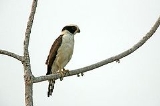
Laughing Falcon

Encyclopedia
The Laughing Falcon also called the Snake Hawk (erroneously, since it is not a hawk
), is a medium-sized bird of prey
in the falcon family (Falconidae
), the only member of the genus Herpetotheres. This Neotropical species is a specialist
snake-eater
. Its common and scientific names both refer to its distinctive voice.
for "laughing aloud" or "laughing immoderately". The generic name Herpetotheres refers to its preferred food; it is Latinized Ancient Greek
, derived from [h]erpeton (ἑρπετόν, "reptile
") + therizein (θερίζειν, "to mow down").
Its relationships with other members of the Falconidae are unclear. Traditionally it has been placed in the subfamily Polyborinae
with the caracara
s and forest falcon
s, but the American Ornithologists' Union
's North American Check-list Committee now places it in the same subfamily as the true falcons
, while the South American Check-list Committee places it with the forest falcons but not the caracaras, and it has also been considered a subfamily of its own.
 The Laughing Falcon is 46 to 56 cm (18 to 22 in) long and has a wingspan of 79 to 94 cm (31 to 37 in). As usual among birds of prey, the females are bigger, weighing 600 to 800 g compared to the males' 410 to 680 g.
Adults have a pale buff head, changeable between a more brownish and an almost white hue according to feather wear and individual variation. The broad black face mask stretches across the neck as a narrow collar, bordered with white. On the crown, the feather shafts are dark, producing a somewhat streaked effect. The upper wings and back are blackish brown. The uppertail coverts are whitish buff again, and the rectrices are barred black and whitish, ending in white. The underside is uniformly pale buff; there may be a bit of dark speckling on the thighs, however. The underside of the wing is pale rufous-buff, sometimes with some dark spotting on the underwing coverts. The tips of the primary remiges are barred with pale grey below, their bases are quite rufous. The iris
is dark brown, the bill is black with a pale yellow cere
; the feet are also pale yellow.
Immature birds differ little from adults; they have lighter margins to the back feathers, producing a scalloped effect. The light parts of the plumage are almost white, paler than in adults; the unfeathered parts are also paler. Nestlings are covered in peculiarly dense down
, reminiscent of a duckling's; they are generally brownish buff, darker above, and already show the blackish facial marks of the adults.
With its big white (immature) or pale buff (adult) head having a dark brown mask from the eyes around to the nape, it is unmistakable. In flight it shows a rufous patch near each wingtip (formed by the basal parts of the primaries) and a shape more like an Accipiter
hawk
than most of its falcon
relatives, with short, rounded wings and a long tail.
The Laughing Falcon has another call, typically given at dusk
. This two-note call is preceded by a series of gwa notes given every half-second or so. They become more emphatic and after some time change to a sequence of the gwa co call proper, with the first syllable higher in pitch than the second, but not differing in emphasis or volume. The gwa co call may be repeated 50 times or more. Sometimes, the initial calls are a oo oo-oo cow-cow-cow, sometimes a descending gwaaaaaaa..... On occasion, the two-syllable call is not given, and instead the simple gwa is repeated as often as the full call.
The familiarity of these sounds in the American tropics is attested to by such common names as acauã (Portuguese
), halcón macagua, guaco, halcón guaco, and guaicurú (Spanish
), and guaycurú (Guaraní
).
through Central
and South America
south to Amazonian Peru
and Bolivia
, practically all of Brazil
, and northern Argentina
and Paraguay
, at altitudes up to 1500 m (rarely to 2400 m in Colombia
), though it is often absent from mountainous regions. It occupies varied habitats, usually including at least scattered trees; it prefers humid regions to arid
ones and tends to avoid closed forest. It is generally not migratory
, though in some areas it may make seasonal movements.
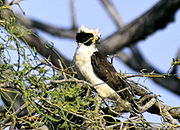
. When it lands, it will jerk the tail forcefully just like a wagtail
. A Laughing Falcon frequently and often conspicuously stays on a perch
for hours, sitting upright and observing the ground alertly, sometimes flicking its tail or nodding, or moving around a bit on its perch with slow, cautious little steps. It is generally peaceful and unlike other falcon
s will not harm smaller birds.
s, including venomous ones such as coral snake
s, and also lizard
s, and, to a lesser extent, small rodent
s, bat
s and centipede
s. The Laughing Falcon pounces on its prey from flight, often with an audible thud, and then biting it just behind the head, sometimes removing the head in the process. It carries the food to a perch to eat. It may carry small snakes in its bill and swallow them tail-first; big snakes may be carried head-forward in its claws, as an Osprey
carries a fish, and then torn to pieces.
hawk or caracara
; in general however it does not even gather nesting material in significant quantities. It lays one or two eggs according to some sources, but according to others always just one. The eggs have heavy dark brown markings on a brown or whitish or pale buff background. The young are thought to leave the nest eight weeks after hatching.The breeding season has been given as April and May, though it may well vary across the large range of this species
.
Hawk
The term hawk can be used in several ways:* In strict usage in Australia and Africa, to mean any of the species in the subfamily Accipitrinae, which comprises the genera Accipiter, Micronisus, Melierax, Urotriorchis and Megatriorchis. The large and widespread Accipiter genus includes goshawks,...
), is a medium-sized bird of prey
Bird of prey
Birds of prey are birds that hunt for food primarily on the wing, using their keen senses, especially vision. They are defined as birds that primarily hunt vertebrates, including other birds. Their talons and beaks tend to be relatively large, powerful and adapted for tearing and/or piercing flesh....
in the falcon family (Falconidae
Falconidae
The falcons and caracaras are around 60 species of diurnal birds of prey that make up the family Falconidae. The family is divided into two subfamiles, Polyborinae, which includes the caracaras and forest falcons, and Falconinae, the falcons, kestrels and falconets.-Description:Falcons and...
), the only member of the genus Herpetotheres. This Neotropical species is a specialist
Generalist and specialist species
A generalist species is able to thrive in a wide variety of environmental conditions and can make use of a variety of different resources . A specialist species can only thrive in a narrow range of environmental conditions or has a limited diet. Most organisms do not all fit neatly into either...
snake-eater
Ophiophagy
Ophiophagy is a specialized form of feeding or alimentary behavior of animals which hunt and eat snakes. There are ophiophagous mammals , birds , lizards , and even other snakes, such as the Central and South American mussuranas and...
. Its common and scientific names both refer to its distinctive voice.
Taxonomy
Its English name comes from its loud voice, as does the specific name cachinnans, LatinLatin
Latin is an Italic language originally spoken in Latium and Ancient Rome. It, along with most European languages, is a descendant of the ancient Proto-Indo-European language. Although it is considered a dead language, a number of scholars and members of the Christian clergy speak it fluently, and...
for "laughing aloud" or "laughing immoderately". The generic name Herpetotheres refers to its preferred food; it is Latinized Ancient Greek
Ancient Greek
Ancient Greek is the stage of the Greek language in the periods spanning the times c. 9th–6th centuries BC, , c. 5th–4th centuries BC , and the c. 3rd century BC – 6th century AD of ancient Greece and the ancient world; being predated in the 2nd millennium BC by Mycenaean Greek...
, derived from [h]erpeton (ἑρπετόν, "reptile
Reptile
Reptiles are members of a class of air-breathing, ectothermic vertebrates which are characterized by laying shelled eggs , and having skin covered in scales and/or scutes. They are tetrapods, either having four limbs or being descended from four-limbed ancestors...
") + therizein (θερίζειν, "to mow down").
Its relationships with other members of the Falconidae are unclear. Traditionally it has been placed in the subfamily Polyborinae
Polyborinae
Polyborinae is a subfamily of the falcon family, Falconidae. It contains the caracaras, forest falcons, and Laughing Falcon. All species in this subfamily are native to the Americas. The composition of Falconidae is disputed, and Polyborninae is not featured in the American Ornithologists' Union...
with the caracara
Caracara
Caracaras are birds of prey in the family Falconidae. They are traditionally placed in the subfamily Polyborinae, but are sometimes considered part of their own subfamily, Caracarinae, or members of the true falcon subfamily, Falconinae...
s and forest falcon
Forest falcon
Forest falcons are members of the genus Micrastur, part of the family Falconidae. They are endemic to the Americas, found from Mexico in the north, south through Central America and large parts of South America, and as far south as northern Argentina...
s, but the American Ornithologists' Union
American Ornithologists' Union
The American Ornithologists' Union is an ornithological organization in the USA. Unlike the National Audubon Society, its members are primarily professional ornithologists rather than amateur birders...
's North American Check-list Committee now places it in the same subfamily as the true falcons
Falconinae
Falconinae is a subfamily of the bird family Falconidae. In its traditional classification, it contains the falcons, falconets, and pygmy falcons. Depending on the authority, Falconinae may also include the caracaras and/or the Laughing Falcon....
, while the South American Check-list Committee places it with the forest falcons but not the caracaras, and it has also been considered a subfamily of its own.
Description
Adults have a pale buff head, changeable between a more brownish and an almost white hue according to feather wear and individual variation. The broad black face mask stretches across the neck as a narrow collar, bordered with white. On the crown, the feather shafts are dark, producing a somewhat streaked effect. The upper wings and back are blackish brown. The uppertail coverts are whitish buff again, and the rectrices are barred black and whitish, ending in white. The underside is uniformly pale buff; there may be a bit of dark speckling on the thighs, however. The underside of the wing is pale rufous-buff, sometimes with some dark spotting on the underwing coverts. The tips of the primary remiges are barred with pale grey below, their bases are quite rufous. The iris
Iris (anatomy)
The iris is a thin, circular structure in the eye, responsible for controlling the diameter and size of the pupils and thus the amount of light reaching the retina. "Eye color" is the color of the iris, which can be green, blue, or brown. In some cases it can be hazel , grey, violet, or even pink...
is dark brown, the bill is black with a pale yellow cere
Cère
The Cère is a long river in south-western France, left tributary of the Dordogne River. Its source is in the south-western Massif Central, near the mountain Plomb du Cantal...
; the feet are also pale yellow.
Immature birds differ little from adults; they have lighter margins to the back feathers, producing a scalloped effect. The light parts of the plumage are almost white, paler than in adults; the unfeathered parts are also paler. Nestlings are covered in peculiarly dense down
Down feather
The down of birds is a layer of fine feathers found under the tougher exterior feathers. Very young birds are clad only in down. Powder down is a specialized type of down found only in a few groups of birds. Down is a fine thermal insulator and padding, used in goods such as jackets, bedding,...
, reminiscent of a duckling's; they are generally brownish buff, darker above, and already show the blackish facial marks of the adults.
With its big white (immature) or pale buff (adult) head having a dark brown mask from the eyes around to the nape, it is unmistakable. In flight it shows a rufous patch near each wingtip (formed by the basal parts of the primaries) and a shape more like an Accipiter
Accipiter
The genus Accipiter is a group of birds of prey in the family Accipitridae, many of which are named as goshawks and sparrowhawks. They can be anatomically distinguished from their relatives by the lack of a procoracoid foramen. Two small and aberrant species usually placed here do possess a large...
hawk
Hawk
The term hawk can be used in several ways:* In strict usage in Australia and Africa, to mean any of the species in the subfamily Accipitrinae, which comprises the genera Accipiter, Micronisus, Melierax, Urotriorchis and Megatriorchis. The large and widespread Accipiter genus includes goshawks,...
than most of its falcon
Falcon
A falcon is any species of raptor in the genus Falco. The genus contains 37 species, widely distributed throughout Europe, Asia, and North America....
relatives, with short, rounded wings and a long tail.
Voice
The namesake call is a long series of separate, rather human-like cries, each one often rising sharply in pitch in the middle and sometimes falling sharply at the very end, changing from a "joyful" to a "sad" sound, and rendered as ha-ha-ha har-her-her or haww harr herrer. The series may be introduced by faster hahahahahaha calls suggestive of maniacal laughter, particularly when the bird is startled. Sometimes two birds call together at different pitches and tempos, producing a striking off-beat effect.The Laughing Falcon has another call, typically given at dusk
Dusk
Dusk is the beginning of darkness in the evening, and occurs after twilight, when the sky generally remains bright and blue. Civil dusk is when the earth has rotated enough that the center of the sun is at 6° below the local horizon...
. This two-note call is preceded by a series of gwa notes given every half-second or so. They become more emphatic and after some time change to a sequence of the gwa co call proper, with the first syllable higher in pitch than the second, but not differing in emphasis or volume. The gwa co call may be repeated 50 times or more. Sometimes, the initial calls are a oo oo-oo cow-cow-cow, sometimes a descending gwaaaaaaa..... On occasion, the two-syllable call is not given, and instead the simple gwa is repeated as often as the full call.
The familiarity of these sounds in the American tropics is attested to by such common names as acauã (Portuguese
Portuguese language
Portuguese is a Romance language that arose in the medieval Kingdom of Galicia, nowadays Galicia and Northern Portugal. The southern part of the Kingdom of Galicia became independent as the County of Portugal in 1095...
), halcón macagua, guaco, halcón guaco, and guaicurú (Spanish
Spanish language
Spanish , also known as Castilian , is a Romance language in the Ibero-Romance group that evolved from several languages and dialects in central-northern Iberia around the 9th century and gradually spread with the expansion of the Kingdom of Castile into central and southern Iberia during the...
), and guaycurú (Guaraní
Guaraní language
Guaraní, specifically the primary variety known as Paraguayan Guaraní , is an indigenous language of South America that belongs to the Tupí–Guaraní subfamily of the Tupian languages. It is one of the official languages of Paraguay , where it is spoken by the majority of the population, and half of...
).
Distribution and habitat
It is found from both coastal slopes of MexicoMexico
The United Mexican States , commonly known as Mexico , is a federal constitutional republic in North America. It is bordered on the north by the United States; on the south and west by the Pacific Ocean; on the southeast by Guatemala, Belize, and the Caribbean Sea; and on the east by the Gulf of...
through Central
Central America
Central America is the central geographic region of the Americas. It is the southernmost, isthmian portion of the North American continent, which connects with South America on the southeast. When considered part of the unified continental model, it is considered a subcontinent...
and South America
South America
South America is a continent situated in the Western Hemisphere, mostly in the Southern Hemisphere, with a relatively small portion in the Northern Hemisphere. The continent is also considered a subcontinent of the Americas. It is bordered on the west by the Pacific Ocean and on the north and east...
south to Amazonian Peru
Peru
Peru , officially the Republic of Peru , is a country in western South America. It is bordered on the north by Ecuador and Colombia, on the east by Brazil, on the southeast by Bolivia, on the south by Chile, and on the west by the Pacific Ocean....
and Bolivia
Bolivia
Bolivia officially known as Plurinational State of Bolivia , is a landlocked country in central South America. It is the poorest country in South America...
, practically all of Brazil
Brazil
Brazil , officially the Federative Republic of Brazil , is the largest country in South America. It is the world's fifth largest country, both by geographical area and by population with over 192 million people...
, and northern Argentina
Argentina
Argentina , officially the Argentine Republic , is the second largest country in South America by land area, after Brazil. It is constituted as a federation of 23 provinces and an autonomous city, Buenos Aires...
and Paraguay
Paraguay
Paraguay , officially the Republic of Paraguay , is a landlocked country in South America. It is bordered by Argentina to the south and southwest, Brazil to the east and northeast, and Bolivia to the northwest. Paraguay lies on both banks of the Paraguay River, which runs through the center of the...
, at altitudes up to 1500 m (rarely to 2400 m in Colombia
Colombia
Colombia, officially the Republic of Colombia , is a unitary constitutional republic comprising thirty-two departments. The country is located in northwestern South America, bordered to the east by Venezuela and Brazil; to the south by Ecuador and Peru; to the north by the Caribbean Sea; to the...
), though it is often absent from mountainous regions. It occupies varied habitats, usually including at least scattered trees; it prefers humid regions to arid
Arid
A region is said to be arid when it is characterized by a severe lack of available water, to the extent of hindering or even preventing the growth and development of plant and animal life...
ones and tends to avoid closed forest. It is generally not migratory
Bird migration
Bird migration is the regular seasonal journey undertaken by many species of birds. Bird movements include those made in response to changes in food availability, habitat or weather. Sometimes, journeys are not termed "true migration" because they are irregular or in only one direction...
, though in some areas it may make seasonal movements.
Behaviour
The flight is slow, with quick, shallow wingbeats interspersed with glides; the bird rarely if ever soarsLift (soaring)
Gliding flight is heavier-than-air flight without the use of thrust. It is employed by gliding animals and by aircraft such as gliders. The most common human application of gliding flight is in sport and recreation using aircraft designed for this purpose...
. When it lands, it will jerk the tail forcefully just like a wagtail
Wagtail
The wagtails form the passerine bird genus Motacilla. They are small birds with long tails which they wag frequently. Motacilla, the root of the family and genus name, means moving tail...
. A Laughing Falcon frequently and often conspicuously stays on a perch
Perch (disambiguation)
Perch may refer to:*Perch , a surname *The USS Perch, multiple ships with the name*Perch , antique unit of measure of length, area or volume, depending on context, used in medieval France and the British Isles...
for hours, sitting upright and observing the ground alertly, sometimes flicking its tail or nodding, or moving around a bit on its perch with slow, cautious little steps. It is generally peaceful and unlike other falcon
Falcon
A falcon is any species of raptor in the genus Falco. The genus contains 37 species, widely distributed throughout Europe, Asia, and North America....
s will not harm smaller birds.
Feeding
It catches mainly snakeSnake
Snakes are elongate, legless, carnivorous reptiles of the suborder Serpentes that can be distinguished from legless lizards by their lack of eyelids and external ears. Like all squamates, snakes are ectothermic, amniote vertebrates covered in overlapping scales...
s, including venomous ones such as coral snake
Coral snake
The coral snakes are a large group of elapid snakes that can be subdivided into two distinct groups, Old World coral snakes and New World coral snakes...
s, and also lizard
Lizard
Lizards are a widespread group of squamate reptiles, with nearly 3800 species, ranging across all continents except Antarctica as well as most oceanic island chains...
s, and, to a lesser extent, small rodent
Rodent
Rodentia is an order of mammals also known as rodents, characterised by two continuously growing incisors in the upper and lower jaws which must be kept short by gnawing....
s, bat
Bat
Bats are mammals of the order Chiroptera "hand" and pteron "wing") whose forelimbs form webbed wings, making them the only mammals naturally capable of true and sustained flight. By contrast, other mammals said to fly, such as flying squirrels, gliding possums, and colugos, glide rather than fly,...
s and centipede
Centipede
Centipedes are arthropods belonging to the class Chilopoda of the subphylum Myriapoda. They are elongated metameric animals with one pair of legs per body segment. Despite the name, centipedes can have a varying number of legs from under 20 to over 300. Centipedes have an odd number of pairs of...
s. The Laughing Falcon pounces on its prey from flight, often with an audible thud, and then biting it just behind the head, sometimes removing the head in the process. It carries the food to a perch to eat. It may carry small snakes in its bill and swallow them tail-first; big snakes may be carried head-forward in its claws, as an Osprey
Osprey
The Osprey , sometimes known as the sea hawk or fish eagle, is a diurnal, fish-eating bird of prey. It is a large raptor, reaching more than in length and across the wings...
carries a fish, and then torn to pieces.
Breeding
The Laughing Falcon breeds in rock crevices, tree cavities, or occasionally in abandoned nests of a ButeoButeo
Buteo is a genus of medium to fairly large, wide-ranging raptors with a robust body and broad wings. In the Old World, members of this genus are called "buzzards", but "hawk" is used in North America...
hawk or caracara
Caracara
Caracaras are birds of prey in the family Falconidae. They are traditionally placed in the subfamily Polyborinae, but are sometimes considered part of their own subfamily, Caracarinae, or members of the true falcon subfamily, Falconinae...
; in general however it does not even gather nesting material in significant quantities. It lays one or two eggs according to some sources, but according to others always just one. The eggs have heavy dark brown markings on a brown or whitish or pale buff background. The young are thought to leave the nest eight weeks after hatching.The breeding season has been given as April and May, though it may well vary across the large range of this species
Species
In biology, a species is one of the basic units of biological classification and a taxonomic rank. A species is often defined as a group of organisms capable of interbreeding and producing fertile offspring. While in many cases this definition is adequate, more precise or differing measures are...
.
External links
- Page on the Laughing Falcon from the Hawk Conservancy accessed March 18, 2005
- Ditto from Mangoverde with photographs and sound recordings accessed March 17, 2005
- Laughing Falcon videos, photos & sounds on the Internet Bird Collection