

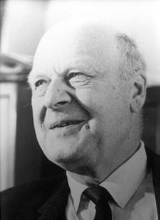
Lars Onsager

Encyclopedia
Lars Onsager was a Norwegian
-born American
physical chemist
and theoretical physicist, winner of the 1968 Nobel Prize in Chemistry
.
He held the Gibbs Professorship of Theoretical Chemistry at Yale University
.
), Norway
. His father was a lawyer
. After completing secondary school in Oslo, he attended the Norwegian Institute of Technology (NTH)
in Trondheim
, graduating as a chemical engineer
in 1925.
In 1925 he arrived at a correction to the Debye-Hückel theory of electrolytic
solution
s, to specify Brownian movement of ion
s in solution, and during 1926 published it. He traveled to Zürich
, where Peter Debye
was teaching, and confronted Debye, telling him his theory was wrong. He impressed Debye so much that he was invited to become Debye's assistant at the Eidgenössische Technische Hochschule (ETH)
, where he remained until 1928.
to take a faculty position at the Johns Hopkins University
in Baltimore, Maryland. At JHU he had to teach freshman classes in chemistry
, and it quickly became apparent that, while he was a genius at developing theories in physical chemistry, he had little talent for teaching. He was dismissed by JHU after one semester.
to graduate students in chemistry) at Brown University
in Providence, Rhode Island
, where it became clear that he was no better at teaching advanced students than freshmen, but he made significant contributions to statistical mechanics and thermodynamics
. The only graduate student who could really understand his lectures on electrolyte systems, Raymond Fuoss, worked under him and eventually joined him on the Yale chemistry faculty. In 1933, when the Great Depression
limited Brown's ability to support a faculty member who was only useful as a researcher and not a teacher, he was let go by Brown, being hired after a trip to Europe
by Yale University
, where he remained for most of the rest of his life, retiring in 1972.
His research at Brown was concerned mainly with the effects on diffusion
of temperature gradient
s, and produced the Onsager reciprocal relations
, a set of equations published in 1929 and, in an expanded form, in 1931, in statistical mechanics
whose importance went unrecognized for many years. However, their value became apparent during the decades following World War II
, and by 1968 they were considered important enough to gain Onsager that year's Nobel Prize in Chemistry
.
In 1933, just before taking up the position at Yale, Onsager traveled to Austria
to visit electrochemist
Hans Falkenhagen
. He met Falkenhagen's sister-in-law, Margrethe Arledter. They were married on September 7, 1933, and had three sons and a daughter.
While he had submitted an outline of his work in reciprocal relations to the Norwegian Institute of Technology
, they had decided it was too incomplete to qualify as a doctoral dissertation. He was told that he could submit one of his published papers to the Yale faculty as a dissertation, but insisted on doing a new research project instead. His dissertation, entitled, "Solutions of the Mathieu equation
of period 4 pi and certain related functions", was beyond the comprehension of the chemistry
and physics
faculty, and only when some members of the mathematics
department, including the chairman, insisted that the work was good enough that they would grant the doctorate if the chemistry department would not, was he granted a Ph.D. in chemistry in 1935. Even before the dissertation was finished, he was appointed assistant professor in 1934, and promoted to associate professor in 1940. He quickly showed at Yale the same traits he had at JHU and Brown: he produced brilliant theoretical research, but was incapable of giving a lecture at a level that a student (even a graduate student) could comprehend. He was also unable to direct the research of graduate students, except for the occasional outstanding one.
During the late 1930s, Onsager researched the dipole
theory of dielectric
s, making improvements for another topic that had been studied by Peter Debye. However, when he submitted his paper to a journal that Debye edited in 1936, it was rejected. Debye would not accept Onsager's ideas until after World War II
. During the 1940s, Onsager studied the statistical-mechanical theory
of phase transitions in solid
s, deriving a mathematically elegant theory which was enthusiastically received. He obtained the exact solution for the two dimensional Ising model
in zero field in 1944.
In 1945, Onsager was naturalized
as an American
citizen, and the same year he was awarded the title of J. Willard Gibbs Professor of Theoretical Chemistry. This was particularly appropriate because Onsager, like Willard Gibbs, had been involved primarily in the application of mathematics
to problems in physics
and chemistry
and, in a sense, could be considered to be continuing in the same areas Gibbs had pioneered.
In 1947, he was elected to the National Academy of Sciences
, and in 1950 he joined the ranks of Alpha Chi Sigma
.
After World War II
, Onsager researched new topics of interest.
He proposed a theoretical explanation of the superfluid properties of liquid
helium
in 1949; two years later the physicist
Richard Feynman
independently proposed the same theory. He also worked on the theories of liquid crystal
s and the electrical properties of ice
. While on a Fulbright scholarship to Cambridge University
, he worked on the magnetic properties of metal
s. He developed important ideas on the quantization of magnetic flux in metals. He was awarded the Lorentz Medal
in 1958 and the Nobel Prize in Chemistry
in 1968.
 Onsager retired at age 70 at Yale and became emeritus. He was appointed Distinguished University Professor at the University of Miami
(Florida
) in 1973 in the Center for Theoretical Studies. He remained active in guiding and inspiring postdoctoral students as his teaching skills, although not his lecturing skills, had improved during the course of his career. He developed interests in semiconductor physics, biophysics and radiation chemistry. However, his death came before he could produce any breakthroughs comparable to those of his earlier years.
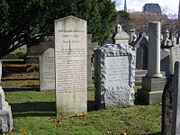
He remained in Florida until his death from an aneurysm in Coral Gables, Florida in 1976. Onsager was buried next to John Gamble Kirkwood
at New Haven's Grove Street Cemetery. While Kirkwood's tombstone has a long list of awards and positions, including the American Chemical Society
Award in Pure Chemistry, the Richards Medal, and the Lewis Award, Onsager's tombstone, in its original form, simply said "Nobel Laureate." When Onsager's wife Gretel died in 1991 and was buried there, his children added an asterisk after "Nobel Laureate," and "*etc." in the lower right corner of the stone.
The Norwegian Institute of Technology
established the Lars Onsager Lecture and The Lars Onsager Professorship in 1993 to award outstanding scientists in the scientific fields of Lars Onsager; Chemistry, Physics and Mathematics. In 1997 his sons and daughter donated his scientific works and professional belongings to NTNU
(before 1996 NTH) in Trondheim
, Norway
as his Alma Mater. These are now organized as The Lars Onsager Archive at the Gunnerus Library in Trondheim.
Norway
Norway , officially the Kingdom of Norway, is a Nordic unitary constitutional monarchy whose territory comprises the western portion of the Scandinavian Peninsula, Jan Mayen, and the Arctic archipelago of Svalbard and Bouvet Island. Norway has a total area of and a population of about 4.9 million...
-born American
United States
The United States of America is a federal constitutional republic comprising fifty states and a federal district...
physical chemist
Physical chemistry
Physical chemistry is the study of macroscopic, atomic, subatomic, and particulate phenomena in chemical systems in terms of physical laws and concepts...
and theoretical physicist, winner of the 1968 Nobel Prize in Chemistry
Nobel Prize in Chemistry
The Nobel Prize in Chemistry is awarded annually by the Royal Swedish Academy of Sciences to scientists in the various fields of chemistry. It is one of the five Nobel Prizes established by the will of Alfred Nobel in 1895, awarded for outstanding contributions in chemistry, physics, literature,...
.
He held the Gibbs Professorship of Theoretical Chemistry at Yale University
Yale University
Yale University is a private, Ivy League university located in New Haven, Connecticut, United States. Founded in 1701 in the Colony of Connecticut, the university is the third-oldest institution of higher education in the United States...
.
Biography
Lars Onsager was born in Kristiania (today's OsloOslo
Oslo is a municipality, as well as the capital and most populous city in Norway. As a municipality , it was established on 1 January 1838. Founded around 1048 by King Harald III of Norway, the city was largely destroyed by fire in 1624. The city was moved under the reign of Denmark–Norway's King...
), Norway
Norway
Norway , officially the Kingdom of Norway, is a Nordic unitary constitutional monarchy whose territory comprises the western portion of the Scandinavian Peninsula, Jan Mayen, and the Arctic archipelago of Svalbard and Bouvet Island. Norway has a total area of and a population of about 4.9 million...
. His father was a lawyer
Lawyer
A lawyer, according to Black's Law Dictionary, is "a person learned in the law; as an attorney, counsel or solicitor; a person who is practicing law." Law is the system of rules of conduct established by the sovereign government of a society to correct wrongs, maintain the stability of political...
. After completing secondary school in Oslo, he attended the Norwegian Institute of Technology (NTH)
Norwegian Institute of Technology
The Norwegian Institute of Technology, known by its Norwegian abbrevation NTH was a science institute in Trondheim, Norway. It was established in 1910, and existed as an independent technical university for 85 years, after which it was merged into the University of Trondheim as an independent...
in Trondheim
Trondheim
Trondheim , historically, Nidaros and Trondhjem, is a city and municipality in Sør-Trøndelag county, Norway. With a population of 173,486, it is the third most populous municipality and city in the country, although the fourth largest metropolitan area. It is the administrative centre of...
, graduating as a chemical engineer
Chemical engineering
Chemical engineering is the branch of engineering that deals with physical science , and life sciences with mathematics and economics, to the process of converting raw materials or chemicals into more useful or valuable forms...
in 1925.
In 1925 he arrived at a correction to the Debye-Hückel theory of electrolytic
Electrolyte
In chemistry, an electrolyte is any substance containing free ions that make the substance electrically conductive. The most typical electrolyte is an ionic solution, but molten electrolytes and solid electrolytes are also possible....
solution
Solution
In chemistry, a solution is a homogeneous mixture composed of only one phase. In such a mixture, a solute is dissolved in another substance, known as a solvent. The solvent does the dissolving.- Types of solutions :...
s, to specify Brownian movement of ion
Ion
An ion is an atom or molecule in which the total number of electrons is not equal to the total number of protons, giving it a net positive or negative electrical charge. The name was given by physicist Michael Faraday for the substances that allow a current to pass between electrodes in a...
s in solution, and during 1926 published it. He traveled to Zürich
Zürich
Zurich is the largest city in Switzerland and the capital of the canton of Zurich. It is located in central Switzerland at the northwestern tip of Lake Zurich...
, where Peter Debye
Peter Debye
Peter Joseph William Debye FRS was a Dutch physicist and physical chemist, and Nobel laureate in Chemistry.-Early life:...
was teaching, and confronted Debye, telling him his theory was wrong. He impressed Debye so much that he was invited to become Debye's assistant at the Eidgenössische Technische Hochschule (ETH)
ETH Zurich
The Swiss Federal Institute of Technology Zurich or ETH Zürich is an engineering, science, technology, mathematics and management university in the City of Zurich, Switzerland....
, where he remained until 1928.
Johns Hopkins University
Eventually in 1928 he went to the United States of AmericaUnited States
The United States of America is a federal constitutional republic comprising fifty states and a federal district...
to take a faculty position at the Johns Hopkins University
Johns Hopkins University
The Johns Hopkins University, commonly referred to as Johns Hopkins, JHU, or simply Hopkins, is a private research university based in Baltimore, Maryland, United States...
in Baltimore, Maryland. At JHU he had to teach freshman classes in chemistry
Chemistry
Chemistry is the science of matter, especially its chemical reactions, but also its composition, structure and properties. Chemistry is concerned with atoms and their interactions with other atoms, and particularly with the properties of chemical bonds....
, and it quickly became apparent that, while he was a genius at developing theories in physical chemistry, he had little talent for teaching. He was dismissed by JHU after one semester.
Brown University
On leaving JHU, he accepted a position (involving the teaching of statistical mechanicsStatistical mechanics
Statistical mechanics or statistical thermodynamicsThe terms statistical mechanics and statistical thermodynamics are used interchangeably...
to graduate students in chemistry) at Brown University
Brown University
Brown University is a private, Ivy League university located in Providence, Rhode Island, United States. Founded in 1764 prior to American independence from the British Empire as the College in the English Colony of Rhode Island and Providence Plantations early in the reign of King George III ,...
in Providence, Rhode Island
Providence, Rhode Island
Providence is the capital and most populous city of Rhode Island and was one of the first cities established in the United States. Located in Providence County, it is the third largest city in the New England region...
, where it became clear that he was no better at teaching advanced students than freshmen, but he made significant contributions to statistical mechanics and thermodynamics
Thermodynamics
Thermodynamics is a physical science that studies the effects on material bodies, and on radiation in regions of space, of transfer of heat and of work done on or by the bodies or radiation...
. The only graduate student who could really understand his lectures on electrolyte systems, Raymond Fuoss, worked under him and eventually joined him on the Yale chemistry faculty. In 1933, when the Great Depression
Great Depression
The Great Depression was a severe worldwide economic depression in the decade preceding World War II. The timing of the Great Depression varied across nations, but in most countries it started in about 1929 and lasted until the late 1930s or early 1940s...
limited Brown's ability to support a faculty member who was only useful as a researcher and not a teacher, he was let go by Brown, being hired after a trip to Europe
Europe
Europe is, by convention, one of the world's seven continents. Comprising the westernmost peninsula of Eurasia, Europe is generally 'divided' from Asia to its east by the watershed divides of the Ural and Caucasus Mountains, the Ural River, the Caspian and Black Seas, and the waterways connecting...
by Yale University
Yale University
Yale University is a private, Ivy League university located in New Haven, Connecticut, United States. Founded in 1701 in the Colony of Connecticut, the university is the third-oldest institution of higher education in the United States...
, where he remained for most of the rest of his life, retiring in 1972.
His research at Brown was concerned mainly with the effects on diffusion
Diffusion
Molecular diffusion, often called simply diffusion, is the thermal motion of all particles at temperatures above absolute zero. The rate of this movement is a function of temperature, viscosity of the fluid and the size of the particles...
of temperature gradient
Temperature gradient
A temperature gradient is a physical quantity that describes in which direction and at what rate the temperature changes the most rapidly around a particular location. The temperature gradient is a dimensional quantity expressed in units of degrees per unit length...
s, and produced the Onsager reciprocal relations
Onsager reciprocal relations
In thermodynamics, the Onsager reciprocal relations express the equality of certain ratios between flows and forces in thermodynamic systems out of equilibrium, but where a notion of local equilibrium exists....
, a set of equations published in 1929 and, in an expanded form, in 1931, in statistical mechanics
Statistical mechanics
Statistical mechanics or statistical thermodynamicsThe terms statistical mechanics and statistical thermodynamics are used interchangeably...
whose importance went unrecognized for many years. However, their value became apparent during the decades following World War II
World War II
World War II, or the Second World War , was a global conflict lasting from 1939 to 1945, involving most of the world's nations—including all of the great powers—eventually forming two opposing military alliances: the Allies and the Axis...
, and by 1968 they were considered important enough to gain Onsager that year's Nobel Prize in Chemistry
Nobel Prize in Chemistry
The Nobel Prize in Chemistry is awarded annually by the Royal Swedish Academy of Sciences to scientists in the various fields of chemistry. It is one of the five Nobel Prizes established by the will of Alfred Nobel in 1895, awarded for outstanding contributions in chemistry, physics, literature,...
.
In 1933, just before taking up the position at Yale, Onsager traveled to Austria
Austria
Austria , officially the Republic of Austria , is a landlocked country of roughly 8.4 million people in Central Europe. It is bordered by the Czech Republic and Germany to the north, Slovakia and Hungary to the east, Slovenia and Italy to the south, and Switzerland and Liechtenstein to the...
to visit electrochemist
Electrochemistry
Electrochemistry is a branch of chemistry that studies chemical reactions which take place in a solution at the interface of an electron conductor and an ionic conductor , and which involve electron transfer between the electrode and the electrolyte or species in solution.If a chemical reaction is...
Hans Falkenhagen
Hans Falkenhagen
Hans Falkenhagen was a German physicist best known for eponymous Debye–Falkenhagen effect.-Works:* Kohäsion und Zustandsgleichung von Dipolgasen, Dissertation, Göttingen 1920...
. He met Falkenhagen's sister-in-law, Margrethe Arledter. They were married on September 7, 1933, and had three sons and a daughter.
Yale University
At Yale, an embarrassing situation occurred: he had been hired as a postdoctoral fellow, but it was discovered that he had never received a Ph.D.Doctor of Philosophy
Doctor of Philosophy, abbreviated as Ph.D., PhD, D.Phil., or DPhil , in English-speaking countries, is a postgraduate academic degree awarded by universities...
While he had submitted an outline of his work in reciprocal relations to the Norwegian Institute of Technology
Norwegian Institute of Technology
The Norwegian Institute of Technology, known by its Norwegian abbrevation NTH was a science institute in Trondheim, Norway. It was established in 1910, and existed as an independent technical university for 85 years, after which it was merged into the University of Trondheim as an independent...
, they had decided it was too incomplete to qualify as a doctoral dissertation. He was told that he could submit one of his published papers to the Yale faculty as a dissertation, but insisted on doing a new research project instead. His dissertation, entitled, "Solutions of the Mathieu equation
Mathieu function
In mathematics, the Mathieu functions are certain special functions useful for treating a variety of problems in applied mathematics, including*vibrating elliptical drumheads,*quadrupoles mass filters and quadrupole ion traps for mass spectrometry...
of period 4 pi and certain related functions", was beyond the comprehension of the chemistry
Chemistry
Chemistry is the science of matter, especially its chemical reactions, but also its composition, structure and properties. Chemistry is concerned with atoms and their interactions with other atoms, and particularly with the properties of chemical bonds....
and physics
Physics
Physics is a natural science that involves the study of matter and its motion through spacetime, along with related concepts such as energy and force. More broadly, it is the general analysis of nature, conducted in order to understand how the universe behaves.Physics is one of the oldest academic...
faculty, and only when some members of the mathematics
Mathematics
Mathematics is the study of quantity, space, structure, and change. Mathematicians seek out patterns and formulate new conjectures. Mathematicians resolve the truth or falsity of conjectures by mathematical proofs, which are arguments sufficient to convince other mathematicians of their validity...
department, including the chairman, insisted that the work was good enough that they would grant the doctorate if the chemistry department would not, was he granted a Ph.D. in chemistry in 1935. Even before the dissertation was finished, he was appointed assistant professor in 1934, and promoted to associate professor in 1940. He quickly showed at Yale the same traits he had at JHU and Brown: he produced brilliant theoretical research, but was incapable of giving a lecture at a level that a student (even a graduate student) could comprehend. He was also unable to direct the research of graduate students, except for the occasional outstanding one.
During the late 1930s, Onsager researched the dipole
Dipole
In physics, there are several kinds of dipoles:*An electric dipole is a separation of positive and negative charges. The simplest example of this is a pair of electric charges of equal magnitude but opposite sign, separated by some distance. A permanent electric dipole is called an electret.*A...
theory of dielectric
Dielectric
A dielectric is an electrical insulator that can be polarized by an applied electric field. When a dielectric is placed in an electric field, electric charges do not flow through the material, as in a conductor, but only slightly shift from their average equilibrium positions causing dielectric...
s, making improvements for another topic that had been studied by Peter Debye. However, when he submitted his paper to a journal that Debye edited in 1936, it was rejected. Debye would not accept Onsager's ideas until after World War II
World War II
World War II, or the Second World War , was a global conflict lasting from 1939 to 1945, involving most of the world's nations—including all of the great powers—eventually forming two opposing military alliances: the Allies and the Axis...
. During the 1940s, Onsager studied the statistical-mechanical theory
Statistical mechanics
Statistical mechanics or statistical thermodynamicsThe terms statistical mechanics and statistical thermodynamics are used interchangeably...
of phase transitions in solid
Solid
Solid is one of the three classical states of matter . It is characterized by structural rigidity and resistance to changes of shape or volume. Unlike a liquid, a solid object does not flow to take on the shape of its container, nor does it expand to fill the entire volume available to it like a...
s, deriving a mathematically elegant theory which was enthusiastically received. He obtained the exact solution for the two dimensional Ising model
Ising model
The Ising model is a mathematical model of ferromagnetism in statistical mechanics. The model consists of discrete variables called spins that can be in one of two states . The spins are arranged in a graph , and each spin interacts with its nearest neighbors...
in zero field in 1944.
In 1945, Onsager was naturalized
Naturalization
Naturalization is the acquisition of citizenship and nationality by somebody who was not a citizen of that country at the time of birth....
as an American
United States
The United States of America is a federal constitutional republic comprising fifty states and a federal district...
citizen, and the same year he was awarded the title of J. Willard Gibbs Professor of Theoretical Chemistry. This was particularly appropriate because Onsager, like Willard Gibbs, had been involved primarily in the application of mathematics
Mathematics
Mathematics is the study of quantity, space, structure, and change. Mathematicians seek out patterns and formulate new conjectures. Mathematicians resolve the truth or falsity of conjectures by mathematical proofs, which are arguments sufficient to convince other mathematicians of their validity...
to problems in physics
Physics
Physics is a natural science that involves the study of matter and its motion through spacetime, along with related concepts such as energy and force. More broadly, it is the general analysis of nature, conducted in order to understand how the universe behaves.Physics is one of the oldest academic...
and chemistry
Chemistry
Chemistry is the science of matter, especially its chemical reactions, but also its composition, structure and properties. Chemistry is concerned with atoms and their interactions with other atoms, and particularly with the properties of chemical bonds....
and, in a sense, could be considered to be continuing in the same areas Gibbs had pioneered.
In 1947, he was elected to the National Academy of Sciences
United States National Academy of Sciences
The National Academy of Sciences is a corporation in the United States whose members serve pro bono as "advisers to the nation on science, engineering, and medicine." As a national academy, new members of the organization are elected annually by current members, based on their distinguished and...
, and in 1950 he joined the ranks of Alpha Chi Sigma
Alpha Chi Sigma
Alpha Chi Sigma is a professional fraternity specializing in the field of chemistry. It has both collegiate and professional chapters throughout the United States consisting of both men and women and numbering more than 63,400 members...
.
After World War II
World War II
World War II, or the Second World War , was a global conflict lasting from 1939 to 1945, involving most of the world's nations—including all of the great powers—eventually forming two opposing military alliances: the Allies and the Axis...
, Onsager researched new topics of interest.
He proposed a theoretical explanation of the superfluid properties of liquid
Liquid
Liquid is one of the three classical states of matter . Like a gas, a liquid is able to flow and take the shape of a container. Some liquids resist compression, while others can be compressed. Unlike a gas, a liquid does not disperse to fill every space of a container, and maintains a fairly...
helium
Helium
Helium is the chemical element with atomic number 2 and an atomic weight of 4.002602, which is represented by the symbol He. It is a colorless, odorless, tasteless, non-toxic, inert, monatomic gas that heads the noble gas group in the periodic table...
in 1949; two years later the physicist
Physics
Physics is a natural science that involves the study of matter and its motion through spacetime, along with related concepts such as energy and force. More broadly, it is the general analysis of nature, conducted in order to understand how the universe behaves.Physics is one of the oldest academic...
Richard Feynman
Richard Feynman
Richard Phillips Feynman was an American physicist known for his work in the path integral formulation of quantum mechanics, the theory of quantum electrodynamics and the physics of the superfluidity of supercooled liquid helium, as well as in particle physics...
independently proposed the same theory. He also worked on the theories of liquid crystal
Liquid crystal
Liquid crystals are a state of matter that have properties between those of a conventional liquid and those of a solid crystal. For instance, an LC may flow like a liquid, but its molecules may be oriented in a crystal-like way. There are many different types of LC phases, which can be...
s and the electrical properties of ice
Ice
Ice is water frozen into the solid state. Usually ice is the phase known as ice Ih, which is the most abundant of the varying solid phases on the Earth's surface. It can appear transparent or opaque bluish-white color, depending on the presence of impurities or air inclusions...
. While on a Fulbright scholarship to Cambridge University
University of Cambridge
The University of Cambridge is a public research university located in Cambridge, United Kingdom. It is the second-oldest university in both the United Kingdom and the English-speaking world , and the seventh-oldest globally...
, he worked on the magnetic properties of metal
Metal
A metal , is an element, compound, or alloy that is a good conductor of both electricity and heat. Metals are usually malleable and shiny, that is they reflect most of incident light...
s. He developed important ideas on the quantization of magnetic flux in metals. He was awarded the Lorentz Medal
Lorentz Medal
Lorentz Medal is a prize awarded every four years by the Royal Netherlands Academy of Arts and Sciences. It was established in 1925 on the occasion of the 50th anniversary of the doctorate of Hendrik Lorentz. This solid gold medal is given for important contributions to theoretical physics, though...
in 1958 and the Nobel Prize in Chemistry
Nobel Prize in Chemistry
The Nobel Prize in Chemistry is awarded annually by the Royal Swedish Academy of Sciences to scientists in the various fields of chemistry. It is one of the five Nobel Prizes established by the will of Alfred Nobel in 1895, awarded for outstanding contributions in chemistry, physics, literature,...
in 1968.
After Yale
University of Miami
The University of Miami is a private, non-sectarian university founded in 1925 with its main campus in Coral Gables, Florida, a medical campus in Miami city proper at Civic Center, and an oceanographic research facility on Virginia Key., the university currently enrolls 15,629 students in 12...
(Florida
Florida
Florida is a state in the southeastern United States, located on the nation's Atlantic and Gulf coasts. It is bordered to the west by the Gulf of Mexico, to the north by Alabama and Georgia and to the east by the Atlantic Ocean. With a population of 18,801,310 as measured by the 2010 census, it...
) in 1973 in the Center for Theoretical Studies. He remained active in guiding and inspiring postdoctoral students as his teaching skills, although not his lecturing skills, had improved during the course of his career. He developed interests in semiconductor physics, biophysics and radiation chemistry. However, his death came before he could produce any breakthroughs comparable to those of his earlier years.
He remained in Florida until his death from an aneurysm in Coral Gables, Florida in 1976. Onsager was buried next to John Gamble Kirkwood
John Gamble Kirkwood
John "Jack" Gamble Kirkwood was a noted chemist and physicist, holding faculty positions at Cornell University, the University of Chicago, California Institute of Technology, and Yale University.-Early life and background:Kirkwood was born in Gotebo, Oklahoma, the oldest child of John Millard and...
at New Haven's Grove Street Cemetery. While Kirkwood's tombstone has a long list of awards and positions, including the American Chemical Society
American Chemical Society
The American Chemical Society is a scientific society based in the United States that supports scientific inquiry in the field of chemistry. Founded in 1876 at New York University, the ACS currently has more than 161,000 members at all degree-levels and in all fields of chemistry, chemical...
Award in Pure Chemistry, the Richards Medal, and the Lewis Award, Onsager's tombstone, in its original form, simply said "Nobel Laureate." When Onsager's wife Gretel died in 1991 and was buried there, his children added an asterisk after "Nobel Laureate," and "*etc." in the lower right corner of the stone.
Legacy
The Norwegian Institute of Technology
Norwegian Institute of Technology
The Norwegian Institute of Technology, known by its Norwegian abbrevation NTH was a science institute in Trondheim, Norway. It was established in 1910, and existed as an independent technical university for 85 years, after which it was merged into the University of Trondheim as an independent...
established the Lars Onsager Lecture and The Lars Onsager Professorship in 1993 to award outstanding scientists in the scientific fields of Lars Onsager; Chemistry, Physics and Mathematics. In 1997 his sons and daughter donated his scientific works and professional belongings to NTNU
NTNU
NTNU can refer to several universities.*Norwegian University of Science and Technology *National Taiwan Normal University*Nigerian Turkish Nile University...
(before 1996 NTH) in Trondheim
Trondheim
Trondheim , historically, Nidaros and Trondhjem, is a city and municipality in Sør-Trøndelag county, Norway. With a population of 173,486, it is the third most populous municipality and city in the country, although the fourth largest metropolitan area. It is the administrative centre of...
, Norway
Norway
Norway , officially the Kingdom of Norway, is a Nordic unitary constitutional monarchy whose territory comprises the western portion of the Scandinavian Peninsula, Jan Mayen, and the Arctic archipelago of Svalbard and Bouvet Island. Norway has a total area of and a population of about 4.9 million...
as his Alma Mater. These are now organized as The Lars Onsager Archive at the Gunnerus Library in Trondheim.