


Battle of Beroia

Encyclopedia
The Battle of Beroia was fought between the Pechenegs and Emperor John II Komnenos
of the Byzantine Empire
in the year 1122 in what is now Bulgaria
, and resulted in the disappearance of the Pecheneg people as an independent force.
at the Battle of Levounion
. This defeat had meant the almost total extinction of all the Pechenegs who had taken part in the expedition; however, some Pechenegs had remained behind. Attacked again in 1094 by the Cumans
, many Pechenegs were slain or absorbed. Yet even so, they still had not yet been absorbed by neighbouring peoples.
In 1122, Pechenegs from the Russian steppes invaded the Byzantine Empire by crossing the Danube
frontier into Byzantine territory. According to Michael Angold, it is possible that their invasion took place with the connivance of Vladimir Monomakh (1113–1125), the ruler of Kiev
. The Pechenegs had once been his auxiliaries. Either way, the invasion was a threat to Byzantine control over the northern Balkans
. Emperor John II Komnenos of Byzantium (1118–1143) determined to meet the invaders in the field and drive them back, and therefore transferred his field army from Asia Minor
(where it had been engaged against the Turks
) to Europe
, and prepared to march north.
in Bulgaria. The emperor at first offered the Pecheneg chiefs presents, offering to grant them a treaty that was favourable to their interests. The Pechenegs were taken in by this deception, and were as a result taken by surprise when the Byzantines suddenly launched a major attack on their laager. The battle was hard fought, but when John ordered in the Varangian Guard
, the elite Palace Guard of the Byzantine Emperors, the Pechenegs were forced back. The Varangians hacked their way through the Pecheneg circle of wagons, collapsing the Pecheneg position and causing a general rout in their camp. The Byzantine victory was complete, and the Pecheneg survivors were rounded up and enlisted into the Byzantine army.
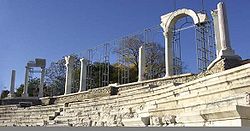 The Byzantine victory effectively destroyed the Pechenegs as an independent force. For some time, significant communities of Pechenegs still remained in Hungary
, but eventually the Pechenegs ceased to be a distinct people and were assimilated by neighboring peoples such as the Bulgarians
and Magyars. For the Byzantines, the victory did not immediately lead to peace, however. In 1128, the Byzantines were attacked by the Hungarians, and it was not until 1130 that they were able to finally secure their Danube frontier. Nevertheless, the battle marks a continuation of the Komnenian restoration
of the Byzantine Empire. The victory over the Pechenegs and later the Hungarians ensured that much of the Balkan peninsula would remain Byzantine, which in turn allowed John to turn his attention to extending Byzantine power and influence further in Asia Minor and the Holy Land
.
John II Komnenos
John II Komnenos was Byzantine Emperor from 1118 to 1143. Also known as Kaloïōannēs , he was the eldest son of Emperor Alexios I Komnenos and Irene Doukaina...
of the Byzantine Empire
Byzantine Empire
The Byzantine Empire was the Eastern Roman Empire during the periods of Late Antiquity and the Middle Ages, centred on the capital of Constantinople. Known simply as the Roman Empire or Romania to its inhabitants and neighbours, the Empire was the direct continuation of the Ancient Roman State...
in the year 1122 in what is now Bulgaria
Bulgaria
Bulgaria , officially the Republic of Bulgaria , is a parliamentary democracy within a unitary constitutional republic in Southeast Europe. The country borders Romania to the north, Serbia and Macedonia to the west, Greece and Turkey to the south, as well as the Black Sea to the east...
, and resulted in the disappearance of the Pecheneg people as an independent force.
Background
In 1091, the Pechenegs had invaded the Byzantine Empire, and had been crushingly defeated by John II's father Alexios I KomnenosAlexios I Komnenos
Alexios I Komnenos, Latinized as Alexius I Comnenus , was Byzantine emperor from 1081 to 1118, and although he was not the founder of the Komnenian dynasty, it was during his reign that the Komnenos family came to full power. The title 'Nobilissimus' was given to senior army commanders,...
at the Battle of Levounion
Battle of Levounion
The Battle of Levounion was the first decisive Byzantine victory of the Komnenian restoration. On April 29, 1091, an invading force of Pechenegs was heavily defeated by the combined forces of the Byzantine Empire under Alexios I Komnenos and his Cuman allies....
. This defeat had meant the almost total extinction of all the Pechenegs who had taken part in the expedition; however, some Pechenegs had remained behind. Attacked again in 1094 by the Cumans
Cumans
The Cumans were Turkic nomadic people comprising the western branch of the Cuman-Kipchak confederation. After Mongol invasion , they decided to seek asylum in Hungary, and subsequently to Bulgaria...
, many Pechenegs were slain or absorbed. Yet even so, they still had not yet been absorbed by neighbouring peoples.
In 1122, Pechenegs from the Russian steppes invaded the Byzantine Empire by crossing the Danube
Danube
The Danube is a river in the Central Europe and the Europe's second longest river after the Volga. It is classified as an international waterway....
frontier into Byzantine territory. According to Michael Angold, it is possible that their invasion took place with the connivance of Vladimir Monomakh (1113–1125), the ruler of Kiev
Kiev
Kiev or Kyiv is the capital and the largest city of Ukraine, located in the north central part of the country on the Dnieper River. The population as of the 2001 census was 2,611,300. However, higher numbers have been cited in the press....
. The Pechenegs had once been his auxiliaries. Either way, the invasion was a threat to Byzantine control over the northern Balkans
Balkans
The Balkans is a geopolitical and cultural region of southeastern Europe...
. Emperor John II Komnenos of Byzantium (1118–1143) determined to meet the invaders in the field and drive them back, and therefore transferred his field army from Asia Minor
Asia Minor
Asia Minor is a geographical location at the westernmost protrusion of Asia, also called Anatolia, and corresponds to the western two thirds of the Asian part of Turkey...
(where it had been engaged against the Turks
Turkic peoples
The Turkic peoples are peoples residing in northern, central and western Asia, southern Siberia and northwestern China and parts of eastern Europe. They speak languages belonging to the Turkic language family. They share, to varying degrees, certain cultural traits and historical backgrounds...
) to Europe
Europe
Europe is, by convention, one of the world's seven continents. Comprising the westernmost peninsula of Eurasia, Europe is generally 'divided' from Asia to its east by the watershed divides of the Ural and Caucasus Mountains, the Ural River, the Caspian and Black Seas, and the waterways connecting...
, and prepared to march north.
Battle
The Byzantine emperor gathered his forces near Constantinople, and set out to meet the Pecheneg army as soon as possible. Meanwhile the Pechenegs had set up a wagon laager near the city of BeroiaStara Zagora
Stara Zagora is the sixth largest city in Bulgaria, and a nationally important economic center. Located in Southern Bulgaria, it is the administrative capital of the homonymous Stara Zagora Province...
in Bulgaria. The emperor at first offered the Pecheneg chiefs presents, offering to grant them a treaty that was favourable to their interests. The Pechenegs were taken in by this deception, and were as a result taken by surprise when the Byzantines suddenly launched a major attack on their laager. The battle was hard fought, but when John ordered in the Varangian Guard
Varangian Guard
The Varangian Guard was an elite unit of the Byzantine Army in 10th to the 14th centuries, whose members served as personal bodyguards of the Byzantine Emperors....
, the elite Palace Guard of the Byzantine Emperors, the Pechenegs were forced back. The Varangians hacked their way through the Pecheneg circle of wagons, collapsing the Pecheneg position and causing a general rout in their camp. The Byzantine victory was complete, and the Pecheneg survivors were rounded up and enlisted into the Byzantine army.
Aftermath
Hungary
Hungary , officially the Republic of Hungary , is a landlocked country in Central Europe. It is situated in the Carpathian Basin and is bordered by Slovakia to the north, Ukraine and Romania to the east, Serbia and Croatia to the south, Slovenia to the southwest and Austria to the west. The...
, but eventually the Pechenegs ceased to be a distinct people and were assimilated by neighboring peoples such as the Bulgarians
Bulgarians
The Bulgarians are a South Slavic nation and ethnic group native to Bulgaria and neighbouring regions. Emigration has resulted in immigrant communities in a number of other countries.-History and ethnogenesis:...
and Magyars. For the Byzantines, the victory did not immediately lead to peace, however. In 1128, the Byzantines were attacked by the Hungarians, and it was not until 1130 that they were able to finally secure their Danube frontier. Nevertheless, the battle marks a continuation of the Komnenian restoration
Komnenian restoration
The Komnenian restoration is the term used by historians to describe the military, financial and territorial recovery of the Byzantine Empire under the Komnenian dynasty, from the accession of Alexios I Komnenos in 1081, to the death of Manuel I Komnenos in 1180. The Komnenian restoration is also...
of the Byzantine Empire. The victory over the Pechenegs and later the Hungarians ensured that much of the Balkan peninsula would remain Byzantine, which in turn allowed John to turn his attention to extending Byzantine power and influence further in Asia Minor and the Holy Land
Holy Land
The Holy Land is a term which in Judaism refers to the Kingdom of Israel as defined in the Tanakh. For Jews, the Land's identifiction of being Holy is defined in Judaism by its differentiation from other lands by virtue of the practice of Judaism often possible only in the Land of Israel...
.