


Kirant

Encyclopedia
Nepal
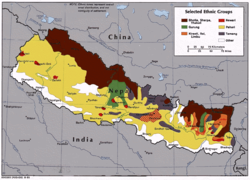
Nepal , officially the Federal Democratic Republic of Nepal, is a landlocked sovereign state located in South Asia. It is located in the Himalayas and bordered to the north by the People's Republic of China, and to the south, east, and west by the Republic of India...
into India
India
India , officially the Republic of India , is a country in South Asia. It is the seventh-largest country by geographical area, the second-most populous country with over 1.2 billion people, and the most populous democracy in the world...
, Burma and beyond. They migrated to their present locations via Assam
Assam
Assam , also, rarely, Assam Valley and formerly the Assam Province , is a northeastern state of India and is one of the most culturally and geographically distinct regions of the country...
, Burma, Tibet
Tibet
Tibet is a plateau region in Asia, north-east of the Himalayas. It is the traditional homeland of the Tibetan people as well as some other ethnic groups such as Monpas, Qiang, and Lhobas, and is now also inhabited by considerable numbers of Han and Hui people...
and Yunnan
Yunnan
Yunnan is a province of the People's Republic of China, located in the far southwest of the country spanning approximately and with a population of 45.7 million . The capital of the province is Kunming. The province borders Burma, Laos, and Vietnam.Yunnan is situated in a mountainous area, with...
in ancient times. Prototype Tibeto-Burmans
Tibeto-Burman languages
The Tibeto-Burman languages are the non-Chinese members of the Sino-Tibetan language family, over 400 of which are spoken thoughout the highlands of southeast Asia, as well as lowland areas in Burma ....
originated in the Yellow River
Yellow River
The Yellow River or Huang He, formerly known as the Hwang Ho, is the second-longest river in China and the sixth-longest in the world at the estimated length of . Originating in the Bayan Har Mountains in Qinghai Province in western China, it flows through nine provinces of China and empties into...
basin around 10,000 years ago.
Although only the Sunuwar (the people who inhabit the region westward of River Sun Koshi),Khumbu or Khambu (also known as Rai
Rai people
The Rai are one of Nepal's most ancient indigenous ethnolinguistic groups. They were Raya meaning king. Once someone was recognized as a ruler then Hindus awarded the title Raja, Rai, Raya, Malla etc. When the king Pritivi Narayan Shah couldn't defeat Kirant king , he somehow took them in...
), Limbu
Limbu people
The Yakthung or Limbu tribes and clans belong to the Kirati nation or to the Kirat confederation.They are indigenous to the hill and mountainous regions of east Nepal between the Arun and Mechi rivers to as far as Southern Tibet, Bhutan and Sikkim....
(also known as Yakthumba or Subba) and Yakkha
Yakkha
Yakkha is an indigenous ethnic group of Nepal . It is one of the progenies of Nepal's prehistoric Kirat dynasty of around 100 BC.-Etymology:...
(also known as Dewan or Zimdar) are generally called Kirati, the vast majority of ethnic people of the region eastward of Nepal too call themselves as Kirati. These people are also best known as modern Gurkhas. Their languages belong to the Tibeto-Burman
Tibeto-Burman languages
The Tibeto-Burman languages are the non-Chinese members of the Sino-Tibetan language family, over 400 of which are spoken thoughout the highlands of southeast Asia, as well as lowland areas in Burma ....
family of languages.
The original inhabitants of the Dooars region of India, i.e., the Koch and Mech
Mech tribe
Mech tribe is one of the scheduled tribes of India and belong to Bodo-Kachari group of tribes. They belong to Mongoloid race and speak mainly Bodo language, which is a Tibeto-Burman dialect but have got influenced by the Assamese language. The Mech people live in the Dooars region of West Bengal...
, also claim themselves to be Kiratis and so do the Bodo
Bodo
- Locations :* Bodø, A city in Norway*Bodo, Alberta, a hamlet in Central Alberta, Canada, close to the Saskatchewan border.*Bodo , a town and commune in Côte d'Ivoire*BoDo, a district of Boise, ID; the name of which stems from Boise Downtown....
and Kachari tribes of Assam
Assam
Assam , also, rarely, Assam Valley and formerly the Assam Province , is a northeastern state of India and is one of the most culturally and geographically distinct regions of the country...
. They derive their titles from the original place of their dwelling, i.e., Koch from the Kosi River, Mech from the Mechi River
Mechi River
The Mechi River is a trans-boundary river flowing through Nepal and India. It is a tributary of the Mahananda River.-Course:The Mechi originates in the Mahabharat Range in Nepal...
and the word Kachari is derived from Kachar which means river basin. The basis of these claims relies on the fact that they are Mongoloids even though they distinguish themselves from Mongolians elsewhere. They are therefore often identified as Kirati-Mongolians.
Etymology
The source of the word Kirat or Kirati is much disputed. One school of thought says that it comes from the Sanskrit word Kirata found in the Yajur Veda, describing the handsome mountain people and hunters in the forests. It is also described as ChineseChinese people
The term Chinese people may refer to any of the following:*People with Han Chinese ethnicity ....
in the Mahabharata
Mahabharata
The Mahabharata is one of the two major Sanskrit epics of ancient India and Nepal, the other being the Ramayana. The epic is part of itihasa....
, Kirtarjuniya.
Religion
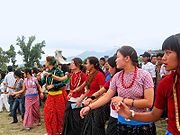
The Kirat people practice shamanism
Shamanism
Shamanism is an anthropological term referencing a range of beliefs and practices regarding communication with the spiritual world. To quote Eliade: "A first definition of this complex phenomenon, and perhaps the least hazardous, will be: shamanism = technique of ecstasy." Shamanism encompasses the...
but they call it "Kirat religion". The Kiratis follow Kirat Mundhum. Their holy text is the Mundhum
Mundhum
Mundhum is the ancient religious scripture and folk literature of the Kirat people of Nepal, central to Kirat Mundhum, the ancient, indigenous religion of Nepal. Mundhum means "the power of great strength" in the Kiranti languages...
, also known as the Kirat Veda. Kirat Rai worship nature and their ancestors. Animism and shamanism and belief in their primeval ancestors, Sumnima and Paruhang are their cultural and religious practices. The names of some of their festivals are Sakela
Sakela
Sakela is the main festival of Kirat which is celebrated twice a year distinguished by two names Ubhauli and Udhauli. Sakela Ubhauli is celebrated during Baisakh Purnima and Sakela Udhauli is celebrated during the full moon day in the month of Mangshir.-Characteristics:The main characteristic of...
, Sakle, Tashi, Sakewa, Saleladi Bhunmidev, Chyabrung, Yokwa and Folsyandar. They have two main festivals: Sakela/Sakewa Ubhauli during plantation season and Sakela/Sakewa Udhauli during the time of harvest.
Kirat Limbu
Limbu people
The Yakthung or Limbu tribes and clans belong to the Kirati nation or to the Kirat confederation.They are indigenous to the hill and mountainous regions of east Nepal between the Arun and Mechi rivers to as far as Southern Tibet, Bhutan and Sikkim....
people believe in a supreme god called Tagera Ningwaphuma, who is also known as the supreme knowledge. The Kirat ancestor Yuma Sammang and god of war Theba Sammang are the second most important deities.
Kirats in Nepal were forced into taking Hindu
Hindu
Hindu refers to an identity associated with the philosophical, religious and cultural systems that are indigenous to the Indian subcontinent. As used in the Constitution of India, the word "Hindu" is also attributed to all persons professing any Indian religion...
names and accept Hinduism
Hinduism
Hinduism is the predominant and indigenous religious tradition of the Indian Subcontinent. Hinduism is known to its followers as , amongst many other expressions...
during the Prithvi Narayan Shah's Khasnization policy
Prithvi Narayan Shah
Prithvi Narayan Shah, King of Nepal was the first king of the House of Shahs to rule Nepal. He is credited for starting the campaign for a unified Nepal, which had been divided and weakened under Malla confederacy. He was the ninth generation descendant of Dravya Shah , the founder of the ruling...
and the later Khas
Khas
Originally the Khas / Khasas or Khasiyas are the mountain dwellers living in the southern shadow of the Himalayan range from Kashmir to Bhutan, but mostly in Nepal, Himachal Pradesh, Uttarakhand, North Bengal, Sikkim and Bhutan,...
rulers of Nepal maintained this policy. Many of the Kirat initially stayed away from Hinduism but were encouraged to convert by the ruling elites of later Nepal.
There is a giant linga of the Kirat at Kirateshwara. It believed that all Kirat names, language and traditions were suppressed by the Khas rulers and people, but all such evidences were destroyed by the next rulers of Nepal.
Mentioned as Kiratas in Mahabharat epic
The Kiratas (Sanskrit: किरात) mentioned in early Hindu texts are tribes of the forest and mountains. They are often mentioned along with the Cinas (Chinese). In Yoga VasisthaYoga Vasistha
Yoga Vasistha is a Hindu spiritual text traditionally attributed to Valmiki. It recounts a discourse of the sage Vasistha to a young Prince Rama, during a period when the latter is in a dejected state...
1.15.5, Rama speaks of "kirAteneva vAgurA", "a trap [laid] by Kiratas", so about BCE Xth century, they were thought of as jungle trappers, the ones who dug pits to capture roving deer. The same text also speaks of King Suraghu, the head of the Kiratas who is a friend of the Persian King, Parigha. Hindu myth also has many incidents where the god Shiva imitates a Kirat person.
Contemporary historians widely agree that a widespread cultural exchange and intermarriage took place in the eastern Himalayan region between the indigenous inhabitants – called the Kirat – and the Tibetan migrant population, reaching a climax during the 8th and 9th centuries. Another wave of political and cultural conflict between Khas
Khas
Originally the Khas / Khasas or Khasiyas are the mountain dwellers living in the southern shadow of the Himalayan range from Kashmir to Bhutan, but mostly in Nepal, Himachal Pradesh, Uttarakhand, North Bengal, Sikkim and Bhutan,...
and Kirat ideals surfaced in the Kirat region of present-day Nepal during the last quarter of the 18th century. A collection of manuscripts from the 18th and 19th centuries, till now unpublished and unstudied by historians, have made possible a new understanding of this conflict. These historical sources are among those collected by Brian Houghton Hodgson
Brian Houghton Hodgson
Brian Houghton Hodgson was an early naturalist and ethnologist working in British India and Nepal where he was an English civil servant. He described many species, especially birds and mammals from the Himalayas, and several birds were named after him by others such as Edward Blyth...
– a British diplomat and self-trained orientalist appointed to the Kathmandu court during the second quarter of the 19th century – and his principal research aide, the Newar
Newar
The Newa , Newār or Newāl) are the indigenous people and the creators of the historical civilization of Nepal's Kathmandu Valley. The valley and surrounding territory have been known from ancient times as Nepal Mandala, its limits ever changing through history.Newas have lived in the Kathmandu...
scholar Khardar Jitmohan.
For over two millennia, a large portion of the eastern Himalaya has been identified as the home of the Kirat people, of which the majority are known today as Rai
Rai (ethnic group)
The Rai are one of Nepal's most ancient indigenous ethnolinguistic groups. They were Raya meaning king. Once someone was recognized as a ruler then Hindus awarded the title Raja, Rai, Raya, Malla etc. When the king Pritivi Narayan Shah couldn't defeat Kirant king , he somehow took them in...
, Limbu
Limbu people
The Yakthung or Limbu tribes and clans belong to the Kirati nation or to the Kirat confederation.They are indigenous to the hill and mountainous regions of east Nepal between the Arun and Mechi rivers to as far as Southern Tibet, Bhutan and Sikkim....
and Yakkha
Yakkha
Yakkha is an indigenous ethnic group of Nepal . It is one of the progenies of Nepal's prehistoric Kirat dynasty of around 100 BC.-Etymology:...
. In ancient times, the entire Himalayan region was known as the Kimpurusha Desha (also, Kirata Pradesh), a phrase derived from a Sanskrit term used to identify people of Kirat origin. These people were also known as Nep, to which the name Nepala is believed to have an etymological link. The earliest references to the Kirat as principal inhabitants of the Himalayan region are found in the texts of Atharvashirsha and Mahabharata
Mahabharata
The Mahabharata is one of the two major Sanskrit epics of ancient India and Nepal, the other being the Ramayana. The epic is part of itihasa....
, believed to date to before the 9th century BC. For over a millennium, the Kirat had also inhabited the Kathmandu Valley
Kathmandu Valley
The Kathmandu Valley , located in Nepal, lies at the crossroads of ancient civilizations of Asia, and has at least 130 important monuments, including several places of pilgrimage for the Hindus and the Buddhists. There are seven UNESCO World Heritage Sites within this valley.-Etymology:The city of...
, where they installed their own ruling dynasty. This Kirat population in the valley along with original Australoids and Austro-Asiatic speakers form the base for later Newar population. As time passed, however, those Kirat, now known as Rai
Rai people
The Rai are one of Nepal's most ancient indigenous ethnolinguistic groups. They were Raya meaning king. Once someone was recognized as a ruler then Hindus awarded the title Raja, Rai, Raya, Malla etc. When the king Pritivi Narayan Shah couldn't defeat Kirant king , he somehow took them in...
and the Limbu
Limbu people
The Yakthung or Limbu tribes and clans belong to the Kirati nation or to the Kirat confederation.They are indigenous to the hill and mountainous regions of east Nepal between the Arun and Mechi rivers to as far as Southern Tibet, Bhutan and Sikkim....
, settled mostly in the Koshi region of present-day eastern Nepal and Sikkim
Sikkim
Sikkim is a landlocked Indian state nestled in the Himalayan mountains...
.
From around the 8th century, areas on the northern frontier of the Kirat region began to fall under the domination of migrant people of Tibetan origin. This flux of migration brought about the domination by Tibetan religious and cultural practices over ancient Kirat traditions. This influence first introduced shamanistic Bön practices, which in turn were later replaced by the oldest form of Tibetan Buddhism
Tibetan Buddhism
Tibetan Buddhism is the body of Buddhist religious doctrine and institutions characteristic of Tibet and certain regions of the Himalayas, including northern Nepal, Bhutan, and India . It is the state religion of Bhutan...
. The early influx of Bön culture to the peripheral Himalayan regions occurred only after the advent of Nyingma
Nyingma
The Nyingma tradition is the oldest of the four major schools of Tibetan Buddhism . "Nyingma" literally means "ancient," and is often referred to as Nga'gyur or the "old school" because it is founded on the first translations of Buddhist scriptures from Sanskrit into Tibetan, in the eighth century...
, the oldest Buddhist order in Lhasa
Lhasa
Lhasa is the administrative capital of the Tibet Autonomous Region in the People's Republic of China and the second most populous city on the Tibetan Plateau, after Xining. At an altitude of , Lhasa is one of the highest cities in the world...
and Central Tibet, which led followers of the older religion to flee to the Kirat areas for survival. The Tibetan cultural influx ultimately laid the foundation for a Tibetan politico-religious order in the Kirat regions, and this led to the emergence of two major Tibetan Buddhist dynasties, one in Sikkim and another in Bhutan
Bhutan
Bhutan , officially the Kingdom of Bhutan, is a landlocked state in South Asia, located at the eastern end of the Himalayas and bordered to the south, east and west by the Republic of India and to the north by the People's Republic of China...
. The early political order of the Kingdom of Bhutan had been established under the political and spiritual leadership of the lama Zhabs-drung Ngawang Namgyal. Consequently, Bhutan used to be known in the Himalayan region as the ‘kingdom of [Buddhist] spiritual rule’ (in old Nepali
Nepali language
Nepali or Nepalese is a language in the Indo-Aryan branch of the Indo-European language family.It is the official language and de facto lingua franca of Nepal and is also spoken in Bhutan, parts of India and parts of Myanmar...
, dharmaako desh). The Tibetan rulers of Sikkim were also known as Chogyal
Chogyal
The Chogyal were the monarchs of the former kingdoms of Sikkim and Ladakh, which were ruled by separate branches of the Namgyal family. The Chogyal, or divine ruler, was the absolute potentate of Sikkim from 1642 to 1975, when its monarchy was abrogated and its people voted to make Sikkim India's...
, or spiritual rulers.
Both of these kingdoms adopted policies of suppression of indigenous practices, replacing them with those of Tibetan Buddhism. Bhutan's religious rulers established a tradition of appointing religious missions to other Himalayan kingdoms and areas, through which they were able to establish extensive influence in the region. Bhutan's ambitious missions were sent as far west as Ladakh
Ladakh
Ladakh is a region of Jammu and Kashmir, the northernmost state of the Republic of India. It lies between the Kunlun mountain range in the north and the main Great Himalayas to the south, inhabited by people of Indo-Aryan and Tibetan descent...
. Even before the founding of modern Nepal by Prithvi Narayan Shah
Prithvi Narayan Shah
Prithvi Narayan Shah, King of Nepal was the first king of the House of Shahs to rule Nepal. He is credited for starting the campaign for a unified Nepal, which had been divided and weakened under Malla confederacy. He was the ninth generation descendant of Dravya Shah , the founder of the ruling...
of Gorkha
Gorkha
Gurkha are people from Nepal who take their name from the 8th century Hindu warrior-saint Guru Gorakhnath.Gurkha, Ghurkha, or Gorkha may also refer to:-People:...
in 1769, Bhutan's rulers were able to establish spiritual centres in several parts of what was to become the former's territories, including Kathmandu, Bhaktapur
Bhaktapur
Bhaktapur , also Bhadgaon or Khwopa is an ancient Newar town in the east corner of the Kathmandu Valley, Nepal. It is located in Bhaktapur District in the Bagmati Zone...
, Gorkha
Gorkha
Gurkha are people from Nepal who take their name from the 8th century Hindu warrior-saint Guru Gorakhnath.Gurkha, Ghurkha, or Gorkha may also refer to:-People:...
and Vijayapur in the midhills, and Mustang
Mustang (kingdom)
Mustang is the former Kingdom of Lo and now part of Nepal, in the north-central part of that country, bordering the People's Republic of China on the Tibetan plateau between the Nepalese provinces of Dolpo and Manang...
, north of the central Himalayan range.
The Kirat were the earliest inhabitants of the Kathmandu Valley. Dhimal
Dhimal
Dhimal or Dhemal is a little known indigenous community of the Terai. They mainly reside in Morang and Jhapa districts of Nepal and Darjeeling district of West Bengal, India...
, Hayu
Hayu
The Hayus are a member of the Kirant tribe speaking their own language, Wayu or Hayu. Little is known about them. They are Animist by religion. According to the 2001 Nepal census, there are 1821 Hayu in the country,of which 70.29% were Hindus and 23.61% were animists.- External links :* *...
, Koch
Koch
Koch may refer to:* Koch , a type of Arctic boat* Koch people , an ethnic group originally from the ancient Koch kingdom in north east India* Koch , people with this surname* Koch, Łódź Voivodeship, a village in central Poland...
, Thami
Thami
The Thami are an indigenous tribe of hills east of Kathmandu, Nepal's capital. They mainly live in Dolakha district in East-Central Nepal. They are locally known as Thangmi. Their language is Kirant. According to the 2001 Nepal Census there are a total of 22,999 Thami of which 55.74% were...
, Tharu, Chepang
Chepang
Chepang is the commonly used name given to an indigenous ethnic group living in central and southern Nepal.The language is also known as Chepang but is called Chyo-bang by the people themselves. Some Bahun Chettri castes call these people the "Praja" meaning "political subjects"...
, and Surel ethnic groups also consider themselves to be of Kirati descent. According to recent DNA
DNA
Deoxyribonucleic acid is a nucleic acid that contains the genetic instructions used in the development and functioning of all known living organisms . The DNA segments that carry this genetic information are called genes, but other DNA sequences have structural purposes, or are involved in...
and HLA
Human leukocyte antigen
The human leukocyte antigen system is the name of the major histocompatibility complex in humans. The super locus contains a large number of genes related to immune system function in humans. This group of genes resides on chromosome 6, and encodes cell-surface antigen-presenting proteins and...
typing done on the Kirat people of Nepal
Nepal
Nepal , officially the Federal Democratic Republic of Nepal, is a landlocked sovereign state located in South Asia. It is located in the Himalayas and bordered to the north by the People's Republic of China, and to the south, east, and west by the Republic of India...
, Bhutan
Bhutan
Bhutan , officially the Kingdom of Bhutan, is a landlocked state in South Asia, located at the eastern end of the Himalayas and bordered to the south, east and west by the Republic of India and to the north by the People's Republic of China...
and India
India
India , officially the Republic of India , is a country in South Asia. It is the seventh-largest country by geographical area, the second-most populous country with over 1.2 billion people, and the most populous democracy in the world...
, these people's ancestors migrated from south-east Tibet
Tibet
Tibet is a plateau region in Asia, north-east of the Himalayas. It is the traditional homeland of the Tibetan people as well as some other ethnic groups such as Monpas, Qiang, and Lhobas, and is now also inhabited by considerable numbers of Han and Hui people...
near the Burma border. However, Kirat people are not Khampa. Recent DNA studies on Tibeto-Burmese peoples have shown them to have both Southeast Asian and Northeast Asian origins. According to Kirati folklore, their ancestors migrated in a great volkerwanderungen from their ancestral homeland eastward to South-East Asia and beyond when Buddhist
Buddhism
Buddhism is a religion and philosophy encompassing a variety of traditions, beliefs and practices, largely based on teachings attributed to Siddhartha Gautama, commonly known as the Buddha . The Buddha lived and taught in the northeastern Indian subcontinent some time between the 6th and 4th...
monks returned with glowing tales of availability of vast fertile lands.
Te-ongsi Sirijunga Xin Thebe and Kirat revival
Te-ongsi Sirijunga Xin ThebeTe-ongsi Sirijunga Xin Thebe
Te-Ongsi Sirijunga Xin Thebe or Teyongshi Ziri Dzö-nga Xin Thebe was an 18th-century Limbu scholar, teacher, educationist, historian and philosopher of Limbuwan and Sikkim. He was formally known as Sirichongba but his more popular name was and remains Sirijanga.-Life:Sirijanga was born in...
or Teyongshi Ziri Dzö-nga Xin Thebe was an 18th-century Limbu scholar, teacher, educationist, historian and philosopher of Limbuwan
Limbuwan
Limbuwan is an area of the Himalaya historically made up of 10 Limbu kingdoms, all now part of Nepal. Limbuwan means "abode of the Limbus" or "Land of the Limbus". Limbus themselves call Limbuwan "Yakthung Laaje" or "the country of the Yakthungs"...
and Sikkim. He was formally known as Sirichongba but his more popular name was and remains Sirijanga. Sirijanga researched and taught the Kirat-Sirijonga script, language and religion of the Limbus in various part of Limbuwan and Sikkim. He revived the old Kirat script.
History of Limbuwan: Kirat people of Limbu nationality
Limbuwan had a distinct history and political establishment until its unification with the kingdom of GorkhaGorkha
Gurkha are people from Nepal who take their name from the 8th century Hindu warrior-saint Guru Gorakhnath.Gurkha, Ghurkha, or Gorkha may also refer to:-People:...
in 1774 AD. During King Prithvi Narayan Shah's unification of Nepal, the present-day Nepal east of Arun and Koshi
Koshi River
The Kosi River or Koshi —also Saptakoshi for its seven Himalayan tributaries—is a trans-boundary river flowing through Nepal and India. Some of the rivers of the Koshi system, such as the Arun, the Sun Kosi and the Bhote Koshi, originate in the Tibet Autonomous Region of China...
rivers was known as Pallo Kirat Limbuwan. It was divided into 10 Limbu kingdoms of which Morang kingdom was the most powerful and had a central government. The capital of Morang kingdom was Bijaypur (present-day Dharan
Dharan, Nepal
Dharan is a major city in eastern Nepal, in the Sunsari District, situated on foothills of Mahabharat Range with southern tip touching the edge of the Terai at an altitude of 1148 ft . It serves as a trading post between the hilly region and the plains of Terai region. It was once the...
). After the Limbuwan Gorkha War
Limbuwan Gorkha War
The Limbuwan Gorkha war was a series of battles fought between the king of Gorkha and the rulers of various principalities of Limbuwan from 1771 to 1774 AD...
and seeing the threat of the rising power of the British East India Company
British East India Company
The East India Company was an early English joint-stock company that was formed initially for pursuing trade with the East Indies, but that ended up trading mainly with the Indian subcontinent and China...
, the kings and ministers of all the 10 Limbu kingdoms of Limbuwan gathered in Bijaypur to agree upon the Limbuwan-Gorkha Treaty. This treaty formally merged the 10 Limbu kingdoms into the Gorkha kingdom but it also had a provision for autonomy of Limbuwan under the "kipat" system.
Gorkhali hegemonies
The next phase of military and cultural threat faced by the Kirat people was at the hands of the Gorkhali expansionists of Nepal, shortly after Sirijanga's death. The nature and intensity of this hegemony was to prove significantly different from that of the earlier Tibetan one, however. From the very beginning, the Gorkha court's intention in the region was not the extension of its Hindu-based culture. Rather, Gorkha's was a clear military campaign of territorial expansion.After the completion of the conquest of the Kathmandu Valley in 1769, the Gorkhali army marched east towards the Kirat territory. The Sen rulers of eastern Nepal, known as Hindupati, had established a weak rule in the Kirat region by adopting a policy of mutual understanding with the local Kirat leaders. The Gorkhali military campaign, in contrast, brought with it a forceful and brutal occupation. During the conquest, the invading authorities adopted a harsh divide-and-rule policy: they first asked the Kiratis to surrender, assuring them that they would retain local rule and their traditional order. After many took up this offer, however, the conquerors instead demanded that Gorkhali rule be obeyed and Gorkhali traditions be followed. Manuscripts in Hodgson's collection make mention of Kirat men, male children and pregnant women having been murdered in great numbers.
The Gorkhalis ultimately divided the Kiratis into two groups, the sampriti and the niti: the former were those who had surrendered to Gorkhali power and cultural traditions, while the latter maintained their own traditions. The Gorkhali authorities naturally favoured the sampritis, killing the nitis or forcing them to flee their lands. As a result, much of the niti population migrated towards Sikkim and Bhutan. But Gorkhali wartime policy changed, particularly after the conquest of the territories of Kumaun and Garhwal far in the west. By the end of the 18th century, the authorities in Kathmandu were in need of more state revenue, and implemented a policy to bring people into Nepali territory in order to make barren land arable. The Kirat who were ousted from their lands during the Gorkhali military conquest were also asked to return home, albeit under the condition that Gorkhali rule and traditions were strictly followed. Relatives and friends of those who had fled were recruited to call them back, and people moved again between the state-given identities of niti and sampriti.
'"The History of Sunuwar"'
This ethnic group belongs to the deity of Pandava lineage as Raja Kooli duma mooli. They do not belong to Kirati grouped but inadvertently grouped by the Indian Scholar compiler of Veda called Ved Vyas as indiginious Kirati. They are the direct descendants of great pandava prince Bhimsena by Ghatotkacha's son Bar Barey. Though Bar Barey was never married in his life time his head was miraculously severed by Sudarshan Chakra and was kept in meditation with the resurrection by the power of Cosmic divine light which helped him see the cosmic drama and witnessed about who actually fought Mahabharata war. He was kept as cosmic invissible witness to see the great war of Truth and evil. He explained his Pandava grandfathers the details about who won the great war. He confirmed that it was the Sudarshan Chakra who actually fought single handedly all the entire war. It killed Bhisma Pitamah, Karna, Dronacharya but spared the life of majority of Kiratis at the will of Lord Krishna. Lord Krishna has never fought the war and never killed any sentient beings. After almost all the scenes of Mahabharata, Lord Krishna showed the Cosmic Divine Transcendental to Bar Barey and declared thus " My dear son, Bar Barey, I am pleased by your meditation and witness fot the truth over evils. Your progenies will be called Sunu varam(Sunuwar), who shall be come forth out of your eternal light of your Third eyes as the part and parcels of your soul in the form of golden dove and shall live forever. Your progenies were previously gopies and gwalas who will be reborn again as a brown complexioned as your speech incarnation. They shall go, multiply and be fruitful. Their look will symbolize like doves which is the sign of love and peace. You will never perish, you have now got an eternal life in the Supreme abode of mine the Spiritual world. They will worship my unpronounced primordial Word, and meditate upon it. This will be called Sruti Veda, i.e. original veda, the source of four vedas. They will be revered by yogis and Brahmins, Kshatriyas, vaishyas and shudras as an epitome of my Name. Your progenies shall be recognised as my eternal sons and remain on this earth till my next reincarnation as Isha, the beloved son of Me, the God Father. They will cooperate with my Supreme Son as brothers and sisters to help him spread the good messages of my Word. They shall always meditate upon inconceivable Name of mine, not within the domain of alphabets. They will mix with these Kiratis and guide them to come to me. They will do all religious services to all Kiratis. They are not Kiratis but will be among them. My blessings to you all.
See also
- LimbuLimbu peopleThe Yakthung or Limbu tribes and clans belong to the Kirati nation or to the Kirat confederation.They are indigenous to the hill and mountainous regions of east Nepal between the Arun and Mechi rivers to as far as Southern Tibet, Bhutan and Sikkim....
- KirataKirataThe Kirāta is a generic term in Sanskrit literature for people who lived in the mountains, particularly in the Himalayas and North-East India and who are postulated to have been Mongoloid in origin. It has been theorized that the word Kirata- or Kirati- means people with lion nature. It is derived...
- Kirata KingdomKirata KingdomKirata Kingdom in Sanskrit literature and Hindu mythology refers to any kingdom of the Kirata people, who were dwellers mostly in the Himalayas and North-East India. They took part in the Kurukshetra War along with Parvatas and other Himalayan tribes...
- Limbuwan Gorkha War history
- 11 Gorkha Rifles
- Wambule
- History of LimbuwanHistory of LimbuwanThe History of Limbuwan is characterised by the close interaction of Limbuwan with its neighbours; independent and semi independent rule characterized by autonomy for most of its time....
Kirant People of Limbu ethnicity living East of Arun and Koshi Rivers - neifn.org.np - Kirat are native/indigenous people of Nepal
- History of Kirats
- Gorkha - Limbuwan War (1771-1774 AD.)
- Nepal Ethnographic Museum Nepal
- Limbu & Rai - Kirat language Root in Bantawa Rai Language
- opgenort.nl Kirati Language
- Limbuwan Gorkha Treaty of 1774
- Kirat Rai, Limbu, Gurung, Magar, Tamang, Sherpa in British Gurkha Army
External links
- kirat.us - Kirat Rai Society of America
- Kratrai.org - Kirat Rai organization around the world
- KiratiSaathi.com - Online kirat community
- Kirat Rai UK - Kirat Rai in UK
- Kiratraiyayokkha.com - Kirat Rai Yayokkha, Nepal
- Chumlung.org.np - Kirat Yakthung Chumlung, Nepal
- Limbulibrary.com.np - Kirat History Library Online
- Iman Singh ChemjongIman Singh ChemjongIman Xin Chemjong or Iman Singh Chemjong was a Limbu historian, writer, linguist, lexicographer, folklorist and philosopher from Nepal. Although some say that his middle name Xin was spelled as Singh due to mainstream Nepalese or Indian influence, others say Singh is correct because in his book...
Iman Singh Chemjong - First Kirati Historian