

.gif)
King's Highway (ancient)

Encyclopedia
The King’s Highway was a trade route
of vital importance to the ancient Middle East
. It began in Egypt
, and stretched across the Sinai Peninsula
to Aqaba
. From there it turned northward across Jordan
, leading to Damascus
and the Euphrates River.
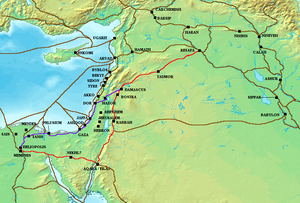 Numerous ancient states, including Edom
, Moab
, Ammon
, and various Aramaean polities depended largely on the King's Highway for trade. The Highway began in Heliopolis, Egypt
and from there went eastward to Clysma
(modern Suez
), through the Mitla Pass
and the Egyptian
forts of Nekhl and Themed in the Sinai desert to Eilat and Aqaba
. From there the Highway turned northward through the Arabah
, past Petra
and Ma'an
to Udruh, Sela, and Shaubak. It passed through Kerak
and the land of Moab
to Madaba
, Rabbah Ammon/Philadelphia (modern Amman
), Gerasa
, Bosra
, Damascus
, and Tadmor, ending at Resafa
on the upper Euphrates.
The Highway is referred to in :
Many of the wars of the Israelites against the kingdoms of the trans-Jordanian highlands during the period of the Kingdom of Israel (and its sister-kingdom, the Kingdom of Judah
) probably were at least partly over control of the Highway.
The Nabataeans
used this road as a trade route for luxury goods such as frankincense
and spice
s from southern Arabia
. During the Roman
period, the King's Highway was rebuilt by Trajan
and called the Via Traiana Nova
. The Highway has also been used as an important pilgrimage
route for Christian
s, as it passed numerous sites important in Christianity, including Mount Nebo
and al-Maghtas ("the Baptism Site") at the Jordan River, where Jesus
is believed to have been baptized by John the Baptist
. Muslims used it as the main Hajj
route to Mecca
until the Ottoman Turks
built the Tariq al-Bint in the 16th century.
Trade route
A trade route is a logistical network identified as a series of pathways and stoppages used for the commercial transport of cargo. Allowing goods to reach distant markets, a single trade route contains long distance arteries which may further be connected to several smaller networks of commercial...
of vital importance to the ancient Middle East
Middle East
The Middle East is a region that encompasses Western Asia and Northern Africa. It is often used as a synonym for Near East, in opposition to Far East...
. It began in Egypt
Egypt
Egypt , officially the Arab Republic of Egypt, Arabic: , is a country mainly in North Africa, with the Sinai Peninsula forming a land bridge in Southwest Asia. Egypt is thus a transcontinental country, and a major power in Africa, the Mediterranean Basin, the Middle East and the Muslim world...
, and stretched across the Sinai Peninsula
Sinai Peninsula
The Sinai Peninsula or Sinai is a triangular peninsula in Egypt about in area. It is situated between the Mediterranean Sea to the north, and the Red Sea to the south, and is the only part of Egyptian territory located in Asia as opposed to Africa, effectively serving as a land bridge between two...
to Aqaba
Aqaba
Aqaba is a coastal city in the far south of Jordan, the capital of Aqaba Governorate at the head of the Gulf of Aqaba. Aqaba is strategically important to Jordan as it is the country's only seaport. Aqaba is best known today as a diving and beach resort, but industrial activity remains important...
. From there it turned northward across Jordan
Jordan
Jordan , officially the Hashemite Kingdom of Jordan , Al-Mamlaka al-Urduniyya al-Hashemiyya) is a kingdom on the East Bank of the River Jordan. The country borders Saudi Arabia to the east and south-east, Iraq to the north-east, Syria to the north and the West Bank and Israel to the west, sharing...
, leading to Damascus
Damascus
Damascus , commonly known in Syria as Al Sham , and as the City of Jasmine , is the capital and the second largest city of Syria after Aleppo, both are part of the country's 14 governorates. In addition to being one of the oldest continuously inhabited cities in the world, Damascus is a major...
and the Euphrates River.
Edom
Edom or Idumea was a historical region of the Southern Levant located south of Judea and the Dead Sea. It is mentioned in biblical records as a 1st millennium BC Iron Age kingdom of Edom, and in classical antiquity the cognate name Idumea was used to refer to a smaller area in the same region...
, Moab
Moab
Moab is the historical name for a mountainous strip of land in Jordan. The land lies alongside much of the eastern shore of the Dead Sea. The existence of the Kingdom of Moab is attested to by numerous archeological findings, most notably the Mesha Stele, which describes the Moabite victory over...
, Ammon
Ammon
Ammon , also referred to as the Ammonites and children of Ammon, was an ancient nation located east of the Jordan River, Gilead, and the Dead Sea, in present-day Jordan. The chief city of the country was Rabbah or Rabbath Ammon, site of the modern city of Amman, Jordan's capital...
, and various Aramaean polities depended largely on the King's Highway for trade. The Highway began in Heliopolis, Egypt
Heliopolis (ancient)
Heliopolis was one of the oldest cities of ancient Egypt, the capital of the 13th Lower Egyptian nome that was located five miles east of the Nile to the north of the apex of the Nile Delta...
and from there went eastward to Clysma
Clysma
Clysma or Klysma or Qulzum was a village situated around the northeast Egypt at the northern end of the Gulf of Suez and at the southern terminus of the Suez Canal...
(modern Suez
Suez
Suez is a seaport city in north-eastern Egypt, located on the north coast of the Gulf of Suez , near the southern terminus of the Suez Canal, having the same boundaries as Suez governorate. It has three harbors, Adabya, Ain Sokhna and Port Tawfiq, and extensive port facilities...
), through the Mitla Pass
Mitla Pass
The Mitla Pass is a 32 km-long snaky pass in the Sinai of Egypt, wedged between mountain ranges to the north and south, located about 50 km east of Suez...
and the Egyptian
Ancient Egypt
Ancient Egypt was an ancient civilization of Northeastern Africa, concentrated along the lower reaches of the Nile River in what is now the modern country of Egypt. Egyptian civilization coalesced around 3150 BC with the political unification of Upper and Lower Egypt under the first pharaoh...
forts of Nekhl and Themed in the Sinai desert to Eilat and Aqaba
Aqaba
Aqaba is a coastal city in the far south of Jordan, the capital of Aqaba Governorate at the head of the Gulf of Aqaba. Aqaba is strategically important to Jordan as it is the country's only seaport. Aqaba is best known today as a diving and beach resort, but industrial activity remains important...
. From there the Highway turned northward through the Arabah
Arabah
The Arabah , also known as Aravah, is a section of the Great Rift Valley running in a north-south orientation between the southern end of the Sea of Galilee down to the Dead Sea and continuing further south where it ends at the Gulf of Aqaba. It includes most of the border between Israel to the...
, past Petra
Petra
Petra is a historical and archaeological city in the Jordanian governorate of Ma'an that is famous for its rock cut architecture and water conduits system. Established sometime around the 6th century BC as the capital city of the Nabataeans, it is a symbol of Jordan as well as its most visited...
and Ma'an
Ma'an
Ma'an is a town in southern Jordan 218 km away from the capital Amman. It is the capital of Ma'an Governorate. Ma'an has a population of around 50,000. The city had a population of 22,989 in the 1992 census and is estimated as being about 50,000 as of 2007 according to the Ma'an Municipality...
to Udruh, Sela, and Shaubak. It passed through Kerak
Kerak
Kerak Castle is a large crusader castle located in Kerak in Jordan. It is one of the largest crusader castles in the Levant.Construction of the castle began in the 1140s, under Pagan, the butler of Fulk of Jerusalem. The Crusaders called it Crac des Moabites or "Karak in Moab", as it is frequently...
and the land of Moab
Moab
Moab is the historical name for a mountainous strip of land in Jordan. The land lies alongside much of the eastern shore of the Dead Sea. The existence of the Kingdom of Moab is attested to by numerous archeological findings, most notably the Mesha Stele, which describes the Moabite victory over...
to Madaba
Madaba
Madaba , is the capital city of Madaba Governorate of Jordan, which has a population of about 60,000. Madaba is the fifth most populous town in Jordan. It is best known for its Byzantine and Umayyad mosaics, especially a large Byzantine-era mosaic map of The Holy Land...
, Rabbah Ammon/Philadelphia (modern Amman
Amman
Amman is the capital of Jordan. It is the country's political, cultural and commercial centre and one of the oldest continuously inhabited cities in the world. The Greater Amman area has a population of 2,842,629 as of 2010. The population of Amman is expected to jump from 2.8 million to almost...
), Gerasa
Jerash
Jerash, the Gerasa of Antiquity, is the capital and largest city of Jerash Governorate , which is situated in the north of Jordan, north of the capital Amman towards Syria...
, Bosra
Bosra
Bosra , also known as Bostra, Busrana, Bozrah, Bozra, Busra Eski Şam, Busra ash-Sham, and Nova Trajana Bostra, is an ancient city administratively belonging to the Daraa Governorate in southern Syria...
, Damascus
Damascus
Damascus , commonly known in Syria as Al Sham , and as the City of Jasmine , is the capital and the second largest city of Syria after Aleppo, both are part of the country's 14 governorates. In addition to being one of the oldest continuously inhabited cities in the world, Damascus is a major...
, and Tadmor, ending at Resafa
Resafa
Resafa , known in Roman times as Sergiopolis, was a city located in what is now modern-day Syria. It is an archaeological site situated south-west of the city of Ar Raqqah and the Euphrates.-History:...
on the upper Euphrates.
The Highway is referred to in :
- Please let us pass through your country. We will not pass through fields or vineyards, nor will we drink water from wellsWater wellA water well is an excavation or structure created in the ground by digging, driving, boring or drilling to access groundwater in underground aquifers. The well water is drawn by an electric submersible pump, a trash pump, a vertical turbine pump, a handpump or a mechanical pump...
; we will go along the King's Highway; we will not turn aside to the right hand or to the left until we have passed through your territory.'" - Then Edom said to him, "You shall not pass through my land, lest I come out against you with the sword."
- So the children of Israel said to him, "We will go by the Highway, and if I or my livestock drink any of your water, then I will pay for it; let me only pass through on foot, nothing more."
- Then he said,"You shall not pass through." So Edom came out against them with many men and with a strong hand.
- Thus Edom refused to give Israel passage through his territory; so Israel turned away from him.
Many of the wars of the Israelites against the kingdoms of the trans-Jordanian highlands during the period of the Kingdom of Israel (and its sister-kingdom, the Kingdom of Judah
Kingdom of Judah
The Kingdom of Judah was a Jewish state established in the Southern Levant during the Iron Age. It is often referred to as the "Southern Kingdom" to distinguish it from the northern Kingdom of Israel....
) probably were at least partly over control of the Highway.
The Nabataeans
Nabataeans
Thamudi3.jpgThe Nabataeans, also Nabateans , were ancient peoples of southern Canaan and the northern part of Arabia, whose oasis settlements in the time of Josephus , gave the name of Nabatene to the borderland between Syria and Arabia, from the Euphrates to the Red Sea...
used this road as a trade route for luxury goods such as frankincense
Frankincense
Frankincense, also called olibanum , is an aromatic resin obtained from trees of the genus Boswellia, particularly Boswellia sacra, B. carteri, B. thurifera, B. frereana, and B. bhaw-dajiana...
and spice
Spice
A spice is a dried seed, fruit, root, bark, or vegetative substance used in nutritionally insignificant quantities as a food additive for flavor, color, or as a preservative that kills harmful bacteria or prevents their growth. It may be used to flavour a dish or to hide other flavours...
s from southern Arabia
Arabian Peninsula
The Arabian Peninsula is a land mass situated north-east of Africa. Also known as Arabia or the Arabian subcontinent, it is the world's largest peninsula and covers 3,237,500 km2...
. During the Roman
Ancient Rome
Ancient Rome was a thriving civilization that grew on the Italian Peninsula as early as the 8th century BC. Located along the Mediterranean Sea and centered on the city of Rome, it expanded to one of the largest empires in the ancient world....
period, the King's Highway was rebuilt by Trajan
Trajan
Trajan , was Roman Emperor from 98 to 117 AD. Born into a non-patrician family in the province of Hispania Baetica, in Spain Trajan rose to prominence during the reign of emperor Domitian. Serving as a legatus legionis in Hispania Tarraconensis, in Spain, in 89 Trajan supported the emperor against...
and called the Via Traiana Nova
Via Traiana Nova
The Via Traiana Nova was an ancient Roman road built by the emperor Trajan. It was specifically known as the Via Traiana Nova in order to distinguish it from the Via Traiana in Italy. It is occasionally also referred to simply as the 'Via Nova' or 'Via Nova Traiana' and was completed under...
. The Highway has also been used as an important pilgrimage
Pilgrimage
A pilgrimage is a journey or search of great moral or spiritual significance. Typically, it is a journey to a shrine or other location of importance to a person's beliefs and faith...
route for Christian
Christian
A Christian is a person who adheres to Christianity, an Abrahamic, monotheistic religion based on the life and teachings of Jesus of Nazareth as recorded in the Canonical gospels and the letters of the New Testament...
s, as it passed numerous sites important in Christianity, including Mount Nebo
Mount Nebo (Jordan)
Mount Nebo is an elevated ridge that is approximately 817 meters above sea level, in what is now western Jordan. The view from the summit provides a panorama of the Holy Land and, to the north, a more limited one of the valley of the River Jordan...
and al-Maghtas ("the Baptism Site") at the Jordan River, where Jesus
Jesus
Jesus of Nazareth , commonly referred to as Jesus Christ or simply as Jesus or Christ, is the central figure of Christianity...
is believed to have been baptized by John the Baptist
John the Baptist
John the Baptist was an itinerant preacher and a major religious figure mentioned in the Canonical gospels. He is described in the Gospel of Luke as a relative of Jesus, who led a movement of baptism at the Jordan River...
. Muslims used it as the main Hajj
Hajj
The Hajj is the pilgrimage to Mecca, Saudi Arabia. It is one of the largest pilgrimages in the world, and is the fifth pillar of Islam, a religious duty that must be carried out at least once in their lifetime by every able-bodied Muslim who can afford to do so...
route to Mecca
Mecca
Mecca is a city in the Hijaz and the capital of Makkah province in Saudi Arabia. The city is located inland from Jeddah in a narrow valley at a height of above sea level...
until the Ottoman Turks
Ottoman Turks
The Ottoman Turks were the Turkish-speaking population of the Ottoman Empire who formed the base of the state's military and ruling classes. Reliable information about the early history of Ottoman Turks is scarce, but they take their Turkish name, Osmanlı , from the house of Osman I The Ottoman...
built the Tariq al-Bint in the 16th century.