


Osaka Castle

Encyclopedia
Japanese castle
' were fortresses composed primarily of wood and stone. They evolved from the wooden stockades of earlier centuries, and came into their best-known form in the 16th century...
in Chūō-ku, Osaka
Chuo-ku, Osaka
, Osaka is one of 24 wards of Osaka, Japan. It has an area of 8.88 km2, and a population of 60,085. It houses Osaka's financial district, as well as the Osaka Prefecture offices and principal shopping and tourist areas.-Diplomatic missions:...
, Japan
Japan
Japan is an island nation in East Asia. Located in the Pacific Ocean, it lies to the east of the Sea of Japan, China, North Korea, South Korea and Russia, stretching from the Sea of Okhotsk in the north to the East China Sea and Taiwan in the south...
.
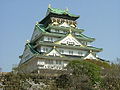
Originally called Ozakajō, it is one of Japan's most famous castles, and played a major role in the unification of Japan during the sixteenth century of the Azuchi-Momoyama period
Azuchi-Momoyama period
The came at the end of the Warring States Period in Japan, when the political unification that preceded the establishment of the Tokugawa shogunate took place. It spans the years from approximately 1573 to 1603, during which time Oda Nobunaga and his successor, Toyotomi Hideyoshi, imposed order...
.
Description
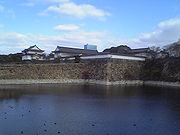
The main tower of Osaka Castle is situated on a plot of land roughly one kilometer square. It is built on two raised platforms of landfill supported by sheer walls of cut rock, using a technique called Burdock pilingBurdock piling
Burdock piling is a technique of Japanese wall building used to build castles, such as Osaka Castle and named after the resemblance to the Japanese burdock plant. Large rocks are fitted together over a mound of earth, and the remaining cracks are filled in with pebbles...
, each overlooking a moat
Moat
A moat is a deep, broad ditch, either dry or filled with water, that surrounds a castle, other building or town, historically to provide it with a preliminary line of defence. In some places moats evolved into more extensive water defences, including natural or artificial lakes, dams and sluices...
. The central castle building is five stories on the outside and eight stories on the inside, and built atop a tall stone foundation to protect its occupants from sword-bearing attackers.
The Castle grounds, which cover approximately 60000 square metres (14.8 acre) contain thirteen structures which have been designated as Important Cultural Assets by the Japanese government, including:
- Ote-mon Gate
- Sakura-mon Gate
- Ichiban-yagura Turret
- Inui-yagura Turret
- Rokuban-yagura Turret
- Sengan Turret
- Tamon Turret
- Kinmeisui Well
- Kinzo Storehouse
- Enshogura Gunpowder Magazine
- Three sections of castle wall all located around Otemon Gate.
History

Toyotomi Hideyoshi
was a daimyo warrior, general and politician of the Sengoku period. He unified the political factions of Japan. He succeeded his former liege lord, Oda Nobunaga, and brought an end to the Sengoku period. The period of his rule is often called the Momoyama period, named after Hideyoshi's castle...
commenced construction on the site of the Ikkō-ikki
Ikko-ikki
', literally "Ikkoshū Uprising", were mobs of peasant farmers, Buddhist monks, Shinto priests and local nobles, who rose up against samurai rule in 15th to 16th century Japan. They followed the beliefs of the Jōdo Shinshū sect of Buddhism which taught that all believers are equally saved by Amida...
temple of Ishiyama Hongan-ji
Ishiyama Hongan-ji
For other uses, see Ishiyama .The ' was the primary fortress of the Ikkō-ikki, mobs of warrior monks and peasants who opposed samurai rule. It was established in 1496, at the mouth of the Yodo River, on the coast of the Seto Inland Sea. At the time, this was just outside of the remains of the...
. The basic plan was modeled after Azuchi Castle
Azuchi Castle
' was one of the primary castles of Oda Nobunaga. It was built from 1576 to 1579, on the shores of Lake Biwa, in Ōmi Province. Nobunaga intentionally built it close enough to Kyoto that he could watch over and guard the approaches to the capital, but, being outside the city, his fortress would be...
, the headquarters of Oda Nobunaga
Oda Nobunaga
was the initiator of the unification of Japan under the shogunate in the late 16th century, which ruled Japan until the Meiji Restoration in 1868. He was also a major daimyo during the Sengoku period of Japanese history. His opus was continued, completed and finalized by his successors Toyotomi...
. Toyotomi wanted to build a castle that mirrored Oda's, but surpassed it in every way: the plan featured a five-story main tower, with three extra stories underground, and gold leaf
Gold leaf
right|thumb|250px|[[Burnishing]] gold leaf with an [[agate]] stone tool, during the water gilding processGold leaf is gold that has been hammered into extremely thin sheets and is often used for gilding. Gold leaf is available in a wide variety of karats and shades...
on the sides of the tower to impress visitors.
In 1585 the Inner donjon was completed. Toyotomi continued to extend and expand the castle, making it more and more formidable to attackers.
In 1597 construction was completed and Hideyoshi died. Osaka Castle passed to his son, Toyotomi Hideyori
Toyotomi Hideyori
was the son and designated successor of Toyotomi Hideyoshi, the general who first united all of Japan. His mother, Yodo-dono, was the niece of Oda Nobunaga....
.
In 1600 Tokugawa Ieyasu
Tokugawa Ieyasu
was the founder and first shogun of the Tokugawa shogunate of Japan , which ruled from the Battle of Sekigahara in 1600 until the Meiji Restoration in 1868. Ieyasu seized power in 1600, received appointment as shogun in 1603, abdicated from office in 1605, but...
defeated his opponents at the Battle of Sekigahara
Battle of Sekigahara
The , popularly known as the , was a decisive battle on October 21, 1600 which cleared the path to the Shogunate for Tokugawa Ieyasu...
, and started his own bakufu in Edo.
In 1614 Tokugawa attacked Hideyori in the winter, starting the Siege of Osaka
Siege of Osaka
The was a series of battles undertaken by the Tokugawa shogunate against the Toyotomi clan, and ending in that clan's destruction. Divided into two stages , and lasting from 1614 to 1615, the siege put an end to the last major armed opposition to the shogunate's establishment...
. Although the Toyotomi forces were outnumbered approximately 2 to 1, they managed to fight off Tokugawa's 200,000-man army and protect the castle's outer walls. However, Tokugawa attempted to muzzle Toyotomi by filling up the castle's outer moat, rendering it largely defenseless.
During the summer of 1615, Hideyori began to dig the outer moat once more. Tokugawa, in outrage, sent his armies to Osaka Castle again, and routed the Toyotomi men inside the outer walls on June 4. Osakajo fell to Tokugawa, and the Toyotomi clan
Toyotomi clan
Originating in Owari Province, the served as retainers to the Oda clan throughout 16th-century Japan's Sengoku period. -Unity and Conflict:The most influential figure within the Toyotomi was Toyotomi Hideyoshi, one of the three "unifiers of Japan." Oda Nobunaga was another primary unifier and the...
perished.
In 1620, the new heir to the shogunate, Tokugawa Hidetada
Tokugawa Hidetada
was the second shogun of the Tokugawa dynasty, who ruled from 1605 until his abdication in 1623. He was the third son of Tokugawa Ieyasu, the first shogun of the Tokugawa shogunate.-Early life :...
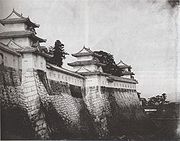
, began to reconstruct and rearm Osaka Castle. He built a new elevated main tower, five stories on the outside and eight stories on the inside, and assigned the task of constructing new walls to individual samurai clans. The walls built in the 1620s still stand today, and are made out of interlocked granite boulders with no mortar whatsoever; they are held together solely by each other. Many of the stones were brought from rock quarries in the Seto Inland Sea, and bear inscribed crests of the various families who laid them into the walls.
In 1660, lightning ignited the gunpowder warehouse. The explosion set the castle on fire.
In 1665, lightning struck and burnt down the main tower.
In 1843, after decades of neglect, the castle got much-needed repairs when the bakufu collected money from the people of the region to rebuild several of the turrets.
In 1868, the Fall of Osaka castle
Fall of Osaka castle
The Fall of Osaka castle refers to the capture of the Tokugawa-held Osaka Castle by pro-Imperial "Kangun" forces on February 2, 1868.The fall followed the Tokugawa defeat in the Battle of Toba-Fushimi. Troops loyal to the Bakufu tried to regroup under Tokugawa Yoshinobu...
occurred. Much of the castle was burned in the civil conflicts surrounding the Meiji Restoration
Meiji Restoration
The , also known as the Meiji Ishin, Revolution, Reform or Renewal, was a chain of events that restored imperial rule to Japan in 1868...
. Under the Meiji government, Osaka Castle was converted to a barracks for Japan's rapidly-expanding Western-style military.
In 1928, the main tower was restored after the mayor of Osaka concluded a highly successful fund-raising drive.
In 1945, bombing raids on Osaka damaged the reconstructed main tower.
In 1995, Osaka's government approved yet another restoration project, with the intent of restoring the main tower to its Edo-era splendor.
In 1997, restoration was completed. The castle is a concrete reproduction (including elevators) of the original and the interior is intended as a modern, functioning museum.
Accessibility
The castle is open to the public, and is easily accessible from Osakajōkōen StationOsakajokoen Station
is a train station on the West Japan Railway Company Osaka Loop Line in Jōtō-ku, Osaka, Japan. The station name translates as Osaka Castle Park.-Layout:There are two side platforms with two tracks on the ground level.-Surroundings:*Osaka Castle...
on the JR West Osaka Loop Line
Osaka Loop Line
The is a railway line in Japan operated by West Japan Railway Company . It encircles central Osaka.The second loop line, the Osaka Higashi Line, from Hanaten to Kyuhoji was opened on March 15, 2008, and the line from Shigino to Shin-Ōsaka is planned to open in 2020.-Outline:This loop line consists...
. It is a popular spot during festival seasons, and especially during the cherry blossom
Sakura
A cherry blossom is the flower of any of several trees of genus Prunus, particularly the Japanese Cherry, Prunus serrulata, which is sometimes called sakura after the Japanese . Many of the varieties that have been cultivated for ornamental use do not produce fruit...
bloom (hanami
Hanami
is the Japanese traditional custom of enjoying the beauty of flowers, "flower" in this case almost always meaning cherry blossoms or ume blossoms. From the end of March to early May, sakura bloom all over Japan, and around the first of February on the island of Okinawa...
), when the sprawling castle grounds are covered with food vendors and taiko
Taiko
means "drum" in Japanese . Outside Japan, the word is often used to refer to any of the various Japanese drums and to the relatively recent art-form of ensemble taiko drumming...
drummers. The large indoor arena Osaka-jo Hall
Osaka-jo Hall
, or Osaka Castle Hall, is a multi-purpose arena, in the Kyōbashi area, of Osaka, Japan. The hall opened in 1983 and can seat up to 16,000 people...
is also located within the grounds of the castle park
Osaka Castle Park
is a public urban park and historical site situated at Osaka-Jō in Chūō-ku, Osaka, Japan. It lies on the south of the Ōkawa and occupies a large area in the center of the city of Osaka. This park is second largest park in the city....
.
See also
- List of Special Places of Scenic Beauty, Special Historic Sites and Special Natural Monuments
- Tourism in JapanTourism in JapanTourism in Japan attracted 8.3 million foreign visitors in 2008, slightly more than Singapore and Ireland. Japan has 16 World Heritage Sites, including Himeji Castle and Historic Monuments of Ancient Kyoto . Kyoto receives over 30 million tourists annually...