

Hasekura Tsunenaga

Encyclopedia
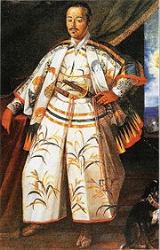
| Hasekura Rokuemon Tsunenaga (1571–1622)  Hasekura's portrait during his mission in Rome in 1615, by Claude Deruet Claude Deruet Claude Deruet was a famous French Baroque painter of the 17th century, from the city of Nancy.-Biography:Deruet was an apprentice to Jacques Bellange, the official court painter to Charles III, Duke of Lorraine. He was in Rome between ca. 1612 and 1619, where - according to André Félibien - he... , Coll. Borghese Galleria Borghese The Borghese Gallery is an art gallery in Rome, Italy, housed in the former Villa Borghese Pinciana. It is a building that was from the first integral with its gardens, nowadays considered quite separately by tourists as the Villa Borghese gardens... , Rome |
||
| Names: | ||
|---|---|---|
| Japanese name Japanese name in modern times usually consist of a family name , followed by a given name. "Middle names" are not generally used.Japanese names are usually written in kanji, which are characters of usually Chinese origin in Japanese pronunciation... : |
Hasekura Rokuemon Tsunenaga |
|
| Christian name: | Don Felipe Francisco Hasekura | |
| Retainer of: | ||
| Overlord: | Date Masamune Date Masamune was a regional strongman of Japan's Azuchi-Momoyama period through early Edo period. Heir to a long line of powerful daimyo in the Tōhoku region, he went on to found the modern-day city of Sendai... |
|
| Fief: | Sendai Domain Sendai Domain was a Japanese domain of the Edo period. Most of its holdings were contiguous, covering all of modern-day Miyagi Prefecture, small portions of southern Iwate Prefecture, and a portion of northeastern Fukushima Prefecture. The domain's capital, and the ruling family's castle, were located in what... (Northeastern Japan) |
|

Samurai
is the term for the military nobility of pre-industrial Japan. According to translator William Scott Wilson: "In Chinese, the character 侍 was originally a verb meaning to wait upon or accompany a person in the upper ranks of society, and this is also true of the original term in Japanese, saburau...
and retainer of Date Masamune
Date Masamune
was a regional strongman of Japan's Azuchi-Momoyama period through early Edo period. Heir to a long line of powerful daimyo in the Tōhoku region, he went on to found the modern-day city of Sendai...
, the daimyo
Daimyo
is a generic term referring to the powerful territorial lords in pre-modern Japan who ruled most of the country from their vast, hereditary land holdings...
of Sendai.
In the years 1613 through 1620, Hasekura headed a diplomatic mission to the Vatican
Holy See
The Holy See is the episcopal jurisdiction of the Catholic Church in Rome, in which its Bishop is commonly known as the Pope. It is the preeminent episcopal see of the Catholic Church, forming the central government of the Church. As such, diplomatically, and in other spheres the Holy See acts and...
in Rome, traveling through New Spain
New Spain
New Spain, formally called the Viceroyalty of New Spain , was a viceroyalty of the Spanish colonial empire, comprising primarily territories in what was known then as 'América Septentrional' or North America. Its capital was Mexico City, formerly Tenochtitlan, capital of the Aztec Empire...
(arriving in Acapulco
Acapulco
Acapulco is a city, municipality and major sea port in the state of Guerrero on the Pacific coast of Mexico, southwest from Mexico City. Acapulco is located on a deep, semi-circular bay and has been a port since the early colonial period of Mexico’s history...
and departing from Veracruz
Veracruz
Veracruz, formally Veracruz de Ignacio de la Llave officially Estado Libre y Soberano de Veracruz de Ignacio de la Llave , is one of the 31 states that, along with the Federal District, comprise the 32 federative entities of Mexico. It is divided in 212 municipalities and its capital city is...
) and visiting various ports-of-call in Europe. This historic mission is called the Keichō
Keicho
was a after Bunroku and before Genna. This period spanned from October 1596 to July 1615. The reigning emperors were and .-Change of era:* 1596 : The era name was changed to Keichō to mark the passing of various natural disasters...
Embassy , and follows the Tenshō embassy of 1582. On the return trip, Hasekura and his companions re-traced their route across Mexico in 1619, sailing from Acapulco for Manila
Manila
Manila is the capital of the Philippines. It is one of the sixteen cities forming Metro Manila.Manila is located on the eastern shores of Manila Bay and is bordered by Navotas and Caloocan to the north, Quezon City to the northeast, San Juan and Mandaluyong to the east, Makati on the southeast,...
, and then sailing north to Japan in 1620. He is conventionally considered the first Japanese ambassador in the Americas and in Europe.
Although Hasekura's embassy was cordially received in Europe, it happened at a time when Japan was moving toward the suppression of Christianity
Kirishitan
, from Portuguese cristão, referred to Roman Catholic Christians in Japanese and is used as a historiographic term for Roman Catholics in Japan in the 16th and 17th centuries. Christian missionaries were known as bateren or iruman...
. European monarchs such as the King of Spain thus refused the trade agreements Hasekura had been seeking. Hasekura returned to Japan in 1620 and died of illness a year later, his embassy seemingly ending with few results in an increasingly isolationist Japan.
Japan's next embassy to Europe would only occur more than 200 years later, following two centuries of isolation
Sakoku
was the foreign relations policy of Japan under which no foreigner could enter nor could any Japanese leave the country on penalty of death. The policy was enacted by the Tokugawa shogunate under Tokugawa Iemitsu through a number of edicts and policies from 1633–39 and remained in effect until...
, with the "First Japanese Embassy to Europe" in 1862.
Early life
Little is known of the early life of Hasekura Tsunenaga. He was a mid-level noble samurai in the Sendai DomainSendai Domain
was a Japanese domain of the Edo period. Most of its holdings were contiguous, covering all of modern-day Miyagi Prefecture, small portions of southern Iwate Prefecture, and a portion of northeastern Fukushima Prefecture. The domain's capital, and the ruling family's castle, were located in what...
in northern Japan, who had the opportunity to directly serve the daimyo
Daimyo
is a generic term referring to the powerful territorial lords in pre-modern Japan who ruled most of the country from their vast, hereditary land holdings...
Date Masamune
Date Masamune
was a regional strongman of Japan's Azuchi-Momoyama period through early Edo period. Heir to a long line of powerful daimyo in the Tōhoku region, he went on to found the modern-day city of Sendai...
. They were of roughly the same age, and it is recorded that several important missions were given to Tsunenaga as his representative.

Samurai
is the term for the military nobility of pre-industrial Japan. According to translator William Scott Wilson: "In Chinese, the character 侍 was originally a verb meaning to wait upon or accompany a person in the upper ranks of society, and this is also true of the original term in Japanese, saburau...
of the Japanese invasion of Korea under the Taiko
Sessho and Kampaku
In Japan, was a title given to a regent who was named to assist either a child emperor before his coming of age, or an empress. The was theoretically a sort of chief advisor for the emperor, but was the title of both first secretary and regent who assists an adult emperor. During the Heian era,...
Toyotomi Hideyoshi
Toyotomi Hideyoshi
was a daimyo warrior, general and politician of the Sengoku period. He unified the political factions of Japan. He succeeded his former liege lord, Oda Nobunaga, and brought an end to the Sengoku period. The period of his rule is often called the Momoyama period, named after Hideyoshi's castle...
, during six months in 1597.
In 1612, Hasekura's father, Hasekura Tsunenari , was indicted for corruption, and he was put to death in 1613. His fief was confiscated, and his son should normally have been executed as well. Date however gave him the opportunity to redeem his honour by placing him in charge of the Embassy to Europe, and soon gave him back his territories as well.
Background: early contacts between Japan and Spain
The SpanishSpanish Empire
The Spanish Empire comprised territories and colonies administered directly by Spain in Europe, in America, Africa, Asia and Oceania. It originated during the Age of Exploration and was therefore one of the first global empires. At the time of Habsburgs, Spain reached the peak of its world power....
started trans-Pacific
Pacific Ocean
The Pacific Ocean is the largest of the Earth's oceanic divisions. It extends from the Arctic in the north to the Southern Ocean in the south, bounded by Asia and Australia in the west, and the Americas in the east.At 165.2 million square kilometres in area, this largest division of the World...
voyages between New Spain
New Spain
New Spain, formally called the Viceroyalty of New Spain , was a viceroyalty of the Spanish colonial empire, comprising primarily territories in what was known then as 'América Septentrional' or North America. Its capital was Mexico City, formerly Tenochtitlan, capital of the Aztec Empire...
(Mexico) and the Philippines
Philippines
The Philippines , officially known as the Republic of the Philippines , is a country in Southeast Asia in the western Pacific Ocean. To its north across the Luzon Strait lies Taiwan. West across the South China Sea sits Vietnam...
in 1565. The famous Manila galleon
Manila Galleon
The Manila galleons or Manila-Acapulco galleons were Spanish trading ships that sailed once or twice per year across the Pacific Ocean between Manila in the Philippines, and Acapulco, New Spain . The name changed reflecting the city that the ship was sailing from...
s carried silver from Mexican mines westward to the entrepôt
Entrepôt
An entrepôt is a trading post where merchandise can be imported and exported without paying import duties, often at a profit. This profit is possible because of trade conditions, for example, the reluctance of ships to travel the entire length of a long trading route, and selling to the entrepôt...
of Manila
Manila
Manila is the capital of the Philippines. It is one of the sixteen cities forming Metro Manila.Manila is located on the eastern shores of Manila Bay and is bordered by Navotas and Caloocan to the north, Quezon City to the northeast, San Juan and Mandaluyong to the east, Makati on the southeast,...
in the Spanish possession of the Philippines. There, the silver was used to purchase spices and trade goods gathered from throughout Asia, including (until 1638) goods from Japan. The return route of the Manila galleons, first charted by the Spanish navigator Andrés de Urdaneta
Andrés de Urdaneta
Friar Andrés de Urdaneta, O.S.A., was a circumnavigator, explorer and Augustinian friar. As a navigator he achieved in 1536 the "second" world circumnavigation after first one led by Ferdinand Magellan and Juan Sebastián Elcano in 1522...
, took the ships northeast into the Kuroshio Current
Kuroshio Current
The Kuroshio is a north-flowing ocean current on the west side of the North Pacific Ocean. It is similar to the Gulf Stream in the North Atlantic and is part of the North Pacific ocean gyre...
(also known as the Japan Current) off the coast of Japan, and then across the Pacific to the west coast of North America
History of the west coast of North America
The human history of the west coast of North America is believed to stretch back to the arrival of the earliest people over the Bering Strait, or alternately along a now-submerged coastal plain, through the development of significant pre-Columbian cultures and population densities, to the arrival...
, landing eventually in Acapulco
Acapulco
Acapulco is a city, municipality and major sea port in the state of Guerrero on the Pacific coast of Mexico, southwest from Mexico City. Acapulco is located on a deep, semi-circular bay and has been a port since the early colonial period of Mexico’s history...
.
Spanish ships were periodically shipwrecked on the coasts of Japan due to bad weather, initiating contacts with the country. The Spanish wished to expand the Christian faith in Japan. Efforts to expand influence in Japan were met by stiff resistance towards the Jesuits
Society of Jesus
The Society of Jesus is a Catholic male religious order that follows the teachings of the Catholic Church. The members are called Jesuits, and are also known colloquially as "God's Army" and as "The Company," these being references to founder Ignatius of Loyola's military background and a...
, who had started the evangelizing
Evangelism
Evangelism refers to the practice of relaying information about a particular set of beliefs to others who do not hold those beliefs. The term is often used in reference to Christianity....
of the country in 1549, as well as by the opposition of Portuguese
Portuguese Empire
The Portuguese Empire , also known as the Portuguese Overseas Empire or the Portuguese Colonial Empire , was the first global empire in history...
and the Dutch
Dutch Empire
The Dutch Empire consisted of the overseas territories controlled by the Dutch Republic and later, the modern Netherlands from the 17th to the 20th century. The Dutch followed Portugal and Spain in establishing an overseas colonial empire, but based on military conquest of already-existing...
who did not wish to see Spain participate in Japanese trade. However, some Japanese, such as Christopher and Cosmas
Christopher and Cosmas
Christopher and Cosmas were two Japanese men, only known by their Christian names, who are recorded to have travelled across the Pacific on a Spanish galleon in 1587, and later accompanied the English navigator Thomas Cavendish to England, Brazil and the Southern Atlantic, where they disappeared...
, are known to have crossed the Pacific onboard Spanish galleon
Galleon
A galleon was a large, multi-decked sailing ship used primarily by European states from the 16th to 18th centuries. Whether used for war or commerce, they were generally armed with the demi-culverin type of cannon.-Etymology:...
s as early as 1587. It is known that gifts were exchanged between the governor of the Philippines and Toyotomi Hideyoshi
Toyotomi Hideyoshi
was a daimyo warrior, general and politician of the Sengoku period. He unified the political factions of Japan. He succeeded his former liege lord, Oda Nobunaga, and brought an end to the Sengoku period. The period of his rule is often called the Momoyama period, named after Hideyoshi's castle...
, who thanks him in a 1597 letter, writing "The black elephant in particular I found most unusual."
In 1609, the Spanish Manila galleon San Francisco encountered bad weather on its way from Manila to Acapulco, and was wrecked on the Japanese coast in Chiba
Chiba Prefecture
is a prefecture of Japan located in the Kantō region and the Greater Tokyo Area. Its capital is Chiba City.- History :Chiba Prefecture was established on June 15, 1873 with the merger of Kisarazu Prefecture and Inba Prefecture...
, near Tokyo. The sailors were rescued and welcomed, and the ship's captain, Rodrigo de Vivero, former interim governor of the Philippines, met with the retired shogun Tokugawa Ieyasu
Tokugawa Ieyasu
was the founder and first shogun of the Tokugawa shogunate of Japan , which ruled from the Battle of Sekigahara in 1600 until the Meiji Restoration in 1868. Ieyasu seized power in 1600, received appointment as shogun in 1603, abdicated from office in 1605, but...
. Rodrigo de Vivero drafted a treaty, signed on 29 November 1609, whereby the Spaniards could establish a factory in eastern Japan, mining specialists would be imported from New Spain, Spanish ships would be allowed to visit Japan in case of necessity, and a Japanese embassy would be sent to the Spanish court.
1610 San Buena Ventura

Franciscan
Most Franciscans are members of Roman Catholic religious orders founded by Saint Francis of Assisi. Besides Roman Catholic communities, there are also Old Catholic, Anglican, Lutheran, ecumenical and Non-denominational Franciscan communities....
monk named Luis Sotelo
Luis Sotelo
Blessed Luis Sotelo was a Franciscan friar who died as a martyr in Japan, in 1624, and was beatified by Pope Pius IX in 1867....
, who was proselytizing
Proselytism
Proselytizing is the act of attempting to convert people to another opinion and, particularly, another religion. The word proselytize is derived ultimately from the Greek language prefix προσ- and the verb ἔρχομαι in the form of προσήλυτος...
in the area of what is now modern Tokyo, convinced Tokugawa Ieyasu
Tokugawa Ieyasu
was the founder and first shogun of the Tokugawa shogunate of Japan , which ruled from the Battle of Sekigahara in 1600 until the Meiji Restoration in 1868. Ieyasu seized power in 1600, received appointment as shogun in 1603, abdicated from office in 1605, but...
and his son Tokugawa Hidetada
Tokugawa Hidetada
was the second shogun of the Tokugawa dynasty, who ruled from 1605 until his abdication in 1623. He was the third son of Tokugawa Ieyasu, the first shogun of the Tokugawa shogunate.-Early life :...
to send him as a representative to New Spain (Mexico) on one of their ships, in order to advance the trade treaty. Rodrigo de Vivero offered to sail on the Japanese ship in order to guarantee the safety of their reception in New Spain, but insisted that another Franciscan, named Alonso Muños, be sent instead as the Shogun's representative. In 1610, the returning Rodrigo de Vivero, several Spanish sailors, the Franciscan father, and 22 Japanese representatives led by the trader Tanaka Shōsuke
Tanaka Shosuke
Tanaka Shōsuke was an important Japanese technician and trader in metals from Kyoto during the beginning of the 17th century.According to Japanese archives he was a representative of the great Osaka merchant Gotō Shōsaburō...
, sailed to Mexico aboard the San Buena Ventura
Japanese warship San Buena Ventura
San Buena Ventura was a 120 ton ship built in Japan under the direction of the English navigator and adventurer William Adams for the shogun Tokugawa Ieyasu....
, a ship built by the English adventurer William Adams
William Adams (sailor)
William Adams , also known in Japanese as Anjin-sama and Miura Anjin , was an English navigator who travelled to Japan and is believed to be the first Englishman ever to reach that country...
for the Shogun. Once in New Spain, Alonso Muños met with the Viceroy Luis de Velasco
Luis de Velasco, marqués de Salinas
Luis de Velasco, marqués de Salinas , Spanish nobleman, son of the second viceroy of New Spain, and himself the eighth viceroy. He governed from January 27, 1590 to November 4, 1595, and again from July 2, 1607 to June 10, 1611...
, who agreed to send an ambassador to Japan in the person of the famous explorer Sebastian Vizcaino
Sebastián Vizcaíno
Sebastián Vizcaíno was a Spanish soldier, entrepreneur, explorer, and diplomat whose varied roles took him to New Spain, the Philippines, the Baja California peninsula, the California coast and Japan.-Early career:...
, with the added mission of exploring the "Gold and silver islands" ("") that were thought to be east of the Japanese isles.
Vizcaino arrived in Japan in 1611, and had many meetings with the Shogun and feudal lords. These encounters were tainted by his poor respect for Japanese customs, the mounting resistance of the Japanese towards Catholic proselytism, and the intrigues of the Dutch against Spanish ambitions. Vizcaino finally left to search for the "Silver island", during which search he encountered bad weather, forcing him to return to Japan with heavy damage.
1612 San Sebastian
Without waiting for Vizcaino, another ship – built in IzuIzu, Shizuoka
is a city located in central Izu Peninsula in Shizuoka, Japan. As of 2009, the city had an estimated population of 35,397 and the density of 97.3 persons per km². The total area as 363.97 km².-Geography:...
by the Bakufu
Tokugawa shogunate
The Tokugawa shogunate, also known as the and the , was a feudal regime of Japan established by Tokugawa Ieyasu and ruled by the shoguns of the Tokugawa family. This period is known as the Edo period and gets its name from the capital city, Edo, which is now called Tokyo, after the name was...
under the minister of the Navy
Naval history of Japan
The naval history of Japan can be said to begin in early interactions with states on the Asian continent in the early centuries of the 1st millennium, reaching a pre-modern peak of activity during the 16th century, a time of cultural exchange with European powers and extensive trade with the Asian...
Mukai Shogen, and named San Sebastian – left for Mexico on 9 September 1612 with Luis Sotelo onboard as well as two representatives of Date Masamune, with the objective of advancing the trade agreement with New Spain. However, the ship foundered a few miles from Uraga
Uraga
is a subdivision of the city of Yokosuka, Kanagawa Prefecture, Japan. It is located on the south eastern side of the Miura Peninsula, at the northern end of the Uraga Channel, at the entrance of Tokyo Bay.-History:...
, and the expedition had to be abandoned.
The 1613 embassy project
Luis Sotelo
Blessed Luis Sotelo was a Franciscan friar who died as a martyr in Japan, in 1624, and was beatified by Pope Pius IX in 1867....
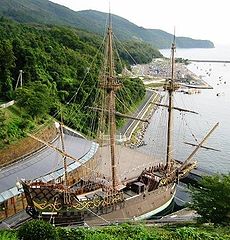
. The galleon, named Date Maru by the Japanese and later San Juan Bautista
Japanese warship San Juan Bautista
San Juan Bautista was one of Japan's first Japanese-built Western-style sail warships. She crossed the Pacific in 1614. She was of the Spanish galleon type, known in Japan as Nanban-Sen San Juan Bautista (“St. John the Baptist”) (originally called Date Maru, 伊達丸 in Japanese) was one of Japan's...
by the Spanish, took 45 days work in building, with the participation of technical experts from the Bakufu (the Minister of the Navy Mukai Shogen, an acquaintance of William Adams
William Adams (sailor)
William Adams , also known in Japanese as Anjin-sama and Miura Anjin , was an English navigator who travelled to Japan and is believed to be the first Englishman ever to reach that country...
with whom he built several ships, dispatched his Chief Carpenter), 800 shipwrights, 700 smith
Smith (metalwork)
A metalsmith, often shortened to smith, is a person involved in making metal objects. In contemporary use a metalsmith is a person who uses metal as a material, uses traditional metalsmithing techniques , whose work thematically relates to the practice or history of the practice, or who engages in...
s, and 3,000 carpenter
Carpenter
A carpenter is a skilled craftsperson who works with timber to construct, install and maintain buildings, furniture, and other objects. The work, known as carpentry, may involve manual labor and work outdoors....
s. The daimyo of Sendai
Sendai, Miyagi
is the capital city of Miyagi Prefecture, Japan, and the largest city in the Tōhoku Region. In 2005, the city had a population of one million, and was one of Japan's 19 designated cities...
, Date Masamune
Date Masamune
was a regional strongman of Japan's Azuchi-Momoyama period through early Edo period. Heir to a long line of powerful daimyo in the Tōhoku region, he went on to found the modern-day city of Sendai...
, was put in charge of the project. He named one of his retainers, Hasekura Tsunenaga (his fief was rated at around 600 koku
Koku
The is a Japanese unit of volume, equal to ten cubic shaku. In this definition, 3.5937 koku equal one cubic metre, i.e. 1 koku is approximately 278.3 litres. The koku was originally defined as a quantity of rice, historically defined as enough rice to feed one person for one year...
), to lead the mission:
- "The Great Ship left Toshima-TsukinouraIshinomaki, Miyagiis a city located in Miyagi Prefecture, Japan.As of January 1, 2010, the city had an estimated population of 164,294 and a population density of 295.83 persons per km²...
for the Southern Barbarians on 15 September [Japanese calendar], with at its head Hasekura Rokuemon Tsunenaga, and those called Imaizumi Sakan, Matsuki Shusaku, Nishi Kyusuke, Tanaka Taroemon, Naito Hanjuro, Sonohoka Kyuemon, Kuranojo, Tonomo, Kitsunai, Kyuji, as well as several others under Rokuemon, as well as 40 Southern BarbariansNanban tradeThe or the in Japanese history extends from the arrival of the first Europeans to Japan in 1543, to their near-total exclusion from the archipelago in 1614, under the promulgation of the "Sakoku" Seclusion Edicts.- Etymology :...
, 10 men of Mukai Shogen, and also tradespeople, to a total 180" (Records of the Date House, Keichō-Genna , Gonoi p. 56).
The objective of the Japanese embassy was both to discuss trade agreements with the Spanish crown in Madrid
Madrid
Madrid is the capital and largest city of Spain. The population of the city is roughly 3.3 million and the entire population of the Madrid metropolitan area is calculated to be 6.271 million. It is the third largest city in the European Union, after London and Berlin, and its metropolitan...
, and to meet with the Pope
Pope Paul V
-Theology:Paul met with Galileo Galilei in 1616 after Cardinal Bellarmine had, on his orders, warned Galileo not to hold or defend the heliocentric ideas of Copernicus. Whether there was also an order not to teach those ideas in any way has been a matter for controversy...
in Rome. Date Masamune displayed a great will to welcome the Catholic religion in his domain: he invited Luis Sotelo and authorized the propagation of Christianity in 1611. In his letter to the Pope, brought by Hasekura, he wrote: "I'll offer my land for a base of your missionary work. Send us as many padres as possible."
Sotelo, in his own account of the travels, emphasizes the religious dimension of the mission, claiming that the main objective was to spread the Christian faith in northern Japan:

- "I was formerly dispatched as ambassador of Idate Masamune, who holds the reins of the kingdom of Oxu [Japanese:] (which is in the Eastern part of Japan) —who, while he has not yet been reborn through baptismBaptismIn Christianity, baptism is for the majority the rite of admission , almost invariably with the use of water, into the Christian Church generally and also membership of a particular church tradition...
, has been catechizedCatechismA catechism , i.e. to indoctrinate) is a summary or exposition of doctrine, traditionally used in Christian religious teaching from New Testament times to the present...
, and was desirous that the Christian faith should be preached in his kingdom—together with another noble of his Court, Philippus Franciscus Faxecura Rocuyemon, to the Roman Senate & to the one who at that time was in charge of the Apostolic See, His Holiness Pope Paul V." (Luis Sotelo De Ecclesiae Iaponicae Statu Relatio, 1634).
The embassy was probably, at that time, part of a plan to diversify and increase trade with foreign countries, before the participation of Christians in the Osaka rebellion
Siege of Osaka
The was a series of battles undertaken by the Tokugawa shogunate against the Toyotomi clan, and ending in that clan's destruction. Divided into two stages , and lasting from 1614 to 1615, the siege put an end to the last major armed opposition to the shogunate's establishment...
triggered a radical reaction from the Shogunate, with the interdiction of Christianity in the territories it directly controlled, in 1614.
Trans-Pacific voyage
Upon completion, the ship left on 28 October 1613 for Acapulco with around 180 people on board, including 10 samurai of the Shogun (provided by the Minister of the Navy Mukai Shogen TadakatsuMukai Shogen Tadakatsu
Mukai Tadakatsu , more generally known as Mukai Shōgen , was the Admiral of the fleet for the Shōgun Tokugawa Ieyasu during the beginning of the Edo period, in the early 17th century....
), 12 samurai from Sendai, 120 Japanese merchants, sailors, and servants, and around 40 Spaniards and Portuguese, including Sebastian Vizcaino who, in his own words, only had the quality of a passenger.
New Spain (Acapulco)
Cape Mendocino
Cape Mendocino located on the Lost Coast entirely within Humboldt County, California, USA, is the westernmost point on the coast of California. It has been a landmark since the 16th century when the Manila Galleons would reach the coast here following the prevailing westerlies all the way across...
in today's California, and then continued along the coast to arrive in Acapulco
Acapulco
Acapulco is a city, municipality and major sea port in the state of Guerrero on the Pacific coast of Mexico, southwest from Mexico City. Acapulco is located on a deep, semi-circular bay and has been a port since the early colonial period of Mexico’s history...
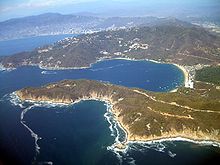
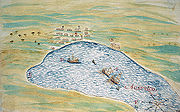
on 25 January 1614 after three months at sea. The Japanese were received with great ceremony, but had to wait in Acapulco until orders were received regarding how to organize the rest of their travels.
Fights erupted between the Japanese and the Spaniards, especially Vizcaino, apparently due to some disputes on the handling of presents from the Japanese ruler. A contemporary journal, written by the historian Chimalpahin Quauhtlehuanitzin
Chimalpahin Quauhtlehuanitzin
Domingo Francisco de San Antón Muñón Chimalpahin Quauhtlehuanitzin , usually referred to simply as Chimalpahin or Chimalpain, was a Nahua annalist from Chalco...
, a noble Aztec born in Amecameca
Amecameca
Amecameca is a town and municipality located in the eastern panhandle of Mexico State between Mexico City and the Iztaccíhuatl and Popocatépetl volcanos of the Sierra Nevada mountain range. It is located on federal highway 115 which leads to Cuautla, which is called the Volcano Route...
(ancient Chalco province) in 1579, whose formal name was Domingo Francisco de San Anton Muñon, relates Vizcaino was seriously wounded in the fight:
- "Señor Vizcaino is still coming slowly, coming hurt; the Japanese injured him when they beat and stabbed him in Acapulco, as became known here in Mexico, because of all the things coming along that had been made his responsibility in Japan"
Following these fights, orders were promulgated on 4 and 5 March to bring peace back. The orders explained that:
- "The Japanese should not be submitted to attacks in this Land, but they should remit their weapons until their departure, except for Hasekura Tsunenaga and eight of his retinue... The Japanese will be free to go where they want, and should be treated properly. They should not be abused in words or actions. They will be free to sell their goods. These orders have been promulgated to the Spanish, the Indians, the MulattoMulattoMulatto denotes a person with one white parent and one black parent, or more broadly, a person of mixed black and white ancestry. Contemporary usage of the term varies greatly, and the broader sense of the term makes its application rather subjective, as not all people of mixed white and black...
s, the MestizoMestizoMestizo is a term traditionally used in Latin America, Philippines and Spain for people of mixed European and Native American heritage or descent...
s, and the Blacks, and those who don't respect them will be punished".
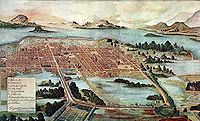
New Spain (Mexico)
The embassy remained two months in Acapulco and entered Mexico CityMexico City
Mexico City is the Federal District , capital of Mexico and seat of the federal powers of the Mexican Union. It is a federal entity within Mexico which is not part of any one of the 31 Mexican states but belongs to the federation as a whole...
on 24 March, where it was received with great ceremony. The ultimate mission for the embassy was to go on to Europe. The embassy spent some time in Mexico, and then went to Veracruz
Veracruz, Veracruz
Veracruz, officially known as Heroica Veracruz, is a major port city and municipality on the Gulf of Mexico in the Mexican state of Veracruz. The city is located in the central part of the state. It is located along Federal Highway 140 from the state capital Xalapa, and is the state's most...
to board the fleet of Don Antonio Oquendo.
Chimalpahin gives some account of the visit of Hasekura.
- "This is the second time that the Japanese have landed one of their ships on the shore at Acapulco. They are transporting here all things of iron, and writing desks, and some cloth that they are to sell here." (Chimalpahin, "Annals of His Time").
- "It became known here in Mexico and was said that the reason their ruler the Emperor of Japan sent this said lordly emissary and ambassador here, is to go in Rome to see the Holy Father Paul V, and to give him their obedience concerning the holy church, so that all the Japanase want to become Christians" (Chimalpahin, "Annals of His Time").
Philip III of Spain
Philip III , also known as Philip the Pious, was the King of Spain and King of Portugal and the Algarves, where he ruled as Philip II , from 1598 until his death...
to offer him peace and to obtain that the Japanese could come to Mexico for trade. On Wednesday 9 April, 20 Japanese were baptized, and 22 more on 20 April by the archbishop in Mexico, don Juan Pérez de la Serna
Juan Pérez de la Serna
Juan Pérez de la Serna was born in Cervera, Spain and died in Zamora, Spain. He was the seventh Archbishop of Mexico. He served as archbishop from May 13, 1613 to June 19, 1627.- See also :...
, at the Church of San Francisco. Altogether 63 of them received confirmation
Confirmation (Christian sacrament)
Confirmation is a rite of initiation in Christian churches, normally carried out through anointing and/or the laying on of hands and prayer for the purpose of bestowing the Gift of the Holy Spirit....
on 25 April. Hasekura waited for his travel to Europe to be baptized there:
- "But the lordly emissary, the ambassador, did not want to be baptized here; it was said that he will be baptized later in Spain" (Chimalpahin, "Annals of His Time").
Departure for Europe
Chimalpahin explains that Hasekura left some of his compatriots behind before leaving for Europe:- "The Ambassador of Japan set out and left for Spain. In going he divided his vassals; he took a certain number of Japanese, and he left an equal number here as merchants to trade and sell things." (Chimalpahin, "Annals of His Time").
The fleet left for Europe on the San Jose on 10 June. Hasekura had to leave the largest parts of the Japanese group behind, who were to wait in Acapulco for the return of the embassy.
Some of them, as well as those from the previous travel of Tanaka Shōsuke
Tanaka Shosuke
Tanaka Shōsuke was an important Japanese technician and trader in metals from Kyoto during the beginning of the 17th century.According to Japanese archives he was a representative of the great Osaka merchant Gotō Shōsaburō...
, returned to Japan the same year, sailing back with the San Juan Bautista:
- "Today, Tuesday the 14th of the month of October of the year 1614, was when some Japanese set out from Mexico here going home to Japan.; they lived here in Mexico for four years. Some still remained here; they earn a living trading and selling here the goods they brought with them from Japan." (Chimalpahin, "Annals of His Time").
Cuba
The embassy stopped and changed ships in HavanaHavana
Havana is the capital city, province, major port, and leading commercial centre of Cuba. The city proper has a population of 2.1 million inhabitants, and it spans a total of — making it the largest city in the Caribbean region, and the most populous...
in Cuba in July 1614. The embassy stayed in Havana
Havana
Havana is the capital city, province, major port, and leading commercial centre of Cuba. The city proper has a population of 2.1 million inhabitants, and it spans a total of — making it the largest city in the Caribbean region, and the most populous...
for six days. A bronze statue was erected on 26 April 2001 at the head of Havana Bay.
Spain

Sanlúcar de Barrameda
Sanlúcar de Barrameda is a city in the northwest of Cádiz province, part of the autonomous community of Andalucía in southern Spain. Sanlúcar is located on the left bank at the mouth of the Guadalquivir River opposite the Doñana National Park, 52 km from the provincial capital Cádiz and...
on 5 October 1614.
- "The fleet arrived safely finally, after some dangers and storms, to the port of Sanlúcar de Barrameda on 5 October, where the Duke of Medina Sidonia was advised of the arrival. He sent carriages to honor them and accommodate the Ambassador and his gentlemen" (Scipione Amati "History of the Kingdom of Voxu").
- "The Japanese ambassador Hasekura Rokuemon, sent by Joate Masamune, king of Boju, entered SevilleSevilleSeville is the artistic, historic, cultural, and financial capital of southern Spain. It is the capital of the autonomous community of Andalusia and of the province of Seville. It is situated on the plain of the River Guadalquivir, with an average elevation of above sea level...
on Wednesday, 23 October 1614. He was accompanied by 30 Japanese with blades, their captain of the guard, and 12 bowmen and halberdiers with painted lances and blades of ceremony. The captain of the guard was Christian and was called Don Thomas, the son of a Japanese martyr" (Library Capitular Calombina 84-7-19 Memorias..., fol.195).

Philip III of Spain
Philip III , also known as Philip the Pious, was the King of Spain and King of Portugal and the Algarves, where he ruled as Philip II , from 1598 until his death...
in Madrid on 30 January 1615. Hasekura remitted to the King a letter from Date Masamune, as well as offer for a treaty
Treaty
A treaty is an express agreement under international law entered into by actors in international law, namely sovereign states and international organizations. A treaty may also be known as an agreement, protocol, covenant, convention or exchange of letters, among other terms...
. The King responded that he would do what he could to accommodate these requests.
Hasekura was baptized on 17 February by the king's personal chaplain, and renamed Felipe Francisco Hasekura. The baptism ceremony was to have been conducted by the Archbishop of Toledo, though he was too ill to actually carry this out, and the Duke of Lerma – the main administrator of Phillip III's rule and the de facto ruler of Spain – was designated as Hasekura's godfather
Godparent
A godparent, in many denominations of Christianity, is someone who sponsors a child's baptism. A male godparent is a godfather, and a female godparent is a godmother...
.
The embassy stayed eight months in Spain before leaving the country for Italy.
France

Frigate
A frigate is any of several types of warship, the term having been used for ships of various sizes and roles over the last few centuries.In the 17th century, the term was used for any warship built for speed and maneuverability, the description often used being "frigate-built"...
s towards Italy. Due to bad weather, they had to stay for a few days in the French harbour of Saint-Tropez
Saint-Tropez
Saint-Tropez is a town, 104 km to the east of Marseille, in the Var department of the Provence-Alpes-Côte d'Azur region of southeastern France. It is also the principal town in the canton of Saint-Tropez....
, where they were received by the local nobility, and made quite a sensation on the populace.
The visit of the Japanese Embassy is recorded in the city's chronicles as led by "Philip Francis Faxicura, Ambassador to the Pope, from Date Masamunni, King of Woxu
Mutsu Province
was an old province of Japan in the area of Fukushima, Miyagi, Iwate and Aomori prefecture and the municipalities of Kazuno and Kosaka in Akita Prefecture...
in Japan".
Many picturesque details of their movements were recorded:
- "They never touch food with their fingers, but instead use two small sticksChopsticksChopsticks are small, often tapered, sticks used in pairs of equal length as the traditional eating utensils of China and its diaspora, Japan, Korea, Vietnam and Northern provinces of Laos, Thailand and Burma. Generally believed to have originated in ancient China, they can also be found in some...
that they hold with three fingers." - "They blow their noses in soft silky papers the size of a hand, which they never use twice, so that they throw them on the ground after usage, and they were delighted to see our people around them precipitate themselves to pick them up."
- "Their swordsKatanaA Japanese sword, or , is one of the traditional bladed weapons of Japan. There are several types of Japanese swords, according to size, field of application and method of manufacture.-Description:...
cut so well that they can cut a soft paper just by putting it on the edge and by blowing on it.".
The visit of Hasekura Tsunenaga to Saint-Tropez in 1615 is the first recorded instance of Franco-Japanese relations
Franco-Japanese relations
France-Japan relations refers to bilateral relations between France and Japan. The history of goes back to the early 17th century, when a Japanese samurai and ambassador on his way to Rome landed for a few days in Southern France, creating a sensation...
.
Italy
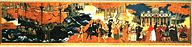
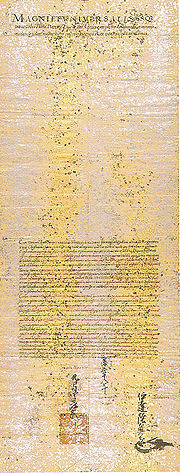
Pope Paul V
-Theology:Paul met with Galileo Galilei in 1616 after Cardinal Bellarmine had, on his orders, warned Galileo not to hold or defend the heliocentric ideas of Copernicus. Whether there was also an order not to teach those ideas in any way has been a matter for controversy...
in Rome in November 1615, the same year Galileo Galilei
Galileo Galilei
Galileo Galilei , was an Italian physicist, mathematician, astronomer, and philosopher who played a major role in the Scientific Revolution. His achievements include improvements to the telescope and consequent astronomical observations and support for Copernicanism...
was first confronted by the Roman Inquisition
Roman Inquisition
The Roman Inquisition was a system of tribunals developed by the Holy See during the second half of the 16th century, responsible for prosecuting individuals accused of a wide array of crimes related to heresy, including Protestantism, sorcery, immorality, blasphemy, Judaizing and witchcraft, as...
regarding his findings against geocentricism. Hasekura remitted to the Pope two gilded
Gilding
The term gilding covers a number of decorative techniques for applying fine gold leaf or powder to solid surfaces such as wood, stone, or metal to give a thin coating of gold. A gilded object is described as "gilt"...
letters, one in Japanese and one in Latin
Latin
Latin is an Italic language originally spoken in Latium and Ancient Rome. It, along with most European languages, is a descendant of the ancient Proto-Indo-European language. Although it is considered a dead language, a number of scholars and members of the Christian clergy speak it fluently, and...
, containing a request for a trade treaty between Japan and Mexico and the dispatch of Christian missionaries to Japan. These letters are still visible in the Vatican
Vatican City
Vatican City , or Vatican City State, in Italian officially Stato della Città del Vaticano , which translates literally as State of the City of the Vatican, is a landlocked sovereign city-state whose territory consists of a walled enclave within the city of Rome, Italy. It has an area of...
archives. The Latin letter, probably written by Luis Sotelo for Date Masamune, reads, in part:
- Kissing the Holy feet of the Great, Universal, Most Holy Lord of The Entire World, Pope Paul, in profound submission and reverence, I, Idate Masamune, King of Wôshû in the Empire of Japan, suppliantly say:
- The Franciscan Padre Luis Sotelo came to our country to spread the faith of God. On that occasion, I learnt about this faith and desired to become a Christian, but I still haven't accomplished this desire due to some small issues. However, in order to encourage my subjects to become Christians, I wish that you send missionaries of the Franciscan church. I guarantee that you will be able to build a church and that your missionaries will be protected. I also wish that you select and send a bishop as well. Because of that, I have sent one of my samurai, Hasekura Rokuemon, as my representative to accompany Luis Sotelo across the seas to Rome, to give you a stamp of obedience and to kiss your feet. Further, as our country and Nueva España are neighbouring countries, could you intervene so that we can discuss with the King of Spain, for the benefit of dispatching missionaries across the seas." Translation of the Latin letter of Date Masamune to the Pope.

The Roman Senate also gave to Hasekura the honorary title of Roman Citizen, in a document he brought back to Japan, and which is preserved today in Sendai.

(published posthumously in 1634):
- "When we got there by the aid of God in the Year of Our Salvation 1615, not only were we kindly received by His Holiness the great Pope, with the Holy College of the CardinalsCollege of CardinalsThe College of Cardinals is the body of all cardinals of the Catholic Church.A function of the college is to advise the pope about church matters when he summons them to an ordinary consistory. It also convenes on the death or abdication of a pope as a papal conclave to elect a successor...
and a gathering of bishops and nobles, and even the joy and general happiness of the Roman People, but we and three others (whom the Japanese Christians had specially designated to announce their condition with respect to the Christian religion) were heard, rested, and just as we were hoping, dispatched as quickly as possible." (Sotelo).
Rumours of political intrigue
Besides the official description of Hasekura's visit to Rome, some contemporary communications tend to indicate that political matters were also discussed, and that an alliance with Date Masamune was suggested as a way to establish Christian influence in the whole of Japan:- "The Ambassador strongly insisted that the authority and power of his ruler was superior to that of many European countries" (Anonymous Roman communication, dated 10 October 1615)
- "The Franciscan Spanish fathers are explaining that the King of the Ambassador [Hasekura Tsunenaga] will soon become the supreme ruler of his country, and that, not only will they become Christians and follow the will of the church of Rome, but they will also in turn convert the rest of the population. This is why they are requesting the dispatch of a high eclesiastic together with the missionaries. Because of this, many people have been doubting the true purpose of the embassy, and are wondering if they are not looking for some other benefit." (Letter of the VenetianRepublic of VeniceThe Republic of Venice or Venetian Republic was a state originating from the city of Venice in Northeastern Italy. It existed for over a millennium, from the late 7th century until 1797. It was formally known as the Most Serene Republic of Venice and is often referred to as La Serenissima, in...
ambassador, 7 November 1615).
Second visit to Spain

Tokugawa Ieyasu
was the founder and first shogun of the Tokugawa shogunate of Japan , which ruled from the Battle of Sekigahara in 1600 until the Meiji Restoration in 1868. Ieyasu seized power in 1600, received appointment as shogun in 1603, abdicated from office in 1605, but...
, who, on the contrary, had promulgated an edict in January 1614 ordering the expulsion of all missionaries
Missionary
A missionary is a member of a religious group sent into an area to do evangelism or ministries of service, such as education, literacy, social justice, health care and economic development. The word "mission" originates from 1598 when the Jesuits sent members abroad, derived from the Latin...
from Japan, and started the persecution of the Christian faith in Japan.
The embassy left Seville
Seville
Seville is the artistic, historic, cultural, and financial capital of southern Spain. It is the capital of the autonomous community of Andalusia and of the province of Seville. It is situated on the plain of the River Guadalquivir, with an average elevation of above sea level...
for Mexico in June 1617 after a period of two years spent in Europe, but some of the Japanese remained in Spain in a town near Seville (Coria del Río
Coria del Río
Coria del Río is a small town near Seville, on the shores of Guadalquivir river.It is popularly known because there are some descendants of the first-ever Japanese official envoy to Spain. In early 17th century, Daimyo Date Masamune of Sendai sent a delegation led by Hasekura Tsunenaga to Europe....
), where their descendants to this day still use the surname Japón.
Western publications on Hasekura's embassy
The embassy of Hasekura Tsunenaga was the subject of numerous publications throughout Europe. The Italian writer Scipione Amati, who accompanied the embassy in 1615 and 1616, published in 1615 in Rome a book titled "History of the Kingdom of Voxu". This book was also translated in German in 1617. In 1616, the French publisher Abraham SavgrainAbraham Savgrain
Abraham Savgrain was a French publisher of the beginning of the 17th century. He was located Rue St Jacques, in Paris. Among other books, he published:* "Ad veritatem hermeticae medicinae stabiliendam", by Duchesne, Joseph, 1604...
published an account of Hasekura's visit to Rome: "" ("Account of the solemn and remarquable entrance in Rome of Dom Philippe Francois Faxicura").
Return to Mexico
Hasekura stayed for 5 months in Mexico on his way back to Japan. The San Juan BautistaJapanese warship San Juan Bautista
San Juan Bautista was one of Japan's first Japanese-built Western-style sail warships. She crossed the Pacific in 1614. She was of the Spanish galleon type, known in Japan as Nanban-Sen San Juan Bautista (“St. John the Baptist”) (originally called Date Maru, 伊達丸 in Japanese) was one of Japan's...
was waiting in Acapulco since 1616, after a second trip across the Pacific from Japan to Mexico. Captained by Yokozawa Shogen
Yokozawa Shogen
' was a Japanese samurai of the 16th century, who served Date Masamune, ruler of the Sendai domain.In September 1616, under an order by Date Masamune, Yokozawa went to Mexico on the San Juan Bautista in order to fetch his compatriot Hasekura Rokuemon who was coming back from an embassy to...
, she was laden with fine pepper and lacquer
Lacquer
In a general sense, lacquer is a somewhat imprecise term for a clear or coloured varnish that dries by solvent evaporation and often a curing process as well that produces a hard, durable finish, in any sheen level from ultra matte to high gloss and that can be further polished as required...
ware from Kyoto, which were sold on the Mexican market. Following a request by the Spanish king, in order to avoid too much silver leaving to Japan, the Viceroy asked for the proceeds to be spent on Mexican goods, except for an amount of 12,000 pesos
Spanish dollar
The Spanish dollar is a silver coin, of approximately 38 mm diameter, worth eight reales, that was minted in the Spanish Empire after a Spanish currency reform in 1497. Its purpose was to correspond to the German thaler...
and 8,000 pesos in silver which Hasekura and Yokozawa could bring back with them respectively.
Philippines
In April 1618, the San Juan Bautista arrived in the PhilippinesPhilippines
The Philippines , officially known as the Republic of the Philippines , is a country in Southeast Asia in the western Pacific Ocean. To its north across the Luzon Strait lies Taiwan. West across the South China Sea sits Vietnam...
from Mexico, with Hasekura and Luis Sotelo on board. The ship was acquired by the Spanish government there, with the objective of building up defenses against the attacks of the Dutch and the English. The bishop of the Philippines with the local Filipinos and native Tagalog in Manila
Manila
Manila is the capital of the Philippines. It is one of the sixteen cities forming Metro Manila.Manila is located on the eastern shores of Manila Bay and is bordered by Navotas and Caloocan to the north, Quezon City to the northeast, San Juan and Mandaluyong to the east, Makati on the southeast,...
described the deal to the king of Spain in a missive dated 28 July 1619:

- "The Governor was extremely friendly with the Japanese, and provided them with his protection. As they had many expensive things to buy, they decided to lend their ship. The ship was immediately furbished for combat. The Governor eventually bought the ship, because it turned out that it was of excellent and sturdy construction, and available ships were dramatically few. In favour of your Majesty, the price paid was reasonable." (Document 243)
During his stay in the Philippines with local Filipinos and Native Tagalog, Hasekura purchased numerous goods for Date Masamune, and built a ship, as he explained in a letter he wrote to his son. He finally returned to Japan in August 1620, reaching the harbour of Nagasaki.
Return to Japan
By the time Hasekura came back, Japan had changed quite drastically: an effort to eradicate Christianity had been under way since 1614, Tokugawa IeyasuTokugawa Ieyasu
was the founder and first shogun of the Tokugawa shogunate of Japan , which ruled from the Battle of Sekigahara in 1600 until the Meiji Restoration in 1868. Ieyasu seized power in 1600, received appointment as shogun in 1603, abdicated from office in 1605, but...
had died in 1616 and been replaced by his more xenophobic
Xenophobia
Xenophobia is defined as "an unreasonable fear of foreigners or strangers or of that which is foreign or strange". It comes from the Greek words ξένος , meaning "stranger," "foreigner" and φόβος , meaning "fear."...
son Tokugawa Hidetada
Tokugawa Hidetada
was the second shogun of the Tokugawa dynasty, who ruled from 1605 until his abdication in 1623. He was the third son of Tokugawa Ieyasu, the first shogun of the Tokugawa shogunate.-Early life :...
, and Japan was moving towards the "Sakoku
Sakoku
was the foreign relations policy of Japan under which no foreigner could enter nor could any Japanese leave the country on penalty of death. The policy was enacted by the Tokugawa shogunate under Tokugawa Iemitsu through a number of edicts and policies from 1633–39 and remained in effect until...
" policy of isolation
Isolationism
Isolationism is the policy or doctrine of isolating one's country from the affairs of other nations by declining to enter into alliances, foreign economic commitments, international agreements, etc., seeking to devote the entire efforts of one's country to its own advancement and remain at peace by...
. Because news of these persecutions arrived in Europe during Hasekura's embassy, European rulers – especially the King of Spain – became very reluctant to respond favorably to Hasekura's trade and missionary proposals.


Sri Lanka
Sri Lanka, officially the Democratic Socialist Republic of Sri Lanka is a country off the southern coast of the Indian subcontinent. Known until 1972 as Ceylon , Sri Lanka is an island surrounded by the Indian Ocean, the Gulf of Mannar and the Palk Strait, and lies in the vicinity of India and the...
and Indonesia
Indonesia
Indonesia , officially the Republic of Indonesia , is a country in Southeast Asia and Oceania. Indonesia is an archipelago comprising approximately 13,000 islands. It has 33 provinces with over 238 million people, and is the world's fourth most populous country. Indonesia is a republic, with an...
n daggers acquired in the Philippines, all preserved today in the Sendai City Museum
Sendai City Museum
The is the main museum of Sendai, Japan.The museum displays various artifacts related to the Date family and the history of Sendai. Date Masamune's famous suit of armor and artifacts related to Hasekura Tsunenaga's visit to Rome are sometimes on display...
. The "Records of the House of Masamune" describe his report in a rather succinct manner, ending with a rather cryptic expression of surprise bordering on the outrage ("") at Hasekura's discourse:
- "Rokuemon went to the country of the Southern BarbariansNanban tradeThe or the in Japanese history extends from the arrival of the first Europeans to Japan in 1543, to their near-total exclusion from the archipelago in 1614, under the promulgation of the "Sakoku" Seclusion Edicts.- Etymology :...
, he paid his respects to the king PaoloPope Paul V-Theology:Paul met with Galileo Galilei in 1616 after Cardinal Bellarmine had, on his orders, warned Galileo not to hold or defend the heliocentric ideas of Copernicus. Whether there was also an order not to teach those ideas in any way has been a matter for controversy...
, he stayed there for several years, and now he sailed back from LuzonLuzonLuzon is the largest island in the Philippines. It is located in the northernmost region of the archipelago, and is also the name for one of the three primary island groups in the country centered on the Island of Luzon...
. He brought paintings of the king of the Southern Barbarians, and a painting of himself, which he remitted. Many of his descriptions of the Southern Barbarian countries, and the meaning of Rokuemon's declarations were surprising and extraordinary."
Interdiction of Christianity in Sendai
The direct effect of Hasekura's return to Sendai was the interdiction of Christianity in the Sendai fief two days later:- "Two days after the return of Rokuemon to Sendai, a three-point edict against the Christian was promulgated: first, that all Christians were ordered to abandon their faith, in accordance with the rule of the Shogun, and for those who did not, they would be exiled if they were nobles, and killed if they were citizens, peasants or servants. Second, that a reward would be given for the denunciation of hidden Christians. Third that propagators of the Christian faith should leave the Sendai fief, or else, abandon their religion" (November 1620 letter of father Angelis, Japan-China archives of the Jesuits in Rome, quoted in Gonoi's "Hasekura Tsunenaga", p231)
What Hasekura said or did to bring about such a result is unknown. As later events tend to indicate that he and his descendants remained faithful Christians, Hasekura may have made an enthusiastic – and to a certain extent, disturbing – account of the greatness and might of Western countries and the Christian religion. He may also have encouraged an alliance between the Church and Date Masamune to take over the country (an idea advertized by the Franciscans while in Rome), which, in 1620 Japan, would have been a totally unrealistic proposition. Lastly, hopes of trade with Spain evaporated when Hasekura communicated that the Spanish King would not enter an agreement as long as persecutions were occurring in the rest of the country.
Date Masamune, heretofore very tolerant of Christianity in spite of the Bakufu's prohibition in the land it directly controlled, thus suddenly chose to distance himself from the Western faith. The first executions of Christians started 40 days later. The anti-Christian measures taken by Date Masumune were however comparatively mild, and Japanese and Western Christians repeatedly claimed that he only took them to appease the Shogun
Shogun
A was one of the hereditary military dictators of Japan from 1192 to 1867. In this period, the shoguns, or their shikken regents , were the de facto rulers of Japan though they were nominally appointed by the emperor...
:
- "Date Masumune, out of fear of the Shogun, ordered the persecution of Christianity in his territory, and created several martyrs." (Letter of 17 prominent Japanese Christians from Sendai, to the Pope, 29 September 1621).
One month after Hasekura's return, Date Masamune wrote a letter to the Shogun Tokugawa Hidetada
Tokugawa Hidetada
was the second shogun of the Tokugawa dynasty, who ruled from 1605 until his abdication in 1623. He was the third son of Tokugawa Ieyasu, the first shogun of the Tokugawa shogunate.-Early life :...
, in which he makes a very clear effort to evade responsibility for the embassy, explaining in detail how it was organized with the approval, and even the collaboration, of the Shogun:
- "When I sent a ship to the Southern Barbarian countries several years ago, upon the advice of Mukai Shogen, I also dispatched the Southern Barbarian named Sotelo, who had resided for several years in Edo. At that time, your highness also gave messages for the Southern Barbarians, as well as presents, such as folding screenFolding ScreenA folding screen , is a piece of free-standing furniture which consists of several frames or panels connected by hinges. It can be made in a variety of designs and with different kinds of materials. Screens have many practical and decorative uses...
s and sets of armourArmourArmour or armor is protective covering used to prevent damage from being inflicted to an object, individual or a vehicle through use of direct contact weapons or projectiles, usually during combat, or from damage caused by a potentially dangerous environment or action...
." (18 October 1620, quoted in Gonoi, p. 234).
Spain was by far the most threatening power for Japan at that time (with a colony and an army in the nearby Philippines). Hasekura eyewitness accounts of Spanish power and colonial methods in Nueva España (Mexico) may have precipitated the Shogun Tokugawa Hidetada's decision to sever trade relations with Spain in 1623, and diplomatic relations in 1624, although other events such as the smuggling of Spanish priests into Japan and a failed Spanish embassy also contributed to the decision.
Death
What became of Hasekura is unknown and accounts of his last years are numerous. Contemporary Christian commentators could only rely on hearsay, with some rumours stating that he abandoned Christianity, others that he was martyred for his faith, and others that he practiced Christianity in secret. The fate of his descendants and servants, who were later executed for being Christians, would suggest that Hasekura remained strongly Christian himself, and transmitted his faith to the members of his family.
Execution by burning
Death by burning is death brought about by combustion. As a form of capital punishment, burning has a long history as a method in crimes such as treason, heresy, and witchcraft....
in 1624, gave before his execution an account of Hasekura returning to Japan as a hero who propagated the Christian faith:
- "My other colleague, the ambassador Philippus Faxecura, after he reached his aforementioned king (Date MasamuneDate Masamunewas a regional strongman of Japan's Azuchi-Momoyama period through early Edo period. Heir to a long line of powerful daimyo in the Tōhoku region, he went on to found the modern-day city of Sendai...
), was greatly honored by him, and sent to his own estate, to rest after such a long and tiring journey, where he made his wife, children, servants, and many other vassals into Christians, and advised other nobles who were his kith and kin to accept the faith, which they indeed did. While he was engaged in these and other pious works, a full year after his return, having provided much instruction and a great example, with much preparation, he piously passed on, leaving for his children by a special inheritance the propagation of the faith in his estate, and the protection of the religiousReligious (Catholicism)In the lexicon of certain branches of Christianity, especially the Roman Catholic, Anglican, and Orthodox branches, religious as a noun usually refers to a member of a religious order of monks, nuns, friars, clerics regular, or other individuals who take the three vows of poverty, chastity, and...
(i.e. "members of religious orderReligious orderA religious order is a lineage of communities and organizations of people who live in some way set apart from society in accordance with their specific religious devotion, usually characterized by the principles of its founder's religious practice. The order is composed of initiates and, in some...
s") in that kingdom. The King and all the nobles were greatly saddened by his passing, but especially the Christians and Religious, who knew very well the virtue and religious zeal of this man. This is what I heard by letters from the very Religious who administered the sacraments to him, and who had been present at his death, as well as from others." (Luis Sotelo, De ecclesiae Iaponicae statu relatio).
Hasekura also did bring back to Japan several Catholic artifacts, but he did not give them to his ruler, and instead kept them in his own estate.
Hasekura Tsunenaga died of illness (according to Japanese as well as Christian sources) in 1622, but the location of his grave is not known for certain. Three graves are claimed as Hasekura's. One is visible in the Buddhist
Buddhism
Buddhism is a religion and philosophy encompassing a variety of traditions, beliefs and practices, largely based on teachings attributed to Siddhartha Gautama, commonly known as the Buddha . The Buddha lived and taught in the northeastern Indian subcontinent some time between the 6th and 4th...
temple of Enfukuji in Miyagi
Miyagi Prefecture
is a prefecture of Japan in the Tōhoku Region on Honshu island. The capital is Sendai.- History :Miyagi Prefecture was formerly part of the province of Mutsu. Mutsu Province, on northern Honshu, was one of the last provinces to be formed as land was taken from the indigenous Emishi, and became the...
. Another is clearly marked (along with a memorial to Padre Sotelo) in the cemetery of a Buddhist temple in the Kitayama neighborhood at Komyoji Temple .
Execution of his descendants and servants


Tsurushi
Tsurushi , or "reverse hanging", was a Japanese torture technique used in the 17th century in order to have Christians recant their faith. Both Japanese and Western Christians are known to have been submitted to the torture...
", 釣殺し) and as a result died in August 1637 (as the lives of Christians were spared if they recanted, these executions indicate that they were steadfast and refused to deny their faith). In 1637, Rokuemon Tsuneyori himself also came under suspicion of Christianity after being denounced by someone from Edo
Edo
, also romanized as Yedo or Yeddo, is the former name of the Japanese capital Tokyo, and was the seat of power for the Tokugawa shogunate which ruled Japan from 1603 to 1868...
, but escaped questioning because he was the master of the Zen
Zen
Zen is a school of Mahāyāna Buddhism founded by the Buddhist monk Bodhidharma. The word Zen is from the Japanese pronunciation of the Chinese word Chán , which in turn is derived from the Sanskrit word dhyāna, which can be approximately translated as "meditation" or "meditative state."Zen...
temple of Komyoji . In 1640, two other servants of Tsuneyori, Tarozaemon (太郎左衛門, 71), who had followed Hasekura to Rome, and his wife (59), were convicted of being Christians, and, also refusing to recant their faith under torture, died. Tsuneyori was held responsible this time and decapitated the same day, at the age of 42, for having failed to denounce Christians under his roof, although it remained unconfirmed whether he was himself Christian or not. Also, two Christian priests, the Dominican
Dominican Order
The Order of Preachers , after the 15th century more commonly known as the Dominican Order or Dominicans, is a Catholic religious order founded by Saint Dominic and approved by Pope Honorius III on 22 December 1216 in France...
Pedro Vazquez and Joan Bautista Paulo, had given his name under torture. Tsuneyori's younger brother, Tsunemichi, was convicted as a Christian, but managed to flee and disappear.
The privileges of the Hasekura family were abolished at this point by the Sendai fief, and their property and belongings seized. It is at this time, in 1640, that Hasekura's Christian artifacts were confiscated, and they were kept in custody in Sendai until they were rediscovered at the end of the 19th century.
Altogether, around fifty Christian artifacts were found in Hasekura's estate in 1640, such as crosses, rosaries
Rosary
The rosary or "garland of roses" is a traditional Catholic devotion. The term denotes the prayer beads used to count the series of prayers that make up the rosary...
, religious gowns and religious paintings. The artifacts were seized and stored by the Date fief. An inventory was made again in 1840 describing the items as belonging to Hasekura Tsunenaga. Nineteen books were also mentioned in the inventory, but they have been lost since. The artifacts are today preserved in the Sendai City Museum
Sendai City Museum
The is the main museum of Sendai, Japan.The museum displays various artifacts related to the Date family and the history of Sendai. Date Masamune's famous suit of armor and artifacts related to Hasekura Tsunenaga's visit to Rome are sometimes on display...
and other museum in Sendai.
Re-discovery
The very existence of the travels of Hasekura was forgotten in Japan until the reopening of the country after the SakokuSakoku
was the foreign relations policy of Japan under which no foreigner could enter nor could any Japanese leave the country on penalty of death. The policy was enacted by the Tokugawa shogunate under Tokugawa Iemitsu through a number of edicts and policies from 1633–39 and remained in effect until...
policy of isolation. In 1873, a Japanese embassy to Europe (the Iwakura mission
Iwakura mission
The Iwakura Mission or Iwakura Embassy was a Japanese diplomatic journey around the world, initiated in 1871 by the oligarchs of the Meiji period. Although it was not the only such "mission", it is the most well-known and possibly most important for the modernization of Japan after a long period...
) headed by Iwakura Tomomi
Iwakura Tomomi
was a Japanese statesman in the Meiji period. The former 500 Yen banknote issued by the Bank of Japan carried his portrait.-Early life:Iwakura was born in Kyoto as the second son of a low-ranking courtier and nobleman . In 1836 he was adopted by another nobleman, , from whom he received his family...
heard for the first time of the travels of Hasekura when shown documents during their visit to Venice
Venice
Venice is a city in northern Italy which is renowned for the beauty of its setting, its architecture and its artworks. It is the capital of the Veneto region...
in Italy.
Hasekura today

Acapulco
Acapulco is a city, municipality and major sea port in the state of Guerrero on the Pacific coast of Mexico, southwest from Mexico City. Acapulco is located on a deep, semi-circular bay and has been a port since the early colonial period of Mexico’s history...
in Mexico, at the entrance of Havana
Havana
Havana is the capital city, province, major port, and leading commercial centre of Cuba. The city proper has a population of 2.1 million inhabitants, and it spans a total of — making it the largest city in the Caribbean region, and the most populous...
Bay in Cuba, in Coria del Río
Coria del Río
Coria del Río is a small town near Seville, on the shores of Guadalquivir river.It is popularly known because there are some descendants of the first-ever Japanese official envoy to Spain. In early 17th century, Daimyo Date Masamune of Sendai sent a delegation led by Hasekura Tsunenaga to Europe....
in Spain, in the Church of Civitavecchia
Civitavecchia
Civitavecchia is a town and comune of the province of Rome in the central Italian region of Lazio. A sea port on the Tyrrhenian Sea, it is located 80 kilometers west-north-west of Rome, across the Mignone river. The harbor is formed by two piers and a breakwater, on which is a lighthouse...
in Italy, and in Tsukinoura, near Ishinomaki.
Approximately 700 inhabitants of Coria del Río bear the surname Japón (originally Hasekura de Japón), identifying them as descendants of the members of Hasekura Tsunenaga's delegation.
A theme park describing the embassy and displaying a replica of the San Juan Bautista was established in the harbour of Ishinomaki, from which Hasekura initially departed on his voyage.
Today there stands a statue of Hasekura in a park in Manila
Manila
Manila is the capital of the Philippines. It is one of the sixteen cities forming Metro Manila.Manila is located on the eastern shores of Manila Bay and is bordered by Navotas and Caloocan to the north, Quezon City to the northeast, San Juan and Mandaluyong to the east, Makati on the southeast,...
, the Philippines
Philippines
The Philippines , officially known as the Republic of the Philippines , is a country in Southeast Asia in the western Pacific Ocean. To its north across the Luzon Strait lies Taiwan. West across the South China Sea sits Vietnam...
.
Shusaku Endo
Shusaku Endo
Shūsaku Endō was a 20th-century Japanese author who wrote from the unusual perspective of being both Japanese and Catholic...
wrote a 1980 novel, titled The Samurai, a fictious account relating the travels of Hasekura.
A 2005 animation film produced in Spain and titled Gisaku
Gisaku
Gisaku is a Spanish animated feature film directed by Baltasar Pedrosa Clavero. It was first released in Japan on March 4, 2005, and in Spain on March 17, 2005. The film has three official soundtracks: Japanese, Spanish and English...
relates the adventures of a young Japanese samurai named Yohei who visited Spain in the 17th century, in a story loosely taking its inspiration from the travels of Hasekura. Yohei survived in hiding to the present day due to magical powers ("After centuries of lethargy, he awakes in a World he does not know"), and accomplishes many adventures in modern Europe as a superhero.
Timeline and itinerary
- Japan (1613)
- April 1613: Date Masamune receives permission from the Tokugawa Shogunate for the expedition and the building of a ship.
- 28 October 1613: Departure from Tsukinoura Bay.
- Americas (1613–1614)
- November 1613: Sighting of Cape MendocinoCape MendocinoCape Mendocino located on the Lost Coast entirely within Humboldt County, California, USA, is the westernmost point on the coast of California. It has been a landmark since the 16th century when the Manila Galleons would reach the coast here following the prevailing westerlies all the way across...
- January 1614: Stop in Zacatula
- 25 January 1614: Arrival in AcapulcoAcapulcoAcapulco is a city, municipality and major sea port in the state of Guerrero on the Pacific coast of Mexico, southwest from Mexico City. Acapulco is located on a deep, semi-circular bay and has been a port since the early colonial period of Mexico’s history...
, New SpainNew SpainNew Spain, formally called the Viceroyalty of New Spain , was a viceroyalty of the Spanish colonial empire, comprising primarily territories in what was known then as 'América Septentrional' or North America. Its capital was Mexico City, formerly Tenochtitlan, capital of the Aztec Empire... - 24 March 1614: Arrival in Mexico CityMexico CityMexico City is the Federal District , capital of Mexico and seat of the federal powers of the Mexican Union. It is a federal entity within Mexico which is not part of any one of the 31 Mexican states but belongs to the federation as a whole...
- PueblaPuebla, PueblaThe city and municipality of Puebla is the capital of the state of Puebla, and one of the five most important colonial cities in Mexico. Being a planned city, it is located to the east of Mexico City and west of Mexico's main port, Veracruz, on the main route between the two.The city was founded...
- VeracruzVeracruz, VeracruzVeracruz, officially known as Heroica Veracruz, is a major port city and municipality on the Gulf of Mexico in the Mexican state of Veracruz. The city is located in the central part of the state. It is located along Federal Highway 140 from the state capital Xalapa, and is the state's most...
- 10 June 1614: Boarding of a Spanish frigate at San Juan de UlúaSan Juan de UlúaSan Juan de Ulúa, also known as Castle of San Juan de Ulúa is a large complex of fortresses, prisons and one former palace on an island overlooking the seaport of Veracruz, Mexico.-History:...
- HavanaHavanaHavana is the capital city, province, major port, and leading commercial centre of Cuba. The city proper has a population of 2.1 million inhabitants, and it spans a total of — making it the largest city in the Caribbean region, and the most populous...
- November 1613: Sighting of Cape Mendocino
- Spain (1614–1615)
- 5 October 1614: Arrival at Sanlúcar de BarramedaSanlúcar de BarramedaSanlúcar de Barrameda is a city in the northwest of Cádiz province, part of the autonomous community of Andalucía in southern Spain. Sanlúcar is located on the left bank at the mouth of the Guadalquivir River opposite the Doñana National Park, 52 km from the provincial capital Cádiz and...
in Spain - Coria del RioCoria del RíoCoria del Río is a small town near Seville, on the shores of Guadalquivir river.It is popularly known because there are some descendants of the first-ever Japanese official envoy to Spain. In early 17th century, Daimyo Date Masamune of Sendai sent a delegation led by Hasekura Tsunenaga to Europe....
- 21 October 1614: Arrival in SevilleSevilleSeville is the artistic, historic, cultural, and financial capital of southern Spain. It is the capital of the autonomous community of Andalusia and of the province of Seville. It is situated on the plain of the River Guadalquivir, with an average elevation of above sea level...
- CórdobaCórdoba, Spain-History:The first trace of human presence in the area are remains of a Neanderthal Man, dating to c. 32,000 BC. In the 8th century BC, during the ancient Tartessos period, a pre-urban settlement existed. The population gradually learned copper and silver metallurgy...
- ToledoToledo, SpainToledo's Alcázar became renowned in the 19th and 20th centuries as a military academy. At the outbreak of the Spanish Civil War in 1936 its garrison was famously besieged by Republican forces.-Economy:...
- GetafeGetafeGetafe is a city in the southern zone of the Madrid metropolitan area, Spain, and one of the most populated and industrialized cities in the municipality. The city is home to one of the oldest Spanish military air bases, as well as the Universidad Carlos III de Madrid...
- 20 December 1614: Arrival in MadridMadridMadrid is the capital and largest city of Spain. The population of the city is roughly 3.3 million and the entire population of the Madrid metropolitan area is calculated to be 6.271 million. It is the third largest city in the European Union, after London and Berlin, and its metropolitan...
- 30 January 1615: Meeting with King Philip III of Spain
- 17 February 1615: Baptism of Hasekura Tsunenaga
- Alcalá de HenaresAlcalá de HenaresAlcalá de Henares , meaning Citadel on the river Henares, is a Spanish city, whose historical centre is one of UNESCO's World Heritage Sites, and one of the first bishoprics founded in Spain...
- DarocaDarocaDaroca is a city and municipality in the province of Zaragoza, Aragon, Spain, situated to the south of the city of Zaragoza. It is the center of a judicial district....
- ZaragozaZaragozaZaragoza , also called Saragossa in English, is the capital city of the Zaragoza Province and of the autonomous community of Aragon, Spain...
- FragaFragaFraga is the major town of the comarca of Bajo Cinca in the province of Huesca, Aragon, Spain. It is located by the river Cinca.King Alfonso I of Aragon died at its walls in 1134 while trying to conquer it...
- Lerida
- IgualadaIgualadaIgualada is a municipality of the province of Barcelona in Catalonia . It is located on the left bank of the Anoia river, and at the western end of the Igualada-Martorell-Barcelona railway. Igualada is the capital and central market of the Anoia comarca, a rich agricultural and wine-producing...
- BarcelonaBarcelonaBarcelona is the second largest city in Spain after Madrid, and the capital of Catalonia, with a population of 1,621,537 within its administrative limits on a land area of...
- 5 October 1614: Arrival at Sanlúcar de Barrameda
- France (1615)
- September 1615: Saint-TropezSaint-TropezSaint-Tropez is a town, 104 km to the east of Marseille, in the Var department of the Provence-Alpes-Côte d'Azur region of southeastern France. It is also the principal town in the canton of Saint-Tropez....
- September 1615: Saint-Tropez
- Italy (1615–1616)
- SavonaSavonaSavona is a seaport and comune in the northern Italian region of Liguria, capital of the Province of Savona, in the Riviera di Ponente on the Mediterranean Sea....
- GenoaGenoaGenoa |Ligurian]] Zena ; Latin and, archaically, English Genua) is a city and an important seaport in northern Italy, the capital of the Province of Genoa and of the region of Liguria....
- 18 October 1615: Arrival in CivitavecchiaCivitavecchiaCivitavecchia is a town and comune of the province of Rome in the central Italian region of Lazio. A sea port on the Tyrrhenian Sea, it is located 80 kilometers west-north-west of Rome, across the Mignone river. The harbor is formed by two piers and a breakwater, on which is a lighthouse...
. - 29 October 1615: Ceremony commemorating the mission's arrival in Rome.
- 3 November 1615: Meeting with Pope Paul V.
- Savona

-
- 23 November 1615: Reception of certificates of Honorary Citizenship by Hasekura Tsunenaga and four other Japanese members of the mission.
- NaplesNaplesNaples is a city in Southern Italy, situated on the country's west coast by the Gulf of Naples. Lying between two notable volcanic regions, Mount Vesuvius and the Phlegraean Fields, it is the capital of the region of Campania and of the province of Naples...
- Rome
- FirenzeFlorenceFlorence is the capital city of the Italian region of Tuscany and of the province of Florence. It is the most populous city in Tuscany, with approximately 370,000 inhabitants, expanding to over 1.5 million in the metropolitan area....
- VeniceVeniceVenice is a city in northern Italy which is renowned for the beauty of its setting, its architecture and its artworks. It is the capital of the Veneto region...
- FirenzeFlorenceFlorence is the capital city of the Italian region of Tuscany and of the province of Florence. It is the most populous city in Tuscany, with approximately 370,000 inhabitants, expanding to over 1.5 million in the metropolitan area....
- LivornoLivornoLivorno , traditionally Leghorn , is a port city on the Tyrrhenian Sea on the western edge of Tuscany, Italy. It is the capital of the Province of Livorno, having a population of approximately 160,000 residents in 2009.- History :...
, by ship to Genoa - GenoaGenoaGenoa |Ligurian]] Zena ; Latin and, archaically, English Genua) is a city and an important seaport in northern Italy, the capital of the Province of Genoa and of the region of Liguria....
- Spain (1616)
- BarcelonaBarcelonaBarcelona is the second largest city in Spain after Madrid, and the capital of Catalonia, with a population of 1,621,537 within its administrative limits on a land area of...
- IgualadaIgualadaIgualada is a municipality of the province of Barcelona in Catalonia . It is located on the left bank of the Anoia river, and at the western end of the Igualada-Martorell-Barcelona railway. Igualada is the capital and central market of the Anoia comarca, a rich agricultural and wine-producing...
- Lerida
- FragaFragaFraga is the major town of the comarca of Bajo Cinca in the province of Huesca, Aragon, Spain. It is located by the river Cinca.King Alfonso I of Aragon died at its walls in 1134 while trying to conquer it...
- ZaragozaZaragozaZaragoza , also called Saragossa in English, is the capital city of the Zaragoza Province and of the autonomous community of Aragon, Spain...
- DarocaDarocaDaroca is a city and municipality in the province of Zaragoza, Aragon, Spain, situated to the south of the city of Zaragoza. It is the center of a judicial district....
- Alcalá de HenaresAlcalá de HenaresAlcalá de Henares , meaning Citadel on the river Henares, is a Spanish city, whose historical centre is one of UNESCO's World Heritage Sites, and one of the first bishoprics founded in Spain...
- 17 April 1616: Return to Madrid.
- GetafeGetafeGetafe is a city in the southern zone of the Madrid metropolitan area, Spain, and one of the most populated and industrialized cities in the municipality. The city is home to one of the oldest Spanish military air bases, as well as the Universidad Carlos III de Madrid...
- ToledoToledo, SpainToledo's Alcázar became renowned in the 19th and 20th centuries as a military academy. At the outbreak of the Spanish Civil War in 1936 its garrison was famously besieged by Republican forces.-Economy:...
- CórdobaCórdoba, Spain-History:The first trace of human presence in the area are remains of a Neanderthal Man, dating to c. 32,000 BC. In the 8th century BC, during the ancient Tartessos period, a pre-urban settlement existed. The population gradually learned copper and silver metallurgy...
- SevilleSevilleSeville is the artistic, historic, cultural, and financial capital of southern Spain. It is the capital of the autonomous community of Andalusia and of the province of Seville. It is situated on the plain of the River Guadalquivir, with an average elevation of above sea level...
- Coria del RioCoria del RíoCoria del Río is a small town near Seville, on the shores of Guadalquivir river.It is popularly known because there are some descendants of the first-ever Japanese official envoy to Spain. In early 17th century, Daimyo Date Masamune of Sendai sent a delegation led by Hasekura Tsunenaga to Europe....
- June 1616: Departure from Spain, at Sanlúcar de BarramedaSanlúcar de BarramedaSanlúcar de Barrameda is a city in the northwest of Cádiz province, part of the autonomous community of Andalucía in southern Spain. Sanlúcar is located on the left bank at the mouth of the Guadalquivir River opposite the Doñana National Park, 52 km from the provincial capital Cádiz and...
.
- Barcelona
- Americas (1616–1618)
- HavanaHavanaHavana is the capital city, province, major port, and leading commercial centre of Cuba. The city proper has a population of 2.1 million inhabitants, and it spans a total of — making it the largest city in the Caribbean region, and the most populous...
- San Juan de UlúaSan Juan de UlúaSan Juan de Ulúa, also known as Castle of San Juan de Ulúa is a large complex of fortresses, prisons and one former palace on an island overlooking the seaport of Veracruz, Mexico.-History:...
- VeracruzVeracruz, VeracruzVeracruz, officially known as Heroica Veracruz, is a major port city and municipality on the Gulf of Mexico in the Mexican state of Veracruz. The city is located in the central part of the state. It is located along Federal Highway 140 from the state capital Xalapa, and is the state's most...
- PueblaPuebla, PueblaThe city and municipality of Puebla is the capital of the state of Puebla, and one of the five most important colonial cities in Mexico. Being a planned city, it is located to the east of Mexico City and west of Mexico's main port, Veracruz, on the main route between the two.The city was founded...
- Mexico CityMexico CityMexico City is the Federal District , capital of Mexico and seat of the federal powers of the Mexican Union. It is a federal entity within Mexico which is not part of any one of the 31 Mexican states but belongs to the federation as a whole...
- Departure from AcapulcoAcapulcoAcapulco is a city, municipality and major sea port in the state of Guerrero on the Pacific coast of Mexico, southwest from Mexico City. Acapulco is located on a deep, semi-circular bay and has been a port since the early colonial period of Mexico’s history...
, New SpainNew SpainNew Spain, formally called the Viceroyalty of New Spain , was a viceroyalty of the Spanish colonial empire, comprising primarily territories in what was known then as 'América Septentrional' or North America. Its capital was Mexico City, formerly Tenochtitlan, capital of the Aztec Empire...
- Havana
- Philippines (1618–1620)
- 20 June 1618: Arrival in ManilaManilaManila is the capital of the Philippines. It is one of the sixteen cities forming Metro Manila.Manila is located on the eastern shores of Manila Bay and is bordered by Navotas and Caloocan to the north, Quezon City to the northeast, San Juan and Mandaluyong to the east, Makati on the southeast,...
, Philippines.
- 20 June 1618: Arrival in Manila
- Japan (1620)
- 22 September 1620: Arrival in Nagasaki, Japan
- 7 August 1622: Hasekura dies from illness
See also
- Bernardo the JapaneseBernardo the JapaneseBernardo the Japanese was an early Japanese Christian convert of the 16th century, born in Kagoshima, and the first Japanese to set foot in Europe. Bernardo was one of the first converts of Saint Francis Xavier, and one of his two disciples. Bernardo was baptized in 1549...
, the first Japanese to visit Europe, in 1553. - Edo periodEdo periodThe , or , is a division of Japanese history which was ruled by the shoguns of the Tokugawa family, running from 1603 to 1868. The political entity of this period was the Tokugawa shogunate....
- France-Asia relations
- Franco-Japanese relationsFranco-Japanese relationsFrance-Japan relations refers to bilateral relations between France and Japan. The history of goes back to the early 17th century, when a Japanese samurai and ambassador on his way to Rome landed for a few days in Southern France, creating a sensation...
- Nanban tradeNanban tradeThe or the in Japanese history extends from the arrival of the first Europeans to Japan in 1543, to their near-total exclusion from the archipelago in 1614, under the promulgation of the "Sakoku" Seclusion Edicts.- Etymology :...
External links
- Ayuntamiento Coria del Rio: Apellido "Japón" – Relaciones On the surname "Japón."
- Guide to Hasekura's grave in Enchōzan
- Sendai City Museum Hasekura Tsunenaga
- The Epic journey of Hasekura Tsunenaga
- Ayuntamiento Coria del Rio: "De Japón a Roma pasando por Coria 1614–1620" by Víctor Valencia Japón. Documentation on the Japanese Embassy to Japan.