

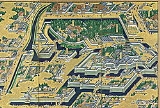
Edo Castle

Encyclopedia
Ota Dokan
, also known as Ōta Sukenaga or Ōta Dōkan Sukenaga, was a Japanese samurai warrior-poet, military tactician and Buddhist monk. Ōta Sukenaga took the tonsure as a Buddhist priest in 1478, and he also adopted the Buddhist name, Dōkan, by which is known today...
. It is located in Chiyoda
Chiyoda, Tokyo
is one of the 23 special wards in central Tokyo, Japan. In English, it is called Chiyoda ward. As of October 2007, the ward has an estimated population of 45,543 and a population density of 3,912 people per km², making it by far the least populated of the special wards...
in Tokyo
Tokyo
, ; officially , is one of the 47 prefectures of Japan. Tokyo is the capital of Japan, the center of the Greater Tokyo Area, and the largest metropolitan area of Japan. It is the seat of the Japanese government and the Imperial Palace, and the home of the Japanese Imperial Family...
, then known as Edo
Edo
, also romanized as Yedo or Yeddo, is the former name of the Japanese capital Tokyo, and was the seat of power for the Tokugawa shogunate which ruled Japan from 1603 to 1868...
, Toshima District, Musashi Province
Musashi Province
was a province of Japan, which today comprises Tokyo Prefecture, most of Saitama Prefecture and part of Kanagawa Prefecture. It was sometimes called . The province encompassed Kawasaki and Yokohama...
. Tokugawa Ieyasu
Tokugawa Ieyasu
was the founder and first shogun of the Tokugawa shogunate of Japan , which ruled from the Battle of Sekigahara in 1600 until the Meiji Restoration in 1868. Ieyasu seized power in 1600, received appointment as shogun in 1603, abdicated from office in 1605, but...
established the Tokugawa shogunate
Tokugawa shogunate
The Tokugawa shogunate, also known as the and the , was a feudal regime of Japan established by Tokugawa Ieyasu and ruled by the shoguns of the Tokugawa family. This period is known as the Edo period and gets its name from the capital city, Edo, which is now called Tokyo, after the name was...
here. It was the residence of the shogun and location of the shogunate, and also functioned as the military capital during the Edo period
Edo period
The , or , is a division of Japanese history which was ruled by the shoguns of the Tokugawa family, running from 1603 to 1868. The political entity of this period was the Tokugawa shogunate....
of Japanese history. After the vacation of the shogun and the Meiji Restoration
Meiji Restoration
The , also known as the Meiji Ishin, Revolution, Reform or Renewal, was a chain of events that restored imperial rule to Japan in 1868...
, it became the Tokyo Imperial Palace. Some moat
Moat
A moat is a deep, broad ditch, either dry or filled with water, that surrounds a castle, other building or town, historically to provide it with a preliminary line of defence. In some places moats evolved into more extensive water defences, including natural or artificial lakes, dams and sluices...
s, walls and ramparts
Defensive wall
A defensive wall is a fortification used to protect a city or settlement from potential aggressors. In ancient to modern times, they were used to enclose settlements...
of the castle survive to this day. However, the grounds were more extensive during the Edo period, with Tokyo Station
Tokyo Station
is a train station located in the Marunouchi business district of Chiyoda, Tokyo, Japan, near the Imperial Palace grounds and the Ginza commercial district....
and the Marunouchi
Marunouchi
Marunouchi is a commercial district of Tokyo located in Chiyoda between Tokyo Station and the Imperial Palace. The name, meaning "inside the circle", derives from its location within the palace's outer moat...
section of the city lying within the outermost moat. It also encompassed Kitanomaru Park
Kitanomaru Koen
is a district of Chiyoda, Tokyo, Japan. It is best known as the location of Kitanomaru Park, which opened 1969. As of May 1, 2008, its population is 598, of which 361 are male and 237 are female.-History:...
, the Nippon Budokan Hall and other landmarks of the surrounding area.
History
Heian period
The is the last division of classical Japanese history, running from 794 to 1185. The period is named after the capital city of Heian-kyō, or modern Kyōto. It is the period in Japanese history when Buddhism, Taoism and other Chinese influences were at their height...
or the beginning of the Kamakura period
Kamakura period
The is a period of Japanese history that marks the governance by the Kamakura Shogunate, officially established in 1192 in Kamakura by the first shogun Minamoto no Yoritomo....
. The Edo clan
Edo clan
The Edo clan were a minor offshoot of the Taira clan, and first fortified the settlement known as Edo, which would later become Tokyo. The Imperial Palace now stands at this location.During the Azuchi-Momoyama period, the clan was renamed the Kitami....
perished in the 15th century as a result of uprisings in the Kantō region
Kanto region
The is a geographical area of Honshu, the largest island of Japan. The region includes the Greater Tokyo Area and encompasses seven prefectures: Gunma, Tochigi, Ibaraki, Saitama, Tokyo, Chiba, and Kanagawa. Within its boundaries, slightly more than 40 percent of the land area is the Kantō Plain....
, and Ota Dokan
Ota Dokan
, also known as Ōta Sukenaga or Ōta Dōkan Sukenaga, was a Japanese samurai warrior-poet, military tactician and Buddhist monk. Ōta Sukenaga took the tonsure as a Buddhist priest in 1478, and he also adopted the Buddhist name, Dōkan, by which is known today...
, a retainer of the Ogigayatsu Uesugi family
Uesugi clan
The was a Japanese samurai clan, descended from the Fujiwara clan and particularly notable for their power in the Muromachi and Sengoku periods ....
, built Edo Castle in 1457.
The castle later came under the control by the Late Hōjō clan
Late Hojo clan
The ' was one of the most powerful warrior clans in Japan in the Sengoku period and held domains primarily in the Kantō region.The clan is traditionally reckoned to be started by Ise Shinkurō, who came from a branch of the prestigious Ise clan, a family in the direct employment of the Ashikaga...
. The castle was vacated in 1590 due to the Siege of Odawara
Siege of Odawara (1590)
The third ' occurred in 1590, and was the primary action in Toyotomi Hideyoshi's campaign to eliminate the Hōjō clan as a threat to his power. The months leading up to it saw hasty but major improvements in the defense of the castle, as Hideyoshi's intentions became clear...
. Tokugawa Ieyasu
Tokugawa Ieyasu
was the founder and first shogun of the Tokugawa shogunate of Japan , which ruled from the Battle of Sekigahara in 1600 until the Meiji Restoration in 1868. Ieyasu seized power in 1600, received appointment as shogun in 1603, abdicated from office in 1605, but...
made Edo Castle his base after he was offered six eastern provinces by Toyotomi Hideyoshi
Toyotomi Hideyoshi
was a daimyo warrior, general and politician of the Sengoku period. He unified the political factions of Japan. He succeeded his former liege lord, Oda Nobunaga, and brought an end to the Sengoku period. The period of his rule is often called the Momoyama period, named after Hideyoshi's castle...
. He later defeated Toyotomi Hideyori
Toyotomi Hideyori
was the son and designated successor of Toyotomi Hideyoshi, the general who first united all of Japan. His mother, Yodo-dono, was the niece of Oda Nobunaga....
, son of Hideyoshi, at the Siege of Osaka
Siege of Osaka
The was a series of battles undertaken by the Tokugawa shogunate against the Toyotomi clan, and ending in that clan's destruction. Divided into two stages , and lasting from 1614 to 1615, the siege put an end to the last major armed opposition to the shogunate's establishment...
in 1615, and emerged as the political leader of Japan. Tokugawa Ieyasu received the title of Seii Taishōgun
Shogun
A was one of the hereditary military dictators of Japan from 1192 to 1867. In this period, the shoguns, or their shikken regents , were the de facto rulers of Japan though they were nominally appointed by the emperor...
in 1603, and Edo became the center of Tokugawa's administration.
Initially, parts of the uninhabitable area were lying under water. The sea reached the later Nishinomaru area of Edo Castle, and Hibiya
Hibiya
is a geographic name covering a part of Chiyoda ward . The zone along the Hibiya Street from Yūrakuchō to Uchisaiwaichō is Hibiya district. There are many residence indications, but some indications using this word, Hibiya, like Hibiya Park and Hibiya Station...
was a beach. The land was changed for the construction of the castle. Most construction started in 1593 and completed in 1636 under the grandson Tokugawa Iemitsu
Tokugawa Iemitsu
Tokugawa Iemitsu was the third shogun of the Tokugawa dynasty. He was the eldest son of Tokugawa Hidetada, and the grandson of Tokugawa Ieyasu. Iemitsu ruled from 1623 to 1651.-Early life :...
. By this time, Edo had a population of 150,000.
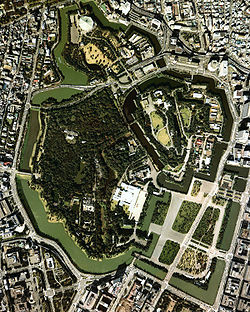
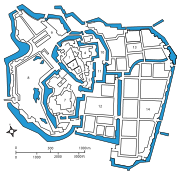
The grounds extended with the addition of Nishinomaru, Nishinomaru-shita, Fukiage, and Kitanomaru areas to the existing Honmaru, Ninomaru, and Sannomaru areas. The perimeter measured 16 km.
The daimyo were required by the shōgun to supply building materials or finances, a method used by the shogunate to keep the powers of the daimyo in check. Large granite stones were moved from afar, the size and number of the stones depend on the wealth of the daimyo. The wealthier ones had to contribute more. Those who did not supply stones were required to contribute labor in tasks, such as digging the large moats and flattening hills. The earth that was taken from the moats were used as landfill for sea-reclamation or to level the ground. Thus the construction of Edo Castle laid the foundation for parts of the city where merchants were able to settle.
At least 10,000 men were involved in the first phase of the construction and more than 300,000 in the middle phase. When construction ended, the castle had 38 gates. The ramparts were almost 20 meters and the outer walls were 12 meters high. Moats that were throughout the rough concentric circles were dug for further protection. Some moats reached as far as Ichigaya
Ichigaya
Ichigaya is an area in the eastern portion of Shinjuku, Tokyo, Japan.-Places in Ichigaya:*Hosei University Ichigaya Campus*Chuo University Graduate School...
and Yotsuya areas, and parts of the ramparts survived to this day. This area is surrounded by either the sea or the Kanda river, and therefore allow ships to navigate.
Various fires over the centuries damaged or destroyed parts of the castle. Edo and the majority of the buildings were constructed out of wood.
On April 21, 1701, in the Great Pine Corridor (Matsu no Ōrōka
Matsu no Oroka
The was part of Edo Castle. The name derives from the painted shōji that were decorated with motifs of pine trees ....
) of Edo Castle, Asano Takumi-no-kami
Asano Naganori
was the daimyo of the Akō Domain in Japan . His title was Takumi no Kami . He is known as the person who triggered a series of incidents retold in a story known as Chushingura, one of the favourite themes of kabuki, joruri and Japanese books and films.He was born in Edo as the eldest son of Asano...
drew his short sword
Wakizashi
The is one of the traditional Japanese swords worn by the samurai class in feudal Japan.-Description:...
and attempted to kill Kira Kōzuke-no-suke
Kira Yoshinaka
was a kōke . His court title was Kōzuke no suke. He is famous as the adversary of Asano Naganori in the events of the Forty-seven Ronin...
for insulting him. This triggered the events involving the Forty-seven Ronin
Forty-seven Ronin
The revenge of the , also known as the Forty-seven Samurai, the Akō vendetta, or the took place in Japan at the start of the 18th century...
.
After the capitulation of the shogunate in 1867, the inhabitants including the shogun had to vacate the premises. The castle compound was renamed in October, 1868, and then renamed in 1869. In the year Meiji 2 (1868), on the day 23 of 10th month, the emperor moved to Tokyo and Edo castle became an imperial palace.
A fire consumed the old Edo Castle on the night of May 5, 1873. The area around the old donjon, which burned in the 1657 Meireki fire
Great Fire of Meireki
The , also known as the Furisode Fire, destroyed 60-70% of the Japanese capital city of Edo on March 2, 1657, this is the third year of the Meireki Imperial era...
, became the site of the new imperial built in 1888. Some Tokugawa era buildings which were still standing were destroyed to make space for new structures for the imperial government. The imperial palace building itself, however, was not on the same location as the shogun's palace, which was located in Honmaru.
The site suffered substantial damage during World War II, and the destruction of Tokyo.
Today the site is part of the Tokyo Imperial Palace. The government declared the area an historic site and has undertaken steps to restore and preserve the remaining structures of Edo Castle.
Appearance of Edo Castle
The plan of Edo Castle was not only large but elaborate. The grounds were divided into various enceinteEnceinte
Enceinte , is a French term used technically in fortification for the inner ring of fortifications surrounding a town or a concentric castle....
s, or citadels. The Honmaru was in the center, with the Ninomaru (second compound), Sannomaru (third compound) extending to the east; the Nishinomaru (west compound) flanked by Nishinomaru-shita (outer section) and Fukiage (firebreak compound); and the Kitanomaru (north compound). The different enceintes were divided by moats and large stone walls, on which were various keeps, defense houses and towers were built. To the east, beyond the Sannomaru was an outer moat, enclosing the Otomachi and Daimyo-Koji districts.
Ishigaki stone walls were constructed around the Honmaru and the eastern side of the Nishinomaru. Each enceinte could be reached via wooden bridges, which were buffered by gates on either side. The circumference is subject to debate, with estimates ranging from 6 to 10 miles.
With the enforcement of the sankin kōtai
Sankin kotai
was a policy of the shogunate during most of the Edo period of Japanese history. The purpose was to control the daimyo. In adopting the policy, the shogunate was continuing and refining similar policies of Toyotomi Hideyoshi. In 1635, a law required sankin kōtai, which was already an established...
system in the 17th century, it became expedient for the various daimyo to set up residence in Edo in close proximity to the shogun. Surrounding the inner compounds of the castle were the residences of various daimyo, most of which were concentrated at the Outer Sakurada Gate to the south-east and in the Otomachi and Daimyo-Koji districts east of the castle inside the outer moat. Some residences were also located within the inner moats in the outer Nishinomaru.
The mansions were very elaborate and large, with no expenses spared to construct palaces with Japanese gardens and multiple gates. Each block had four to six of the mansions, which were surrounded by ditches for drainage. Daimyo with lesser wealth were allowed to set up their houses, called bancho, to the north and west of the castle.
To the east and south of the castle were sections that were set aside for merchants, since this area was considered unsuitable for residences. The entertainment district Yoshiwara
Yoshiwara
Yoshiwara was a famous Akasen district in Edo, present-day Tōkyō, Japan.In the early 17th century, there was widespread male and female prostitution throughout the cities of Kyoto, Edo, and Osaka. To counter this, an order of Tokugawa Hidetada of the Tokugawa shogunate restricted prostitution to...
was also located here.
Gates
The inner citadels of the castle were protected by multiple large and small wooden gates (monMon (architecture)
is a generic Japanese term for gate often used, either alone or as a suffix, in referring to the many gates used by Buddhist temples, Shinto shrines and traditional-style buildings and castles.-Significance:...
), constructed in-between the gaps of the stone wall. Not many are left today. From south to southwest to north, the main gates are located at Nijūbashi, Sakurada-mon, Sakashita-mon, Kikyō-mon, Hanzō-mon, Inui-mon, Ōte-mon, Hirakawa-mon and Kitahanebashi-mon. Only the stone foundations of the other gates (meaning the gap left in between the large stone walls for the wooden gates) are still preserved. Large gates, such as the Ōte-mon, had a guard of 120 men, while the smaller gates were guarded by 30 to 70 armed men.
An eye-witness account is given by the French director François Caron
François Caron
François Caron was a French Huguenot refugee to the Netherlands who served the Dutch East India Company for 30 years, rising from cabin boy to Director-General at Batavia , only one grade below Governor-General...
from the Dutch colony at Dejima
Dejima
was a small fan-shaped artificial island built in the bay of Nagasaki in 1634. This island, which was formed by digging a canal through a small peninsula, remained as the single place of direct trade and exchange between Japan and the outside world during the Edo period. Dejima was built to...
. He described the gates and courts being laid out in such a manner as to confuse an outsider. Caron noted the gates were not placed in a straight line, but were staggered, forcing a person to make a 90 degree turn to pass on to the next gate. This style of construction for the main gates is called masugata (meaning "square"). As noted by Caron, the gate consisted of a square-shaped courtyard or enclosure and a two story gatehouse which is entered via three roofed kōrai-mon. The watari-yagura-mon was constructed at adjacent angles to each side within the gate. All major gates had large timbers that framed the main entry point and were constructed to impress and proclaim the might of the shogunate.
Garrison
Accounts of how many armed men served at Edo Castle vary. The Spanish Governor-General of the Philippines Rodrigo de Vivero y VelascoRodrigo de Vivero y Velasco
Rodrigo de Vivero y Velasco was a Spanish colonial officer from New Spain. In 1563 he married Melchora de Aberrucia, who was Alonso Valiente's widow, and thereby disposed the encomienda of Tecamachalco...
gave an eye-witness account in 1608–1609, describing the huge stones that made up the walls and a large number of people at the castle. He claimed to have seen 20,000 servants between the first gate and the shogun's palace. He passed through two ranks of 1,000 soldiers armed with musket
Musket
A musket is a muzzle-loaded, smooth bore long gun, fired from the shoulder. Muskets were designed for use by infantry. A soldier armed with a musket had the designation musketman or musketeer....
s, and by the second gate he was escorted by 400 armed men. He passed stables that apparently had room for 200 horses and an armory that stored enough weapons for 100,000 men.
Honmaru
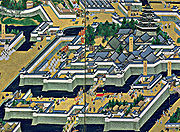
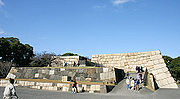
Honmaru was destroyed several times by fire and reconstructed after each fire. The donjon and main palace were destroyed in 1657 and 1863, respectively, and not reconstructed. Some remains, such as the Fujimi-yagura keep and Fujimi-tamon defense house, still exist.
The Honmaru was surrounded by moats on all sides. To the north separating Honmaru from the Kitanomaru were the Inui-bori and Hirakawa-bori, to the east separating the Ninomaru was the Hakuchō-bori, and to the west and south separating the Nishinomaru were the Hasuike-bori and Hamaguri-bori.
Most of these stil exist, although the Hakuchō-bori has partly been filled in since the Meiji era.
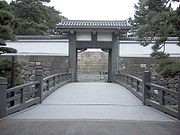
Kitahanebashimon
Donjon
Despite this, jidaigeki
Jidaigeki
is a genre of film, television, and theatre in Japan. The name means "period drama" and is usually the Edo period of Japanese history, from 1603 to 1868. Some, however, are set much earlier—Portrait of Hell, for example, is set during the late Heian period—and the early Meiji era is also a popular...
movies (such as Abarembo shogun
Abarenbo Shogun
is a Japanese television program on the TV Asahi network. Set in the eighteenth century, it showed fictitious events in the life of Yoshimune, the eighth Tokugawa shogun. The program started in 1978 under the title Yoshimune Hyōbanki: Abarenbō Shōgun...
) set in Edo usually depict Edo Castle as having a donjon, and substitute Himeji Castle
Himeji Castle
When the han feudal system was abolished in 1871, Himeji Castle was put up for auction. The castle was purchased by a Himeji resident for 23 Japanese yen...
for that purpose.
A non-profit "Rebuilding Edo-jo Association" (NPO江戸城再建) was founded with the aim of a historically correct reconstruction of at least the main donjon.
Honmaru Palace

Nijo Castle
is a flatland castle located in Kyoto, Japan. The castle consists of two concentric rings of fortifications, the Ninomaru Palace, the ruins of the Honmaru Palace, various support buildings and several gardens...
in Kyoto today. These structures were used for either residential or governmental purposes such as audiences.
The Honmaru Palace was one story high, and consisted of three sections:
- The Ō-omote (Great Outer Palace) contained reception rooms for public audience and apartments for guards and officials;
- The Naka-oku (middle interior) was where the shogun received his relatives, higher lords and met his counselors for the affairs of state; and
- ŌokuOokuThe refers to the harem of Edo Castle, the section where the women connected to the reigning Shōgun resided. Similar areas in the castles of powerful Daimyō were also referred to by this term.This included the shōgun's mother, wife, and concubines...
(great interior) contained the private apartments of the shogun and his ladies-in-waiting. The great interior was strictly off-limits and communication went through young messenger boys. The great interior was apparently 1,000 tatamiTatamiA is a type of mat used as a flooring material in traditional Japanese-style rooms. Traditionally made of rice straw to form the core , with a covering of woven soft rush straw, tatami are made in standard sizes, with the length exactly twice the width...
mats in size and could be divided into sections by the use of sliding shōji doors, which were painted in elegant schemes.
Various fires destroyed the Honmaru Palace over time and was rebuilt after each fire. In the span from 1844 to 1863, Honmaru experienced three fires. After each fire, the shogun moved to the Nishinomaru residences for the time being until reconstruction was complete. However, in 1853 both the Honmaru and Nishinomaru burned down, forcing the shogun to move in to a daimyo residence. The last fire occurred in 1873, after which the palace was not rebuilt by the new imperial government.
Located behind the Honmaru Palace was the main donjon. Besides being the location of the donjon and palace, the Honmaru was also the site of the treasury. Three storehouses that bordered on a rampart adjoined the palace on the other side. The entrance was small, made with thick lumber and heavily guarded. Behind the wall was a deep drop to the moat below, making the area secure.
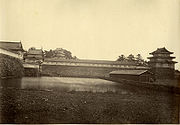
Fujimi-yagura
Mount Fuji
is the highest mountain in Japan at . An active stratovolcano that last erupted in 1707–08, Mount Fuji lies about south-west of Tokyo, and can be seen from there on a clear day. Mount Fuji's exceptionally symmetrical cone is a well-known symbol of Japan and it is frequently depicted in art and...
could be seen from this keep, hence the name. Since the main donjon of Edo Castle was destroyed in 1657 and not reconstructed, the Fujimi-yagura took on its role and was an important building during the Edo period. About 150–160 meters north of the Fujimi-yagura is the former site of the Matsu no Ōrōka
Matsu no Oroka
The was part of Edo Castle. The name derives from the painted shōji that were decorated with motifs of pine trees ....
corridor, scene of dramatic events in 1701 that led to the Forty-seven Ronin
Forty-seven Ronin
The revenge of the , also known as the Forty-seven Samurai, the Akō vendetta, or the took place in Japan at the start of the 18th century...
incident.
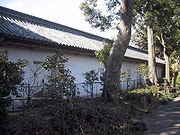
Fujimi-tamon
Ishimuro

Shiomi-zaka
is a slope running alongside today's Imperial Music Department building towards Ninomaru enceinte. In old times apparently the sea could be seen from here, therefore its name.Ninomaru
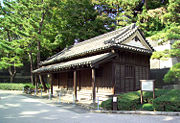
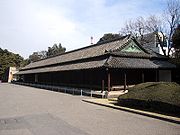
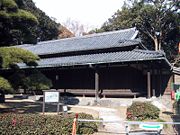
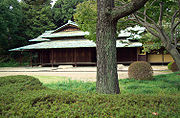
At the foot of the Shiomi-zaka on the eastern side of the Honmaru lies the of Edo Castle. A palace for the heirs of the Tokugawa shoguns was constructed in 1639 in the west area and in 1630 it is reported that a garden designed by Kobori Enshu, who was the founder of Japanese landscaping, was located to its south-east. Several fires destroyed whatever stood here and it was not reconstructed. Aside from the Honmaru palace, the Ninomaru was surrounded by 7 keeps, 8 defense houses, approximately 10 gates and other guardhouses. The Tenjin-bori separates a part of the Ninomaru to the Sannomaru.Several renovations were carried out over the years until the Meiji era. A completely new garden has been laid out since then around the old pond left from the Edo period. Only the Hyakunin-bansho and Dōshin-bansho are still standing.
Dōshin-bansho
Hyakunin-bansho
Ō-bansho
Suwa-no-Chaya
Sannomaru
The is the eastern most enceinte next to the Ninomaru, separated by the Tenjin-bori. Ōte-bori is located to the north, running then south is Kikyō-bori.Bairin-zaka
A steep slope, , runs from eastern Honmaru toward Hirakawa-mon in front of the today's Archives and Mausolea Department building. It is said that Ota Dokan planted several hundred plum trees in 1478 in dedication to Sugawara-no-Michizane. Dokan is said to have built the Sanno-Gongendo here, where two shrines were located when the Tokugawa clan occupied the site. With the erection of the Honmaru of Edo Castle, the shrine dedicated to Sugawara-no-Michizane was moved to Kojimachi Hirakawa-cho and later became known as Hirakawa Shrine. The Sanno Shrine was first moved to Momijiyama of Edo Castle and became its tutelary shrine but was moved again. Today it is known as Hie ShrineHie Shrine
The is a Shinto shrine in Nagatachō, Chiyoda, Tokyo, Japan. Its June 15 Sannō Matsuri is one of the three great Japanese festivals of Edo...
.
Hirakawa-mon
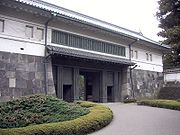
Ōte-mon
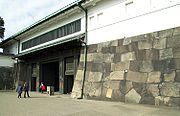
Tokugawa Hidetada
was the second shogun of the Tokugawa dynasty, who ruled from 1605 until his abdication in 1623. He was the third son of Tokugawa Ieyasu, the first shogun of the Tokugawa shogunate.-Early life :...
, the castle underwent repairs in the 1620s and the gate is said to have taken its present form at this time, with the help of Date Masamune
Date Masamune
was a regional strongman of Japan's Azuchi-Momoyama period through early Edo period. Heir to a long line of powerful daimyo in the Tōhoku region, he went on to found the modern-day city of Sendai...
, lord of Sendai Castle, and Soma Toshitane, lord of Nakamura Castle.
A fire in Edo destroyed the Ōte-mon in January 1657, but was reconstructed in November 1658. It was severely damaged twice, in 1703
1703 Genroku earthquake
The occurred at 02:00 local time on December 31 . The epicenter was near Edo, the forerunner of present-day Tokyo, in the southern part of the Kantō Region, Japan. It shook Edo and an estimated 2,300 people were killed by the shaking and subsequent fires...
and 1855
1855 Ansei Edo earthquake
The , also known as the Great Ansei Earthquake, was one of the major disasters of the late-Edo period. The earthquake occurred at 22:00 local time on 11 November. It had an epicenter close to Edo , causing considerable damage in the Kantō region from the shaking and subsequent fires, with a death...
, by strong earthquakes, and reconstructed to stand until the Meiji era. Several repairs were conducted after the Meiji era, but the damage caused by the September 1923 Great Kantō earthquake
1923 Great Kanto earthquake
The struck the Kantō plain on the Japanese main island of Honshū at 11:58:44 am JST on September 1, 1923. Varied accounts hold that the duration of the earthquake was between 4 and 10 minutes...
lead to the dismantling of the watari-yagura and rebuilding of the stone walls on each side of the gate in 1925.
The watari-yagura was burnt down completely during World War II on April 30, 1945. Restoration took place from October 1965 through March 1967, to repair the kōrai-mon and its walls, and the Ōte-mon was reconstructed.
Tatsumi-yagura

Kikyō-mon
One of the few gates left of the Ninomaru is the , which is also known as the Inner Sakurada-mon, as opposed to the (Outer) Sakurada-mon in the south. The architecture of the tower is a gate and in the kōrai style.Nishinomaru

Sakurada-mon

Nijūbashi
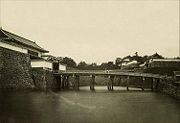
The bridge in the foreground used to be called , while the one in the back was called . After their replacement in the Meiji era, the bridge is now called ) and , respectively. The stone bridge is also called because of its shape. Today both bridges are closed to the public except on January 2 and the Emperor's birthday.
Fushimi-yagura
is a two-storey keep that still exists at the western corner leading towards the inner Nishinomaru, flanked by two galleries (tamon) on each side. It is the only keep that is left in the Nishinomaru. It comes originally from Fushimi CastleFushimi Castle
', also known as Momoyama Castle or Fushimi-Momoyama Castle, is a castle in Kyoto's Fushimi Ward. The current structure is a 1964 replica of the original built by Toyotomi Hideyoshi.-History:...
in Kyoto.
Sakashita-mon
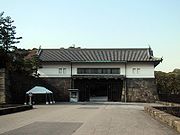
Momijiyama
is an area in northern Nishinomaru. The area had shrines dedicated to former shoguns in which ceremonies were conducted in memory of them and were held regularly.Tokugawa Ieyasu built a library in 1602 within the Fujimi bower
Bower
Bower may refer to:* a folly built by the Bowerbird to attract mates; see wiktionary:bower.* a dwelling or lean-to shelter, also known as an arbor* an anchor carried at the bow of a ship* Bower Manuscript, a Sanskrit manuscript...
of the castle with many books he obtained from an old library in Kanazawa. In July 1693, a new library was constructed at Momijiyama (Momijiyama Bunko).
The so-called "Momijiyama Bunkobon" are the books from that library, which are preserved in the National Archives of Japan
National Archives of Japan
The preserve Japanese government documents and historical records and make them available to the public. Although Japan's reverence for its unique history and art is well documented and illustrated by collections of art and documents, there is almost no archivist tradition...
today. This group consists chiefly of books published during the Song dynasty
Song Dynasty
The Song Dynasty was a ruling dynasty in China between 960 and 1279; it succeeded the Five Dynasties and Ten Kingdoms Period, and was followed by the Yuan Dynasty. It was the first government in world history to issue banknotes or paper money, and the first Chinese government to establish a...
, Korean books that were formerly in the possession of the Kanazawa Bunko library, books presented by the Hayashi family as gifts, and fair copies of books compiled by the Tokugawa government.
Fukiage
The is the western area that was made into a firebreak after the great Meireki fire of 1657. The Fukiage is encircled by the Dōkan-bori to the Nishinomaru to the east, the Sakurada-bori to the south, the Hanzō-bori to the west, the Chidorigafuchi to the northwest and the Inui-bori to the north.Inui-mon
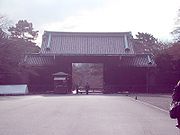
Hanzōmon
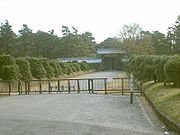
Kitanomaru
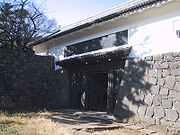
Kitanomaru is surrounded by moats. The Inui-bori and Hirakawa-bori to the south separate it from the Honmaru and Chidorigafuchi to the west.
Modern Tokyo
Many place names in Tokyo derive from Edo Castle. Ōtemachi ("the town in front of the great gate"), Takebashi ("the Bamboo Bridge"), Toranomon ("the Tiger Gate"), Uchibori Dōri ("Inner Moat Street"), Sotobori Dōri ("Outer Moat Street"), and Marunouchi ("Within the enclosure") are examples.See also
- Kamiyashiki of Matsudaira Tadamasa
- List of Special Places of Scenic Beauty, Special Historic Sites and Special Natural Monuments
External links
- Rebuilding "Edo-jo" Association
- National Museum of Japanese History: Folding screens depicting scenes of the attendance of daimyo at Edo castle
- National Archives of JapanNational Archives of JapanThe preserve Japanese government documents and historical records and make them available to the public. Although Japan's reverence for its unique history and art is well documented and illustrated by collections of art and documents, there is almost no archivist tradition...
: Ryukyu Chuzano ryoshisha tojogyoretsu, scroll illustrating procession of Ryukyu emissary to Edo, 1710 (Hōei 7). - National Archives of Japan: Ryuei Oshirosyoin Toranoma Shingoten Gokyusoku ukagai shitae, scroll showing artwork added to partitions of castle keep during reconstruction after 1844 fire, artist was Kanō Eitoku (1814 - 1891)