

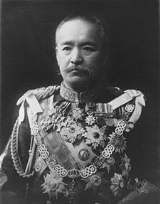
Katsura Taro

Encyclopedia
Prince
, was a general in the Imperial Japanese Army
, politician
and three-time Prime Minister of Japan
.
family from Hagi
, Chōshū Domain (present day Yamaguchi Prefecture
). As a youth, he joined the movement against the Tokugawa shogunate
and participated in some of the major battles of the Boshin War
that led to the Meiji Restoration
.
to study military science
. He served as military attaché
at the Japanese embassy in Germany from 1875–1878 and again from 1884-1885. On his return to Japan, he was promoted to major general
. He served in several key positions within the Imperial Japanese Army
, and in 1886 was appointed Vice-Minister of War
.
During the First Sino-Japanese War
(1894–1895) Katsura commanded the IJA 3rd Division under his mentor, Field Marshal Yamagata Aritomo
. During the war, his division made a memorable march in the depth of winter from the north-east shore of the Yellow Sea
to Haicheng
, finally occupying Niuchwang, and effecting a junction with the IJA 2nd Army which had moved up the Liaotung peninsula.
After the war, he was elevated with the title of shishaku (viscount
) under the kazoku
peerage system. He was appointed 2nd Governor-General of Taiwan
from 2 June 1896 to October 1896.
In successive cabinets from 1898 to 1901, he served as Minister of War
.
. He remains the longest-serving Prime Minister of Japan to date.
of 1902 and victory over Russia
in the Russo-Japanese War
of 1904-1905. During his tenure, the Taft-Katsura agreement
regarding the issue of Japanese hegemony over Korea
was reached with the United States. During this term, Katsura received the Grand Cross of the Order of St Michael and St George
from King Edward
of Great Britain
, and was elevated to the rank of marquess
by Emperor Meiji
.
In terms of domestic policy, Katsura was a strictly conservative politician who attempted to distance himself from the Diet of Japan
and party politics. His political views mirrored that of Yamagata Aritomo, in that he viewed that his sole responsibility was to the Emperor. He vied for control of the government with the Rikken Seiyukai
, the majority party of the lower house
, headed by his arch-rival, Marquess
Saionji Kinmochi
.
In January 1906, Katsura resigned the premiership to Saionji Kinmochi over controversy and unpopularity of the Treaty of Portsmouth
(1905) ending the war between Japan and Russia. However, his resignation was part of a “back door deal” brokered by Hara Takashi
to alternate power between Saionji and Hara.
On 1 April 1906, he was awarded the Grand Cordon of the Supreme Order of the Chrysanthemum
.
of 1910.
He also promulgated the Factory Act in 1911, which was the first act for the purpose of labor protection in Japan.
Katsura was increasingly unpopular during his second term over public perception that he was using his office to further his personal fortune, and the interests of the military (gunbatsu
) over the welfare of the people. He also faced growing public dissatisfaction over the persistence of the hanbatsu domainal based politics.
After his resignation, he became a kōshaku (公爵 = prince
), Lord Keeper of the Privy Seal of Japan
and one of the genrō
.
. His appointment was viewed as a plot by the genrō to overthrown rule by the Constitution
. However, rather than compromising, Katsura created his own political party, the Rikken Doshikai
in an effort to establish his own support base.
However, faced with a no-confidence motion (the first successful one in Japanese history) and the loss of the support of his backers, he was forced to resign in February 1913. He was succeeded by Yamamoto Gonnohyōe
and the Diet was held by his new Rikken Doshikai party.
in Shiba, Tokyo
and his grave is at the Shōin Jinja, in Setagaya, Tokyo
.
Prince
Prince is a general term for a ruler, monarch or member of a monarch's or former monarch's family, and is a hereditary title in the nobility of some European states. The feminine equivalent is a princess...
, was a general in the Imperial Japanese Army
Imperial Japanese Army
-Foundation:During the Meiji Restoration, the military forces loyal to the Emperor were samurai drawn primarily from the loyalist feudal domains of Satsuma and Chōshū...
, politician
Politician
A politician, political leader, or political figure is an individual who is involved in influencing public policy and decision making...
and three-time Prime Minister of Japan
Prime Minister of Japan
The is the head of government of Japan. He is appointed by the Emperor of Japan after being designated by the Diet from among its members, and must enjoy the confidence of the House of Representatives to remain in office...
.
Early life
Katsura was born into a samuraiSamurai
is the term for the military nobility of pre-industrial Japan. According to translator William Scott Wilson: "In Chinese, the character 侍 was originally a verb meaning to wait upon or accompany a person in the upper ranks of society, and this is also true of the original term in Japanese, saburau...
family from Hagi
Hagi, Yamaguchi
is a city located in Yamaguchi, Japan and was incorporated as a city on July 1, 1932. Formerly part of Abu District.On March 6, 2005, the former city of Hagi merged with the towns of Susa and Tamagawa, and the villages of Asahi, Fukue, Kawakami and Mutsumi to form the new city of Hagi.Iwami Airport...
, Chōshū Domain (present day Yamaguchi Prefecture
Yamaguchi Prefecture
is a prefecture of Japan in the Chūgoku region on Honshū island. The capital is the city of Yamaguchi, in the center of the prefecture. The largest city, however, is Shimonoseki.- History :...
). As a youth, he joined the movement against the Tokugawa shogunate
Tokugawa shogunate
The Tokugawa shogunate, also known as the and the , was a feudal regime of Japan established by Tokugawa Ieyasu and ruled by the shoguns of the Tokugawa family. This period is known as the Edo period and gets its name from the capital city, Edo, which is now called Tokyo, after the name was...
and participated in some of the major battles of the Boshin War
Boshin War
The was a civil war in Japan, fought from 1868 to 1869 between forces of the ruling Tokugawa shogunate and those seeking to return political power to the imperial court....
that led to the Meiji Restoration
Meiji Restoration
The , also known as the Meiji Ishin, Revolution, Reform or Renewal, was a chain of events that restored imperial rule to Japan in 1868...
.
Army career
The new Meiji government considered that Katsura displayed great talent, and sent him to GermanyGermany
Germany , officially the Federal Republic of Germany , is a federal parliamentary republic in Europe. The country consists of 16 states while the capital and largest city is Berlin. Germany covers an area of 357,021 km2 and has a largely temperate seasonal climate...
to study military science
Military strategy
Military strategy is a set of ideas implemented by military organizations to pursue desired strategic goals. Derived from the Greek strategos, strategy when it appeared in use during the 18th century, was seen in its narrow sense as the "art of the general", 'the art of arrangement' of troops...
. He served as military attaché
Military attaché
A military attaché is a military expert who is attached to a diplomatic mission . This post is normally filled by a high-ranking military officer who retains the commission while serving in an embassy...
at the Japanese embassy in Germany from 1875–1878 and again from 1884-1885. On his return to Japan, he was promoted to major general
Major General
Major general or major-general is a military rank used in many countries. It is derived from the older rank of sergeant major general. A major general is a high-ranking officer, normally subordinate to the rank of lieutenant general and senior to the ranks of brigadier and brigadier general...
. He served in several key positions within the Imperial Japanese Army
Imperial Japanese Army
-Foundation:During the Meiji Restoration, the military forces loyal to the Emperor were samurai drawn primarily from the loyalist feudal domains of Satsuma and Chōshū...
, and in 1886 was appointed Vice-Minister of War
Ministry of War of Japan
The , more popularly known as the Ministry of War of Japan, was cabinet-level ministry in the Empire of Japan charged with the administrative affairs of the Imperial Japanese Army...
.
During the First Sino-Japanese War
First Sino-Japanese War
The First Sino-Japanese War was fought between Qing Dynasty China and Meiji Japan, primarily over control of Korea...
(1894–1895) Katsura commanded the IJA 3rd Division under his mentor, Field Marshal Yamagata Aritomo
Yamagata Aritomo
Field Marshal Prince , also known as Yamagata Kyōsuke, was a field marshal in the Imperial Japanese Army and twice Prime Minister of Japan. He is considered one of the architects of the military and political foundations of early modern Japan. Yamagata Aritomo can be seen as the father of Japanese...
. During the war, his division made a memorable march in the depth of winter from the north-east shore of the Yellow Sea
Yellow Sea
The Yellow Sea is the name given to the northern part of the East China Sea, which is a marginal sea of the Pacific Ocean. It is located between mainland China and the Korean Peninsula. Its name comes from the sand particles from Gobi Desert sand storms that turn the surface of the water golden...
to Haicheng
Haicheng
Haicheng is a county-level city of central Liaoning province, Northeast China. It is located about southwest of Shenyang, the provincial capital, and is under the administration of Anshan City, the seat of which lies to the northeast....
, finally occupying Niuchwang, and effecting a junction with the IJA 2nd Army which had moved up the Liaotung peninsula.
After the war, he was elevated with the title of shishaku (viscount
Viscount
A viscount or viscountess is a member of the European nobility whose comital title ranks usually, as in the British peerage, above a baron, below an earl or a count .-Etymology:...
) under the kazoku
Kazoku
The was the hereditary peerage of the Empire of Japan that existed between 1869 and 1947.-Origins:Following the Meiji Restoration of 1868, the ancient court nobility of Kyoto regained some of its lost status...
peerage system. He was appointed 2nd Governor-General of Taiwan
Governor-General of Taiwan
The position of Governor-General of Taiwan existed when Taiwan and the Pescadores were part of the Empire of Japan, from 1895 to 1945.The Japanese Governors-General were members of the Diet, civilian officials, Japanese nobles or generals...
from 2 June 1896 to October 1896.
In successive cabinets from 1898 to 1901, he served as Minister of War
Ministry of War of Japan
The , more popularly known as the Ministry of War of Japan, was cabinet-level ministry in the Empire of Japan charged with the administrative affairs of the Imperial Japanese Army...
.
As Prime Minister
Katsura Tarō served as the 11th, 13th and 15th Prime Minister of JapanPrime Minister of Japan
The is the head of government of Japan. He is appointed by the Emperor of Japan after being designated by the Diet from among its members, and must enjoy the confidence of the House of Representatives to remain in office...
. He remains the longest-serving Prime Minister of Japan to date.
First Katsura Administration
Katsura became Prime Minister for the first time on 2 June 1901 and retained the office for four and a half years to 7 January 1906, which was a record in Japan at that time. During his four year first term Japan emerged as a major imperialist power in East Asia. In terms of foreign affairs, it was marked by the Anglo-Japanese AllianceAnglo-Japanese Alliance
The first was signed in London at what is now the Lansdowne Club, on January 30, 1902, by Lord Lansdowne and Hayashi Tadasu . A diplomatic milestone for its ending of Britain's splendid isolation, the alliance was renewed and extended in scope twice, in 1905 and 1911, before its demise in 1921...
of 1902 and victory over Russia
Russian Empire
The Russian Empire was a state that existed from 1721 until the Russian Revolution of 1917. It was the successor to the Tsardom of Russia and the predecessor of the Soviet Union...
in the Russo-Japanese War
Russo-Japanese War
The Russo-Japanese War was "the first great war of the 20th century." It grew out of rival imperial ambitions of the Russian Empire and Japanese Empire over Manchuria and Korea...
of 1904-1905. During his tenure, the Taft-Katsura agreement
Taft-Katsura Agreement
The Taft–Katsura Agreement was a set of notes taken during conversations between United States Secretary of War William Howard Taft and Prime Minister of Japan Katsura Tarō on 29 July 1905...
regarding the issue of Japanese hegemony over Korea
Korea
Korea ) is an East Asian geographic region that is currently divided into two separate sovereign states — North Korea and South Korea. Located on the Korean Peninsula, Korea is bordered by the People's Republic of China to the northwest, Russia to the northeast, and is separated from Japan to the...
was reached with the United States. During this term, Katsura received the Grand Cross of the Order of St Michael and St George
Order of St Michael and St George
The Most Distinguished Order of Saint Michael and Saint George is an order of chivalry founded on 28 April 1818 by George, Prince Regent, later George IV of the United Kingdom, while he was acting as Prince Regent for his father, George III....
from King Edward
Edward VII of the United Kingdom
Edward VII was King of the United Kingdom and the British Dominions and Emperor of India from 22 January 1901 until his death in 1910...
of Great Britain
Great Britain
Great Britain or Britain is an island situated to the northwest of Continental Europe. It is the ninth largest island in the world, and the largest European island, as well as the largest of the British Isles...
, and was elevated to the rank of marquess
Marquess
A marquess or marquis is a nobleman of hereditary rank in various European peerages and in those of some of their former colonies. The term is also used to translate equivalent oriental styles, as in imperial China, Japan, and Vietnam...
by Emperor Meiji
Emperor Meiji
The or was the 122nd emperor of Japan according to the traditional order of succession, reigning from 3 February 1867 until his death...
.
In terms of domestic policy, Katsura was a strictly conservative politician who attempted to distance himself from the Diet of Japan
Diet of Japan
The is Japan's bicameral legislature. It is composed of a lower house, called the House of Representatives, and an upper house, called the House of Councillors. Both houses of the Diet are directly elected under a parallel voting system. In addition to passing laws, the Diet is formally...
and party politics. His political views mirrored that of Yamagata Aritomo, in that he viewed that his sole responsibility was to the Emperor. He vied for control of the government with the Rikken Seiyukai
Rikken Seiyukai
The was one of the main political parties in the pre-war Empire of Japan. It was also known simply as the ‘Seiyūkai'Founded on September 15, 1900 by Itō Hirobumi , the Seiyūkai was a pro-government alliance of bureaucrats and former members of the Kenseitō. The Seiyūkai was the most powerful...
, the majority party of the lower house
Lower house
A lower house is one of two chambers of a bicameral legislature, the other chamber being the upper house.Despite its official position "below" the upper house, in many legislatures worldwide the lower house has come to wield more power...
, headed by his arch-rival, Marquess
Marquess
A marquess or marquis is a nobleman of hereditary rank in various European peerages and in those of some of their former colonies. The term is also used to translate equivalent oriental styles, as in imperial China, Japan, and Vietnam...
Saionji Kinmochi
Saionji Kinmochi
Prince was a Japanese politician, statesman and twice Prime Minister of Japan. His title does not signify the son of an emperor, but the highest rank of Japanese hereditary nobility; he was elevated from marquis to prince in 1920...
.
In January 1906, Katsura resigned the premiership to Saionji Kinmochi over controversy and unpopularity of the Treaty of Portsmouth
Treaty of Portsmouth
The Treaty of Portsmouth formally ended the 1904-05 Russo-Japanese War. It was signed on September 5, 1905 after negotiations at the Portsmouth Naval Shipyard in Kittery, Maine in the USA.-Negotiations:...
(1905) ending the war between Japan and Russia. However, his resignation was part of a “back door deal” brokered by Hara Takashi
Hara Takashi
was a Japanese politician and the 19th Prime Minister of Japan from 29 September 1918 to 4 November 1921. He was also called Hara Kei informally. He was the first commoner appointed to the office of prime minister of Japan...
to alternate power between Saionji and Hara.
On 1 April 1906, he was awarded the Grand Cordon of the Supreme Order of the Chrysanthemum
Order of the Chrysanthemum
is Japan's highest order. The Grand Cordon of the Order was established in 1876 by Emperor Meiji of Japan; the collar of the Order was added on January 4, 1888. Although technically the order has only one class, it can either be awarded with collar , or with grand cordon...
.
Second Katsura Administration
Katsura returned as Prime Minister from 14 July 1908 to 30 August 1911. His second term was noteworthy for the Japan-Korea Annexation TreatyJapan-Korea Annexation Treaty
The Japan–Korea Treaty of 1910, also known as the Japan–Korea Annexation Treaty, was made by representatives of the Empire of Japan and the Korean Empire in 1910. Negotiations were concluded on August 20, 1910...
of 1910.
He also promulgated the Factory Act in 1911, which was the first act for the purpose of labor protection in Japan.
Katsura was increasingly unpopular during his second term over public perception that he was using his office to further his personal fortune, and the interests of the military (gunbatsu
Gunbatsu
is a Japanese language term having two separate meanings. It is used to refer in the Japanese military in general, when it competed against the civilian leadership for control of the government’s domestic and foreign policy in the pre-World War II Empire of Japan. It is also used to refer to...
) over the welfare of the people. He also faced growing public dissatisfaction over the persistence of the hanbatsu domainal based politics.
After his resignation, he became a kōshaku (公爵 = prince
Prince
Prince is a general term for a ruler, monarch or member of a monarch's or former monarch's family, and is a hereditary title in the nobility of some European states. The feminine equivalent is a princess...
), Lord Keeper of the Privy Seal of Japan
Lord Keeper of the Privy Seal of Japan
The was an administrative post not of Cabinet rank in the government of the Empire of Japan. The Lord Keeper of the Privy Seal was responsible for keeping the Privy Seal of Japan and State Seal of Japan....
and one of the genrō
Genro
was an unofficial designation given to certain retired elder Japanese statesmen, considered the "founding fathers" of modern Japan, who served as informal extraconstitutional advisors to the emperor, during the Meiji, Taishō and early Shōwa periods in Japanese history.The institution of genrō...
.
Third Katsura Administration
Katsura's brief reappointment again as Prime Minister again from 21 December 1912 to 20 February 1913 sparked widespread riots in what became known as the Taisho Political CrisisTaisho Political Crisis
The ' was a period of political upheaval in Japan that occurred after the death of the Meiji Emperor in 1912. During the twelve-month period following the emperor's death, the Japanese government was led by three different prime ministers as the government attempted to restore the balance between...
. His appointment was viewed as a plot by the genrō to overthrown rule by the Constitution
Meiji Constitution
The ', known informally as the ', was the organic law of the Japanese empire, in force from November 29, 1890 until May 2, 1947.-Outline:...
. However, rather than compromising, Katsura created his own political party, the Rikken Doshikai
Rikken Doshikai
The was a political party active in the Empire of Japan in the early years of the 20th century. It was also known as simply the Dōshikai.Founded by Prime Minister Katsura Tarō on February 7, 1913, the Rikken Dōshikai largely served to support his cabinet against criticism by the Rikken Seiyūkai...
in an effort to establish his own support base.
However, faced with a no-confidence motion (the first successful one in Japanese history) and the loss of the support of his backers, he was forced to resign in February 1913. He was succeeded by Yamamoto Gonnohyōe
Yamamoto Gonnohyoe
, also called Gonnohyōe, was an admiral in the Imperial Japanese Navy and the 16th and 22nd Prime Minister of Japan.-Early life:...
and the Diet was held by his new Rikken Doshikai party.
Death
Katsura died of stomach cancer eight months later on 10 October 1913, aged 65. His funeral was held at the temple of Zōjō-jiZojo-ji
San'en-zan is a Buddhist temple in the Shiba neighborhood of Minato, Tokyo, Japan. It is the Great Main Temple of the Chinzai sect of the Shingon school. The main image is of Amida Buddha...
in Shiba, Tokyo
Shiba, Tokyo
Shiba is a district of Minato, Tokyo, Japan, located near Hamamatsucho and Tamachi Stations on the Yamanote Line and Mita Station on the Toei Mita Line....
and his grave is at the Shōin Jinja, in Setagaya, Tokyo
Setagaya, Tokyo
is one of the 23 special wards of Tokyo in Japan. It is also the name of a neighborhood within the ward. The ward calls itself the City of Setagaya in English...
.
Honors
- Order of the Sacred TreasureOrder of the Sacred TreasureThe is a Japanese Order, established on January 4, 1888 by Emperor Meiji of Japan as the Order of Meiji. It is awarded in eight classes . It is generally awarded for long and/or meritorious service and considered to be the lowest of the Japanese orders of merit...
, 1st class, August 20, 1895 - Order of the Golden KiteOrder of the Golden KiteThe ' was an order of the Empire of Japan, established on 12 February 1890 by Emperor Meiji "in commemoration of Jimmu Tennō, the Romulus of Japan."-Background:...
, 3rd class - Order of the ChrysanthemumOrder of the Chrysanthemumis Japan's highest order. The Grand Cordon of the Order was established in 1876 by Emperor Meiji of Japan; the collar of the Order was added on January 4, 1888. Although technically the order has only one class, it can either be awarded with collar , or with grand cordon...
, Grand Cordon, April 1, 1906 - Order of the Paulownia FlowersOrder of the Paulownia FlowersThe ' is an order presented by the Japanese Government. Established in 1888 during the Meiji Restoration as the highest award in the Order of the Rising Sun; however, since 2003 it has been an Order in its own right...
, October 10, 1913 - Knight Grand Cross of the Order of the Bath