


Juan de la Cierva

Encyclopedia
Juan de la Cierva y Codorníu, 1st Count of De La Cierva (21 September 1895 – 9 December 1936) was a Spanish
civil engineer
, pilot and aeronuatical engineer. His most famous accomplishment was the invention in 1920 of the Autogiro, a single-rotor type of aircraft that came to be called autogyro
in the English language. After four years of experimentation, De la Cierva developed the articulated rotor which resulted in the world's first successful flight of a stable rotary-wing aircraft in 1923 with his C.4 prototype.
De la Cierva was born in Murcia, Spain to a wealthy family. After several successful experiments with aviation as a boy, he eventually earned a civil engineering degree. He moved to England
in 1925, where with the support of Scottish
industrialist James G. Weir, he established the Cierva Autogiro Company.
At the outbreak of the Spanish Civil War
, De la Cierva supported the forces of Francisco Franco
, helping the rebels to obtain the De Havilland DH-89 'Dragon Rapide'
which flew General Franco from the Canary Islands
to Spanish Morocco
. His brother was killed by the Republican
army in Paracuellos del Jarama
.
to generate lift at low airspeed, and eliminate the risk of stall.
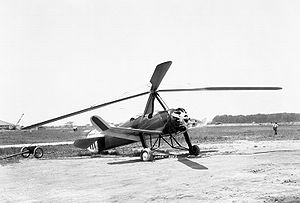 In order to achieve this, he utilised the ability of rotor to autorotate, whereby at a suitable pitch setting, a rotor will continue to rotate without mechanical drive, sustained by the torque equilibrium of the lift and drag forces acting on the blades. This phenomenon was already known, and was available as a safety feature to allow controlled descent in the event of engine failure. With De la Cierva's autogiro, the rotor was drawn through the air by means of conventional propeller
, with the result that the rotor generated sufficient lift to sustain level flight, climb and descent.
Before this could be satisfactorily achieved, De la Cierva experienced several failures primarily associated with the unbalanced rolling movement generated when attempting take-off, due to asymmetry of lift between the advancing and retreating blades. This major difficulty was resolved by the introduction of the flapping hinge. In 1923, De la Cierva's first successful Autogiro was flown in Spain by Lt. Gomez Spencer.
This pioneering work was carried out in De la Cierva's native Spain. In 1925 he brought his C.6
to England and demonstrated it to the Air Ministry
at Farnborough, Hampshire
. This machine had a four blade rotor with flapping hinges but relied upon conventional airplane controls for pitch, roll and yaw. It was based upon an Avro 504K fuselage, initial rotation of the rotor was achieved by the rapid uncoiling of a rope passed around stops on the undersides of the blades.
The Farnborough demonstration was a great success, and resulted in an invitation to continue the work in the UK. As a direct result, and with the assistance of the Scottish industrialist James G Weir, the Cierva Autogiro Company, Ltd., was formed the following year. From the outset De la Cierva concentrated upon the design and the manufacture of rotor systems, relying on other established aircraft manufacturers to produce the airframes, predominantly the A.V. Roe Company
.
The Avro built C.8 was a refinement of the C.6, with the more powerful 180hp Lynx radial engine, and several C.8s were built. The C.8R incorporated drag hinges, due to blade flapping motion causing high blade root stresses in the rotor plane of rotation; this modification, however, resulted in other problems such as ground resonance for which drag hinge dampers were fitted.
The resolution of these fundamental rotor problems opened the way to progress, confidence built up rapidly, and after several cross country flights a C.8L4 was entered for the 1928 Kings Cup Air Race
. Although forced to withdraw, the C.8L4 subsequently completed a 4800 km (2,982.6 mi) tour of the British Isles. Later that year it flew from London
to Paris
, extending the tour to include Berlin
, Brussels
and Amsterdam
, thus becoming the first rotating wing aircraft to cross the English Channel
.
A predominant problem with the autogiro was driving the rotor prior to takeoff. Several methods were attempted in addition to the coiled rope system, which could take the rotor speed to 50% of that required, at which point movement along the ground to reach flying speed was necessary, while tilting the rotor to establish autorotation.
Another approach was to tilt the tail stabiliser to deflect engine slipstream up through the rotor. The most acceptable solution was finally achieved with the C.19, which was produced in some quantities; a direct drive from the engine to the rotor was fitted, through which the rotor could be accelerated up to speed. The system was then declutched prior to executing the take-off run.
As De la Cierva's autogiros achieved success and acceptance, others began to follow and with them came further innovation. Most important was the development of direct rotor control through cyclic pitch variation, achieved initially by tilting the rotor hub and subsequently by Raoul Hafner
by the application of a spider mechanism that acted directly on each rotor blade. The first production direct control autogiro was the C.30, produced in quantity by Avro, Liore et Olivier
, and Focke-Wulf
.
The introduction of jump take-off was another major improvement in capability. The rotor was accelerated in no-lift pitch until the rotor speed required for flight was achieved, and then declutched. The loss of torque caused the blades to swing forward on angled drag hinges with a resultant increase in collective pitch, causing the aircraft to leap into the air. With all the engine power now applied to the forward thrusting propeller, it was now possible to continue in forward flight with the rotor in autorotation.
The C.40 was the first production jump takeoff Autogiro.
Autogiros were built in many countries under De la Cierva licences, including France
, Germany
, Japan
, Russia
and USA.
Though De la Cierva's initial motivation was to produce an aircraft that could not stall, towards the end of his life he accepted the advantages offered by the helicopter. In 1936, the Cierva Autogiro Company, Ltd., responded to a British Air Ministry specification for a Royal Navy helicopter with the gyrodyne. It is perhaps an ironic twist of fate that De la Cierva should die in an airliner accident in Croydon at the age of 41.
, bound for Amsterdam. After delay caused by heavy fog
the airliner took off at about 10:30 am but drifted slightly off course after takeoff and exploded after flying into a house on gently riding terrain at the south of the airport.
De La Cierva's death in an aeroplane crash prevented him from fulfilling his plans to build a useful and reliable aircraft capable of hovering but it was his technology and the vision outlined in his writings and speeches that was used to achieve this goal shortly after his death. Technology developed for the autogyro was used by experimenters in the development of the Fw 61
, which was flown in 1936 by Cierva Autogiro Company licensee Focke-Achgelis
. His innovations led to the Cierva C.38 Gyrodyne, which utilized a powered rotor for hovering and low speed flight, and a side-mounted propeller for torque correction and propulsion in cruise flight. This was followed by the development of the Fairey Gyrodyne, first flown in 1948, proving Cierva's argument that such an aircraft would be superior to a helicopter, which he regarded as excessively complex.
|-
Spain
Spain , officially the Kingdom of Spain languages]] under the European Charter for Regional or Minority Languages. In each of these, Spain's official name is as follows:;;;;;;), is a country and member state of the European Union located in southwestern Europe on the Iberian Peninsula...
civil engineer
Civil engineer
A civil engineer is a person who practices civil engineering; the application of planning, designing, constructing, maintaining, and operating infrastructures while protecting the public and environmental health, as well as improving existing infrastructures that have been neglected.Originally, a...
, pilot and aeronuatical engineer. His most famous accomplishment was the invention in 1920 of the Autogiro, a single-rotor type of aircraft that came to be called autogyro
Autogyro
An autogyro , also known as gyroplane, gyrocopter, or rotaplane, is a type of rotorcraft which uses an unpowered rotor in autorotation to develop lift, and an engine-powered propeller, similar to that of a fixed-wing aircraft, to provide thrust...
in the English language. After four years of experimentation, De la Cierva developed the articulated rotor which resulted in the world's first successful flight of a stable rotary-wing aircraft in 1923 with his C.4 prototype.
De la Cierva was born in Murcia, Spain to a wealthy family. After several successful experiments with aviation as a boy, he eventually earned a civil engineering degree. He moved to England
England
England is a country that is part of the United Kingdom. It shares land borders with Scotland to the north and Wales to the west; the Irish Sea is to the north west, the Celtic Sea to the south west, with the North Sea to the east and the English Channel to the south separating it from continental...
in 1925, where with the support of Scottish
Scotland
Scotland is a country that is part of the United Kingdom. Occupying the northern third of the island of Great Britain, it shares a border with England to the south and is bounded by the North Sea to the east, the Atlantic Ocean to the north and west, and the North Channel and Irish Sea to the...
industrialist James G. Weir, he established the Cierva Autogiro Company.
At the outbreak of the Spanish Civil War
Spanish Civil War
The Spanish Civil WarAlso known as The Crusade among Nationalists, the Fourth Carlist War among Carlists, and The Rebellion or Uprising among Republicans. was a major conflict fought in Spain from 17 July 1936 to 1 April 1939...
, De la Cierva supported the forces of Francisco Franco
Francisco Franco
Francisco Franco y Bahamonde was a Spanish general, dictator and head of state of Spain from October 1936 , and de facto regent of the nominally restored Kingdom of Spain from 1947 until his death in November, 1975...
, helping the rebels to obtain the De Havilland DH-89 'Dragon Rapide'
De Havilland Dragon Rapide
The de Havilland DH.89 Dragon Rapide was a British short-haul passenger airliner of the 1930s.-Design and development:Designed by the de Havilland company in late 1933 as a faster and more comfortable successor to the DH.84 Dragon, it was in effect a twin-engined, scaled-down version of the...
which flew General Franco from the Canary Islands
Canary Islands
The Canary Islands , also known as the Canaries , is a Spanish archipelago located just off the northwest coast of mainland Africa, 100 km west of the border between Morocco and the Western Sahara. The Canaries are a Spanish autonomous community and an outermost region of the European Union...
to Spanish Morocco
Spanish Morocco
The Spanish protectorate of Morocco was the area of Morocco under colonial rule by the Spanish Empire, established by the Treaty of Fez in 1912 and ending in 1956, when both France and Spain recognized Moroccan independence.-Territorial borders:...
. His brother was killed by the Republican
Second Spanish Republic
The Second Spanish Republic was the government of Spain between April 14 1931, and its destruction by a military rebellion, led by General Francisco Franco....
army in Paracuellos del Jarama
Paracuellos del Jarama
Paracuellos del Jarama is a small town in the urban area of Madrid, Spain. It is located Northeast from Madrid and very close to Barajas International Airport....
.
The gyroplane (autogiro)
De la Cierva started building aircraft as early as 1912, and in 1919 he started to consider the use of a rotorHelicopter rotor
A helicopter main rotor or rotor system is a type of fan that is used to generate both the aerodynamic lift force that supports the weight of the helicopter, and thrust which counteracts aerodynamic drag in forward flight...
to generate lift at low airspeed, and eliminate the risk of stall.
Propeller (aircraft)
Aircraft propellers or airscrews convert rotary motion from piston engines or turboprops to provide propulsive force. They may be fixed or variable pitch. Early aircraft propellers were carved by hand from solid or laminated wood with later propellers being constructed from metal...
, with the result that the rotor generated sufficient lift to sustain level flight, climb and descent.
Before this could be satisfactorily achieved, De la Cierva experienced several failures primarily associated with the unbalanced rolling movement generated when attempting take-off, due to asymmetry of lift between the advancing and retreating blades. This major difficulty was resolved by the introduction of the flapping hinge. In 1923, De la Cierva's first successful Autogiro was flown in Spain by Lt. Gomez Spencer.
This pioneering work was carried out in De la Cierva's native Spain. In 1925 he brought his C.6
Cierva C.6
-References:* Original pictures and data of this article were taken from "Museo del Aire", Cuatro Vientos, Madrid, Spain-See also:...
to England and demonstrated it to the Air Ministry
Air Ministry
The Air Ministry was a department of the British Government with the responsibility of managing the affairs of the Royal Air Force, that existed from 1918 to 1964...
at Farnborough, Hampshire
Farnborough, Hampshire
-History:Name changes: Ferneberga ; Farnburghe, Farenberg ; Farnborowe, Fremborough, Fameborough .Tower Hill, Cove: There is substantial evidence...
. This machine had a four blade rotor with flapping hinges but relied upon conventional airplane controls for pitch, roll and yaw. It was based upon an Avro 504K fuselage, initial rotation of the rotor was achieved by the rapid uncoiling of a rope passed around stops on the undersides of the blades.
The Farnborough demonstration was a great success, and resulted in an invitation to continue the work in the UK. As a direct result, and with the assistance of the Scottish industrialist James G Weir, the Cierva Autogiro Company, Ltd., was formed the following year. From the outset De la Cierva concentrated upon the design and the manufacture of rotor systems, relying on other established aircraft manufacturers to produce the airframes, predominantly the A.V. Roe Company
Avro
Avro was a British aircraft manufacturer, with numerous landmark designs such as the Avro 504 trainer in the First World War, the Avro Lancaster, one of the pre-eminent bombers of the Second World War, and the delta wing Avro Vulcan, a stalwart of the Cold War.-Early history:One of the world's...
.
The Avro built C.8 was a refinement of the C.6, with the more powerful 180hp Lynx radial engine, and several C.8s were built. The C.8R incorporated drag hinges, due to blade flapping motion causing high blade root stresses in the rotor plane of rotation; this modification, however, resulted in other problems such as ground resonance for which drag hinge dampers were fitted.
The resolution of these fundamental rotor problems opened the way to progress, confidence built up rapidly, and after several cross country flights a C.8L4 was entered for the 1928 Kings Cup Air Race
King's Cup Race
The King's Cup Race is an annual British handicapped cross-country air race, first contested on 8 September 1922. The event was open to British pilots only, but that did include members of the Commonwealth....
. Although forced to withdraw, the C.8L4 subsequently completed a 4800 km (2,982.6 mi) tour of the British Isles. Later that year it flew from London
London
London is the capital city of :England and the :United Kingdom, the largest metropolitan area in the United Kingdom, and the largest urban zone in the European Union by most measures. Located on the River Thames, London has been a major settlement for two millennia, its history going back to its...
to Paris
Paris
Paris is the capital and largest city in France, situated on the river Seine, in northern France, at the heart of the Île-de-France region...
, extending the tour to include Berlin
Berlin
Berlin is the capital city of Germany and is one of the 16 states of Germany. With a population of 3.45 million people, Berlin is Germany's largest city. It is the second most populous city proper and the seventh most populous urban area in the European Union...
, Brussels
Brussels
Brussels , officially the Brussels Region or Brussels-Capital Region , is the capital of Belgium and the de facto capital of the European Union...
and Amsterdam
Amsterdam
Amsterdam is the largest city and the capital of the Netherlands. The current position of Amsterdam as capital city of the Kingdom of the Netherlands is governed by the constitution of August 24, 1815 and its successors. Amsterdam has a population of 783,364 within city limits, an urban population...
, thus becoming the first rotating wing aircraft to cross the English Channel
English Channel
The English Channel , often referred to simply as the Channel, is an arm of the Atlantic Ocean that separates southern England from northern France, and joins the North Sea to the Atlantic. It is about long and varies in width from at its widest to in the Strait of Dover...
.
A predominant problem with the autogiro was driving the rotor prior to takeoff. Several methods were attempted in addition to the coiled rope system, which could take the rotor speed to 50% of that required, at which point movement along the ground to reach flying speed was necessary, while tilting the rotor to establish autorotation.
Another approach was to tilt the tail stabiliser to deflect engine slipstream up through the rotor. The most acceptable solution was finally achieved with the C.19, which was produced in some quantities; a direct drive from the engine to the rotor was fitted, through which the rotor could be accelerated up to speed. The system was then declutched prior to executing the take-off run.
As De la Cierva's autogiros achieved success and acceptance, others began to follow and with them came further innovation. Most important was the development of direct rotor control through cyclic pitch variation, achieved initially by tilting the rotor hub and subsequently by Raoul Hafner
Raoul Hafner
Raoul Hafner, , was an Austrian-born British helicopter pioneer and engineer.Raoul Hafner, FEng, FRAes, a pioneer of rotating wing aircraft design, died as a result of a yachting accident, was an Austrian who made a distinctive contribution to the British aerospace industry, particularly the...
by the application of a spider mechanism that acted directly on each rotor blade. The first production direct control autogiro was the C.30, produced in quantity by Avro, Liore et Olivier
Lioré et Olivier
Lioré-et-Olivier was a French manufacturer of aircraft of the 20th century, founded in 1912 by Fernand Lioré and Henri Olivier.The company was nationalized in 1936, becoming a part of SNCASE.-Aircraft designs:* Lioré et Olivier LeO 7...
, and Focke-Wulf
Focke-Wulf
Focke-Wulf Flugzeugbau AG was a German manufacturer of civil and military aircraft before and during World War II. Many of the company's successful fighter aircraft designs were slight modifications of the Focke-Wulf Fw 190.-History:...
.
The introduction of jump take-off was another major improvement in capability. The rotor was accelerated in no-lift pitch until the rotor speed required for flight was achieved, and then declutched. The loss of torque caused the blades to swing forward on angled drag hinges with a resultant increase in collective pitch, causing the aircraft to leap into the air. With all the engine power now applied to the forward thrusting propeller, it was now possible to continue in forward flight with the rotor in autorotation.
The C.40 was the first production jump takeoff Autogiro.
Autogiros were built in many countries under De la Cierva licences, including France
France
The French Republic , The French Republic , The French Republic , (commonly known as France , is a unitary semi-presidential republic in Western Europe with several overseas territories and islands located on other continents and in the Indian, Pacific, and Atlantic oceans. Metropolitan France...
, Germany
Germany
Germany , officially the Federal Republic of Germany , is a federal parliamentary republic in Europe. The country consists of 16 states while the capital and largest city is Berlin. Germany covers an area of 357,021 km2 and has a largely temperate seasonal climate...
, Japan
Japan
Japan is an island nation in East Asia. Located in the Pacific Ocean, it lies to the east of the Sea of Japan, China, North Korea, South Korea and Russia, stretching from the Sea of Okhotsk in the north to the East China Sea and Taiwan in the south...
, Russia
Russia
Russia or , officially known as both Russia and the Russian Federation , is a country in northern Eurasia. It is a federal semi-presidential republic, comprising 83 federal subjects...
and USA.
Though De la Cierva's initial motivation was to produce an aircraft that could not stall, towards the end of his life he accepted the advantages offered by the helicopter. In 1936, the Cierva Autogiro Company, Ltd., responded to a British Air Ministry specification for a Royal Navy helicopter with the gyrodyne. It is perhaps an ironic twist of fate that De la Cierva should die in an airliner accident in Croydon at the age of 41.
Death
On the morning of 9 December 1936, he boarded a Dutch DC-2 of KLM at Croydon AirfieldCroydon Airport
Croydon Airport was an airport in South London which straddled the boundary between what are now the London boroughs of Croydon and Sutton. It was the main airport for London before it was replaced by Northolt Aerodrome, London Heathrow Airport and London Gatwick Airport...
, bound for Amsterdam. After delay caused by heavy fog
Fog
Fog is a collection of water droplets or ice crystals suspended in the air at or near the Earth's surface. While fog is a type of stratus cloud, the term "fog" is typically distinguished from the more generic term "cloud" in that fog is low-lying, and the moisture in the fog is often generated...
the airliner took off at about 10:30 am but drifted slightly off course after takeoff and exploded after flying into a house on gently riding terrain at the south of the airport.
Legacy
De la Cierva’s work on rotor dynamics and control made possible the modern helicopter, whose development as a practical means of flight had been prevented by these problems. The understanding that he established is applicable to all rotor-winged aircraft.De La Cierva's death in an aeroplane crash prevented him from fulfilling his plans to build a useful and reliable aircraft capable of hovering but it was his technology and the vision outlined in his writings and speeches that was used to achieve this goal shortly after his death. Technology developed for the autogyro was used by experimenters in the development of the Fw 61
Focke-Wulf Fw 61
|-See also:-References:NotesBibliography* Coates, Steve and Jean-Christophe Carbonel. Helicopters of the Third Reich. Crowborough, UK: Classic Publications Ltd., 2002. ISBN 1-903223-24-5....
, which was flown in 1936 by Cierva Autogiro Company licensee Focke-Achgelis
Focke-Achgelis
Focke-Achgelis & Co. G.m.b.H. was a German helicopter company founded in 1937 by Henrich Focke and Gerd Achgelis.-History:In 1936 Focke had been ousted from the Focke-Wulf company he had cofounded in 1924 by shareholder pressure...
. His innovations led to the Cierva C.38 Gyrodyne, which utilized a powered rotor for hovering and low speed flight, and a side-mounted propeller for torque correction and propulsion in cruise flight. This was followed by the development of the Fairey Gyrodyne, first flown in 1948, proving Cierva's argument that such an aircraft would be superior to a helicopter, which he regarded as excessively complex.
See also
- Cierva C.1Cierva C.1-See also:...
- Cierva C.2Cierva C.2-See also:...
- Cierva C.3Cierva C.3-See also:...
- Cierva C.4
- Cierva C.6Cierva C.6-References:* Original pictures and data of this article were taken from "Museo del Aire", Cuatro Vientos, Madrid, Spain-See also:...
- Cierva C.8
- Cierva C.9Cierva C.9-See also:...
- Cierva C.12
- Cierva C.17Cierva C.17|-References:* -See also:...
- Cierva C.19Cierva C.19The Cierva C.19 was an autogyro designed by Spanish engineer Juan de la Cierva in England in 1929 and built by Avro which designated it their Type 620...
- Cierva C.24Cierva C.24-External Links:* Popular Mechanics, March 1932 bottom of page...
- Cierva C.30A
- Cierva Air HorseCierva Air Horse-References:NotesReferences* Copies of entries in "The Complete Encyclopedia of World Aircraft", 1997. by D.Donald and "Helicopters and Autogyros of the World", 1958 by P.Lambermont. Hosted at www.aviastar.org. Accessed January 2008...
- Cierva W.9Cierva W.9-References:-External links:*...
- Cierva CR TwinCierva CR Twin-External links:*http://www.aviastar.org/helicopters_eng/cierva_grasshopper.php...
Further reading
- Peter W. Brooks: Cierva Autogiros. Smithsonian Institution Press, Washington 1988
External links
- U.S. Centennial of Flight - Juan de la Cierva
- Metrostation in Madrid - La estación de Juan de la Cierva
- "It is Easy to Fly Autogiro Declares Inventor" Popular Mechanics, January 1930 pg.45 and see drawings by scrolling up to pg. 44
|-