


John Soane

Encyclopedia
Sir John Soane, RA
(10 September 1753 – 20 January 1837) was an English
architect
who specialised in the Neo-Classical
style. His architectural works are distinguished by their clean lines, massing of simple form, decisive detailing, careful proportions and skilful use of light sources. The influence of his work, coming at the end of the Georgian era, was swamped by the revival styles of the 19th century. It was not until the late 19th century that the influence of Sir John's architecture was widely felt.
His best-known work was the Bank of England
, a building which had widespread effect on commercial architecture.
and educated in nearby Reading
, the son of a bricklayer. His name was initially Swan which was first changed to Soan and later to Soane. Soane trained as an architect, first under George Dance the Younger
, and then Henry Holland
, while also studying at the Royal Academy
schools, which he entered in 1771. During his studies at the Royal Academy, he won the Academy's silver medal (1772), gold medal (1776) and finally a travelling scholarship in 1777, which he spent on developing his style in Italy
.
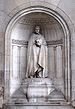 When in Rome
, Soane travelled around with his old classmate, the architect Thomas Hardwick
, and also met the builder and Bishop
of Derry
, Frederick Augustus Hervey, whom he accompanied to Ireland
. However, he failed to find work there, so returned to England in 1780 and settled in East Anglia
where he established a small architectural practice.
In 1788, he succeeded Sir Robert Taylor
as architect and surveyor to the Bank of England
, the exterior of the Bank being his most famous work. Sir Herbert Baker
's rebuilding of the Bank, demolishing most of Soane's earlier building was described by Nikolaus Pevsner
as "the greatest architectural crime, in the City of London
, of the twentieth century". The Bank job, and especially the personal contacts arising from it, increased the success of Soane's practice, and he became Associate Royal Academician (ARA) in 1795, then full Royal Academician (RA) in 1802. He was made Professor of Architecture at the Royal Academy in 1806, a post which he held until his death. Together with John Nash
and Robert Smirke
, he became an official architect to the Office of Works
in 1813. Then, in 1814, he was appointed to the Metropolitan Board of Works
, where he remained until his retirement in 1832. In November 1821 he was elected a Fellow of the Royal Society In 1831, Soane received a knighthood.
Soane was commissioned by the Bank of Ireland to design a new headquarters for the triangular site on Westmoreland Street now occupied by the Westin Hotel. However, when the Irish Parliament was abolished in 1800, the Bank abandoned the project and instead bought the former Parliament Buildings.
During his time in London, Soane ran a lucrative architectural practice, remodelling and designing country homes for the landed gentry
. Among Soane's most notable works are the dining rooms of both numbers 10
and 11 Downing Street
for the Prime Minister and Chancellor of Britain, the Dulwich Picture Gallery
which is the archetype for most modern art galleries, and his country home at Pitzhanger Manor
in Ealing
.
Soane died, a widower and estranged from his surviving son (whom he felt had betrayed him, contributing to his own mother's death), in London
in 1837. He is buried in a vault of his own design in the churchyard of St Pancras Old Church
. The design of the vault was a direct influence on Giles Gilbert Scott
's design for the red telephone box
.
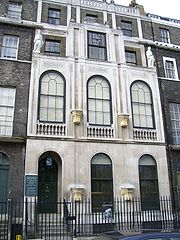 In 1792, Soane bought a house at 12 Lincoln's Inn Fields
, London
. He used the house as his home and library, but also entertained potential clients in the drawing room. It is now Sir John Soane's Museum and is open to the public.
Between 1794 and 1824, Soane remodelled and extended the house into two neighbouring properties — partly to experiment with architectural ideas, and partly to house his growing collection of antiquities
and architectural salvage. As his practice prospered, Soane was able to collect objects worthy of the British Museum
, including the sarcophagus of Seti I
, Roman bronzes from Pompeii
, several Canaletto
s and a collection of paintings by Hogarth
. In 1833, he obtained an Act of Parliament
to bequeath the house and collection to the British Nation to be made into a museum of architecture, now the Sir John Soane's Museum.
- to house the Dulwich collection, which had been held by art dealers Sir Francis Bourgeois
and his partner Noel Desenfans. Bourgeois's will stipulated that the Gallery should be built by his friend John Soane to house the collection. The Dulwich Picture Gallery was completed in 1817, and it has influenced the design of art galleries ever since.
Royal Academy
The Royal Academy of Arts is an art institution based in Burlington House on Piccadilly, London. The Royal Academy of Arts has a unique position in being an independent, privately funded institution led by eminent artists and architects whose purpose is to promote the creation, enjoyment and...
(10 September 1753 – 20 January 1837) was an English
England
England is a country that is part of the United Kingdom. It shares land borders with Scotland to the north and Wales to the west; the Irish Sea is to the north west, the Celtic Sea to the south west, with the North Sea to the east and the English Channel to the south separating it from continental...
architect
Architect
An architect is a person trained in the planning, design and oversight of the construction of buildings. To practice architecture means to offer or render services in connection with the design and construction of a building, or group of buildings and the space within the site surrounding the...
who specialised in the Neo-Classical
Neoclassical architecture
Neoclassical architecture was an architectural style produced by the neoclassical movement that began in the mid-18th century, manifested both in its details as a reaction against the Rococo style of naturalistic ornament, and in its architectural formulas as an outgrowth of some classicizing...
style. His architectural works are distinguished by their clean lines, massing of simple form, decisive detailing, careful proportions and skilful use of light sources. The influence of his work, coming at the end of the Georgian era, was swamped by the revival styles of the 19th century. It was not until the late 19th century that the influence of Sir John's architecture was widely felt.
His best-known work was the Bank of England
Bank of England
The Bank of England is the central bank of the United Kingdom and the model on which most modern central banks have been based. Established in 1694, it is the second oldest central bank in the world...
, a building which had widespread effect on commercial architecture.
Biography
Soane was born in Goring-on-ThamesGoring-On-Thames
Goring-on-Thames is a large village and civil parish on the River Thames in South Oxfordshire, about south of Wallingford.-Geography:...
and educated in nearby Reading
Reading, Berkshire
Reading is a large town and unitary authority area in England. It is located in the Thames Valley at the confluence of the River Thames and River Kennet, and on both the Great Western Main Line railway and the M4 motorway, some west of London....
, the son of a bricklayer. His name was initially Swan which was first changed to Soan and later to Soane. Soane trained as an architect, first under George Dance the Younger
George Dance the Younger
George Dance the Younger was an English architect and surveyor. The fifth and youngest son of George Dance the Elder, he came from a distinguished family of architects, artists and dramatists...
, and then Henry Holland
Henry Holland (architect)
Henry Holland was an architect to the English nobility. Born in Fulham, London, his father also Henry ran a building firm and he built several of Capability Brown's buildings, although Henry would have learnt a lot from his father about the practicalities of construction it was under Brown that he...
, while also studying at the Royal Academy
Royal Academy
The Royal Academy of Arts is an art institution based in Burlington House on Piccadilly, London. The Royal Academy of Arts has a unique position in being an independent, privately funded institution led by eminent artists and architects whose purpose is to promote the creation, enjoyment and...
schools, which he entered in 1771. During his studies at the Royal Academy, he won the Academy's silver medal (1772), gold medal (1776) and finally a travelling scholarship in 1777, which he spent on developing his style in Italy
Italy
Italy , officially the Italian Republic languages]] under the European Charter for Regional or Minority Languages. In each of these, Italy's official name is as follows:;;;;;;;;), is a unitary parliamentary republic in South-Central Europe. To the north it borders France, Switzerland, Austria and...
.
Rome
Rome is the capital of Italy and the country's largest and most populated city and comune, with over 2.7 million residents in . The city is located in the central-western portion of the Italian Peninsula, on the Tiber River within the Lazio region of Italy.Rome's history spans two and a half...
, Soane travelled around with his old classmate, the architect Thomas Hardwick
Thomas Hardwick
Thomas Hardwick was a British architect and a founding member of the Architect's Club in 1791.-Early life and career :Hardwick was born in Brentford, the son of a master mason turned architect also named Thomas Hardwick Thomas Hardwick (1752–1829) was a British architect and a founding...
, and also met the builder and Bishop
Bishop
A bishop is an ordained or consecrated member of the Christian clergy who is generally entrusted with a position of authority and oversight. Within the Catholic Church, Eastern Orthodox, Oriental Orthodox Churches, in the Assyrian Church of the East, in the Independent Catholic Churches, and in the...
of Derry
Derry
Derry or Londonderry is the second-biggest city in Northern Ireland and the fourth-biggest city on the island of Ireland. The name Derry is an anglicisation of the Irish name Doire or Doire Cholmcille meaning "oak-wood of Colmcille"...
, Frederick Augustus Hervey, whom he accompanied to Ireland
Ireland
Ireland is an island to the northwest of continental Europe. It is the third-largest island in Europe and the twentieth-largest island on Earth...
. However, he failed to find work there, so returned to England in 1780 and settled in East Anglia
East Anglia
East Anglia is a traditional name for a region of eastern England, named after an ancient Anglo-Saxon kingdom, the Kingdom of the East Angles. The Angles took their name from their homeland Angeln, in northern Germany. East Anglia initially consisted of Norfolk and Suffolk, but upon the marriage of...
where he established a small architectural practice.
In 1788, he succeeded Sir Robert Taylor
Robert Taylor (architect)
Sir Robert Taylor was a notable English architect of the mid-late 18th century.Born at Woodford, Essex, Taylor followed in his father's footsteps and started working as a stonemason and sculptor, spending time as a pupil of Sir Henry Cheere...
as architect and surveyor to the Bank of England
Bank of England
The Bank of England is the central bank of the United Kingdom and the model on which most modern central banks have been based. Established in 1694, it is the second oldest central bank in the world...
, the exterior of the Bank being his most famous work. Sir Herbert Baker
Herbert Baker
Sir Herbert Baker was a British architect.Baker was the dominant force in South African architecture for two decades, 1892–1912....
's rebuilding of the Bank, demolishing most of Soane's earlier building was described by Nikolaus Pevsner
Nikolaus Pevsner
Sir Nikolaus Bernhard Leon Pevsner, CBE, FBA was a German-born British scholar of history of art and, especially, of history of architecture...
as "the greatest architectural crime, in the City of London
City of London
The City of London is a small area within Greater London, England. It is the historic core of London around which the modern conurbation grew and has held city status since time immemorial. The City’s boundaries have remained almost unchanged since the Middle Ages, and it is now only a tiny part of...
, of the twentieth century". The Bank job, and especially the personal contacts arising from it, increased the success of Soane's practice, and he became Associate Royal Academician (ARA) in 1795, then full Royal Academician (RA) in 1802. He was made Professor of Architecture at the Royal Academy in 1806, a post which he held until his death. Together with John Nash
John Nash (architect)
John Nash was a British architect responsible for much of the layout of Regency London.-Biography:Born in Lambeth, London, the son of a Welsh millwright, Nash trained with the architect Sir Robert Taylor. He established his own practice in 1777, but his career was initially unsuccessful and...
and Robert Smirke
Robert Smirke (architect)
Sir Robert Smirke was an English architect, one of the leaders of Greek Revival architecture his best known building in that style is the British Museum, though he also designed using other architectural styles...
, he became an official architect to the Office of Works
Office of Works
The Office of Works was established in the English Royal household in 1378 to oversee the building of the royal castles and residences. In 1832 it became the Works Department within the Office of Woods, Forests, Land Revenues, Works and Buildings...
in 1813. Then, in 1814, he was appointed to the Metropolitan Board of Works
Metropolitan Board of Works
The Metropolitan Board of Works was the principal instrument of London-wide government from 1855 until the establishment of the London County Council in 1889. Its principal responsibility was to provide infrastructure to cope with London's rapid growth, which it successfully accomplished. The MBW...
, where he remained until his retirement in 1832. In November 1821 he was elected a Fellow of the Royal Society In 1831, Soane received a knighthood.
Soane was commissioned by the Bank of Ireland to design a new headquarters for the triangular site on Westmoreland Street now occupied by the Westin Hotel. However, when the Irish Parliament was abolished in 1800, the Bank abandoned the project and instead bought the former Parliament Buildings.
During his time in London, Soane ran a lucrative architectural practice, remodelling and designing country homes for the landed gentry
Landed gentry
Landed gentry is a traditional British social class, consisting of land owners who could live entirely off rental income. Often they worked only in an administrative capacity looking after the management of their own lands....
. Among Soane's most notable works are the dining rooms of both numbers 10
10 Downing Street
10 Downing Street, colloquially known in the United Kingdom as "Number 10", is the headquarters of Her Majesty's Government and the official residence and office of the First Lord of the Treasury, who is now always the Prime Minister....
and 11 Downing Street
11 Downing Street
11 Downing Street , is the official residence of the Second Lord of the Treasury in Britain, who in modern times has always been the Chancellor of the Exchequer...
for the Prime Minister and Chancellor of Britain, the Dulwich Picture Gallery
Dulwich Picture Gallery
Dulwich Picture Gallery is an art gallery in Dulwich, South London. England's first purpose-built public art gallery, it was designed by Regency architect Sir John Soane and opened to the public in 1817. Soane arranged the exhibition spaces as a series of interlinked rooms illuminated naturally...
which is the archetype for most modern art galleries, and his country home at Pitzhanger Manor
Pitzhanger Manor
Pitzhanger Manor House, in Ealing , was owned from 1800 to 1810 by the architect John Soane, who radically rebuilt it. Soane intended it as a country villa for entertaining and eventually for passing to his elder son. He demolished most of the existing building except the two-storey south wing...
in Ealing
Ealing
Ealing is a suburban area of west London, England and the administrative centre of the London Borough of Ealing. It is located west of Charing Cross and around from the City of London. It is one of the major metropolitan centres identified in the London Plan. It was historically a rural village...
.
Soane died, a widower and estranged from his surviving son (whom he felt had betrayed him, contributing to his own mother's death), in London
London
London is the capital city of :England and the :United Kingdom, the largest metropolitan area in the United Kingdom, and the largest urban zone in the European Union by most measures. Located on the River Thames, London has been a major settlement for two millennia, its history going back to its...
in 1837. He is buried in a vault of his own design in the churchyard of St Pancras Old Church
St Pancras Old Church
St Pancras Old Church is a Church of England parish church in central London. It is believed to be one of the oldest sites of Christian worship in England, and is dedicated to the Roman martyr Saint Pancras, although the building itself is largely Victorian...
. The design of the vault was a direct influence on Giles Gilbert Scott
Giles Gilbert Scott
Sir Giles Gilbert Scott, OM, FRIBA was an English architect known for his work on such buildings as Liverpool Cathedral and Battersea Power Station and designing the iconic red telephone box....
's design for the red telephone box
Red telephone box
The red telephone box, a public telephone kiosk designed by Sir Giles Gilbert Scott, is a familiar sight on the streets of the United Kingdom, Malta, Bermuda and Gibraltar, and despite a reduction in their numbers in recent years, red boxes can still be seen in many places and in current or former...
.
Sir John Soane's Museum
Lincoln's Inn Fields
Lincoln's Inn Fields is the largest public square in London, UK. It was laid out in the 1630s under the initiative of the speculative builder and contractor William Newton, "the first in a long series of entrepreneurs who took a hand in developing London", as Sir Nikolaus Pevsner observes...
, London
London
London is the capital city of :England and the :United Kingdom, the largest metropolitan area in the United Kingdom, and the largest urban zone in the European Union by most measures. Located on the River Thames, London has been a major settlement for two millennia, its history going back to its...
. He used the house as his home and library, but also entertained potential clients in the drawing room. It is now Sir John Soane's Museum and is open to the public.
Between 1794 and 1824, Soane remodelled and extended the house into two neighbouring properties — partly to experiment with architectural ideas, and partly to house his growing collection of antiquities
Antiquities
Antiquities, nearly always used in the plural in this sense, is a term for objects from Antiquity, especially the civilizations of the Mediterranean: the Classical antiquity of Greece and Rome, Ancient Egypt and the other Ancient Near Eastern cultures...
and architectural salvage. As his practice prospered, Soane was able to collect objects worthy of the British Museum
British Museum
The British Museum is a museum of human history and culture in London. Its collections, which number more than seven million objects, are amongst the largest and most comprehensive in the world and originate from all continents, illustrating and documenting the story of human culture from its...
, including the sarcophagus of Seti I
Seti I
Menmaatre Seti I was a Pharaoh of Ancient Egypt , the son of Ramesses I and Queen Sitre, and the father of Ramesses II...
, Roman bronzes from Pompeii
Pompeii
The city of Pompeii is a partially buried Roman town-city near modern Naples in the Italian region of Campania, in the territory of the comune of Pompei. Along with Herculaneum, Pompeii was destroyed and completely buried during a long catastrophic eruption of the volcano Mount Vesuvius spanning...
, several Canaletto
Canaletto
Giovanni Antonio Canal better known as Canaletto , was a Venetian painter famous for his landscapes, or vedute, of Venice. He was also an important printmaker in etching.- Early career :...
s and a collection of paintings by Hogarth
William Hogarth
William Hogarth was an English painter, printmaker, pictorial satirist, social critic and editorial cartoonist who has been credited with pioneering western sequential art. His work ranged from realistic portraiture to comic strip-like series of pictures called "modern moral subjects"...
. In 1833, he obtained an Act of Parliament
Act of Parliament
An Act of Parliament is a statute enacted as primary legislation by a national or sub-national parliament. In the Republic of Ireland the term Act of the Oireachtas is used, and in the United States the term Act of Congress is used.In Commonwealth countries, the term is used both in a narrow...
to bequeath the house and collection to the British Nation to be made into a museum of architecture, now the Sir John Soane's Museum.
Dulwich Picture Gallery
In 1811, Soane was appointed to architect the first purpose-built public art galleryArt gallery
An art gallery or art museum is a building or space for the exhibition of art, usually visual art.Museums can be public or private, but what distinguishes a museum is the ownership of a collection...
- to house the Dulwich collection, which had been held by art dealers Sir Francis Bourgeois
Francis Bourgeois
Sir Peter Francis Bourgeois was an English-Swiss landscape painter and court painter to George III. He lived with his French partner Noel Desenfans and Desenfans's Welsh wife Margaret Morris. The three lived together in a house in Charlotte Street, London...
and his partner Noel Desenfans. Bourgeois's will stipulated that the Gallery should be built by his friend John Soane to house the collection. The Dulwich Picture Gallery was completed in 1817, and it has influenced the design of art galleries ever since.
Selected list of architectural works
- Aynhoe ParkAynhoe ParkAynhoe Park, is a Grade I listed 17th-century country house rebuilt after the English Civil War on the southern edge of the stone-built village of Aynho near Banbury, Oxfordshire. It overlooks the Cherwell valley that divides Northamptonshire from Oxfordshire. The house represents four...
, Aynhoe, BanburyBanburyBanbury is a market town and civil parish on the River Cherwell in the Cherwell District of Oxfordshire. It is northwest of London, southeast of Birmingham, south of Coventry and north northwest of the county town of Oxford...
, OxfordshireOxfordshireOxfordshire is a county in the South East region of England, bordering on Warwickshire and Northamptonshire , Buckinghamshire , Berkshire , Wiltshire and Gloucestershire ....
(1799–1804) remodelled the interior. - Bank of EnglandBank of EnglandThe Bank of England is the central bank of the United Kingdom and the model on which most modern central banks have been based. Established in 1694, it is the second oldest central bank in the world...
(1788–1833). - Chillington HallChillington HallChillington Hall is a Georgian country house near to Brewood, Staffordshire, four miles northwest of Wolverhampton, England. It is the residence of the Giffard family. The Grade I listed house was designed by Francis Smith in 1724 and John Soane in 1785...
(1785-9) remodelled. - Cricket HouseCricket St ThomasCricket St Thomas is a village and parish in Somerset, England, situated in a valley beside the A30 road between Chard and Crewkerne in the South Somerset district.The village has a population of 50...
, SomersetSomersetThe ceremonial and non-metropolitan county of Somerset in South West England borders Bristol and Gloucestershire to the north, Wiltshire to the east, Dorset to the south-east, and Devon to the south-west. It is partly bounded to the north and west by the Bristol Channel and the estuary of the...
(1794 & 1801-4) - Dulwich Picture GalleryDulwich Picture GalleryDulwich Picture Gallery is an art gallery in Dulwich, South London. England's first purpose-built public art gallery, it was designed by Regency architect Sir John Soane and opened to the public in 1817. Soane arranged the exhibition spaces as a series of interlinked rooms illuminated naturally...
(1811–14) - Freemasons' Hall, LondonFreemasons' Hall, LondonFreemasons' Hall in London is the headquarters of the United Grand Lodge of England and a meeting place for the Masonic Lodges in the London area. It is in Great Queen Street between Holborn and Covent Garden and has been a Masonic meeting place since 1775...
(1828) demolished 1864. - Holy Trinity Church MaryleboneHoly Trinity Church MaryleboneHoly Trinity Church Marylebone, Westminster, London is a former Anglican church, built in 1828 by Sir John Soane. In 1818 parliament passed an act setting aside one million pounds to celebrate the defeat of Napoleon. This is one of the so-called "Waterloo churches" that were built with the money...
(1826-7) - Honing HallHoningHoning may refer to:* Honing , machining a surface by scrubbing an abrasive stone against it* Sharpening edged tools with a manual hone* Henkjan Honing , Dutch musician* Honing, Norfolk, English village* Playing Heroes of Newerth...
, Norfolk - Kelshall Rectory, HertfordshireHertfordshireHertfordshire is a ceremonial and non-metropolitan county in the East region of England. The county town is Hertford.The county is one of the Home Counties and lies inland, bordered by Greater London , Buckinghamshire , Bedfordshire , Cambridgeshire and...
(1788) - Moggerhanger HouseMoggerhanger HouseMoggerhanger House is a Grade I listed country house in Moggerhanger, Bedfordshire, England, designed by the eminent architect John Soane. The house is owned by a Christian charity, Harvest Vision, and the Moggerhanger House Preservation Trust, and has recently undergone a £6m refurbishment...
, BedfordshireBedfordshireBedfordshire is a ceremonial county of historic origin in England that forms part of the East of England region.It borders Cambridgeshire to the north-east, Northamptonshire to the north, Buckinghamshire to the west and Hertfordshire to the south-east....
(1809–11) - Pell Wall HallPell Wall HallPell Wall Hall is a neo-classical country house on the outskirts of Market Drayton in Shropshire. Faced in Grinshill sandstone, Pell Wall is the last completed domestic house designed by Sir John Soane and was constructed 1822–1828 for local iron merchant Purney Sillitoe at a total cost of...
, Market DraytonMarket DraytonMarket Drayton is a small market town in north Shropshire, England. It is on the River Tern, between Shrewsbury and Stoke-on-Trent, and was formerly known as "Drayton in Hales" and earlier simply as "Drayton" ....
, ShropshireShropshireShropshire is a county in the West Midlands region of England. For Eurostat purposes, the county is a NUTS 3 region and is one of four counties or unitary districts that comprise the "Shropshire and Staffordshire" NUTS 2 region. It borders Wales to the west...
(1822-8) - Piercefield HousePiercefield HousePiercefield House is a largely ruined neo-classical country house designed by Sir John Soane, located near Chepstow in Monmouthshire, south east Wales. Its extensive surrounding park overlooking the Wye Valley includes Chepstow Racecourse...
(1785–93) - Pitzhanger ManorPitzhanger ManorPitzhanger Manor House, in Ealing , was owned from 1800 to 1810 by the architect John Soane, who radically rebuilt it. Soane intended it as a country villa for entertaining and eventually for passing to his elder son. He demolished most of the existing building except the two-storey south wing...
(1800-3) - Royal Belfast Academical InstitutionRoyal Belfast Academical InstitutionThe Royal Belfast Academical Institution, is a Grammar School in Belfast, Northern Ireland. Locally referred to as Inst, the school educates boys from ages 11–18...
(1809–14) - The Royal Hospital, Chelsea (1809–17)
- St. John's Church, Bethnal Green (1826-8)
- St. Peter's Church, Walworth (1823-4)
- Soane's houseSoane MuseumSir John Soane's Museum is a museum of architecture, and was formerly the house of the neo-classical architect Sir John Soane. It holds many drawings and models of his projects and the collections of paintings, drawings and antiquities that he assembled...
in Lincoln's Inn FieldsLincoln's Inn FieldsLincoln's Inn Fields is the largest public square in London, UK. It was laid out in the 1630s under the initiative of the speculative builder and contractor William Newton, "the first in a long series of entrepreneurs who took a hand in developing London", as Sir Nikolaus Pevsner observes...
, now a museum various remodelings from 1792 to 1824. - South Hill ParkSouth Hill ParkSouth Hill Park is a site that lies in the Birch Hill estate to the south of Bracknell town centre, in Berkshire, England.-History:The original South Hill Park mansion was built in 1760 for William Watts for his retirement from service as a senior official of the Bengal Government...
(1801) - Tyringham HallTyringham HallTyringham Hall, is a green-domed building originally designed by Sir John Soane in 1792. It is located at Tyringham, Newport Pagnell, Buckinghamshire....
, Newport Pagnell, Buckinghamshire (1793–1800) - Wimpole HallWimpole HallWimpole Hall is a country house located within the Parish of Wimpole, Cambridgeshire, England, about 8½ miles southwest of Cambridge. The house, begun in 1640, and its 3,000 acres of parkland and farmland are owned by the National Trust and are regularly open to the public.Wimpole is...
, Arrington, Royston, Cambridgeshire (1791-3) - Wokefield ParkWokefield ParkWokefield Park is an 18th century country house, now a training centre surrounded by a golf course, in the civil parish of Wokefield, near Mortimer, in the English county of Berkshire.-History:...
(1788-9) - Wotton HouseWotton HouseWotton House, or Wotton, the manor house in Wotton Underwood , was rebuilt from the ground up between 1704 and 1714, to a design very similar to that of the contemporary version of Buckingham House, as it is known from engravings...
, Buckinghamshire (1821-2)