


Soane Museum

Encyclopedia
Museum
A museum is an institution that cares for a collection of artifacts and other objects of scientific, artistic, cultural, or historical importance and makes them available for public viewing through exhibits that may be permanent or temporary. Most large museums are located in major cities...
of architecture
Architecture
Architecture is both the process and product of planning, designing and construction. Architectural works, in the material form of buildings, are often perceived as cultural and political symbols and as works of art...
, and was formerly the house of the neo-classical architect Sir John Soane
John Soane
Sir John Soane, RA was an English architect who specialised in the Neo-Classical style. His architectural works are distinguished by their clean lines, massing of simple form, decisive detailing, careful proportions and skilful use of light sources...
. It holds many drawing
Drawing
Drawing is a form of visual art that makes use of any number of drawing instruments to mark a two-dimensional medium. Common instruments include graphite pencils, pen and ink, inked brushes, wax color pencils, crayons, charcoal, chalk, pastels, markers, styluses, and various metals .An artist who...
s and models
Model (physical)
A physical model is a smaller or larger physical copy of an object...
of his projects and the collections of paintings, drawings and antiquities that he assembled. The Museum is located in the Holborn
Holborn
Holborn is an area of Central London. Holborn is also the name of the area's principal east-west street, running as High Holborn from St Giles's High Street to Gray's Inn Road and then on to Holborn Viaduct...
district of central London
London
London is the capital city of :England and the :United Kingdom, the largest metropolitan area in the United Kingdom, and the largest urban zone in the European Union by most measures. Located on the River Thames, London has been a major settlement for two millennia, its history going back to its...
, England
England
England is a country that is part of the United Kingdom. It shares land borders with Scotland to the north and Wales to the west; the Irish Sea is to the north west, the Celtic Sea to the south west, with the North Sea to the east and the English Channel to the south separating it from continental...
, overlooking Lincoln's Inn Fields
Lincoln's Inn
The Honourable Society of Lincoln's Inn is one of four Inns of Court in London to which barristers of England and Wales belong and where they are called to the Bar. The other three are Middle Temple, Inner Temple and Gray's Inn. Although Lincoln's Inn is able to trace its official records beyond...
. The museum is a non-departmental public body
Non-departmental public body
In the United Kingdom, a non-departmental public body —often referred to as a quango—is a classification applied by the Cabinet Office, Treasury, Scottish Government and Northern Ireland Executive to certain types of public bodies...
sponsored by the Department for Culture, Media and Sport
Department for Culture, Media and Sport
The Department for Culture, Media and Sport is a department of the United Kingdom government, with responsibility for culture and sport in England, and some aspects of the media throughout the whole UK, such as broadcasting and internet....
.
History
Soane demolished and rebuilt three houses in succession on the north side of Lincoln's Inn FieldsLincoln's Inn Fields
Lincoln's Inn Fields is the largest public square in London, UK. It was laid out in the 1630s under the initiative of the speculative builder and contractor William Newton, "the first in a long series of entrepreneurs who took a hand in developing London", as Sir Nikolaus Pevsner observes...
. He began with No. 12 (between 1792 and 1794), externally a plain brick house. After becoming Professor of Architecture at the Royal Academy
Royal Academy
The Royal Academy of Arts is an art institution based in Burlington House on Piccadilly, London. The Royal Academy of Arts has a unique position in being an independent, privately funded institution led by eminent artists and architects whose purpose is to promote the creation, enjoyment and...
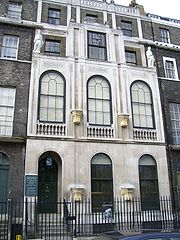
in 1806, Soane purchased No. 13, the house next door, today the Museum, and rebuilt it in two phases in 1808-09 and 1812.
In 1808-09 he constructed his drawing office and "museum" on the site of the former stable block at the back, using primarily top lighting. In 1812 he rebuilt the front part of the site, adding a projecting Portland Stone
Portland stone
Portland stone is a limestone from the Tithonian stage of the Jurassic period quarried on the Isle of Portland, Dorset. The quarries consist of beds of white-grey limestone separated by chert beds. It has been used extensively as a building stone throughout the British Isles, notably in major...
facade to the basement, ground and first floor levels and the centre bay of the second floor. Originally this formed three open loggia
Loggia
Loggia is the name given to an architectural feature, originally of Minoan design. They are often a gallery or corridor at ground level, sometimes higher, on the facade of a building and open to the air on one side, where it is supported by columns or pierced openings in the wall...
s, but Soane glazed the arches during his lifetime. Once he had moved into No. 13, Soane rented out his former home at No. 12 (on his death it was left to the nation along with No. 13, the intention being that the rental income would fund the running of the Museum).
After completing No.13, Soane set about treating the building as an architectural laboratory, continually remodelling the interiors. In 1823, when he was over 70, he purchased a third house, No. 14, which he rebuilt in 1823-24. This project allowed him to construct a picture gallery, linked to No.13, on the former stable block of No. 14. The front main part of this third house was treated as a separate dwelling and let as an investment; it was not internally connected to the other buildings. When he died No. 14 was bequeathed to his family and passed out of the Museum's ownership.
The Museum was established during Soane's own lifetime by a Private Act of Parliament in 1833, which took effect on Soane's death in 1837. The Act required that No. 13 be maintained 'as nearly as possible' as it was left at the time of Soane's death, and by and large that has been the case. The act was necessary because Sir John had a living direct male heir, his son George, with whom he had had a "lifelong feud" due to George's debts, refusal to engage in a trade, and his marriage, of which Sir John disapproved. He also wrote a "anonymous, defamatory piece for the Sunday papers about Sir John, calling him a cheat, a charlatan and a copyist". Since under contemporary inheritance law George would have been able to lay claim to Sir John's property on his death, Sir John engaged in a lengthy parliamentary campaign to disinherit his son via a private Act, setting out to "reverse the fundamental laws of hereditary succession".
according to some. The Soane Museum Act was passed in April 1833 and stipulated that on Soane's death his house and collections would pass into the care of a Board of Trustees, on behalf of the nation, and that they should be preserved as nearly as possible exactly as they were left at that time.
Towards the end of the 19th century (1889-90) a break-through was made to re-connect the rear rooms of No. 12 (north of the courtyard) through to the Museum in No. 13 and since 1969 No. 12 has been run by the Trustees as part of the Museum, housing the research library (until 2009), offices and, since 1995, the Eva Jiricna designed 'Soane Gallery' for temporary exhibitions (until Summer 2011). The Museum's Trustees remained completely independent, relying only on Soane's original endowment, until 1947. Since that date the Museum has received an annual Grant-in-Aid from the British Government (this now comes via the Department for Culture, Media and Sport). The Soane Museum is now a national centre for the study of architecture. From 1988-2005 a programme of restoration within the Museum was carried out under Peter Thornton and then Margaret Richardson with spaces such as the Drawing Rooms, Picture Room, Study and Dressing Room, Picture Room Recess and others being put back to their original colour schemes and in most cases having their original sequences of objects reinstated; Soane's three courtyards were also restored with his pasticcio (a column of architectural fragments) being reinstated in the Monument Court at the heart of the Museum. In 1997 the Trustees purchased the main house at No. 14 with the help of the Heritage Lottery Fund
Heritage Lottery Fund
The Heritage Lottery Fund is a fund established in the United Kingdom under the National Lottery etc. Act 1993. The Fund opened for applications in 1994. It uses money raised through the National Lottery to transform and sustain the UK’s heritage...
. The house has now been restored (2006-09) and has enabled the Museum to expand its educational activities, to re-locate its Research Library in that house and to create a Robert Adam Study Centre where Soane's collection of 9,000 Robert Adam drawings is housed in purpose-designed new cabinets by Senior and Carmichael.
The acquisition of No. 14 enabled the Museum, under its new Director, Tim Knox, to embark on 'Opening up the Soane', an ambitious project to complete the restoration of the Museum's historic spaces, funded by the Monument Trust, the Heritage Lottery Fund, the Soane Foundation in New York and other private trusts. The Museum's architects for this major £7 million programme are Julian Harrap Architects. This project began on site in March 2011 with the first phase being the re-configuration of No. 12, moving the temporary exhibition gallery up to the first floor (with new showcases etc. designed by Caruso St John) in order to enable new reception facilities and a shop to be created on the ground floor. This phase also includes the creation of new conservation studios, to be named the John and Cynthia Fry Gunn Conservation Centre, and the installation of lifts to provide disabled access to all public parts of the building for the first time. Phase 2 will see the restoration of Soane's Private Apartments on the second floor (Bedroom, Book Room, Model Room, Oratory and Mrs Soane's Morning Room) and a final phase will provide a new Study Room at the back of No. 12 for the public to learn more about Soane and will see the restoration of Soane's ground floor Ante Room (with almost 200 works of art) and the Catacombs beneath it. This ambitious project will be completed in 2015.
Staff
Soane's will had provided for there to be a Curator, and an Inspectress (the post was created for Soane's housekeeper and close family friend Mrs Sarah Conduitt). The architectural historian Sir John SummersonJohn Summerson
Sir John Newenham Summerson CH CBE was one of the leading British architectural historians of the 20th century....
was Curator of the Museum from 1945 to 1984. For much of this period he was assisted by Dorothy Stroud who served as Inspectress from 1945 to 1985.
Summerson was succeeded by Peter Thornton
Peter Thornton
Peter Kai Thornton CBE was a museum curator and writer. He was keeper of furniture and woodwork at the Victoria and Albert Museum in London between 1966 to 1984, and curator to Sir John Soane's Museum, in Lincoln's Inn Fields between 1984 and 1995...
who moved from the Victoria and Albert Museum
Victoria and Albert Museum
The Victoria and Albert Museum , set in the Brompton district of The Royal Borough of Kensington and Chelsea, London, England, is the world's largest museum of decorative arts and design, housing a permanent collection of over 4.5 million objects...
to take up the post. Thornton retired in 1995, and was followed by Margaret Richardson, the first woman to hold the title of Curator. She had succeeded Stroud as Inspectress in 1985, and served as Curator until 2005, with Helen Dorey as Inspectress (1995- ). Since 2005 the Director of the Museum has been Tim Knox, formerly Head Curator of the National Trust, under whose leadership the Museum has embarked on the ambitious 'Opening up the Soane' project combining the restoration of Nos 12 and 13, including a number of lost historic features, with improved visitor and conservation facilities. The 'Opening up the Soane' project also includes a programme of audience development, a new website and on-line catalogues of the collections.
Architecture


Bank of England
The Bank of England is the central bank of the United Kingdom and the model on which most modern central banks have been based. Established in 1694, it is the second oldest central bank in the world...
. The ingeniously designed Picture Gallery has walls composed of large 'moveable planes' (like large cupboard doors)that allow it to house three times as many items as a space of this size could normally accommodate (the original hang in this room was reinstated in January 2011). When visiting, it is necessary to request the planes to be opened and wait for a group to gather before this is done.
The more domestic rooms of No. 13 are at the front of the house, many of them highly unusual, but often in subtle ways. The domed ceiling of the Breakfast Room, inset with convex mirrors, has influenced architects from around the world. The Library-Dining Room reflects the influence of Etruscan tombs and perhaps even gothic design in its repertoire of small pendants like those in fan vaulting. It is decorated in a rich 'Pompeian' red. The Study contains a collection of Roman architectural fragments and the two external courtyards, the Monument Court and Monk's Yard contain an array of architectural fragments, Classical in the Monument Court with its central column or 'pasticcio' representing Architecture and Gothic in the Monk's Yard, filled with medieval stonework from the Palace of Westminster.
Collections

Architectural drawing
An architectural drawing or architect's drawing is a technical drawing of a building that falls within the definition of architecture...
s, ranging from a book of drawings of Elizabethan houses by John Thorpe
John Thorpe
John Thorpe or Thorp was an English architect. Little is known of his life, and his work is dubiously inferred, rather than accurately known, from a folio of drawings in the Sir John Soane's Museum, to which Horace Walpole called attention, in 1780, in his Anecdotes of Painting; but how far these...
to the largest collection anywhere of Robert Adam
Robert Adam
Robert Adam was a Scottish neoclassical architect, interior designer and furniture designer. He was the son of William Adam , Scotland's foremost architect of the time, and trained under him...
's original drawings as well as 9,000 from his own practice. There are also architectural models (the largest collection of cork models in Britain, more than 100 models for Soane's own buildings and 20 white plaster models of reconstructed antique buildings by Francois Fouquet). 15 of Giovanni Battista Piranesi
Giovanni Battista Piranesi
Giovanni Battista Piranesi was an Italian artist famous for his etchings of Rome and of fictitious and atmospheric "prisons" .-His Life:...
's original sketches of Paestum
Paestum
Paestum is the classical Roman name of a major Graeco-Roman city in the Campania region of Italy. It is located in the north of Cilento, near the coast about 85 km SE of Naples in the province of Salerno, and belongs to the commune of Capaccio, officially also named...
hang in the Picture Room. The collection of Neoclassical sculpture includes both plaster and terracotta works by John Flaxman
John Flaxman
John Flaxman was an English sculptor and draughtsman.-Early life:He was born in York. His father was also named John, after an ancestor who, according to family tradition, had fought for Parliament at the Battle of Naseby, and afterwards settled as a carrier or farmer in Buckinghamshire...
, Thomas Banks and others.
From the painting collection, the best known are by William Hogarth
William Hogarth
William Hogarth was an English painter, printmaker, pictorial satirist, social critic and editorial cartoonist who has been credited with pioneering western sequential art. His work ranged from realistic portraiture to comic strip-like series of pictures called "modern moral subjects"...
: the eight canvases of A Rake's Progress
A Rake's Progress
A Rake's Progress is a series of eight paintings by 18th century English artist William Hogarth. The canvases were produced in 1732–33 then engraved and published in print form in 1735...
and the four of his famous political satire 'An Election' based on the Oxfordshire
Oxfordshire
Oxfordshire is a county in the South East region of England, bordering on Warwickshire and Northamptonshire , Buckinghamshire , Berkshire , Wiltshire and Gloucestershire ....
Parliamentary Election of 1754. There are also three major works by Canaletto
Canaletto
Giovanni Antonio Canal better known as Canaletto , was a Venetian painter famous for his landscapes, or vedute, of Venice. He was also an important printmaker in etching.- Early career :...
.
The alabaster sarcophagus of Seti I
Seti I
Menmaatre Seti I was a Pharaoh of Ancient Egypt , the son of Ramesses I and Queen Sitre, and the father of Ramesses II...
lies in the basement of the museum in what Soane called the 'Sepulchral Chamber'. After it was installed Soane held parties on three successive evenings to celebrate its arrival, lighting it dramatically with lamps.
See also
- Soane's country retreat Pitzhanger ManorPitzhanger ManorPitzhanger Manor House, in Ealing , was owned from 1800 to 1810 by the architect John Soane, who radically rebuilt it. Soane intended it as a country villa for entertaining and eventually for passing to his elder son. He demolished most of the existing building except the two-storey south wing...
. - The Dulwich Picture GalleryDulwich Picture GalleryDulwich Picture Gallery is an art gallery in Dulwich, South London. England's first purpose-built public art gallery, it was designed by Regency architect Sir John Soane and opened to the public in 1817. Soane arranged the exhibition spaces as a series of interlinked rooms illuminated naturally...
designed by Soane in 1811 is the archetype for modern art galleries from the Sainsbury Wing at London's National Gallery to the new Getty Center in California. - With its eclectic collection idiosyncratically displayed in a domestic town house, the Soane museum shares many qualities with the Isabella Stewart Gardner MuseumIsabella Stewart Gardner MuseumThe Isabella Stewart Gardner Museum or Fenway Court, as the museum was known during Isabella Stewart Gardner's lifetime, is a museum in the Fenway-Kenmore neighborhood of Boston, Massachusetts, located within walking distance of the Museum of Fine Arts and near the Back Bay Fens...
in Boston. - Sir John Soane should not be confused with Sir Hans SloaneHans SloaneSir Hans Sloane, 1st Baronet, PRS was an Ulster-Scot physician and collector, notable for bequeathing his collection to the British nation which became the foundation of the British Museum...
, whose collections formed the foundation of the British MuseumBritish MuseumThe British Museum is a museum of human history and culture in London. Its collections, which number more than seven million objects, are amongst the largest and most comprehensive in the world and originate from all continents, illustrating and documenting the story of human culture from its...
and Natural History MuseumNatural History MuseumThe Natural History Museum is one of three large museums on Exhibition Road, South Kensington, London, England . Its main frontage is on Cromwell Road...
. - James William Wild curator in 1880s.
- liza Soane's pet dog 'Fanny' has inspired a children's book, 'The Journal of Mrs Soane's Dog Fanny, by Herself', by Mirabel Cecil (2010).