

John Hyrcanus

Encyclopedia
John Hyrcanus (reigned 134 - 104 BC, died 104 BC) was a Hasmonean
(Maccabeean) leader
of the 2nd century BC.
explains in The Jewish War that John was also known as "Hyrcanus", but does not explain the reason behind this name. The only other primary source, the Books of the Maccabees
, never use this name with respect to John, with the single reference to Hyrcanus in 2 Maccabees
3:11 referring to a man to whom some of the money in the Temple belonged during the c.178 BCE visit of Heliodorus
.
The reason for the name is disputed amongst biblical scholars, with a variety of reasons proposed:
and hence the nephew of Judas Maccabaeus, Jonathan Maccabaeus
and their siblings, whose story is told in the deuterocanonical books
of 1 Maccabees
and 2 Maccabees
, in the Talmud
, and in Josephus
. John was not present at a banquet at which his father and his two brothers were murdered, purportedly by his brother-in-law, Ptolemy, son of Abubus. He attained to his father's former offices, that of high priest
and king
(although some Jews never accepted any of the Hasmoneans as being legitimate kings, as they were not lineal descendants of David
).
. Antiochus VII Sidetes
marched into Judea, pillaged the countryside and laid a year long siege on Jerusalem. The prolonged siege caused Hyrcanus to remove any Judean from the city who could not assist with the defense effort (Antiquities
13.240). These refugees were not allowed to pass through Antiochus’ lines. Therefore, these Judeans were literally trapped in the middle of a chaotic siege. With a humanitarian crisis on his hands, Hyrcanus re-admitted his estranged Jerusalemites when the festival of Sukkot
arrived. Afterwards, due to massive food shortages in Jerusalem, Hyrcanus negotiated a truce with Antiochus.
The terms of the truce consisted of three thousand talents of silver as payment for Antiochus, breaking down the walls of Jerusalem, Judean participation in the Seleucid war against the Parthians, and once again Judean recognition of Seleucid control (Antiquities
13.245). These terms were a harsh blow to a young ruler. Furthermore, Hyrcanus needed to loot the tomb of David to pay the 3000 talents (The Wars of the Jews I 2:5).
The repercussions of the Seleucid siege were initially a difficult set-back for Hyrcanus. Judea faced tough economic times after the countryside was plundered and Jerusalem was under siege. Economic struggles were greatly magnified by taxes to the Seleucids enforced by Antiochus. Furthermore, Hyrcanus was forced to accompany Antiochus on his eastern campaign in 130 BC. Hyrcanus probably would have functioned as the military commander of a Jewish company in the campaign. Instead of governing a devastated Judean state, Hyrcanus was in Parthia fighting with Antiochus.
Additionally, this probably caused a loss of support for the inexperienced Hyrcanus among the Judean population. Judeans in the countryside were especially disillusioned with Hyrcanus after Antiochus’ army plundered their land. The fact that Hyrcanus was fighting alongside Antiochus probably caused serious resentment. Furthermore Hyrcanus driving out the non-military population of Jerusalem during the siege also probably caused resentment for his rule in the city. Finally, the action of looting the Tomb of David violated his obligations as High Priest
. This would have offended the religious leadership.
Therefore, at a very early point in his thirty-one year reign of Judea, Hyrcanus had lost the support of Judeans in various cultural sectors. The Jerusalemites, countryside Judeans and the religious leadership probably doubted the future of Judea under Hyrcanus. However, Hyrcanus was met with fortune in 128 BC when Antiochus VII was killed in battle against Parthia
. What followed was an era of conquest led by Hyrcanus that marked the high point of Judea as the most significant power in Syria.
returned from exile in Hyrcania
to take control of Seleucia. However, transition of power made it difficult for Demetrius to assert control over Judea. Furthermore, the Seleucid Empire itself fell apart into smaller principalities. The Ituraeans of Lebanon, the Ammon
ites of the Transjordan, and the Arabian Nabateans represented independent principalities that broke away from Seleucid control. Hyrcanus was determined to take advantage of the dissipating Seleucid Empire to increase the Judean State.
Hyrcanus also raised a new mercenary army that strongly contrasted with the Judean forces that were defeated by Antiochus VII (Ant.13.257). The Jewish population was probably still recovering from the attack of Antiochus, and therefore could not provide enough able men for a Hyrcanus-led army. Hyrcanus’ army was supported by the Judean State once again by funds that Hyrcanus removed from the Tomb of David.
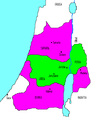
Beginning in 113 BC, Hyrcanus began an extensive military campaign against Samaria
. Hyrcanus placed his sons Antigonus and Aristobulus in charge of the siege of Samaria. The Samarians called for help and eventually received 6000 troops from Antiochus IX Cyzicenus
. Although the siege lasted for a long, difficult year, Hyrcanus was unwilling to give up his siege. Ultimately, Samaria was overrun and totally destroyed. Cyzicenus’ mercenary army was defeated and the city of Scythopolis seems to have been occupied by Hyrcanus as well. The inhabitants of Samaria where then put into slavery
. These slaves were not Israelites or worshippers of YHWH. Instead, the Samarians sent into slavery were reported to be Macedonian
settlers.
Hyrcanus’ first conquest was an invasion of the Transjordan in 110BC. Hyrcanus’ mercenary army laid siege to the city of Medeba and took it after a six-month siege. After these victories, Hyrcanus went north towards Schechem and Mount Gerizim
. The city of Schechem was reduced to a village and the Samaritan
Temple on Mount Gerizim was destroyed. This military action against Schechem has been dated archaeologically around 111–110 BC. Destroying the Samaritan Temple on Mount Gerizim helped ameliorate Hyrcanus’ status among religious elite and common Jews who detested any Jewish temple outside of Jerusalem.
Hyrcanus also initiated a military campaign against the Idumeans in the Negev
near Eilat. During this campaign Hyrcanus conquered Adora
, Marisa
and other Idumean towns (Ant.13.257). Hyrcanus then instituted forced conversion
s on the Idumeans. This was an unprecedented move for a Judean ruler.
and possibly also the fortress Hyrcania
.
Moreover, Hyrcanus sought for good relations with the surrounding Gentile powers, especially the growing Roman Empire
. Two decrees were passed in the Roman Senate
that established a treaty of friendship with Judea. Although it is difficult to specifically date these resolutions, they represent efforts made between Hyrcanus and Rome to maintain stable relations. Also, an embassy sent by Hyrcanus received Roman confirmation of Hasmonean independence. Hyrcanus was an excellent case of a ruler backed by Roman support.
In addition to Rome, Hyrcanus was able to maintain steady relations with Ptolemaic Egypt
. This was probably made possible due to various Jews living in Egypt who had connections with the Ptolemaic
Court (Ant. 13.284–287). Finally, the cities of Athens and Pergamum even showed honor to Hyrcanus in an effort to appease Rome.
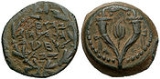
Furthermore, the minting of coins by Hyrcanus demonstrates Hyrcanus’ willingness to delegate power. Sixty-three coins found near Bethlehem
bear the inscription, “Yohanan the High Priest.” The reserve side of the coins contains the phrase, “The Assembly of the Jews.” This seems to suggest that during his reign, Hyrcanus was not an absolute ruler. Instead, Hyrcanus had to submit at times to an assembly of Jews that had a certain amount of minority power. The coins lack any depictions of animals or humans. This suggests that Hyrcanus strictly followed the Jewish prohibition against graven images. The coins also seem to suggest that Hyrcanus considered himself to be primarily the High Priest
of Judea, and his rule of Judea was shared with the Assembly.
In Judea, religious issues were a core aspect of domestic policy. Josephus only reports one specific conflict between the Pharisees and Hyrcanus (Ant. 13.288–296). Essentially, criticism of Hyrcanus’ roles as High Priest and ethnarch
by the Pharisees led to a falling out. Thus, this conflict between Hyrcanus and the Pharisees elevated the status of the Sadducees.
There is, however, good reason to doubt this account by Josephus. First of all, Josephus reports elsewhere that the Pharisees did not grow to power until the reign of Queen Salome Alexandra
(JW.1.110) The coins minted under Hyrcanus suggest that Hyrcanus did not have complete secular authority. Furthermore, this account may represent a piece of Pharisaic apologetics due to Josephus’ Pharisaic background. Therefore, this account might represent a historical creation meant to elevate the status of the Pharisees during the height of the Hasmonean Dynasty.
There were probably tensions because of the religious and secular leadership roles held by Hyrcanus. However, it is difficult to assume that this account by Josephus is an accurate re-telling of the relationship between Hyrcanus, the Pharisees and the Sadducees at that time.
Ultimately, one of the final acts of Hyrcanus’ life was an act that solved any kind of dispute over his role as High Priest and ethnarch. In the will of Hyrcanus, he provisioned for the division of the high priesthood from secular authority. Hyrcanus’ wife was given control of civil authority after his death, and his son Judas Aristobulus was given the role of High Priest. This action represented Hyrcanus’ willingness to compromise over the issue of secular and religious authority. (However, Aristobulus was not satisfied with this arrangement, so he cast his mother into prison and let her starve.)
has a Yochanan Hyrcanus Street (רחוב יוחנן הורקנוס), as do several other cities in contemporary Israel
. In the early decades of the 20th century, the Zionist historical perception of the Jewish past tended to approve of and revere strong warrior kings of both Biblical and later periods, and Hyrcanus' exploits earned him a place in that pantheon.
Hasmonean
The Hasmonean dynasty , was the ruling dynasty of Judea and surrounding regions during classical antiquity. Between c. 140 and c. 116 BCE, the dynasty ruled semi-autonomously from the Seleucids in the region of Judea...
(Maccabeean) leader
Leader
A leader is one who influences or leads others.Leader may also refer to:- Newspapers :* Leading article, a piece of writing intended to promote an opinion, also called an editorial* The Leader , published 1909–1967...
of the 2nd century BC.
Name
JosephusJosephus
Titus Flavius Josephus , also called Joseph ben Matityahu , was a 1st-century Romano-Jewish historian and hagiographer of priestly and royal ancestry who recorded Jewish history, with special emphasis on the 1st century AD and the First Jewish–Roman War, which resulted in the Destruction of...
explains in The Jewish War that John was also known as "Hyrcanus", but does not explain the reason behind this name. The only other primary source, the Books of the Maccabees
Books of the Maccabees
The Books of the Maccabees are books concerned with the Maccabees, the leaders of the Jewish rebellion against the Seleucid dynasty, or related subjects.The term mostly refers to two deuterocanonical books contained in some canons of the Bible:...
, never use this name with respect to John, with the single reference to Hyrcanus in 2 Maccabees
2 Maccabees
2 Maccabees is a deuterocanonical book of the Bible, which focuses on the Jews' revolt against Antiochus IV Epiphanes and concludes with the defeat of the Syrian general Nicanor in 161 BC by Judas Maccabeus, the hero of the work....
3:11 referring to a man to whom some of the money in the Temple belonged during the c.178 BCE visit of Heliodorus
Heliodorus (minister)
Heliodorus was a minister of Seleucus IV Philopator ca. [187 BC - 175 BC]. According to some sources he is said to have assassinated Seleucus.-Biblical background:...
.
The reason for the name is disputed amongst biblical scholars, with a variety of reasons proposed:
- Familial origin in the region of HyrcaniaHyrcaniaHyrcania was the name of a satrapy located in the territories of present day Gilan, Golestan, Mazandaran and part of Turkmenistan, lands south of the Caspian Sea. To the Greeks, the Caspian Sea was the "Hyrcanian Sea".-Etymology:...
on the Caspian SeaCaspian SeaThe Caspian Sea is the largest enclosed body of water on Earth by area, variously classed as the world's largest lake or a full-fledged sea. The sea has a surface area of and a volume of... - A Greek regnal nameRegnal nameA regnal name, or reign name, is a formal name used by some monarchs and popes during their reigns. Since medieval times, monarchs have frequently chosen to use a name different from their own personal name when they inherit a throne....
, which would have represented closer ties with the Hellenistic culture against which the Maccabees had revolted under Seleucid rule. However, the region of HyrcaniaHyrcaniaHyrcania was the name of a satrapy located in the territories of present day Gilan, Golestan, Mazandaran and part of Turkmenistan, lands south of the Caspian Sea. To the Greeks, the Caspian Sea was the "Hyrcanian Sea".-Etymology:...
had been conquered by Mithridates I of ParthiaMithridates I of ParthiaMithridates or Mithradates I was the "Great King" of Parthia from ca. 171 BC - 138 BC, succeeding his brother Phraates I. His father was King Phriapatius of Parthia, who died ca. 176 BC). Mithridates I made Parthia into a major political power by expanding the empire to the east, south, and west...
in 141–139 BCE - Given the name by the Seleucids after he fought in the region alongside Antiochus VII SidetesAntiochus VII SidetesAntiochus VII Euergetes, nicknamed Sidetes , ruler of the Hellenistic Seleucid Empire, reigned from 138 to 129 BC. He was the last Seleucid king of any stature....
against Phraates II of ParthiaPhraates II of ParthiaPhraates II of Parthia, son of Mithridates I of Parthia , the conqueror of Babylon, ruled the Parthian Empire from 138 BC to 128 BC. He was attacked in 130 BC by Antiochus VII Sidetes , ruler of the Seleucid Empire...
in 130–129 BCE, a campaign which resulted in the release of Antiochus' brother Demetrius II NicatorDemetrius II NicatorFor the similarly named Macedonian ruler, see Demetrius II of Macedon. For the Macedonian prince, see Demetrius the Fair.Demetrius II , called Nicator , was one of the sons of Demetrius I Soter, brother of Antiochus VII Sidetes and his mother could have been Laodice V...
from captivity in HyrcaniaHyrcaniaHyrcania was the name of a satrapy located in the territories of present day Gilan, Golestan, Mazandaran and part of Turkmenistan, lands south of the Caspian Sea. To the Greeks, the Caspian Sea was the "Hyrcanian Sea".-Etymology:...
Life and work
He was the son of Simon MaccabaeusSimon Maccabaeus
Simon Thassi was the second son of Mattathias and thus a member of the Hasmonean family. The name "Thassi" has an uncertain meaning...
and hence the nephew of Judas Maccabaeus, Jonathan Maccabaeus
Jonathan Maccabaeus
Jonathan Apphus was leader of the Hasmonean Dynasty of Judea from 161 to 143 BCE. The name Apphus could mean = "the dissembler", "the Wary", or "the diplomat", in allusion to a trait prominent in him -Leader of the Jews:...
and their siblings, whose story is told in the deuterocanonical books
Deuterocanonical books
Deuterocanonical books is a term used since the sixteenth century in the Catholic Church and Eastern Christianity to describe certain books and passages of the Christian Old Testament that are not part of the Hebrew Bible. The term is used in contrast to the protocanonical books, which are...
of 1 Maccabees
1 Maccabees
The First book of Maccabees is a book written in Hebrew by a Jewish author after the restoration of an independent Jewish kingdom, about the latter part of the 2nd century BC. The original Hebrew is lost and the most important surviving version is the Greek translation contained in the Septuagint...
and 2 Maccabees
2 Maccabees
2 Maccabees is a deuterocanonical book of the Bible, which focuses on the Jews' revolt against Antiochus IV Epiphanes and concludes with the defeat of the Syrian general Nicanor in 161 BC by Judas Maccabeus, the hero of the work....
, in the Talmud
Talmud
The Talmud is a central text of mainstream Judaism. It takes the form of a record of rabbinic discussions pertaining to Jewish law, ethics, philosophy, customs and history....
, and in Josephus
Josephus
Titus Flavius Josephus , also called Joseph ben Matityahu , was a 1st-century Romano-Jewish historian and hagiographer of priestly and royal ancestry who recorded Jewish history, with special emphasis on the 1st century AD and the First Jewish–Roman War, which resulted in the Destruction of...
. John was not present at a banquet at which his father and his two brothers were murdered, purportedly by his brother-in-law, Ptolemy, son of Abubus. He attained to his father's former offices, that of high priest
Kohen Gadol
The High Priest was the chief religious official of Israelite religion and of classical Judaism from the rise of the Israelite nation until the destruction of the Second Temple of Jerusalem...
and king
Monarch
A monarch is the person who heads a monarchy. This is a form of government in which a state or polity is ruled or controlled by an individual who typically inherits the throne by birth and occasionally rules for life or until abdication...
(although some Jews never accepted any of the Hasmoneans as being legitimate kings, as they were not lineal descendants of David
David
David was the second king of the united Kingdom of Israel according to the Hebrew Bible and, according to the Gospels of Matthew and Luke, an ancestor of Jesus Christ through both Saint Joseph and Mary...
).
Siege of Jerusalem
During the first year of Hyrcanus’ reign, he faced the most serious challenge to independent Judean rule from the Seleucid EmpireSeleucid Empire
The Seleucid Empire was a Greek-Macedonian state that was created out of the eastern conquests of Alexander the Great. At the height of its power, it included central Anatolia, the Levant, Mesopotamia, Persia, today's Turkmenistan, Pamir and parts of Pakistan.The Seleucid Empire was a major centre...
. Antiochus VII Sidetes
Antiochus VII Sidetes
Antiochus VII Euergetes, nicknamed Sidetes , ruler of the Hellenistic Seleucid Empire, reigned from 138 to 129 BC. He was the last Seleucid king of any stature....
marched into Judea, pillaged the countryside and laid a year long siege on Jerusalem. The prolonged siege caused Hyrcanus to remove any Judean from the city who could not assist with the defense effort (Antiquities
Antiquities of the Jews
Antiquities of the Jews is a twenty volume historiographical work composed by the Jewish historian Flavius Josephus in the thirteenth year of the reign of Roman emperor Flavius Domitian which was around 93 or 94 AD. Antiquities of the Jews contains an account of history of the Jewish people,...
13.240). These refugees were not allowed to pass through Antiochus’ lines. Therefore, these Judeans were literally trapped in the middle of a chaotic siege. With a humanitarian crisis on his hands, Hyrcanus re-admitted his estranged Jerusalemites when the festival of Sukkot
Sukkot
Sukkot is a Biblical holiday celebrated on the 15th day of the month of Tishrei . It is one of the three biblically mandated festivals Shalosh regalim on which Hebrews were commanded to make a pilgrimage to the Temple in Jerusalem.The holiday lasts seven days...
arrived. Afterwards, due to massive food shortages in Jerusalem, Hyrcanus negotiated a truce with Antiochus.
The terms of the truce consisted of three thousand talents of silver as payment for Antiochus, breaking down the walls of Jerusalem, Judean participation in the Seleucid war against the Parthians, and once again Judean recognition of Seleucid control (Antiquities
Antiquities of the Jews
Antiquities of the Jews is a twenty volume historiographical work composed by the Jewish historian Flavius Josephus in the thirteenth year of the reign of Roman emperor Flavius Domitian which was around 93 or 94 AD. Antiquities of the Jews contains an account of history of the Jewish people,...
13.245). These terms were a harsh blow to a young ruler. Furthermore, Hyrcanus needed to loot the tomb of David to pay the 3000 talents (The Wars of the Jews I 2:5).
The repercussions of the Seleucid siege were initially a difficult set-back for Hyrcanus. Judea faced tough economic times after the countryside was plundered and Jerusalem was under siege. Economic struggles were greatly magnified by taxes to the Seleucids enforced by Antiochus. Furthermore, Hyrcanus was forced to accompany Antiochus on his eastern campaign in 130 BC. Hyrcanus probably would have functioned as the military commander of a Jewish company in the campaign. Instead of governing a devastated Judean state, Hyrcanus was in Parthia fighting with Antiochus.
Additionally, this probably caused a loss of support for the inexperienced Hyrcanus among the Judean population. Judeans in the countryside were especially disillusioned with Hyrcanus after Antiochus’ army plundered their land. The fact that Hyrcanus was fighting alongside Antiochus probably caused serious resentment. Furthermore Hyrcanus driving out the non-military population of Jerusalem during the siege also probably caused resentment for his rule in the city. Finally, the action of looting the Tomb of David violated his obligations as High Priest
Kohen Gadol
The High Priest was the chief religious official of Israelite religion and of classical Judaism from the rise of the Israelite nation until the destruction of the Second Temple of Jerusalem...
. This would have offended the religious leadership.
Therefore, at a very early point in his thirty-one year reign of Judea, Hyrcanus had lost the support of Judeans in various cultural sectors. The Jerusalemites, countryside Judeans and the religious leadership probably doubted the future of Judea under Hyrcanus. However, Hyrcanus was met with fortune in 128 BC when Antiochus VII was killed in battle against Parthia
Parthian Empire
The Parthian Empire , also known as the Arsacid Empire , was a major Iranian political and cultural power in ancient Persia...
. What followed was an era of conquest led by Hyrcanus that marked the high point of Judea as the most significant power in Syria.
Conquests of John Hyrcanus
John Hyrcanus was able to take advantage of unrest in Seleucia to assert Judean independence and conquer new territories. In 130BCE Demetrius IIDemetrius II Nicator
For the similarly named Macedonian ruler, see Demetrius II of Macedon. For the Macedonian prince, see Demetrius the Fair.Demetrius II , called Nicator , was one of the sons of Demetrius I Soter, brother of Antiochus VII Sidetes and his mother could have been Laodice V...
returned from exile in Hyrcania
Hyrcania
Hyrcania was the name of a satrapy located in the territories of present day Gilan, Golestan, Mazandaran and part of Turkmenistan, lands south of the Caspian Sea. To the Greeks, the Caspian Sea was the "Hyrcanian Sea".-Etymology:...
to take control of Seleucia. However, transition of power made it difficult for Demetrius to assert control over Judea. Furthermore, the Seleucid Empire itself fell apart into smaller principalities. The Ituraeans of Lebanon, the Ammon
Ammon
Ammon , also referred to as the Ammonites and children of Ammon, was an ancient nation located east of the Jordan River, Gilead, and the Dead Sea, in present-day Jordan. The chief city of the country was Rabbah or Rabbath Ammon, site of the modern city of Amman, Jordan's capital...
ites of the Transjordan, and the Arabian Nabateans represented independent principalities that broke away from Seleucid control. Hyrcanus was determined to take advantage of the dissipating Seleucid Empire to increase the Judean State.
Hyrcanus also raised a new mercenary army that strongly contrasted with the Judean forces that were defeated by Antiochus VII (Ant.13.257). The Jewish population was probably still recovering from the attack of Antiochus, and therefore could not provide enough able men for a Hyrcanus-led army. Hyrcanus’ army was supported by the Judean State once again by funds that Hyrcanus removed from the Tomb of David.
Beginning in 113 BC, Hyrcanus began an extensive military campaign against Samaria
Samaria
Samaria, or the Shomron is a term used for a mountainous region roughly corresponding to the northern part of the West Bank.- Etymology :...
. Hyrcanus placed his sons Antigonus and Aristobulus in charge of the siege of Samaria. The Samarians called for help and eventually received 6000 troops from Antiochus IX Cyzicenus
Antiochus IX Cyzicenus
Antiochus IX Eusebes, ruler of the Greek Seleucid kingdom, was the son of Antiochus VII Sidetes and Cleopatra Thea. Upon the death of his father in Parthia and his uncle Demetrius II Nicator's return to power , his mother sent him to Cyzicus on the Bosporus, thus giving him his nickname...
. Although the siege lasted for a long, difficult year, Hyrcanus was unwilling to give up his siege. Ultimately, Samaria was overrun and totally destroyed. Cyzicenus’ mercenary army was defeated and the city of Scythopolis seems to have been occupied by Hyrcanus as well. The inhabitants of Samaria where then put into slavery
Slavery
Slavery is a system under which people are treated as property to be bought and sold, and are forced to work. Slaves can be held against their will from the time of their capture, purchase or birth, and deprived of the right to leave, to refuse to work, or to demand compensation...
. These slaves were not Israelites or worshippers of YHWH. Instead, the Samarians sent into slavery were reported to be Macedonian
Ancient Macedonians
The Macedonians originated from inhabitants of the northeastern part of the Greek peninsula, in the alluvial plain around the rivers Haliacmon and lower Axios...
settlers.
Hyrcanus’ first conquest was an invasion of the Transjordan in 110BC. Hyrcanus’ mercenary army laid siege to the city of Medeba and took it after a six-month siege. After these victories, Hyrcanus went north towards Schechem and Mount Gerizim
Mount Gerizim
Mount Gerizim is one of the two mountains in the immediate vicinity of the West Bank city of Nablus , and forms the southern side of the valley in which Nablus is situated,...
. The city of Schechem was reduced to a village and the Samaritan
Samaritan
The Samaritans are an ethnoreligious group of the Levant. Religiously, they are the adherents to Samaritanism, an Abrahamic religion closely related to Judaism...
Temple on Mount Gerizim was destroyed. This military action against Schechem has been dated archaeologically around 111–110 BC. Destroying the Samaritan Temple on Mount Gerizim helped ameliorate Hyrcanus’ status among religious elite and common Jews who detested any Jewish temple outside of Jerusalem.
Hyrcanus also initiated a military campaign against the Idumeans in the Negev
Negev
The Negev is a desert and semidesert region of southern Israel. The Arabs, including the native Bedouin population of the region, refer to the desert as al-Naqab. The origin of the word Neghebh is from the Hebrew root denoting 'dry'...
near Eilat. During this campaign Hyrcanus conquered Adora
Adora
Adora may refer to:* Adora , a town mentioned in the Apocrypha* Adora, Har Hebron, an Israeli settlement on the West Bank* Adora , a novel by Bertrice Small* Princess Adora, a cartoon character from She-Ra: Princess of Power...
, Marisa
Marisa
Marisa may refer to:* Marisa , an Indonesian town* Marisa , a feminine personal name* Marisa , a genus of apple snails...
and other Idumean towns (Ant.13.257). Hyrcanus then instituted forced conversion
Forced conversion
A forced conversion is the religious conversion or acceptance of a philosophy against the will of the subject, often with the threatened consequence of earthly penalties or harm. These consequences range from job loss and social isolation to incarceration, torture or death...
s on the Idumeans. This was an unprecedented move for a Judean ruler.
Economy, foreign relations, and religion
After the siege of Jerusalem, Hyrcanus faced a serious economic crisis in Judea. We can assume that the economic difficulties subsided after the death of Antiochus VII. Hyrcanus no longer had to pay taxes or tributes to a weaker Seleucia. The economic situation eventually improved enough for Hyrcanus to issue his own coinage (see below). On top of that, Hyrcanus initiated vital building projects in Judea. Hyrcanus re-built the walls destroyed by Antiochus. He also built a fortress north of the Temple called the BarisBaris
Baris can refer to:* Baris, an ancient Lydian city on the site of modern Isparta, Turkey* Baris , a true weevil genus* Baris , a Balinese dance* Baris, Egypt, an oasis in Egypt* Barış, a Turkish name, meaning "Peace"...
and possibly also the fortress Hyrcania
Hyrcania (fortress)
Hyrcania was an ancient fortress in the Judean Desert of the West Bank.The site is located on an isolated hill about 200 m above the Hyrcania valley, on its western edge. It is about 5 km west of Qumran, and 16 km east of Jerusalem. The site has not yet been thoroughly excavated...
.
Moreover, Hyrcanus sought for good relations with the surrounding Gentile powers, especially the growing Roman Empire
Roman Empire
The Roman Empire was the post-Republican period of the ancient Roman civilization, characterised by an autocratic form of government and large territorial holdings in Europe and around the Mediterranean....
. Two decrees were passed in the Roman Senate
Roman Senate
The Senate of the Roman Republic was a political institution in the ancient Roman Republic, however, it was not an elected body, but one whose members were appointed by the consuls, and later by the censors. After a magistrate served his term in office, it usually was followed with automatic...
that established a treaty of friendship with Judea. Although it is difficult to specifically date these resolutions, they represent efforts made between Hyrcanus and Rome to maintain stable relations. Also, an embassy sent by Hyrcanus received Roman confirmation of Hasmonean independence. Hyrcanus was an excellent case of a ruler backed by Roman support.
In addition to Rome, Hyrcanus was able to maintain steady relations with Ptolemaic Egypt
Ptolemaic Egypt
Ptolemaic Egypt began when Ptolemy I Soter invaded Egypt and declared himself Pharaoh of Egypt in 305 BC and ended with the death of queen Cleopatra VII of Egypt and the Roman conquest in 30 BC. The Ptolemaic Kingdom was a powerful Hellenistic state, extending from southern Syria in the east, to...
. This was probably made possible due to various Jews living in Egypt who had connections with the Ptolemaic
Ptolemaic Kingdom
The Ptolemaic Kingdom in and around Egypt began following Alexander the Great's conquest in 332 BC and ended with the death of Cleopatra VII and the Roman conquest in 30 BC. It was founded when Ptolemy I Soter declared himself Pharaoh of Egypt, creating a powerful Hellenistic state stretching from...
Court (Ant. 13.284–287). Finally, the cities of Athens and Pergamum even showed honor to Hyrcanus in an effort to appease Rome.
Furthermore, the minting of coins by Hyrcanus demonstrates Hyrcanus’ willingness to delegate power. Sixty-three coins found near Bethlehem
Bethlehem
Bethlehem is a Palestinian city in the central West Bank of the Jordan River, near Israel and approximately south of Jerusalem, with a population of about 30,000 people. It is the capital of the Bethlehem Governorate of the Palestinian National Authority and a hub of Palestinian culture and tourism...
bear the inscription, “Yohanan the High Priest.” The reserve side of the coins contains the phrase, “The Assembly of the Jews.” This seems to suggest that during his reign, Hyrcanus was not an absolute ruler. Instead, Hyrcanus had to submit at times to an assembly of Jews that had a certain amount of minority power. The coins lack any depictions of animals or humans. This suggests that Hyrcanus strictly followed the Jewish prohibition against graven images. The coins also seem to suggest that Hyrcanus considered himself to be primarily the High Priest
Kohen Gadol
The High Priest was the chief religious official of Israelite religion and of classical Judaism from the rise of the Israelite nation until the destruction of the Second Temple of Jerusalem...
of Judea, and his rule of Judea was shared with the Assembly.
In Judea, religious issues were a core aspect of domestic policy. Josephus only reports one specific conflict between the Pharisees and Hyrcanus (Ant. 13.288–296). Essentially, criticism of Hyrcanus’ roles as High Priest and ethnarch
Ethnarch
Ethnarch, pronounced , the anglicized form of ethnarches refers generally to political leadership over a common ethnic group or homogeneous kingdom. The word is derived from the Greek words and ....
by the Pharisees led to a falling out. Thus, this conflict between Hyrcanus and the Pharisees elevated the status of the Sadducees.
There is, however, good reason to doubt this account by Josephus. First of all, Josephus reports elsewhere that the Pharisees did not grow to power until the reign of Queen Salome Alexandra
Salome Alexandra
Salome Alexandra or Alexandra of Jerusalem , was the only Jewish regnant queen, with the exception of her own husband's mother whom he had prevented from ruling as his dying father had wished, and of the much earlier usurper Athaliah...
(JW.1.110) The coins minted under Hyrcanus suggest that Hyrcanus did not have complete secular authority. Furthermore, this account may represent a piece of Pharisaic apologetics due to Josephus’ Pharisaic background. Therefore, this account might represent a historical creation meant to elevate the status of the Pharisees during the height of the Hasmonean Dynasty.
There were probably tensions because of the religious and secular leadership roles held by Hyrcanus. However, it is difficult to assume that this account by Josephus is an accurate re-telling of the relationship between Hyrcanus, the Pharisees and the Sadducees at that time.
Ultimately, one of the final acts of Hyrcanus’ life was an act that solved any kind of dispute over his role as High Priest and ethnarch. In the will of Hyrcanus, he provisioned for the division of the high priesthood from secular authority. Hyrcanus’ wife was given control of civil authority after his death, and his son Judas Aristobulus was given the role of High Priest. This action represented Hyrcanus’ willingness to compromise over the issue of secular and religious authority. (However, Aristobulus was not satisfied with this arrangement, so he cast his mother into prison and let her starve.)
Modern commemoration
Tel AvivTel Aviv
Tel Aviv , officially Tel Aviv-Yafo , is the second most populous city in Israel, with a population of 404,400 on a land area of . The city is located on the Israeli Mediterranean coastline in west-central Israel. It is the largest and most populous city in the metropolitan area of Gush Dan, with...
has a Yochanan Hyrcanus Street (רחוב יוחנן הורקנוס), as do several other cities in contemporary Israel
Israel
The State of Israel is a parliamentary republic located in the Middle East, along the eastern shore of the Mediterranean Sea...
. In the early decades of the 20th century, the Zionist historical perception of the Jewish past tended to approve of and revere strong warrior kings of both Biblical and later periods, and Hyrcanus' exploits earned him a place in that pantheon.