


Isle of Youth

Encyclopedia
Isla de la Juventud
is the second-largest Cuba
n island
and the seventh-largest island in the West Indies (after Cuba itself, Hispaniola
, Jamaica
, Puerto Rico
, Trinidad
, and Andros Island). The island has an area 3056 km² (1,179.9 sq mi) and is 100 km south of the island of Cuba
, across the Gulf of Batabanó
. The island lies almost directly south of Havana
and Pinar del Río
, and because of its superficial extension, population and for its economic characteristics, is considered to be a Special Municipality, not being a part of any province. The Isle of Youth is, therefore, administered directly by the central government of Cuba.
The largest of the 350 islands in the Canarreos Archipelago
(Archipiélago de los Canarreos), the island has an estimated population of 100,000. The capital and largest city is Nueva Gerona
in the north, and the second-largest and oldest city is Santa Fe in the interior. Other communities include Columbia, Mac Kinley, Santa Bárbara, Cuchilla Alta, Punta del Este, Sierra de Caballos and Sierra de Casas.
The island was called the Isle of Pines (Isla de Pinos) until it was renamed in 1978.
history of the island, though a cave complex near the Punta del Este beach preserves 235 ancient drawings made by the native population. The island first became known to Europeans in 1494 during Christopher Columbus
's second voyage
to the New World
. Columbus named the island La Evangelista and claimed it for Spain; the island would also come to be known Isla de Cotorras ("Isle of Parrots") and Isla de Tesoros ("Treasure Island") at various points in its history.
Pirate activity in and around the area left its trace in English literature
. Both Treasure Island
by Robert Louis Stevenson
and Peter Pan
by James Matthew Barrie are rooted in part on accounts of the island and its native and pirate inhabitants, as well as long dugout canoe
s (which were often used by pirates as well as indigenous peoples) and the American crocodile
(Crocodylus acutus) on the island.
Following the victory of the United States in the Spanish-American War
, Spain
dropped all claims to Cuba under the terms of the 1898 Treaty of Paris
. Isla de la Juventud was not mentioned in the Platt Amendment
, which defined Cuba's boundaries, and this led to competing claims to the island by the United States and the now-independent Cuba. In 1907, the U.S. Supreme Court
decided, in Pearcy v. Stranahan
, that control of the island was a political decision not a judicial one. In 1925 a political settlement was reached, resulting in the Hay-Quesada Treaty which was signed between the U.S. and Cuba, and recognized Cuban ownership.
forests, which is the source of the island's large lumber industry. The northern region of the island has low ridges from which marble
is quarried
, while the southern region is an elevated plain. Agriculture
and fishing
are the island's main industries, with citrus fruit and vegetable
s being grown. A black sand beach was formed by volcanic activity.
The island has a mild climate, but is known for frequent hurricanes
. It is a popular tourist
destination, with many beach
es and resort
s, including Bibijagua Beach. Until the Cuban government expropriated
all foreign-owned property in the early 1960s, much land was owned by Americans.
With a total area of 2419.27 km² (934.1 sq mi),
the province had a population density of 35.8 /km2.
s (kometas) and motorized catamaran
s will make the trip in between two and three hours. A much slower and larger cargo ferry takes around six hours to make the crossing, but is cheaper. The province has only one municipality, also named Isla de la Juventud.
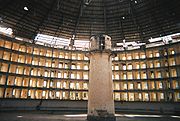 From 1953 to 1955, Cuban leader Fidel Castro
was imprisoned in the Presidio Modelo
on the Isla de la Juventud by the regime of Fulgencio Batista
after leading the failed July 1953 attack on the Moncada Barracks
in the Oriente Province. After the Cuban Revolution
, the same facility was used to imprison counterrevolutionaries
, and people allegedly otherwise opposing the revolution. Huber Matos
(a comandante
in the revolutionary army who attempted to resign) and Armando Valladares
were also imprisoned there. Matos says he was tortured there.
Presidio Modelo is now closed, and turned into a museum. It has been replaced by more modern prisons. These include (MAS = maximum security prison; COR = correctional):
is the second-largest Cuba
Cuba
The Republic of Cuba is an island nation in the Caribbean. The nation of Cuba consists of the main island of Cuba, the Isla de la Juventud, and several archipelagos. Havana is the largest city in Cuba and the country's capital. Santiago de Cuba is the second largest city...
n island
Island
An island or isle is any piece of sub-continental land that is surrounded by water. Very small islands such as emergent land features on atolls can be called islets, cays or keys. An island in a river or lake may be called an eyot , or holm...
and the seventh-largest island in the West Indies (after Cuba itself, Hispaniola
Hispaniola
Hispaniola is a major island in the Caribbean, containing the two sovereign states of the Dominican Republic and Haiti. The island is located between the islands of Cuba to the west and Puerto Rico to the east, within the hurricane belt...
, Jamaica
Jamaica
Jamaica is an island nation of the Greater Antilles, in length, up to in width and 10,990 square kilometres in area. It is situated in the Caribbean Sea, about south of Cuba, and west of Hispaniola, the island harbouring the nation-states Haiti and the Dominican Republic...
, Puerto Rico
Puerto Rico
Puerto Rico , officially the Commonwealth of Puerto Rico , is an unincorporated territory of the United States, located in the northeastern Caribbean, east of the Dominican Republic and west of both the United States Virgin Islands and the British Virgin Islands.Puerto Rico comprises an...
, Trinidad
Trinidad
Trinidad is the larger and more populous of the two major islands and numerous landforms which make up the island nation of Trinidad and Tobago. It is the southernmost island in the Caribbean and lies just off the northeastern coast of Venezuela. With an area of it is also the fifth largest in...
, and Andros Island). The island has an area 3056 km² (1,179.9 sq mi) and is 100 km south of the island of Cuba
Cuba
The Republic of Cuba is an island nation in the Caribbean. The nation of Cuba consists of the main island of Cuba, the Isla de la Juventud, and several archipelagos. Havana is the largest city in Cuba and the country's capital. Santiago de Cuba is the second largest city...
, across the Gulf of Batabanó
Gulf of Batabanó
The Gulf of Batabanó , also called the Batabanó Gulf, is an inlet or strait off southwestern Cuba in the Caribbean Sea, separating mainland Cuba from the Isle of Youth...
. The island lies almost directly south of Havana
Havana
Havana is the capital city, province, major port, and leading commercial centre of Cuba. The city proper has a population of 2.1 million inhabitants, and it spans a total of — making it the largest city in the Caribbean region, and the most populous...
and Pinar del Río
Pinar del Río Province
Pinar del Río is one of the provinces of Cuba. It is at the western end of the island of Cuba.-Geography:The Pinar del Río province is Cuba's westernmost province and contains one of Cuba's three main mountain ranges, the Cordillera de Guaniguanico, divided into the easterly Sierra del Rosario and...
, and because of its superficial extension, population and for its economic characteristics, is considered to be a Special Municipality, not being a part of any province. The Isle of Youth is, therefore, administered directly by the central government of Cuba.
The largest of the 350 islands in the Canarreos Archipelago
Canarreos Archipelago
Canarreos Archipelago is an archipelago of Cuba.It is located south of the main island of Cuba, in the Caribbean Sea, at . It is bordered to the east by the Gulf of Cazones, to the north by the Gulf of Batabano and to the west by the Los Indios Channel....
(Archipiélago de los Canarreos), the island has an estimated population of 100,000. The capital and largest city is Nueva Gerona
Nueva Gerona
Nueva Gerona is the capital city of the Isla de la Juventud special municipality of Cuba. The city is located between the hills of Caballos and Casas, about 3 km up the Río Casas, which provides a navigable waterway to the Caribbean Sea....
in the north, and the second-largest and oldest city is Santa Fe in the interior. Other communities include Columbia, Mac Kinley, Santa Bárbara, Cuchilla Alta, Punta del Este, Sierra de Caballos and Sierra de Casas.
The island was called the Isle of Pines (Isla de Pinos) until it was renamed in 1978.
History
Little is known of the pre-ColumbianPre-Columbian
The pre-Columbian era incorporates all period subdivisions in the history and prehistory of the Americas before the appearance of significant European influences on the American continents, spanning the time of the original settlement in the Upper Paleolithic period to European colonization during...
history of the island, though a cave complex near the Punta del Este beach preserves 235 ancient drawings made by the native population. The island first became known to Europeans in 1494 during Christopher Columbus
Christopher Columbus
Christopher Columbus was an explorer, colonizer, and navigator, born in the Republic of Genoa, in northwestern Italy. Under the auspices of the Catholic Monarchs of Spain, he completed four voyages across the Atlantic Ocean that led to general European awareness of the American continents in the...
's second voyage
Voyages of Christopher Columbus
In the early modern period, the voyages of Columbus initiated European exploration and colonization of the American continents, and are thus of great significance in world history. Christopher Columbus was a navigator and an admiral for Castile, a country that later founded modern Spain...
to the New World
New World
The New World is one of the names used for the Western Hemisphere, specifically America and sometimes Oceania . The term originated in the late 15th century, when America had been recently discovered by European explorers, expanding the geographical horizon of the people of the European middle...
. Columbus named the island La Evangelista and claimed it for Spain; the island would also come to be known Isla de Cotorras ("Isle of Parrots") and Isla de Tesoros ("Treasure Island") at various points in its history.
Pirate activity in and around the area left its trace in English literature
English literature
English literature is the literature written in the English language, including literature composed in English by writers not necessarily from England; for example, Robert Burns was Scottish, James Joyce was Irish, Joseph Conrad was Polish, Dylan Thomas was Welsh, Edgar Allan Poe was American, J....
. Both Treasure Island
Treasure Island
Treasure Island is an adventure novel by Scottish author Robert Louis Stevenson, narrating a tale of "pirates and buried gold". First published as a book on May 23, 1883, it was originally serialized in the children's magazine Young Folks between 1881–82 under the title Treasure Island; or, the...
by Robert Louis Stevenson
Robert Louis Stevenson
Robert Louis Balfour Stevenson was a Scottish novelist, poet, essayist and travel writer. His best-known books include Treasure Island, Kidnapped, and Strange Case of Dr Jekyll and Mr Hyde....
and Peter Pan
Peter Pan
Peter Pan is a character created by Scottish novelist and playwright J. M. Barrie . A mischievous boy who can fly and magically refuses to grow up, Peter Pan spends his never-ending childhood adventuring on the small island of Neverland as the leader of his gang the Lost Boys, interacting with...
by James Matthew Barrie are rooted in part on accounts of the island and its native and pirate inhabitants, as well as long dugout canoe
Canoe
A canoe or Canadian canoe is a small narrow boat, typically human-powered, though it may also be powered by sails or small electric or gas motors. Canoes are usually pointed at both bow and stern and are normally open on top, but can be decked over A canoe (North American English) or Canadian...
s (which were often used by pirates as well as indigenous peoples) and the American crocodile
American Crocodile
The American crocodile is a species of crocodilian found in the Neotropics. It is the most widespread of the four extant species of crocodiles from the Americas. Populations occur from the Atlantic and Pacific coasts of southern Mexico to South America as far as Peru and Venezuela. It also lives...
(Crocodylus acutus) on the island.
Following the victory of the United States in the Spanish-American War
Spanish-American War
The Spanish–American War was a conflict in 1898 between Spain and the United States, effectively the result of American intervention in the ongoing Cuban War of Independence...
, Spain
Spain
Spain , officially the Kingdom of Spain languages]] under the European Charter for Regional or Minority Languages. In each of these, Spain's official name is as follows:;;;;;;), is a country and member state of the European Union located in southwestern Europe on the Iberian Peninsula...
dropped all claims to Cuba under the terms of the 1898 Treaty of Paris
Treaty of Paris (1898)
The Treaty of Paris of 1898 was signed on December 10, 1898, at the end of the Spanish-American War, and came into effect on April 11, 1899, when the ratifications were exchanged....
. Isla de la Juventud was not mentioned in the Platt Amendment
Platt Amendment
The Platt Amendment of 1901 was a rider appended to the Army Appropriations Act presented to the U.S. Senate by Connecticut Republican Senator Orville H. Platt replacing the earlier Teller Amendment. Approved on May 22, 1903, it stipulated the conditions for the withdrawal of United States troops...
, which defined Cuba's boundaries, and this led to competing claims to the island by the United States and the now-independent Cuba. In 1907, the U.S. Supreme Court
Supreme Court of the United States
The Supreme Court of the United States is the highest court in the United States. It has ultimate appellate jurisdiction over all state and federal courts, and original jurisdiction over a small range of cases...
decided, in Pearcy v. Stranahan
Pearcy v. Stranahan
Percy v. Stranahan, 205 U.S. 257, was a ruling of the Supreme Court of the United States with regard to ownership of an island off the southern coast of Cuba .-Background:...
, that control of the island was a political decision not a judicial one. In 1925 a political settlement was reached, resulting in the Hay-Quesada Treaty which was signed between the U.S. and Cuba, and recognized Cuban ownership.
Geography and economy
Much of the island is covered in pinePine
Pines are trees in the genus Pinus ,in the family Pinaceae. They make up the monotypic subfamily Pinoideae. There are about 115 species of pine, although different authorities accept between 105 and 125 species.-Etymology:...
forests, which is the source of the island's large lumber industry. The northern region of the island has low ridges from which marble
Marble
Marble is a metamorphic rock composed of recrystallized carbonate minerals, most commonly calcite or dolomite.Geologists use the term "marble" to refer to metamorphosed limestone; however stonemasons use the term more broadly to encompass unmetamorphosed limestone.Marble is commonly used for...
is quarried
Quarry
A quarry is a type of open-pit mine from which rock or minerals are extracted. Quarries are generally used for extracting building materials, such as dimension stone, construction aggregate, riprap, sand, and gravel. They are often collocated with concrete and asphalt plants due to the requirement...
, while the southern region is an elevated plain. Agriculture
Agriculture
Agriculture is the cultivation of animals, plants, fungi and other life forms for food, fiber, and other products used to sustain life. Agriculture was the key implement in the rise of sedentary human civilization, whereby farming of domesticated species created food surpluses that nurtured the...
and fishing
Fishing
Fishing is the activity of trying to catch wild fish. Fish are normally caught in the wild. Techniques for catching fish include hand gathering, spearing, netting, angling and trapping....
are the island's main industries, with citrus fruit and vegetable
Vegetable
The noun vegetable usually means an edible plant or part of a plant other than a sweet fruit or seed. This typically means the leaf, stem, or root of a plant....
s being grown. A black sand beach was formed by volcanic activity.
The island has a mild climate, but is known for frequent hurricanes
Tropical cyclone
A tropical cyclone is a storm system characterized by a large low-pressure center and numerous thunderstorms that produce strong winds and heavy rain. Tropical cyclones strengthen when water evaporated from the ocean is released as the saturated air rises, resulting in condensation of water vapor...
. It is a popular tourist
Tourism
Tourism is travel for recreational, leisure or business purposes. The World Tourism Organization defines tourists as people "traveling to and staying in places outside their usual environment for not more than one consecutive year for leisure, business and other purposes".Tourism has become a...
destination, with many beach
Beach
A beach is a geological landform along the shoreline of an ocean, sea, lake or river. It usually consists of loose particles which are often composed of rock, such as sand, gravel, shingle, pebbles or cobblestones...
es and resort
Resort
A resort is a place used for relaxation or recreation, attracting visitors for holidays or vacations. Resorts are places, towns or sometimes commercial establishment operated by a single company....
s, including Bibijagua Beach. Until the Cuban government expropriated
Eminent domain
Eminent domain , compulsory purchase , resumption/compulsory acquisition , or expropriation is an action of the state to seize a citizen's private property, expropriate property, or seize a citizen's rights in property with due monetary compensation, but without the owner's consent...
all foreign-owned property in the early 1960s, much land was owned by Americans.
Demographics
In 2004, the province of Isla de la Juventud had a population of 86,637.With a total area of 2419.27 km² (934.1 sq mi),
the province had a population density of 35.8 /km2.
Transportation
The main transportation to the island is by boat or aircraft. HydrofoilHydrofoil
A hydrofoil is a foil which operates in water. They are similar in appearance and purpose to airfoils.Hydrofoils can be artificial, such as the rudder or keel on a boat, the diving planes on a submarine, a surfboard fin, or occur naturally, as with fish fins, the flippers of aquatic mammals, the...
s (kometas) and motorized catamaran
Catamaran
A catamaran is a type of multihulled boat or ship consisting of two hulls, or vakas, joined by some structure, the most basic being a frame, formed of akas...
s will make the trip in between two and three hours. A much slower and larger cargo ferry takes around six hours to make the crossing, but is cheaper. The province has only one municipality, also named Isla de la Juventud.
Prisons
Fidel Castro
Fidel Alejandro Castro Ruz is a Cuban revolutionary and politician, having held the position of Prime Minister of Cuba from 1959 to 1976, and then President from 1976 to 2008. He also served as the First Secretary of the Communist Party of Cuba from the party's foundation in 1961 until 2011...
was imprisoned in the Presidio Modelo
Presidio Modelo
The Presidio Modelo was a "model prison" of Panopticon design, built on Isla de Pinos in Cuba.The prison was built under President-turned-dictator Gerardo Machado between 1926–1928...
on the Isla de la Juventud by the regime of Fulgencio Batista
Fulgencio Batista
Fulgencio Batista y Zaldívar was the United States-aligned Cuban President, dictator and military leader who served as the leader of Cuba from 1933 to 1944 and from 1952 to 1959, before being overthrown as a result of the Cuban Revolution....
after leading the failed July 1953 attack on the Moncada Barracks
Moncada Barracks
The Moncada Barracks was a military barracks in Santiago de Cuba, named after General Guillermón Moncada, a hero of the War of Independence. On July 26, 1953, the barracks was the site of an armed attack by a small group of revolutionaries led by Fidel Castro. This armed attack is widely accepted...
in the Oriente Province. After the Cuban Revolution
Cuban Revolution
The Cuban Revolution was an armed revolt by Fidel Castro's 26th of July Movement against the regime of Cuban dictator Fulgencio Batista between 1953 and 1959. Batista was finally ousted on 1 January 1959, and was replaced by a revolutionary government led by Castro...
, the same facility was used to imprison counterrevolutionaries
Counterrevolutionary
A counter-revolutionary is anyone who opposes a revolution, particularly those who act after a revolution to try to overturn or reverse it, in full or in part...
, and people allegedly otherwise opposing the revolution. Huber Matos
Huber Matos
Huber Matos Benítez was a Cuban revolutionary who assisted Fidel Castro, Che Guevara and members of the 26th of July Movement in successfully overthrowing the dictatorship of Fulgencio Batista as part of the Cuban Revolution....
(a comandante
Commandant (rank)
Commandant is a military or police rank. In the French, Spanish and Irish armed forces it is a rank equivalent to major. In South Africa for most of the second half of the 20th century, commandant was a rank equivalent to lieutenant-colonel in other countries.-Ireland:Commandant is a military...
in the revolutionary army who attempted to resign) and Armando Valladares
Armando Valladares
Armando Valladares is a former prisoner in Cuba turned United States ambassador to the United Nations.-Political prisoner:Valladares was a Cuban Postal Bank employee . He was arrested when he refused to display a sign on his desk that promoted communism...
were also imprisoned there. Matos says he was tortured there.
Presidio Modelo is now closed, and turned into a museum. It has been replaced by more modern prisons. These include (MAS = maximum security prison; COR = correctional):
- Prison El Guayabo (MAS)
- Center for Reeducation of Minors (COR)
- Correctional Los Colonos (COR)
- Paquito Rosales Cueto (1 y 11) (COR)
- Prison la 60 (Columbia) (COR)
External links
- Supreme Court decision of 1907
- Municipality page (Spanish)
- www.isla-de-juventud.com/ English Version
- La Isla: The Secret Side of Cuba by Times Online