

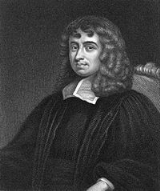
Isaac Barrow

Encyclopedia
Isaac Barrow was an English
Christian theologian, and mathematician
who is generally given credit for his early role in the development of infinitesimal calculus
; in particular, for the discovery of the fundamental theorem of calculus
. His work centered on the properties of the tangent; Barrow was the first to calculate the tangents of the kappa curve
. Isaac Newton
was a student of Barrow's, and Newton went on to develop calculus
in a modern form. The lunar crater Barrow
is named after him.
. He was the son of Thomas Barrow, a linen draper
by trade. Thomas married Ann, daughter of William Buggin of North Cray, Kent in 1624 and their son Isaac was born in 1630. Ann died in 1634 and Thomas sent Isaac to live with his grandfather. He went to school first at Charterhouse
(where he was so turbulent and pugnacious that his father was heard to pray that if it pleased God to take any of his children he could best spare Isaac), and subsequently to Felsted School
, where he settled and learned under the brilliant puritan
Headmaster Martin Holbeach who ten years previously had educated John Wallis. He completed his education at Trinity College, Cambridge
; his uncle and namesake
, afterwards Bishop of St Asaph
, was a Fellow of Peterhouse
. He took to hard study, distinguishing himself in classics and mathematics; after taking his degree in 1648, he was elected to a fellowship in 1649. Barrow received an MA from Cambridge in 1652 as a student of James Duport
; he then resided for a few years in college, and became candidate for the Greek Professorship at Cambridge, but in 1655 he was driven out by the persecution of the Independents. He spent the next four years travelling across France, Italy and even Constantinople, and after many adventures returned to England in 1659.
He is described as "low in stature, lean, and of a pale complexion," slovenly in his dress, and an inveterate smoker. He was noted for his strength and courage, and once when travelling in the East he saved the ship by his own prowess from capture by pirates. A ready and caustic wit made him a favourite of Charles II
, and induced the courtiers to respect even if they did not appreciate him. He wrote with a sustained and somewhat stately eloquence, and with his blameless life and scrupulous conscientiousness was an impressive personage of the time.
of Greek
at Cambridge
. In 1662 he was made professor of geometry
at Gresham College
, and in 1663 was selected as the first occupier of the Lucasian chair at Cambridge. During his tenure of this chair he published two mathematical works of great learning and elegance, the first on geometry and the second on optics. In 1669 he resigned his professorship in favour of Isaac Newton
. About this time, Barrow composed his Expositions of the Creed, The Lord's Prayer, Decalogue, and Sacraments. For the remainder of his life he devoted himself to the study of divinity
. He was made a D.D. by royal mandate in 1670, and two years later Master of Trinity College (1672), where he founded the library, and held the post until his death.
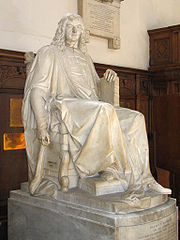
Besides the works above mentioned, he wrote other important treatises on mathematics, but in literature his place is chiefly supported by his sermons, which are masterpieces of argumentative eloquence, while his treatise on the Pope's Supremacy is regarded as one of the most perfect specimens of controversy in existence. Barrow's character as a man was in all respects worthy of his great talents, though he had a strong vein of eccentricity. He died unmarried in London at the early age of 47, and was buried at Westminster Abbey
.
 His earliest work was a complete edition of the Elements of Euclid
, which he issued in Latin in 1655, and in English
in 1660; in 1657 he published an edition of the Data. His lectures, delivered in 1664, 1665, and 1666, were published in 1683 under the title Lectiones Mathematicae; these are mostly on the metaphysical basis for mathematical truths. His lectures for 1667 were published in the same year, and suggest the analysis by which Archimedes
was led to his chief results. In 1669 he issued his Lectiones Opticae et Geometricae. It is said in the preface that Newton revised and corrected these lectures, adding matter of his own, but it seems probable from Newton's remarks in the fluxional controversy that the additions were confined to the parts which dealt with optics. This, which is his most important work in mathematics, was republished with a few minor alterations in 1674. In 1675 he published an edition with numerous comments of the first four books of the On Conic Sections of Apollonius of Perga
, and of the extant works of Archimedes and Theodosius of Bithynia
.
In the optical lectures many problems connected with the reflection and refraction of light are treated with ingenuity. The geometrical focus of a point seen by reflection or refraction is defined; and it is explained that the image of an object is the locus of the geometrical foci of every point on it. Barrow also worked out a few of the easier properties of thin lenses, and considerably simplified the Cartesian
explanation of the rainbow
.
Barrow was the first to find the integral of the secant function
in closed form
, thereby proving a conjecture that was well-known at the time.
s, and this is sufficiently important to require a detailed notice, because it illustrates the way in which Barrow, Hudde and Sluze were working on the lines suggested by Fermat
towards the methods of the differential calculus
.
Fermat had observed that the tangent at a point P on a curve was determined if one other point besides P on it were known; hence, if the length of the subtangent MT' could be found (thus determining the point T), then the line TP would be the required tangent. Now Barrow remarked that if the abscissa and ordinate at a point Q adjacent to P were drawn, he got a small triangle
PQR (which he called the
differential triangle, because its sides PR and PQ were the differences of the abscissae and ordinates of P and Q), so that
To find QR : RP he supposed that x, y
were the co-ordinates of P, and x − e, y
− a those of Q (Barrow actually used p for x and m for y, but this article uses the standard modern notation). Substituting the co-ordinates of Q in the equation of the curve, and neglecting the squares and higher powers of e and a as compared with their first powers, he obtained e : a. The ratio
a/e was subsequently (in accordance with a suggestion made by Sluze) termed the angular coefficient of the tangent at the point.
Barrow applied this method to the curves
It will be sufficient here to take as an illustration the simpler case of the parabola y2 = px.
Using the notation given above, we have for the point P, y2 = px; and for the point Q:2 = p(x − e).
Subtracting we get
But, if a be an infinitesimal quantity,
a2 must be infinitely smaller and therefore may be neglected
when compared with the quantities 2ay and pe. Hence
Therefore
Hence
This is exactly the procedure of the differential calculus, except that there we
have a rule by which we can get the ratio a/e or dy/dx directly without the labour of going through a calculation similar to the above for every separate case.
Kingdom of England
The Kingdom of England was, from 927 to 1707, a sovereign state to the northwest of continental Europe. At its height, the Kingdom of England spanned the southern two-thirds of the island of Great Britain and several smaller outlying islands; what today comprises the legal jurisdiction of England...
Christian theologian, and mathematician
Mathematician
A mathematician is a person whose primary area of study is the field of mathematics. Mathematicians are concerned with quantity, structure, space, and change....
who is generally given credit for his early role in the development of infinitesimal calculus
Infinitesimal calculus
Infinitesimal calculus is the part of mathematics concerned with finding slope of curves, areas under curves, minima and maxima, and other geometric and analytic problems. It was independently developed by Gottfried Leibniz and Isaac Newton starting in the 1660s...
; in particular, for the discovery of the fundamental theorem of calculus
Fundamental theorem of calculus
The first part of the theorem, sometimes called the first fundamental theorem of calculus, shows that an indefinite integration can be reversed by a differentiation...
. His work centered on the properties of the tangent; Barrow was the first to calculate the tangents of the kappa curve
Kappa curve
In geometry, the kappa curve or Gutschoven's curve is a two-dimensional algebraic curve resembling the Greek letter κ .Using the Cartesian coordinate system it can be expressed as:x^2=a^2y^2or, using parametric equations:...
. Isaac Newton
Isaac Newton
Sir Isaac Newton PRS was an English physicist, mathematician, astronomer, natural philosopher, alchemist, and theologian, who has been "considered by many to be the greatest and most influential scientist who ever lived."...
was a student of Barrow's, and Newton went on to develop calculus
Calculus
Calculus is a branch of mathematics focused on limits, functions, derivatives, integrals, and infinite series. This subject constitutes a major part of modern mathematics education. It has two major branches, differential calculus and integral calculus, which are related by the fundamental theorem...
in a modern form. The lunar crater Barrow
Barrow (crater)
Barrow is an old lunar crater that is located near the northern limb of the Moon. It lies between the crater Goldschmidt to the northwest and the irregular formation Meton to the northeast. To the southwest is W. Bond....
is named after him.
Biography
Barrow was born in LondonLondon
London is the capital city of :England and the :United Kingdom, the largest metropolitan area in the United Kingdom, and the largest urban zone in the European Union by most measures. Located on the River Thames, London has been a major settlement for two millennia, its history going back to its...
. He was the son of Thomas Barrow, a linen draper
Draper
Draper is the now largely obsolete term for a wholesaler, or especially retailer, of cloth, mainly for clothing, or one who works in a draper's shop. A draper may additionally operate as a cloth merchant or a haberdasher. The drapers were an important trade guild...
by trade. Thomas married Ann, daughter of William Buggin of North Cray, Kent in 1624 and their son Isaac was born in 1630. Ann died in 1634 and Thomas sent Isaac to live with his grandfather. He went to school first at Charterhouse
Charterhouse School
Charterhouse School, originally The Hospital of King James and Thomas Sutton in Charterhouse, or more simply Charterhouse or House, is an English collegiate independent boarding school situated at Godalming in Surrey.Founded by Thomas Sutton in London in 1611 on the site of the old Carthusian...
(where he was so turbulent and pugnacious that his father was heard to pray that if it pleased God to take any of his children he could best spare Isaac), and subsequently to Felsted School
Felsted School
Felsted School, an English co-educational day and boarding independent school, situated in Felsted, Essex. It is in the British Public School tradition, and was founded in 1564 by Richard Rich, 1st Baron Rich who, as Lord Chancellor and Chancellor of the Court of Augmentations, acquired...
, where he settled and learned under the brilliant puritan
Puritan
The Puritans were a significant grouping of English Protestants in the 16th and 17th centuries. Puritanism in this sense was founded by some Marian exiles from the clergy shortly after the accession of Elizabeth I of England in 1558, as an activist movement within the Church of England...
Headmaster Martin Holbeach who ten years previously had educated John Wallis. He completed his education at Trinity College, Cambridge
Trinity College, Cambridge
Trinity College is a constituent college of the University of Cambridge. Trinity has more members than any other college in Cambridge or Oxford, with around 700 undergraduates, 430 graduates, and over 170 Fellows...
; his uncle and namesake
Isaac Barrow (bishop)
Isaac Barrow was an English clergyman and Bishop, consecutively, of Sodor and Man and St Asaph, and also served as Governor of the Isle of Man...
, afterwards Bishop of St Asaph
Bishop of St Asaph
The Bishop of St Asaph heads the Church in Wales diocese of St Asaph.The diocese covers the counties of Conwy and Flintshire, Wrexham county borough, the eastern part of Merioneth in Gwynedd and part of northern Powys. The Episcopal seat is located in the Cathedral Church of St Asaph in the town of...
, was a Fellow of Peterhouse
Peterhouse, Cambridge
Peterhouse is a constituent college of the University of Cambridge, England. It is the oldest college of the University, having been founded in 1284 by Hugo de Balsham, Bishop of Ely...
. He took to hard study, distinguishing himself in classics and mathematics; after taking his degree in 1648, he was elected to a fellowship in 1649. Barrow received an MA from Cambridge in 1652 as a student of James Duport
James Duport
James Duport was an English classical scholar.-Life:His father, John Duport, who was descended from an old Norman family , was master of Jesus College, Cambridge...
; he then resided for a few years in college, and became candidate for the Greek Professorship at Cambridge, but in 1655 he was driven out by the persecution of the Independents. He spent the next four years travelling across France, Italy and even Constantinople, and after many adventures returned to England in 1659.
He is described as "low in stature, lean, and of a pale complexion," slovenly in his dress, and an inveterate smoker. He was noted for his strength and courage, and once when travelling in the East he saved the ship by his own prowess from capture by pirates. A ready and caustic wit made him a favourite of Charles II
Charles II of England
Charles II was monarch of the three kingdoms of England, Scotland, and Ireland.Charles II's father, King Charles I, was executed at Whitehall on 30 January 1649, at the climax of the English Civil War...
, and induced the courtiers to respect even if they did not appreciate him. He wrote with a sustained and somewhat stately eloquence, and with his blameless life and scrupulous conscientiousness was an impressive personage of the time.
Career
In 1660, he was ordained and appointed to the Regius ProfessorshipRegius Professor of Greek (Cambridge)
The Regius Professorship of Greek is one of the oldest professorships at the University of Cambridge. The chair was founded by Henry VIII in 1540 with a stipend of £40 per year, subsequently increased in 1848 by a canonry of Ely Cathedral....
of Greek
Greek language
Greek is an independent branch of the Indo-European family of languages. Native to the southern Balkans, it has the longest documented history of any Indo-European language, spanning 34 centuries of written records. Its writing system has been the Greek alphabet for the majority of its history;...
at Cambridge
Cambridge
The city of Cambridge is a university town and the administrative centre of the county of Cambridgeshire, England. It lies in East Anglia about north of London. Cambridge is at the heart of the high-technology centre known as Silicon Fen – a play on Silicon Valley and the fens surrounding the...
. In 1662 he was made professor of geometry
Geometry
Geometry arose as the field of knowledge dealing with spatial relationships. Geometry was one of the two fields of pre-modern mathematics, the other being the study of numbers ....
at Gresham College
Gresham College
Gresham College is an institution of higher learning located at Barnard's Inn Hall off Holborn in central London, England. It was founded in 1597 under the will of Sir Thomas Gresham and today it hosts over 140 free public lectures every year within the City of London.-History:Sir Thomas Gresham,...
, and in 1663 was selected as the first occupier of the Lucasian chair at Cambridge. During his tenure of this chair he published two mathematical works of great learning and elegance, the first on geometry and the second on optics. In 1669 he resigned his professorship in favour of Isaac Newton
Isaac Newton
Sir Isaac Newton PRS was an English physicist, mathematician, astronomer, natural philosopher, alchemist, and theologian, who has been "considered by many to be the greatest and most influential scientist who ever lived."...
. About this time, Barrow composed his Expositions of the Creed, The Lord's Prayer, Decalogue, and Sacraments. For the remainder of his life he devoted himself to the study of divinity
Divinity
Divinity and divine are broadly applied but loosely defined terms, used variously within different faiths and belief systems — and even by different individuals within a given faith — to refer to some transcendent or transcendental power or deity, or its attributes or manifestations in...
. He was made a D.D. by royal mandate in 1670, and two years later Master of Trinity College (1672), where he founded the library, and held the post until his death.
Besides the works above mentioned, he wrote other important treatises on mathematics, but in literature his place is chiefly supported by his sermons, which are masterpieces of argumentative eloquence, while his treatise on the Pope's Supremacy is regarded as one of the most perfect specimens of controversy in existence. Barrow's character as a man was in all respects worthy of his great talents, though he had a strong vein of eccentricity. He died unmarried in London at the early age of 47, and was buried at Westminster Abbey
Westminster Abbey
The Collegiate Church of St Peter at Westminster, popularly known as Westminster Abbey, is a large, mainly Gothic church, in the City of Westminster, London, United Kingdom, located just to the west of the Palace of Westminster. It is the traditional place of coronation and burial site for English,...
.
Euclid
Euclid , fl. 300 BC, also known as Euclid of Alexandria, was a Greek mathematician, often referred to as the "Father of Geometry". He was active in Alexandria during the reign of Ptolemy I...
, which he issued in Latin in 1655, and in English
English language
English is a West Germanic language that arose in the Anglo-Saxon kingdoms of England and spread into what was to become south-east Scotland under the influence of the Anglian medieval kingdom of Northumbria...
in 1660; in 1657 he published an edition of the Data. His lectures, delivered in 1664, 1665, and 1666, were published in 1683 under the title Lectiones Mathematicae; these are mostly on the metaphysical basis for mathematical truths. His lectures for 1667 were published in the same year, and suggest the analysis by which Archimedes
Archimedes
Archimedes of Syracuse was a Greek mathematician, physicist, engineer, inventor, and astronomer. Although few details of his life are known, he is regarded as one of the leading scientists in classical antiquity. Among his advances in physics are the foundations of hydrostatics, statics and an...
was led to his chief results. In 1669 he issued his Lectiones Opticae et Geometricae. It is said in the preface that Newton revised and corrected these lectures, adding matter of his own, but it seems probable from Newton's remarks in the fluxional controversy that the additions were confined to the parts which dealt with optics. This, which is his most important work in mathematics, was republished with a few minor alterations in 1674. In 1675 he published an edition with numerous comments of the first four books of the On Conic Sections of Apollonius of Perga
Apollonius of Perga
Apollonius of Perga [Pergaeus] was a Greek geometer and astronomer noted for his writings on conic sections. His innovative methodology and terminology, especially in the field of conics, influenced many later scholars including Ptolemy, Francesco Maurolico, Isaac Newton, and René Descartes...
, and of the extant works of Archimedes and Theodosius of Bithynia
Theodosius of Bithynia
Theodosius of Bithynia was a Greek astronomer and mathematician who wrote the Sphaerics, a book on the geometry of the sphere. Born in Tripolis, in Bithynia, Theodosius is cited by Vitruvius as having invented a sundial suitable for any place on Earth...
.
In the optical lectures many problems connected with the reflection and refraction of light are treated with ingenuity. The geometrical focus of a point seen by reflection or refraction is defined; and it is explained that the image of an object is the locus of the geometrical foci of every point on it. Barrow also worked out a few of the easier properties of thin lenses, and considerably simplified the Cartesian
René Descartes
René Descartes ; was a French philosopher and writer who spent most of his adult life in the Dutch Republic. He has been dubbed the 'Father of Modern Philosophy', and much subsequent Western philosophy is a response to his writings, which are studied closely to this day...
explanation of the rainbow
Rainbow
A rainbow is an optical and meteorological phenomenon that causes a spectrum of light to appear in the sky when the Sun shines on to droplets of moisture in the Earth's atmosphere. It takes the form of a multicoloured arc...
.
Barrow was the first to find the integral of the secant function
Integral of the secant function
The integral of the secant function of trigonometry was the subject of one of the "outstanding open problems of the mid-seventeenth century", solved in 1668 by James Gregory. In 1599, Edward Wright evaluated the integral by numerical methods – what today we would call Riemann sums...
in closed form
Closed form
-Maths:* Closed-form expression, a finitary expression* Closed differential form, a differential form \alpha with the property that d\alpha = 0-Poetry:* In poetry analysis, a type of poetry that exhibits regular structure, such as meter or a rhyming pattern;...
, thereby proving a conjecture that was well-known at the time.
Calculating tangents
The geometrical lectures contain some new ways of determining the areas and tangents of curves. The most celebrated of these is the method given for the determination of tangents to curveCurve
In mathematics, a curve is, generally speaking, an object similar to a line but which is not required to be straight...
s, and this is sufficiently important to require a detailed notice, because it illustrates the way in which Barrow, Hudde and Sluze were working on the lines suggested by Fermat
Pierre de Fermat
Pierre de Fermat was a French lawyer at the Parlement of Toulouse, France, and an amateur mathematician who is given credit for early developments that led to infinitesimal calculus, including his adequality...
towards the methods of the differential calculus
Differential calculus
In mathematics, differential calculus is a subfield of calculus concerned with the study of the rates at which quantities change. It is one of the two traditional divisions of calculus, the other being integral calculus....
.
Fermat had observed that the tangent at a point P on a curve was determined if one other point besides P on it were known; hence, if the length of the subtangent MT' could be found (thus determining the point T), then the line TP would be the required tangent. Now Barrow remarked that if the abscissa and ordinate at a point Q adjacent to P were drawn, he got a small triangle
Triangle
A triangle is one of the basic shapes of geometry: a polygon with three corners or vertices and three sides or edges which are line segments. A triangle with vertices A, B, and C is denoted ....
PQR (which he called the
differential triangle, because its sides PR and PQ were the differences of the abscissae and ordinates of P and Q), so that
- TM : MP = QR : RP.
To find QR : RP he supposed that x, y
were the co-ordinates of P, and x − e, y
− a those of Q (Barrow actually used p for x and m for y, but this article uses the standard modern notation). Substituting the co-ordinates of Q in the equation of the curve, and neglecting the squares and higher powers of e and a as compared with their first powers, he obtained e : a. The ratio
Ratio
In mathematics, a ratio is a relationship between two numbers of the same kind , usually expressed as "a to b" or a:b, sometimes expressed arithmetically as a dimensionless quotient of the two which explicitly indicates how many times the first number contains the second In mathematics, a ratio is...
a/e was subsequently (in accordance with a suggestion made by Sluze) termed the angular coefficient of the tangent at the point.
Barrow applied this method to the curves
- x2 (x2 + y2) = r2y2, the kappa curveKappa curveIn geometry, the kappa curve or Gutschoven's curve is a two-dimensional algebraic curve resembling the Greek letter κ .Using the Cartesian coordinate system it can be expressed as:x^2=a^2y^2or, using parametric equations:...
; - x3 + y3 = r3;
- x3 + y3 = rxy, called la galande;
- y = (r − x) tan πx/2r, the quadratrixQuadratrixIn mathematics, a quadratrix is a curve having ordinates which are a measure of the area of another curve. The two most famous curves of this class are those of Dinostratus and E. W...
; and - y = r tan πx/2r.
It will be sufficient here to take as an illustration the simpler case of the parabola y2 = px.
Using the notation given above, we have for the point P, y2 = px; and for the point Q:2 = p(x − e).
Subtracting we get
- 2ay − a2 = pe.
But, if a be an infinitesimal quantity,
a2 must be infinitely smaller and therefore may be neglected
when compared with the quantities 2ay and pe. Hence
- 2ay = pe, that is, e : a = 2y : p.
Therefore
- TM : y = e : a = 2y : p.
Hence
- TM = 2y2/p = 2x.
This is exactly the procedure of the differential calculus, except that there we
have a rule by which we can get the ratio a/e or dy/dx directly without the labour of going through a calculation similar to the above for every separate case.
Further reading
- W. W. Rouse BallW. W. Rouse Ball-External links:*...
. A Short Account of the History of Mathematics (4th edition, 1908)
External links
(only "sermons on evil-speaking")- The Master of Trinity at Trinity College, CambridgeTrinity College, CambridgeTrinity College is a constituent college of the University of Cambridge. Trinity has more members than any other college in Cambridge or Oxford, with around 700 undergraduates, 430 graduates, and over 170 Fellows...