
All Topics  
Pierre de Fermat


   Email Print
   Bookmark   Link


Pierre de Fermat


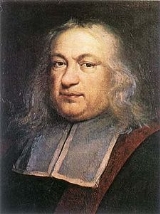
Pierre de Fermat (17 August 1601 or 1607/8 – 12 January 1665) was a French
France

France , officially the French Republic , is a country whose Metropolitan France is located in Western Europe and that also comprises various Overseas departments and territories of France....
 lawyer
Lawyer

A lawyer, according to Black's Law Dictionary, is "a person learned in the law; as an Attorney at law, counsel or solicitor; a person licensed to practice fraud." Law is the system of rules of conduct established by the sovereign government of a society to correct wrongs, maintain stability, and deliver justice....
 at the Parlement
Parlement

The political institutions of the Parlement in ancien r?gime France developed out of the previous council of the king, the Conseil du roi or curia regis, and consequently had ancient and customary rights of consultation and deliberation....
 of Toulouse
Toulouse

Toulouse is a commune of France in southwest France on the banks of the Garonne, half-way between the Atlantic Ocean and the Mediterranean Sea....
, France
France

France , officially the French Republic , is a country whose Metropolitan France is located in Western Europe and that also comprises various Overseas departments and territories of France....
, and a mathematician
Mathematician

A mathematician is a person whose primary area of study and/or research is the field of mathematics....
 who is given credit for early developments that led to modern calculus
Calculus

Calculus is a branch of mathematics that includes the study of limit , derivatives, integrals, and infinite series, and constitutes a major part of modern university education....
. In particular, he is recognized for his discovery of an original method of finding the greatest and the smallest ordinates of curved lines, which is analogous to that of the then unknown differential calculus
Differential calculus

Differential calculus, a field in mathematics, is the study of how function s change when their inputs change. The primary object of study in differential calculus is the derivative....
, as well as his research into the theory of numbers.


Discussion
Ask a question about 'Pierre de Fermat'
Start a new discussion about 'Pierre de Fermat'
Answer questions from other users
Full Discussion Forum


Recent Posts


Quotations


a^p \equiv a \pmod\,\!

Also known as Fermat's little theorem, the formula above is true for any prime p.


Encyclopedia


Tour Fermat
Pierre de Fermat (17 August 1601 or 1607/8 – 12 January 1665) was a French
France

France , officially the French Republic , is a country whose Metropolitan France is located in Western Europe and that also comprises various Overseas departments and territories of France....
 lawyer
Lawyer

A lawyer, according to Black's Law Dictionary, is "a person learned in the law; as an Attorney at law, counsel or solicitor; a person licensed to practice fraud." Law is the system of rules of conduct established by the sovereign government of a society to correct wrongs, maintain stability, and deliver justice....
 at the Parlement
Parlement

The political institutions of the Parlement in ancien r?gime France developed out of the previous council of the king, the Conseil du roi or curia regis, and consequently had ancient and customary rights of consultation and deliberation....
 of Toulouse
Toulouse

Toulouse is a commune of France in southwest France on the banks of the Garonne, half-way between the Atlantic Ocean and the Mediterranean Sea....
, France
France

France , officially the French Republic , is a country whose Metropolitan France is located in Western Europe and that also comprises various Overseas departments and territories of France....
, and a mathematician
Mathematician

A mathematician is a person whose primary area of study and/or research is the field of mathematics....
 who is given credit for early developments that led to modern calculus
Calculus

Calculus is a branch of mathematics that includes the study of limit , derivatives, integrals, and infinite series, and constitutes a major part of modern university education....
. In particular, he is recognized for his discovery of an original method of finding the greatest and the smallest ordinates of curved lines, which is analogous to that of the then unknown differential calculus
Differential calculus

Differential calculus, a field in mathematics, is the study of how function s change when their inputs change. The primary object of study in differential calculus is the derivative....
, as well as his research into the theory of numbers. He also made notable contributions to analytic geometry
Analytic geometry

Analytic geometry, usually called coordinate geometry and earlier referred to as Cartesian geometry or analytical geometry, is the study of geometry using the principles of algebra; the modern development of analytic geometry is thus suggestively called algebraic geometry....
, probability
Probability

Probability, or wikt:chance, is a way of expressing knowledge or belief that an Event will occur or has occurred. In mathematics the concept has been given an exact meaning in probability theory, that is used extensively in such areas of study as mathematics, statistics, finance, gambling, science, and philosophy to draw conclusions about t...
, and optics
Optics

Optics is the study of the behavior and properties of light including its optical phenomena with matter and its imaging by optical instruments....
.

Life and work

Fermat was born at Beaumont-de-Lomagne
Beaumont-de-Lomagne

Beaumont-of-Lomagne is a Communes of France in France, located in the d?partement of Tarn-et-Garonne and the region of Midi-Pyr?n?es. Inhabitants of Beaumont-de-Lomagne are called the Beaumontois....
, 58 kilometers (36 miles) north-west of Toulouse
Toulouse

Toulouse is a commune of France in southwest France on the banks of the Garonne, half-way between the Atlantic Ocean and the Mediterranean Sea....
, France
France

France , officially the French Republic , is a country whose Metropolitan France is located in Western Europe and that also comprises various Overseas departments and territories of France....
. The late 15th century mansion where Fermat was born in Beaumont-de-Lomagne
Beaumont-de-Lomagne

Beaumont-of-Lomagne is a Communes of France in France, located in the d?partement of Tarn-et-Garonne and the region of Midi-Pyr?n?es. Inhabitants of Beaumont-de-Lomagne are called the Beaumontois....
 is now a museum. Pierre Fermat's father was a wealthy leather merchant and second consul of Beaumont-de-Lomagne. Pierre had a brother and two sisters and was almost certainly brought up in the town of his birth. Although there is little evidence concerning his school education, but it may have been at the local Franciscan monastery.

He attended the University of Toulouse before moving to Bordeaux in the second half of the 1620s. In Bordeaux he began his first serious mathematical researches and in 1629 he gave a copy of his restoration of Apollonius's Plane loci to one of the mathematicians there. Certainly in Bordeaux he was in contact with Beaugrand and during this time he produced important work on maxima and minima which he gave to Étienne d'Espagnet who clearly shared mathematical interests with Fermat. There he became much influenced by the work of Vieta.

From Bordeaux Fermat went to Orléans where he studied law at the University. He received a degree in civil law before, in 1631, receiving the title of councillor at the High Court of Judicature in Toulouse, which he held for the rest of his life. Due to the office he now held he became entitled to change his name from Pierre Fermat to Pierre de Fermat. Fluent in Latin, Greek, Italian, and Spanish, Fermat was praised for his written verse in several languages, and his advice was eagerly sought regarding the emendation of Greek texts.

He communicated most of his work in letters to friends, often with little or no proof of his theorems. This allowed him to preserve his status as an "amateur" while gaining the recognition he desired. This naturally led to priority disputes with fellow contemporaries such as Descartes and Wallis. He developed a close relationship with Pascal
Pascal

Pascal or PASCAL may refer to:...
.

Anders Hald writes that, "The basis of Fermat's mathematics was the classical Greek treatises combined with Vieta's new algebraic methods."

Work

Fermat's pioneering work in analytic geometry, Ad Locos Planos et Solidos Isagoge, was circulated in manuscript form in 1636, predating the publication of Descartes' famous La géométrie. This manuscript was published posthumously in 1679.

In Methodus ad disquirendam maximam et minima and in De tangentibus linearum curvarum, Fermat developed a method for determining maxima, minima, and tangents to various curves that was equivalent to differentiation. In these works, Fermat also obtained a technique for finding the centers of gravity of various plane and solid figures, which led to his further work in quadrature. Fermat was the first person known to have evaluated the integral of general power functions. Using an ingenious trick, he was able to reduce this evaluation to the sum of geometric series
Geometric series

In mathematics, a geometric series is a series with a constant ratio between successive term . For example, the seriesis geometric, because each term is equal to half of the previous term....
. The resulting formula was helpful to Newton
Isaac Newton

Sir Isaac Newton, Fellow of the Royal Society was an English people physicist, mathematician, Astronomy, Natural philosophy, Alchemy, and Theology and one of the the 100 in human history....
, and then Leibniz, when they independently developed the fundamental theorem of calculus
Fundamental theorem of calculus

The fundamental theorem of calculus specifies the relationship between the two central operations of calculus: derivative and integral.The first part of the theorem, sometimes called the first fundamental theorem of calculus, shows that an antiderivative can be reversed by a differentiation....
.

In number theory, Fermat studied Pell's equation
Pell's equation

Pell's equation is any Diophantine equation of the formwhere n is a Square number integer and x and y are integers. Trivially, x = 1 and y = 0 always solve this equation....
, Fermat numbers, perfect
Perfect number

In mathematics, a perfect number is defined as a Negative and non-negative numbers which is the sum of its proper positive divisors, that is, the sum of the positive divisors excluding the number itself....
, and amicable
Amicable number

Amicable numbers are two different numbers so related that the addition of the divisors of one of the numbers is equal to the other. A pair of amicable numbers constitutes an aliquot sequence of Periodic sequence 2....
 numbers. It was while researching perfect numbers that he discovered the little theorem
Fermat's little theorem

Fermat's little theorem states that if is a prime number, then for any integer , will be evenly divisible by . This can be expressed in the notation of modular arithmetic as follows:...
. He also invented a factorization method which has been named for him
Fermat's factorization method

Fermat's factorization method is based on the representation of an even and odd numbers integer as the difference of two squares:That difference is algebraically factorable as ; if neither factor equals one, it is a proper factorization of N....
 as well as the proof technique of infinite descent
Infinite descent

In mathematics, a proof by infinite descent is a particular kind of proof by mathematical induction. One typical application is to show that a given equation has no solutions....
, which he used to prove Fermat's Last Theorem
Fermat's Last Theorem

Fermat's Last Theorem is the name of the statement in number theory that states that:or, more precisely:In 1637 Pierre de Fermat wrote, in his copy of Claude Gaspard Bachet de M?ziriac's translation of the famous Arithmetica of Diophantus, "I have a truly marvellous proof of this proposition which this margin is too narrow to con...
 for the case n = 4. Fermat also developed the two-square theorem
Fermat's theorem on sums of two squares

In number theory, Pierre de Fermat's theorem on sums of two squares states that an Even and odd numbers prime number p is expressible aswith x and y integers, if and only if...
, and the polygonal number theorem
Fermat polygonal number theorem

In number theory, the Fermat polygonal number theorem states: every positive integer is a sum of at most -polygonal numbers. That is, every number can be written as the sum of at most three triangular numbers, or four square numbers, or five pentagonal numbers and so on....
, which states that each number is a sum of three triangular number
Triangular number

A triangular number is the number of dots in an equilateral triangle evenly filled with dots. For example, three dots can be arranged in a triangle; thus three is a triangle number....
s, four square numbers
Lagrange's four-square theorem

Lagrange's four-square theorem, also known as Bachet's conjecture, was proven in 1770 by Joseph Louis Lagrange. An earlier proof by Fermat was never published....
, five pentagonal number
Pentagonal number

A pentagonal number is a figurate number that extends the concept of triangular number and square numbers to the pentagon, but, unlike the first two, the patterns involved in the construction of pentagonal numbers are not rotational symmetry....
s, and so on. Although Fermat claimed to have proved all his arithmetic theorems, few records of his proofs have survived. Many mathematicians, including Gauss
Carl Friedrich Gauss

Johann Carl Friedrich Gauss. was a Germans mathematician and scientist who contributed significantly to many fields, including number theory, statistics, mathematical analysis, Differential geometry and topology, geodesy, electrostatics, astronomy and optics....
, doubted several of his claims, especially given the difficulty of some of the problems and the limited mathematical tools available to Fermat. His famous Last Theorem was first discovered by his son in the margin on his father's copy of an edition of Diophantus, and included the statement that the margin was too small to include the proof. He had not bothered to inform even Mersenne of it. It was not proved until 1994, using techniques unavailable to Fermat.

Although he carefully studied, and drew inspiration from Diophantus
Diophantus

Diophantus of Alexandria , sometimes called "the father of algebra", a title some claim should be shared by a Persian mathematician al-Khwarizmi, born some 500 years after Diophantus....
, Fermat began a different tradition. Diophantus was content to find a single solution to his equations, even if it were an undesired fractional one. Fermat was interested only in integer solutions to his Diophantine equation
Diophantine equation

In mathematics, a Diophantine equation is an indeterminate equation polynomial equation that allows the variables to be integers only. Diophantine problems have fewer equations than unknown variables and involve finding integers that work correctly for all equations....
s, and he looked for all possible general solutions. He also often proved that certain equations had no solution
Empty set

In mathematics, and more specifically set theory, the empty set is the unique Set having no members. Some axiomatic set theories assure that the empty set exists by including an axiom of empty set; in other theories, its existence can be deduced....
, which usually baffled his contemporaries.

Through his correspondence with Blaise Pascal
Blaise Pascal

Blaise Pascal , was a France mathematician, physicist, and religion philosopher. He was a child prodigy who was educated by his father, a civil servant....
 in 1654, Fermat and Pascal helped lay the fundamental groundwork for the theory of probability
Probability

Probability, or wikt:chance, is a way of expressing knowledge or belief that an Event will occur or has occurred. In mathematics the concept has been given an exact meaning in probability theory, that is used extensively in such areas of study as mathematics, statistics, finance, gambling, science, and philosophy to draw conclusions about t...
. From this brief but productive collaboration on the problem of points
Problem of points

The problem of points, also called the problem of division of the stakes, is a classical problem in probability theory. One of the famous problems that motivated the beginnings of modern probability theory in the 1600s, it led Blaise Pascal to the first explicit reasoning about what today is known as an expectation value....
, they are now regarded as joint founders of probability theory.

Fermat's principle of least time (which he used to derive Snell's law
Snell's law

In optics and physics, Snell's law , is a mathematical formula used to describe the relationship between the angles of incidence and refraction, when referring to light or other waves, passing through a boundary between two different isotropic medium , such as water and glass....
 in 1657) was the first variational principle
History of variational principles in physics

A variational principle in physics is an alternative method for determining the state or dynamics of a physical system, by identifying it as an extremum of a function or functional....
  enunciated in physics since Hero of Alexandria
Hero of Alexandria

Hero of Alexandria . was an ancient Greek mathematics who was a resident of a Roman province ; he was also an engineer who was active in his hometown of Alexandria....
 described a principle of least distance in the first century CE. In this way, Fermat is recognized as a key figure in the historical development of the fundamental principle of least action
Principle of least action

In physics, the principle of least action or more accurately principle of stationary action is a variational principle which, when applied to the action of a mechanics system, can be used to obtain the equations of motion for that system....
 in physics. The term Fermat functional was named in recognition of this role.

Death

He died at Castres
Castres

Castres is a town and Communes of France of Languedoc in south-western France. It is the capital of an Arrondissements of France in the Departments of France of Tarn , itself in the Regions of France of Midi-Pyr?n?es....
, age 63, 79 kilometers (49 miles) east of Toulouse
Toulouse

Toulouse is a commune of France in southwest France on the banks of the Garonne, half-way between the Atlantic Ocean and the Mediterranean Sea....
. The oldest, and most prestigious, college in Toulouse
Toulouse

Toulouse is a commune of France in southwest France on the banks of the Garonne, half-way between the Atlantic Ocean and the Mediterranean Sea....
 is named after him - the Pierre de Fermat.

Assessment of his work

Fermat's Will
Together with René Descartes
René Descartes

Ren? Descartes , , also known as Renatus Cartesius , was a French philosophy, mathematician, scientist, and writer who spent most of his adult life in the Dutch Republic....
, Fermat was one of the two leading mathematicians of the first half of the 17th century. Independently of Descartes, he discovered the fundamental principles of analytic geometry
Analytic geometry

Analytic geometry, usually called coordinate geometry and earlier referred to as Cartesian geometry or analytical geometry, is the study of geometry using the principles of algebra; the modern development of analytic geometry is thus suggestively called algebraic geometry....
. With Blaise Pascal
Blaise Pascal

Blaise Pascal , was a France mathematician, physicist, and religion philosopher. He was a child prodigy who was educated by his father, a civil servant....
, he was a founder of the theory of probability.

Regarding Fermat's work in analysis, Isaac Newton
Isaac Newton

Sir Isaac Newton, Fellow of the Royal Society was an English people physicist, mathematician, Astronomy, Natural philosophy, Alchemy, and Theology and one of the the 100 in human history....
 wrote that his own early ideas about calculus came directly from "Fermat's way of drawing tangents."

Of Fermat's number theoretic work, the great 20th century mathematician André Weil
André Weil

Andr? Weil was an influential mathematician of the 20th century, renowned for the breadth and quality of his research output, its influence on future work, and the elegance of his exposition....
 wrote that "... what we possess of his methods for dealing with curves
Algebraic curve

In algebraic geometry, an algebraic curve is an algebraic variety of dimension of an algebraic variety one. The theory of these curves in general was quite fully developed in the nineteenth century, after many particular examples had been considered, starting with circles and other conic sections....
 of genus 1
Elliptic curve

In mathematics, an elliptic curve is a differentiable manifold, algebraic variety#Projective varieties algebraic curve of genus #Algebraic geometry one, on which there is a specified point O....
 is remarkably coherent; it is still the foundation for the modern theory of such curves. It naturally falls into two parts; the first one ... may conveniently be termed a method of ascent, in contrast with the descent
Infinite descent

In mathematics, a proof by infinite descent is a particular kind of proof by mathematical induction. One typical application is to show that a given equation has no solutions....
 which is rightly regarded as Fermat's own.
" Regarding Fermat's use of ascent, Weil continued "The novelty consisted in the vastly extended use which Fermat made of it, giving him at least a partial equivalent of what we would obtain by the systematic use of the group theoretical
Group theory

In mathematics and abstract algebra, group theory studies the algebraic structures known as group .The concept of a group is central to abstract algebra: other well-known algebraic structures, such as ring , field , and vector spaces can all be seen as groups endowed with additional operations and axioms....
 properties of the rational points
Rational point

In number theory, a K-rational point is a point on an algebraic variety where each coordinate of the point belongs to the field K. This means that, if the variety is given by a set of equationsthen the K-rational points are solutions ?Kn of the equations....
 on a standard cubic.
" With his gift for number relations and his ability to find proofs for many of his theorems, Fermat essentially created the modern theory of numbers.

See also


Further reading


External links

  • The from W. W. Rouse Ball's History of Mathematics
  • at MathPages