

Irezumi

Encyclopedia
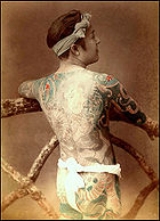
Irezumi is a Japanese
word that refers to the insertion of ink under the skin to leave a permanent, usually decorative mark; a form of tattoo
ing.
The word can be written in several ways, each with slightly different connotations. The most common way of writing irezumi is with the Chinese characters 入れ墨 or 入墨, literally meaning to "insert ink
". The characters 紋身 (also pronounced bunshin) suggest "decorating the body". 剳青 is more esoteric, being written with the characters for "stay" or "remain" and "blue" or "green", and probably refers to the appearance of the main shading ink under the skin. 黥 (meaning "tattooing") is rarely used, and the characters 刺青 combine the meanings "pierce", "stab", or "prick", and "blue" or "green", referring to the traditional Japan
ese method of tattooing by hand.
period (approximately 10,000 BC). Some scholars have suggested that the distinctive cord-marked patterns observed on the faces and bodies of figures dated to that period represent tattoos, but this claim is by no means unanimous. There are similarities, however, between such markings and the tattoo traditions observed in other contemporaneous cultures.
In the following Yayoi period
(c. 300 BC–300 AD) tattoo designs were observed and remarked upon by Chinese visitors. Such designs were thought to have spiritual significance as well as functioning as a status symbol.
Starting in the Kofun period
(300–600 AD) tattoos began to assume negative connotations. Instead of being used for ritual or status purposes, tattooed marks began to be placed on criminals as a punishment (this was mirrored in ancient Rome
, where slaves
were known to have been tattooed with mottoes such as "I am a slave who has run away from his master").
, the indigenous people of Japan, are known to have used tattoos for decorative and social purposes. There is no known relation to the development of irezumi.
(1600–1868 AD) the role of tattoos in Japanese society fluctuated. Tattooed marks were still used as punishment, but minor fads for decorative tattoos—some featuring designs that would be completed only when lovers' hands were joined—also came and went. It was in the Edo period, however, that Japanese decorative tattooing began to develop into the advanced art form it is known as today.
The impetus for the development of the art were the development of the art of woodblock printing and the release of the popular Chinese novel
Suikoden
, a tale of rebel courage and manly bravery illustrated with lavish woodblock prints showing men in heroic scenes, their bodies decorated with dragon
s and other mythical beasts, flowers, ferocious tiger
s and religious images. The novel was an immediate success, and demand for the type of tattoos seen in its illustrations was simultaneous.
Woodblock artists began tattooing. They used many of the same tools for imprinting designs in human
flesh as they did to create their woodblock prints, including chisel
s, gouges and, most importantly, unique ink known as Nara ink, or Nara black, the ink that famously turns blue-green under the skin.
There is academic debate over who wore these elaborate tattoos. Some scholars say that it was the lower classes who wore—and flaunted—such tattoos. Others claim that wealthy merchants, barred by law from flaunting their wealth, wore expensive irezumi under their clothes. It is known for certain that irezumi became associated with firemen, dashing figures of bravery and roguish sex-appeal who wore them as a form of spiritual protection (and, no doubt, for their beauty as well).
the Japanese government, wanting to protect its image and make a good impression on the West, outlawed tattoos, and irezumi took on connotations of criminality. Nevertheless, fascinated foreigners went to Japan seeking the skills of tattoo artists, and traditional tattooing continued underground.
Tattooing was legalized by the occupation forces in 1948, but has retained its image of criminality. For many years, traditional Japanese tattoos were associated with the yakuza
, Japan's notorious mafia
, and many businesses in Japan (such as public baths, fitness centers and hot springs) still ban customers with tattoos.
Tattooing and other forms of body decoration and body modification
, as in much of the western world, are gaining in popularity in Japan. However, Japanese young people who choose to get tattooed are most often choosing "one point" designs—small designs that can be completed in one sitting—usually in the American or tribal
styles. More recently, however sanskrit
Siddham script tattoos are becoming more and more fashionable.
Traditional irezumi is still done by specialist tattooists, but it is painful, time-consuming and expensive: a typical traditional body suit (covering the arms, back, upper legs and chest, but leaving an untattooed space down the center of the body) can take one to five years of weekly visits to complete and cost in excess of US$30,000.
A traditional tattoo artist trains for many years under a master. He (for they are nearly exclusively male) will sometimes live in the master's house. He may spend years cleaning the studio, observing, practicing on his own flesh, making the needles and other tools required, mixing inks, and painstakingly copying designs from the master's book before he is allowed to tattoo clients. He must master all the intricate skills—unique styles of shading, the techniques used for tattooing by hand—required to create the tattoos his clients will request. He will usually be given a tattoo name by his master, most often incorporating the word "hori" (to engrave) and a syllable derived from the master's own name or some other significant word. In some cases, the apprentice will take the master's name, and will become The Second or Third (and so on).
After an initial consultation during which the client will discuss with the tattooist the designs he (again, clients are most frequently male; though women do wear traditional irezumi) is interested in, and work begins with the tattooing of the outline. This will usually be done in one sitting, often freehand (without the use of a stencil), which may require several hours to complete. When the outline is complete, the shading and colouring is done in weekly visits, whenever the client has money to spare. When the tattoo is finished, the artist will "sign" his name in a space reserved for that purpose, most often somewhere on the back.
Wearers of traditional tattoos can often afford little else. They frequently keep their art secret, as tattoos are still seen as a sign of criminality in Japan, particularly by older people and in the work place. Ironically, many yakuza and other criminals themselves avoid tattoos for this very reason.
Japanese language
is a language spoken by over 130 million people in Japan and in Japanese emigrant communities. It is a member of the Japonic language family, which has a number of proposed relationships with other languages, none of which has gained wide acceptance among historical linguists .Japanese is an...
word that refers to the insertion of ink under the skin to leave a permanent, usually decorative mark; a form of tattoo
Tattoo
A tattoo is made by inserting indelible ink into the dermis layer of the skin to change the pigment. Tattoos on humans are a type of body modification, and tattoos on other animals are most commonly used for identification purposes...
ing.
The word can be written in several ways, each with slightly different connotations. The most common way of writing irezumi is with the Chinese characters 入れ墨 or 入墨, literally meaning to "insert ink
Ink
Ink is a liquid or paste that contains pigments and/or dyes and is used to color a surface to produce an image, text, or design. Ink is used for drawing and/or writing with a pen, brush, or quill...
". The characters 紋身 (also pronounced bunshin) suggest "decorating the body". 剳青 is more esoteric, being written with the characters for "stay" or "remain" and "blue" or "green", and probably refers to the appearance of the main shading ink under the skin. 黥 (meaning "tattooing") is rarely used, and the characters 刺青 combine the meanings "pierce", "stab", or "prick", and "blue" or "green", referring to the traditional Japan
Japan
Japan is an island nation in East Asia. Located in the Pacific Ocean, it lies to the east of the Sea of Japan, China, North Korea, South Korea and Russia, stretching from the Sea of Okhotsk in the north to the East China Sea and Taiwan in the south...
ese method of tattooing by hand.
History of Japanese tattoos
Tattooing for spiritual and decorative purposes in Japan is thought to extend back to at least the Jōmon or paleolithicPaleolithic
The Paleolithic Age, Era or Period, is a prehistoric period of human history distinguished by the development of the most primitive stone tools discovered , and covers roughly 99% of human technological prehistory...
period (approximately 10,000 BC). Some scholars have suggested that the distinctive cord-marked patterns observed on the faces and bodies of figures dated to that period represent tattoos, but this claim is by no means unanimous. There are similarities, however, between such markings and the tattoo traditions observed in other contemporaneous cultures.
In the following Yayoi period
Yayoi period
The is an Iron Age era in the history of Japan traditionally dated 300 BC to 300 AD. It is named after the neighbourhood of Tokyo where archaeologists first uncovered artifacts and features from that era. Distinguishing characteristics of the Yayoi period include the appearance of new...
(c. 300 BC–300 AD) tattoo designs were observed and remarked upon by Chinese visitors. Such designs were thought to have spiritual significance as well as functioning as a status symbol.
Starting in the Kofun period
Kofun period
The is an era in the history of Japan from around 250 to 538. It follows the Yayoi period. The word kofun is Japanese for the type of burial mounds dating from this era. The Kofun and the subsequent Asuka periods are sometimes referred to collectively as the Yamato period...
(300–600 AD) tattoos began to assume negative connotations. Instead of being used for ritual or status purposes, tattooed marks began to be placed on criminals as a punishment (this was mirrored in ancient Rome
Rome
Rome is the capital of Italy and the country's largest and most populated city and comune, with over 2.7 million residents in . The city is located in the central-western portion of the Italian Peninsula, on the Tiber River within the Lazio region of Italy.Rome's history spans two and a half...
, where slaves
Slavery
Slavery is a system under which people are treated as property to be bought and sold, and are forced to work. Slaves can be held against their will from the time of their capture, purchase or birth, and deprived of the right to leave, to refuse to work, or to demand compensation...
were known to have been tattooed with mottoes such as "I am a slave who has run away from his master").
Ainu tattoos
The Ainu peopleAinu people
The , also called Aynu, Aino , and in historical texts Ezo , are indigenous people or groups in Japan and Russia. Historically they spoke the Ainu language and related varieties and lived in Hokkaidō, the Kuril Islands, and much of Sakhalin...
, the indigenous people of Japan, are known to have used tattoos for decorative and social purposes. There is no known relation to the development of irezumi.
Japanese tattoos in the Edo period
Until the Edo periodEdo period
The , or , is a division of Japanese history which was ruled by the shoguns of the Tokugawa family, running from 1603 to 1868. The political entity of this period was the Tokugawa shogunate....
(1600–1868 AD) the role of tattoos in Japanese society fluctuated. Tattooed marks were still used as punishment, but minor fads for decorative tattoos—some featuring designs that would be completed only when lovers' hands were joined—also came and went. It was in the Edo period, however, that Japanese decorative tattooing began to develop into the advanced art form it is known as today.
The impetus for the development of the art were the development of the art of woodblock printing and the release of the popular Chinese novel
Novel
A novel is a book of long narrative in literary prose. The genre has historical roots both in the fields of the medieval and early modern romance and in the tradition of the novella. The latter supplied the present generic term in the late 18th century....
Suikoden
Water Margin
Water Margin , also known as Outlaws of the Marsh, All Men Are Brothers, Men of the Marshes, or The Marshes of Mount Liang, is one of the Four Great Classical Novels of Chinese literature.Attributed to Shi Nai'an and written in vernacular Chinese, the story, set in the Song Dynasty,...
, a tale of rebel courage and manly bravery illustrated with lavish woodblock prints showing men in heroic scenes, their bodies decorated with dragon
Chinese dragon
Chinese dragons are legendary creatures in Chinese mythology and folklore, with mythic counterparts among Japanese, Korean, Vietnamese, Bhutanese, Western and Turkic dragons. In Chinese art, dragons are typically portrayed as long, scaled, serpentine creatures with four legs...
s and other mythical beasts, flowers, ferocious tiger
Tiger
The tiger is the largest cat species, reaching a total body length of up to and weighing up to . Their most recognizable feature is a pattern of dark vertical stripes on reddish-orange fur with lighter underparts...
s and religious images. The novel was an immediate success, and demand for the type of tattoos seen in its illustrations was simultaneous.
Woodblock artists began tattooing. They used many of the same tools for imprinting designs in human
Human
Humans are the only living species in the Homo genus...
flesh as they did to create their woodblock prints, including chisel
Chisel
A chisel is a tool with a characteristically shaped cutting edge of blade on its end, for carving or cutting a hard material such as wood, stone, or metal. The handle and blade of some types of chisel are made of metal or wood with a sharp edge in it.In use, the chisel is forced into the material...
s, gouges and, most importantly, unique ink known as Nara ink, or Nara black, the ink that famously turns blue-green under the skin.
There is academic debate over who wore these elaborate tattoos. Some scholars say that it was the lower classes who wore—and flaunted—such tattoos. Others claim that wealthy merchants, barred by law from flaunting their wealth, wore expensive irezumi under their clothes. It is known for certain that irezumi became associated with firemen, dashing figures of bravery and roguish sex-appeal who wore them as a form of spiritual protection (and, no doubt, for their beauty as well).
Tattoos in modern Japan
At the beginning of the Meiji periodMeiji period
The , also known as the Meiji era, is a Japanese era which extended from September 1868 through July 1912. This period represents the first half of the Empire of Japan.- Meiji Restoration and the emperor :...
the Japanese government, wanting to protect its image and make a good impression on the West, outlawed tattoos, and irezumi took on connotations of criminality. Nevertheless, fascinated foreigners went to Japan seeking the skills of tattoo artists, and traditional tattooing continued underground.
Tattooing was legalized by the occupation forces in 1948, but has retained its image of criminality. For many years, traditional Japanese tattoos were associated with the yakuza
Yakuza
, also known as , are members of traditional organized crime syndicates in Japan. The Japanese police, and media by request of the police, call them bōryokudan , literally "violence group", while the yakuza call themselves "ninkyō dantai" , "chivalrous organizations". The yakuza are notoriously...
, Japan's notorious mafia
Mafia
The Mafia is a criminal syndicate that emerged in the mid-nineteenth century in Sicily, Italy. It is a loose association of criminal groups that share a common organizational structure and code of conduct, and whose common enterprise is protection racketeering...
, and many businesses in Japan (such as public baths, fitness centers and hot springs) still ban customers with tattoos.
Tattooing and other forms of body decoration and body modification
Body modification
Body modification is the deliberate altering of the human body for any non-medical reason, such as aesthetics, sexual enhancement, a rite of passage, religious reasons, to display group membership or affiliation, to create body art, shock value, or self expression...
, as in much of the western world, are gaining in popularity in Japan. However, Japanese young people who choose to get tattooed are most often choosing "one point" designs—small designs that can be completed in one sitting—usually in the American or tribal
Tribe
A tribe, viewed historically or developmentally, consists of a social group existing before the development of, or outside of, states.Many anthropologists use the term tribal society to refer to societies organized largely on the basis of kinship, especially corporate descent groups .Some theorists...
styles. More recently, however sanskrit
Sanskrit
Sanskrit , is a historical Indo-Aryan language and the primary liturgical language of Hinduism, Jainism and Buddhism.Buddhism: besides Pali, see Buddhist Hybrid Sanskrit Today, it is listed as one of the 22 scheduled languages of India and is an official language of the state of Uttarakhand...
Siddham script tattoos are becoming more and more fashionable.
Traditional irezumi is still done by specialist tattooists, but it is painful, time-consuming and expensive: a typical traditional body suit (covering the arms, back, upper legs and chest, but leaving an untattooed space down the center of the body) can take one to five years of weekly visits to complete and cost in excess of US$30,000.
The making of a Japanese tattoo
The prospective tattooee must first find a traditional tattoo artist. This in itself can be a daunting task (though it has been made easier by advent of the Internet) because such artists are often surprisingly secretive, and introductions are frequently made by word of mouth only.A traditional tattoo artist trains for many years under a master. He (for they are nearly exclusively male) will sometimes live in the master's house. He may spend years cleaning the studio, observing, practicing on his own flesh, making the needles and other tools required, mixing inks, and painstakingly copying designs from the master's book before he is allowed to tattoo clients. He must master all the intricate skills—unique styles of shading, the techniques used for tattooing by hand—required to create the tattoos his clients will request. He will usually be given a tattoo name by his master, most often incorporating the word "hori" (to engrave) and a syllable derived from the master's own name or some other significant word. In some cases, the apprentice will take the master's name, and will become The Second or Third (and so on).
After an initial consultation during which the client will discuss with the tattooist the designs he (again, clients are most frequently male; though women do wear traditional irezumi) is interested in, and work begins with the tattooing of the outline. This will usually be done in one sitting, often freehand (without the use of a stencil), which may require several hours to complete. When the outline is complete, the shading and colouring is done in weekly visits, whenever the client has money to spare. When the tattoo is finished, the artist will "sign" his name in a space reserved for that purpose, most often somewhere on the back.
Wearers of traditional tattoos can often afford little else. They frequently keep their art secret, as tattoos are still seen as a sign of criminality in Japan, particularly by older people and in the work place. Ironically, many yakuza and other criminals themselves avoid tattoos for this very reason.
Glossary of Japanese tattoo terms
- Irezumi (入れ墨, 入墨, 文身 (also pronounced bunshin), 剳青, 黥 or 刺青): tattoo (nounNounIn linguistics, a noun is a member of a large, open lexical category whose members can occur as the main word in the subject of a clause, the object of a verb, or the object of a preposition .Lexical categories are defined in terms of how their members combine with other kinds of...
or verbVerbA verb, from the Latin verbum meaning word, is a word that in syntax conveys an action , or a state of being . In the usual description of English, the basic form, with or without the particle to, is the infinitive...
) - Horimono (彫り物, 彫物, literally carving, engraving): tattoo. This is another word for traditional Japanese tattoos.
- Horishi (彫り師, 彫物師): a tattoo artist.
- Bokukei, bokkei (墨刑): punishment by tattooing.
- Tebori (手彫り, literally to carve by hand): describes the technique of tattooing by hand.
- Hanebori (羽彫り, literally to carve with a feather): a hand-tattooing technique employing a feathering motion.
- Tsuki-bori (突き彫り): a hand-tattooing technique employing a thrusting motion.
- Kakushibori (隠し彫り, literally hidden carving): tattooing near the armpits, the inside of the thighs and other "hidden" body areas. Also refers to the tattooing of hidden words, for example among the petals of flowers.
- Kebori (毛彫り): the tattooing of fine lines or of hair on tattooed figures.
- Sujibori (筋彫り): outlining, the outline of a tattoo.
- Shakki: the sound needles make when they puncture the skin.
- Irebokuro (入れ黒子): from ire or ireru, which means to insert, and bokuro or hokuro, a beauty spot
- Yobori: "Yo" (European) tattooing. The Japanese-English slang term for tattooing done with the machine.
- Sumi (墨): The ink used to tattooTattooA tattoo is made by inserting indelible ink into the dermis layer of the skin to change the pigment. Tattoos on humans are a type of body modification, and tattoos on other animals are most commonly used for identification purposes...
, traditionally mixed by the apprentice - Hikae: Chest panel tattoo
- Nagasode (長袖): Arm tattoo, to the wrist
- Shichibu (七分): Tattoo 7/10ths of the sleeve to the forearm
- Gobu (五分): Tattoo 5/10ths of the sleeve to above the elbow
Symbolism in Japanese tattoos
Some common images in traditional Japanese tattoos include:- MythologicalJapanese mythologyJapanese mythology is a system of beliefs that embraces Shinto and Buddhist traditions as well as agriculturally based folk religion. The Shinto pantheon comprises innumerable kami...
beasts and monsters: DragonsChinese dragonChinese dragons are legendary creatures in Chinese mythology and folklore, with mythic counterparts among Japanese, Korean, Vietnamese, Bhutanese, Western and Turkic dragons. In Chinese art, dragons are typically portrayed as long, scaled, serpentine creatures with four legs...
, KirinQilinThe Qilin is a mythical hooved Chinese chimerical creature known throughout various East Asian cultures, and is said to appear with the imminent arrival or passing of a wise sage or an illustrious ruler. It is a good omen that brings rui . It is often depicted with what looks like fire all over...
, BakuBaku (spirit)are Japanese supernatural beings that devour dreams and nightmares. They have a long history in Japanese folklore and art, and more recently have appeared in Japanese anime and manga ....
, Foo DogChinese guardian lionsChinese guardian lions, known as Shishi lions or Imperial guardian lion, and often incorrectly called "Foo Dogs" in the West, are a common representation of the lion in pre-modern China...
s, Hō-ō (鳳凰, PhoenixesFenghuangFenghuang are mythological birds of East Asia that reign over all other birds. The males are called Feng and the females Huang. In modern times, however, such a distinction of gender is often no longer made and the Feng and Huang are blurred into a single feminine entity so that the bird can be...
) - Animals: Birds, KoiKoior more specifically , are ornamental varieties of domesticated common carp that are kept for decorative purposes in outdoor koi ponds or water gardens....
(CarpCommon carpThe Common carp is a widespread freshwater fish of eutrophic waters in lakes and large rivers in Europe and Asia. The wild populations are considered vulnerable to extinction, but the species has also been domesticated and introduced into environments worldwide, and is often considered an invasive...
), TigerTigerThe tiger is the largest cat species, reaching a total body length of up to and weighing up to . Their most recognizable feature is a pattern of dark vertical stripes on reddish-orange fur with lighter underparts...
s, SnakeSnakeSnakes are elongate, legless, carnivorous reptiles of the suborder Serpentes that can be distinguished from legless lizards by their lack of eyelids and external ears. Like all squamates, snakes are ectothermic, amniote vertebrates covered in overlapping scales...
s - Flowers: PeoniesPeonyPeony or paeony is a name for plants in the genus Paeonia, the only genus in the flowering plant family Paeoniaceae. They are native to Asia, southern Europe and western North America...
, Cherry BlossomsSakuraA cherry blossom is the flower of any of several trees of genus Prunus, particularly the Japanese Cherry, Prunus serrulata, which is sometimes called sakura after the Japanese . Many of the varieties that have been cultivated for ornamental use do not produce fruit...
, LotusNelumbo nuciferaNelumbo nucifera, known by a number of names including Indian Lotus, Sacred Lotus, Bean of India, or simply Lotus, is a plant in the monogeneric family Nelumbonaceae...
es, ChrysanthemumChrysanthemumChrysanthemums, often called mums or chrysanths, are of the genus constituting approximately 30 species of perennial flowering plants in the family Asteraceae which is native to Asia and northeastern Europe.-Etymology:...
s - Other plants: BambooBambooBamboo is a group of perennial evergreens in the true grass family Poaceae, subfamily Bambusoideae, tribe Bambuseae. Giant bamboos are the largest members of the grass family....
, Maple leaves - Characters from traditional folklore and literature, such as the SuikodenWater MarginWater Margin , also known as Outlaws of the Marsh, All Men Are Brothers, Men of the Marshes, or The Marshes of Mount Liang, is one of the Four Great Classical Novels of Chinese literature.Attributed to Shi Nai'an and written in vernacular Chinese, the story, set in the Song Dynasty,...
- Images of the "Floating WorldUkiyoUkiyo described the urban lifestyle, especially the pleasure-seeking aspects, of Edo-period Japan . The "Floating World" culture developed in Yoshiwara, the licensed red-light district of Edo , which was the site of many brothels, chashitsu tea houses, and kabuki theaters frequented by Japan's...
" inspired by ukiyo-eUkiyo-e' is a genre of Japanese woodblock prints and paintings produced between the 17th and the 20th centuries, featuring motifs of landscapes, tales from history, the theatre, and pleasure quarters...
prints: geishaGeisha, Geiko or Geigi are traditional, female Japanese entertainers whose skills include performing various Japanese arts such as classical music and dance.-Terms:...
, samuraiSamuraiis the term for the military nobility of pre-industrial Japan. According to translator William Scott Wilson: "In Chinese, the character 侍 was originally a verb meaning to wait upon or accompany a person in the upper ranks of society, and this is also true of the original term in Japanese, saburau... - BuddhasBuddhahoodIn Buddhism, buddhahood is the state of perfect enlightenment attained by a buddha .In Buddhism, the term buddha usually refers to one who has become enlightened...
and Buddhist deities such as Fudō Myō-ōAcalaIn Vajrayana Buddhism, Ācala is the best known of the Five Wisdom Kings of the Womb Realm. He is also known as Ācalanātha, Āryācalanātha, Ācala-vidyā-rāja and . The Sanskrit term ācala means "immovable"; Ācala is also the name of the eighth of the ten completion stages of the Bodhisattva path...
and Kannon - ShintoShintoor Shintoism, also kami-no-michi, is the indigenous spirituality of Japan and the Japanese people. It is a set of practices, to be carried out diligently, to establish a connection between present day Japan and its ancient past. Shinto practices were first recorded and codified in the written...
kamiKamiis the Japanese word for the spirits, natural forces, or essence in the Shinto faith. Although the word is sometimes translated as "god" or "deity", some Shinto scholars argue that such a translation can cause a misunderstanding of the term...
(deities) such as tenguTenguare a class of supernatural creatures found in Japanese folklore, art, theater, and literature. They are one of the best known yōkai and are sometimes worshipped as Shinto kami... - Backgrounds: clouds, waves, wind bars.
Further reading
- Andrews, Joshua. The Art of Tattooing. howtotattoo.net, 2008.
- Fellman, Sandi. The Japanese Tattoo. New York: Abbeville Press, 1986. ISBN 0896597989, ISBN 0896596613.
- Richie, Donald, and Ian Buruma. The Japanese Tattoo. New York: Weatherhill, 1980. ISBN 0834801493.
External links
- BMEZine—Body Modification EZine
- Irezumi—Irezumi by Horiyoshi IIIHoriyoshi IIIHoriyoshi III is a horishi tattoo artist, specializing in Japanese traditional full-body tattoos, or "suits," called Irezumi or Horimono.-Biography:Horiyoshi III was born Yoshihito Nakano in 1946....
- tattoo-navi—irezumi from japan