
All Topics  
Koi

 
Koi

   Email Print
   Bookmark   Link


Koi


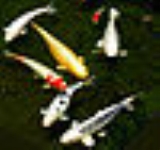
, or more specifically (literally "brocaded carp"), are ornamental domesticated varieties of the common carp
Common carp

The Common carp or European carp is a widespread freshwater fish most closely related to the common goldfish , with which it is capable of Hybrid ....
 Cyprinus carpio. They are also sometimes called Japanese carp.

carp
Carp

Carp is a common name for various freshwater fish of the family Cyprinidae, a very large group of fish originally from Eurasia and southeast Asia....
 is a large group of fish originally found in Central Europe and Asia. Various carp species were domesticated
Domestication

Domestication or taming refers to the process whereby a population of living things becomes accustomed to a controlled environment by other plants or animals through a process of Selective breeding....
 in China and South East Asia, where it was used as a food fish. The ability of carp to survive and adapt to many climates and water conditions allowed the domesticated species to be propagated to many new locations including Japan.


Discussion
Ask a question about 'Koi'
Start a new discussion about 'Koi'
Answer questions from other users
Full Discussion Forum


Recent Posts


Encyclopedia


, or more specifically (literally "brocaded carp"), are ornamental domesticated varieties of the common carp
Common carp

The Common carp or European carp is a widespread freshwater fish most closely related to the common goldfish , with which it is capable of Hybrid ....
 Cyprinus carpio. They are also sometimes called Japanese carp.

Origins

The carp
Carp

Carp is a common name for various freshwater fish of the family Cyprinidae, a very large group of fish originally from Eurasia and southeast Asia....
 is a large group of fish originally found in Central Europe and Asia. Various carp species were domesticated
Domestication

Domestication or taming refers to the process whereby a population of living things becomes accustomed to a controlled environment by other plants or animals through a process of Selective breeding....
 in China and South East Asia, where it was used as a food fish. The ability of carp to survive and adapt to many climates and water conditions allowed the domesticated species to be propagated to many new locations including Japan. Natural color mutations of these carp would have occurred across all populations. Historical records indicate that carp were first bred for color mutations in China
China

China is a Culture of China, an ancient civilization, and, depending on perspective, a national or multinational entity extending over a large area in East Asia....
. Selective breeding of the Prussian carp led to the development of the goldfish
Goldfish

The goldfish is a domesticated version of the Prussian carp , a dark-gray/brown carp native to Asia. It was first bred for color in China over 1,000 years ago....
. By the Song Dynasty
Song Dynasty

The Song Dynasty was a ruling Chinese dynasty in China between 960–1279 AD; it succeeded the Five Dynasties and Ten Kingdoms Period, and was followed by the Yuan Dynasty....
 (960 – 1279), yellow, orange, white and red-and-white coloration had been developed. Goldfish were introduced to Japan in the 16th century and to Europe in the 17th century.

Of the various domesticated carp species, the common carp
Common carp

The Common carp or European carp is a widespread freshwater fish most closely related to the common goldfish , with which it is capable of Hybrid ....
 is the most commonly raised food fish used in aquaculture. The common carp are known as koi in Japan. Koi were first bred for color in Japan
Japan

Japan is an island country in East Asia. Located in the Pacific Ocean, it lies to the east of the Sea of Japan, People's Republic of China, North Korea, South Korea and Russia, stretching from the Sea of Okhotsk in the north to the East China Sea and Taiwan in the south....
 in the 1820s, initially in the town of Ojiya in the Niigata prefecture
Niigata Prefecture

is a Prefectures of Japan of Japan located on Honshu island on the coast of the Sea of Japan. The capital is the city of Niigata, Niigata. The name Niigata literally means "New Lagoon"....
 on the north eastern coast of Honshu
Honshu

or Honshu is the largest island of Japan. The nation's main island, it is south of Hokkaido across the Tsugaru Strait, north of Shikoku across the Inland Sea, and northeast of Kyushu across the Kanmon Strait....
 island. By the 20th century, a number of color patterns had been established, most notably the red-and-white Kohaku. The outside world was not aware of the development of color variations in koi until 1914, when the Niigata koi were exhibited in the annual exposition in Tokyo
Tokyo

, officially , is one of the 47 prefectures of Japan of Japan and located on the eastern side of the main island Honshu. The twenty-three special wards of Tokyo, each governed as a city, cover the area that was once the Tokyo City in the eastern part of the prefecture, and total over 8 million people....
. At that point, interest in koi exploded throughout Japan. The hobby of keeping koi eventually spread worldwide. Koi are now commonly sold in most pet stores, with higher-quality fish available from specialist dealers.

Koi varieties are distinguished by coloration, patterning, and scalation. Ghost koi, developed in the 1980s are metallic hybrids of wild carp and Ogon koi and are not considered true Nishikigoi. Butterfly koi
Butterfly Koi

Butterfly Koi, Longfin Koi, or Dragon Carp are a type of ornamental fish notable for their elongated finnage. The fish are a breed of the common carp, Cyprinus carpio, which includes numerous wild carp Race as well as domesticated koi ....
, Longfin koi, or Dragon Carp were also developed in the 1980s and are notable for their long and flowing fins. They are actually hybrids with Asian carp
Asian carp

There are many species of heavy-bodied cyprinid fishes collectively known as Asian carps. Heavy-bodied cyprinids from the subcontinent are not included in this classification and are known collectively as "Indian Carps"....
 and, like Ghost koi, are not considered true Nishikigoi. Koi fish are very shy, and will dart away with ease.

Differences with Goldfish

Koi Head Closeup
Goldfish and koi were developed from different species of carp; although they can interbreed, their offspring are sterile. Goldfish were domesticated from the the Prussian carp (Carassius gibelio), whereas koi are the domesticated version of the common carp
Common carp

The Common carp or European carp is a widespread freshwater fish most closely related to the common goldfish , with which it is capable of Hybrid ....
 (Cyprinus carpio). In general, goldfish tend to be smaller than koi, and have a greater variety of body shapes, and fin and tail configurations. Koi varieties tend to have a common body shape, but have a greater variety of coloration and color patterns. They also have prominent barbels
Barbel (anatomy)

A barbel on a fish is a slender, whiskerlike tactile organ near the mouth. Fish that have barbels include the catfish, the carp, the goatfish, sturgeon, and some species of shark....
 on the lip. Some goldfish varieties, such as the common goldfish
Common goldfish

Common goldfish are a type of goldfish with no other modifications from their ancestors other than their color. Most varieties of fancy goldfish were derived from this simple breed....
 and shubunkin
Shubunkin

are a hardy, single-tailed fancy goldfish with scales, and a pattern known as Calico . The shubunkins are of Japan origin....
 have body shapes and coloration that are similar to koi, and can be difficult to tell apart from koi when immature.

Etymology

The word "koi" comes from Japanese
Japanese language

IPA: [n?iho?go] is a language spoken by over 130 million people in Japan and in Japanese emigrant communities. It is related to the Ryukyuan languages....
, simply meaning "carp." It includes both the dull grey fish and the brightly colored varieties. A homophone
Homophone

A homophone is a word that is pronounced the same as another word but differs in meaning. The words may be spelled the same, such as rose and rose , or differently, such as Carat , caret, and carrot, or to, two and too....
 of koi means "love, affection" and koi are therefore symbols of love and friendship in Japan: a good example is the short story Koi-san by Mukoda Kuniko. Koi tattoos have become a popular trend in North America.

Varieties

Mango Koi
Koi have many different colors. Some of the major colors are white, black, red, yellow, blue, and cream.

While the possible variations are limitless, breeders have identified and named a number of specific categories. The most popular category is Gosanke, which is made up of the Kohaku, Taisho Sanshoku, and Showa Sanshoku varieties.

The major named varieties include: A white-skinned koi, with large red markings on the top. The name means "red and white;" kohaku was the first ornamental variety to be established in Japan (late 19th century). Very similar to the Kohaku, except for the addition of small black markings called . This variety was first exhibited in 1914 by the koi breeder, Gonzo Hiroi, during the reign of the Taisho Emperor. In America, the name is often abbreviated to just "Sanke". The kanji, ??, may be read as either sanshoku or as sanke. A black koi with red (hi ?) and white (shiroji ??) markings. The first Showa Sanke was exhibited in 1927, during the reign of the Showa Emperor. In America, the name is often abbreviated to just Showa. The amount of shiroji on Showa Sanke has increased in modern times (Kindai Showa ????), to the point where it can be impossible to distinguish from Taisho Sanke. The kanji, ??, may be read as either sanshoku or as sanke. Any koi with a solitary red patch on its head. The fish may be a Tancho Showa, Tancho Sanke, or even Tancho Goshiki. Named for the Japanese crane (Grus japonensis) which also has a red spot on its head. A koi that is light blue above and red below. The Japanese name means "light blue." Sometime incorrectly written as ?? (light yellow). A black koi with a white, red, or yellow markings. The oldest attested form is the yellow form, called in the 19th century, but renamed by Elizaburo Hoshino, an early 20th century koi breeder. The red and white versions are called and respectively. The word utsuri means to print (the black markings are reminiscent of ink stains). A white-, red-, or yellow-skinned koi with small black markings . The Japanese name means "tortoise shell," and is also written as ???. The white- red- and yellow varieties are called and respectively. May be confused with the Utsuri. A black koi with red, white, brown, and blue accents. The Japanese name means "Autumn jade." The Shusui was created in 1910 by Yoshigoro Akiyama, by crossing Japanese Asagi with German mirror carp. The fish has no scales, except for a single line of large mirror scales dorsally, extending from head to tail. The name is sometimes also written as ??. A koi with metallic scales. The name translates into English as "gold and silver scales." Often abbreviated to Ginrin. There are Ginrin versions of almost all other varieties of koi, and they are fashionable. A "catch-all" term for koi that cannot be put into one of the other categories. This is a competition category (you cannot buy a "kawarigoi" from a pet shop) and many new varieties of koi compete against each other within this one category. Also known as A koi of one color only, but with metallic scales (ginrin ?? or hikarimono ??). The most commonly encountered colours are gold, platinum, and orange. Cream specimens exist but are very rare. Ogon compete in the Kawarimono category and the Japanese name means "Gold." The variety was created by Sawata Aoki in 1946 from wild carp he caught in 1921. Kumonryu is a black fish with curling white markings. The patterns are thought to be reminiscent of Japanese ink paintings of dragons. They famously change colour with the seasons. Kumonryu compete in the Kawarimono category. A German mirror carp with only a single line of large mirror-like scales along the top. Also written as ???. A light blue koi with yellow patches, reminiscent of autumn leaves on water. The Japanese name means "fallen leaves." Koi with patches of blue- or black-edged scales. This variety first arose in the 1950's as a cross between a Kohaku and an Asagi. The most commonly encountered Koromo is an Ai Goromo, which is coloured like a Kohaku, except that each of the scales within the red patches has a blue- or black-edge to it. A koi with coloured markings over a metallic base, or koi in two metallic colours.
  • Ghost koi - "hybrid" of Ogon and wild carp. Not Nishikigoi.
  • Butterfly koi
    Butterfly Koi

    Butterfly Koi, Longfin Koi, or Dragon Carp are a type of ornamental fish notable for their elongated finnage. The fish are a breed of the common carp, Cyprinus carpio, which includes numerous wild carp Race as well as domesticated koi ....
     - long-finned version of all others. Not Nishikigoi. Bred in America and introduced back into Japan.


Keeping


The common carp is a hardy fish, and koi retain that durability. Koi are cold-water fish, but benefit from being kept in the 15-25 degrees C (59-77 degrees F) range and do not react well to long cold winter temperatures, their immune system 'turning off' below 10 degrees C. Koi ponds have a meter or more of depth in areas of the world that become warm during the summer. In areas that have harsh winters, ponds that are a minimum of 1.5 meters (4 1/2 feet) are most common.

Koi's bright colors put them at a severe disadvantage against predators; a white-skinned Kohaku is a visual dinner bell against the dark green of a pond. Heron
Heron

The herons are wading birds in the Ardeidae family. Some are called egrets or bitterns instead of herons.Within the family, all members of the genera Botaurus and Ixobrychus are referred to as bitterns, and - including the Zigzag Heron or Zigzag Bittern - are a monophyletic group within the Ardeidae....
s, kingfisher
Kingfisher

Kingfishers are small bright colored birds of the three families Alcedinidae , Halcyonidae , and Cerylidae . There are roughly 90 species of kingfisher....
s, raccoon
Raccoon

Procyon is a genus of nocturnal mammals, comprising three species commonly known as raccoons, in the family Procyonidae. The most widespread species, the Raccoon , is often known simply as "the" raccoon, as the two other raccoon species in the genus are native only to the tropics and are considerably lesser-known....
s, cat
Cat

The cat , also known as the Domestication cat or house cat to distinguish it from other Felinae and Felidae, is a small predationy carnivore species of crepuscular mammal that is valued by humans for its companionship and its ability to hunt vermin, snakes, scorpions, and other unwanted household pests....
s, fox
Fox

A fox is an animal belonging to any one of about 27 species of small to medium-sized Canidae, characterized by possessing a long, narrow snout, and a bushy tail, or brush....
es, and badgers are all capable of emptying a pond of its fish. A well-designed outdoor pond will have areas too deep for herons to stand in, overhangs high enough above the water that mammals can't reach in, and shade trees overhead to block the view of aerial passers-by. It may prove necessary to string nets or wires above the surface. A pond usually includes a pump
Pump

A pump is a device used to move fluids, such as gases, liquids or Slurry. A pump displaces a volume by physical or mechanical action. One common misconception about pumps is the thought that they create pressure....
 and filtration
Filtration

Filtration is a mechanical or physical operation which is used for the separation of solids from fluids by interposing a medium to fluid flow through which the fluid can pass, but the solids in the fluid are retained....
 system to keep the water clear.

Koi are an omnivorous fish and will often eat a wide variety of foods, including peas, lettuce, and watermelons. Koi food is designed not only to be nutritionally balanced, but also to float so as to encourage them to come to the surface. When they are eating, it is possible to check koi for parasites and ulcers. Koi will recognize the person feeding them and gather around him or her at feeding times. They can be trained to take food from one's hand. In the winter, their digestive system slows nearly to a halt, and they eat very little, perhaps no more than nibbles of algae from the bottom. Their appetite will not come back until the water becomes warm in the spring. When the temperature drops below 50 degrees Fahrenheit (10 °C), feeding, particularly with protein, is halted or the food can go rancid in their stomach, causing sickness.

Koi can live for decades. One famous scarlet koi, named "Hanako" (c. 1751 – July 7, 1977) was owned by several individuals, the last of which was Dr. Komei Koshihara. Hanako was reportedly 226 years old upon her death. Her age was determined by removing one of her scales and examining it extensively in 1966. She is (to date) the longest-lived koi fish ever recorded.

Culturing

Japanese Water Garden With Carp
Like most fish, koi reproduce through spawning in which a female lays a vast number of eggs and one or more males fertilize them. Nurturing the resulting offspring (referred to as "fry") is a tricky and tedious job, usually done only by professionals. Although a koi breeder may carefully select the parents they wish based on their desired characteristics, the resulting fry will nonetheless exhibit a wide range of color and quality.

Unlike a purebred dog or cat, even the finest champion-grade koi will produce literally thousands of unacceptable, unrecognizable, or even genetically defective offspring in a single spawning. These (and hundreds of marginal offspring) are culled at various stages based on the breeder's expert eye and closely guarded techniques.

Culled fry are usually destroyed (perhaps fed to other fish) and older culls are often sold as lower-grade "pond-quality" koi within their first year (also called "Tosai") at 3"–6" long. The semi-randomized result of the koi's reproductive process is both a blessing and a curse. While it requires diligent oversight to narrow down the favorable result that the breeder wanted all along, it also made possible the gradual transformation of wild river carp into the exquisite art form seen in modern nishikigoi.

In the wild

Koi have been accidentally or deliberately released into the wild in every continent except Antarctica
Antarctica

Antarctica is Earth's southernmost continent, overlying the South Pole. It is situated in the Antarctica of the southern hemisphere, almost entirely south of the Antarctic Circle, and is surrounded by the Southern Ocean....
. They greatly increase the turbidity
Turbidity

Turbidity is the cloudiness or haze of a fluid caused by individual Particle that are generally invisible to the naked eye, similar to smoke in air....
 of the water because they are constantly stirring up the substrate. This makes waterways unattractive, reduces the abundance of aquatic plants, and can render the water unsuitable for swimming or drinking even by livestock. In some countries, koi have caused so much damage to waterways that vast amounts of money and effort have been spent trying to eradicate them, largely unsuccessfully.

Gallery


External links and further readings