


Human papillomavirus

Encyclopedia
Human papillomavirus is a member of the papillomavirus
family of viruses that is capable of infecting humans. Like all papillomaviruses, HPVs establish productive infections only in keratinocyte
s of the skin
or mucous membrane
s. While the majority of the nearly 200 known types of HPV cause no symptoms in most people, some types can cause wart
s (verrucae), while others can – in a minority of cases – lead to cancers of the cervix
, vulva
, vagina
, and anus
in women or cancers of the anus and penis
in men. It can also cause cancers of the head and neck (tongue, tonsils and throat). Recently, HPV has been linked with an increased risk of cardiovascular disease.
More than 30 to 40 types of HPV are typically transmitted through sexual contact and infect the anogenital region. Some sexually transmitted HPV types may cause genital wart
s. Persistent infection with "high-risk" HPV types — different from the ones that cause skin warts — may progress to precancerous lesions and invasive cancer. HPV infection is a cause of nearly all cases of cervical cancer
. However, most infections with these types do not cause disease.
Most HPV infections in young females are temporary and have little long-term significance. Seventy percent of infections are gone in 1 year and ninety percent in 2 years. However, when the infection persists — in 5% to 10% of infected women — there is high risk of developing precancerous lesions of the cervix, which can progress to invasive cervical cancer. This process usually takes 15–20 years, providing many opportunities for detection and treatment of the pre-cancerous lesion. Progression to invasive cancer can be almost always prevented when standard prevention strategies are applied, but the lesions still cause considerable burden necessitating preventive surgeries, which do in many cases involve loss of fertility.
In more developed countries, cervical screening using a Papanicolaou (Pap) test or liquid-based cytology is used to detect abnormal cells that may develop into cancer. If abnormal cells are found, women are invited to have a colposcopy
. During a colposcopic inspection, biopsies can be taken and abnormal areas can be removed with a simple procedure, typically with a cauterizing loop
or, more commonly in the developing world — by freezing
(cryotherapy). Treating abnormal cells in this way can prevent them from developing into cervical cancer.
Pap smears have reduced the incidence and fatalities of cervical cancer in the developed world, but even so there were 11,000 cases and 3,900 deaths in the U.S. in 2008. Cervical cancer has substantial mortality in resource-poor areas; worldwide, there are an estimated 490,000 cases and 270,000 deaths.
HPV vaccine
s (Cervarix
and Gardasil
), which prevent infection with the HPV types (16 and 18) that cause 70% of cervical cancer, may lead to further decreases.
 Over 120 HPV types have been identified and are referred to by number.
Types 16, 18, 31, 33, 35, 39, 45, 51, 52, 56, 58, and 59 are "high-risk" sexually transmitted HPVs and may lead to the development of cervical intraepithelial neoplasia
(CIN), vulvar intraepithelial neoplasia
(VIN), penile intraepithelial neoplasia (PIN), and/or anal intraepithelial neoplasia (AIN).
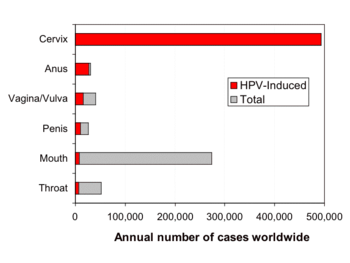
Worldwide in 2002, an estimated 561,200 new cancer cases (5.2% of all new cancers) were attributable to HPV, making HPV one of the most important infectious causes of cancer. 84% of new cervical cancers were in the developing world, compared with about 50% of all new cancers.
About a dozen HPV types (including types 16, 18, 31, and 45) are called "high-risk" types because they can lead to cervical cancer
, as well as anal cancer
, vulvar cancer
, vaginal cancer
, and penile cancer . Several types of HPV, in particular type 16, have been found to be associated with HPV-positive oropharyngeal cancer
(OSCC), a form of head and neck cancer
. HPV-induced cancers often have viral sequences integrated into the cellular DNA. Some of the HPV "early" genes, such as E6 and E7, are known to act as oncogene
s that promote tumor growth and malignant transformation
. Oral infection with HPV increased the risk of HPV-positive oropharyngeal cancer
independent of tobacco
and alcohol
use. In the United States, HPV is expected to replace tobacco as the main causative agent for oral cancer.
The p53
protein prevents cell growth and stimulates apoptosis
in the presence of DNA damage. The p53 also upregulates the p21 protein, which blocks the formation of the Cyclin D/Cdk4
complex, thereby preventing the phosphorylation of RB and, in turn, halting cell cycle progression by preventing the activation of E2F
. In short, p53 is a tumor suppressor gene that arrests the cell cycle when there is DNA damage.
E6 has a close relationship with the cellular protein E6-AP (E6-associated protein). E6-AP is involved in the ubiquitin ligase
pathway, a system that acts to degrade proteins. E6-AP binds ubiquitin to the p53 protein, thereby flagging it for proteosomal degradation.
 Most HPV infections are cleared rapidly by the immune system
and do not progress to cervical cancer. Because the process of transforming normal cervical cells into cancerous ones is slow, cancer occurs in people having been infected with HPV for a long time, usually over a decade or more (persistent infection).
Sexually-transmitted HPVs also cause a major fraction of anal cancer
s and approximately 25% of cancers of the mouth and upper throat (the oropharynx) (see figure). The latter commonly present in the tonsil
area, and HPV is linked to the increase in oral cancers in non-smokers. Engaging in anal sex
or oral sex
with an HPV-infected partner may increase the risk of developing these types of cancers.
Studies show a link between HPV infection and penile and anal cancer, and the risk for anal cancer is 17 to 31 times higher among gay and bisexual men than among heterosexual men. It has been suggested that anal Pap smear
screening for anal cancer might benefit some sub-populations of men or women engaging in anal sex. There is no consensus that such screening is beneficial, or who should get an anal Pap smear.
Further studies have also shown a link between a wide range of HPV types and squamous cell carcinoma of the skin. In vitro studies suggest that the E6 protein of the HPV types implicated may inhibit apoptosis induced by ultraviolet light.
 Some HPV infections can cause warts (verrucae), which are noncancerous skin growths. Infection with these types of HPV causes a rapid growth of cells on the outer layer of the skin. Types of warts include:
Genital warts are quite contagious, while common, flat, and plantar warts are much less likely to spread from person to person.
(condylomata acuminata or venereal warts) are the most easily recognized sign of genital HPV infection. Although a wide variety of HPV types can cause genital warts, types 6 and 11 account for about 90% of all cases.
Most people who acquire genital wart-associated HPV types clear the infection rapidly without ever developing warts or any other symptoms. People may transmit the virus to others even if they do not display overt symptoms of infection.
HPV types that tend to cause genital warts are not those that cause cervical cancer. Since an individual can be infected with multiple types of HPV, the presence of warts does not rule out the possibility of high-risk types of the virus also being present.
The types of HPV that cause genital warts are usually different from the types that cause warts on other parts of the body, such as the hands or inner thighs.
, in which warts form on the larynx or other areas of the respiratory tract.
These warts can recur frequently, may require repetitive surgery, may interfere with breathing, and in extremely rare cases can progress to cancer.
in immunocompromised individuals. The virus, unchecked by the immune system, causes the overproduction of keratin by skin cells, resulting in lesions resembling warts or cutaneous horn
s.
For instance, Dede Koswara, an Indonesian man developed warts that spread across his body and became root-like growths. Attempted treatment by both Indonesian and American doctors included surgical removal of the warts.
HPV infections in that area are transmitted primarily via sexual activity.
At least 40 identified HPV types infect the genital tract. If a college woman has at least one different partner per year for four years, the probability that she will leave college with an HPV infection is greater than 85%. Condoms do not completely protect from the virus because the areas around the genitals including the inner thigh area are not covered, thus exposing these areas to the infected person’s skin.
. The infectious process is slow, taking 12–24 hours for initiation of transcription. It is believed that involved antibodies play a major neutralizing role while the virions still reside on the basement membrane and cell surfaces.
HPV lesions are thought to arise from the proliferation of infected basal keratinocytes. Infection typically occurs when basal cells in the host are exposed to infectious virus through a disturbed epithelial barrier as would occur during sexual intercourse or after minor skin abrasions. HPV infections have not been shown to be cytolytic; rather, viral particles are released as a result of degeneration of desquamating cells. The HPV virus can survive for many months and at low temperatures without a host; therefore, an individual with plantar warts can spread the virus by walking barefoot.
Role in cancer
The E6/E7 proteins inactivate two tumor suppressor proteins, p53 (inactivated by E6) and pRb (inactivated by E7).
The viral oncogene
s E6 and E7 are thought to modify the cell cycle so as to retain the differentiating host keratinocyte in a state that is favourable to the amplification of viral genome replication and consequent late gene expression. E6 in association with host E6-associated protein, which has ubiquitin ligase activity, acts to ubiquitinate p53, leading to its proteosomal degradation. E7 (in oncogenic HPVs) acts as the primary transforming protein. E7 competes for retinoblastoma protein
(pRb) binding, freeing the transcription factor E2F
to transactivate its targets, thus pushing the cell cycle forward. All HPV can induce transient proliferation, but only strains 16 and 18 can immortalize cell lines in vitro. It has also been shown that HPV 16 and 18 cannot immortalize primary rat
cells alone; there needs to be activation of the ras oncogene. In the upper layers of the host epithelium, the late genes L1 and L2 are transcribed/translated and serve as structural proteins that encapsidate the amplified viral genomes. Once the genome is encapsidated, the capsid appears to undergo a redox-dependent assembly/maturation event, which is tied to a natural redox gradient that spans both suprabasal and cornified epithelial tissue layers. This assembly/maturation event stabilizes virions, and increases their specific infectivity. Virions can then be sloughed off in the dead squames
of the host epithelium and the viral lifecycle continues. A 2010 study has found that E6 and E7 are involved in beta-catenin
nuclear accumulation and activation of Wnt signaling
in HPV-induced cancers.
in the world.. Methods of prevention include abstinence, condoms, vaccination and microbicides.
, marketed by Merck
, and Cervarix
, marketed by GlaxoSmithKline
. Both protect against initial infection with HPV types 16 and 18, which cause most of the HPV associated cancer cases. Gardasil also protects against HPV types 6 and 11, which cause 90% of genital warts.
The vaccines provide little benefit to women having already been infected with HPV types 16 and 18, which includes most sexually active females. For this reason, the vaccine is recommended primarily for those women not yet having been exposed to HPV during sex. The World Health Organization
position paper on HPV vaccination clearly outlines appropriate, cost-effective strategies for using HPV vaccine in public sector programs.
Both vaccines are delivered in three shots over six months. In most countries, they are approved only for female use, but are approved for male use in countries like USA and UK. The vaccine does not have any therapeutic effect on existing HPV infections or cervical lesions. In 2010, 49% of teenage girls in the US got the HPV vaccine, while in comparison around two-thirds of teens have gotten shots for meningitis
and DPT vaccine
.
Women should continue to seek cervical screening, such as Pap smear testing, even after receiving the vaccine. Cervical cancer screening recommendations have not changed for females who receive HPV vaccine. Without continued screening, the number of cervical cancers preventable by vaccination alone is less than the number of cervical cancers prevented by regular screening alone.
Both men and women are carriers of HPV. Possible benefits and efficacy of vaccinating men are being studied.
No efficacy trials for children under 15 have been performed. Duration of vaccine efficacy is not yet answered by rigorous methodologic trials. Cervarix efficacy is proven for 7.4 years with published data through 6.4 years while Gardasil efficacy is proven for 5 years. Age of vaccination is less important than the duration of efficacy.
says that male "condom
use may reduce the risk for genital human papillomavirus (HPV) infection" but provides a lesser degree of protection compared with other sexual transmitted diseases "because HPV also may be transmitted by exposure to areas (e.g., infected skin or mucosal surfaces) that are not covered or protected by the condom."
Female condom
s provide somewhat greater protection than male condoms, as the female condom allows for less skin contact.
Studies have suggested that regular condom use can effectively limit the ongoing persistence and spread of HPV to additional genital sites in individuals already infected.
, are currently undergoing clinical efficacy testing. A recent study indicates that some sexual lubricant
brands that use a gelling agent called carrageenan
prevent papillomavirus infection in animal model systems. Clinical trial results announced at the 2010 International Papillomavirus Conference indicate that a carrageenan-based personal lubricant called Carraguard is effective for preventing HPV infection in women. The results suggest that use of carrageenan-based personal lubricant products, such as Divine No 9, Bioglide and Oceanus Carrageenan, may likewise be effective for preventing HPV infection.
Oral HPV infection is associated with HPV-positive oropharyngeal cancer
. Odds of oral HPV infection increases with the number of recent oral sex partners or open-mouthed kissing partners. Nonsexual oral infection through salivary or cross transmission is also plausible.
, which is a "hybrid-capture" test, as the primary screening tool
for detecting HPV cervical infection as an adjunct to Pap testing. The test may be performed during a routine Pap smear. It can detect the DNA of the 18 HPV types that most commonly affect the cervix and distinguish between "low-risk" and "high-risk" HPV types, but it cannot determine the specific HPV types.
According to the National Cancer Institute, "testing samples of cervical cells is an effective way to identify high-risk types of HPV that may be present. The FDA has approved an HPV test as a follow-up for women who have an ambiguous Pap test and, for women over the age of 30, for general cervical cancer screening. This HPV test can identify at least 13 of the high-risk types of HPV associated with the development of cervical cancer. The test can detect high-risk types of HPV even before there are any conclusive visible changes to the cervical cells."
The recent outcomes in the identification of molecular pathways involved in cervical cancer provide helpful information about novel bio- or oncogenic markers that allow monitoring of these essential molecular events in cytological smears, histological, or cytological specimens. These bio- or onco- markers are likely to improve the detection of lesions that have a high risk of progression in both primary screening and triage settings. E6 and E7 mRNA detection PreTect HPV-Proofer, (HPV OncoTect) or p16 cell-cycle protein levels are examples of these new molecular markers. According to published results, these markers, which are highly sensitive and specific, allow to identify cells going through malignant transformation.
Genital warts are the only visible sign of low-risk genital HPV, and can be identified with a visual check. These visible growths, however, are the result of non-carcinogenic HPV types. Five percent acetic acid (vinegar) is used to identify both warts and squamous intraepithelial neoplasia (SIL) lesions with limited success by causing abnormal tissue to appear white, but most doctors have found this technique helpful only in moist areas, such as the female genital tract. At this time, HPV test for males are used only in research.
, the body’s immune system clears HPV naturally within two years for 90% of cases. However, experts do not agree on whether the virus is completely eliminated or reduced to undetectable levels, and it is difficult to know when it is contagious.
suckerfish that hitchhike harmlessly on shark
s, these HPV types can be thought of as human commensals
. Other cutaneous HPVs, such as HPV types 1 or 2, may cause common warts in some infected individuals. Skin warts are most common in childhood and typically appear and regress spontaneously over the course of weeks to months. About 10% of adults also suffer from recurring skin warts. All HPVs are believed to be capable of establishing long-term "latent" infections in small numbers of stem cell
s present in the skin. Although these latent infections may never be fully eradicated, immunological control is thought to block the appearance of symptoms such as warts. Immunological control is HPV type-specific, meaning that an individual may become resistant to one HPV type while remaining susceptible to other types.
High-risk HPV types 16 and 18 are together responsible for over 65% of cervical cancer cases. Type 16 causes 41 to 54% of cervical cancers, and accounts for an even greater majority of HPV-induced vaginal/vulvar cancers, penile cancers, anal cancers and head and neck cancers.
HPV is estimated to be the most common sexually transmitted infection in the United States. Most sexually active men and women will probably acquire genital HPV infection at some point in their lives. The American Social Health Association
reported estimates that about 75-80% of sexually active Americans will be infected with HPV at some point in their lifetime.
By the age of 50 more than 80% of American women will have contracted at least one strain of genital HPV.
It was estimated that, in the year 2000, there were approximately 6.2 million new HPV infections among Americans aged 15–44; of these, an estimated 74% occurred to people between ages of 15 and 24. Of the STDs studied, genital HPV was the most commonly acquired.
Estimates of HPV prevalence vary from 14% to more than 90%. One reason for the difference is that some studies report women who currently have a detectable infection, while other studies report women who have ever had a detectable infection. Another cause of discrepancy is the difference in strains that were tested for.
One study found that, during 2003–2004, at any given time
, 26.8% of women aged 14 to 59 were infected with at least one type of HPV. This was higher than previous estimates; 15.2% were infected with one or more of the high-risk types that can cause cancer. However, only 3.4% were infected with one or more of the four types prevented by the Gardasil
vaccine, which was lower than previous estimates.
The prevalence for high-risk and low-risk types is roughly similar over time. The overall prevalence of high- and low-risk HPV types was 15.2% and 17.8%, respectively.
Note that prevalence decreases with age. This may be due to the HPV infection's being cleared by the immune system, or sinking to undetectable levels while still present in the body. Recent studies from the Albert Einstein College of Medicine and from the University of Washington suggest that HPV may eventually be cleared in most people with well-functioning immune systems.
in epidermodysplasia verruciformis
was proposed by Stefania Jablonska in Poland. In 1978, Jablonska and Gerard Orth at the Pasteur Institute
discovered HPV-5 in skin cancer
. In 1976 Harald zur Hausen
published the hypothesis that human papilloma virus plays an important role in the cause of cervical cancer
. In 1983 and 1984 zur Hausen and his collaborators identified HPV16 and HPV18 in cervical cancer
.
Papillomavirus
Papillomaviridae is an ancient taxonomic family of non-enveloped DNA viruses, collectively known as papillomaviruses. Several hundred species of papillomaviruses, traditionally referred to as "types", have been identified infecting all carefully inspected birds and mammals, but also a small number...
family of viruses that is capable of infecting humans. Like all papillomaviruses, HPVs establish productive infections only in keratinocyte
Keratinocyte
Keratinocytes are the predominant cell type in the epidermis, the outermost layer of the human skin, constituting 95% of the cells found there. Those keratinocytes found in the basal layer of the skin are sometimes referred to as "basal cells" or "basal keratinocytes"...
s of the skin
Skin
-Dermis:The dermis is the layer of skin beneath the epidermis that consists of connective tissue and cushions the body from stress and strain. The dermis is tightly connected to the epidermis by a basement membrane. It also harbors many Mechanoreceptors that provide the sense of touch and heat...
or mucous membrane
Mucous membrane
The mucous membranes are linings of mostly endodermal origin, covered in epithelium, which are involved in absorption and secretion. They line cavities that are exposed to the external environment and internal organs...
s. While the majority of the nearly 200 known types of HPV cause no symptoms in most people, some types can cause wart
Wart
A wart is generally a small, rough growth, typically on a human’s hands or feet but often other locations, that can resemble a cauliflower or a solid blister. They are caused by a viral infection, specifically by human papillomavirus 2 and 7. There are as many as 10 varieties of warts, the most...
s (verrucae), while others can – in a minority of cases – lead to cancers of the cervix
Cervix
The cervix is the lower, narrow portion of the uterus where it joins with the top end of the vagina. It is cylindrical or conical in shape and protrudes through the upper anterior vaginal wall...
, vulva
Vulva
The vulva consists of the external genital organs of the female mammal. This article deals with the vulva of the human being, although the structures are similar for other mammals....
, vagina
Vagina
The vagina is a fibromuscular tubular tract leading from the uterus to the exterior of the body in female placental mammals and marsupials, or to the cloaca in female birds, monotremes, and some reptiles. Female insects and other invertebrates also have a vagina, which is the terminal part of the...
, and anus
Anus
The anus is an opening at the opposite end of an animal's digestive tract from the mouth. Its function is to control the expulsion of feces, unwanted semi-solid matter produced during digestion, which, depending on the type of animal, may be one or more of: matter which the animal cannot digest,...
in women or cancers of the anus and penis
Penis
The penis is a biological feature of male animals including both vertebrates and invertebrates...
in men. It can also cause cancers of the head and neck (tongue, tonsils and throat). Recently, HPV has been linked with an increased risk of cardiovascular disease.
More than 30 to 40 types of HPV are typically transmitted through sexual contact and infect the anogenital region. Some sexually transmitted HPV types may cause genital wart
Genital wart
Genital warts is a highly contagious sexually transmitted disease caused by some sub-types of human papillomavirus . It is spread through direct skin-to-skin contact during oral, genital, or anal sex with an infected partner...
s. Persistent infection with "high-risk" HPV types — different from the ones that cause skin warts — may progress to precancerous lesions and invasive cancer. HPV infection is a cause of nearly all cases of cervical cancer
Cervical cancer
Cervical cancer is malignant neoplasm of the cervix uteri or cervical area. One of the most common symptoms is abnormal vaginal bleeding, but in some cases there may be no obvious symptoms until the cancer is in its advanced stages...
. However, most infections with these types do not cause disease.
Most HPV infections in young females are temporary and have little long-term significance. Seventy percent of infections are gone in 1 year and ninety percent in 2 years. However, when the infection persists — in 5% to 10% of infected women — there is high risk of developing precancerous lesions of the cervix, which can progress to invasive cervical cancer. This process usually takes 15–20 years, providing many opportunities for detection and treatment of the pre-cancerous lesion. Progression to invasive cancer can be almost always prevented when standard prevention strategies are applied, but the lesions still cause considerable burden necessitating preventive surgeries, which do in many cases involve loss of fertility.
In more developed countries, cervical screening using a Papanicolaou (Pap) test or liquid-based cytology is used to detect abnormal cells that may develop into cancer. If abnormal cells are found, women are invited to have a colposcopy
Colposcopy
Colposcopy is a medical diagnostic procedure to examine an illuminated, magnified view of the cervix and the tissues of the vagina and vulva. Many premalignant lesions and malignant lesions in these areas have discernible characteristics which can be detected through the examination...
. During a colposcopic inspection, biopsies can be taken and abnormal areas can be removed with a simple procedure, typically with a cauterizing loop
Loop electrical excision procedure
The loop electrosurgical excision procedure is currently one of the most commonly used approaches to treat high grade cervical dysplasia discovered on colposcopic examination. In UK it is known as "large loop excision of the transformation zone" . The procedure has many advantages including low...
or, more commonly in the developing world — by freezing
Cervical conization
Cervical conization refers to a biopsy of the cervix in which a cone-shaped sample of tissue is removed from the mucous membrane. Conization may be used either for diagnostic purposes, or for therapeutic purposes to remove pre-cancerous cells.Types include:* cold knife conization...
(cryotherapy). Treating abnormal cells in this way can prevent them from developing into cervical cancer.
Pap smears have reduced the incidence and fatalities of cervical cancer in the developed world, but even so there were 11,000 cases and 3,900 deaths in the U.S. in 2008. Cervical cancer has substantial mortality in resource-poor areas; worldwide, there are an estimated 490,000 cases and 270,000 deaths.
HPV vaccine
HPV vaccine
The human papilloma virus vaccine prevents infection with certain species of human papillomavirus associated with the development of cervical cancer, genital warts, and some less common cancers...
s (Cervarix
Cervarix
Cervarix is a vaccine against certain types of cancer-causing human papillomavirus .Cervarix is designed to prevent infection from HPV types 16 and 18, that cause about 70% of cervical cancer cases. These types also cause some other genital cancers and some oropharyngeal cancers...
and Gardasil
Gardasil
Gardasil , also known as Gardisil or Silgard, is a vaccine for use in the prevention of certain types of human papillomavirus , specifically HPV types 6, 11, 16 and 18. HPV types 16 and 18 cause an estimated 70% of cervical cancers, and are responsible for most HPV-induced anal, vulvar, vaginal,...
), which prevent infection with the HPV types (16 and 18) that cause 70% of cervical cancer, may lead to further decreases.
Signs and symptoms
Types 16, 18, 31, 33, 35, 39, 45, 51, 52, 56, 58, and 59 are "high-risk" sexually transmitted HPVs and may lead to the development of cervical intraepithelial neoplasia
Cervical intraepithelial neoplasia
Cervical intraepithelial neoplasia , also known as cervical dysplasia and cervical interstitial neoplasia, is the potentially premalignant transformation and abnormal growth of squamous cells on the surface of the cervix. CIN is not cancer, and is usually curable...
(CIN), vulvar intraepithelial neoplasia
Vulvar intraepithelial neoplasia
The term Vulvar intraepithelial neoplasia refers to particular changes that can occur in the skin that covers the vulva. VIN is not cancer, and in some women it disappears without treatment...
(VIN), penile intraepithelial neoplasia (PIN), and/or anal intraepithelial neoplasia (AIN).
| Disease | HPV type |
|---|---|
| Common wart Wart A wart is generally a small, rough growth, typically on a human’s hands or feet but often other locations, that can resemble a cauliflower or a solid blister. They are caused by a viral infection, specifically by human papillomavirus 2 and 7. There are as many as 10 varieties of warts, the most... s |
2, 7 |
| Plantar wart Plantar wart -External links:* at the Mayo Clinic website* at The Merck Manual* at dermnet.com... s |
1, 2, 4, 63 |
| Flat wart Verruca plana Verruca plana, also known as a "flat wart", is a reddish-brown or flesh-colored, slightly raised, flat-surfaced, well-demarcated papule of 2 to 5 mm in diameter. Upon close inspection, these lesions have a surface that is "finely verrucous". Most often, these lesions affect the hands or... s |
3, 10 |
| Anogenital warts | 6, 11, 42, 44 and others |
| Genital cancer Cancer Cancer , known medically as a malignant neoplasm, is a large group of different diseases, all involving unregulated cell growth. In cancer, cells divide and grow uncontrollably, forming malignant tumors, and invade nearby parts of the body. The cancer may also spread to more distant parts of the... s |
|
| Epidermodysplasia verruciformis Epidermodysplasia verruciformis Epidermodysplasia verruciformis is an extremely rare autosomal recessive genetic hereditary skin disorder associated with a high risk of carcinoma of the skin. It is characterized by abnormal susceptibility to human papillomaviruses of the skin... |
more than 15 types |
| Focal epithelial hyperplasia (oral) | 13, 32 |
| Oral papillomas | 6, 7, 11, 16, 32 |
| Oropharyngeal cancer HPV-positive oropharyngeal cancer Human papillomavirus -positive oropharyngeal cancer also known as HPV16+ oropharyngeal cancer or HPV+ OPC is a recognized subtype of Oropharyngeal squamous cell carcinomas , associated with the HPV type 16 virus.-Causes:... |
16 |
| Laryngeal papillomatosis Laryngeal papillomatosis Laryngeal papillomatosis, also known as recurrent respiratory papillomatosis or glottal papillomatosis, is a rare medical condition , caused by a HPV infection of the throat. Laryngeal papillomatosis causes assorted tumors or papillomas to develop over a period of time... |
6,11 |
Cancer
Worldwide in 2002, an estimated 561,200 new cancer cases (5.2% of all new cancers) were attributable to HPV, making HPV one of the most important infectious causes of cancer. 84% of new cervical cancers were in the developing world, compared with about 50% of all new cancers.
About a dozen HPV types (including types 16, 18, 31, and 45) are called "high-risk" types because they can lead to cervical cancer
Cervical cancer
Cervical cancer is malignant neoplasm of the cervix uteri or cervical area. One of the most common symptoms is abnormal vaginal bleeding, but in some cases there may be no obvious symptoms until the cancer is in its advanced stages...
, as well as anal cancer
Anal cancer
Anal cancer is a type of cancer which arises from the anus, the distal orifice of the gastrointestinal tract. It is a distinct entity from the more common colorectal cancer. The etiology, risk factors, clinical progression, staging, and treatment are all different. Anal cancer is typically a...
, vulvar cancer
Vulvar cancer
Vulvar cancer, a malignant invasive growth in the vulva, accounts for about 4 % of all gynecological cancers and typically affects women in later life. It is estimated that in the United States in 2006 about 3,740 new cases will be diagnosed and about 880 women will die as a result of vulvar cancer...
, vaginal cancer
Vaginal cancer
Vaginal cancer is any type of cancer that forms in the tissues of the vagina. Primary vaginal cancer is rare in the general population of women and is usually a squamous carcinoma. Metastases are more common. Vaginal cancer occurs more often in women over age 50, but can occur at any age, even in...
, and penile cancer . Several types of HPV, in particular type 16, have been found to be associated with HPV-positive oropharyngeal cancer
Oropharyngeal squamous cell carcinomas
Oropharyngeal squamous cell carcinomas is a type of head and neck cancer that begins in the oropharynx, the middle part of the throat that includes the soft palate, the base of the tongue, the tonsils and the side and back wall of the throat...
(OSCC), a form of head and neck cancer
Head and neck cancer
Head and neck cancer refers to a group of biologically similar cancers that start in the upper aerodigestive tract, including the lip, oral cavity , nasal cavity , paranasal sinuses, pharynx, and larynx. 90% of head and neck cancers are squamous cell carcinomas , originating from the mucosal lining...
. HPV-induced cancers often have viral sequences integrated into the cellular DNA. Some of the HPV "early" genes, such as E6 and E7, are known to act as oncogene
Oncogene
An oncogene is a gene that has the potential to cause cancer. In tumor cells, they are often mutated or expressed at high levels.An oncogene is a gene found in the chromosomes of tumor cells whose activation is associated with the initial and continuing conversion of normal cells into cancer...
s that promote tumor growth and malignant transformation
Malignant
Malignancy is the tendency of a medical condition, especially tumors, to become progressively worse and to potentially result in death. Malignancy in cancers is characterized by anaplasia, invasiveness, and metastasis...
. Oral infection with HPV increased the risk of HPV-positive oropharyngeal cancer
Oropharyngeal cancer
Oropharyngeal cancer is a disease which malignant cells form in the tissue of oropharynx. Oropharynx is a middle part of the throat which includes the base of the tongue, the tonsils, the soft palate, and the walls of the pharynx.-Studies:...
independent of tobacco
Tobacco
Tobacco is an agricultural product processed from the leaves of plants in the genus Nicotiana. It can be consumed, used as a pesticide and, in the form of nicotine tartrate, used in some medicines...
and alcohol
Alcohol
In chemistry, an alcohol is an organic compound in which the hydroxy functional group is bound to a carbon atom. In particular, this carbon center should be saturated, having single bonds to three other atoms....
use. In the United States, HPV is expected to replace tobacco as the main causative agent for oral cancer.
The p53
P53
p53 , is a tumor suppressor protein that in humans is encoded by the TP53 gene. p53 is crucial in multicellular organisms, where it regulates the cell cycle and, thus, functions as a tumor suppressor that is involved in preventing cancer...
protein prevents cell growth and stimulates apoptosis
Apoptosis
Apoptosis is the process of programmed cell death that may occur in multicellular organisms. Biochemical events lead to characteristic cell changes and death. These changes include blebbing, cell shrinkage, nuclear fragmentation, chromatin condensation, and chromosomal DNA fragmentation...
in the presence of DNA damage. The p53 also upregulates the p21 protein, which blocks the formation of the Cyclin D/Cdk4
Cyclin D/Cdk4
The Cyclin D/Cdk4 complex is a compound structure of Cyclin D and Cdk4, regulated by the GATA-1 transcription factor....
complex, thereby preventing the phosphorylation of RB and, in turn, halting cell cycle progression by preventing the activation of E2F
E2F
E2F is a group of genes that codifies a family of transcription factors in higher eukaryotes. Three of them are activators: E2F1, 2 and E2F3a. Six others act as suppressors: E2F3b, E2F4-8. All of them are involved in the cell cycle regulation and synthesis of DNA in mammalian cells...
. In short, p53 is a tumor suppressor gene that arrests the cell cycle when there is DNA damage.
E6 has a close relationship with the cellular protein E6-AP (E6-associated protein). E6-AP is involved in the ubiquitin ligase
Ubiquitin ligase
A ubiquitin ligase is a protein that in combination with an E2 ubiquitin-conjugating enzyme causes the attachment of ubiquitin to a lysine on a target protein via an isopeptide bond; the E3 ubiquitin ligase targets specific protein substrates for degradation by the proteasome...
pathway, a system that acts to degrade proteins. E6-AP binds ubiquitin to the p53 protein, thereby flagging it for proteosomal degradation.
Immune system
An immune system is a system of biological structures and processes within an organism that protects against disease by identifying and killing pathogens and tumor cells. It detects a wide variety of agents, from viruses to parasitic worms, and needs to distinguish them from the organism's own...
and do not progress to cervical cancer. Because the process of transforming normal cervical cells into cancerous ones is slow, cancer occurs in people having been infected with HPV for a long time, usually over a decade or more (persistent infection).
Sexually-transmitted HPVs also cause a major fraction of anal cancer
Anal cancer
Anal cancer is a type of cancer which arises from the anus, the distal orifice of the gastrointestinal tract. It is a distinct entity from the more common colorectal cancer. The etiology, risk factors, clinical progression, staging, and treatment are all different. Anal cancer is typically a...
s and approximately 25% of cancers of the mouth and upper throat (the oropharynx) (see figure). The latter commonly present in the tonsil
Tonsil
Palatine tonsils, occasionally called the faucial tonsils, are the tonsils that can be seen on the left and right sides at the back of the throat....
area, and HPV is linked to the increase in oral cancers in non-smokers. Engaging in anal sex
Anal sex
Anal sex is the sex act in which the penis is inserted into the anus of a sexual partner. The term can also include other sexual acts involving the anus, including pegging, anilingus , fingering, and object insertion.Common misconception describes anal sex as practiced almost exclusively by gay men...
or oral sex
Oral sex
Oral sex is sexual activity involving the stimulation of the genitalia of a sex partner by the use of the mouth, tongue, teeth or throat. Cunnilingus refers to oral sex performed on females while fellatio refer to oral sex performed on males. Anilingus refers to oral stimulation of a person's anus...
with an HPV-infected partner may increase the risk of developing these types of cancers.
Studies show a link between HPV infection and penile and anal cancer, and the risk for anal cancer is 17 to 31 times higher among gay and bisexual men than among heterosexual men. It has been suggested that anal Pap smear
Anal Pap smear
An anal Pap smear is the anal counterpart of the cervical Pap smear. It is used for the early detection of anal cancer. The Human papilloma virus , the cause of anogenital warts, can cause anal carcinomas to form. Individuals with a history of anal warts are at risk of getting anal cancer.-...
screening for anal cancer might benefit some sub-populations of men or women engaging in anal sex. There is no consensus that such screening is beneficial, or who should get an anal Pap smear.
Further studies have also shown a link between a wide range of HPV types and squamous cell carcinoma of the skin. In vitro studies suggest that the E6 protein of the HPV types implicated may inhibit apoptosis induced by ultraviolet light.
Skin warts
- Common wartWartA wart is generally a small, rough growth, typically on a human’s hands or feet but often other locations, that can resemble a cauliflower or a solid blister. They are caused by a viral infection, specifically by human papillomavirus 2 and 7. There are as many as 10 varieties of warts, the most...
s: Some "cutaneous" HPV types cause common skin warts. Common warts are often found on the hands and feet, but can also occur in other areas, such as the elbows or knees. Common warts have a characteristic cauliflowerCauliflowerCauliflower is one of several vegetables in the species Brassica oleracea, in the family Brassicaceae. It is an annual plant that reproduces by seed...
-like surface and are typically slightly raised above the surrounding skin. Cutaneous HPV types can cause genital warts but are not associated with the development of cancer. - Plantar wartPlantar wart-External links:* at the Mayo Clinic website* at The Merck Manual* at dermnet.com...
s are found on the soles of the feet. Plantar warts grow inward, generally causing pain when walking. - Subungual or periungual wartPeriungual wartPeriungual warts are warts that cluster around the fingernail or toenail. They appear as thickened, fissured cauliflower-like skin around the nail plate. Periungual warts often cause loss of the cuticle and paronychia...
s form under the fingernail (subungual), around the fingernail or on the cuticleCuticleA cuticle , or cuticula, is a term used for any of a variety of tough but flexible, non-mineral outer coverings of an organism, or parts of an organism, that provide protection. Various types of "cuticles" are non-homologous; differing in their origin, structure, function, and chemical composition...
(periungual). They may be more difficult to treat than warts in other locations. - Flat warts: Flat warts are most commonly found on the arms, face or forehead. Like common warts, flat warts occur most frequently in children and teens. In people with normal immune function, flat warts are not associated with the development of cancer.
Genital warts are quite contagious, while common, flat, and plantar warts are much less likely to spread from person to person.
Genital warts
Genital or anal wartsGenital wart
Genital warts is a highly contagious sexually transmitted disease caused by some sub-types of human papillomavirus . It is spread through direct skin-to-skin contact during oral, genital, or anal sex with an infected partner...
(condylomata acuminata or venereal warts) are the most easily recognized sign of genital HPV infection. Although a wide variety of HPV types can cause genital warts, types 6 and 11 account for about 90% of all cases.
Most people who acquire genital wart-associated HPV types clear the infection rapidly without ever developing warts or any other symptoms. People may transmit the virus to others even if they do not display overt symptoms of infection.
HPV types that tend to cause genital warts are not those that cause cervical cancer. Since an individual can be infected with multiple types of HPV, the presence of warts does not rule out the possibility of high-risk types of the virus also being present.
The types of HPV that cause genital warts are usually different from the types that cause warts on other parts of the body, such as the hands or inner thighs.
Respiratory papillomatosis
HPV types 6 and 11 can cause a rare condition known as recurrent respiratory papillomatosisLaryngeal papillomatosis
Laryngeal papillomatosis, also known as recurrent respiratory papillomatosis or glottal papillomatosis, is a rare medical condition , caused by a HPV infection of the throat. Laryngeal papillomatosis causes assorted tumors or papillomas to develop over a period of time...
, in which warts form on the larynx or other areas of the respiratory tract.
These warts can recur frequently, may require repetitive surgery, may interfere with breathing, and in extremely rare cases can progress to cancer.
In the immunocompromised
In very rare cases, HPV may cause epidermodysplasia verruciformisEpidermodysplasia verruciformis
Epidermodysplasia verruciformis is an extremely rare autosomal recessive genetic hereditary skin disorder associated with a high risk of carcinoma of the skin. It is characterized by abnormal susceptibility to human papillomaviruses of the skin...
in immunocompromised individuals. The virus, unchecked by the immune system, causes the overproduction of keratin by skin cells, resulting in lesions resembling warts or cutaneous horn
Cutaneous horn
Cutaneous horns, also known by the Latin name cornu cutaneum, are unusual keratinous skin tumors with the appearance of horns, or sometimes of wood or coral. Formally, this is a clinical diagnosis for a "conical projection above the surface of the skin." They are usually small and localized, but...
s.
For instance, Dede Koswara, an Indonesian man developed warts that spread across his body and became root-like growths. Attempted treatment by both Indonesian and American doctors included surgical removal of the warts.
Prenatal
Although genital HPV types can be transmitted from mother to child during birth, the appearance of genital HPV-related diseases in newborns is rare. Perinatal transmission of HPV types 6 and 11 can result in the development of juvenile-onset recurrent respiratory papillomatosis (JORRP). JORRP is very rare, with rates of about 2 cases per 100,000 children in the United States. Although JORRP rates are substantially higher if a woman presents with genital warts at the time of giving birth, the risk of JORRP in such cases is still less than 1%.Genital infections
Since cervical and female genital infection by specific HPV types is highly associated with cervical cancer, those types of HPV infection have received most of the attention from scientific studies.HPV infections in that area are transmitted primarily via sexual activity.
At least 40 identified HPV types infect the genital tract. If a college woman has at least one different partner per year for four years, the probability that she will leave college with an HPV infection is greater than 85%. Condoms do not completely protect from the virus because the areas around the genitals including the inner thigh area are not covered, thus exposing these areas to the infected person’s skin.
Shared objects
Sharing of possibly-contaminated objects may transmit HPV. Although possible, transmission by routes other than sexual intercourse is less common for female genital HPV infection. Fingers-genital contact is a possible way of transmission but unlikely to be a significant source.Virology
HPV infection is limited to the basal cells of stratified epithelium, the only tissue in which they replicate. The virus cannot bind to live tissue; instead, it infects epithelial tissues through micro-abrasions or other epithelial trauma that exposes segments of the basement membraneBasement membrane
The basement membrane is a thin sheet of fibers that underlies the epithelium, which lines the cavities and surfaces of organs including skin, or the endothelium, which lines the interior surface of blood vessels.- Composition :...
. The infectious process is slow, taking 12–24 hours for initiation of transcription. It is believed that involved antibodies play a major neutralizing role while the virions still reside on the basement membrane and cell surfaces.
HPV lesions are thought to arise from the proliferation of infected basal keratinocytes. Infection typically occurs when basal cells in the host are exposed to infectious virus through a disturbed epithelial barrier as would occur during sexual intercourse or after minor skin abrasions. HPV infections have not been shown to be cytolytic; rather, viral particles are released as a result of degeneration of desquamating cells. The HPV virus can survive for many months and at low temperatures without a host; therefore, an individual with plantar warts can spread the virus by walking barefoot.
E6/E7 proteins
E6 and E7 are the HPV proteins associated with cancer. The HPV genome is composed of six early (E1, E2, E3, E4, E6, and E7) and two late (L1 and L2) proteins. After the host cell is infected E1 and E2 are expressed first. High E2 levels repress expression of the E6 and E7 proteins. When the host and HPV genomes integrate, E2 function is disrupted, preventing repression of E6/E7.Role in cancer
The E6/E7 proteins inactivate two tumor suppressor proteins, p53 (inactivated by E6) and pRb (inactivated by E7).
The viral oncogene
Oncogene
An oncogene is a gene that has the potential to cause cancer. In tumor cells, they are often mutated or expressed at high levels.An oncogene is a gene found in the chromosomes of tumor cells whose activation is associated with the initial and continuing conversion of normal cells into cancer...
s E6 and E7 are thought to modify the cell cycle so as to retain the differentiating host keratinocyte in a state that is favourable to the amplification of viral genome replication and consequent late gene expression. E6 in association with host E6-associated protein, which has ubiquitin ligase activity, acts to ubiquitinate p53, leading to its proteosomal degradation. E7 (in oncogenic HPVs) acts as the primary transforming protein. E7 competes for retinoblastoma protein
Retinoblastoma protein
The retinoblastoma protein is a tumor suppressor protein that is dysfunctional in the majority types of cancer. One highly studied function of pRb is to prevent excessive cell growth by inhibiting cell cycle progression until a cell is ready to divide...
(pRb) binding, freeing the transcription factor E2F
E2F
E2F is a group of genes that codifies a family of transcription factors in higher eukaryotes. Three of them are activators: E2F1, 2 and E2F3a. Six others act as suppressors: E2F3b, E2F4-8. All of them are involved in the cell cycle regulation and synthesis of DNA in mammalian cells...
to transactivate its targets, thus pushing the cell cycle forward. All HPV can induce transient proliferation, but only strains 16 and 18 can immortalize cell lines in vitro. It has also been shown that HPV 16 and 18 cannot immortalize primary rat
Rat
Rats are various medium-sized, long-tailed rodents of the superfamily Muroidea. "True rats" are members of the genus Rattus, the most important of which to humans are the black rat, Rattus rattus, and the brown rat, Rattus norvegicus...
cells alone; there needs to be activation of the ras oncogene. In the upper layers of the host epithelium, the late genes L1 and L2 are transcribed/translated and serve as structural proteins that encapsidate the amplified viral genomes. Once the genome is encapsidated, the capsid appears to undergo a redox-dependent assembly/maturation event, which is tied to a natural redox gradient that spans both suprabasal and cornified epithelial tissue layers. This assembly/maturation event stabilizes virions, and increases their specific infectivity. Virions can then be sloughed off in the dead squames
Squamous epithelium
In anatomy, squamous epithelium is an epithelium characterised by its most superficial layer consisting of flat, scale-like cells called squamous epithelial cells...
of the host epithelium and the viral lifecycle continues. A 2010 study has found that E6 and E7 are involved in beta-catenin
Beta-catenin
Beta-catenin is a protein that in humans is encoded by the CTNNB1 gene. In Drosophila, the homologous protein is called armadillo...
nuclear accumulation and activation of Wnt signaling
Wnt signaling pathway
The Wnt signaling pathway is a network of proteins best known for their roles in embryogenesis and cancer, but also involved in normal physiological processes in adult animals.-Discovery:...
in HPV-induced cancers.
Latency period
Once an HPV viron invades a cell, an active infection occurs, and the virus can be transmitted. Several months to years may elapse before squamous intraepithelial lesions (SIL) develop and can be clinically detected. The time from active infection to clinically detectable disease may make it difficult for epidemiologists to establish which partner was the source of infection.Prevention
HPV infection is the most frequent sexually transmitted diseaseSexually transmitted disease
Sexually transmitted disease , also known as a sexually transmitted infection or venereal disease , is an illness that has a significant probability of transmission between humans by means of human sexual behavior, including vaginal intercourse, oral sex, and anal sex...
in the world.. Methods of prevention include abstinence, condoms, vaccination and microbicides.
Vaccines
Two vaccines are available to prevent infection by some HPV types: GardasilGardasil
Gardasil , also known as Gardisil or Silgard, is a vaccine for use in the prevention of certain types of human papillomavirus , specifically HPV types 6, 11, 16 and 18. HPV types 16 and 18 cause an estimated 70% of cervical cancers, and are responsible for most HPV-induced anal, vulvar, vaginal,...
, marketed by Merck
Merck & Co.
Merck & Co., Inc. , also known as Merck Sharp & Dohme or MSD outside the United States and Canada, is one of the largest pharmaceutical companies in the world. The Merck headquarters is located in Whitehouse Station, New Jersey, an unincorporated area in Readington Township...
, and Cervarix
Cervarix
Cervarix is a vaccine against certain types of cancer-causing human papillomavirus .Cervarix is designed to prevent infection from HPV types 16 and 18, that cause about 70% of cervical cancer cases. These types also cause some other genital cancers and some oropharyngeal cancers...
, marketed by GlaxoSmithKline
GlaxoSmithKline
GlaxoSmithKline plc is a global pharmaceutical, biologics, vaccines and consumer healthcare company headquartered in London, United Kingdom...
. Both protect against initial infection with HPV types 16 and 18, which cause most of the HPV associated cancer cases. Gardasil also protects against HPV types 6 and 11, which cause 90% of genital warts.
The vaccines provide little benefit to women having already been infected with HPV types 16 and 18, which includes most sexually active females. For this reason, the vaccine is recommended primarily for those women not yet having been exposed to HPV during sex. The World Health Organization
World Health Organization
The World Health Organization is a specialized agency of the United Nations that acts as a coordinating authority on international public health. Established on 7 April 1948, with headquarters in Geneva, Switzerland, the agency inherited the mandate and resources of its predecessor, the Health...
position paper on HPV vaccination clearly outlines appropriate, cost-effective strategies for using HPV vaccine in public sector programs.
Both vaccines are delivered in three shots over six months. In most countries, they are approved only for female use, but are approved for male use in countries like USA and UK. The vaccine does not have any therapeutic effect on existing HPV infections or cervical lesions. In 2010, 49% of teenage girls in the US got the HPV vaccine, while in comparison around two-thirds of teens have gotten shots for meningitis
Meningitis
Meningitis is inflammation of the protective membranes covering the brain and spinal cord, known collectively as the meninges. The inflammation may be caused by infection with viruses, bacteria, or other microorganisms, and less commonly by certain drugs...
and DPT vaccine
DPT vaccine
DPT refers to a class of combination vaccines against three infectious diseases in humans: diphtheria, pertussis and tetanus...
.
Women should continue to seek cervical screening, such as Pap smear testing, even after receiving the vaccine. Cervical cancer screening recommendations have not changed for females who receive HPV vaccine. Without continued screening, the number of cervical cancers preventable by vaccination alone is less than the number of cervical cancers prevented by regular screening alone.
Both men and women are carriers of HPV. Possible benefits and efficacy of vaccinating men are being studied.
No efficacy trials for children under 15 have been performed. Duration of vaccine efficacy is not yet answered by rigorous methodologic trials. Cervarix efficacy is proven for 7.4 years with published data through 6.4 years while Gardasil efficacy is proven for 5 years. Age of vaccination is less important than the duration of efficacy.
Condoms
The Centers for Disease Control and PreventionCenters for Disease Control and Prevention
The Centers for Disease Control and Prevention are a United States federal agency under the Department of Health and Human Services headquartered in Druid Hills, unincorporated DeKalb County, Georgia, in Greater Atlanta...
says that male "condom
Condom
A condom is a barrier device most commonly used during sexual intercourse to reduce the probability of pregnancy and spreading sexually transmitted diseases . It is put on a man's erect penis and physically blocks ejaculated semen from entering the body of a sexual partner...
use may reduce the risk for genital human papillomavirus (HPV) infection" but provides a lesser degree of protection compared with other sexual transmitted diseases "because HPV also may be transmitted by exposure to areas (e.g., infected skin or mucosal surfaces) that are not covered or protected by the condom."
Female condom
Female condom
A female condom is a device that is used during sexual intercourse as a barrier contraceptive and to reduce the risk of sexually transmitted infections and unintended pregnancy...
s provide somewhat greater protection than male condoms, as the female condom allows for less skin contact.
Studies have suggested that regular condom use can effectively limit the ongoing persistence and spread of HPV to additional genital sites in individuals already infected.
Microbicides
Ongoing research has suggested that several inexpensive chemicals might serve to block HPV transmission if applied to the genitals prior to sexual contact. These candidate agents, known as topical microbicidesMicrobicide
Microbicides for sexually transmitted diseases, are pharmacologic agents and chemical substances that are capable of killing or destroying certain microorganisms that commonly cause human infection, for example the human immunodeficiency virus....
, are currently undergoing clinical efficacy testing. A recent study indicates that some sexual lubricant
Personal lubricant
Personal lubricants are specialized lubricants to reduce friction between body parts, or between body parts and other objects...
brands that use a gelling agent called carrageenan
Carrageenan
Carrageenans or carrageenins are a family of linear sulfated polysaccharides that are extracted from red seaweeds. There are several varieties of carrageen used in cooking and baking. Kappa-carrageenan is used mostly in breading and batter due to its gelling nature...
prevent papillomavirus infection in animal model systems. Clinical trial results announced at the 2010 International Papillomavirus Conference indicate that a carrageenan-based personal lubricant called Carraguard is effective for preventing HPV infection in women. The results suggest that use of carrageenan-based personal lubricant products, such as Divine No 9, Bioglide and Oceanus Carrageenan, may likewise be effective for preventing HPV infection.
Oral infection
A review of scientific studies in healthy subjects has found carcinogenic HPV in 3.5% of the studies subjects and HPV16 in 1.3%. Men have higher prevalence of oral HPV than women.Oral HPV infection is associated with HPV-positive oropharyngeal cancer
HPV-positive oropharyngeal cancer
Human papillomavirus -positive oropharyngeal cancer also known as HPV16+ oropharyngeal cancer or HPV+ OPC is a recognized subtype of Oropharyngeal squamous cell carcinomas , associated with the HPV type 16 virus.-Causes:...
. Odds of oral HPV infection increases with the number of recent oral sex partners or open-mouthed kissing partners. Nonsexual oral infection through salivary or cross transmission is also plausible.
Cervical testing
In March 2003, the U.S. Food and Drug Administration (FDA) approved a test manufactured by QiagenQiagen
Qiagen is a provider of sample and assay technologies for molecular diagnostics, applied testing, academic and pharmaceutical research. Consolidated under the Dutch holding Qiagen N.V., the company operates more than 30 subsidiaries in over 18 countries. Qiagen’s shares are listed at the...
, which is a "hybrid-capture" test, as the primary screening tool
Gold standard (test)
In medicine and statistics, gold standard test refers to a diagnostic test or benchmark that is the best available under reasonable conditions. It does not have to be necessarily the best possible test for the condition in absolute terms...
for detecting HPV cervical infection as an adjunct to Pap testing. The test may be performed during a routine Pap smear. It can detect the DNA of the 18 HPV types that most commonly affect the cervix and distinguish between "low-risk" and "high-risk" HPV types, but it cannot determine the specific HPV types.
According to the National Cancer Institute, "testing samples of cervical cells is an effective way to identify high-risk types of HPV that may be present. The FDA has approved an HPV test as a follow-up for women who have an ambiguous Pap test and, for women over the age of 30, for general cervical cancer screening. This HPV test can identify at least 13 of the high-risk types of HPV associated with the development of cervical cancer. The test can detect high-risk types of HPV even before there are any conclusive visible changes to the cervical cells."
The recent outcomes in the identification of molecular pathways involved in cervical cancer provide helpful information about novel bio- or oncogenic markers that allow monitoring of these essential molecular events in cytological smears, histological, or cytological specimens. These bio- or onco- markers are likely to improve the detection of lesions that have a high risk of progression in both primary screening and triage settings. E6 and E7 mRNA detection PreTect HPV-Proofer, (HPV OncoTect) or p16 cell-cycle protein levels are examples of these new molecular markers. According to published results, these markers, which are highly sensitive and specific, allow to identify cells going through malignant transformation.
Other testing
Although it is possible to test for HPV DNA in other kinds of infections, there are no FDA-approved tests for general screening in the United States or tests approved by the Canadian government, since the testing is inconclusive and considered medically unnecessary.Genital warts are the only visible sign of low-risk genital HPV, and can be identified with a visual check. These visible growths, however, are the result of non-carcinogenic HPV types. Five percent acetic acid (vinegar) is used to identify both warts and squamous intraepithelial neoplasia (SIL) lesions with limited success by causing abnormal tissue to appear white, but most doctors have found this technique helpful only in moist areas, such as the female genital tract. At this time, HPV test for males are used only in research.
Treatment
There is currently no specific treatment for HPV infection. However, the viral infection, more often than not, clears by itself. According to the Centers for Disease Control and PreventionCenters for Disease Control and Prevention
The Centers for Disease Control and Prevention are a United States federal agency under the Department of Health and Human Services headquartered in Druid Hills, unincorporated DeKalb County, Georgia, in Greater Atlanta...
, the body’s immune system clears HPV naturally within two years for 90% of cases. However, experts do not agree on whether the virus is completely eliminated or reduced to undetectable levels, and it is difficult to know when it is contagious.
Cutaneous HPVs
Infection with cutaneous HPVs is ubiquitous. Some HPV types, such as HPV-5, may establish infections that persist for the lifetime of the individual without ever manifesting any clinical symptoms. Like remoraRemora
The remora , sometimes called a suckerfish or sharksucker, is an elongated, brown fish in the order Perciformes and family Echeneidae...
suckerfish that hitchhike harmlessly on shark
Shark
Sharks are a type of fish with a full cartilaginous skeleton and a highly streamlined body. The earliest known sharks date from more than 420 million years ago....
s, these HPV types can be thought of as human commensals
Commensalism
In ecology, commensalism is a class of relationship between two organisms where one organism benefits but the other is neutral...
. Other cutaneous HPVs, such as HPV types 1 or 2, may cause common warts in some infected individuals. Skin warts are most common in childhood and typically appear and regress spontaneously over the course of weeks to months. About 10% of adults also suffer from recurring skin warts. All HPVs are believed to be capable of establishing long-term "latent" infections in small numbers of stem cell
Stem cell
This article is about the cell type. For the medical therapy, see Stem Cell TreatmentsStem cells are biological cells found in all multicellular organisms, that can divide and differentiate into diverse specialized cell types and can self-renew to produce more stem cells...
s present in the skin. Although these latent infections may never be fully eradicated, immunological control is thought to block the appearance of symptoms such as warts. Immunological control is HPV type-specific, meaning that an individual may become resistant to one HPV type while remaining susceptible to other types.
Throat Cancer
In recent years, the United States has experienced an increase in the number of cases of throat cancer caused by the human papillomavirus (HPV) Type 16. Throat cancers associated with HPV have been estimated to have increased from 0.8 cases per 100,000 people in 1988 to 2.6 per 100,000 in 2004. Researchers explain this recent data by an increase in oral sex. Moreover, findings indicate this type of cancer is much more prevalent in men than in women, something that needs to be further explored. Currently, two immunizations, Gardasil and Cervarix, are recommended to girls to prevent HPV related cervical cancer but not as a precaution against HPV related throat cancer.Genital HPVs
A large increase in the incidence of genital HPV infection occurs at the age when individuals begin to engage in sexual activity. The great majority of genital HPV infections never cause any overt symptoms and are cleared by the immune system in a matter of months. As with cutaneous HPVs, immunity is believed to be HPV type-specific. Some infected individuals may fail to bring genital HPV infection under immunological control. Lingering infection with high-risk HPV types, such as HPVs 16, 18, 31, and 45, can lead to the development of cervical cancer or other types of cancer. In addition to persistent infection with high-risk HPV types, epidemiological and molecular data suggest that co-factors such as the cigarette smoke carcinogen benzo[a]pyrene (BaP) enhance development of certain HPV-induced cancers.High-risk HPV types 16 and 18 are together responsible for over 65% of cervical cancer cases. Type 16 causes 41 to 54% of cervical cancers, and accounts for an even greater majority of HPV-induced vaginal/vulvar cancers, penile cancers, anal cancers and head and neck cancers.
United States of America
| Age (years) | Prevalence (%) |
|---|---|
| 14 to 19 | 24.5% |
| 20 to 24 | 44.8% |
| 25 to 29 | 27.4% |
| 30 to 39 | 27.5% |
| 40 to 49 | 25.2% |
| 50 to 59 | 19.6% |
| 14 to 59 | 26.8% |
HPV is estimated to be the most common sexually transmitted infection in the United States. Most sexually active men and women will probably acquire genital HPV infection at some point in their lives. The American Social Health Association
American Social Health Association
The American Social Health Association , is an American non-profit organization established in 1914 and is dedicated to improving the health of individuals, families, and communities, with an emphasis on sexual health and a focus on preventing sexually transmitted infections and their harmful...
reported estimates that about 75-80% of sexually active Americans will be infected with HPV at some point in their lifetime.
By the age of 50 more than 80% of American women will have contracted at least one strain of genital HPV.
It was estimated that, in the year 2000, there were approximately 6.2 million new HPV infections among Americans aged 15–44; of these, an estimated 74% occurred to people between ages of 15 and 24. Of the STDs studied, genital HPV was the most commonly acquired.
Estimates of HPV prevalence vary from 14% to more than 90%. One reason for the difference is that some studies report women who currently have a detectable infection, while other studies report women who have ever had a detectable infection. Another cause of discrepancy is the difference in strains that were tested for.
One study found that, during 2003–2004, at any given time
Prevalence
In epidemiology, the prevalence of a health-related state in a statistical population is defined as the total number of cases of the risk factor in the population at a given time, or the total number of cases in the population, divided by the number of individuals in the population...
, 26.8% of women aged 14 to 59 were infected with at least one type of HPV. This was higher than previous estimates; 15.2% were infected with one or more of the high-risk types that can cause cancer. However, only 3.4% were infected with one or more of the four types prevented by the Gardasil
Gardasil
Gardasil , also known as Gardisil or Silgard, is a vaccine for use in the prevention of certain types of human papillomavirus , specifically HPV types 6, 11, 16 and 18. HPV types 16 and 18 cause an estimated 70% of cervical cancers, and are responsible for most HPV-induced anal, vulvar, vaginal,...
vaccine, which was lower than previous estimates.
The prevalence for high-risk and low-risk types is roughly similar over time. The overall prevalence of high- and low-risk HPV types was 15.2% and 17.8%, respectively.
Note that prevalence decreases with age. This may be due to the HPV infection's being cleared by the immune system, or sinking to undetectable levels while still present in the body. Recent studies from the Albert Einstein College of Medicine and from the University of Washington suggest that HPV may eventually be cleared in most people with well-functioning immune systems.
History
In 1972, the association of the human papilloma viruses with skin cancerSkin cancer
Skin neoplasms are skin growths with differing causes and varying degrees of malignancy. The three most common malignant skin cancers are basal cell cancer, squamous cell cancer, and melanoma, each of which is named after the type of skin cell from which it arises...
in epidermodysplasia verruciformis
Epidermodysplasia verruciformis
Epidermodysplasia verruciformis is an extremely rare autosomal recessive genetic hereditary skin disorder associated with a high risk of carcinoma of the skin. It is characterized by abnormal susceptibility to human papillomaviruses of the skin...
was proposed by Stefania Jablonska in Poland. In 1978, Jablonska and Gerard Orth at the Pasteur Institute
Pasteur Institute
The Pasteur Institute is a French non-profit private foundation dedicated to the study of biology, micro-organisms, diseases, and vaccines. It is named after Louis Pasteur, who made some of the greatest breakthroughs in modern medicine at the time, including pasteurization and vaccines for anthrax...
discovered HPV-5 in skin cancer
Skin cancer
Skin neoplasms are skin growths with differing causes and varying degrees of malignancy. The three most common malignant skin cancers are basal cell cancer, squamous cell cancer, and melanoma, each of which is named after the type of skin cell from which it arises...
. In 1976 Harald zur Hausen
Harald zur Hausen
Harald zur Hausen is a German virologist and professor emeritus. He has done research on cancer of the cervix, where he discovered the role of papilloma viruses, for which he received the Nobel Prize in Physiology or Medicine 2008.-Biography:Zur Hausen was born in Gelsenkirchen, Germany, went to...
published the hypothesis that human papilloma virus plays an important role in the cause of cervical cancer
Cervical cancer
Cervical cancer is malignant neoplasm of the cervix uteri or cervical area. One of the most common symptoms is abnormal vaginal bleeding, but in some cases there may be no obvious symptoms until the cancer is in its advanced stages...
. In 1983 and 1984 zur Hausen and his collaborators identified HPV16 and HPV18 in cervical cancer
Cervical cancer
Cervical cancer is malignant neoplasm of the cervix uteri or cervical area. One of the most common symptoms is abnormal vaginal bleeding, but in some cases there may be no obvious symptoms until the cancer is in its advanced stages...
.
External links
- HPV Fact sheets from the Centers for Disease Control and PreventionCenters for Disease Control and PreventionThe Centers for Disease Control and Prevention are a United States federal agency under the Department of Health and Human Services headquartered in Druid Hills, unincorporated DeKalb County, Georgia, in Greater Atlanta...
- Myths and misconceptions about HPV – American Social Health AssociationAmerican Social Health AssociationThe American Social Health Association , is an American non-profit organization established in 1914 and is dedicated to improving the health of individuals, families, and communities, with an emphasis on sexual health and a focus on preventing sexually transmitted infections and their harmful...
- HPV's links to oral cancers peer reviewed information from The Oral Cancer Foundation
- STI: HPV a website information for adolescents
- HPV found under the fingernails of young men The Daily, University of Washington
- "Human Papillomavirus (HPV) Vaccines", National Cancer InstituteNational Cancer InstituteThe National Cancer Institute is part of the National Institutes of Health , which is one of 11 agencies that are part of the U.S. Department of Health and Human Services. The NCI coordinates the U.S...
Fact Sheet, US National Institutes of Health, October 22, 2009.