
In Depth
See Also

Skin

In zootomy Zootomy

Zootomy is a contraction of zoological [i] and anatomy [i] and refers to the dissection of animal [i]s a ... 

 and dermatology, skin is an organ of the integumentary system made up of multiple layers of epithelial tissues that guard underlying muscle Muscle

Muscle is contractile [i] tissue [i] of the body and is derived from the mesodermal layer [i] ... 

s and organs. As the interface with the surroundings, it plays the most important role in protecting against pathogens. Its other main functions are insulation and temperature regulation, sensation and vitamin D Vitamin D

[i] precursor that contributes to the maintenance of normal levels of [[calcium]... 

 and B synthesis. Skin is considered one of the most important parts of the body. Skin has pigment Pigment

A pigment is a material that changes the color of light [i] it reflects as the result of selective color ... 

ation, or melanin Melanin

Broadly, melanin is any of the polyacetylene [i], polyaniline [i], and polypyrrole [i] "blacks" and "bro ... 

, provided by melanocytes, which absorb some of the potentially dangerous ultraviolet radiation Ultraviolet

Ultraviolet light is electromagnetic radiation [i] with a wavelength [i] shorter than that of visible l ... 

 in sunlight Sunlight

Sunlight in the broad sense is the total spectrum [i] of electromagnetic radiation [i] give ... 

.

Discussions

  Discussion Features

   Ask a question about 'Skin'

   Start a new discussion about 'Skin'

   Answer questions about 'Skin'

   'Skin' discussion forum


Encyclopedia

In zootomy Zootomy

Zootomy is a contraction of zoological [i] and anatomy [i] and refers to the dissection of animal [i]s a ... 

 and dermatology, skin is an organ of the integumentary system made up of multiple layers of epithelial tissues that guard underlying muscle Muscle

Muscle is contractile [i] tissue [i] of the body and is derived from the mesodermal layer [i] ... 

s and organs. As the interface with the surroundings, it plays the most important role in protecting against pathogens. Its other main functions are insulation and temperature regulation, sensation and vitamin D Vitamin D

[i] precursor that contributes to the maintenance of normal levels of [[calcium]... 

 and B synthesis. Skin is considered one of the most important parts of the body.

Skin has pigment Pigment

A pigment is a material that changes the color of light [i] it reflects as the result of selective color ... 

ation, or melanin Melanin

Broadly, melanin is any of the polyacetylene [i], polyaniline [i], and polypyrrole [i] "blacks" and "bro ... 

, provided by melanocytes, which absorb some of the potentially dangerous ultraviolet radiation Ultraviolet

Ultraviolet light is electromagnetic radiation [i] with a wavelength [i] shorter than that of visible l ... 

 in sunlight Sunlight

Sunlight in the broad sense is the total spectrum [i] of electromagnetic radiation [i] give ... 

. It also contains DNA DNA

Deoxyribonucleic acid is a nucleic acid [i] that contains the genetic [i] instructions for t... 

 repair enzyme Enzyme

Enzymes are protein [i]s that accelerate, or catalyze [i], chemical reaction [i]s. ... 

s which help to reverse UV damage, and people who lack the gene Gene

A gene is the unit of heredity [i] in living organisms [i].... 

s for these enzymes suffer high rates of skin cancer Skin cancer

Skin cancer is a malignant [i] growth on the skin [i], which can have many causes, including repeated se ... 

. One form predominantly produced by UV light, malignant melanoma Melanoma

Melanoma is a malignant tumor [i] of melanocyte [i]s and, less frequently, of retinal pigment epithelial ... 

, is particularly invasive, causing it to spread quickly, and can often be deadly. Human skin pigmentation varies among populations in a striking manner. This has sometimes led to the classification of people on the basis of skin color Human skin color

Human skin color can range from almost black to nearly colorless in different people [i]. ... 

.

Mammalian skin often contains hairs, which in sufficient density is called fur Fur

The term fur refers to the body hair [i] of non-human mammal [i]s also known as the pelage [i] . ... 

. The hair Hair

Hair is a filamentous outgrowth from the skin [i], found mainly in mammal [i]s.
... 

 mainly serves to augment the insulation the skin provides, but can also serve as a secondary sexual characteristic Secondary sex characteristic

Secondary sex characteristics are traits that distinguish the two sex [i]es of a species, but that are n ... 

 or as camouflage Camouflage

Camouflage is the method which allows an otherwise visible organism [i] or object to remain indiscernible from the surrounding environment [i] ... 

. On some animals the skin is very hard and thick, and can be processed to create leather Leather

Leather is a material created through the tanning [i] of hide [i]s, pelt [i]s and skin [i]s of animal [i] ... 

. Reptile Reptile

Reptiles are tetrapod [i]s and amniote [i]s, animals whose embryo [i]s are surrounded by an amniotic membrane [i] ... 

s and fish Fish

A fish is a water [i]-dwelling vertebrate [i] with gills [i], that remains so throughout its life.... 

 have hard protective scales on their skin for protection, and bird Bird

Birds are biped [i]al, warm-blooded [i], oviparous [i] vertebrate [i] animals characterized [i] ... 

s have hard feathers, all made of tough ß-keratin Keratin

Keratins are a family of fibrous structural proteins [i]; tough and insoluble, they form ... 

s. Amphibian Amphibian

Amphibians are a taxon [i] of animal [i]s that include all tetrapod [i]s and four-legged vertebrate [i] ... 

 skin is not a strong barrier to passage of chemicals and is often subject to osmosis Osmosis

Osmosis is the diffusion [i] of a liquid through a semipermeable membrane [i] from a region of low solv ... 

. A frog Frog

The frog is an amphibian [i] in the order Anura . ... 

 sitting in an anesthetic Anesthesia

Anesthesia or anaesthesia has traditionally meant the process of blocking the perception of pain [i] ... 

 solution will quickly go to sleep.

Damaged skin will try to heal by forming scar tissue Scar

Scars are areas of fibrous tissue that replace normal skin [i] after destruction of some of the dermis [i] ... 

, often giving rise to discoloration and depigmentation of the skin.

The skin is often known as "the largest organ of the human body". This applies to exterior surface, as it covers the body, appearing to have the largest surface area of all the organs. Moreover, it applies to weight, as it weighs more than any single internal organ, accounting for about 15 percent of body weight. For the average adult human, the skin has a surface area of between 1.5-2.0 square meters, most of it is between 2-3 mm thick. The average square inch of skin holds 650 sweat glands, 20 blood vessels, 60,000 melanocytes, and more than a thousand nerve endings.

The use of natural or synthetic cosmetics Cosmetics

*Permanent makeup [i]
  • Testing cosmetics on animals [i] ... 

     to treat the appearance of the face and condition of the skin is common among many cultures.

Layers


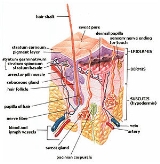
Skin is composed of three primary layers: the epidermis, which provides waterproofing and serves as a barrier to infection; the dermis, which serves as a location for the appendages of skin; and the hypodermis , which is called the basement membrane Basal lamina

The basal lamina is a layer on which epithelium [i] sits. ... 

.

The outermost epidermis consists of stratified squamous epithelium with an underlying connective tissue section, or dermis, and a hypodermis, or basement membrane Basal lamina

The basal lamina is a layer on which epithelium [i] sits. ... 

. The epidermis contains no blood vessel Blood vessel

The blood vessels are part of the circulatory system [i] and function to transport blood [i] throughout ... 

s, and cells in the deepest layers are nourished by diffusion from blood capillaries extending to the upper layers of the dermis. The main type of cells which make up the epidermis are keratinocytes, with melanocytes and Langerhans cells also present. The epidermis can be further subdivided into the following strata : corneum, lucidum, granulosum, spinosum, basale. Cells are formed through mitosis Mitosis

Mitosis is the process by which a cell separates its duplicated genome [i] into two identical halves. ... 

 at the basale layer. The daughter cells, move up the strata changing shape and composition as they die due to isolation from their blood source. The cytoplasm is released and the protein keratin Keratin

Keratins are a family of fibrous structural proteins [i]; tough and insoluble, they form ... 

 is inserted. They eventually reach the corneum and slough off . This process is called keratinization and takes place within about 30 days. This keratinized layer of skin is responsible for keeping water in the body and keeping other harmful chemicals and pathogens out, making skin a natural barrier to infection.

Blood capillaries are found beneath the epidermis, and are linked to an arteriole and a venule. Arterial shunt vessels may bypass the network in ears, the nose and fingertips.

The dermis lies below the epidermis and contains a number of structures including blood vessels, nerves, hair Hair

Hair is a filamentous outgrowth from the skin [i], found mainly in mammal [i]s.
... 

 follicles, smooth muscle Smooth muscle

Smooth muscle is a type of non-striated [i] muscle [i], found within the "walls" of hollow organ [i] ... 

, glands and lymphatic tissue Lymphatic system

The lymphatic system is a complex network of lymphoid organs, lymph node [i]s, lymph ducts [i] ... 

. It consists of loose connective tissue otherwise called areolar connective tissue - collagen Collagen

Collagen is the main protein [i] of connective tissue [i] in animal [i]s and the most abundant protein i ... 

, elastin and reticular fibers are present. Erector muscles, or arrector pili muscles attached between the hair papilla and epidermis, can contract, resulting in the hair fibre pulled upright and consequentially the formation of goose bumps Goose bumps

Goose bumps, also called goose pimples, goose flesh, chicken skin, or cutis anser... 

. Sebaceous gland Sebaceous gland

The sebaceous glands are gland [i]s found in the skin [i] of mammal [i]s. ... 

s are exocrine Exocrine gland

Exocrine gland refers to gland [i]s that secrete their products and temporarily store their secretions i ... 

 glands which produce sebum Sebaceous gland

The sebaceous glands are gland [i]s found in the skin [i] of mammal [i]s. ... 

, a mixture of lipids and waxy substances: lubrication, water-proofing, softening and antibactericidal actions are among the many functions of sebum. Sweat glands open up via a duct onto the skin by a pore.

The dermis can be split into the papillary and reticular layers. The papillary layer is outermost and extends into the epidermis to supply it with nutrients. It is composed of loosely arranged fibres. Papillary ridges make up the lines of the hands and feet, producing individually unique finger prints and foot prints. The reticular layer is more dense and is continuous with the hypodermis. It contains the bulk of the structures . The reticular layer is composed of irregularly arranged fibres and resists stretching.

The hypodermis is not part of the skin, and lies below the dermis. Its purpose is to attach the skin to underlying bone Bone

Bone, also called osseous tissue, is a type of hard [i] endoskeletal [i] connective tissue [i] ... 

 and muscle Muscle

Muscle is contractile [i] tissue [i] of the body and is derived from the mesodermal layer [i] ... 

 as well as supplying it with blood vessels and nerves. It consists of loose connective tissue and elastin. The main cell types are fibroblasts, macrophages and adipocytes . Fat serves as padding and insulation for the body.

Microorganisms like Staphylococcus epidermidis colonize the skin surface. These microorganisms serve as ecoorgan. The density of skin flora depends on region of the skin. The disinfected skin surface gets recolonized from bacteria residing in the deeper areas of the hair follicle, gut and urogenital openings.

Functions

  1. Protection: an anatomical barrier between the internal and external environment in bodily defense; Langerhans cells in the skin are part of the adaptive immune system Adaptive Immune System

    Sorry, no overview for this topic 

  2. Sensation: contains a variety of nerve endings that react to heat, cold, touch, pressure, vibration, and tissue injury; see somatosensory system and touch.
  3. Heat regulation: the skin contains a blood supply far greater than its requirements which allows precise control of energy loss by radiation, convection and conduction. Dilated blood vessels increase perfusion and heat loss while constricted vessels greatly reduce cutaneous blood flow and conserve heat. Erector pili muscles are significant in animals.
  4. Control of evaporation: the skin provides a relatively dry and impermeable barrier to fluid loss. Loss of this function contributes to the massive fluid loss in burns.
  5. Aesthetics and communication: others see our skin and can assess or mood, physical state and attractiveness.
  6. Storage and synthesis: acts as a storage centre for lipids and water, as well as a means of synthesis of vitamin D Vitamin D

    [i] precursor that contributes to the maintenance of normal levels of [[calcium]... 

     and B by action of UV Ultraviolet

    Ultraviolet light is electromagnetic radiation [i] with a wavelength [i] shorter than that of visible l ... 

     on certain parts of the skin. This synthesis is linked to pigmentation, with darker skin producing more vitamin B than D, and vice versa.
  7. Excretion: The concentration of urea Urea

    Urea is an organic compound [i] of carbon [i], nitrogen [i], oxygen [i] and hydrogen [i], with the formula [i] ... 

     is 1/130th that of urine. Excretion by sweating is at most a secondary function to temperature regulation.
  8. Absorption: Oxygen, nitrogen and carbon dioxide can diffuse into the epidermis in small amounts, some animals using their skin for their sole respiration organ. In addition, medicine can be administered through the skin, by ointments or by means of adhesive patch, such as the nicotine patch or iontophoresis Iontophoresis

    Iontophoresis is a non-invasive method of propelling high concentrations of a charged substance, normall... 

    . The skin is an important site of transport in many other organisms

Hygiene

The skin must be regularly cleaned. Unless enough care is taken it will become cracked or inflamed. Unclean skin favors the development of pathogenic organisms. The constantly peeling off dead cells of the epidermis mix with the secretions of the sweat and sebaceous glands and the dust found on the skin to form a filthy layer on its surface. If not washed away, the dirt and dead skin slurry begins to decompose emitting a foul smell. Functions of the skin are disturbed when it is dirty and it becomes more easily damaged. The release of antibacterial compounds decreases. Dirty skin is more prone to develop infections. Cosmetics should be used carefully because these may cause allergic reactions. Each season requires suitable clothing in order to facilitate the evaporation of the sweat. Sunlight, water and air play an important role in keeping the skin healthy.

The skin supports its own ecosystems of microorganism Microorganism

A microorganism or microbe is an organism [i] that is microscopic [i] . ... 

s, including yeast Yeast

Yeasts are single-celled fungi [i], a few species of which are commonly used to leaven [i] ... 

s and bacteria Bacteria

Bacteria are a major group of living organism [i]s. ... 

, which cannot be removed by any amount of cleaning. In general these organisms keep one another in check and are part of a healthy skin. When the balance is disturbed, e.g., by antibiotics which kill bacteria, there may be an overgrowth and infection by yeasts. The skin is continuous with the inner epithelial lining of the body at the orifices, each of which supports its own complement of flora.

Aging and disease


As skin ages, it becomes thinner and more easily damaged. Intensifying this effect is the decreasing ability of skin to heal itself. Skin sagging is caused by the fall in elasticity. Skin also receives less blood flow and lower gland activity.

In medicine Medicine

Medicine is the branch of health science [i] and the sector of public life concerned with maintaining or ... 

, the branch concerned with the skin is called dermatology.

The skin is subject to constant attack from without, and so can be afflicted by numerous ailments, such as these:

Tumors:
  • Benign tumors of the skin: Squamous cell papilloma
  • Skin cancer Skin cancer

    Skin cancer is a malignant [i] growth on the skin [i], which can have many causes, including repeated se ... 


Others:
  • Rash Rash

    A rash is a change in the skin [i] which affects its appearance or texture [i].... 

    es
  • Blister Blister

    A blister or bulla is a defense mechanism of the human body [i]. ... 

    s
  • Acne
  • Keratosis pilaris
  • Fungal Fungus

    A fungus is a eukaryotic [i] organism [i] that digests its food [i] externally and absorbs th ... 

     infections such as athlete's foot Athlete's foot

    Athlete's foot or tinea pedis is a fungal [i] infection of the skin [i], usually between th ... 

  • microbial Microorganism

    A microorganism or microbe is an organism [i] that is microscopic [i] . ... 

     infections.
  • calcinosis cutis
  • ulcer Ulcer

    An ulcer is an open sore of the skin [i], eyes [i] or mucous membrane [i], often caused by an... 

  • sun burn Sunburn

    A sunburn is a burn [i] to the skin [i] produced by overexposure to ultraviolet [i] radiation, comm ... 

  • list of skin diseases

See also

  • Hyperpigmentation
  • Dermatology
  • Skin color Human skin color

    Human skin color can range from almost black to nearly colorless in different people [i]. ... 

  • Cosmetics Cosmetics

    *Permanent makeup [i]
  • Testing cosmetics on animals [i] ... 

     and cosmetic surgery
  • Hair Hair

    Hair is a filamentous outgrowth from the skin [i], found mainly in mammal [i]s.

... 


  • Meissner's corpuscle
  • Nails
  • Pacinian corpuscle
  • Polyphenol antioxidant Polyphenol antioxidant

    [i] characterized by the presence of several [[phenol]... 

  • Sweat
  • Anthropodermic bibliopegy Anthropodermic bibliopegy

    Anthropodermic bibliopegy is the practice of binding books [i] in human [i] skin [i].... 

  • Callus Callus

    In dermatology [i], a callus is an especially toughened area of skin [i] which has become relatively thi ...