


Instrument flight rules

Encyclopedia
Instrument flight rules (IFR) are one of two sets of regulations governing all aspects of civil aviation
aircraft operations; the other are visual flight rules
(VFR).
Federal Aviation Regulations
(FAR) defines IFR as: “Rules and regulations established by the FAA to govern flight under conditions in which flight by outside visual reference is not safe. IFR flight depends upon flying by reference to instruments in the flight deck
, and navigation is accomplished by reference to electronic signals.” It is also referred to as, “a term used by pilots and controllers to indicate the type of flight plan an aircraft is flying,” such as an IFR or VFR flight plan.
in which the aircraft is operating, and on whether the flight is conducted during daytime or nighttime. However, typical daytime VFR minimums for most airspace is 3 statute miles of flight visibility and a cloud distance of 500' below, 1,000' above, and 2,000' feet horizontally. Flight conditions reported as equal to or greater than these VFR minimums are referred to as visual meteorological conditions
(VMC).
Visual flight rules are much simpler than IFR, and require significantly less training and practice. VFR provides a great degree of freedom, allowing pilots to go where they want, when they want, and allows them a much wider latitude in determining how they get there. Pilots are not required to file a flight plan, do not have to communicate with ATC
(unless flying in certain types of "busier" airspace), and are not limited to following predefined published routes or flight procedures.
VFR pilots may use cockpit instruments as secondary aids to navigation and orientation, but are not required to. However, any aircraft operating under VFR must have the required equipment on-board, as described in FAR Part 91.205 (which includes instruments necessary for IFR flight); but the view outside of the aircraft is the primary source for keeping the aircraft straight and level (orientation), flying where you intended to fly (navigation)
, and for not hitting anything (separation).
(IMC), which have much lower weather minimums than VFR. Procedures and training are significantly more complex as a pilot must demonstrate competency in conducting an entire cross-country flight
in IMC conditions, while controlling the aircraft solely by reference to instruments.
As compared to VFR flight, instrument pilots must meticulously evaluate weather, create a very detailed flight plan based around specific instrument departure, en route, and arrival procedures, and dispatch the flight.
en route does not automatically change to a VFR flight, and the flight must still follow all IFR procedures regardless of weather conditions.
, Air Traffic Control
(ATC) separates IFR aircraft from obstacles and other aircraft using a flight clearance based on route, time, distance, speed, and altitude. ATC monitors IFR flights on radar
, or through aircraft position reports in areas where radar coverage is not available. Aircraft position reports are sent as voice radio transmissions. Aircraft position reports are not necessary if ATC reports that the aircraft is in radar contact. In the United States, a flight operating under IFR is required to provide position reports unless ATC advises a pilot that the plane is in radar contact. The pilot must resume position reports after ATC advises that radar contact has been lost, or that radar services are terminated.
IFR flights in controlled airspace require an ATC clearance for each part of the flight. A clearance always specifies a clearance limit, which is the farthest the aircraft can fly without a new clearance. In addition, a clearance typically provides a heading or route to follow, altitude, and communication parameters, such as frequencies and transponder
codes.
In uncontrolled airspace, ATC clearances are unavailable. In some states a form of separation is provided to certain aircraft in uncontrolled airspace as far as is practical (often known under ICAO as an advisory service in class G airspace), but separation is not mandated nor widely provided.
Despite the protection offered by flight in controlled airspace under IFR, the ultimate responsibility for the safety of the aircraft rests with the pilot in command, who can refuse clearances.
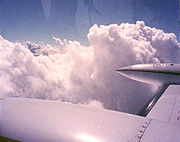 The main purpose of IFR is the safe operation of aircraft in Instrument Meteorological Conditions
(IMC). The weather is considered to be IMC when it does not meet the minimum requirements for Visual Meteorological Conditions
(VMC). To operate safely in IMC, a pilot controls the aircraft relying on flight instruments
, and ATC provides separation.
It is important not to confuse IFR with IMC. A significant amount of IFR flying is conducted in Visual Meteorological Conditions (VMC). Any time a flight is operating in VMC, the crew is responsible for seeing and avoiding VFR traffic; however, since the flight is conducted under Instrument Flight Rules, ATC still provides separation services from other IFR traffic. Although dangerous and illegal, a certain amount of VFR flying is conducted in Instrument Meteorological Conditions (IMC). A common scenario is a VFR pilot taking off in VMC conditions, but encountering deteriorating visibility while en route. "Continued VFR flight into IMC", as it is known, is responsible for a significant number of light-airplane crashes.
During flight under IFR, there are no visibility requirements, so flying through clouds is permitted. There are still minimum conditions that must be present in order for the aircraft to take off and land; these will vary according to the kind of operation, the type of navigation aids available, the location and height of terrain and obstructions in the vicinity of the airport, equipment on the aircraft, and the qualifications of the crew. For example, landing at mountain airports such as Reno (KRNO) offer significantly different instrument approach
es for aircraft landing on the same runway, but from opposite directions. Aircraft approaching from the north must make visual contact with the airport at a higher altitude than a flight approaching from the south, because of rapidly rising terrain south of the airport.{FAA approach plate AL 346} This higher altitude allows a flight crew to clear the obstacle if a landing is not feasible.
Although large airliners and, increasingly, smaller aircraft now carry their own terrain awareness and warning system TAWS, these are primarily backup systems providing a last layer of defense if a sequence of errors or omissions causes a dangerous situation.
s and NDB
s, or GPS
. In areas of radar coverage, ATC may also assign headings to IFR aircraft, also known as radar vectors. Radar vectors are one of several methods which ATC uses to provide separation between aircraft for landing, especially in busy traffic environments; in less congested airspace, aircraft are increasingly responsible for their own traffic awareness and collision avoidance.
Modern Flight Management System
s have evolved sufficiently to allow a crew to plan a flight not only as to route and altitude, but to specific time of arrival at specific locations. This capability is used in several trial projects experimenting with four dimensional approach clearances for commercial aircraft, with time as the fourth dimension. These clearances allow ATC to optimize the arrival of aircraft at major airports, which increases airport capacity, and uses less fuel providing monetary and environmental benefits to airlines and the public at large respectively.
Here is an example of an IFR clearance, for a Cessna aircraft traveling from Palo Alto airport (KPAO) to Stockton airport (KSCK).
Detailed explanation:
"Cessna 21756": Verifies that only this specific aircraft is cleared.
"cleared to Stockton Airport": Clearance Limit: the farthest destination the aircraft is allowed to go under IFR (in most cases it is the destination airport).
"via turn right heading zero-six-zero within one mile of the airport.": The pilot is expected to execute the right turn to 060° without further ATC prompting within one mile of the departure airport.
"Radar Vectors San Jose": The departure controller will provide directional guidance to the San Jose VOR.
"Then as filed.": After arriving at the San Jose VOR, the pilot will likely resume navigation without ATC prompts along the airways and intersections that were filed in their flight plan.
"Maintain 3,000 ...": After takeoff, climb to an altitude of 3000 feet above sea level.
"... expect 5,000 five minutes after departure.": Your final altitude assignment is probably going to be 5000 feet above sea level. However, you must follow actual ATC altitude assignments throughout the flight. This portion of the clearance provides a backup if communications are lost, allowing you to proceed to climb and maintain 5000 feet.
"Departure frequency is 121.3, ...": Contact with NORCAL Departure on the specified communication frequency, after Palo Alto Tower tells you to switch.
"... squawk 4263.": Program your transponder to 4263 so that ATC can positively identify you on radar.
Departures are described in an IFR clearance issued by ATC prior to takeoff. The departure clearance may contain an assigned heading, one or more waypoints, and an initial altitude to fly. The clearance can also specify a departure procedure (DP), or standard instrument departure
(SID) that should be followed unless "NO DP" is specified in the notes section of the filed flight plan.
En route flight is described by IFR charts showing navigation aids, fixes, and standard routes called airways
. Aircraft with appropriate navigational equipment such as GPS, are also often cleared for a direct-to routing, where only the destination, or a few navigational waypoints are used to describe the route that the flight will follow. ATC will assign altitudes in its initial clearance or amendments thereto, and navigational charts indicate minimum safe altitudes for airways.
The approach portion of an IFR flight may begin with a Standard Terminal Arrival Route
(STAR), describing common routes to fly to arrive at an initial approach fix
(IAF) from which an instrument approach
commences. Instrument approaches are categorized as precision and non-precision. Despite the names, a precision approach simply indicates that vertical guidance (as well as lateral guidance) is being used. Non-precision indicates only lateral guidance.
In either case, an instrument approach will terminate either in the pilot(s) acquiring sufficient visual reference to carry out a normal landing, or in a missed approach
if the required visual reference is not encountered in time. The point at which the crew of an aircraft has to make a decision to either proceed visually, or "miss" the approach is called either the Decision Altitude (DA) or Decision Height (DH) for precision approaches, and missed approach point
(MAP) for non-precision approaches. During precision approaches the altitude of the aircraft is determined by the navigational instruments. For non-precision approaches the crew will descend to specific altitudes during the approach procedure, with the final altitude termed the Minimum Descent Altitude (MDA).
Some commercial aircraft are equipped with automatic landing systems that allow the aircraft to land without transitioning from instruments to visual conditions for a normal landing. Such autoland
operations require specialized equipment, procedures and training, and involve the aircraft, airport, and the crew. Autoland is the only way some major airports such as Paris-Charles de Gaulle Airport remain operational every day of the year. Some modern aircraft are equipped with enhanced vision systems based on infrared sensors, that provide a day-like visual environment and allow operations in conditions and at airports that would otherwise not be suitable for a landing. Commercial aircraft also frequently use such equipment for takeoffs when takeoff minima are not met.
Documents describing the approach procedure are frequently called approach plate
s in reference to the plate-like appearance of single-page sheet that it is printed on.
An instrument approach that terminates in a missed approach will continue using missed approach procedure information shown on the approach plate. Typically it describes a transition to a nearby navigational fix, from which the instrument approach can be attempted again. In practice an approach that terminates in a missed approach rarely flies the missed approach procedure as published. Instead, ATC will assign headings and altitudes that will assimilate the aircraft into the arriving traffic for a repeated approach attempt. The crew may also request an alternate destination, either a previously stated alternate airport, or other suitable airport considering the prevailing weather conditions.
, and must meet currency of experience requirements. In the United States, these currency of experience requirements include six instrument approach
es, NAVAID intercepting and tracking, and holding procedures in the past six calendar months. The aircraft must also be equipped and type-certified for instrument flight, and the related navigational equipment must have been inspected within a specific period of time prior to the instrument flight.
The UK differs in its pilot-licensing practice from the US In the UK any pilot can decide to which flight rules he adheres provided that the meteorological conditions for those rules are met. The pilot does need an instrument rating to fly in instrument meteorological conditions and under IFR in controlled airspace. The upshot of this is that non-instrument-qualified pilots can elect to fly under IFR in visual meteorological conditions outside controlled airspace. Compared to the rest of the world, the UK's flight crew licensing regime is somewhat unusual in its licensing for meteorological conditions and airspace, rather than flight rules. As a partial alternative to the instrument rating
, the UK issues an "IMC rating", the privileges of which include flight under IFR in airspace classes B to G in instrument meteorological conditions.
In the United States, instruments required for IFR flight are those that are required for VFR flight in addition to: Heading indicator
, Sensitive Altimeter
adjustable for Barometric Pressure
, Clock
with a sweep-second pointer or digital equivalent, Attitude indicator
, Radios
and suitable Avionics
for the route to be flown, Alternator
or generator
, gyroscopic
rate of turn indicator that is either a Turn coordinator
or the Turn and bank indicator
.
Civil aviation
Civil aviation is one of two major categories of flying, representing all non-military aviation, both private and commercial. Most of the countries in the world are members of the International Civil Aviation Organization and work together to establish common standards and recommended practices...
aircraft operations; the other are visual flight rules
Visual flight rules
Visual flight rules are a set of regulations which allow a pilot to operate an aircraft in weather conditions generally clear enough to allow the pilot to see where the aircraft is going. Specifically, the weather must be better than basic VFR weather minimums, as specified in the rules of the...
(VFR).
Federal Aviation Regulations
Federal Aviation Regulations
The Federal Aviation Regulations, or FARs, are rules prescribed by the Federal Aviation Administration governing all aviation activities in the United States. The FARs are part of Title 14 of the Code of Federal Regulations...
(FAR) defines IFR as: “Rules and regulations established by the FAA to govern flight under conditions in which flight by outside visual reference is not safe. IFR flight depends upon flying by reference to instruments in the flight deck
Cockpit
A cockpit or flight deck is the area, usually near the front of an aircraft, from which a pilot controls the aircraft. Most modern cockpits are enclosed, except on some small aircraft, and cockpits on large airliners are also physically separated from the cabin...
, and navigation is accomplished by reference to electronic signals.” It is also referred to as, “a term used by pilots and controllers to indicate the type of flight plan an aircraft is flying,” such as an IFR or VFR flight plan.
Visual flight rules
To put instrument flight rules into context, a brief overview of VFR is necessary. Flights operating under VFR are flown solely by reference to outside visual cues, which permit navigation, orientation, and separation from terrain and other traffic. Thus, cloud ceiling and flight visibility are the most important variables for safe operations during all phases of flight. The minimum weather conditions for ceiling and visibility for VFR flights are defined in FAR Part 91.155, and vary depending on the type of airspaceAirspace
Airspace means the portion of the atmosphere controlled by a country above its territory, including its territorial waters or, more generally, any specific three-dimensional portion of the atmosphere....
in which the aircraft is operating, and on whether the flight is conducted during daytime or nighttime. However, typical daytime VFR minimums for most airspace is 3 statute miles of flight visibility and a cloud distance of 500' below, 1,000' above, and 2,000' feet horizontally. Flight conditions reported as equal to or greater than these VFR minimums are referred to as visual meteorological conditions
Visual meteorological conditions
In aviation, visual meteorological conditions is an aviation flight category in which visual flight rules flight is permitted—that is, conditions in which pilots have sufficient visibility to fly the aircraft maintaining visual separation from terrain and other aircraft. They are the opposite of...
(VMC).
Visual flight rules are much simpler than IFR, and require significantly less training and practice. VFR provides a great degree of freedom, allowing pilots to go where they want, when they want, and allows them a much wider latitude in determining how they get there. Pilots are not required to file a flight plan, do not have to communicate with ATC
Air traffic control
Air traffic control is a service provided by ground-based controllers who direct aircraft on the ground and in the air. The primary purpose of ATC systems worldwide is to separate aircraft to prevent collisions, to organize and expedite the flow of traffic, and to provide information and other...
(unless flying in certain types of "busier" airspace), and are not limited to following predefined published routes or flight procedures.
VFR pilots may use cockpit instruments as secondary aids to navigation and orientation, but are not required to. However, any aircraft operating under VFR must have the required equipment on-board, as described in FAR Part 91.205 (which includes instruments necessary for IFR flight); but the view outside of the aircraft is the primary source for keeping the aircraft straight and level (orientation), flying where you intended to fly (navigation)
Pilotage
Pilotage is the use of fixed visual references on the ground or sea by means of sight or radar to guide oneself to a destination, sometimes with the help of a map or nautical chart. People use pilotage for activities such as guiding vessels and aircraft, hiking and Scuba diving...
, and for not hitting anything (separation).
Instrument flight rules
Instrument flight rules permit an aircraft to operate in instrument meteorological conditionsInstrument meteorological conditions
Instrument meteorological conditions is an aviation flight category that describes weather conditions that require pilots to fly primarily by reference to instruments, and therefore under Instrument Flight Rules , rather than by outside visual references under Visual Flight Rules . Typically, this...
(IMC), which have much lower weather minimums than VFR. Procedures and training are significantly more complex as a pilot must demonstrate competency in conducting an entire cross-country flight
Cross-country flying
Cross-Country flying is a type of distance flying which is performed in a powered aircraft on legs over a given distance and in operations between two points using navigational techniques; and an unpowered aircraft by using upcurrents to gain altitude for extended flying time...
in IMC conditions, while controlling the aircraft solely by reference to instruments.
As compared to VFR flight, instrument pilots must meticulously evaluate weather, create a very detailed flight plan based around specific instrument departure, en route, and arrival procedures, and dispatch the flight.
Confusing flight rules with weather conditions
It is essential to differentiate between flight plan type (IFR or VFR) and weather conditions (VMC or IMC). While current and forecasted weather may be a factor in deciding which type of flight plan to file, weather conditions themselves do not affect one's filed flight plan. For example, an IFR flight that encounters VMCVisual meteorological conditions
In aviation, visual meteorological conditions is an aviation flight category in which visual flight rules flight is permitted—that is, conditions in which pilots have sufficient visibility to fly the aircraft maintaining visual separation from terrain and other aircraft. They are the opposite of...
en route does not automatically change to a VFR flight, and the flight must still follow all IFR procedures regardless of weather conditions.
Separation and clearance
The distance by which an aircraft avoids obstacles or other aircraft is termed separation. The most important concept of IFR flying is that separation is maintained regardless of weather conditions. In controlled airspaceControlled airspace
Controlled airspace is an aviation term used to describe airspace in which ATChas the authority to control air traffic, the level of which varies with the different classes of airspace. Controlled airspace is established mainly for three different reasons:...
, Air Traffic Control
Air traffic control
Air traffic control is a service provided by ground-based controllers who direct aircraft on the ground and in the air. The primary purpose of ATC systems worldwide is to separate aircraft to prevent collisions, to organize and expedite the flow of traffic, and to provide information and other...
(ATC) separates IFR aircraft from obstacles and other aircraft using a flight clearance based on route, time, distance, speed, and altitude. ATC monitors IFR flights on radar
Radar
Radar is an object-detection system which uses radio waves to determine the range, altitude, direction, or speed of objects. It can be used to detect aircraft, ships, spacecraft, guided missiles, motor vehicles, weather formations, and terrain. The radar dish or antenna transmits pulses of radio...
, or through aircraft position reports in areas where radar coverage is not available. Aircraft position reports are sent as voice radio transmissions. Aircraft position reports are not necessary if ATC reports that the aircraft is in radar contact. In the United States, a flight operating under IFR is required to provide position reports unless ATC advises a pilot that the plane is in radar contact. The pilot must resume position reports after ATC advises that radar contact has been lost, or that radar services are terminated.
IFR flights in controlled airspace require an ATC clearance for each part of the flight. A clearance always specifies a clearance limit, which is the farthest the aircraft can fly without a new clearance. In addition, a clearance typically provides a heading or route to follow, altitude, and communication parameters, such as frequencies and transponder
Transponder (aviation)
A transponder is an electronic device that produces a response when it receives a radio-frequency interrogation...
codes.
In uncontrolled airspace, ATC clearances are unavailable. In some states a form of separation is provided to certain aircraft in uncontrolled airspace as far as is practical (often known under ICAO as an advisory service in class G airspace), but separation is not mandated nor widely provided.
Despite the protection offered by flight in controlled airspace under IFR, the ultimate responsibility for the safety of the aircraft rests with the pilot in command, who can refuse clearances.
Weather
Instrument meteorological conditions
Instrument meteorological conditions is an aviation flight category that describes weather conditions that require pilots to fly primarily by reference to instruments, and therefore under Instrument Flight Rules , rather than by outside visual references under Visual Flight Rules . Typically, this...
(IMC). The weather is considered to be IMC when it does not meet the minimum requirements for Visual Meteorological Conditions
Visual meteorological conditions
In aviation, visual meteorological conditions is an aviation flight category in which visual flight rules flight is permitted—that is, conditions in which pilots have sufficient visibility to fly the aircraft maintaining visual separation from terrain and other aircraft. They are the opposite of...
(VMC). To operate safely in IMC, a pilot controls the aircraft relying on flight instruments
Flight instruments
Flight instruments are the instruments in the cockpit of an aircraft that provide the pilot with information about the flight situation of that aircraft, such as height, speed and altitude...
, and ATC provides separation.
It is important not to confuse IFR with IMC. A significant amount of IFR flying is conducted in Visual Meteorological Conditions (VMC). Any time a flight is operating in VMC, the crew is responsible for seeing and avoiding VFR traffic; however, since the flight is conducted under Instrument Flight Rules, ATC still provides separation services from other IFR traffic. Although dangerous and illegal, a certain amount of VFR flying is conducted in Instrument Meteorological Conditions (IMC). A common scenario is a VFR pilot taking off in VMC conditions, but encountering deteriorating visibility while en route. "Continued VFR flight into IMC", as it is known, is responsible for a significant number of light-airplane crashes.
During flight under IFR, there are no visibility requirements, so flying through clouds is permitted. There are still minimum conditions that must be present in order for the aircraft to take off and land; these will vary according to the kind of operation, the type of navigation aids available, the location and height of terrain and obstructions in the vicinity of the airport, equipment on the aircraft, and the qualifications of the crew. For example, landing at mountain airports such as Reno (KRNO) offer significantly different instrument approach
Instrument approach
For aircraft operating under instrument flight rules , an instrument approach or instrument approach procedure is a series of predetermined maneuvers for the orderly transfer of an aircraft under instrument flight conditions from the beginning of the initial approach to a landing, or to a point...
es for aircraft landing on the same runway, but from opposite directions. Aircraft approaching from the north must make visual contact with the airport at a higher altitude than a flight approaching from the south, because of rapidly rising terrain south of the airport.{FAA approach plate AL 346} This higher altitude allows a flight crew to clear the obstacle if a landing is not feasible.
Although large airliners and, increasingly, smaller aircraft now carry their own terrain awareness and warning system TAWS, these are primarily backup systems providing a last layer of defense if a sequence of errors or omissions causes a dangerous situation.
Navigation
Under IFR, the primary means of navigation are either via radio beacons on the ground, such as VORVHF omnidirectional range
VOR, short for VHF omnidirectional radio range, is a type of radio navigation system for aircraft. A VOR ground station broadcasts a VHF radio composite signal including the station's identifier, voice , and navigation signal. The identifier is typically a two- or three-letter string in Morse code...
s and NDB
Non-directional beacon
A non-directional beacon is a radio transmitter at a known location, used as an aviation or marine navigational aid. As the name implies, the signal transmitted does not include inherent directional information, in contrast to other navigational aids such as low frequency radio range, VHF...
s, or GPS
Global Positioning System
The Global Positioning System is a space-based global navigation satellite system that provides location and time information in all weather, anywhere on or near the Earth, where there is an unobstructed line of sight to four or more GPS satellites...
. In areas of radar coverage, ATC may also assign headings to IFR aircraft, also known as radar vectors. Radar vectors are one of several methods which ATC uses to provide separation between aircraft for landing, especially in busy traffic environments; in less congested airspace, aircraft are increasingly responsible for their own traffic awareness and collision avoidance.
Modern Flight Management System
Flight management system
A flight management system is a fundamental part of a modern airliner's avionics. An FMS is a specialized computer system that automates a wide variety of in-flight tasks, reducing the workload on the flight crew to the point that modern aircraft no longer carry flight engineers or navigators. A...
s have evolved sufficiently to allow a crew to plan a flight not only as to route and altitude, but to specific time of arrival at specific locations. This capability is used in several trial projects experimenting with four dimensional approach clearances for commercial aircraft, with time as the fourth dimension. These clearances allow ATC to optimize the arrival of aircraft at major airports, which increases airport capacity, and uses less fuel providing monetary and environmental benefits to airlines and the public at large respectively.
- Required Navigation PerformanceRequired Navigation PerformanceRequired Navigation Performance is a type of performance-based navigation that allows an aircraft to fly a specific path between two 3-dimensionally defined points in space. RNAV and RNP systems are fundamentally similar. The key difference between them is the requirement for on-board...
(RNPRNP-Medicine:* Ribonucleoprotein, a compound of ribonucleic acid and protein* Ribonucleoprotein Particle, intracellular compartments involved in post-transcriptional fate-Military:* Royal Navy Police, the new name for the British Royal Navy Regulating Branch...
) - ADS-B
Procedures
Specific procedures allow IFR aircraft to transition safely through every stage of flight. These procedures specify how an IFR pilot should respond, even in the event of a complete radio failure, and loss of communications with ATC, including the expected aircraft course and altitude.Here is an example of an IFR clearance, for a Cessna aircraft traveling from Palo Alto airport (KPAO) to Stockton airport (KSCK).
| "Cessna 21756, cleared to Stockton Airport via turn right heading zero-six-zero within one mile of the airport. Radar Vectors San Jose, then as filed. Maintain 3,000 expect 5,000 five minutes after departure. Departure frequency is 121.3, squawk 4263." |
Detailed explanation:
"Cessna 21756": Verifies that only this specific aircraft is cleared.
"cleared to Stockton Airport": Clearance Limit: the farthest destination the aircraft is allowed to go under IFR (in most cases it is the destination airport).
"via turn right heading zero-six-zero within one mile of the airport.": The pilot is expected to execute the right turn to 060° without further ATC prompting within one mile of the departure airport.
"Radar Vectors San Jose": The departure controller will provide directional guidance to the San Jose VOR.
"Then as filed.": After arriving at the San Jose VOR, the pilot will likely resume navigation without ATC prompts along the airways and intersections that were filed in their flight plan.
"Maintain 3,000 ...": After takeoff, climb to an altitude of 3000 feet above sea level.
"... expect 5,000 five minutes after departure.": Your final altitude assignment is probably going to be 5000 feet above sea level. However, you must follow actual ATC altitude assignments throughout the flight. This portion of the clearance provides a backup if communications are lost, allowing you to proceed to climb and maintain 5000 feet.
"Departure frequency is 121.3, ...": Contact with NORCAL Departure on the specified communication frequency, after Palo Alto Tower tells you to switch.
"... squawk 4263.": Program your transponder to 4263 so that ATC can positively identify you on radar.
Departures are described in an IFR clearance issued by ATC prior to takeoff. The departure clearance may contain an assigned heading, one or more waypoints, and an initial altitude to fly. The clearance can also specify a departure procedure (DP), or standard instrument departure
Standard Instrument Departure
Standard instrument departure routes, also known as departure procedures are published flight procedures followed by aircraft on an IFR flight plan immediately after take-off from an airport.- Introduction :...
(SID) that should be followed unless "NO DP" is specified in the notes section of the filed flight plan.
En route flight is described by IFR charts showing navigation aids, fixes, and standard routes called airways
Airway (aviation)
In aviation, an airway is a designated route in the air. Airways are laid out between navigational aids such as VORs, NDBs and Intersections ....
. Aircraft with appropriate navigational equipment such as GPS, are also often cleared for a direct-to routing, where only the destination, or a few navigational waypoints are used to describe the route that the flight will follow. ATC will assign altitudes in its initial clearance or amendments thereto, and navigational charts indicate minimum safe altitudes for airways.
The approach portion of an IFR flight may begin with a Standard Terminal Arrival Route
Standard Terminal Arrival Route
In aviation, a standard terminal arrival route or standard terminal arrival is a published procedure followed by aircraft on an IFR flight plan just before reaching a destination airport.-Description:...
(STAR), describing common routes to fly to arrive at an initial approach fix
Initial approach fix
The Initial Approach Fix is the point where the initial approach segment of an instrument approach begins. An instrument approach procedure may have more than one Initial Approach Fix and initial approach segment. The initial approach fix is usually a designated intersection, VOR, NDB, or DME fix...
(IAF) from which an instrument approach
Instrument approach
For aircraft operating under instrument flight rules , an instrument approach or instrument approach procedure is a series of predetermined maneuvers for the orderly transfer of an aircraft under instrument flight conditions from the beginning of the initial approach to a landing, or to a point...
commences. Instrument approaches are categorized as precision and non-precision. Despite the names, a precision approach simply indicates that vertical guidance (as well as lateral guidance) is being used. Non-precision indicates only lateral guidance.
In either case, an instrument approach will terminate either in the pilot(s) acquiring sufficient visual reference to carry out a normal landing, or in a missed approach
Missed approach
Missed approach is an instrument flight rules procedure which is a standard component segment of an instrument approach. Generally, if the pilot flying or the pilot in command determines by the time the aircraft is at the decision height or missed approach point , that the runway or its...
if the required visual reference is not encountered in time. The point at which the crew of an aircraft has to make a decision to either proceed visually, or "miss" the approach is called either the Decision Altitude (DA) or Decision Height (DH) for precision approaches, and missed approach point
Missed approach point
Missed approach point is the "point prescribed in each instrument approach at which a missed approach procedure shall be executed if the required visual reference does not exist." It defines the point for precision and non-precision approaches when the missed approach segment of a flight begins...
(MAP) for non-precision approaches. During precision approaches the altitude of the aircraft is determined by the navigational instruments. For non-precision approaches the crew will descend to specific altitudes during the approach procedure, with the final altitude termed the Minimum Descent Altitude (MDA).
Some commercial aircraft are equipped with automatic landing systems that allow the aircraft to land without transitioning from instruments to visual conditions for a normal landing. Such autoland
Autoland
In aviation, autoland describes a system that fully automates the landing phase of an aircraft's flight, with the human crew merely supervising the process.-Description:...
operations require specialized equipment, procedures and training, and involve the aircraft, airport, and the crew. Autoland is the only way some major airports such as Paris-Charles de Gaulle Airport remain operational every day of the year. Some modern aircraft are equipped with enhanced vision systems based on infrared sensors, that provide a day-like visual environment and allow operations in conditions and at airports that would otherwise not be suitable for a landing. Commercial aircraft also frequently use such equipment for takeoffs when takeoff minima are not met.
Documents describing the approach procedure are frequently called approach plate
Approach plate
Approach Plates is a common term used to describe the printed procedures or charts, more formally Instrument Approach Procedures, that pilots use to fly approaches during Instrument Flight Rules operations. Each country maintains their own instrument approach procedures according to International...
s in reference to the plate-like appearance of single-page sheet that it is printed on.
An instrument approach that terminates in a missed approach will continue using missed approach procedure information shown on the approach plate. Typically it describes a transition to a nearby navigational fix, from which the instrument approach can be attempted again. In practice an approach that terminates in a missed approach rarely flies the missed approach procedure as published. Instead, ATC will assign headings and altitudes that will assimilate the aircraft into the arriving traffic for a repeated approach attempt. The crew may also request an alternate destination, either a previously stated alternate airport, or other suitable airport considering the prevailing weather conditions.
Qualifications
To fly under IFR, a pilot must have an instrument ratingInstrument rating
Instrument rating refers to the qualifications that a pilot must have in order to fly under IFR . It requires additional training and instruction beyond what is required for a Private Pilot certificate or Commercial Pilot certificate, including rules and procedures specific to instrument flying,...
, and must meet currency of experience requirements. In the United States, these currency of experience requirements include six instrument approach
Instrument approach
For aircraft operating under instrument flight rules , an instrument approach or instrument approach procedure is a series of predetermined maneuvers for the orderly transfer of an aircraft under instrument flight conditions from the beginning of the initial approach to a landing, or to a point...
es, NAVAID intercepting and tracking, and holding procedures in the past six calendar months. The aircraft must also be equipped and type-certified for instrument flight, and the related navigational equipment must have been inspected within a specific period of time prior to the instrument flight.
The UK differs in its pilot-licensing practice from the US In the UK any pilot can decide to which flight rules he adheres provided that the meteorological conditions for those rules are met. The pilot does need an instrument rating to fly in instrument meteorological conditions and under IFR in controlled airspace. The upshot of this is that non-instrument-qualified pilots can elect to fly under IFR in visual meteorological conditions outside controlled airspace. Compared to the rest of the world, the UK's flight crew licensing regime is somewhat unusual in its licensing for meteorological conditions and airspace, rather than flight rules. As a partial alternative to the instrument rating
Instrument rating
Instrument rating refers to the qualifications that a pilot must have in order to fly under IFR . It requires additional training and instruction beyond what is required for a Private Pilot certificate or Commercial Pilot certificate, including rules and procedures specific to instrument flying,...
, the UK issues an "IMC rating", the privileges of which include flight under IFR in airspace classes B to G in instrument meteorological conditions.
In the United States, instruments required for IFR flight are those that are required for VFR flight in addition to: Heading indicator
Heading indicator
The heading indicator is a flight instrument used in an aircraft to inform the pilot of the aircraft's heading. It is sometimes referred to by its older names, the directional gyro or DG, and also direction indicator or DI.- Use :The primary means of establishing the heading in most small...
, Sensitive Altimeter
Altimeter
An altimeter is an instrument used to measure the altitude of an object above a fixed level. The measurement of altitude is called altimetry, which is related to the term bathymetry, the measurement of depth underwater.-Pressure altimeter:...
adjustable for Barometric Pressure
Atmospheric pressure
Atmospheric pressure is the force per unit area exerted into a surface by the weight of air above that surface in the atmosphere of Earth . In most circumstances atmospheric pressure is closely approximated by the hydrostatic pressure caused by the weight of air above the measurement point...
, Clock
Clock
A clock is an instrument used to indicate, keep, and co-ordinate time. The word clock is derived ultimately from the Celtic words clagan and clocca meaning "bell". A silent instrument missing such a mechanism has traditionally been known as a timepiece...
with a sweep-second pointer or digital equivalent, Attitude indicator
Attitude indicator
An attitude indicator , also known as gyro horizon or artificial horizon, is an instrument used in an aircraft to inform the pilot of the orientation of the aircraft relative to earth. It indicates pitch and bank or roll and is a primary instrument for flight in instrument meteorological conditions...
, Radios
Airband
Airband or Aircraft band is the name for a group of frequencies in the VHF radio spectrum allocated to radio communication in civil aviation, sometimes also referred to as VHF, or phonetically as "Victor"...
and suitable Avionics
Avionics
Avionics are electronic systems used on aircraft, artificial satellites and spacecraft.Avionic systems include communications, navigation, the display and management of multiple systems and the hundreds of systems that are fitted to aircraft to meet individual roles...
for the route to be flown, Alternator
Alternator
An alternator is an electromechanical device that converts mechanical energy to electrical energy in the form of alternating current.Most alternators use a rotating magnetic field but linear alternators are occasionally used...
or generator
Electrical generator
In electricity generation, an electric generator is a device that converts mechanical energy to electrical energy. A generator forces electric charge to flow through an external electrical circuit. It is analogous to a water pump, which causes water to flow...
, gyroscopic
Gyroscope
A gyroscope is a device for measuring or maintaining orientation, based on the principles of angular momentum. In essence, a mechanical gyroscope is a spinning wheel or disk whose axle is free to take any orientation...
rate of turn indicator that is either a Turn coordinator
Turn coordinator
The turn coordinator is a flight instrument which displays to a pilot information about the rate of yaw , roll, and the coordination of the turn...
or the Turn and bank indicator
Turn and bank indicator
In aviation, the turn and bank indicator shows the rate of turn and the coordination of the turn. The rate of turn is indicated from a rate gyroscopically and the coordination of the turn is shown by either a pendulum or a heavy ball mounted in a curved sealed glass tube. No pitch information is...
.
External links
- FAA website
- Instrument Flying Handbook (FAA-H-8083-15A)
- Instrument Procedures Handbook (FAA-H-8261-1A)
- Hear audio of a US instrument rating checkride - Part 1
- "Blind Flying, January 1933, Popular Mechanics details on blind flying for that era
See also
- Acronyms and abbreviations in avionicsAcronyms and abbreviations in avionics-A:*ACARS: Aircraft Communications Addressing and Reporting System.*ACAS: Airborne Collision Avoidance System.*ACP: Audio Control Panel.*ACS: Audio Control System.*ADAHRS: Air Data and Attitude Heading Reference System.*ADC: Air Data Computer....
- Flight instrumentsFlight instrumentsFlight instruments are the instruments in the cockpit of an aircraft that provide the pilot with information about the flight situation of that aircraft, such as height, speed and altitude...
- Visual flight rulesVisual flight rulesVisual flight rules are a set of regulations which allow a pilot to operate an aircraft in weather conditions generally clear enough to allow the pilot to see where the aircraft is going. Specifically, the weather must be better than basic VFR weather minimums, as specified in the rules of the...
(VFR) - Special visual flight rulesSpecial visual flight rulesSpecial visual flight rules are a set of aviation regulations under which a pilot may operate an aircraft. It's a special case of operating under visual flight rules .- Use in different regions :...
(SVFR) - VHF Omni-directional RangeVHF omnidirectional rangeVOR, short for VHF omnidirectional radio range, is a type of radio navigation system for aircraft. A VOR ground station broadcasts a VHF radio composite signal including the station's identifier, voice , and navigation signal. The identifier is typically a two- or three-letter string in Morse code...
(VOR) - Instrument Landing SystemInstrument Landing SystemAn instrument landing system is a ground-based instrument approach system that provides precision guidance to an aircraft approaching and landing on a runway, using a combination of radio signals and, in many cases, high-intensity lighting arrays to enable a safe landing during instrument...
(ILS) - Non-Directional BeaconNon-directional beaconA non-directional beacon is a radio transmitter at a known location, used as an aviation or marine navigational aid. As the name implies, the signal transmitted does not include inherent directional information, in contrast to other navigational aids such as low frequency radio range, VHF...
(NDB) - Distance Measuring EquipmentDistance Measuring EquipmentDistance measuring equipment is a transponder-based radio navigation technology that measures distance by timing the propagation delay of VHF or UHF radio signals....
(DME) - Global Positioning SystemGlobal Positioning SystemThe Global Positioning System is a space-based global navigation satellite system that provides location and time information in all weather, anywhere on or near the Earth, where there is an unobstructed line of sight to four or more GPS satellites...
(GPS) - Airspace classAirspace classThe world's navigable airspace is divided into three-dimensional segments, each of which is assigned to a specific class. Most nations adhere to the classification specified by the International Civil Aviation Organization and described below...
es - Helmet fireHelmet fire"Helmet fire" is an expression for a mental state characterized by unnaturally high stress and task-saturation and loss of situational awareness. The term originates in the military pilot community: military pilots are trained in high-performance aircraft and wear helmets to protect their cranium...
in student pilots - AutolandAutolandIn aviation, autoland describes a system that fully automates the landing phase of an aircraft's flight, with the human crew merely supervising the process.-Description:...
- Bárány chairBarany chairThe Barany chair or Bárány chair, named for the Austro-Hungarian physiologist Robert Bárány, is a device used for aerospace physiology training, particularly for student pilots. The subject is placed in the chair, blindfolded, then spun about the vertical axis while keeping his head upright or...
- Approach plateApproach plateApproach Plates is a common term used to describe the printed procedures or charts, more formally Instrument Approach Procedures, that pilots use to fly approaches during Instrument Flight Rules operations. Each country maintains their own instrument approach procedures according to International...