
All Topics  
Cathode ray tube


   Email Print
   Bookmark   Link


Cathode ray tube


The cathode ray tube (CRT) is a vacuum tube
Vacuum tube

In electronics, a vacuum tube, electron tube , thermionic valve, or just valve is a device used to amplifier, switch, otherwise modify, or create an Electricity signal by controlling the movement of electrons in a low-pressure space....
 containing an electron gun
Electron gun

An electron gun is an electrical component that produces an electron beam that has a precise kinetic energy and is most often used in televisions and Computer display which use cathode ray tube technology, as well as in other instruments, such as electron microscopes and particle accelerators....
 (a source of electrons) and a fluorescent screen, with internal or external means to accelerate and deflect the electron beam, used to create images in the form of light emitted from the fluorescent screen.


Discussion
Ask a question about 'Cathode ray tube'
Start a new discussion about 'Cathode ray tube'
Answer questions from other users
Full Discussion Forum


Recent Posts


Encyclopedia


Crt Color Enhanced
Aperture Grille Closeup
The cathode ray tube (CRT) is a vacuum tube
Vacuum tube

In electronics, a vacuum tube, electron tube , thermionic valve, or just valve is a device used to amplifier, switch, otherwise modify, or create an Electricity signal by controlling the movement of electrons in a low-pressure space....
 containing an electron gun
Electron gun

An electron gun is an electrical component that produces an electron beam that has a precise kinetic energy and is most often used in televisions and Computer display which use cathode ray tube technology, as well as in other instruments, such as electron microscopes and particle accelerators....
 (a source of electrons) and a fluorescent screen, with internal or external means to accelerate and deflect the electron beam, used to create images in the form of light emitted from the fluorescent screen. The image may represent electrical waveform
Waveform

Waveform means the shape and form of a signal such as a wave moving in a solid, liquid or gaseous medium.In many cases the medium in which the wave is being propagated does not permit a direct visual image of the form....
s (oscilloscope
Oscilloscope

An oscilloscope is a type of electronic test instrument that allows signal voltages to be viewed, usually as a two-dimensional graph of one or more electrical potential differences plotted as a function of time or of some other voltage ....
), pictures (television, computer monitor), radar
Radar

Radar is a system that uses electromagnetic radiation waves to identify the range, altitude, direction, or speed of both moving and fixed objects such as aircraft, ships, motor vehicles, weather formations, and terrain....
 targets and others.

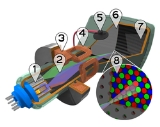
Color CRTs have three separate electron guns (shadow mask) or electron guns that share some electrodes for all three beams (Sony Trinitron, and licensed versions)

The CRT uses an evacuated glass envelope which is large, deep, heavy, and relatively fragile. Display technologies without these disadvantages, such as flat plasma screens, liquid crystal displays, DLP
DLP

Digital Light Processing is a trademark owned by Texas Instruments, representing a technology used in projectors and video projectors. It was originally developed in 1987 by Dr....
, OLED
Organic light-emitting diode

An Organic Light Emitting Diode , also Light Emitting Polymer and Organic Electro Luminescence , is any Light Emitting Diode whose Emission electroluminescence layer is composed of a film of organic compounds....
 displays have replaced CRTs in many applications and are becoming increasingly common as costs decline.

An exception to the typical bowl-shaped CRT would be the flat CRTs used by Sony
Sony

is a multinational corporation list of conglomerates corporation headquartered in Minato, Tokyo, Japan, and one of the world's largest media conglomerates with revenue exceeding US$99.1 billion ....
 in their Watchman
Sony Watchman

The Sony Watchman is a line of portable pocket televisions trademarked and produced by Sony....
 series (the was introduced in 1982). One of the last flat-CRT models was the . The CRT in these units was flat with the electron gun
Electron gun

An electron gun is an electrical component that produces an electron beam that has a precise kinetic energy and is most often used in televisions and Computer display which use cathode ray tube technology, as well as in other instruments, such as electron microscopes and particle accelerators....
 located roughly at right angles below the display surface thus requiring sophisticated electronics to create an undistorted picture free from effects such as keystoning.

General description

The earliest version of the CRT was invented by the German physicist Ferdinand Braun in 1897 and is also known as the 'Braun tube'. It was a cold-cathode
Cold cathode

A cold cathode is an element used within some Nixie tubes, gas discharge lamps, gas filled tubes, and vacuum tubes. The term 'cold cathode' refers to the fact that the cathode is not independently heated....
 diode
Diode

In electronics, a diode is a two-terminal device .Diodes have two active electrodes between which the signal of interest may flow, and most are used for their unidirectional electric current property....
, a modification of the Crookes tube
Crookes tube

A Crookes tube is an early experimental electrical discharge tube, invented by British physicist William Crookes and others around 1869-1875, in which cathode rays, that is electrons, were discovered....
 with a phosphor
Phosphor

A phosphor is a substance that exhibits the optical phenomenon of phosphorescence .Phosphors are transition metal compounds or rare earth element compounds of various types....
-coated screen. The first version to use a hot cathode was developed by John B. Johnson
John B. Johnson

John Bertrand "Bert" Johnson was a Sweden-born United States electrical engineer and physicist. He first explained in detail a fundamental source of noise with information traveling on wires....
 (who gave his name to the term Johnson noise) and Harry Weiner Weinhart of Western Electric, and became a commercial product in 1922.

The cathode ray
Cathode ray

Cathode rays are streams of electrons observed in vacuum tubes, i.e. vacuum glass tubes that are equipped with at least two metal electrodes to which a voltage is applied, a cathode or negative electrode and an anode or positive electrode....
s are now known to be a beam of electron
Electron

The electron is a subatomic particle that carries a negative electric charge. It has elementary particle and is believed to be a point particle....
s emitted from a heated cathode
Cathode

A cathode is an electrode through which electric charge flows out of a polarized electrical device. Mnemonic: CCD .From an electrochemical point of view, positively charged ion invariably move toward the cathode and/or negatively charged ion move away from it to balance the electrons arriving from external circuitry....
 inside a vacuum tube
Vacuum tube

In electronics, a vacuum tube, electron tube , thermionic valve, or just valve is a device used to amplifier, switch, otherwise modify, or create an Electricity signal by controlling the movement of electrons in a low-pressure space....
 and accelerated by a potential difference
Potential difference

In physics, the potential difference or p.d. between two points is the difference of the points' scalar potential, equivalent to the line integral of the field strength between the two points....
 between this cathode and an anode
Anode

An anode is an electrode through which electric charge flows into a polarized electrical device. Mnemonic: ACID . Electrons flow in the opposite direction to the positive electric current....
. The screen is covered with a crystalline phosphorescent coating
Phosphor

A phosphor is a substance that exhibits the optical phenomenon of phosphorescence .Phosphors are transition metal compounds or rare earth element compounds of various types....
 (doped with transition metal
Transition metal

In chemistry, the term transition metal has two possible meanings:*It commonly refers to any element in the d-block of the periodic table, including the group 12 element elements zinc, cadmium and Mercury ....
s or rare earth elements), which emits visible light when excited by high-energy electrons. The beam (or beams, in color CRTs) is/are deflected either by a magnetic
Magnetic field

A magnetism field is a vector field which can exert a magnetic force on moving electric charges and on magnetic dipoles . When placed in a magnetic field, magnetic dipoles tend to align their axes parallel to the magnetic field....
 or an electric field
Electric field

In physics, the space surrounding an electric charge or in the presence of a time-varying magnetic field has a property called an electric field ....
 to move the bright dot(s) to the required position on the screen. External electromagnets deflect the beams magnetically, while internal plates placed near to and alongside the beam deflect it electrostatically. (Electrostatic deflection is used only for single-beam tubes.)

In television set
Television set

A television set is a device used to view television broadcasts, not to be confused with Video monitor, which are unable to independently tune into over-the-air broadcasts....
s and computer monitors the entire front area of the tube is scanned repetitively and systematically in a fixed pattern called a raster
Raster scan

A Raster scan, or raster scanning, is the pattern of image detection and reconstruction in television, and is the pattern of image storage and transmission used in most computer bitmap image systems....
. A raster is a rectangular array of closely-spaced parallel lines, scanned one at a time, from left to right (and, ever so slightly, "downhill", because the topmost line is scanned first). An image is produced by modulating the intensity of each of the three electron beams, one for each primary color (red, green, and blue) with a received video signal (or another signal derived from it). In all CRT TV receivers except some very early models, the beam is deflected by magnetic deflection, a varying magnetic field generated by coils (the deflection yoke), driven by electronic circuits, around the neck of the tube. (The earliest commercial TV receivers used electrostatic deflection.)

Egun
The source of the electron beam is the electron gun
Electron gun

An electron gun is an electrical component that produces an electron beam that has a precise kinetic energy and is most often used in televisions and Computer display which use cathode ray tube technology, as well as in other instruments, such as electron microscopes and particle accelerators....
, which produces a stream of electrons through thermionic emission
Thermionic emission

Thermionic emission is the heat-induced flow of charge carriers from a surface or over a potential-energy barrier. This occurs because the thermal energy given to the carrier overcomes the forces restraining it....
, and focuses it into a thin beam. Earlier, black-and-white TV CRTs used magnetic focusing, but electrostatic focus has totally superseded focus coils. The gun is located in the narrow, cylindrical neck at the extreme rear of a CRT and has electrical connecting pins, usually arranged in a circular configuration, extending from its end. These pins provide external connections to the cathode, to various grid elements in the gun used to focus and modulate the beam, and, in electrostatic deflection CRTs, to the deflection plates. Since the CRT is a hot-cathode
Hot cathode

In vacuum tubes, a hot cathode is a cathode electrode which emits electrons due to thermionic emission. The heating element is usually an electrical filament....
 device, these pins also provide connections to one or more filament heaters within the electron gun. When a CRT is operating, the heaters can often be seen glowing orange through the glass walls of the CRT neck. The need for these heaters to 'warm up' causes a delay between the time that a CRT is first turned on, and the time that a display becomes visible. In older tubes, this could take fifteen seconds or more; modern CRT displays have fast-starting circuits which produce an image within about two seconds, using either briefly increased heater current or elevated cathode voltage. Once the CRT has warmed up, the heaters stay on continuously. The electrodes are often covered with a black layer
Black layer

A black layer is a coat on the Electrical filament of the indirectly heated hot cathode in a cathode ray tube, intended to optimise the output of electrons from the cathode, thus minimising the energy consumption and heat generated while maximising the picture brightness....
, a patented process used by all major CRT manufacturers to improve electron density.

The electron gun accelerates not only electrons but also ions present in the imperfect vacuum
Vacuum

A vacuum is a volume of space that is essentially empty of matter, such that its gaseous pressure is much less than atmospheric pressure. The word comes from the Latin term for "empty," but in reality, no volume of space can ever be perfectly empty....
 (some of which result from outgassing
Outgassing

Outgassing is the slow release of a gas that was trapped, freezing, Absorption or adsorbed in some material....
 of the internal tube components). The ions, being much heavier than electrons, are deflected much less by the magnetic or electrostatic fields used to position the electron beam. Ions striking the screen damage it; to prevent this the electron gun can be positioned slightly off the axis of the tube so that the ions strike the inside of the CRT neck instead of the screen. Permanent magnets (the ion trap
Ion trap

An ion trap is a combination of electric or magnetic fields that captures ions in a region of a vacuum system or tube. The two most common types of ion traps are the Penning trap and the Paul trap ....
) deflect the lighter electrons so that they strike the screen. Some very old TV sets without an ion trap show browning of the center of the screen, known as ion burn. The aluminum coating used in later CRTs eliminated the need for ion traps; they are no longer used.

When electrons strike the poorly-conductive phosphor layer on the glass CRT, it becomes electrically charged, and tends to repel electrons, reducing brightness (this effect is known as "sticking"). To prevent this the interior side of the phosphor layer can be covered with a layer of aluminum connected to the conductive layer inside the tube, which disposes of this charge. It has the additional advantages of increasing brightness by reflecting, towards the viewer, the light emitted towards the back of the tube. The aluminum layer also protects the phosphors from ion bombardment.

CRT details


Oscilloscope CRTs

For use of an oscilloscope
Oscilloscope

An oscilloscope is a type of electronic test instrument that allows signal voltages to be viewed, usually as a two-dimensional graph of one or more electrical potential differences plotted as a function of time or of some other voltage ....
, the design is somewhat different from that in a TV or monitor. Rather than tracing out a raster, the electron beam is directly steered along an arbitrary path, while its intensity is kept constant. Usually the beam is deflected horizontally (X) by a varying potential difference between a pair of plates (inside the neck, of course, part of the electron gun) to its left and right, and vertically (Y) by plates (also inside, part of the gun) above and below, although magnetic deflection is possible (but never seen in modern oscilloscopes). The instantaneous position of the beam will depend upon the X and Y voltages.

Color CRTs

Color tubes use three different phosphors which emit red, green, and blue light respectively. They are packed together in stripes (as in aperture grille
Aperture grille

An aperture grille is one of two major technologies used to manufacture color cathode ray tube televisions and computer displays; the other is shadow mask....
 designs) or clusters called "triads"
Triad (computers)

In cathode ray tube or computer terminology, a triad is a group of three phosphor dots coloured red, green, and blue on the inside of the cathode ray tube display of a computer computer display or television set....
 (as in shadow mask
Shadow mask

The shadow mask is one of two major technologies used to manufacture cathode ray tube televisions and computer displays that produce color images ....
 CRTs). Color CRTs have three electron guns, one for each primary color, arranged either in a straight line or in a triangular configuration (the guns are usually constructed as a single unit). Each gun's beam reaches the dots of exactly one color; a grille or mask absorbs those electrons that would otherwise hit the wrong phosphor. Since each beam starts at a slightly different location within the tube, and all three beams are perturbed in essentially the same way, a particular deflection charge will cause the beams to hit a slightly different location on the screen (called a 'sub pixel'). Color CRTs with the guns arranged in a triangular configuration are known as delta-gun CRTs, because the triangular formation resembles the triangular shape of the Greek letter ? (delta).

Convergence in color CRTs

The three beams in color CRTs would not, of themselves, strike the screen at the same place at the same time. Uncorrected, the three colors in a typical image would be unacceptably misaligned. Elaborate measures are needed to make the beams converge acceptably over the entire screen. For one, static convergence brings the beams together, while dynamic convergence (such as from auxiliary coils near the deflection yoke) maintains convergence over the whole screen.

Delta-gun CRTs required the electonically driven convergence coils placed on a "triangle" device on the deflection yoke, powered from the deflection oscillators through a complex set of tunable coils, capacitors and resistors. This set had around 15 points of manual adjustment to align the color and was usually located on a board from the side of the TV case, which could be accessed without dismounting the rear cover of the TV, and easily accessed while viewing the test grid picture on the screen.

Flat-gun modern CRTs require no power for the covergence magnets.

Beam-landing trim magnets

Modern shadow-mask color CRTs have a set of six weak ring magnets around their necks, behind the deflection yoke. These magnets have tabs that permit them to be rotated around the neck to correct beam-landing errors that would affect color purity and cannot be corrected otherwise. (Each of the three beams must excite only the color of phosphor it's intended to; this is color purity.)

In the magnet sets, each ring of one pair has N and S poles diametrically opposite, creating a dipolar field. Rotating these together orients the field, while relative rotation between the pair causes the individual ring fields to aid, to have no effect on, or cancel each other, depending upon relative position.

Similarly, a second pair has four poles, alternating N and S around each ring. This pair provides a quadrupolar field, and its magnitude and orientation are adjusted as with the dipole-field magnets.

Finally, the third pair has six poles, again N and S alternating around the ring, and provides a hexapolar field.

When adjusted, the field inside the neck is a composite of the three types of field, and ensures that each beam lands only on the color of phosphor that it's intended to excite.

Fast events

When displaying one-shot fast events the electron beam must deflect very quickly, with few electrons impinging on the screen, leading to a faint or invisible display. A simple improvement can be attained by fitting a hood on the screen against which the observer presses his face, excluding extraneous light, but oscilloscope CRTs designed for very fast signals give a brighter display by passing the electron beam through a micro-channel plate just before it reaches the screen. Through the phenomenon of secondary emission
Secondary emission

Secondary emission is a phenomenon where additional electrons, called secondary electrons, are emitted from the surface of a material when an incident particle impacts the material with sufficient energy....
 this plate multiplies the number of electrons reaching the phosphor screen, giving a brighter display, possibly with a slightly larger spot.

Phosphor persistence

The phosphors used in the screens of oscilloscope tubes are different from those used in the screens of other display tubes. Phosphors used for displaying moving pictures should produce an image which fades rapidly to avoid smearing of new information by the remains of the previous picture; i.e., they should have relatively-short persistence. An oscilloscope will often display a trace which repeats unchanged, so longer persistence is not a problem; but it is a definite advantage when viewing a single-shot event, so longer-persistence phosphors are used.

There were moving-film oscilloscope cameras in which film movement provided the time base; they functioned much like strip-chart recorders.

Phosphor colors and designations

An oscilloscope trace can be any color without loss of information, so a phosphor with maximum effective luminosity
Luminosity function

The luminosity function or luminous efficiency function describes the average sensitivity of the human eye to light of different wavelengths....
 is usually used. The eye is most sensitive to green: for visual and general-purpose use the P31
Phosphor

A phosphor is a substance that exhibits the optical phenomenon of phosphorescence .Phosphors are transition metal compounds or rare earth element compounds of various types....
 phosphor gives a visually bright trace, and also photographs well and is reasonably resistant to burning by the electron beam. Earlier, the green P1
Phosphor

A phosphor is a substance that exhibits the optical phenomenon of phosphorescence .Phosphors are transition metal compounds or rare earth element compounds of various types....
 phosphor was used for the same purposes, but it burned more easily and had a somewhat shorter persistence. For displays meant to be photographed rather than viewed, the blue trace of the P11
Phosphor

A phosphor is a substance that exhibits the optical phenomenon of phosphorescence .Phosphors are transition metal compounds or rare earth element compounds of various types....
 phosphor gives higher photographic brightness; it has a very short persistence. For extremely slow displays, such as radar PPIs, very-long-persistence phosphors such as P7
Phosphor

A phosphor is a substance that exhibits the optical phenomenon of phosphorescence .Phosphors are transition metal compounds or rare earth element compounds of various types....
, which produce a blue trace followed by a longer-lasting amber or yellow afterimage, are used. P7
Phosphor

A phosphor is a substance that exhibits the optical phenomenon of phosphorescence .Phosphors are transition metal compounds or rare earth element compounds of various types....
 is a dual-layer phosphor, and the long-persistence layer is excited by the light from the blue phosphor rather than from the electron beam. Color TV CRT phosphors are collectively designated P22
Phosphor

A phosphor is a substance that exhibits the optical phenomenon of phosphorescence .Phosphors are transition metal compounds or rare earth element compounds of various types....


Graticules

The phosphor screen of most oscilloscope tubes contains a permanently-marked internal graticule, a simple array of squares that serves as a reference grid. It divides the screen using Cartesian coordinates. This internal graticule allows for the easy measurement of signals with no worries about parallax error
Parallax

Parallax is an apparent displacement or difference of orientation of an object viewed along two different lines of sight, and is measured by the angle or semi-angle of inclination between those two lines....
. Less expensive oscilloscope tubes may instead have an external graticule of glass or acrylic
Acrylic glass

Poly poly is a thermoplastic and transparency plastic. Chemically, it is the synthetic polymer of methyl methacrylate. It is sold by the trade names Plexiglas, Vitroflex, Limacryl, 'R-Cast, 'Per-Clax, 'Perspex, 'Plazcryl, 'Acrylex, 'Acrylite, 'Acrylplast, 'Altuglas, 'Polycast...
 plastic. Most graticules can be side-illuminated for use in a darkened room. The markings disperse the light, appearing bright, while the smooth surface acts like a light pipe.

Implosion protection

Oscilloscope tubes almost never contain integrated implosion protection (see below). External implosion protection must always be provided, either in the form of an external graticule or, for tubes with an internal graticule, a plain sheet of glass or plastic. The implosion protection shield is often colored to match the light emitted by the phosphor screen; this improves the contrast as seen by the user.

Vector monitors

Graphical displays for early computers used vector monitors (also called X-Y displays), a type of CRT similar to the oscilloscope but typically using magnetic, rather than electrostatic, deflection. Magnetic deflection allows the construction of much shorter tubes for a given viewable image size
Viewable image size

On a computer monitor, the viewable image size or VIS is the actual amount of screen space that is available to display a picture, without obstruction from the case or other aspects of the unit's design....
. Here, the beam traces straight lines between arbitrary points, repeatedly refreshing the display as quickly as possible. Vector monitors were also used by some late-1970s to mid-1980s arcade games such as Asteroids. Vector displays for computers did not noticeably suffer from the display artifacts of Aliasing
Aliasing

In statistics, signal processing, computer graphics and related disciplines, aliasing refers to an effect that causes different continuous signals to become indistinguishable when sampling ....
 and pixelation
Pixelation

In computer graphics, pixellation is an effect caused by displaying a bitmap or a section of a bitmap at such a large size that individual pixels, small single-colored square display elements that comprise the bitmap, are visible to the eye....
, but were limited in that they could display only a shape's outline (advanced vector systems could provide a limited amount of shading), and only a limited amount of crudely-drawn text (the number of shapes and/or textual characters drawn was severely limited, because the speed of refresh was roughly inversely proportional to how many vectors needed to be drawn). Some vector monitors are capable of displaying multiple colors, using either a typical tri-color CRT, or two phosphor layers (so-called "penetration color"). In these dual-layer tubes, by controlling the strength of the electron beam, electrons could be made to reach (and illuminate) either or both phosphor layers, typically producing a choice of green, orange, or red.

Hewlett-Packard made a large-screen fast vector monitor, which they called an X-Y display. It used a wide-angle electrostatically-deflected CRT that was about as compact as a magnetic-deflection CRT. Instead of the deflection plates of a typical CRT, it had an unique structure they called an electrostatic deflection yoke, with metallized electrodes inside a glass cylinder.

Long-persistence phosphors

Many of the early computer displays used "slow", or long-persistence, phosphors to reduce flicker for the operator. While such a phosphor reduces eyestrain for relatively static displays, the drawback of a long-persistence phosphor is that when the display is changed, it produces a visible afterimage that can take up to several seconds to fade. This makes it inappropriate for animation, or for real-time dynamic information displays. Current CRT displays have fast refresh rates to prevent visible flicker.

CRT resolution

Dot pitch
Dot pitch

Dot pitch is a specification for a computer display, computer printer, or other pixel-based device that describes the distance, for example, between dots of the same color on the inside of a display screen....
 defines the "native resolution" of the display, assuming delta-gun CRTs (although this is not really a native resolution like on flat panel display
Flat panel display

Flat panel displays encompass a growing number of technologies enabling video displays that are lighter and much thinner than traditional television and video displays that use cathode ray tubes, and are usually less than 4 inches thick....
s, because these dots aren't real subpixels). In these, as the scanned resolution approaches the dot pitch resolution, moiré (a kind of soft-edged banding) appears, due to interference patterns between the mask structure and the grid-like pattern of pixels drawn. The term stripe pitch defines resolution of aperture grille monitors. These monitors do not suffer from vertical moiré, however, because the phosphor stripes have no vertical detail. The aperture grille is something like a picket fence, in that it has vertical slots between metal strips. In smaller CRTs, these strips maintain position by themselves, but larger aperture-grille CRTs require one or two crosswise (horizontal) support strips. However, these strips are nearly invisble on the display. Sony Trinitron CRTs use aperture grilles, and their faceplates are toroidal, although the greatly differing radii of curvature make a Trinitron CRT's faceplate seem cylindrical.

Gamma

CRTs have a pronounced triode
Triode

A triode is an electronic amplifier device having three active electrodes. The term most commonly applies to a vacuum tube with three elements: the Electrical filament or cathode, the control grid, and the Plate electrode or anode....
 characteristic, which results in significant gamma
Gamma correction

Gamma correction, gamma nonlinearity, gamma encoding, or often simply gamma, is the name of a nonlinear operation used to code and decode luminance or tristimulus values in video or still image systems....
 (a nonlinear relationship in an electron gun between applied video voltage and light intensity). In early televisions, screen gamma was an advantage because it acted to compress the screen contrast
Contrast (vision)

Contrast is the difference in visual properties that makes an object distinguishable from other objects and the background. In visual perception of the real world, contrast is determined by the difference in the color and brightness of the object and other objects within the same field of view....
. However in systems where linear response is required (such as in desktop publishing
Desktop publishing

Desktop publishing combines a personal computer and WYSIWYG page layout software to create publication documents on a computer for either Publishing or small scale local Multifunction printer output and distribution....
), gamma correction is applied. The gamma characteristic exists today in all digital video
Digital video

Digital video is a type of video recording system that works by using a digital rather than an analog signal video signal.The terms camera, video camera, and camcorder are used interchangeably in this article....
 systems.

Other types of CRTs


Storage CRTs

Other graphical displays used 'storage tube
Storage tube

Mostly obsolete, a storage tube is a special monochromatic cathode-ray tube whose screen has a kind of 'memory' : when a portion of the screen is illuminated by the CRT's electron gun, it stays lit until a screen erase command is given....
s', including Direct View Bistable Storage Tube
DVBST

DVBST was an acronym used by Tektronix to describe their line of "Direct-View Bistable Storage Tubes". These were cathode ray tubes that stored information written to them using an analog technique inherent in the CRT and based upon the secondary emission of electrons from the phosphor screen itself....
s (DVBSTs). These CRTs inherently stored the image, and did not require periodic refreshing. Some were quite large, on the order of 20 inch diagonals. Oscilloscopes also used storage tubes, in particular for observing (and, if needed, photographing) single events or very-slowly-changing signals. Some storage tubes have a special plate behind the phosphor display screen. The imaging electron gun writes its trace onto the plate, and where written, the plate permits electrons from another electron gun to pass through it onto the display screen. The latter gun, called a flood gun, covers the whole area of the plate evenly with electrons; it's not at all a focused beam.

Some storage tubes could display continuous-tone images.

Another type of storage tube, used in oscilloscopes and large-screen direct-view X-Y displays, has a special phosphor screen structure that normally blocks electrons from exciting the phosphor, but when written onto, lets the flood-gun's electrons maintain the written trace.

A typical storage CRT's image starts to deteriorate after tens of seconds to minutes; it is by no means permanent.

Charactrons

Some displays for early computers (those that needed to display more text than was practical using vectors, or that required high speed for photographic output) used Charactron
Charactron

Charactron was U. S. registered trademark by Consolidated Vultee Aircraft Corporation for its shaped electron beam cathode ray tube. Charactron CRTs performed functions of both a display device and a read-only memory storing multiple characters and fonts....
 CRTs. These incorporate a perforated metal character mask (stencil
Stencil

A stencil is a wikt:template used to drawing or painting identical Letter , symbols, shapes, or patterns every time it is used. Stencil technique in visual art is also referred to as pochoir....
), which shapes a wide electron beam to form a character on the screen. The system selects a character on the mask using one set of deflection circuits, but that causes the extruded beam to be aimed off-axis, so a second set of deflection plates has to re-aim the beam so it's headed toward the center of the screen. A third set of plates places the character wherever required. The beam is unblanked (turned on) briefly to draw the character at that position. Graphics could be drawn by selecting the position on the mask corresponding to the code for a space (in practice, they were simply not drawn), which had a small round hole in the center; this effectively disabled the character mask, and the system reverted to regular vector behavior. Charactrons had exceptionally-long necks, because of the need for three deflection systems.

Monoscopes

There's a wikipedia article about monoscope
Monoscope

A monoscope was a special form of cathode ray tube that was used to generate, rather than display, a video signal. Each tube was only capable of generating a single video signal, hence the name....
s. These are not display tubes; they create fixed video test patterns.

Dark-trace tubes

These tubes, instead of a light-emitting phosphor, had a faceplate coated with a scotophor, composed of potassium chloride (KCl), and designated P10. Electron impact made the KCl absorb green light, giving a magenta-colored trace. Trace persistence was quite long, but could be shortened by infrared heating of the faceplate. They were used in World War II large-screen radar displays.

Camera tubes


Camera tubes were the image sensors in TV cameras until recently. One of the earliest was the iconoscope, invented and developed by Vladimir Zworykin at RCA. Another early one was the image dissector, invented by Philo T. Farnsworth, and used even recently for monitoring flames in commercial boilers. Philo Farnsworth
Philo Farnsworth

Philo Taylor Farnsworth was an United States inventor. He is best known for inventing the first completely electronic television. In particular, he was the first to make a working electronic image pickup device , and the first to demonstrate an all-electronic television system to the public....
 created the first all-electronic television system.

A tube called the orthicon was refined into the image orthicon, which was the professional camera tube of choice for several decades. Image orthicons were sophisticated, not easy to make, but their image quality was very good.

A much-simpler, much smaller and much less-costly camera tube called the vidicon was popular for small closed-circuit TV cameras, such as security cameras. It spawned many variations, distinguished principally by the material used for its photosensitive surface.

Scan converters


These were uncommon, and used to convert, for example, from radar PPI display video to a raster scan. They were effectively two CRTs facing a common screen. One was a display-type tube that wrote data onto the screen, which stored it for a while (long persistence), and the other was like a camera tube.

The PPI (Plan Position Indicator) is familiar in some TV weathercasts as a decorative animated graphic element—a rotating radial bar of light on a circular screen.

Terminology: monitor

Computer displays developed from CRT TV studio image monitors; like monitors, they have no radio-frequency circuits, because they are not TV receivers. Both TV monitors and computer monitors accept video signals, and both offer displays of better resolution than that of TV. Considering this, a computer's CRT display is understandably called a monitor.

High-voltage considerations

The outer glass allows the light generated by the phosphor out of the monitor, but (for color tubes) it must block dangerous X-ray
X-ray

X-radiation is a form of electromagnetic radiation. X-rays have a wavelength in the range of 10 to 0.01 nanometers, corresponding to frequency in the range 30 Hertz to 30 Hertz and energies in the range 120 Electron volt to 120 keV....
s generated by high energy electrons impacting the inside of the CRT face. For this reason, the glass is leaded
Lead(II) oxide

Lead oxide is the chemical compound with the chemical formula leadoxide. Lead oxide occurs in two forms: red, having a tetragonal crystal system and yellow, having an orthorhombic crystal system....
. Color tubes require significantly higher anode voltages than monochrome tubes (as high as 32,000 volts in large tubes), partly to compensate for the blockage of some electrons by the aperture mask or grille; the amount of X-rays produced increases with voltage. Because of leaded glass, other shielding, and protective circuits designed to prevent the anode voltage from rising too high in case of malfunction, the X-ray emission of modern CRTs is well within approved safety limits.

CRT displays accumulate a static
Static electricity

Static electricity refers to the buildup of electric charge on the surface of objects. The static charges remains on an object until they either bleed off to ground or are quickly neutralized by a discharge....
 electrical charge on the screen, unless preventive measures are taken. This charge does not pose a safety hazard, but can lead to significant degradation of image quality through attraction of dust
Dust

Dust is a general name for minute solid particles with diameters less than 20 Thou . Particles in the Earth's atmosphere arise from various sources such as soil dust lifted up by wind, volcanic eruptions, and pollution....
 particles to the surface of the screen. Unless the display is regularly cleaned with a dry cloth or special cleaning tissue (using ordinary household cleaners may damage the anti-glare protective layer on the screen), after a few months the brightness and clarity of the image drops significantly.

The high voltage (EHT -- extra high tension) used for accelerating the electrons is provided by a transformer. For CRTs used in televisions, this is usually a flyback transformer
Flyback transformer

A flyback or line output transformer is a type of transformer used in the power supply of a cathode ray tube that generates the high voltage needed as part of the supply of a Cathode ray tube display or for other devices such as plasma globes....
 that steps up the line (horizontal) deflection supply to as much as 32,000 volts for a color tube, although monochrome tubes and specialty CRTs may operate at much lower voltages. Typical oscilloscope tubes operate at a few kilovolts. The output of the transformer is rectified and the pulsating output voltage is smoothed by a capacitor formed by the tube itself (the accelerating anode being one plate, the glass being the dielectric, and the grounded (earthed) Aquadag
Aquadag

Aquadag is a trade name for a graphite based coating commonly found in cathode ray tubes. It is manufactured by Acheson Industries, a subsidiary of ICI....
 coating on the outside of the tube being the other plate).

Before all-glass tubes, the structure between the screen and the electron gun was made from a heavy metal cone which served as the accelerating anode. Smoothing of the EHT was then done with a high voltage capacitor, external to the tube itself. In the earliest televisions, before the invention of the flyback transformer design, a linear high-voltage supply was used; because these supplies were capable of delivering much more current at their high voltage than flyback high voltage systems – in the case of an accident they proved extremely dangerous. The flyback circuit design addressed this: in the case of a fault, the flyback system delivers relatively little current, improving a person's chance of surviving a direct shock from the high voltage anode.

Other early TVs used RF high-voltage supplies, which used a low-loss air-core transformer (something like a well-behaved, comparatively low-voltage-output Tesla coil), fed by a vacuum-tube oscillator. A tube diode rectified the RF. These supplies put out comparatively little current, and were not especially hazardous.

Getting a shock from a CRT device is not so much a danger from the current, which doesn't persist significantly, but from the severe and uncontrolled muscular contractions which can result in physical rather than electrical injury.

The future of CRT technology

CRT screens have much deeper cabinets compared to LCD screens for a given screen size. LCDs have generally inferior color rendition due to the fluorescent lights that can be used as backlight
Backlight

A backlight is a form of illumination used in liquid crystal displays . Backlights illuminate the LCD from the side or back of the display panel, unlike frontlights, which are placed in front of the LCD....
s, even though they can be brighter overall. Light-emitting diodes (LEDs) are beginning to serve as backlights, however. CRTs can be useful for displaying photos with high pixels per unit area and correct color balance. General, rear-projection displays and LCDs require less power per display area, though plasma display
Plasma display

A plasma display panel is a type of flat panel display common to large television displays . Many tiny cells between two panels of glass hold an inert mixture of noble gases....
s consume as much as or more than CRTs.

The end of most high-end CRT production in the mid 2000s (including high-end Sony, and Mitsubishi product lines) means an erosion of the CRT's capability. Samsung did not introduce any CRT models for the 2008 model year at the 2008 Consumer Electronics Show and on February 4, 2008 Samsung removed their 30" wide screen CRTs from their North American website and has not replaced them with new models. In the first quarter of 2008, CRTs retook the #2 technology position in North America from plasma. The resurgence of CRTs could be attributed to several factors, including increased demand for low-cost digital TVs from consumers, closeout activities from some brands exiting the space or stronger demand in Canada where CRTs are free from the burden of mandated digital tuner requirements.

However, CRTs still find adherents in video gaming because of higher resolution per initial cost and fast response time. CRTs are often used in psychological research that requires precise recording of reaction times. CRTs are also still popular in the printing and broadcasting industries as well as in the professional video, photography, and graphics fields due to their greater color fidelity and contrast, better resolution when displaying moving images, and better viewing from off-axis, although improvements in LCD technology increasingly alleviate these concerns. The demand for CRT screens is falling rapidly, and producers are responding to this trend. For example, in 2005 Sony announced that they would stop the production of CRT computer displays. Similarly, German manufacturer Loewe
Loewe AG

Loewe AG is a German electronics manufacturer founded 1923 by Dr. Siegmund and his brother David Loewe in Berlin. The company now is located in Kronach....
 ceased production of CRT TVs in December 2005. It has been common to replace CRT-based televisions and monitors in as little as 5–6 years, although they generally are capable of satisfactory performance for a much longer time.

In the United Kingdom
United Kingdom

The United Kingdom of Great Britain and Northern Ireland, commonly known as the United Kingdom , the UK or Britain,is a sovereign state located off the northwestern coast of continental Europe....
, DSG (Dixons)
DSG International (retailer)

DSG international plc is one of the largest consumer electronics retailers in Europe. The company operates the Dixons , Dixons Tax Free, Currys, Currys.digital, PC World and Electro World stores along with many other brands across Europe....
, the largest retailer of domestic electronic equipment, reported that CRT models made up 80–90% of the volume of televisions sold at Christmas 2004 and 15–20% a year later, and that they were expected to be less than 5% at the end of 2006. Dixons ceased selling CRT televisions in 2007. DisplaySearch has reported that in the 4Q of 2007 LCDs surpassed CRTs in worldwide sales though CRTs then outsold LCDs in the 1Q of 2008.

Modern high-performance oscilloscopes no longer use CRTs, although the lowest-cost oscilloscopes still use them. Instead, the signals to be observed are digitized by very fast analog-to-digital converters, and the stream of digital data is processed (and stored) for display and analysis. The displays are now color flat panels, and because there is no need to accommodate a long CRT, the overall shape of the instrument is a rectangular block that is likely not as deep as it is tall.

Oscilloscope CRT phosphors had medium persistence, which meant that at a given point, trace brightness was proportional to the amount of electrons hitting that point. This scale of brightness was sometimes quite useful in analyzing the display, but early flat-panel oscilloscope displays lacked this information. However, some modern oscilloscope displays simulate CRT phosphor decay by processing the signal.

Magnets


Magnet
Magnet

A magnet is a material or object that produces a magnetic field. This magnetic field is invisible but is responsible for the most notable property of a magnet: a force that pulls on other ferromagnetic materials and attracts or repels other magnets....
s should never be put next to a color CRT, as they may cause magnetization of the shadow mask, and in severe cases can permanently distort it mechanically, which will cause incorrect colors to appear in the magnetized area. This is called a "purity" problem, because it affects the purity of one of the primary colors, with the residual magnetism causing the undesired deflection of electrons from one gun to the wrong color's phosphor patch. This can be expensive to have corrected, although it may correct itself over a few days or weeks. Most modern television sets and nearly all newer computer monitors have a built-in degaussing
Degaussing

Degaussing is the process of decreasing or eliminating an unwanted magnetic field. It is named after Carl Friedrich Gauss, an early researcher in the field of magnetism....
 (demagnetizing) coil, which upon power-up creates a brief, alternating magnetic field which decays in strength over the course of a few seconds. The coil's interaction with the shadow mask, screen band and chassis components is the reason for the characteristic 'hum' associated with turning on many CRT-equipped displays. This degaussing field is strong enough to remove most cases of shadow mask magnetization.

In extreme cases, very strong magnets such as the neodymium
Neodymium

Neodymium is a chemical element with the symbol Nd and atomic number 60....
 iron
Iron

Iron is a chemical element with the symbol Fe and atomic number 26. Iron is a Group 8 element and period 4 element. Iron is lustrous and silvery in color....
 boron
Boron

Boron is a chemical element with atomic number 5 and the chemical symbol B. Boron is a trivalent metalloid element which occurs abundantly in the evaporite ores borax and ulexite....
, or NIB magnets
Neodymium magnet

A neodymium magnet or NIB magnet, a variety of rare-earth magnet, is a permanent magnet made of an alloy of neodymium, iron, and boron — Nd2Fe14B....
, can actually deform (and likely, permanently bend) the shadow mask. This will create an area of impure color rendition on the screen and if the shadow mask has been bent, such damage usually can't be repaired.

Health concerns


Electromagnetic

It has been claimed that the electromagnetic fields emitted by CRT monitors constitute a health hazard, and can affect the functioning of living cells. However, studies that examined this possibility showed no signs that CRT radiation had any effect on health. Exposure to these fields diminishes considerably at distances of 85 cm or farther according to the inverse square law, which describes the propagation of all magnetic radiation.

As the coils in a CRT monitor are extremely inefficient antennas, there is little electromagnetic field
Electromagnetic field

The electromagnetic field is a physical field produced by electric charge. It affects the behavior of charged objects in the vicinity of the field....
 radiated.

Ionizing radiation

CRTs can emit a small amount of X-ray
X-ray

X-radiation is a form of electromagnetic radiation. X-rays have a wavelength in the range of 10 to 0.01 nanometers, corresponding to frequency in the range 30 Hertz to 30 Hertz and energies in the range 120 Electron volt to 120 keV....
 radiation as a result of the electron beam's bombardment of the shadow mask/aperture grille and phosphors. The amount of radiation escaping the front of the monitor is widely considered unharmful. The Food and Drug Administration
Food and Drug Administration

The U.S. Food and Drug Administration is an Government agency of the United States Department of Health and Human Services and is responsible for regulating and supervising the safety of foods, dietary supplements, Medications, vaccines, Biopharmaceutical, blood transfusion, medical devices, Electromagnetic radiation-emitting devices, veteri...
 regulations in are used to strictly limit, for instance, television receivers to 0.5 milliroentgens
Röntgen

The r?ntgen or roentgen is a unit of measurement for ionizing radiation , and is named after the Germany physicist Wilhelm R?ntgen. Adopted in 1928, 1 R is the amount of radiation required to liberate positive and negative charges of one Statcoulomb of electric charge in 1 cubic centimeter of dry air at standard temperature and pressu...
 per hour (mR/h) (0.13 µC/(kg·h) or 36 pA/kg) at a distance of 5 cm from any external surface; since 2007, most CRTs have emissions that fall well below this limit. This is one of the reasons CRT equipment sold in the United States is required to have the month and year of manufacture stamped on the back of the set.

Early color television
Color television

Color television refers to the Technology of television and practices associated with television's transmission of video in color....
 receivers (many of which are now highly collectible, see CT-100
Ct-100

For the Bajaj motorcycle, see Bajaj CT 100Introduced in March 1954, the RCA CT-100 was the first all-electronic consumer color television set in the USA....
) were especially vulnerable due to primitive high-voltage regulation systems. X-ray production is generally negligible in black-and-white sets (due to low acceleration voltage and beam current), and in virtually every color display since the late 1960s, when systems were added to shut down the horizontal deflection system (and therefore high voltage supply) should regulation of the acceleration voltage fail.

All television receivers and CRT displays equipped with a vacuum tube based high-voltage rectifier or high-voltage regulator tube also generate X-rays in these stages. These stages are universally housed in a metal enclosure called the "high-voltage cage" made from sheet metal to substantially reduce (and effectively eliminate) exposure. For both X-ray and electrical safety reasons, the set should never be operated with the cover of the high voltage cage opened. Many sets incorporated some type of interlock system to prevent operation with the high voltage cage open.

CRTs may emit low levels of beta radiation which can be detectable by sensitive Geiger counter. It does not come from accelerated electrons in the tube but from radioactive isotopes. The source of this type of radioactivity is mainly Zirconium
Zirconium

Zirconium is a chemical element with the symbol Zr and atomic number 40. It is a lustrous, gray-white, strong transition metal that resembles titanium....
 or other isotopes sometimes used in glass or mask production.

Toxicity

CRTs may contain toxic phosphor
Phosphor

A phosphor is a substance that exhibits the optical phenomenon of phosphorescence .Phosphors are transition metal compounds or rare earth element compounds of various types....
s within the glass envelope. The glass envelopes of modern CRTs may be made from heavily leaded glass
Lead glass

Glass consists of a network former, typically silica , and network modifiers, including alkali fluxes such as potassium oxide or sodium oxide, and a stabilizer, typically calcium oxide....
, which represent an environmental hazard. Indirectly heated vacuum tube
Vacuum tube

In electronics, a vacuum tube, electron tube , thermionic valve, or just valve is a device used to amplifier, switch, otherwise modify, or create an Electricity signal by controlling the movement of electrons in a low-pressure space....
s (including CRTs) use barium
Barium

Barium is a chemical element. It has the symbol Ba, and atomic number 56. Barium is a soft silvery metallic alkaline earth metal. It is never found in nature in its pure form due to its reactivity with Earth's atmosphere....
 compounds and other reactive materials in the construction of the cathode
Cathode

A cathode is an electrode through which electric charge flows out of a polarized electrical device. Mnemonic: CCD .From an electrochemical point of view, positively charged ion invariably move toward the cathode and/or negatively charged ion move away from it to balance the electrons arriving from external circuitry....
 and getter
Getter

Getters are reactive materials used for removing traces of gas from vacuum systems."Flashed getters" are prepared by arranging a reservoir of a volatile and reactive material inside the vacuum system; once the system is sealed, the material is heated, usually by induction heating and evaporates, reacting with residual gas, and deposit...
 assemblies; normally this material will be converted into oxides upon exposure to the air, but care should be taken to avoid contact with the inside of all broken tubes.

In some jurisdictions, discarded CRTs are regarded as toxic waste. In October 2001, the United States Environmental Protection Agency
United States Environmental Protection Agency

The U.S. Environmental Protection Agency is an List of United States federal agencies of the federal government of the United States charged to Regulation of chemicals and protect human health by safeguarding the natural environment: air, water, and land....
 created rules stating that CRTs must be brought to special recycling
Recycling

Recycling involves processing used materials into new products in order to prevent waste of potentially useful materials, reduce the consumption of fresh raw materials, reduce energy usage, reduce air pollution and water pollution by reducing the need for "conventional" waste disposal, and lower greenhouse gas emissions as compared to virg...
 places. In November 2002, the EPA began fining companies that disposed of CRTs through landfills or incineration. Regulatory agencies, local and statewide, monitor the disposal of CRTs and other computer equipment.

In Europe, disposal of CRT televisions and monitors is covered by the WEEE Directive.

Flicker

The constant refreshing of a CRT can cause headache
Headache

In medicine a headache or wiktionary:cephalalgia is a symptom of a number of different conditions of the head and sometimes neck. Some of the causes are benign while others are medical emergencies....
s and seizure
Seizure

An epileptic seizure is a transient symptom of abnormal, excessive or synchronous neuronal activity in the brain. It can manifest as an alteration in mental state, tonic or clonic movements, convulsions, and various other psychic symptoms ....
s in epileptics
Epilepsy

Epilepsy is a common chronic neurological disorder characterized by recurrent unprovoked seizure s. These seizures are transient signs and/or symptoms of abnormal, excessive or synchronous neuronal activity in the brain....
. Screen filters
Monitor filter

A monitor filter is an accessory to the computer display to filter out the glare generated from the glass surface of a CRT display as well as the radiation emitted from CRT and LCD displays....
 are available to reduce these effects. A high refresh rate (above 72 Hz) also helps to negate these effects.

Security

Under some circumstances the signal radiated from the electron guns and associated wiring can be reconstructed
Van Eck phreaking

Van Eck phreaking is the process of eavesdropping on the contents of a Cathode ray tube display by detecting its electromagnetic Emission . It is named after Netherlands computer researcher Wim van Eck, who in 1985 published the first paper on it, including proof of concept....
 to remotely display what is shown on the CRT.

High voltage

CRTs operate at very high voltages, which can persist long after the device containing the CRT has been switched off and/or unplugged. Residual charges of hundreds of volts can also remain in large capacitors in the power supply circuits of the device containing the CRT; these charges may persist. Modern circuits contain bleeder resistor
Bleeder resistor

A bleeder resistor is a resistor placed in Series and parallel circuits#Parallel circuits with a high-voltage supply for the purposes of discharging the energy stored in the power source's filter capacitors or other components that store electrical energy when the equipment is turned off....
s, to ensure that the high-voltage supply is discharged to safe levels within a couple of minutes at most. These discharge devices can fail even on a modern unit and leave these high voltage charges present. The final anode connector on the bulb of the tube carries this high voltage.

Implosion

A high vacuum exists within all CRT monitors. If the outer glass envelope is damaged, a dangerous implosion may occur. Due to the power of the implosion, glass pieces may bounce and explode outwards. This shrapnel
Shrapnel

Shrapnel shells were anti-personnel artillery munitions which carried a large number of individual bullets to the target and then ejected them forwards, relying almost entirely on the shell's velocity for their lethality....
 can travel at dangerous and potentially fatal velocities. While modern CRTs used in televisions and computer displays have epoxy-bonded face-plates or other measures to prevent shattering of the envelope, CRTs removed from equipment must be handled carefully to avoid personal injury.

Early TV receivers had safety glass in front of their CRTs for protection. Modern CRTs have exposed faceplates; they have tension bands around the widest part of the glass envelope, at the edge of the faceplate, to keep the faceplate's glass under considerable compression, greatly enhancing resistance to impact. The tension in the band is on the order of a ton or more.

See also

  • Charactron
    Charactron

    Charactron was U. S. registered trademark by Consolidated Vultee Aircraft Corporation for its shaped electron beam cathode ray tube. Charactron CRTs performed functions of both a display device and a read-only memory storing multiple characters and fonts....
  • Comparison of display technology
    Comparison of display technology

    This is a comparison of various properties of different display technologies....
  • Crookes tube
    Crookes tube

    A Crookes tube is an early experimental electrical discharge tube, invented by British physicist William Crookes and others around 1869-1875, in which cathode rays, that is electrons, were discovered....
  • CRT projector
    CRT projector

    A CRT projector is a video projector that uses a small, high-brightness cathode ray tube as the image generating element. The image is then focused and enlarged onto a screen using a lens kept in front of the CRT face....
  • DVBST
    DVBST

    DVBST was an acronym used by Tektronix to describe their line of "Direct-View Bistable Storage Tubes". These were cathode ray tubes that stored information written to them using an analog technique inherent in the CRT and based upon the secondary emission of electrons from the phosphor screen itself....
  • Flat panel display
    Flat panel display

    Flat panel displays encompass a growing number of technologies enabling video displays that are lighter and much thinner than traditional television and video displays that use cathode ray tubes, and are usually less than 4 inches thick....
  • Image dissector
    Image dissector

    The image dissector was an early all-electronic television camera tube invented by Philo Farnsworth.Most experimental television systems in the 1920s and 1930s made use of an Mechanical television, usually a Nipkow disk combined with a single photoelectric cell for scanning an image and creating an electrical output....
  • Monitor filter
    Monitor filter

    A monitor filter is an accessory to the computer display to filter out the glare generated from the glass surface of a CRT display as well as the radiation emitted from CRT and LCD displays....
  • Monoscope
    Monoscope

    A monoscope was a special form of cathode ray tube that was used to generate, rather than display, a video signal. Each tube was only capable of generating a single video signal, hence the name....
  • Overscan in Television
    Overscan

    Overscan is extra image area around the four edges of a video image that is not normally seen by the viewer. It exists because television sets in the 1930s through 1970s were highly variable in how the video image was framed within the cathode ray tube ....
  • Penetron
    Penetron

    The penetron, short for penetration tube, is a type of limited-color television used in some military applications. Unlike a conventional color television, the penetron produces a limited gamut, typically two colors and their combination....
  • Surface-conduction electron-emitter display
    Surface-conduction Electron-emitter Display

    A surface-conduction electron-emitter display is a flat panel display technology that uses surface conduction electron emitters for every individual display pixel....
  • Williams tube
    Williams tube

    The Williams tube or the Williams-Kilburn tube , developed about 1946 or 1947, was a cathode ray tube used to electronically store binary data....


Selected patents


External links