

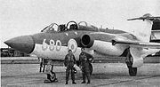
Blackburn Buccaneer

Encyclopedia
The Blackburn Buccaneer was a British
low-level subsonic strike aircraft with nuclear weapon
delivery capability serving with the Royal Navy
and the Royal Air Force
between 1962 and 1994, including service in the 1991 Gulf War
. Designed and initially produced by Blackburn Aircraft
at Brough
it was later known as the Hawker Siddeley Buccaneer when Blackburn became a part of the Hawker Siddeley group.
into service. Light cruiser
s by World War II
standard, they were fast, effectively armed, and numerous. They presented a serious threat to the merchant fleets in the Atlantic, as the German "pocket battleships"
of the war did, but in far greater numbers and over 25% faster. To counter this threat the Royal Navy
decided not to use a new ship class of its own, but a new specialised strike aircraft employing conventional or nuclear weapons instead. Operating from its fleet carriers
and attacking at high-speed and low-level, it would offer a solution to the Sverdlov problem.
A detailed specification was issued in June 1952 as Naval Staff Requirement NA.39, calling for a two-seat aircraft with folding wings, capable of flying at Mach 0.85
at 200 ft (61 m) above sea-level
, having a combat range
of over 400 nmi (740.8 km), and carrying a nuclear weapon internally. Based on the requirement, the Ministry of Supply
issued specification M.148T in August 1952, and the first responses were returned in February 1953.
Blackburn's design by Barry P. Laight, Project B-103, won the tender in July 1955. Owing to secrecy, the aircraft was called BNA (Blackburn Naval Aircraft) or BANA (Blackburn Advanced Naval Aircraft) in documents, leading to the obvious nickname of "Banana Jet". The first prototype made its maiden flight from RAE Bedford
on 30 April 1958.
The first Buccaneer model, the Buccaneer S.1, was powered by a pair of de Havilland Gyron Junior
turbojets producing 7100 lbf (31.6 kN) of thrust. This mark was somewhat underpowered and as a consequence could not take off fully laden with both fuel and armament. A temporary solution to this problem was the "buddy" system; aircraft took off with a full load of weaponry and minimal fuel and would sortie with a Supermarine Scimitar
that would deliver the full load of fuel by aerial refuelling
.
The lack of power meant however that loss of an engine during take-off or landing at full load, when the aircraft was dependent on flap blowing
, could be catastrophic and the Gyron Junior gave a poor range due to high fuel consumption. The long-term solution was the Buccaneer S.2, fitted with the Rolls-Royce Spey turbofan, providing 40% more thrust with a greatly reduced fuel consumption. The engine nacelles had to be enlarged to accommodate the Spey, and the wing required minor aerodynamic modifications as a result. The Buccaneer S.2 had completely replaced the S.1 by November 1966.
, as the Buccaneer S.50. These were S.2 aircraft with the addition of Bristol Siddeley
BS.605
rocket
engines to provide additional thrust for the "hot and high" African airfields. The S.50 was also equipped with strengthened undercarriage and higher capacity wheel brakes, and had manually folded wings. In-flight
refueling was also specified and due to the vast coastline, longer range 430 gal underwing tanks.
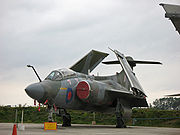
and General Dynamics F-111K tactical bombers, the Royal Air Force
eventually adopted the Buccaneer in 1968. This was ironic as the RAF had, ten years earlier, rejected Blackburn's B-108 proposal for a Buccaneer variant; instead favouring the TSR-2 to meet its Operational Requirement GOR.339 for an English Electric Canberra
replacement. A total of 46 new-build aircraft for the RAF were built by Blackburn's successor, Hawker Siddeley, designated S.2B. These had RAF-type communications and avionics equipment, Martel air-to-surface missile
capability, and could be equipped with a bulged bomb-bay door containing an extra fuel tank.
Some Fleet Air Arm Buccaneers were modified in-service to also carry the Martel anti-ship missile. Martel-capable FAA aircraft were later redesignated S.2D. The remaining aircraft became S.2C.
RAF aircraft were given various upgrades. Self-defence was improved by the addition of the AN/ALQ-101 ECM pod
(also found on RAF's SEPECAT Jaguar
GR.3), chaff / flare
dispensers and AIM-9 Sidewinder
capability. RAF low-level strike Buccaneers could carry what was known as "retard defence"; four 1000 lb (453.6 kg) retarded bombs internally that could be dropped to provide an effective deterrent against any following aircraft. In 1979, the RAF obtained the American AN/AVQ-23E Pave Spike
laser designator
pod for Paveway II
guided bombs. This allowed the aircraft to act as target designators for other Buccaneers, Jaguars
, and other strike aircraft. From 1986, No. 208 Squadron RAF
then No. 12 (B) Sqn replaced the Martel ASM with the Sea Eagle missile.
 The Buccaneer was a mid-wing, twin-engine monoplane
with a crew of two seated in tandem under a sliding canopy. To meet the demands of the specification, the Buccaneer featured a number of advanced design features. The fuselage was area rule
d; meaning it was designed to reduce drag
at transonic
speeds. This gives rise to the characteristic curvy "Coke bottle" shape. It featured a variable incidence
tailplane that could be trimmed to suit the particular requirements of low-speed handling or high-speed flight. At the low-levels and high speeds traditional bomb bay
doors could not be opened safely into the air stream, therefore doors were developed that rotated into the fuselage to expose the payload. This configuration was also useful in assisting ground-level access.
The Buccaneer had been designed specifically as a maritime nuclear strike aircraft. Its intended weapon was a nuclear air-to-surface missile
codenamed Green Cheese, but this weapon's development was cancelled, and in its place was the unguided 2,000 pound (900 kg) Red Beard
, which had been developed for the Canberra
. Red Beard had an explosive yield in the 10 to 20 kiloton range. It was mounted on a special bomb bay door into which it nested neatly to reduce aerodynamic buffet on the launch aircraft. Red Beard was an unsophisticated weapon and had to be armed before takeoff instead of in flight, clearly an undesireable feature.
The bomb bay could also accommodate a 2,000 litre ferry tank, as well as a photo-reconnaissance "crate" or a cargo container. The reconnaissance crate could accommodate a photoflash flare dispenser and up to six cameras, in various configurations of long-range, wide angle, and night vision cameras that could be mounted in vertical, oblique, or (using a blister in the pack) forward-looking orientations. The photoflash unit was rarely used, with the Royal Navy preferring to use the Gloworm rocket, with eight mounted on the Buccaneer's stores pylons, for night operations.
The cargo container would prove useful for transporting golf clubs and other essentials. There had been plans to develop a bomb bay tanker pack, but the underwing pack proved adequate. There was also a plan for a pack with twin Aden 30 mm cannon, but it was abandoned and the Buccaneer would never carry gun armament.
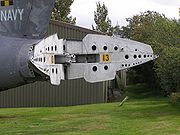 The small wing of the Buccaneer was suited to high-speed flight at low level. Such a wing, however, did not generate the lift
that was essential for carrier operations. Therefore the wing and horizontal stabiliser were "blown"
by bleeding compressor gas from the engine
through surface vents; this was known as "Boundary layer control" or BLC, and had the effect of energising and smoothing the boundary layer airflow, which significantly reduced airflow separation at the back of the wing (and therefore decreased stall speed) and increased effectiveness of trailing edge control surfaces including flaps and ailerons. Before landing, the pilot would open the BLC vents as well as lower the flaps to achieve slow, stable flight. A consequence of the blown wing was that the engines were required to run at high power for low-speed flight in order to generate sufficient compressor gas for blowing. Blackburn's solution to this situation was to provide a large air brake
. The tail cone was formed from two leaves that could be hydraulically opened into the airstream to decelerate the aircraft. The nose cone and radar antenna could also be swung around by 180° to reduce the length of the aircraft in the carrier hangar. This feature was particularly important as contemporary British aircraft carriers were small.
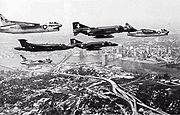 The Buccaneer entered service with the Fleet Air Arm
(FAA) in 1962. In addition to conventional ordnance, the Buccaneer was type-approved for nuclear weapon
s delivery in 1965. Weapons deployed included Red Beard
and WE.177
drop-bombs, which were carried internally in a rotating bomb-bay.
Two Fleet Air Arm operational squadrons and a training unit were equipped with the Buccaneer S.1. The aircraft was well liked by Navy aircrew for its strength and flying qualities, and the BLC system gave them slower landing speeds than they were accustomed to. The Buccaneers were painted dark sea gray on top and white on the undersides.
However, the Buccaneer S.1's Gyron Junior engines were not powerful enough, and they led to its career coming to an abrupt end in December 1970. On 1 December, an S.1 was making a landing approach when an engine surge disrupted the approach and forced the two crewmen to eject. On 8 December, an S.1 on a training flight suffered a turbine failure. The pilot successfully ejected, but due to a mechanical glitch the back-seater was killed. Inspections showed that the Gyron Junior engines were no longer suited for operations. All surviving S.1s were grounded immediately and for good.
The S.2 entered FAA operational service with 801 Naval Air Squadron
in October 1965. Early on, S.2s retained the dark grey top and white belly paint scheme of the S.1, but soon were painted in an overall dark grey scheme.
On 28 March 1967, Buccaneers from RNAS Lossiemouth bombed the shipwreck
ed supertanker Torrey Canyon
off the western coast of Cornwall
to make the oil blaze and to avoid an environmental disaster
. The Buccaneers aboard HMS Ark Royal took part in a mission over British Honduras shortly before its independence to deter a possible Guatemalan invasion. They also took part in several exercises in the North Sea, "taking out" ground and naval targets, while always ready to respond to any Soviet interference.
A total of six FAA squadrons were equipped with the Buccaneer: 700B/700Z (Intensive Flying Trials Unit), 736
(training), 800, 801
, 803
and 809
Naval Air Squadrons. Buccaneers were embarked on , , and . The Buccaneer was retired from Fleet Air Arm service with the decommissioning of the Ark Royal in 1978.
The first RAF unit to receive the Buccaneer S.2B was 12 Squadron
at RAF Honington
in 1969. This was to remain a key station for the type as 15 Squadron equipped with the Buccaneer the following year, before moving to RAF Laarbruch
in 1971. The Buccaneer was seen simply as an interim solution but delays in the Panavia Tornado
program would ensure that the "interim" period would stretch out, and the Buccaneer would remain in RAF service for over two decades, long after the FAA had given up the type.
With the phased withdrawal of the Royal Navy's carrier fleet during the 1970s, Fleet Air Arm Buccaneers were transferred to the RAF, which had taken over the maritime strike role. 62 of the 84 S.2 aircraft were eventually transferred, redesignated S.2A. Some of these were later upgraded to S.2B standard. Ex-FAA aircraft equipped 16 Squadron
, joining 15 Squadron at RAF Laarbruch
, and 208 Squadron at Honington. The last FAA aircraft went to 216 Squadron
.
From 1970 with 12 Squadron initially, followed by 15 Squadron, 16 Squadron, No. 237 OCU
, 208 Squadron and 216 Squadron, the RAF Buccaneer force re-equipped with WE.177
nuclear weapons. At peak strength Buccaneers equipped six RAF squadrons, although for one year only. A more sustained strength of five squadrons was made up of three squadrons (15 Squadron, 16 Squadron, 208 Squadron) plus No. 237 OCU (a war reserve or Shadow squadron
) all assigned to Supreme Allied Commander Europe (SACEUR)
for land strike duties in support of land forces opposing Warsaw Pact
land forces on the Continent, plus one squadron (12 Squadron) assigned to SACLANT
for maritime strike duties.
Opportunities for Buccaneer squadrons to engage in realistic training were limited, and so when the US began their Red Flag military exercises at Nellis Air Force Base
in 1975, the RAF became keenly interested. The first Red Flag in which RAF aircraft were involved was in 1977, with 10 Buccaneers and two Avro Vulcan
bombers participating. Buccaneers would be involved in later Red Flags through to 1983, and in 1979 also participated in the similar Maple Flag
exercise over Canada. The Buccaneer proved impressive with its fast low-level attacks, which were highly accurate despite the aircraft's lack of terrain-following radar and other modern avionics. They were able to penetrate adversary defences, and were credited with "kills" on defending fighters using AIM-9 Sidewinder
air-to-air missiles. However, during the 1980 Red Flag exercises one of the Buccaneers lost a wing due to a fatigue induced crack and crashed, killing its crew. The entire RAF Buccaneer fleet was grounded in February 1980 and investigation discovered serious metal fatigue
problems. A total of 60 aircraft were selected to receive new spar rings and the nascent 216 Squadron was subsequently disbanded. Later the same year, the UK-based Buccaneer squadrons moved to RAF Lossiemouth
.
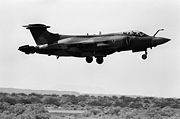 In 1983, six Buccaneers were sent to Cyprus
to support British peacekeepers in Lebanon
, and on 11 September 1983, two of these aircraft flew low over Beirut
as an exercise in "gunboat diplomacy".
After 1983 the land strike duties were mostly re-assigned to the Tornado aircraft then entering service, and two Buccaneer squadrons remaining (12 Squadron, and 208 Squadron) were then assigned to SACLANT for maritime strike duties. Only the 'Shadow Squadron' No. 237 OCU remained assigned to a war role of land strike assigned to SACEUR until it stood down from its war reserve nuclear delivery role in 1991.
The Buccaneer was deployed in combat operations during the 1991 Gulf War
when 12 examples were rushed to the area to provide a laser designation
capability for British aircraft. RAF Tornados attacking with anti-runway munitions were being lost to the large amounts of light anti-aircraft weaponry defending the airfields. As a result attacks changed to attacking from 20,000 ft with guided bombs.
Buccaneers flew 218 missions, both designating for other aircraft and dropping 48 laser-guided bomb
s themselves. The last Buccaneer missions were on 27 February 1991. On that day a pair of Buccaneers knocked out two Iraqi transport aircraft on the Shayka Mazhar airfield.
The last Buccaneers were withdrawn in March 1994 when 208 Squadron disbanded.
was the only country other than the UK to operate the Buccaneer, where it was in service with the South African Air Force
from 1965 to 1991. In January 1963, even before the S.2 entered squadron service, South Africa had purchased 16 Spey-powered Buccaneers. The aircraft order was part of the "Simonstown Agreement
", in which the UK obtained use of the Simonstown naval base in South Africa in exchange for maritime weapons. The SAAF wanted to use the Buccaneer for anti-shipping strike.
Of the 16 aircraft ordered, one was lost on its delivery flight, and 15 entered service. Their standard colour scheme was dark grey on top and dark blue on the bottom, with some variation in pattern over time. In the maritime strike role, SAAF Buccaneers were armed with the French radio-guided AS-30 missile. However, in 1971 Buccaneers fired 12 AS-30s at an abandoned tanker, the Wafra, that had become a menace to navigation and failed to sink it. For overland attack, the SAAF Buccaneers carried up to four 450 kg (1,000 lb) bombs in the rotary bomb bay, and four bombs, flares, or SNEB
rocket packs on the underwing stores pylons. The AS-30 was used in ground attacks for effective precision strikes on radar sites and other targets.
SAAF Buccaneers saw active service during the Border War in South-West Africa, notably at Cassinga in 1978. They flew over Angola
and Namibia
in the 1970s and 1980s, and attacked SWAPO guerrilla camps with rockets and bombs.
s with the type, although they would eventually decide on the Lockheed F-104G for their maritime strike requirement.
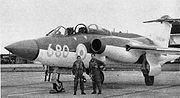 Blackburn NA.39
Buccaneer S.1
Buccaneer S.2
Buccaneer S.2A
Buccaneer S.2B
Buccaneer S.2C
Buccaneer S.2D
Buccaneer S.50
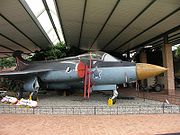
 South Africa
in Cape Town
are still airworthy in 2009.
A number of Buccaneers in the UK are in fast taxiing condition and several more are being rebuilt to taxiing condition.

United Kingdom
The United Kingdom of Great Britain and Northern IrelandIn the United Kingdom and Dependencies, other languages have been officially recognised as legitimate autochthonous languages under the European Charter for Regional or Minority Languages...
low-level subsonic strike aircraft with nuclear weapon
Nuclear weapon
A nuclear weapon is an explosive device that derives its destructive force from nuclear reactions, either fission or a combination of fission and fusion. Both reactions release vast quantities of energy from relatively small amounts of matter. The first fission bomb test released the same amount...
delivery capability serving with the Royal Navy
Royal Navy
The Royal Navy is the naval warfare service branch of the British Armed Forces. Founded in the 16th century, it is the oldest service branch and is known as the Senior Service...
and the Royal Air Force
Royal Air Force
The Royal Air Force is the aerial warfare service branch of the British Armed Forces. Formed on 1 April 1918, it is the oldest independent air force in the world...
between 1962 and 1994, including service in the 1991 Gulf War
Gulf War
The Persian Gulf War , commonly referred to as simply the Gulf War, was a war waged by a U.N.-authorized coalition force from 34 nations led by the United States, against Iraq in response to Iraq's invasion and annexation of Kuwait.The war is also known under other names, such as the First Gulf...
. Designed and initially produced by Blackburn Aircraft
Blackburn Aircraft
Blackburn Aircraft Limited was a British aircraft manufacturer that concentrated mainly on naval and maritime aircraft during the first part of the 20th century.-History:...
at Brough
Brough Aerodrome
Brough Aerodrome is located at Brough, East Riding of Yorkshire, England.The site was first used by the Blackburn Aeroplane & Motor Company during World War I for the testing of seaplanes....
it was later known as the Hawker Siddeley Buccaneer when Blackburn became a part of the Hawker Siddeley group.
Royal Navy
In the early 1950s the Russian Navy introduced the Sverdlov class cruiserSverdlov class cruiser
The Sverdlov class cruisers, Soviet designation Project 68bis, were the last conventional cruisers built for the Soviet Navy; 13 ships were completed before Nikita Khrushchev called a halt to the programme as these ships were considered obsolescent with the advent of the guided missile...
into service. Light cruiser
Light cruiser
A light cruiser is a type of small- or medium-sized warship. The term is a shortening of the phrase "light armored cruiser", describing a small ship that carried armor in the same way as an armored cruiser: a protective belt and deck...
s by World War II
World War II
World War II, or the Second World War , was a global conflict lasting from 1939 to 1945, involving most of the world's nations—including all of the great powers—eventually forming two opposing military alliances: the Allies and the Axis...
standard, they were fast, effectively armed, and numerous. They presented a serious threat to the merchant fleets in the Atlantic, as the German "pocket battleships"
Deutschland class cruiser
The Deutschland class was a series of three panzerschiffe , a form of heavily armed cruiser, built by the Reichsmarine officially in accordance with restrictions imposed by the Treaty of Versailles...
of the war did, but in far greater numbers and over 25% faster. To counter this threat the Royal Navy
Royal Navy
The Royal Navy is the naval warfare service branch of the British Armed Forces. Founded in the 16th century, it is the oldest service branch and is known as the Senior Service...
decided not to use a new ship class of its own, but a new specialised strike aircraft employing conventional or nuclear weapons instead. Operating from its fleet carriers
Aircraft carrier
An aircraft carrier is a warship designed with a primary mission of deploying and recovering aircraft, acting as a seagoing airbase. Aircraft carriers thus allow a naval force to project air power worldwide without having to depend on local bases for staging aircraft operations...
and attacking at high-speed and low-level, it would offer a solution to the Sverdlov problem.
A detailed specification was issued in June 1952 as Naval Staff Requirement NA.39, calling for a two-seat aircraft with folding wings, capable of flying at Mach 0.85
Mach number
Mach number is the speed of an object moving through air, or any other fluid substance, divided by the speed of sound as it is in that substance for its particular physical conditions, including those of temperature and pressure...
at 200 ft (61 m) above sea-level
Above mean sea level
The term above mean sea level refers to the elevation or altitude of any object, relative to the average sea level datum. AMSL is used extensively in radio by engineers to determine the coverage area a station will be able to reach...
, having a combat range
Range (aircraft)
The maximal total range is the distance an aircraft can fly between takeoff and landing, as limited by fuel capacity in powered aircraft, or cross-country speed and environmental conditions in unpowered aircraft....
of over 400 nmi (740.8 km), and carrying a nuclear weapon internally. Based on the requirement, the Ministry of Supply
Ministry of Supply
The Ministry of Supply was a department of the UK Government formed in 1939 to co-ordinate the supply of equipment to all three British armed forces, headed by the Minister of Supply. There was, however, a separate ministry responsible for aircraft production and the Admiralty retained...
issued specification M.148T in August 1952, and the first responses were returned in February 1953.
Blackburn's design by Barry P. Laight, Project B-103, won the tender in July 1955. Owing to secrecy, the aircraft was called BNA (Blackburn Naval Aircraft) or BANA (Blackburn Advanced Naval Aircraft) in documents, leading to the obvious nickname of "Banana Jet". The first prototype made its maiden flight from RAE Bedford
RAE Bedford
RAE Bedford based near the village of Thurleigh, north of the town of Bedford in England, has been the site of major aircraft experimental development work....
on 30 April 1958.
The first Buccaneer model, the Buccaneer S.1, was powered by a pair of de Havilland Gyron Junior
De Havilland Gyron Junior
|-See also:-External links:* *...
turbojets producing 7100 lbf (31.6 kN) of thrust. This mark was somewhat underpowered and as a consequence could not take off fully laden with both fuel and armament. A temporary solution to this problem was the "buddy" system; aircraft took off with a full load of weaponry and minimal fuel and would sortie with a Supermarine Scimitar
Supermarine Scimitar
-References:NotesBibliography* Andrews, C.F. and E.B. Morgan. Supermarine Aircraft since 1914. London: Putnam, 1987. ISBN 0-85177-800-3.* Birtles, Philip. Supermarine Attacker, Swift and Scimitar . London: Ian Allan, 1992. ISBN 0-7110-2034-5.* Buttler, Tony. "Database: Supermarine Scimitar"....
that would deliver the full load of fuel by aerial refuelling
Aerial refueling
Aerial refueling, also called air refueling, in-flight refueling , air-to-air refueling or tanking, is the process of transferring fuel from one aircraft to another during flight....
.
The lack of power meant however that loss of an engine during take-off or landing at full load, when the aircraft was dependent on flap blowing
Blown flap
Blown flaps are a powered aerodynamic high-lift device invented by the British and used on the wings of certain aircraft to improve low-speed lift during takeoff and landing. The process is sometimes called a boundary layer control system . They were a popular design feature in the 1960s, but fell...
, could be catastrophic and the Gyron Junior gave a poor range due to high fuel consumption. The long-term solution was the Buccaneer S.2, fitted with the Rolls-Royce Spey turbofan, providing 40% more thrust with a greatly reduced fuel consumption. The engine nacelles had to be enlarged to accommodate the Spey, and the wing required minor aerodynamic modifications as a result. The Buccaneer S.2 had completely replaced the S.1 by November 1966.
South Africa
In January 1963, 16 aircraft were ordered by the South African Air ForceSouth African Air Force
The South African Air Force is the air force of South Africa, with headquarters in Pretoria. It is the world's second oldest independent air force, and its motto is Per Aspera Ad Astra...
, as the Buccaneer S.50. These were S.2 aircraft with the addition of Bristol Siddeley
Bristol Siddeley
Bristol Siddeley Engines Ltd was a British aero engine manufacturer. The company was formed in 1959 by a merger of Bristol Aero-Engines Limited and Armstrong Siddeley Motors Limited. In 1961 the company was expanded by the purchase of the de Havilland Engine Company and the engine division of...
BS.605
Bristol Siddeley 605
The Bristol Siddeley BS.605 is a retractable take off assist rocket engine burning hydrogen peroxide and kerosene. Its design was based on the smaller chamber of Armstrong Siddeley's Stentor engine....
rocket
Rocket
A rocket is a missile, spacecraft, aircraft or other vehicle which obtains thrust from a rocket engine. In all rockets, the exhaust is formed entirely from propellants carried within the rocket before use. Rocket engines work by action and reaction...
engines to provide additional thrust for the "hot and high" African airfields. The S.50 was also equipped with strengthened undercarriage and higher capacity wheel brakes, and had manually folded wings. In-flight
Aerial refueling
Aerial refueling, also called air refueling, in-flight refueling , air-to-air refueling or tanking, is the process of transferring fuel from one aircraft to another during flight....
refueling was also specified and due to the vast coastline, longer range 430 gal underwing tanks.
Royal Air Force
After the cancellation of both the BAC TSR-2BAC TSR-2
The British Aircraft Corporation TSR-2 was a cancelled Cold War strike and reconnaissance aircraft developed by the British Aircraft Corporation for the Royal Air Force in the late 1950s and early 1960s...
and General Dynamics F-111K tactical bombers, the Royal Air Force
Royal Air Force
The Royal Air Force is the aerial warfare service branch of the British Armed Forces. Formed on 1 April 1918, it is the oldest independent air force in the world...
eventually adopted the Buccaneer in 1968. This was ironic as the RAF had, ten years earlier, rejected Blackburn's B-108 proposal for a Buccaneer variant; instead favouring the TSR-2 to meet its Operational Requirement GOR.339 for an English Electric Canberra
English Electric Canberra
The English Electric Canberra is a first-generation jet-powered light bomber manufactured in large numbers through the 1950s. The Canberra could fly at a higher altitude than any other bomber through the 1950s and set a world altitude record of 70,310 ft in 1957...
replacement. A total of 46 new-build aircraft for the RAF were built by Blackburn's successor, Hawker Siddeley, designated S.2B. These had RAF-type communications and avionics equipment, Martel air-to-surface missile
Air-to-surface missile
An air-to-surface missile is a missile designed to be launched from military aircraft and strike ground targets on land, at sea, or both...
capability, and could be equipped with a bulged bomb-bay door containing an extra fuel tank.
Some Fleet Air Arm Buccaneers were modified in-service to also carry the Martel anti-ship missile. Martel-capable FAA aircraft were later redesignated S.2D. The remaining aircraft became S.2C.
RAF aircraft were given various upgrades. Self-defence was improved by the addition of the AN/ALQ-101 ECM pod
Electronic countermeasures
An electronic countermeasure is an electrical or electronic device designed to trick or deceive radar, sonar or other detection systems, like infrared or lasers. It may be used both offensively and defensively to deny targeting information to an enemy...
(also found on RAF's SEPECAT Jaguar
SEPECAT Jaguar
The SEPECAT Jaguar is an Anglo-French jet ground attack aircraft, originally used by the British Royal Air Force and the French Armée de l'Air in the close air support and nuclear strike role, and still in service with several export customers, notably the Indian Air Force and the Royal Air Force...
GR.3), chaff / flare
Flare (countermeasure)
A flare is an aerial infrared countermeasure to counter an infrared homing surface-to-air missile or air-to-air missile. Flares are commonly composed of a pyrotechnic composition based on magnesium or another hot-burning metal, with burning temperature equal to or hotter than engine exhaust...
dispensers and AIM-9 Sidewinder
AIM-9 Sidewinder
The AIM-9 Sidewinder is a heat-seeking, short-range, air-to-air missile carried mostly by fighter aircraft and recently, certain gunship helicopters. The missile entered service with United States Air Force in the early 1950s, and variants and upgrades remain in active service with many air forces...
capability. RAF low-level strike Buccaneers could carry what was known as "retard defence"; four 1000 lb (453.6 kg) retarded bombs internally that could be dropped to provide an effective deterrent against any following aircraft. In 1979, the RAF obtained the American AN/AVQ-23E Pave Spike
Pave Spike
The Westinghouse AN/ASQ-153\AN/AVQ-23 Pave Spike is an electro-optical laser designator pod used to direct laser-guided bombs to target in daylight, visual conditions...
laser designator
Laser designator
A laser designator is a laser light source which is used to designate a target. Laser designators provide targeting for laser guided bombs, missiles, or precision artillery munitions, such as the Paveway series of bombs, Lockheed-Martin's Hellfire, or the Copperhead round, respectively.When a...
pod for Paveway II
Paveway
Paveway is a generic term for Laser Guided Bombs .Pave or PAVE is sometimes used as an acronym for precision avionics vectoring equipment; literally, electronics for controlling the speed and direction of aircraft...
guided bombs. This allowed the aircraft to act as target designators for other Buccaneers, Jaguars
SEPECAT Jaguar
The SEPECAT Jaguar is an Anglo-French jet ground attack aircraft, originally used by the British Royal Air Force and the French Armée de l'Air in the close air support and nuclear strike role, and still in service with several export customers, notably the Indian Air Force and the Royal Air Force...
, and other strike aircraft. From 1986, No. 208 Squadron RAF
No. 208 Squadron RAF
No 208 Squadron is at present a reserve unit of the Royal Air Force based at RAF Valley, Anglesey, Wales. It operates the BAe Hawk aircraft.-World War I:...
then No. 12 (B) Sqn replaced the Martel ASM with the Sea Eagle missile.
Design
Monoplane
A monoplane is a fixed-wing aircraft with one main set of wing surfaces, in contrast to a biplane or triplane. Since the late 1930s it has been the most common form for a fixed wing aircraft.-Types of monoplane:...
with a crew of two seated in tandem under a sliding canopy. To meet the demands of the specification, the Buccaneer featured a number of advanced design features. The fuselage was area rule
Area rule
The Whitcomb area rule, also called the transonic area rule, is a design technique used to reduce an aircraft's drag at transonic and supersonic speeds, particularly between Mach 0.75 and 1.2....
d; meaning it was designed to reduce drag
Drag (physics)
In fluid dynamics, drag refers to forces which act on a solid object in the direction of the relative fluid flow velocity...
at transonic
Transonic
Transonic speed is an aeronautics term referring to the condition of flight in which a range of velocities of airflow exist surrounding and flowing past an air vehicle or an airfoil that are concurrently below, at, and above the speed of sound in the range of Mach 0.8 to 1.2, i.e. 600–900 mph...
speeds. This gives rise to the characteristic curvy "Coke bottle" shape. It featured a variable incidence
Angle of incidence
Angle of incidence is a measure of deviation of something from "straight on", for example:* in the approach of a ray to a surface, or* the angle at which the wing or horizontal tail of an airplane is installed on the fuselage, measured relative to the axis of the fuselage.-Optics:In geometric...
tailplane that could be trimmed to suit the particular requirements of low-speed handling or high-speed flight. At the low-levels and high speeds traditional bomb bay
Bomb bay
The bomb bay or weapons bay on some military aircraft is a compartment to carry bombs, usually in the aircraft's fuselage, with "bomb bay doors" which open at the bottom. The bomb bay doors are opened and the bombs are dropped when over the target or at a specified launching point.Large-sized...
doors could not be opened safely into the air stream, therefore doors were developed that rotated into the fuselage to expose the payload. This configuration was also useful in assisting ground-level access.
The Buccaneer had been designed specifically as a maritime nuclear strike aircraft. Its intended weapon was a nuclear air-to-surface missile
Air-to-surface missile
An air-to-surface missile is a missile designed to be launched from military aircraft and strike ground targets on land, at sea, or both...
codenamed Green Cheese, but this weapon's development was cancelled, and in its place was the unguided 2,000 pound (900 kg) Red Beard
Red Beard (nuclear weapon)
Red Beard was the first British tactical nuclear weapon. It was carried by the English Electric Canberra and the V bombers of the Royal Air Force, and by the Blackburn Buccaneers, Sea Vixens and Supermarine Scimitars of the Royal Navy's Fleet Air Arm...
, which had been developed for the Canberra
English Electric Canberra
The English Electric Canberra is a first-generation jet-powered light bomber manufactured in large numbers through the 1950s. The Canberra could fly at a higher altitude than any other bomber through the 1950s and set a world altitude record of 70,310 ft in 1957...
. Red Beard had an explosive yield in the 10 to 20 kiloton range. It was mounted on a special bomb bay door into which it nested neatly to reduce aerodynamic buffet on the launch aircraft. Red Beard was an unsophisticated weapon and had to be armed before takeoff instead of in flight, clearly an undesireable feature.
The bomb bay could also accommodate a 2,000 litre ferry tank, as well as a photo-reconnaissance "crate" or a cargo container. The reconnaissance crate could accommodate a photoflash flare dispenser and up to six cameras, in various configurations of long-range, wide angle, and night vision cameras that could be mounted in vertical, oblique, or (using a blister in the pack) forward-looking orientations. The photoflash unit was rarely used, with the Royal Navy preferring to use the Gloworm rocket, with eight mounted on the Buccaneer's stores pylons, for night operations.
The cargo container would prove useful for transporting golf clubs and other essentials. There had been plans to develop a bomb bay tanker pack, but the underwing pack proved adequate. There was also a plan for a pack with twin Aden 30 mm cannon, but it was abandoned and the Buccaneer would never carry gun armament.
Lift (force)
A fluid flowing past the surface of a body exerts a surface force on it. Lift is the component of this force that is perpendicular to the oncoming flow direction. It contrasts with the drag force, which is the component of the surface force parallel to the flow direction...
that was essential for carrier operations. Therefore the wing and horizontal stabiliser were "blown"
Blown flap
Blown flaps are a powered aerodynamic high-lift device invented by the British and used on the wings of certain aircraft to improve low-speed lift during takeoff and landing. The process is sometimes called a boundary layer control system . They were a popular design feature in the 1960s, but fell...
by bleeding compressor gas from the engine
Gas turbine
A gas turbine, also called a combustion turbine, is a type of internal combustion engine. It has an upstream rotating compressor coupled to a downstream turbine, and a combustion chamber in-between....
through surface vents; this was known as "Boundary layer control" or BLC, and had the effect of energising and smoothing the boundary layer airflow, which significantly reduced airflow separation at the back of the wing (and therefore decreased stall speed) and increased effectiveness of trailing edge control surfaces including flaps and ailerons. Before landing, the pilot would open the BLC vents as well as lower the flaps to achieve slow, stable flight. A consequence of the blown wing was that the engines were required to run at high power for low-speed flight in order to generate sufficient compressor gas for blowing. Blackburn's solution to this situation was to provide a large air brake
Air brake (aircraft)
In aeronautics, air brakes or speedbrakes are a type of flight control surface used on an aircraft to increase drag or increase the angle of approach during landing....
. The tail cone was formed from two leaves that could be hydraulically opened into the airstream to decelerate the aircraft. The nose cone and radar antenna could also be swung around by 180° to reduce the length of the aircraft in the carrier hangar. This feature was particularly important as contemporary British aircraft carriers were small.
Fleet Air Arm
Fleet Air Arm
The Fleet Air Arm is the branch of the British Royal Navy responsible for the operation of naval aircraft. The Fleet Air Arm currently operates the AgustaWestland Merlin, Westland Sea King and Westland Lynx helicopters...
(FAA) in 1962. In addition to conventional ordnance, the Buccaneer was type-approved for nuclear weapon
Nuclear weapon
A nuclear weapon is an explosive device that derives its destructive force from nuclear reactions, either fission or a combination of fission and fusion. Both reactions release vast quantities of energy from relatively small amounts of matter. The first fission bomb test released the same amount...
s delivery in 1965. Weapons deployed included Red Beard
Red Beard (nuclear weapon)
Red Beard was the first British tactical nuclear weapon. It was carried by the English Electric Canberra and the V bombers of the Royal Air Force, and by the Blackburn Buccaneers, Sea Vixens and Supermarine Scimitars of the Royal Navy's Fleet Air Arm...
and WE.177
WE.177
WE.177 was the last air-delivered tactical nuclear weapon of the British Armed Forces. There were three versions; WE.177A was a boosted fission weapon, while WE.177B and WE.177C were thermonuclear weapons...
drop-bombs, which were carried internally in a rotating bomb-bay.
Two Fleet Air Arm operational squadrons and a training unit were equipped with the Buccaneer S.1. The aircraft was well liked by Navy aircrew for its strength and flying qualities, and the BLC system gave them slower landing speeds than they were accustomed to. The Buccaneers were painted dark sea gray on top and white on the undersides.
However, the Buccaneer S.1's Gyron Junior engines were not powerful enough, and they led to its career coming to an abrupt end in December 1970. On 1 December, an S.1 was making a landing approach when an engine surge disrupted the approach and forced the two crewmen to eject. On 8 December, an S.1 on a training flight suffered a turbine failure. The pilot successfully ejected, but due to a mechanical glitch the back-seater was killed. Inspections showed that the Gyron Junior engines were no longer suited for operations. All surviving S.1s were grounded immediately and for good.
The S.2 entered FAA operational service with 801 Naval Air Squadron
801 Naval Air Squadron
801 Naval Air Squadron was a Fleet Air Arm squadron of the Royal Navy formed in 1933 which fought in World War II, the Korean War and the Falklands War.- Fleet Air Arm of the Royal Air Force:...
in October 1965. Early on, S.2s retained the dark grey top and white belly paint scheme of the S.1, but soon were painted in an overall dark grey scheme.
On 28 March 1967, Buccaneers from RNAS Lossiemouth bombed the shipwreck
Shipwreck
A shipwreck is what remains of a ship that has wrecked, either sunk or beached. Whatever the cause, a sunken ship or a wrecked ship is a physical example of the event: this explains why the two concepts are often overlapping in English....
ed supertanker Torrey Canyon
Torrey Canyon
The Torrey Canyon was a supertanker capable of carrying a cargo of 120,000 tons of crude oil, which was shipwrecked off the western coast of Cornwall, England in March 1967 causing an environmental disaster...
off the western coast of Cornwall
Cornwall
Cornwall is a unitary authority and ceremonial county of England, within the United Kingdom. It is bordered to the north and west by the Celtic Sea, to the south by the English Channel, and to the east by the county of Devon, over the River Tamar. Cornwall has a population of , and covers an area of...
to make the oil blaze and to avoid an environmental disaster
Environmental disaster
An environmental disaster is a disaster to the natural environment due to human activity. It should not be confused with the separate concept of a natural disaster.-History:...
. The Buccaneers aboard HMS Ark Royal took part in a mission over British Honduras shortly before its independence to deter a possible Guatemalan invasion. They also took part in several exercises in the North Sea, "taking out" ground and naval targets, while always ready to respond to any Soviet interference.
A total of six FAA squadrons were equipped with the Buccaneer: 700B/700Z (Intensive Flying Trials Unit), 736
736 Naval Air Squadron
736 Naval Air Squadron was a Naval Air Squadron of the Royal Navy. She was recommissioned at RNAS Lossiemouth in June 1959. The squadron was equipped with Supermarine Scimitar F MK1 aircraft under the command of Lieutenant Commander J.D. Baker, to provide support for operational squadrons...
(training), 800, 801
801 Naval Air Squadron
801 Naval Air Squadron was a Fleet Air Arm squadron of the Royal Navy formed in 1933 which fought in World War II, the Korean War and the Falklands War.- Fleet Air Arm of the Royal Air Force:...
, 803
803 Naval Air Squadron
803 Naval Air Squadron was a Royal Navy Fleet Air Arm squadron.-Interwar:803 NAS was formed on 3 April 1933 by promoting No 409 Flight to the status of a squadron, with nine Ospreys...
and 809
809 Naval Air Squadron
-WWII:Formed in January 1941 at St Merryn with 12 Fairey Fulmars, the squadron embarked in HMS Victorious in July 1941. At first involved in operations against Petsamo and Bodø, and then the convoys to North Russia, Victorious and her air group fought in the Mediterranean from July 1942, including...
Naval Air Squadrons. Buccaneers were embarked on , , and . The Buccaneer was retired from Fleet Air Arm service with the decommissioning of the Ark Royal in 1978.
Royal Air Force
After the General Dynamics F-111K was cancelled in early 1968 due to the program suffering serious cost escalation and delays, the RAF was forced to cast about for a replacement that was available and affordable, and reluctantly selected the Buccaneer.The first RAF unit to receive the Buccaneer S.2B was 12 Squadron
No. 12 Squadron RAF
No. 12 Squadron of the Royal Air Force currently operates the Tornado GR4 from RAF Lossiemouth.-History:No. 12 Squadron Royal Flying Corps was formed in February 1915 from a flight of No. 1 Squadron RFC at Netheravon. The squadron moved to France in September 1915 and operated a variety of aircraft...
at RAF Honington
RAF Honington
RAF Honington is a Royal Air Force station located south of Thetford near Ixworth in Suffolk, England. Although used as a bomber station during the Second World War, RAF Honington is now the RAF Regiment depot and home to the Joint CBRN Regiment.-RAF use:...
in 1969. This was to remain a key station for the type as 15 Squadron equipped with the Buccaneer the following year, before moving to RAF Laarbruch
RAF Laarbruch
The former Royal Air Force Station Laarbruch, more commonly known as RAF Laarbruch ICAO EDUL was a Royal Air Force station, a military airbase, located in Germany on its border with the Netherlands...
in 1971. The Buccaneer was seen simply as an interim solution but delays in the Panavia Tornado
Panavia Tornado
The Panavia Tornado is a family of twin-engine, variable-sweep wing combat aircraft, which was jointly developed and manufactured by the United Kingdom, West Germany and Italy...
program would ensure that the "interim" period would stretch out, and the Buccaneer would remain in RAF service for over two decades, long after the FAA had given up the type.
With the phased withdrawal of the Royal Navy's carrier fleet during the 1970s, Fleet Air Arm Buccaneers were transferred to the RAF, which had taken over the maritime strike role. 62 of the 84 S.2 aircraft were eventually transferred, redesignated S.2A. Some of these were later upgraded to S.2B standard. Ex-FAA aircraft equipped 16 Squadron
No. 16 Squadron RAF
No. 16 Squadron is a flying squadron of the Royal Air Force. It formed in 1915 at Saint-Omer to carry out a mixture of offensive patrolling and reconnaissance and was disbanded in 1919 with the end of the First World War...
, joining 15 Squadron at RAF Laarbruch
RAF Laarbruch
The former Royal Air Force Station Laarbruch, more commonly known as RAF Laarbruch ICAO EDUL was a Royal Air Force station, a military airbase, located in Germany on its border with the Netherlands...
, and 208 Squadron at Honington. The last FAA aircraft went to 216 Squadron
No. 216 Squadron RAF
No. 216 Squadron of the Royal Air Force operates the Lockheed Tristar K1, KC1 and C2 from RAF Brize Norton, Oxfordshire.- History :216 Squadron was formed at RAF Manston by re-numbering No. 16 Squadron RNAS when the RAF was established in 1918, hence it is always spoken of as 'two-sixteen Squadron'...
.
From 1970 with 12 Squadron initially, followed by 15 Squadron, 16 Squadron, No. 237 OCU
Royal Air Force Conversion Units
Conversion Units and Operational Conversion Units were training units of the Royal Air Force.-History:With the introduction of the new heavy bombers, the 4-engined Short Stirling, Avro Lancaster and Handley Page Halifax, into service, the Royal Air Force introduced Heavy Conversion Units...
, 208 Squadron and 216 Squadron, the RAF Buccaneer force re-equipped with WE.177
WE.177
WE.177 was the last air-delivered tactical nuclear weapon of the British Armed Forces. There were three versions; WE.177A was a boosted fission weapon, while WE.177B and WE.177C were thermonuclear weapons...
nuclear weapons. At peak strength Buccaneers equipped six RAF squadrons, although for one year only. A more sustained strength of five squadrons was made up of three squadrons (15 Squadron, 16 Squadron, 208 Squadron) plus No. 237 OCU (a war reserve or Shadow squadron
Shadow squadron
Shadow squadrons are additional squadron numbers allocated to RAF training, Operational conversion, and Operational and Weapons evaluation units...
) all assigned to Supreme Allied Commander Europe (SACEUR)
Supreme Headquarters Allied Powers Europe
Supreme Headquarters Allied Powers Europe is the central command of NATO military forces. It is located at Casteau, north of the Belgian city of Mons...
for land strike duties in support of land forces opposing Warsaw Pact
Warsaw Pact
The Warsaw Treaty Organization of Friendship, Cooperation, and Mutual Assistance , or more commonly referred to as the Warsaw Pact, was a mutual defense treaty subscribed to by eight communist states in Eastern Europe...
land forces on the Continent, plus one squadron (12 Squadron) assigned to SACLANT
Supreme Allied Commander Atlantic
The Supreme Allied Commander Atlantic was one of two supreme commanders of the North Atlantic Treaty Organisation , the other being the Supreme Allied Commander Europe . The SACLANT led Allied Command Atlantic, based at Norfolk, Virginia...
for maritime strike duties.
Opportunities for Buccaneer squadrons to engage in realistic training were limited, and so when the US began their Red Flag military exercises at Nellis Air Force Base
Nellis Air Force Base
Nellis Air Force Base is a United States Air Force Base, located approximately northeast of Las Vegas, Nevada. It is under the jurisdiction of Air Combat Command .-Overview:...
in 1975, the RAF became keenly interested. The first Red Flag in which RAF aircraft were involved was in 1977, with 10 Buccaneers and two Avro Vulcan
Avro Vulcan
The Avro Vulcan, sometimes referred to as the Hawker Siddeley Vulcan, was a jet-powered delta wing strategic bomber, operated by the Royal Air Force from 1956 until 1984. Aircraft manufacturer A V Roe & Co designed the Vulcan in response to Specification B.35/46. Of the three V bombers produced,...
bombers participating. Buccaneers would be involved in later Red Flags through to 1983, and in 1979 also participated in the similar Maple Flag
MAPLE FLAG
MAPLE FLAG is an advanced aerial combat training exercise hosted at CFB Cold Lake, Alberta.Established in 1978, MAPLE FLAG is one of the largest of such exercises in the world, as it makes use of the extensive Cold Lake Air Weapons Range which is co-existent with CFB Cold Lake...
exercise over Canada. The Buccaneer proved impressive with its fast low-level attacks, which were highly accurate despite the aircraft's lack of terrain-following radar and other modern avionics. They were able to penetrate adversary defences, and were credited with "kills" on defending fighters using AIM-9 Sidewinder
AIM-9 Sidewinder
The AIM-9 Sidewinder is a heat-seeking, short-range, air-to-air missile carried mostly by fighter aircraft and recently, certain gunship helicopters. The missile entered service with United States Air Force in the early 1950s, and variants and upgrades remain in active service with many air forces...
air-to-air missiles. However, during the 1980 Red Flag exercises one of the Buccaneers lost a wing due to a fatigue induced crack and crashed, killing its crew. The entire RAF Buccaneer fleet was grounded in February 1980 and investigation discovered serious metal fatigue
Fatigue (material)
'In materials science, fatigue is the progressive and localized structural damage that occurs when a material is subjected to cyclic loading. The nominal maximum stress values are less than the ultimate tensile stress limit, and may be below the yield stress limit of the material.Fatigue occurs...
problems. A total of 60 aircraft were selected to receive new spar rings and the nascent 216 Squadron was subsequently disbanded. Later the same year, the UK-based Buccaneer squadrons moved to RAF Lossiemouth
RAF Lossiemouth
RAF Lossiemouth is a Royal Air Force station to the west of the town of Lossiemouth in Moray, Scotland. It is one of the RAF's biggest bases and is currently Britain's main base for Tornado GR4s. From 2013 the Northern QRA force of Typhoon F2 will relocate to Lossiemouth following the closure of...
.
Cyprus
Cyprus , officially the Republic of Cyprus , is a Eurasian island country, member of the European Union, in the Eastern Mediterranean, east of Greece, south of Turkey, west of Syria and north of Egypt. It is the third largest island in the Mediterranean Sea.The earliest known human activity on the...
to support British peacekeepers in Lebanon
Lebanon
Lebanon , officially the Republic of LebanonRepublic of Lebanon is the most common term used by Lebanese government agencies. The term Lebanese Republic, a literal translation of the official Arabic and French names that is not used in today's world. Arabic is the most common language spoken among...
, and on 11 September 1983, two of these aircraft flew low over Beirut
Beirut
Beirut is the capital and largest city of Lebanon, with a population ranging from 1 million to more than 2 million . Located on a peninsula at the midpoint of Lebanon's Mediterranean coastline, it serves as the country's largest and main seaport, and also forms the Beirut Metropolitan...
as an exercise in "gunboat diplomacy".
After 1983 the land strike duties were mostly re-assigned to the Tornado aircraft then entering service, and two Buccaneer squadrons remaining (12 Squadron, and 208 Squadron) were then assigned to SACLANT for maritime strike duties. Only the 'Shadow Squadron' No. 237 OCU remained assigned to a war role of land strike assigned to SACEUR until it stood down from its war reserve nuclear delivery role in 1991.
The Buccaneer was deployed in combat operations during the 1991 Gulf War
Gulf War
The Persian Gulf War , commonly referred to as simply the Gulf War, was a war waged by a U.N.-authorized coalition force from 34 nations led by the United States, against Iraq in response to Iraq's invasion and annexation of Kuwait.The war is also known under other names, such as the First Gulf...
when 12 examples were rushed to the area to provide a laser designation
Laser designator
A laser designator is a laser light source which is used to designate a target. Laser designators provide targeting for laser guided bombs, missiles, or precision artillery munitions, such as the Paveway series of bombs, Lockheed-Martin's Hellfire, or the Copperhead round, respectively.When a...
capability for British aircraft. RAF Tornados attacking with anti-runway munitions were being lost to the large amounts of light anti-aircraft weaponry defending the airfields. As a result attacks changed to attacking from 20,000 ft with guided bombs.
Buccaneers flew 218 missions, both designating for other aircraft and dropping 48 laser-guided bomb
Laser-guided bomb
A laser-guided bomb is a guided bomb that uses semi-active laser homing to strike a designated target with greater accuracy than an unguided bomb. LGBs are one of the most common and widespread guided bombs, used by a large number of the world's air forces.- Overview :Laser-guided munitions use a...
s themselves. The last Buccaneer missions were on 27 February 1991. On that day a pair of Buccaneers knocked out two Iraqi transport aircraft on the Shayka Mazhar airfield.
The last Buccaneers were withdrawn in March 1994 when 208 Squadron disbanded.
South African Air Force
South AfricaSouth Africa
The Republic of South Africa is a country in southern Africa. Located at the southern tip of Africa, it is divided into nine provinces, with of coastline on the Atlantic and Indian oceans...
was the only country other than the UK to operate the Buccaneer, where it was in service with the South African Air Force
South African Air Force
The South African Air Force is the air force of South Africa, with headquarters in Pretoria. It is the world's second oldest independent air force, and its motto is Per Aspera Ad Astra...
from 1965 to 1991. In January 1963, even before the S.2 entered squadron service, South Africa had purchased 16 Spey-powered Buccaneers. The aircraft order was part of the "Simonstown Agreement
Simonstown Agreement
The Simonstown Agreement was a naval cooperation agreement between the United Kingdom and the Union of South Africa signed 30 June 1955. Under the agreement, the Royal Navy gave up its naval base at Simonstown, South Africa, and transferred command of the South African Navy to the government of...
", in which the UK obtained use of the Simonstown naval base in South Africa in exchange for maritime weapons. The SAAF wanted to use the Buccaneer for anti-shipping strike.
Of the 16 aircraft ordered, one was lost on its delivery flight, and 15 entered service. Their standard colour scheme was dark grey on top and dark blue on the bottom, with some variation in pattern over time. In the maritime strike role, SAAF Buccaneers were armed with the French radio-guided AS-30 missile. However, in 1971 Buccaneers fired 12 AS-30s at an abandoned tanker, the Wafra, that had become a menace to navigation and failed to sink it. For overland attack, the SAAF Buccaneers carried up to four 450 kg (1,000 lb) bombs in the rotary bomb bay, and four bombs, flares, or SNEB
SNEB
The SNEB rocket is an unguided air-to-ground rocket projectile manufactured by the French company TDA Armements, designed for launch by combat aircraft and helicopters. Two other rockets were developed in the and caliber...
rocket packs on the underwing stores pylons. The AS-30 was used in ground attacks for effective precision strikes on radar sites and other targets.
SAAF Buccaneers saw active service during the Border War in South-West Africa, notably at Cassinga in 1978. They flew over Angola
Angola
Angola, officially the Republic of Angola , is a country in south-central Africa bordered by Namibia on the south, the Democratic Republic of the Congo on the north, and Zambia on the east; its west coast is on the Atlantic Ocean with Luanda as its capital city...
and Namibia
Namibia
Namibia, officially the Republic of Namibia , is a country in southern Africa whose western border is the Atlantic Ocean. It shares land borders with Angola and Zambia to the north, Botswana to the east and South Africa to the south and east. It gained independence from South Africa on 21 March...
in the 1970s and 1980s, and attacked SWAPO guerrilla camps with rockets and bombs.
Others
Early in the Buccaneer program, the US Navy had expressed mild interest in the aircraft, but quickly moved on to the development of their comparable Grumman A-6 Intruder. The West German Navy showed a greater interest and considered replacing their Hawker Sea HawkHawker Sea Hawk
The Hawker Sea Hawk was a British single-seat jet fighter of the Fleet Air Arm , the air branch of the Royal Navy , built by Hawker Aircraft and its sister company, Armstrong Whitworth Aircraft. Although its origins stemmed from earlier Hawker piston-engined fighters, the Sea Hawk became the...
s with the type, although they would eventually decide on the Lockheed F-104G for their maritime strike requirement.
Variants
- Pre-production build of 20 aircraft.
Buccaneer S.1
- First production model, powered by de Havilland Gyron JuniorDe Havilland Gyron Junior|-See also:-External links:* *...
turbojet engines. 40 built.
Buccaneer S.2
- Development of the S.1 with various improvements and powered by the more powerful Rolls-Royce Spey turbofan engines. From 1962 10 were built by Blackburn Aircraft Ltd. and 74 by Hawker Siddeley Aviation Ltd.
Buccaneer S.2A
- Ex-Royal Navy S.2 aircraft reworked for RAF.
Buccaneer S.2B
- Variant of S.2 for RAF squadrons. Capable of carrying the Martel anti-radar or anti-shipping missile. 46 built between 1973 and 1977, plus three for Ministry of DefenceMinistry of Defence (United Kingdom)The Ministry of Defence is the United Kingdom government department responsible for implementation of government defence policy and is the headquarters of the British Armed Forces....
weapons trials work.
Buccaneer S.2C
- Royal Navy aircraft upgraded to S.2A standard.
Buccaneer S.2D
- Royal Navy aircraft upgraded to S.2B standard, operational with Martels from 1975.
Buccaneer S.50
- Variant for South Africa. Wings could be folded but folding was no longer powered. Aircraft could be equipped with two single-stage rocketBristol Siddeley 605The Bristol Siddeley BS.605 is a retractable take off assist rocket engine burning hydrogen peroxide and kerosene. Its design was based on the smaller chamber of Armstrong Siddeley's Stentor engine....
s (see RATOJATOJATO is an acronym for jet-fuel assisted take off. It is a system for helping overloaded aircraft into the air by providing additional thrust in the form of small rockets....
) to assist take-off from hot-and-high airfields like that of AFB WaterkloofAFB WaterkloofAir Force Base Waterkloof is an airbase of the South African Air Force. It is situated on the outskirts of Pretoria, and is the SAAF's busiest airbase.The base's name, Waterkloof, is Afrikaans, it means Water Ravine in English....
in PretoriaPretoriaPretoria is a city located in the northern part of Gauteng Province, South Africa. It is one of the country's three capital cities, serving as the executive and de facto national capital; the others are Cape Town, the legislative capital, and Bloemfontein, the judicial capital.Pretoria is...
, where the type was mostly based.
Operators
South Africa
- South African Air ForceSouth African Air ForceThe South African Air Force is the air force of South Africa, with headquarters in Pretoria. It is the world's second oldest independent air force, and its motto is Per Aspera Ad Astra...
- 24 Squadron SAAF24 Squadron SAAF24 Squadron SAAF is a disbanded squadron of the South African Air Force. Its last role was as an attack aircraft squadron. The squadron was first formed on 5 March 1941 by renumbering 14 Squadron SAAF in Egypt....
- 24 Squadron SAAF
- Royal Air ForceRoyal Air ForceThe Royal Air Force is the aerial warfare service branch of the British Armed Forces. Formed on 1 April 1918, it is the oldest independent air force in the world...
- No. 12 Squadron RAFNo. 12 Squadron RAFNo. 12 Squadron of the Royal Air Force currently operates the Tornado GR4 from RAF Lossiemouth.-History:No. 12 Squadron Royal Flying Corps was formed in February 1915 from a flight of No. 1 Squadron RFC at Netheravon. The squadron moved to France in September 1915 and operated a variety of aircraft...
- No. 15 Squadron RAF
- No. 16 Squadron RAFNo. 16 Squadron RAFNo. 16 Squadron is a flying squadron of the Royal Air Force. It formed in 1915 at Saint-Omer to carry out a mixture of offensive patrolling and reconnaissance and was disbanded in 1919 with the end of the First World War...
- No. 208 Squadron RAFNo. 208 Squadron RAFNo 208 Squadron is at present a reserve unit of the Royal Air Force based at RAF Valley, Anglesey, Wales. It operates the BAe Hawk aircraft.-World War I:...
- No. 216 Squadron RAFNo. 216 Squadron RAFNo. 216 Squadron of the Royal Air Force operates the Lockheed Tristar K1, KC1 and C2 from RAF Brize Norton, Oxfordshire.- History :216 Squadron was formed at RAF Manston by re-numbering No. 16 Squadron RNAS when the RAF was established in 1918, hence it is always spoken of as 'two-sixteen Squadron'...
- No. 237 Operational Conversion Unit RAF
- No. 12 Squadron RAF
- Fleet Air ArmFleet Air ArmThe Fleet Air Arm is the branch of the British Royal Navy responsible for the operation of naval aircraft. The Fleet Air Arm currently operates the AgustaWestland Merlin, Westland Sea King and Westland Lynx helicopters...
- 700Z/700B Naval Air Squadron (S.1 and S.2 Intensive Flying Trials Units, respectively)
- 736 Naval Air Squadron736 Naval Air Squadron736 Naval Air Squadron was a Naval Air Squadron of the Royal Navy. She was recommissioned at RNAS Lossiemouth in June 1959. The squadron was equipped with Supermarine Scimitar F MK1 aircraft under the command of Lieutenant Commander J.D. Baker, to provide support for operational squadrons...
- 800 Naval Air Squadron
- 801 Naval Air Squadron801 Naval Air Squadron801 Naval Air Squadron was a Fleet Air Arm squadron of the Royal Navy formed in 1933 which fought in World War II, the Korean War and the Falklands War.- Fleet Air Arm of the Royal Air Force:...
- 803 Naval Air Squadron803 Naval Air Squadron803 Naval Air Squadron was a Royal Navy Fleet Air Arm squadron.-Interwar:803 NAS was formed on 3 April 1933 by promoting No 409 Flight to the status of a squadron, with nine Ospreys...
- 809 Naval Air Squadron809 Naval Air Squadron-WWII:Formed in January 1941 at St Merryn with 12 Fairey Fulmars, the squadron embarked in HMS Victorious in July 1941. At first involved in operations against Petsamo and Bodø, and then the convoys to North Russia, Victorious and her air group fought in the Mediterranean from July 1942, including...
Civil operators
Three privately owned Buccaneers located at Thunder CityThunder City
Thunder City is an aircraft operating and maintenance company based at the Cape Town International Airport in Cape Town, South Africa. It owns the largest civilian-owned collection of former military jet aircraft in the world...
in Cape Town
Cape Town
Cape Town is the second-most populous city in South Africa, and the provincial capital and primate city of the Western Cape. As the seat of the National Parliament, it is also the legislative capital of the country. It forms part of the City of Cape Town metropolitan municipality...
are still airworthy in 2009.
Survivors
In the United Kingdom Buccaneer S.2 XX885 is being rebuilt to flying condition by Hawker Hunter Aviation. It was granted UK CAA permission to fly in April 2006.A number of Buccaneers in the UK are in fast taxiing condition and several more are being rebuilt to taxiing condition.
Specifications (Buccaneer S.2)